Logistic Regression
Dr. Varun Kumar
Dr. Varun Kumar Lecture 7 1 / 12
Outlines
1 Introduction to Logistic Regression
2 Linear vs Logistic Regression
3 Sigmoid Function
4 References
Dr. Varun Kumar Lecture 7 2 / 12
Introduction to Logistic Regression:
Regression is a process, where real world data is mapped through some
mathematical and logical expression. These data have some input/output
relation.
Key Features
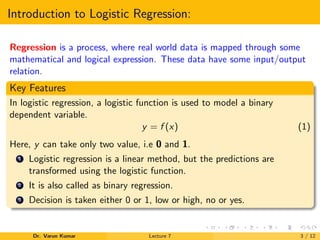
In logistic regression, a logistic function is used to model a binary
dependent variable.
y = f (x) (1)
Here, y can take only two value, i.e 0 and 1.
1 Logistic regression is a linear method, but the predictions are
transformed using the logistic function.
2 It is also called as binary regression.
3 Decision is taken either 0 or 1, low or high, no or yes.
Dr. Varun Kumar Lecture 7 3 / 12
Application of Logistic Regression:
Major Application
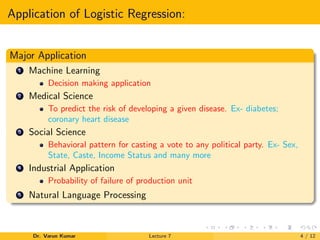
1 Machine Learning
Decision making application
2 Medical Science
To predict the risk of developing a given disease. Ex- diabetes;
coronary heart disease
3 Social Science
Behavioral pattern for casting a vote to any political party. Ex- Sex,
State, Caste, Income Status and many more
4 Industrial Application
Probability of failure of production unit
5 Natural Language Processing
Dr. Varun Kumar Lecture 7 4 / 12
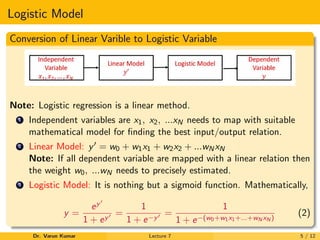
Logistic Model
Conversion of Linear Varible to Logistic Variable
Note: Logistic regression is a linear method.
1 Independent variables are x1, x2, ...xN needs to map with suitable
mathematical model for finding the best input/output relation.
2 Linear Model: y = w0 + w1x1 + w2x2 + ...wNxN
Note: If all dependent variable are mapped with a linear relation then
the weight w0, ...wN needs to precisely estimated.
3 Logistic Model: It is nothing but a sigmoid function. Mathematically,
y =
ey
1 + ey
=
1
1 + e−y
=
1
1 + e−(w0+w1x1+...+wN xN )
(2)
Dr. Varun Kumar Lecture 7 5 / 12
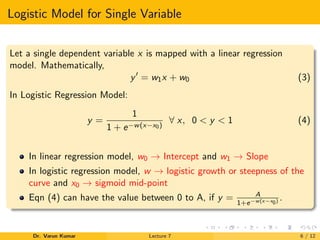
Logistic Model for Single Variable
Let a single dependent variable x is mapped with a linear regression
model. Mathematically,
y = w1x + w0 (3)
In Logistic Regression Model:
y =
1
1 + e−w(x−x0)
∀ x, 0 < y < 1 (4)
In linear regression model, w0 → Intercept and w1 → Slope
In logistic regression model, w → logistic growth or steepness of the
curve and x0 → sigmoid mid-point
Eqn (4) can have the value between 0 to A, if y = A
1+e−w(x−x0) .
Dr. Varun Kumar Lecture 7 6 / 12
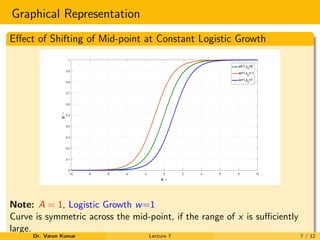
Graphical Representation
Effect of Shifting of Mid-point at Constant Logistic Growth
-10 -8 -6 -4 -2 0 2 4 6 8 10
x→
0
0.1
0.2
0.3
0.4
0.5
0.6
0.7
0.8
0.9
1
y→
w=1,x0
=0
w=1,x0
=-1
w=1,x0
=1
Note: A = 1, Logistic Growth w=1
Curve is symmetric across the mid-point, if the range of x is sufficiently
large.
Dr. Varun Kumar Lecture 7 7 / 12
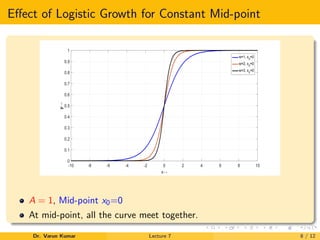
Effect of Logistic Growth for Constant Mid-point
-10 -8 -6 -4 -2 0 2 4 6 8 10
x→
0
0.1
0.2
0.3
0.4
0.5
0.6
0.7
0.8
0.9
1
y→
w=1, x0
=0
w=2, x0
=0
w=3, x0
=0
A = 1, Mid-point x0=0
At mid-point, all the curve meet together.
Dr. Varun Kumar Lecture 7 8 / 12
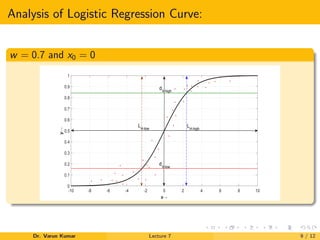
Analysis of Logistic Regression Curve:
w = 0.7 and x0 = 0
-10 -8 -6 -4 -2 0 2 4 6 8 10
x→
0
0.1
0.2
0.3
0.4
0.5
0.6
0.7
0.8
0.9
1
y→
*
*
*
*
* ** *
*
*
*
**
*
*
*
*
*
*
* *
*
*
*
*
*
*
*
*
*
*
*
*
*
*
*
LH-low
LH-high
dV-low
dV-high
Dr. Varun Kumar Lecture 7 9 / 12
Continued–
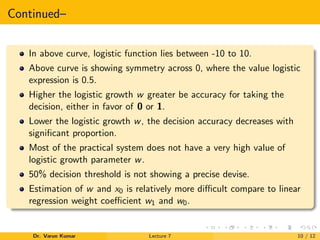
In above curve, logistic function lies between -10 to 10.
Above curve is showing symmetry across 0, where the value logistic
expression is 0.5.
Higher the logistic growth w greater be accuracy for taking the
decision, either in favor of 0 or 1.
Lower the logistic growth w, the decision accuracy decreases with
significant proportion.
Most of the practical system does not have a very high value of
logistic growth parameter w.
50% decision threshold is not showing a precise devise.
Estimation of w and x0 is relatively more difficult compare to linear
regression weight coefficient w1 and w0.
Dr. Varun Kumar Lecture 7 10 / 12
Continued–
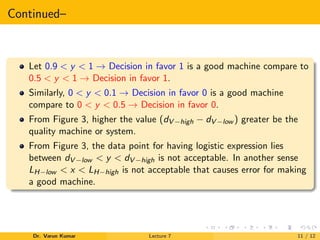
Let 0.9 < y < 1 → Decision in favor 1 is a good machine compare to
0.5 < y < 1 → Decision in favor 1.
Similarly, 0 < y < 0.1 → Decision in favor 0 is a good machine
compare to 0 < y < 0.5 → Decision in favor 0.
From Figure 3, higher the value (dV −high − dV −low ) greater be the
quality machine or system.
From Figure 3, the data point for having logistic expression lies
between dV −low < y < dV −high is not acceptable. In another sense
LH−low < x < LH−high is not acceptable that causes error for making
a good machine.
Dr. Varun Kumar Lecture 7 11 / 12
References
E. Alpaydin, Introduction to machine learning. MIT press, 2020.
J. Grus, Data science from scratch: first principles with python. O’Reilly Media,
2019.
T. M. Mitchell, The discipline of machine learning. Carnegie Mellon University,
School of Computer Science, Machine Learning , 2006, vol. 9.
Dr. Varun Kumar Lecture 7 12 / 12

Logistic regression

  • 1.
    Logistic Regression Dr. VarunKumar Dr. Varun Kumar Lecture 7 1 / 12
  • 2.
    Outlines 1 Introduction toLogistic Regression 2 Linear vs Logistic Regression 3 Sigmoid Function 4 References Dr. Varun Kumar Lecture 7 2 / 12
  • 3.
    Introduction to LogisticRegression: Regression is a process, where real world data is mapped through some mathematical and logical expression. These data have some input/output relation. Key Features In logistic regression, a logistic function is used to model a binary dependent variable. y = f (x) (1) Here, y can take only two value, i.e 0 and 1. 1 Logistic regression is a linear method, but the predictions are transformed using the logistic function. 2 It is also called as binary regression. 3 Decision is taken either 0 or 1, low or high, no or yes. Dr. Varun Kumar Lecture 7 3 / 12
  • 4.
    Application of LogisticRegression: Major Application 1 Machine Learning Decision making application 2 Medical Science To predict the risk of developing a given disease. Ex- diabetes; coronary heart disease 3 Social Science Behavioral pattern for casting a vote to any political party. Ex- Sex, State, Caste, Income Status and many more 4 Industrial Application Probability of failure of production unit 5 Natural Language Processing Dr. Varun Kumar Lecture 7 4 / 12
  • 5.
    Logistic Model Conversion ofLinear Varible to Logistic Variable Note: Logistic regression is a linear method. 1 Independent variables are x1, x2, ...xN needs to map with suitable mathematical model for finding the best input/output relation. 2 Linear Model: y = w0 + w1x1 + w2x2 + ...wNxN Note: If all dependent variable are mapped with a linear relation then the weight w0, ...wN needs to precisely estimated. 3 Logistic Model: It is nothing but a sigmoid function. Mathematically, y = ey 1 + ey = 1 1 + e−y = 1 1 + e−(w0+w1x1+...+wN xN ) (2) Dr. Varun Kumar Lecture 7 5 / 12
  • 6.
    Logistic Model forSingle Variable Let a single dependent variable x is mapped with a linear regression model. Mathematically, y = w1x + w0 (3) In Logistic Regression Model: y = 1 1 + e−w(x−x0) ∀ x, 0 < y < 1 (4) In linear regression model, w0 → Intercept and w1 → Slope In logistic regression model, w → logistic growth or steepness of the curve and x0 → sigmoid mid-point Eqn (4) can have the value between 0 to A, if y = A 1+e−w(x−x0) . Dr. Varun Kumar Lecture 7 6 / 12
  • 7.
    Graphical Representation Effect ofShifting of Mid-point at Constant Logistic Growth -10 -8 -6 -4 -2 0 2 4 6 8 10 x→ 0 0.1 0.2 0.3 0.4 0.5 0.6 0.7 0.8 0.9 1 y→ w=1,x0 =0 w=1,x0 =-1 w=1,x0 =1 Note: A = 1, Logistic Growth w=1 Curve is symmetric across the mid-point, if the range of x is sufficiently large. Dr. Varun Kumar Lecture 7 7 / 12
  • 8.
    Effect of LogisticGrowth for Constant Mid-point -10 -8 -6 -4 -2 0 2 4 6 8 10 x→ 0 0.1 0.2 0.3 0.4 0.5 0.6 0.7 0.8 0.9 1 y→ w=1, x0 =0 w=2, x0 =0 w=3, x0 =0 A = 1, Mid-point x0=0 At mid-point, all the curve meet together. Dr. Varun Kumar Lecture 7 8 / 12
  • 9.
    Analysis of LogisticRegression Curve: w = 0.7 and x0 = 0 -10 -8 -6 -4 -2 0 2 4 6 8 10 x→ 0 0.1 0.2 0.3 0.4 0.5 0.6 0.7 0.8 0.9 1 y→ * * * * * ** * * * * ** * * * * * * * * * * * * * * * * * * * * * * * LH-low LH-high dV-low dV-high Dr. Varun Kumar Lecture 7 9 / 12
  • 10.
    Continued– In above curve,logistic function lies between -10 to 10. Above curve is showing symmetry across 0, where the value logistic expression is 0.5. Higher the logistic growth w greater be accuracy for taking the decision, either in favor of 0 or 1. Lower the logistic growth w, the decision accuracy decreases with significant proportion. Most of the practical system does not have a very high value of logistic growth parameter w. 50% decision threshold is not showing a precise devise. Estimation of w and x0 is relatively more difficult compare to linear regression weight coefficient w1 and w0. Dr. Varun Kumar Lecture 7 10 / 12
  • 11.
    Continued– Let 0.9 <y < 1 → Decision in favor 1 is a good machine compare to 0.5 < y < 1 → Decision in favor 1. Similarly, 0 < y < 0.1 → Decision in favor 0 is a good machine compare to 0 < y < 0.5 → Decision in favor 0. From Figure 3, higher the value (dV −high − dV −low ) greater be the quality machine or system. From Figure 3, the data point for having logistic expression lies between dV −low < y < dV −high is not acceptable. In another sense LH−low < x < LH−high is not acceptable that causes error for making a good machine. Dr. Varun Kumar Lecture 7 11 / 12
  • 12.
    References E. Alpaydin, Introductionto machine learning. MIT press, 2020. J. Grus, Data science from scratch: first principles with python. O’Reilly Media, 2019. T. M. Mitchell, The discipline of machine learning. Carnegie Mellon University, School of Computer Science, Machine Learning , 2006, vol. 9. Dr. Varun Kumar Lecture 7 12 / 12