LOGISTIC
REGRESSION
By Dr Zahid Khan
Senior Lecturer King
Faisal University,KSA
1
Aims
• When and Why do we Use Logistic Regression?
• Binary
• Multinomial

• Theory Behind Logistic Regression
• Assessing the Model
• Assessing predictors
• Things that can go Wrong

• Interpreting Logistic Regression
When And Why
• To predict an outcome variable that is categorical
from one or more categorical or continuous
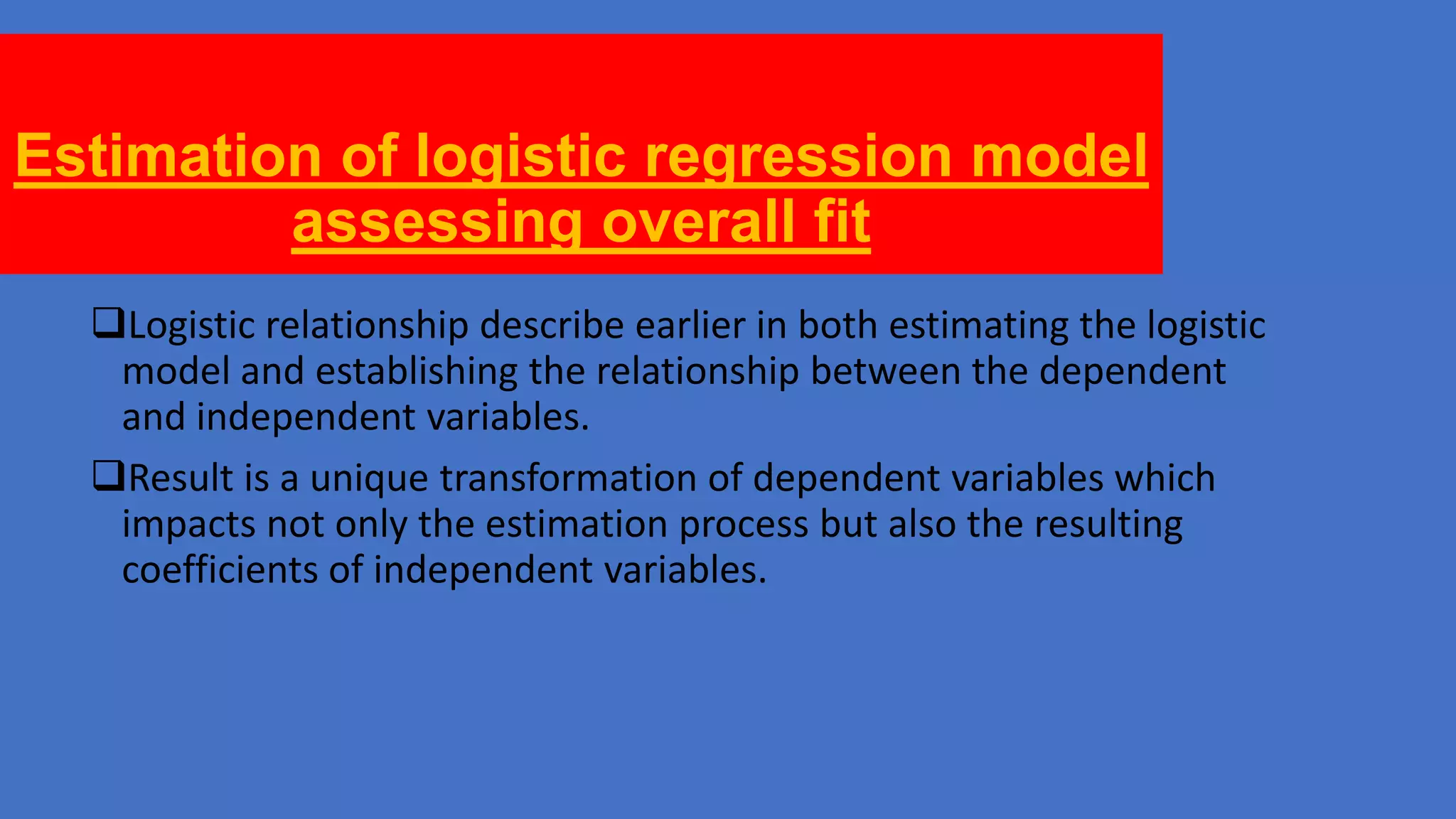
predictor variables.
• Used because having a categorical outcome
variable violates the assumption of linearity in
normal regression.

• Does not assume a linear relationship
between DV and IV
When And Why
No assumptions about the distributions of the predictor
variables.
Predictors do not have to be normally distributed
Logistic regression does not make any assumptions of normality, linearity,
and homogeneity of variance for the independent variables.
Because it does not impose these requirements, it is preferred to
discriminant analysis when the data does not satisfy these assumptions.
4
Logistic regression
• Logistic regression is used to analyze relationships between a
dichotomous dependent variable and continue or dichotomous
independent variables. (SPSS now supports Multinomial Logistic
Regression that can be used with more than two groups, but our
focus here is on binary logistic regression for two groups.)
• Logistic regression combines the independent variables to estimate
the probability that a particular event will occur, i.e. a subject will
be a member of one of the groups defined by the dichotomous
dependent variable. In SPSS, the model is always constructed to
predict the group with higher numeric code. If responses are
coded 1 for Yes and 2 for No, SPSS will predict membership in the
No category. If responses are coded 1 for No and 2 for Yes, SPSS will
predict membership in the Yes category. We will refer to the
predicted event for a particular analysis as the modeled event.
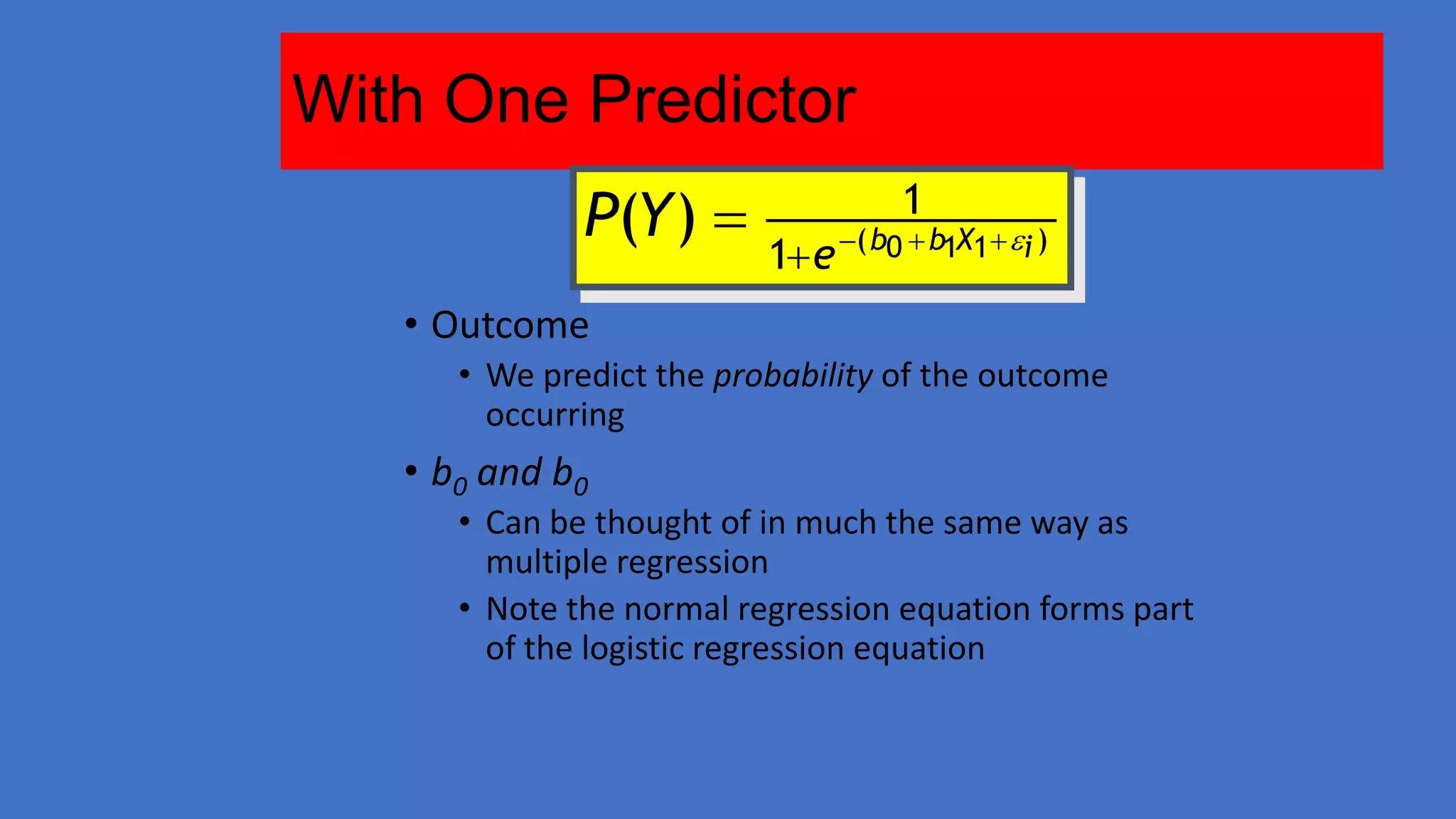
With One Predictor
P(Y ) 

1

1 e ( b0  b1X1 i )

• Outcome
• We predict the probability of the outcome
occurring

• b0 and b0

• Can be thought of in much the same way as
multiple regression
• Note the normal regression equation forms part
of the logistic regression equation
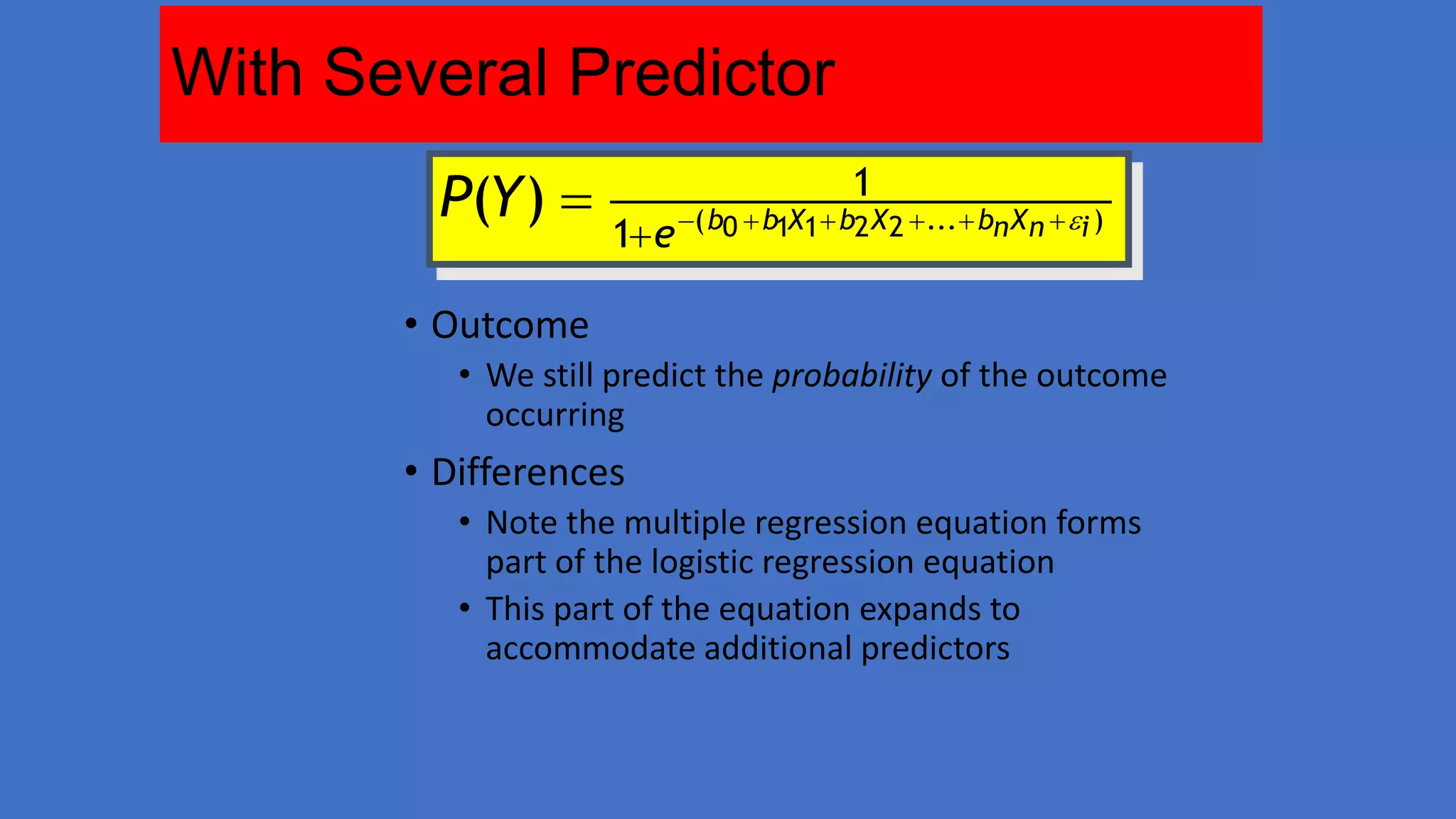
With Several Predictor
P(Y ) 

1

1 e ( b0  b1X1 b2 X 2 ... bn X n  i )

• Outcome
• We still predict the probability of the outcome
occurring

• Differences
• Note the multiple regression equation forms
part of the logistic regression equation
• This part of the equation expands to
accommodate additional predictors
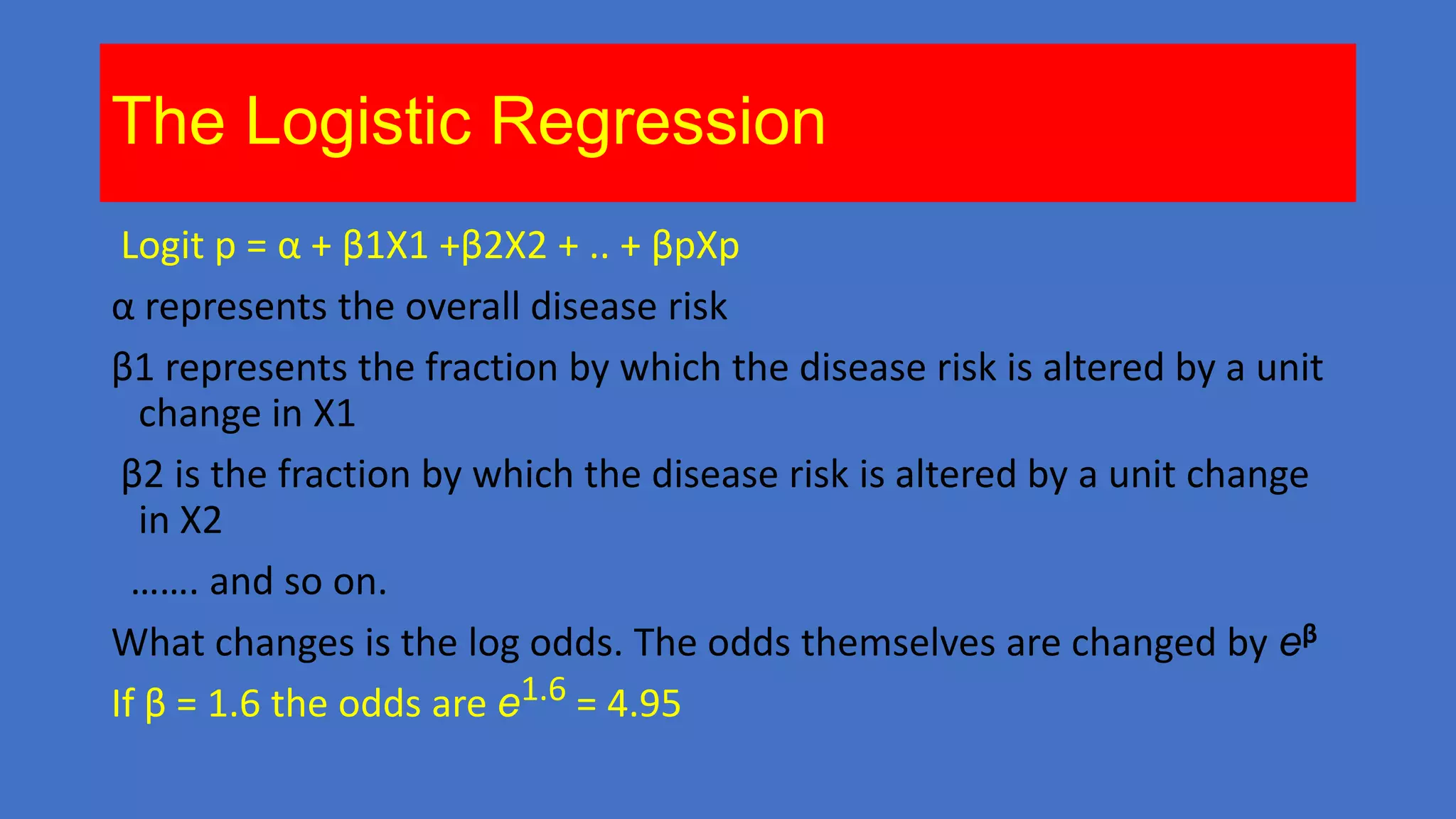
The Logistic Regression
Logit p = α + β1X1 +β2X2 + .. + βpXp
α represents the overall disease risk
β1 represents the fraction by which the disease risk is altered by a unit
change in X1
β2 is the fraction by which the disease risk is altered by a unit change
in X2
……. and so on.
What changes is the log odds. The odds themselves are changed by eβ
If β = 1.6 the odds are e1.6 = 4.95
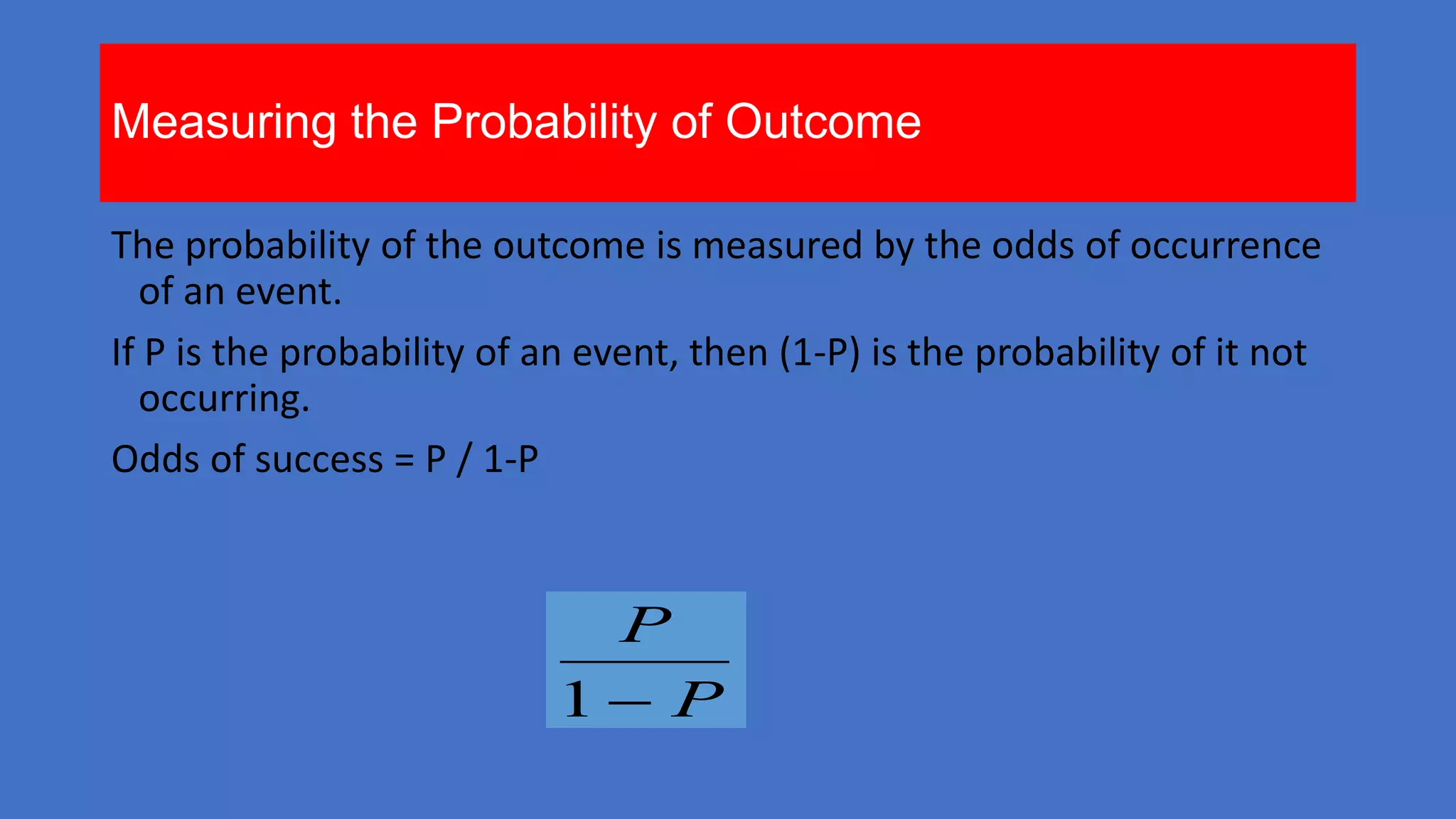
Measuring the Probability of Outcome
The probability of the outcome is measured by the odds of occurrence
of an event.
If P is the probability of an event, then (1-P) is the probability of it not
occurring.
Odds of success = P / 1-P

P
1 P
Methods of Regression
• Forced Entry: All variables entered simultaneously.
• Hierarchical: Variables entered in blocks.
• Blocks should be based on past research, or theory being tested. Good
Method.

• Stepwise: Variables entered on the basis of statistical criteria (i.e.
relative contribution to predicting outcome).
• Should be used only for exploratory analysis.
DECISION PROCESS

Stage 1:
Objectives Of logistic regression
 Identify the independent variable that impact in

the dependent variable

 Establishing classification system based on the
logistic model for determining the group
membership
Types of logistic regression
• BINARY LOGISTIC REGRESSION
It is used when the dependent variable is dichotomous.
MULTINOMIAL LOGISTIC REGRESSION
It is used when the dependent or outcomes variable has more than
two categories.
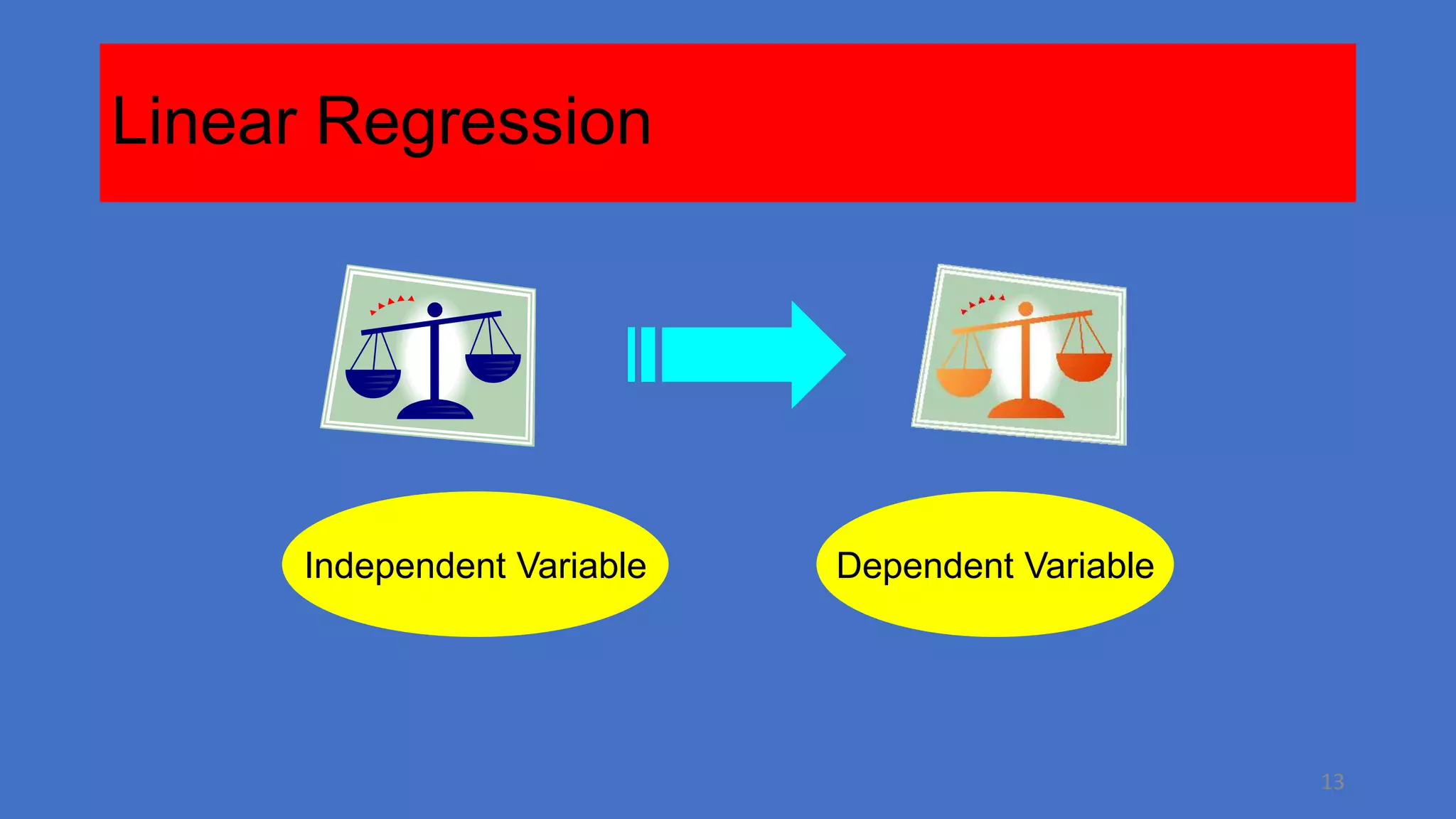
Linear Regression

Independent Variable

Dependent Variable

13
Logistic Regression

Independent Variable

Dependent Variable

14
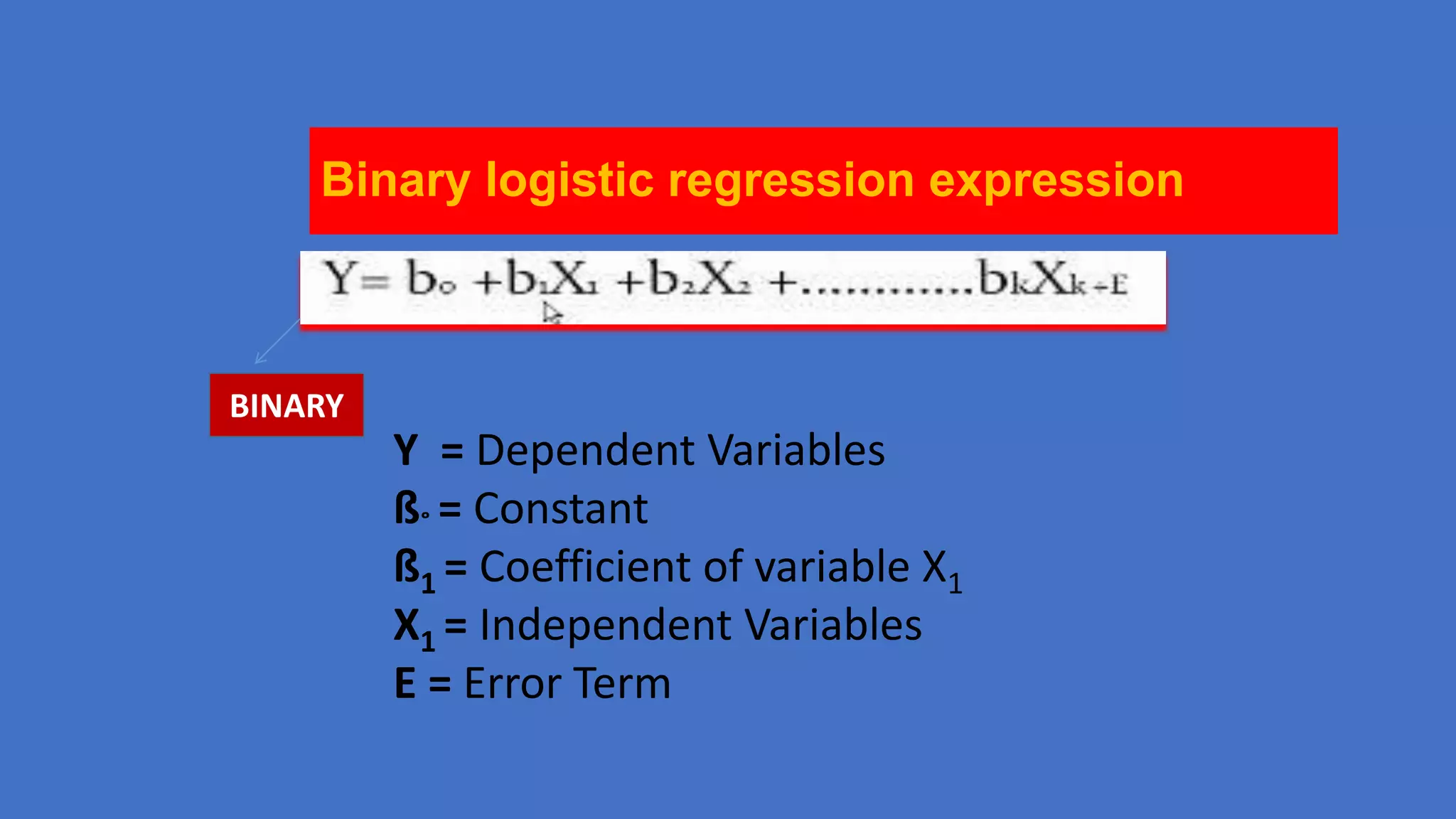
Binary logistic regression expression

BINARY

Y = Dependent Variables
ß˚ = Constant
ß1 = Coefficient of variable X1
X1 = Independent Variables
E = Error Term
SAMPLE SIZE
Very small samples have so much sampling
errors.
Very large sample size decreases the chances of
errors.
Logistic requires larger sample size than multiple
regression.
Hosmer and Lamshow recommended sample
size greater than 400.
SAMPLE SIZE PER CATEGORY OF THE
INDEPENDENT VARIABLE

 The recommended sample size for each group is at

least 10 observations per estimated parameters.
Estimation of logistic regression model
assessing overall fit
Logistic relationship describe earlier in both estimating the logistic
model and establishing the relationship between the dependent
and independent variables.
Result is a unique transformation of dependent variables which
impacts not only the estimation process but also the resulting
coefficients of independent variables.
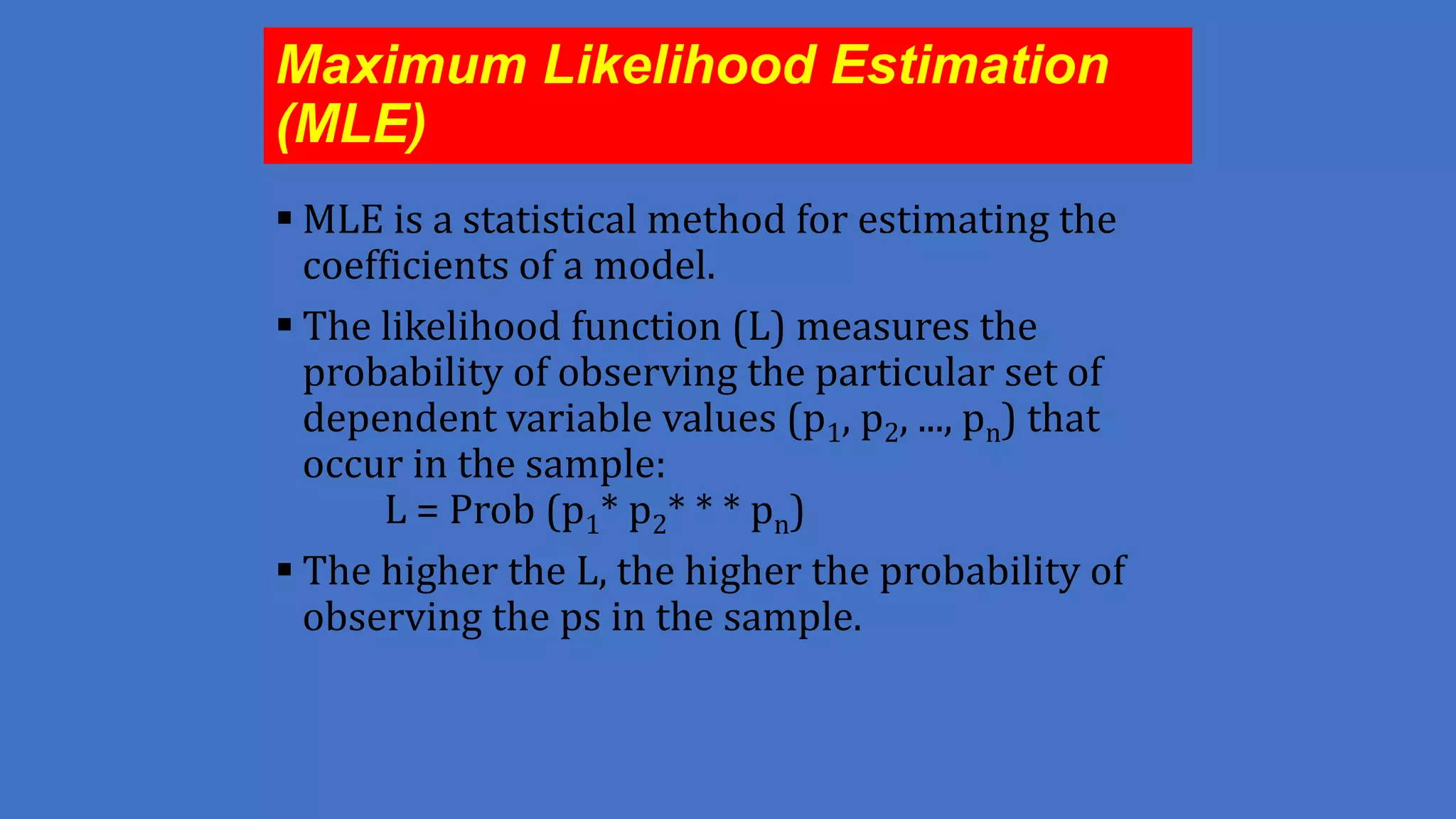
Maximum Likelihood Estimation
(MLE)
 MLE is a statistical method for estimating the
coefficients of a model.
 The likelihood function (L) measures the
probability of observing the particular set of
dependent variable values (p1, p2, ..., pn) that
occur in the sample:
L = Prob (p1* p2* * * pn)
 The higher the L, the higher the probability of
observing the ps in the sample.
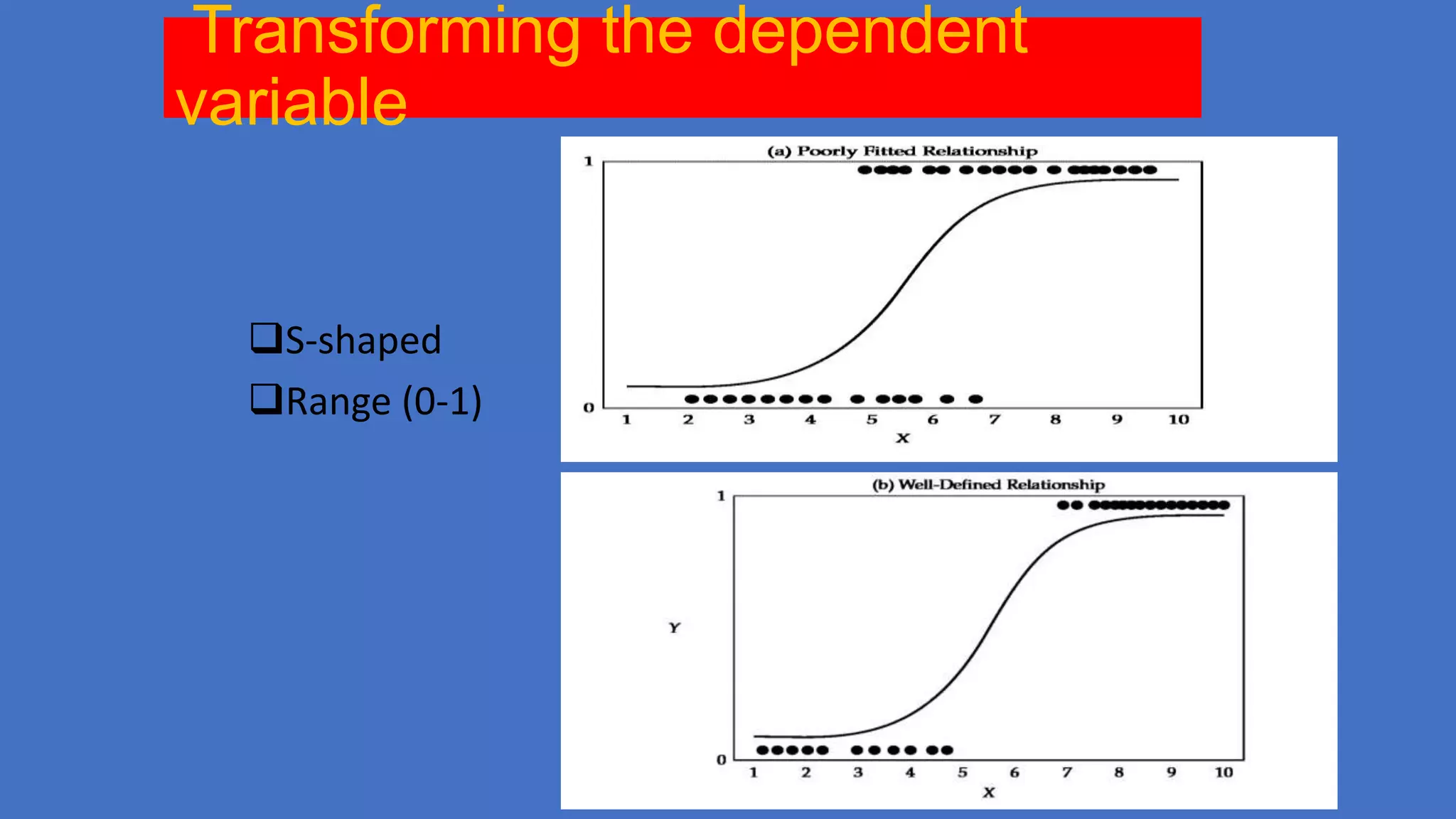
Transforming the dependent
variable

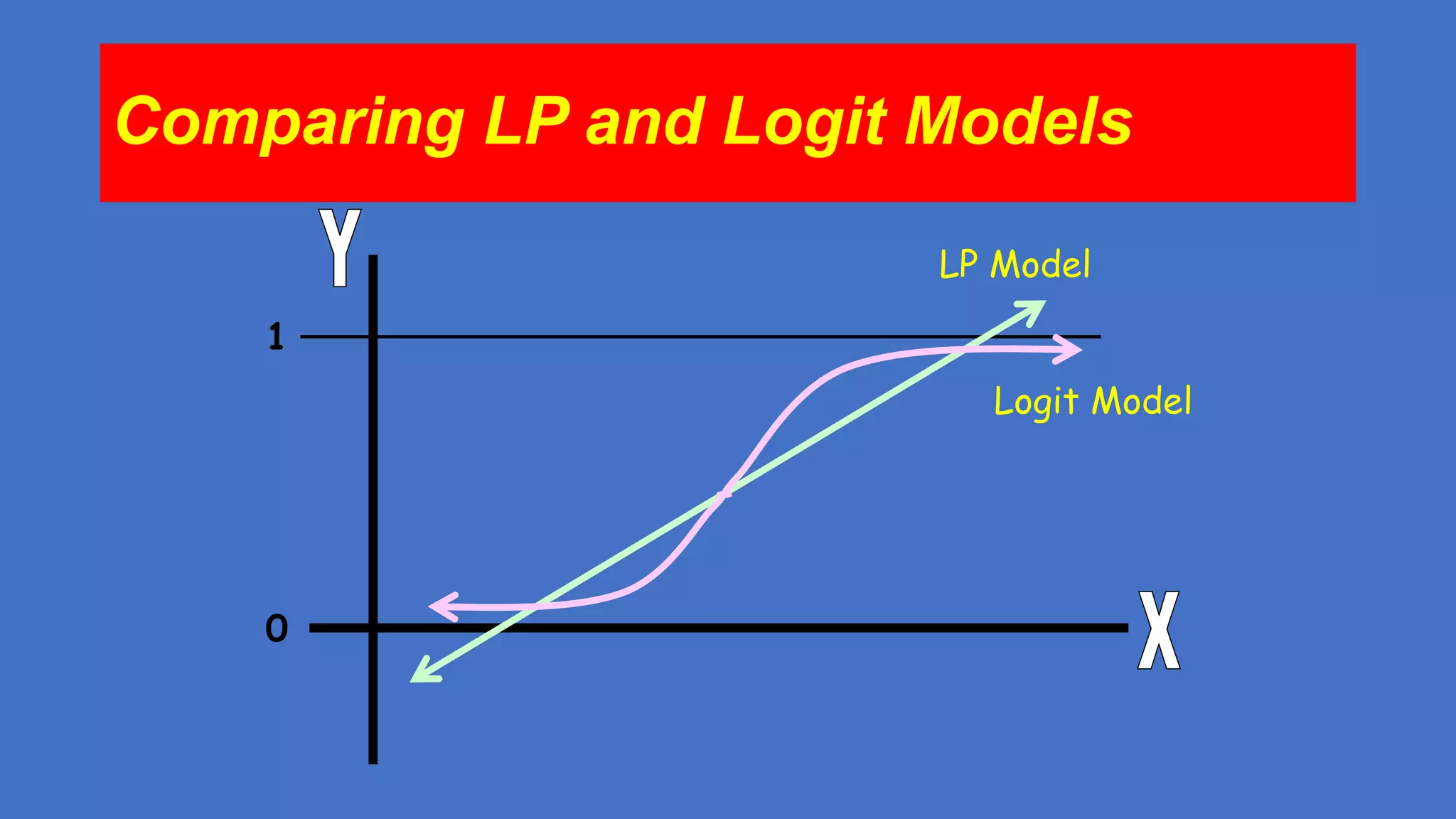
S-shaped
Range (0-1)
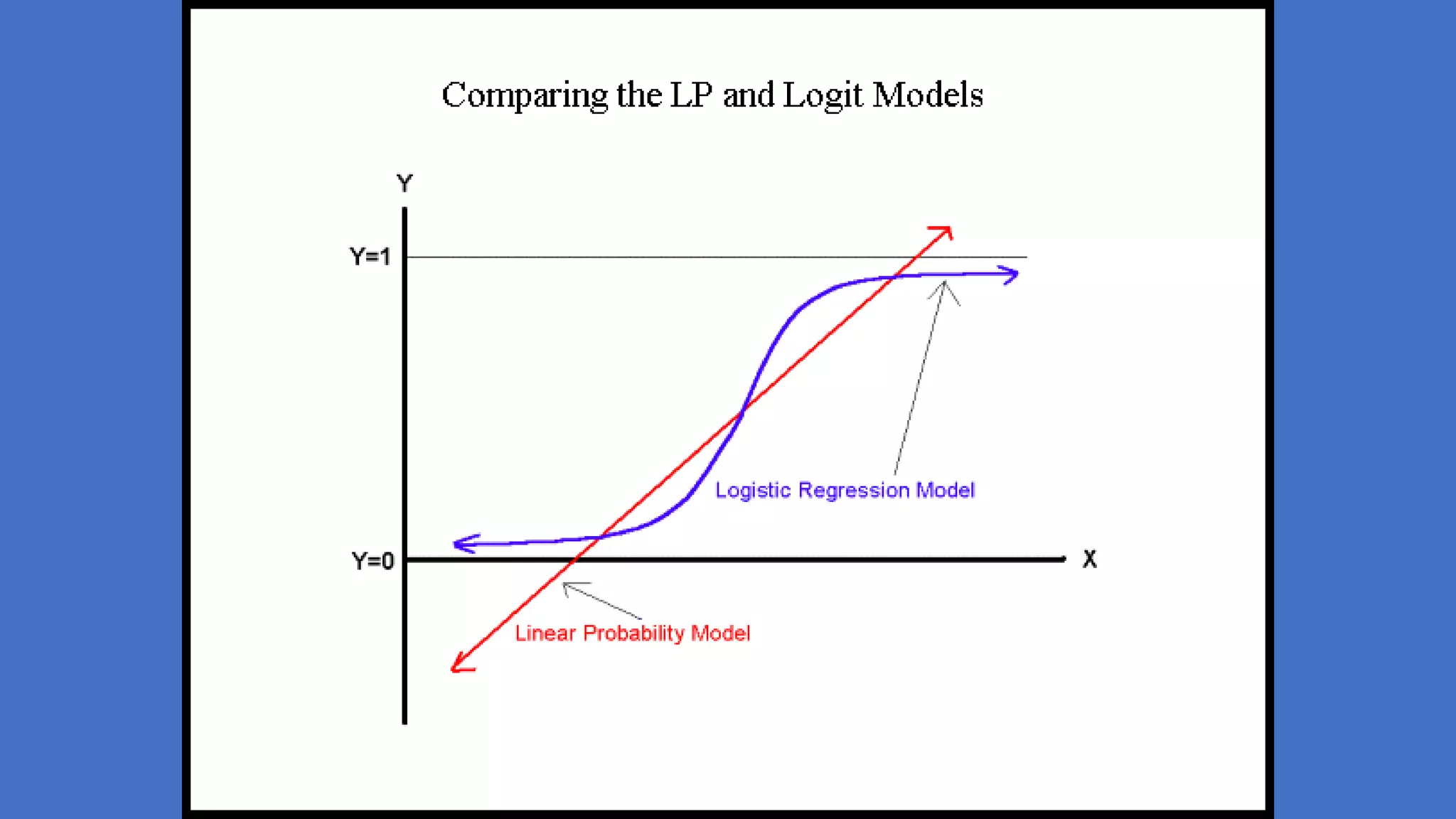
Comparing LP and Logit Models
LP Model
1
Logit Model

0
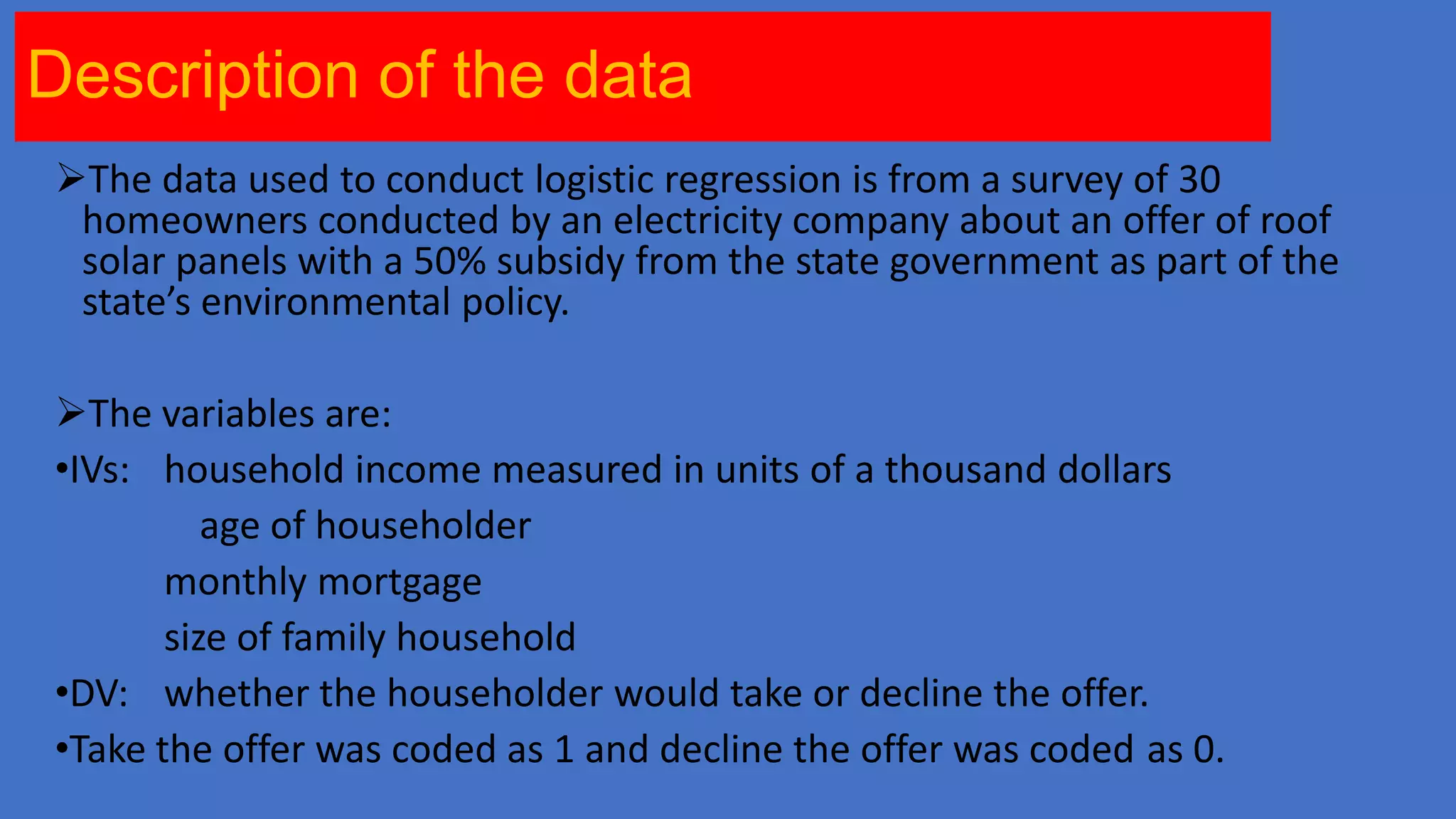
Description of the data
The data used to conduct logistic regression is from a survey of 30
homeowners conducted by an electricity company about an offer of roof
solar panels with a 50% subsidy from the state government as part of the
state’s environmental policy.

The variables are:
•IVs: household income measured in units of a thousand dollars
age of householder
monthly mortgage
size of family household
•DV: whether the householder would take or decline the offer.
•Take the offer was coded as 1 and decline the offer was coded as 0.
WHAT IS THE RESEARCH QUESTION?
To determine whether household income and monthly
mortgage will predict taking or declining the solar panel
offer

Independent Variables: household income and monthly
mortgage
Dependent Variables: Take the offer or decline the offer
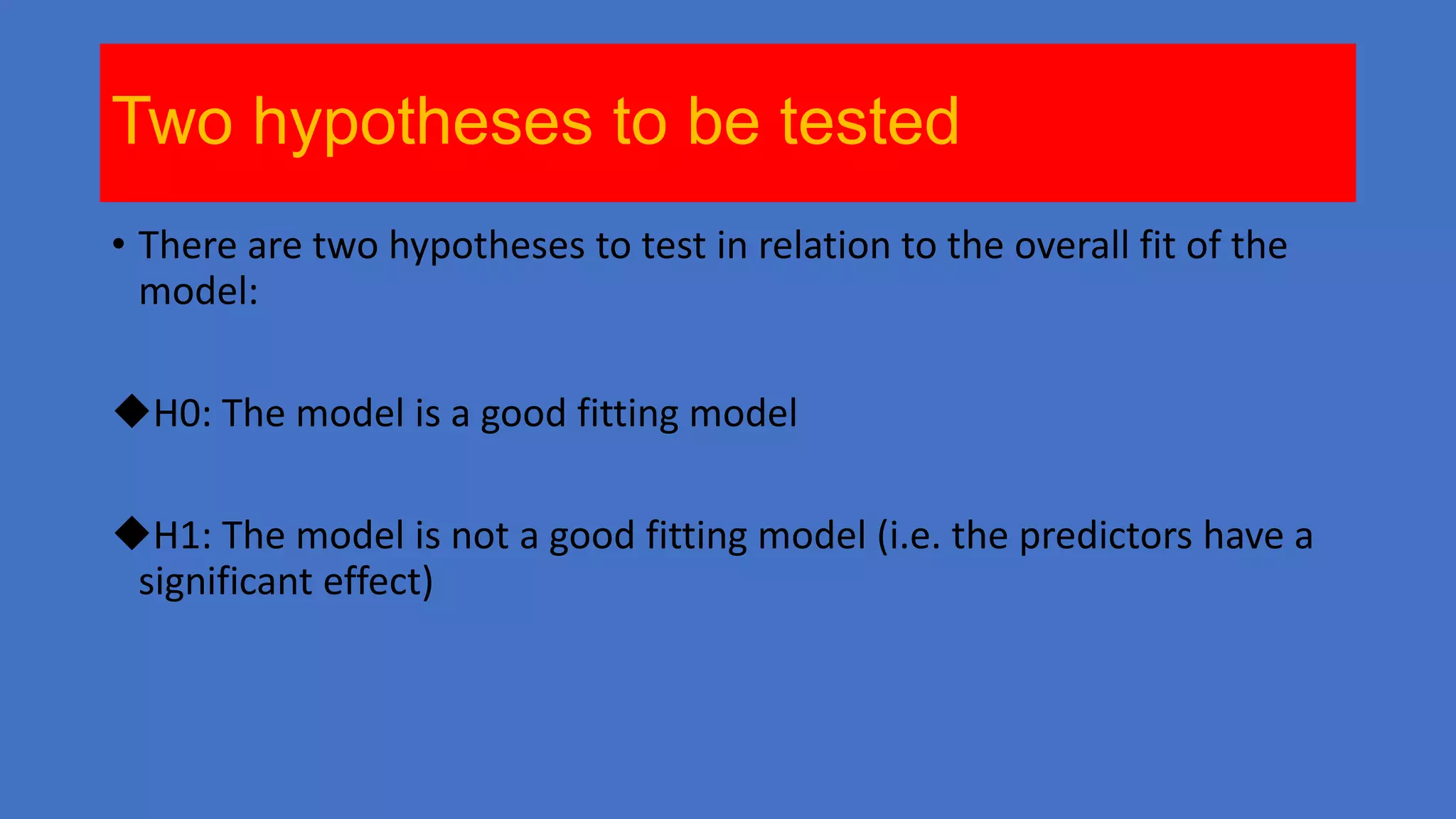
Two hypotheses to be tested
• There are two hypotheses to test in relation to the overall fit of the
model:
H0: The model is a good fitting model
H1: The model is not a good fitting model (i.e. the predictors have a
significant effect)
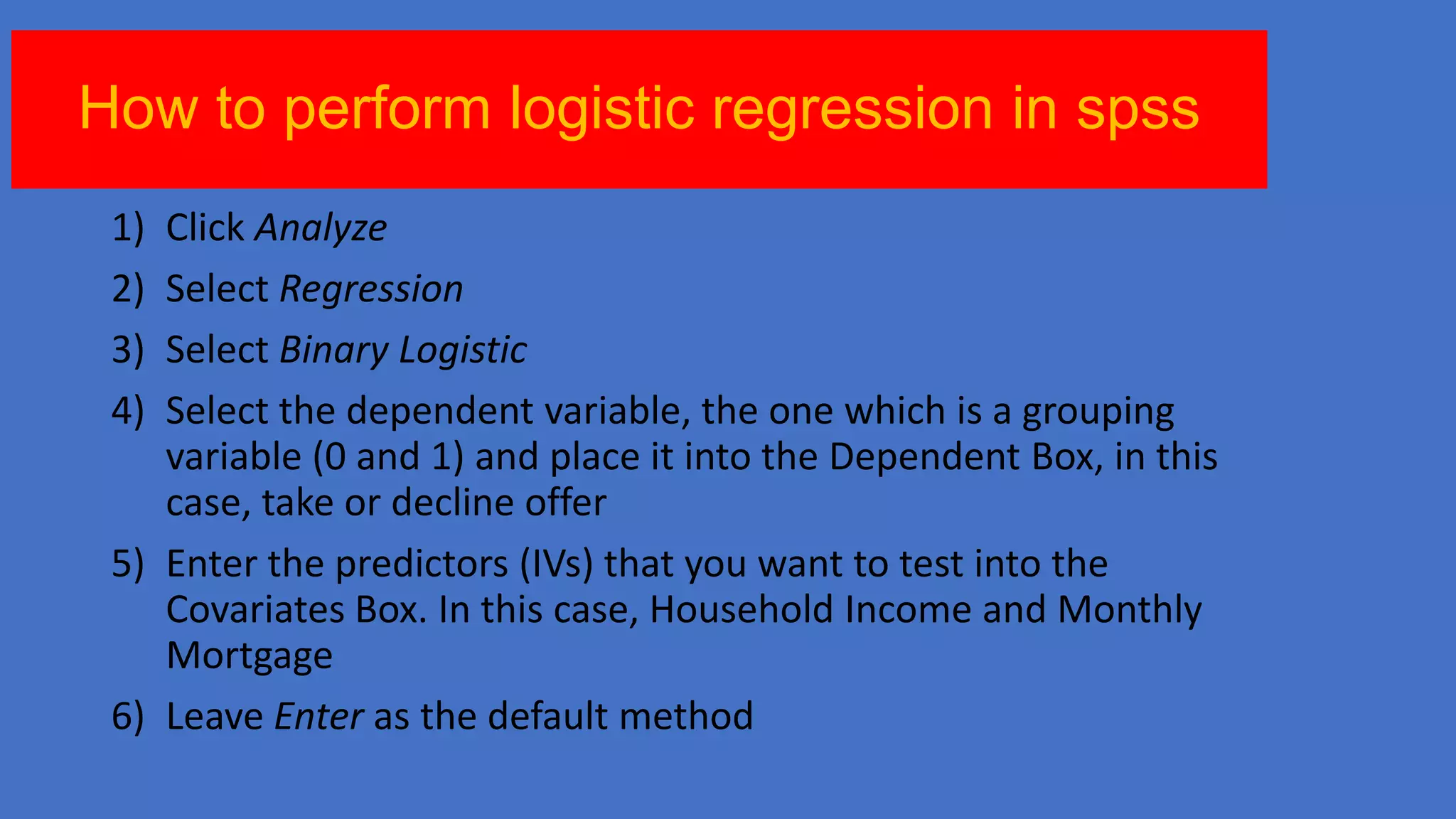
How to perform logistic regression in spss
1)
2)
3)
4)

Click Analyze
Select Regression
Select Binary Logistic
Select the dependent variable, the one which is a grouping
variable (0 and 1) and place it into the Dependent Box, in this
case, take or decline offer
5) Enter the predictors (IVs) that you want to test into the
Covariates Box. In this case, Household Income and Monthly
Mortgage
6) Leave Enter as the default method
Continuation of SPSS Steps
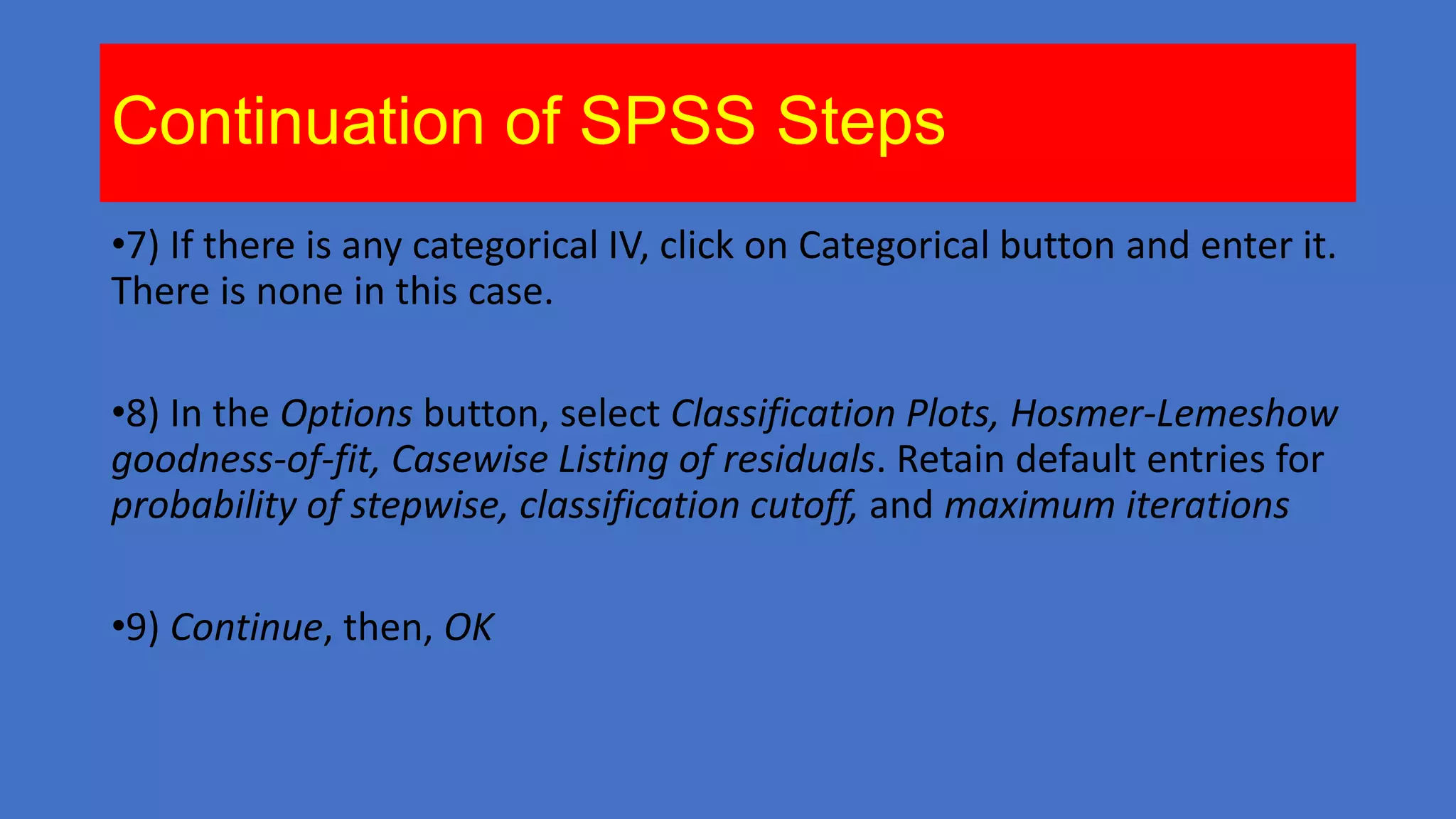
•7) If there is any categorical IV, click on Categorical button and enter it.
There is none in this case.
•8) In the Options button, select Classification Plots, Hosmer-Lemeshow
goodness-of-fit, Casewise Listing of residuals. Retain default entries for
probability of stepwise, classification cutoff, and maximum iterations
•9) Continue, then, OK
Logistic Regression-Demo
• MS-Excel: No default functions
• SPSS: Analyze > Regression > Binary Logistic > Select
Dependent variable: > Select independent variable
(covariate)
Writing Up Results
 Present descriptive statistics in a table
 Make it clear that the dependent variable is discrete (0, 1) and not
continuous and that you will use logistic regression.
 Logistic regression is a standard statistical procedure so you don't
(necessarily) need to write out the formula for it. You also (usually)
don't need to justify that you are using Logit instead of the LP model
or Probit (similar to Logit but based on the normal distribution [the
tails are less fat]).
Any Questions !!!

•

Thank You

30

Logistic regression

  • 1.
    LOGISTIC REGRESSION By Dr ZahidKhan Senior Lecturer King Faisal University,KSA 1
  • 2.
    Aims • When andWhy do we Use Logistic Regression? • Binary • Multinomial • Theory Behind Logistic Regression • Assessing the Model • Assessing predictors • Things that can go Wrong • Interpreting Logistic Regression
  • 3.
    When And Why •To predict an outcome variable that is categorical from one or more categorical or continuous predictor variables. • Used because having a categorical outcome variable violates the assumption of linearity in normal regression. • Does not assume a linear relationship between DV and IV
  • 4.
    When And Why Noassumptions about the distributions of the predictor variables. Predictors do not have to be normally distributed Logistic regression does not make any assumptions of normality, linearity, and homogeneity of variance for the independent variables. Because it does not impose these requirements, it is preferred to discriminant analysis when the data does not satisfy these assumptions. 4
  • 5.
    Logistic regression • Logisticregression is used to analyze relationships between a dichotomous dependent variable and continue or dichotomous independent variables. (SPSS now supports Multinomial Logistic Regression that can be used with more than two groups, but our focus here is on binary logistic regression for two groups.) • Logistic regression combines the independent variables to estimate the probability that a particular event will occur, i.e. a subject will be a member of one of the groups defined by the dichotomous dependent variable. In SPSS, the model is always constructed to predict the group with higher numeric code. If responses are coded 1 for Yes and 2 for No, SPSS will predict membership in the No category. If responses are coded 1 for No and 2 for Yes, SPSS will predict membership in the Yes category. We will refer to the predicted event for a particular analysis as the modeled event.
  • 6.
    With One Predictor P(Y)  1 1 e ( b0  b1X1 i ) • Outcome • We predict the probability of the outcome occurring • b0 and b0 • Can be thought of in much the same way as multiple regression • Note the normal regression equation forms part of the logistic regression equation
  • 7.
    With Several Predictor P(Y)  1 1 e ( b0  b1X1 b2 X 2 ... bn X n  i ) • Outcome • We still predict the probability of the outcome occurring • Differences • Note the multiple regression equation forms part of the logistic regression equation • This part of the equation expands to accommodate additional predictors
  • 8.
    The Logistic Regression Logitp = α + β1X1 +β2X2 + .. + βpXp α represents the overall disease risk β1 represents the fraction by which the disease risk is altered by a unit change in X1 β2 is the fraction by which the disease risk is altered by a unit change in X2 ……. and so on. What changes is the log odds. The odds themselves are changed by eβ If β = 1.6 the odds are e1.6 = 4.95
  • 9.
    Measuring the Probabilityof Outcome The probability of the outcome is measured by the odds of occurrence of an event. If P is the probability of an event, then (1-P) is the probability of it not occurring. Odds of success = P / 1-P P 1 P
  • 10.
    Methods of Regression •Forced Entry: All variables entered simultaneously. • Hierarchical: Variables entered in blocks. • Blocks should be based on past research, or theory being tested. Good Method. • Stepwise: Variables entered on the basis of statistical criteria (i.e. relative contribution to predicting outcome). • Should be used only for exploratory analysis.
  • 11.
    DECISION PROCESS Stage 1: ObjectivesOf logistic regression  Identify the independent variable that impact in the dependent variable  Establishing classification system based on the logistic model for determining the group membership
  • 12.
    Types of logisticregression • BINARY LOGISTIC REGRESSION It is used when the dependent variable is dichotomous. MULTINOMIAL LOGISTIC REGRESSION It is used when the dependent or outcomes variable has more than two categories.
  • 13.
  • 14.
  • 15.
    Binary logistic regressionexpression BINARY Y = Dependent Variables ß˚ = Constant ß1 = Coefficient of variable X1 X1 = Independent Variables E = Error Term
  • 16.
    SAMPLE SIZE Very smallsamples have so much sampling errors. Very large sample size decreases the chances of errors. Logistic requires larger sample size than multiple regression. Hosmer and Lamshow recommended sample size greater than 400.
  • 17.
    SAMPLE SIZE PERCATEGORY OF THE INDEPENDENT VARIABLE  The recommended sample size for each group is at least 10 observations per estimated parameters.
  • 18.
    Estimation of logisticregression model assessing overall fit Logistic relationship describe earlier in both estimating the logistic model and establishing the relationship between the dependent and independent variables. Result is a unique transformation of dependent variables which impacts not only the estimation process but also the resulting coefficients of independent variables.
  • 19.
    Maximum Likelihood Estimation (MLE) MLE is a statistical method for estimating the coefficients of a model.  The likelihood function (L) measures the probability of observing the particular set of dependent variable values (p1, p2, ..., pn) that occur in the sample: L = Prob (p1* p2* * * pn)  The higher the L, the higher the probability of observing the ps in the sample.
  • 20.
  • 22.
    Comparing LP andLogit Models LP Model 1 Logit Model 0
  • 23.
    Description of thedata The data used to conduct logistic regression is from a survey of 30 homeowners conducted by an electricity company about an offer of roof solar panels with a 50% subsidy from the state government as part of the state’s environmental policy. The variables are: •IVs: household income measured in units of a thousand dollars age of householder monthly mortgage size of family household •DV: whether the householder would take or decline the offer. •Take the offer was coded as 1 and decline the offer was coded as 0.
  • 24.
    WHAT IS THERESEARCH QUESTION? To determine whether household income and monthly mortgage will predict taking or declining the solar panel offer Independent Variables: household income and monthly mortgage Dependent Variables: Take the offer or decline the offer
  • 25.
    Two hypotheses tobe tested • There are two hypotheses to test in relation to the overall fit of the model: H0: The model is a good fitting model H1: The model is not a good fitting model (i.e. the predictors have a significant effect)
  • 26.
    How to performlogistic regression in spss 1) 2) 3) 4) Click Analyze Select Regression Select Binary Logistic Select the dependent variable, the one which is a grouping variable (0 and 1) and place it into the Dependent Box, in this case, take or decline offer 5) Enter the predictors (IVs) that you want to test into the Covariates Box. In this case, Household Income and Monthly Mortgage 6) Leave Enter as the default method
  • 27.
    Continuation of SPSSSteps •7) If there is any categorical IV, click on Categorical button and enter it. There is none in this case. •8) In the Options button, select Classification Plots, Hosmer-Lemeshow goodness-of-fit, Casewise Listing of residuals. Retain default entries for probability of stepwise, classification cutoff, and maximum iterations •9) Continue, then, OK
  • 28.
    Logistic Regression-Demo • MS-Excel:No default functions • SPSS: Analyze > Regression > Binary Logistic > Select Dependent variable: > Select independent variable (covariate)
  • 29.
    Writing Up Results Present descriptive statistics in a table  Make it clear that the dependent variable is discrete (0, 1) and not continuous and that you will use logistic regression.  Logistic regression is a standard statistical procedure so you don't (necessarily) need to write out the formula for it. You also (usually) don't need to justify that you are using Logit instead of the LP model or Probit (similar to Logit but based on the normal distribution [the tails are less fat]).
  • 30.