







Maximum Likelihood EstimationA.Al-AnsaryMLE
OutlineIntroduction probability models parameters conditional probability binomial probability distributionModel-fitting likelihood maximum likelihood estimation parameter space 2
OutlineMLE in Practice analytic approachsnumerical optimsiation algorithms log-likelihood identification local minima Likelihood ratio test alternate and null hypothesis chi-squared significance testing degrees of freedom 3
IntroductionProbabilityThe concept of likelihood is closely related to the more common concept of probabilityFor example, for an unbiased coin, the probability of observing heads is 0.5 for every tossThis is taken to mean that if a coin were tossed a large number of times then we would expect, on average, to find half of the time the coin landed heads, half of the time tails4
IntroductionModels: parameters and distributionsWhen we speak about the probability of observing events such as the outcome of a toss of a coin, we are implicitly assuming some kind of modelIn the case of a coin, the model would state that there is some certain, fixed probability for the particular outcomesThis model would have one parameter, p the probability of the coin landing on headsIf the coin is fair, then p=0.55
IntroductionConditional probabilityThe notion of conditional probability allows us to incorporate other potentially important variablesMathematically, we write			P( X | Y) meaning the probability of X conditional on Y or given Y6
IntroductionConditional probabilityThe probability of an outcome will be conditional upon the parameter values of this model. In the case of the coin toss, P (H | p=0.5)where H is the event of obtaining a head and p is the model parameter, set at 0.57
IntroductionConditional probabilitySay we toss a coin a number of times and record the number of times it lands on headsThe probability distribution that describes just this kind of scenario is called the binomial probability distribution. It is written as follows : n= total number of coin tosses h = number of heads obtained p = probability of obtaining a head on any one toss8
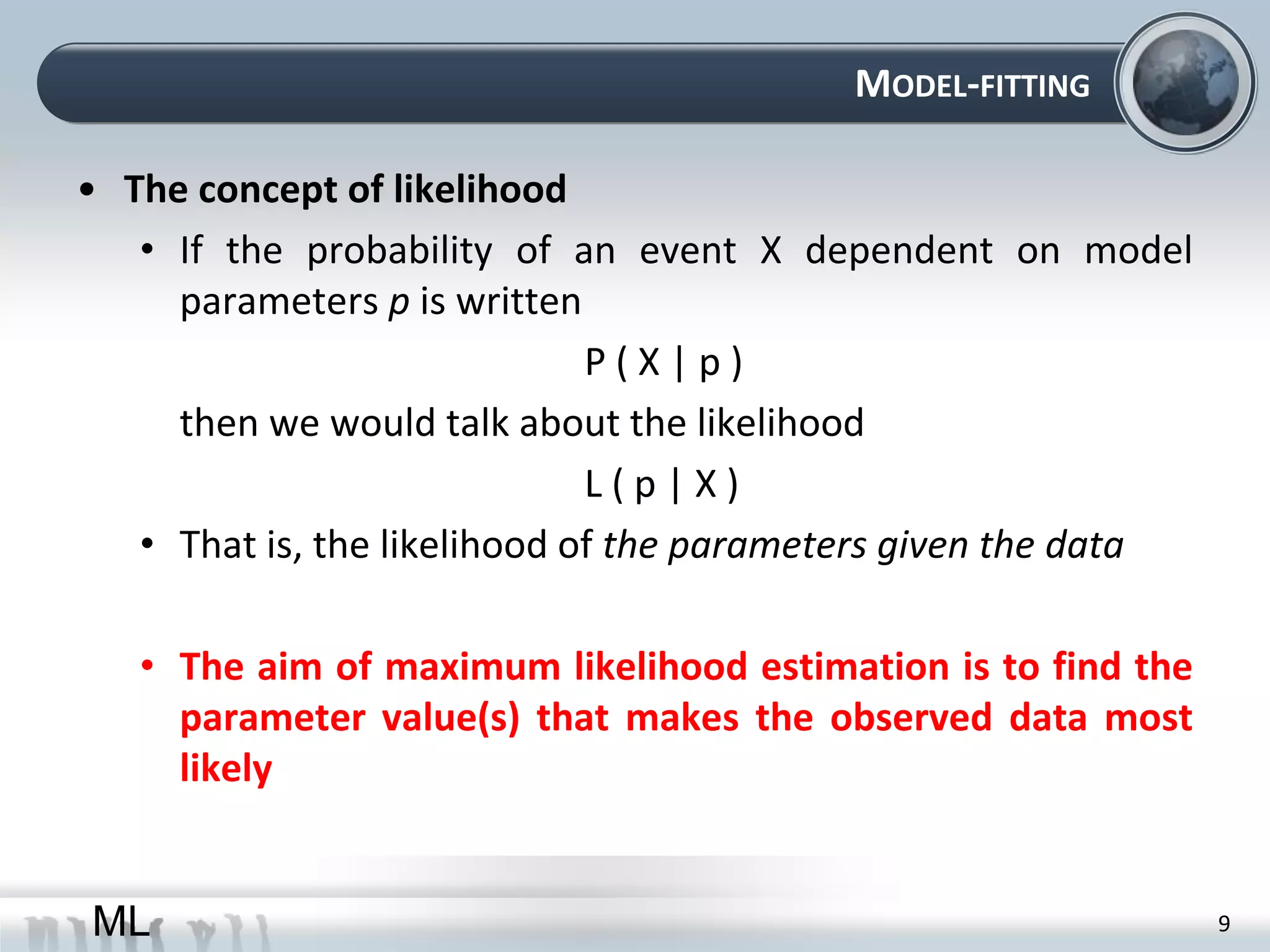
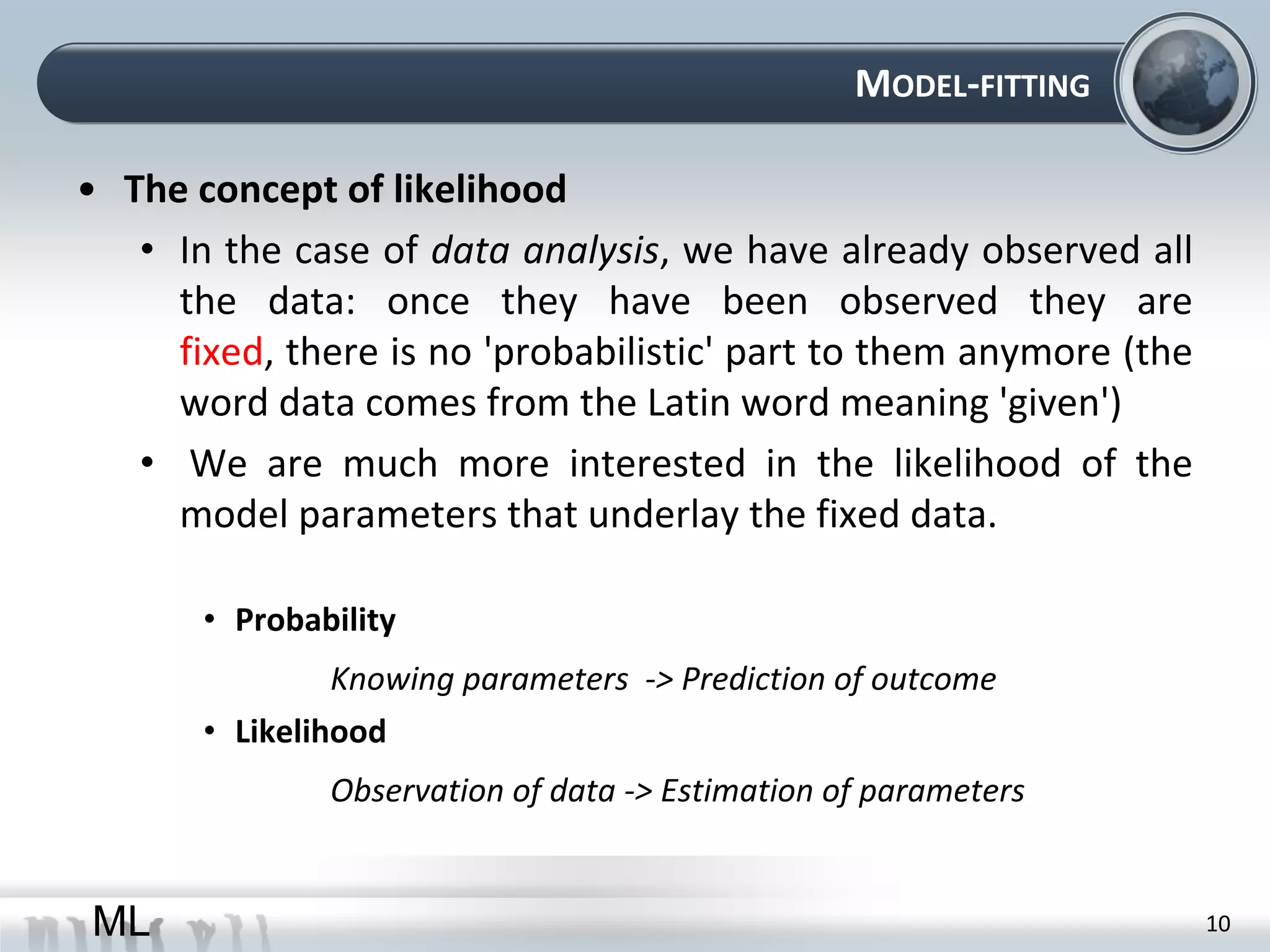
Model-fittingThe concept of likelihoodIf the probability of an event X dependent on model parameters p is written 					P ( X | p )	then we would talk about the likelihood 					L ( p | X )That is, the likelihood of the parameters given the dataThe aim of maximum likelihood estimation is to find the parameter value(s) that makes the observed data most likely9
Model-fittingThe concept of likelihoodIn the case of data analysis, we have already observed all the data: once they have been observed they are fixed, there is no 'probabilistic' part to them anymore (the word data comes from the Latin word meaning 'given') We are much more interested in the likelihood of the model parameters that underlay the fixed data.ProbabilityKnowing parameters  -> Prediction of outcomeLikelihoodObservation of data -> Estimation of parameters10
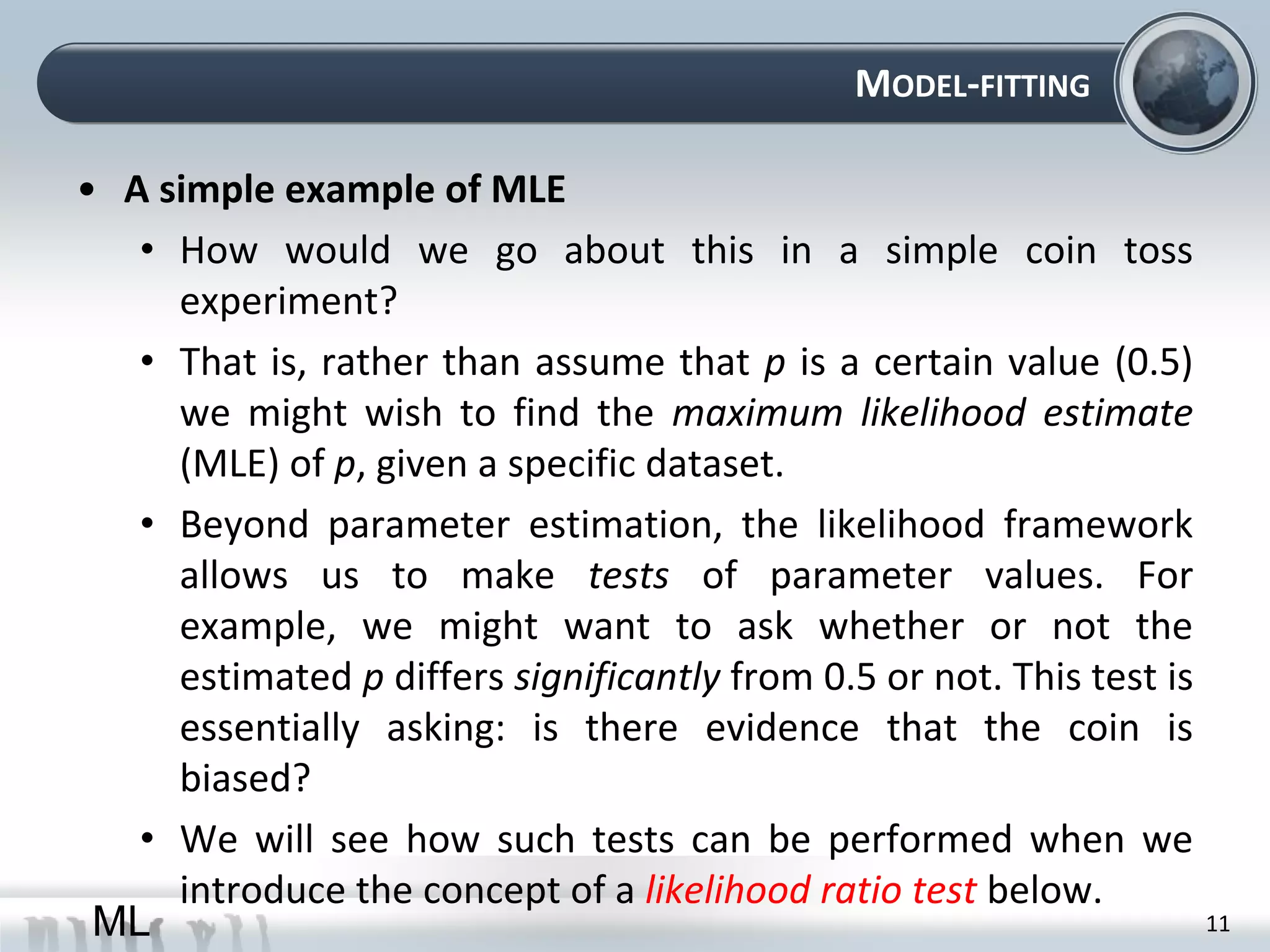
Model-fittingA simple example of MLEHow would we go about this in a simple coin toss experiment?That is, rather than assume that p is a certain value (0.5) we might wish to find the maximum likelihood estimate (MLE) of p, given a specific dataset. Beyond parameter estimation, the likelihood framework allows us to make tests of parameter values. For example, we might want to ask whether or not the estimated p differs significantly from 0.5 or not. This test is essentially asking: is there evidence that the coin is biased? We will see how such tests can be performed when we introduce the concept of a likelihood ratio testbelow.11
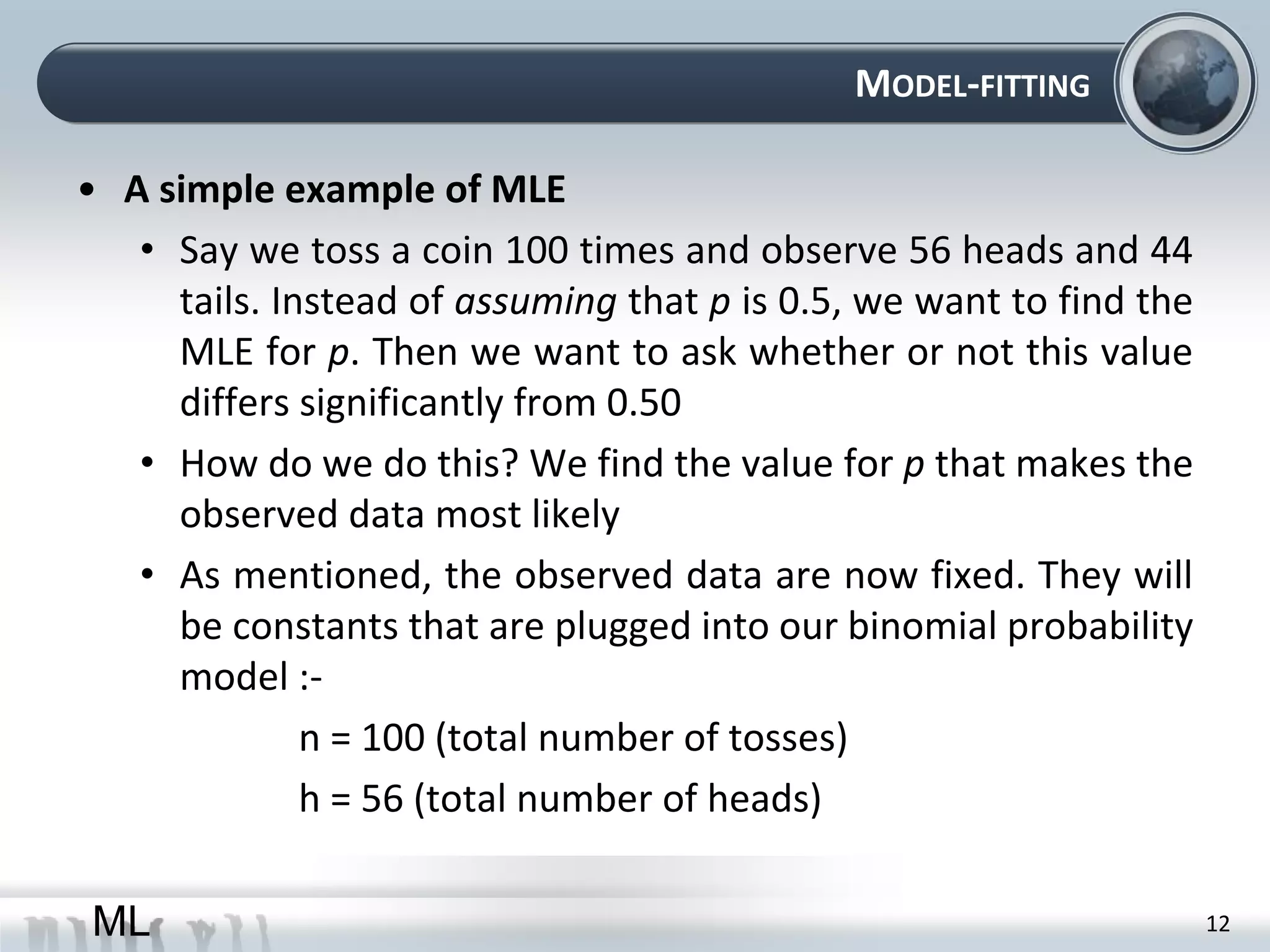
Model-fittingA simple example of MLESay we toss a coin 100 times and observe 56 heads and 44 tails. Instead of assuming that p is 0.5, we want to find the MLE for p. Then we want to ask whether or not this value differs significantly from 0.50How do we do this? We find the value for p that makes the observed data most likelyAs mentioned, the observed data are now fixed. They will be constants that are plugged into our binomial probability model :- 	n = 100 (total number of tosses) 	h = 56 (total number of heads) 12
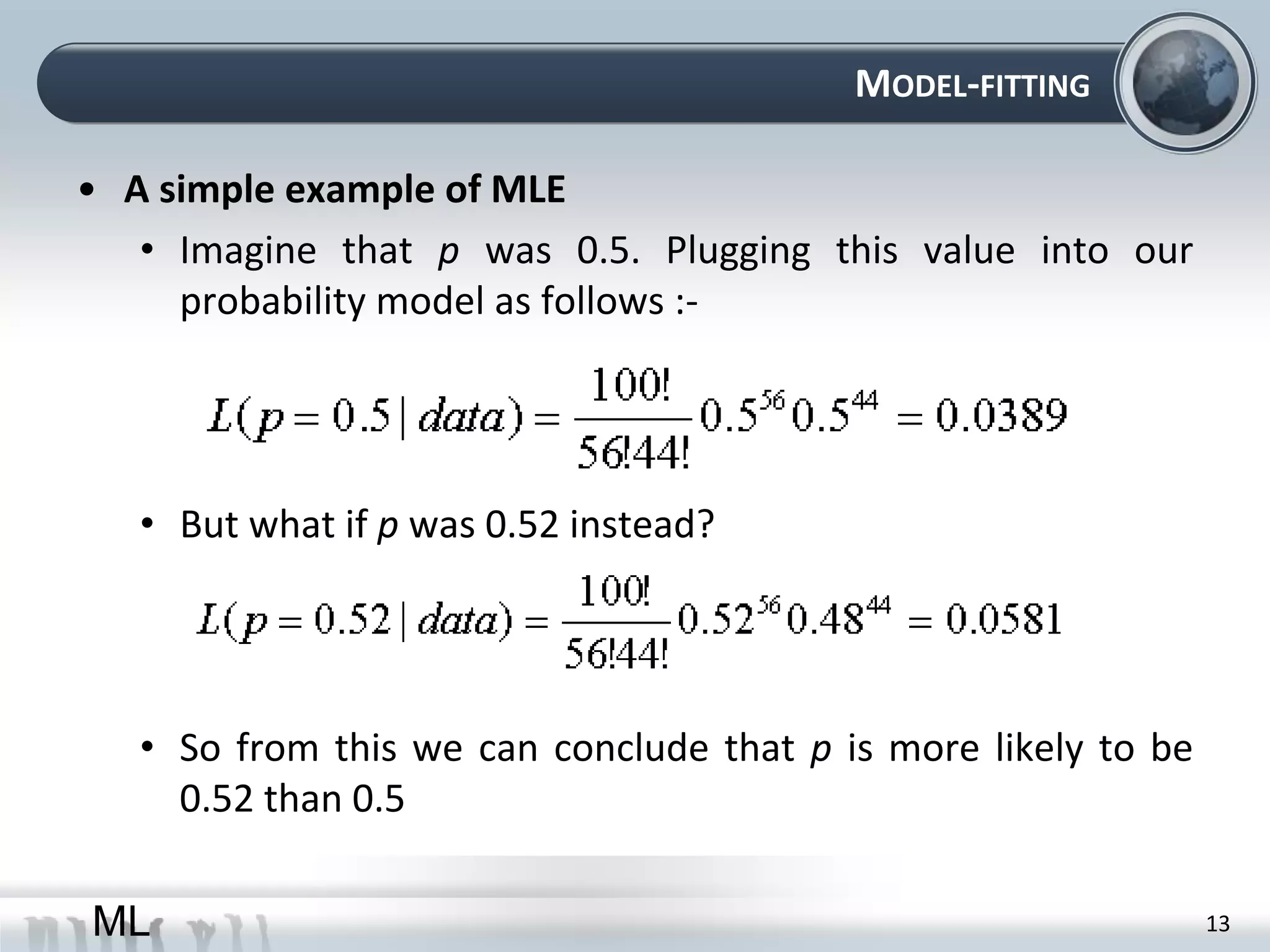
Model-fittingA simple example of MLEImagine that p was 0.5. Plugging this value into our probability model as follows :- But what if p was 0.52 instead? So from this we can conclude that p is more likely to be 0.52 than 0.513
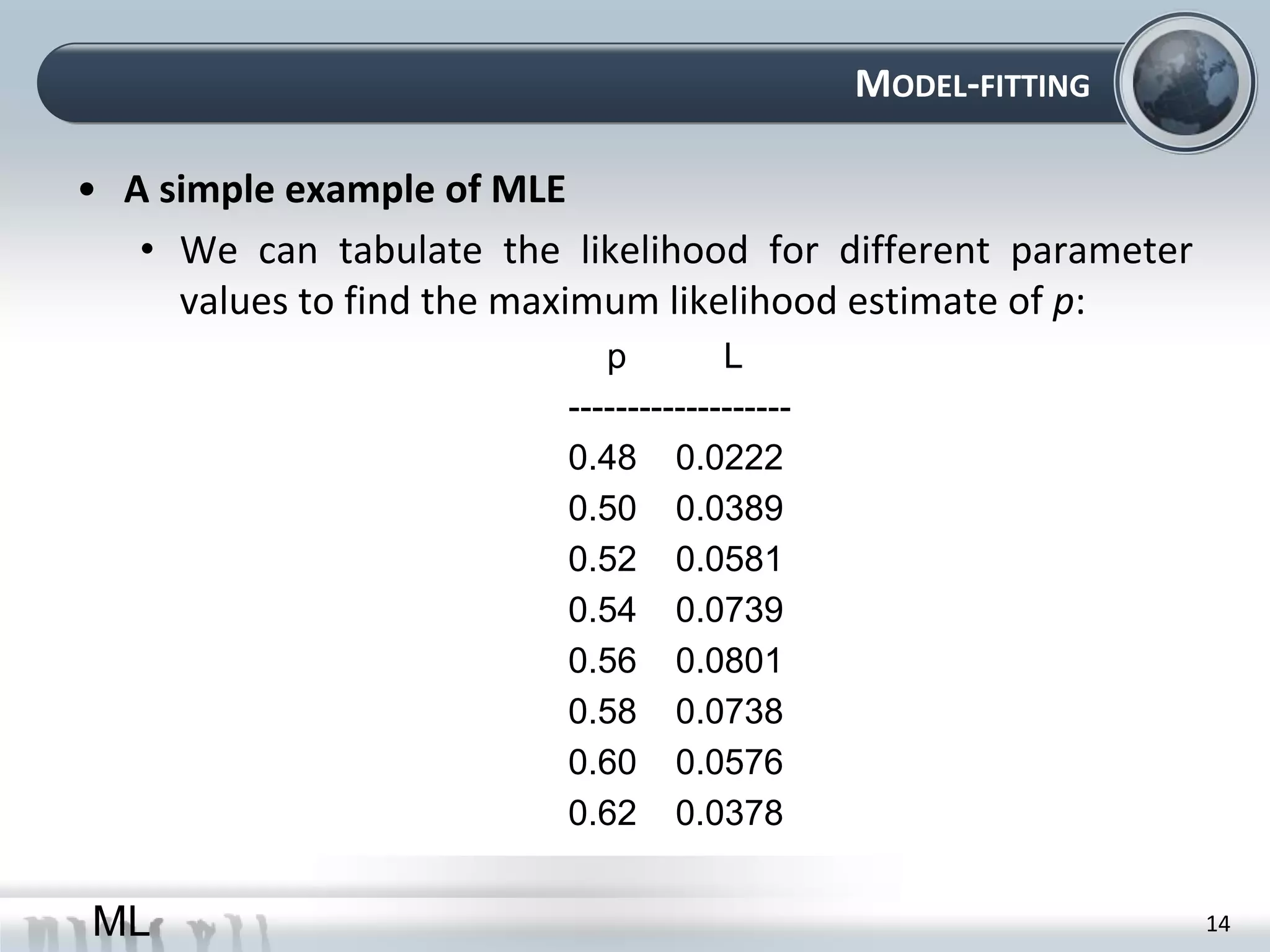
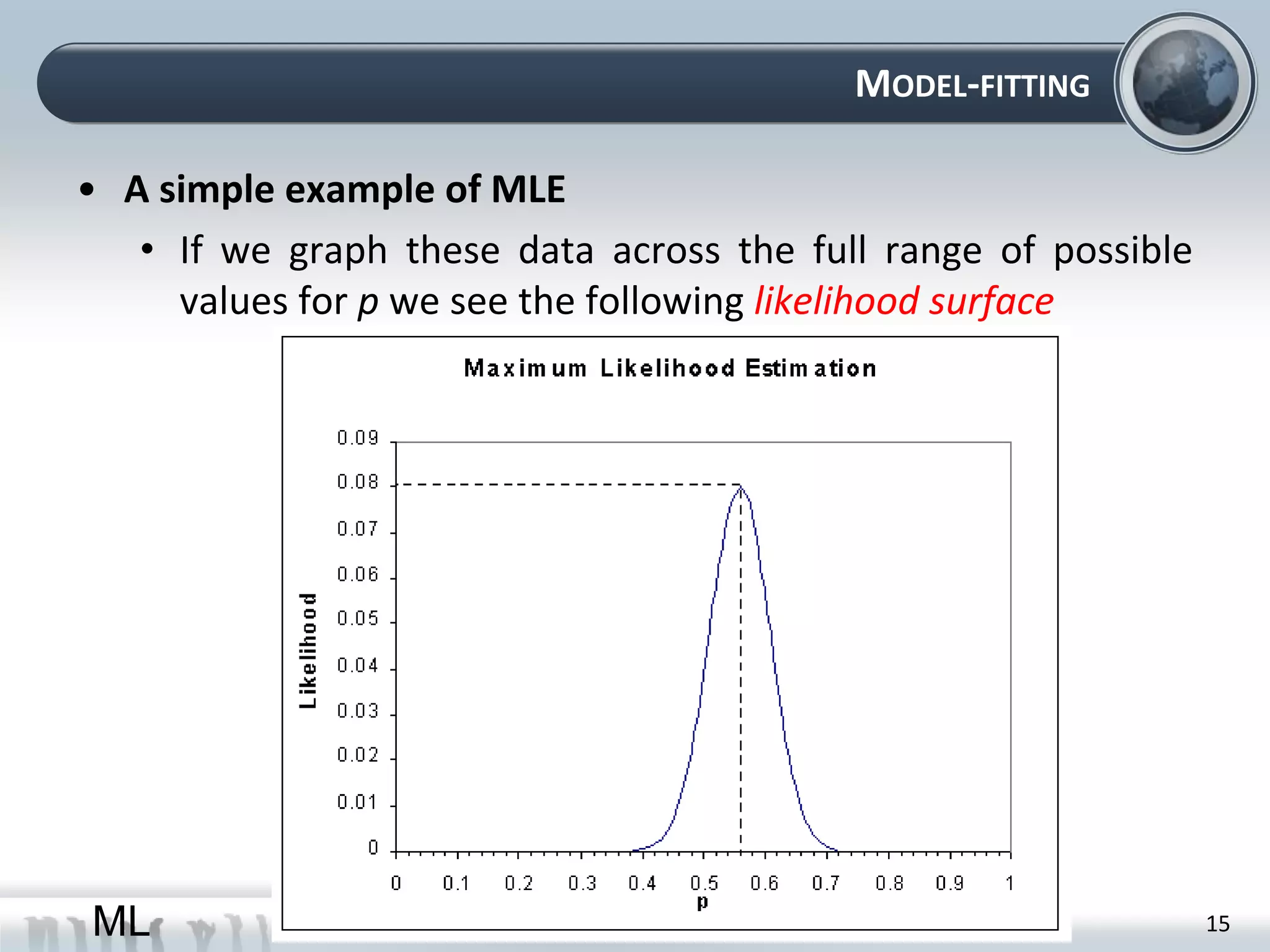
Model-fittingA simple example of MLEWe can tabulate the likelihood for different parameter values to find the maximum likelihood estimate of p: p  L-------------------                  0.48    0.0222                  0.50    0.0389                  0.52    0.0581                  0.54    0.0739                  0.56    0.0801                  0.58    0.0738                  0.60    0.0576                  0.62    0.037814
Model-fittingA simple example of MLEIf we graph these data across the full range of possible values for p we see the following likelihood surface15
MLE in PracticeAnalytic MLE Sometimes we can write a simple equation that describes the likelihood surface (e.g. the line we plotted in the coin tossing example) that can be differentiatedIn this case, we can find the maximum of this curve by setting the first derivative to zeroThat is, this represents the peak of a curve, where the gradient of the curve turns from being positive to negative (going left to right). In theory, this will represent the maximum likelihood estimate of the parameter. 16
MLE in PracticeNumerical MLE If the model is complex and involves many parameters and/or complex probability functions (e.g. the normal probability distribution)We cannot, or choose not, to write an equation that can be differentiated to find the MLE parameter estimatesIn this scenario, it is also typically not feasible to evaluate the likelihood at all points in the parameter spaceof the problem as we did in the coin toss exampleIn that example, the parameter space was only one-dimensional (i.e. only one parameter) and ranged between 0 and 1 because p can theoretically take any value between 0 and 117
MLE in PracticeNumerical MLE If we just evaluate the likelihood for a finite number of parameter valuesFor example, we chose to evaluate the likelihood at steps of 0.02. But we could have chosen steps of 0.01, of 0.001, of 0.000000001, etc. In theory and practice, one has to set a minimum toleranceby which you are happy for your estimates to be outThis is why computers are essential for these types of problems: they can tabulate lots and lots of values very quickly and therefore achieve a much finer resolution18
MLE in PracticeNumerical MLEIf the model has more than one parameter, the parameter space will grow very quickly indeedThe job of an optimization algorithm is to quickly find the set of parameter values that make the observed data most likelyThe 'hotter-colder' information these algorithms utilize essentially comes from the way in which the likelihood changes as the they move across the parameter space19
MLE in PracticeOther Practical ConsiderationsRemoving the constant Log-likelihood 20
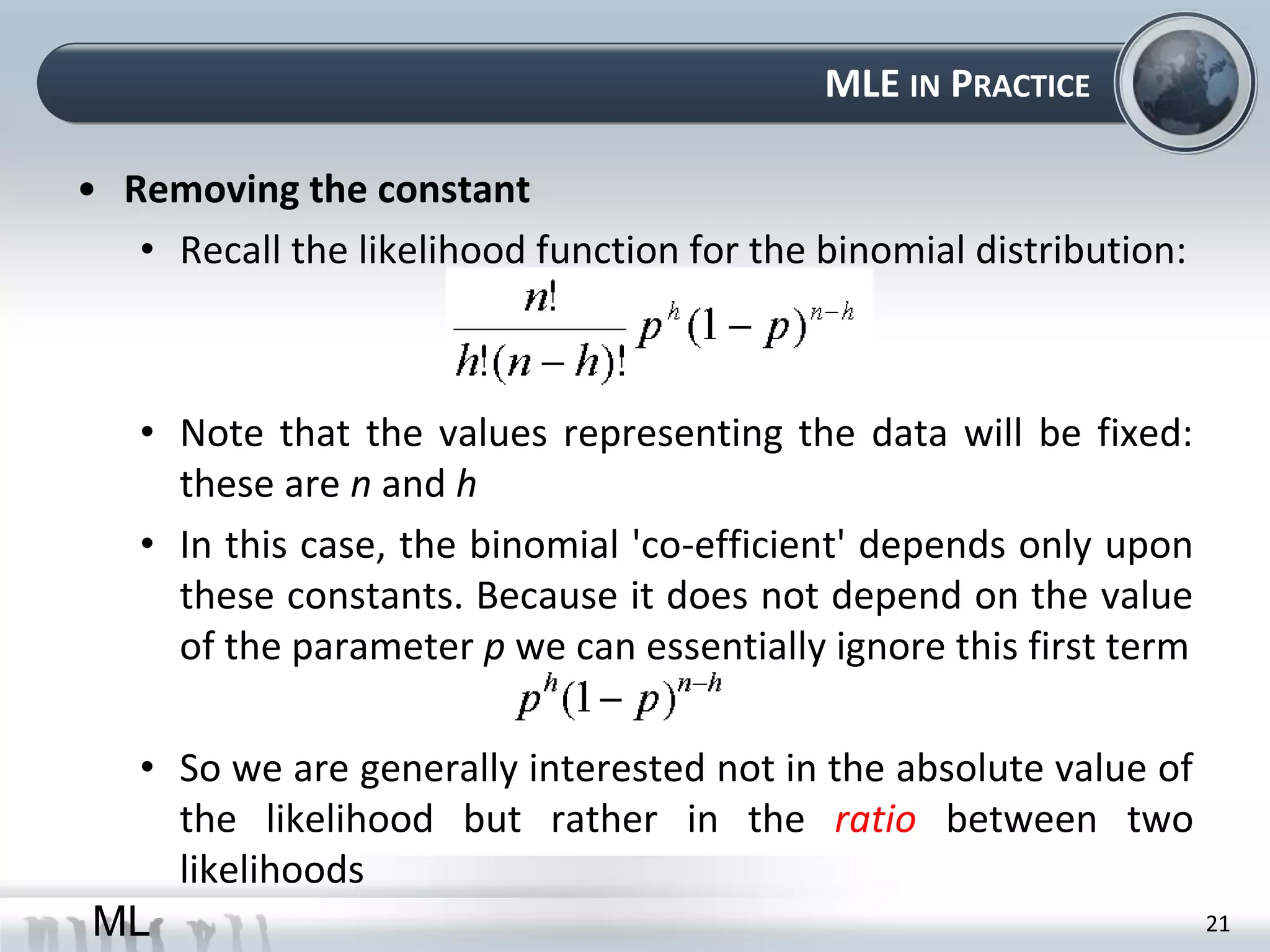
MLE in PracticeRemoving the constant Recall the likelihood function for the binomial distribution: Note that the values representing the data will be fixed: these are n and hIn this case, the binomial 'co-efficient' depends only upon these constants. Because it does not depend on the value of the parameter p we can essentially ignore this first termSo we are generally interested not in the absolute value of the likelihood but rather in the ratio between two likelihoods21
MLE in PracticeLog-likelihood The main reason for this is computational rather than theoreticalIf you multiply lots of very small numbers together (say all less than 0.0001) then you will very quickly end up with a number that is too small to be represented by any calculator or computer as different from zeroThis situation will often occur in calculating likelihoods, when we are often multiplying the probabilities of lots of rare but independent events together to calculate the joint probability22
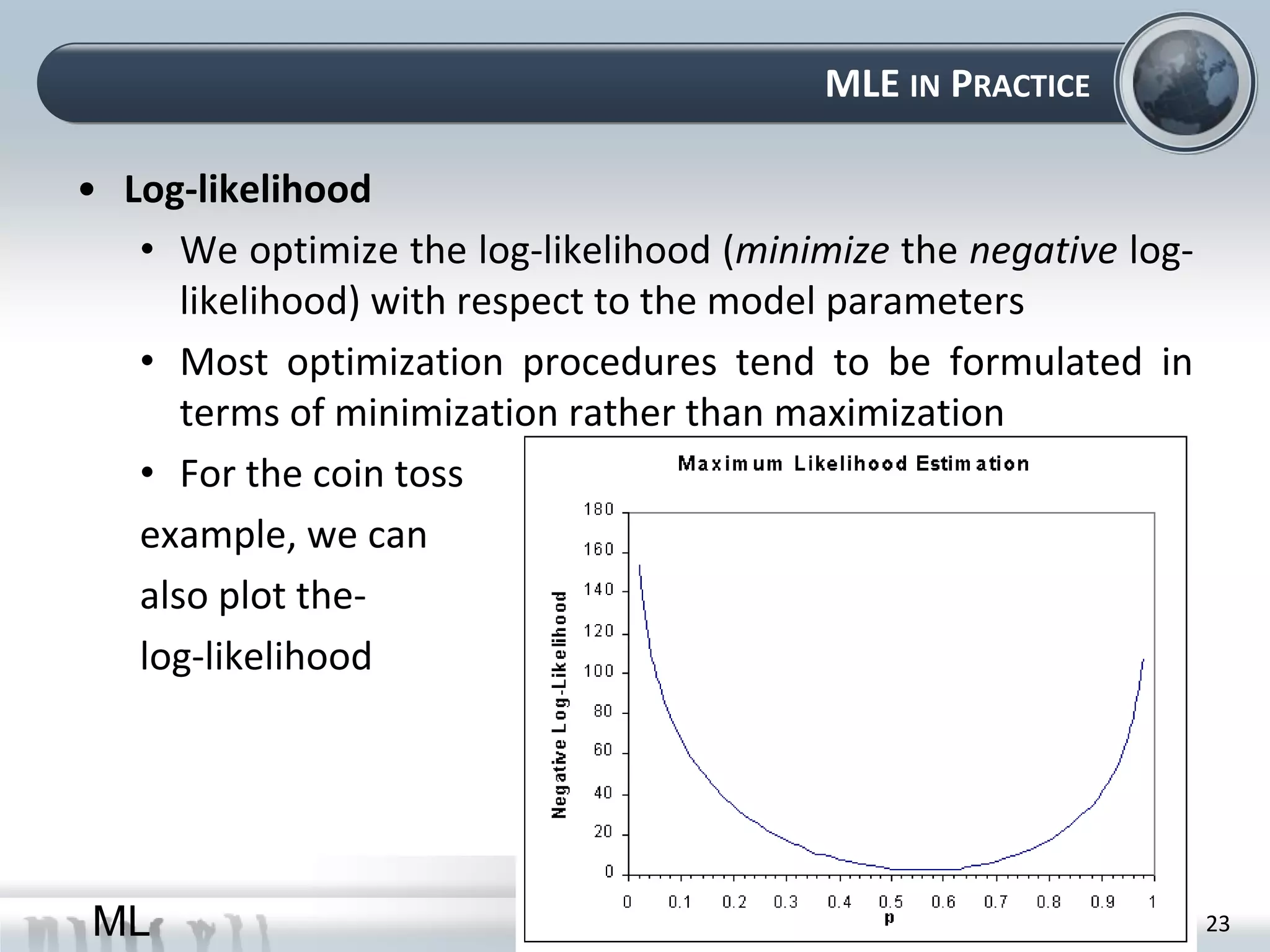
MLE in PracticeLog-likelihoodWe optimize the log-likelihood (minimizethe negative log-likelihood) with respect to the model parametersMost optimization procedures tend to be formulated in terms of minimization rather than maximizationFor the coin toss example, we can also plot the-log-likelihood23
MLE in PracticeModel identification It is worth noting that it is not always possible to find one set of parameter values that uniquely optimizes the log-likelihoodThis may occur if there are too many parameters being estimated for the type of data that has been collected. Such a model is said to be 'under-identified'24
MLE in PracticeLocal MinimaModel fitting is an iterative procedure: the user has to specify a set of starting values for the parameters 25
The Likelihood Ratio TestThe likelihood ratio test provides the means for comparing the likelihood of the data under one hypothesis (the alternate hypothesis) against the likelihood of the data under another, more restricted hypothesis (the nullhypothesis)For example, we may wish to ask: was the coin we tossed 100 times fair? This is rephrased as: 		Alternate hypothesis (HA)	 : p does not equal 0.50		Null hypothesis (H0)     : p equals 0.50The likelihood ratio test answers this question: are the data significantly less likely to have arisen if the null hypothesis is true than if the alternate hypothesis is true? 26
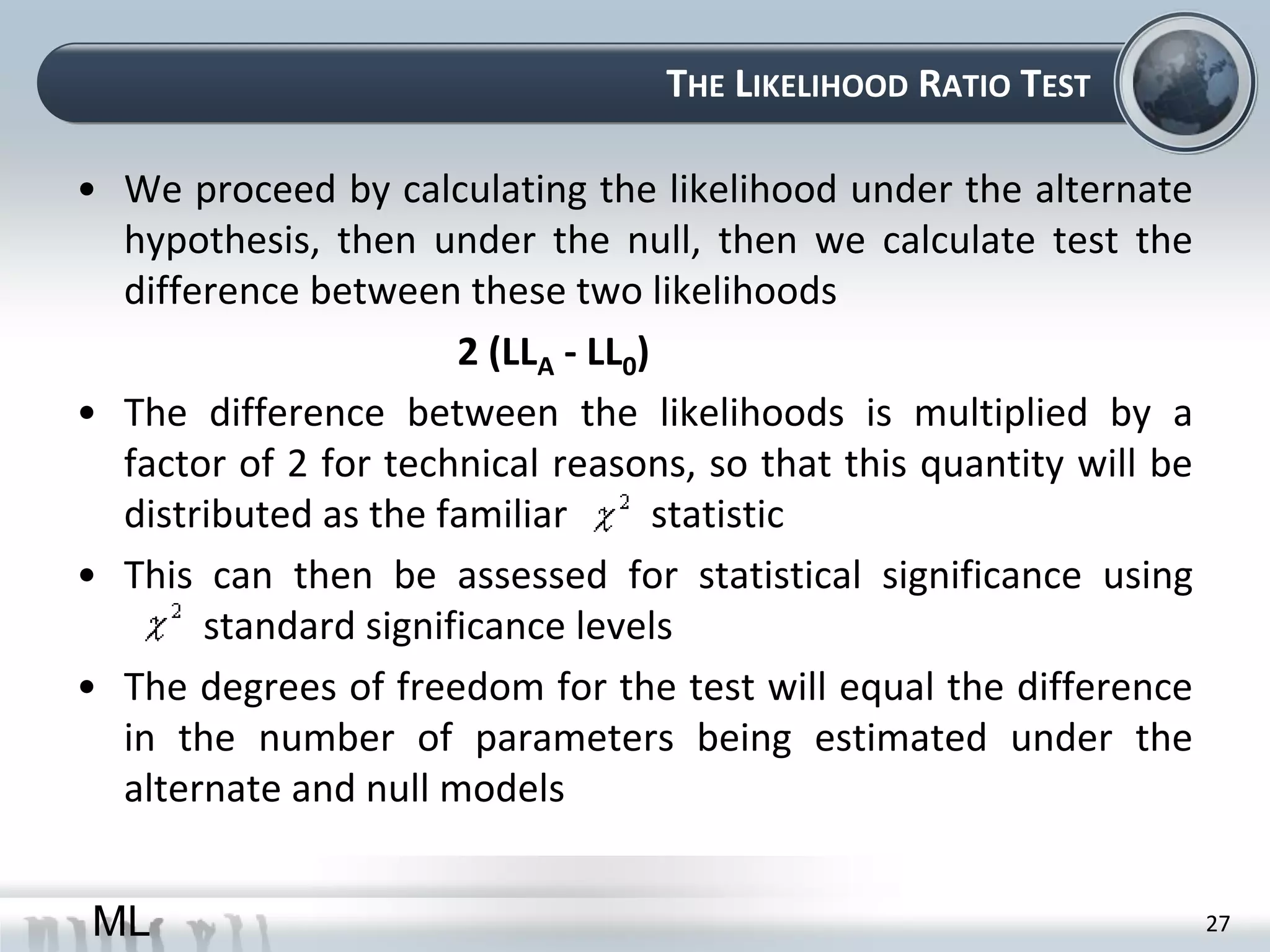
The Likelihood Ratio Test27We proceed by calculating the likelihood under the alternate hypothesis, then under the null, then we calculate test the difference between these two likelihoods 			2 (LLA - LL0)	The difference between the likelihoods is multiplied by a factor of 2 for technical reasons, so that this quantity will be distributed as the familiar	       statisticThis can then be assessed for statistical significance using     	standard significance levelsThe degrees of freedom for the test will equal the difference in the number of parameters being estimated under the alternate and null models
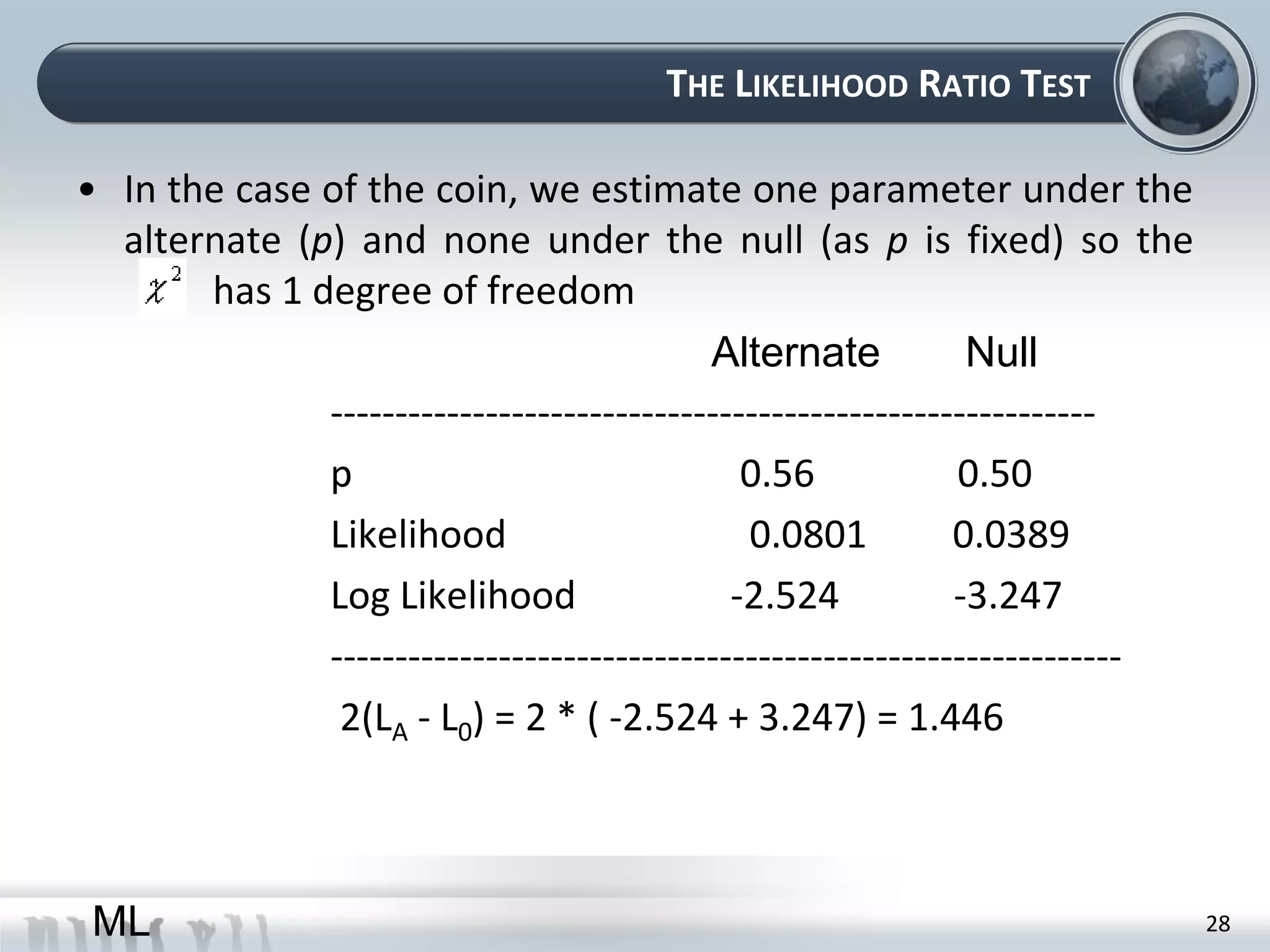
The Likelihood Ratio Test28In the case of the coin, we estimate one parameter under the alternate (p) and none under the null (as p is fixed) so the	 has 1 degree of freedomAlternate     	Null-----------------------------------------------------------p                		   0.56       0.50   Likelihood      0.0801   0.0389Log Likelihood    -2.524    -3.247------------------------------------------------------------- 2(LA - L0) = 2 * ( -2.524 + 3.247) = 1.446 
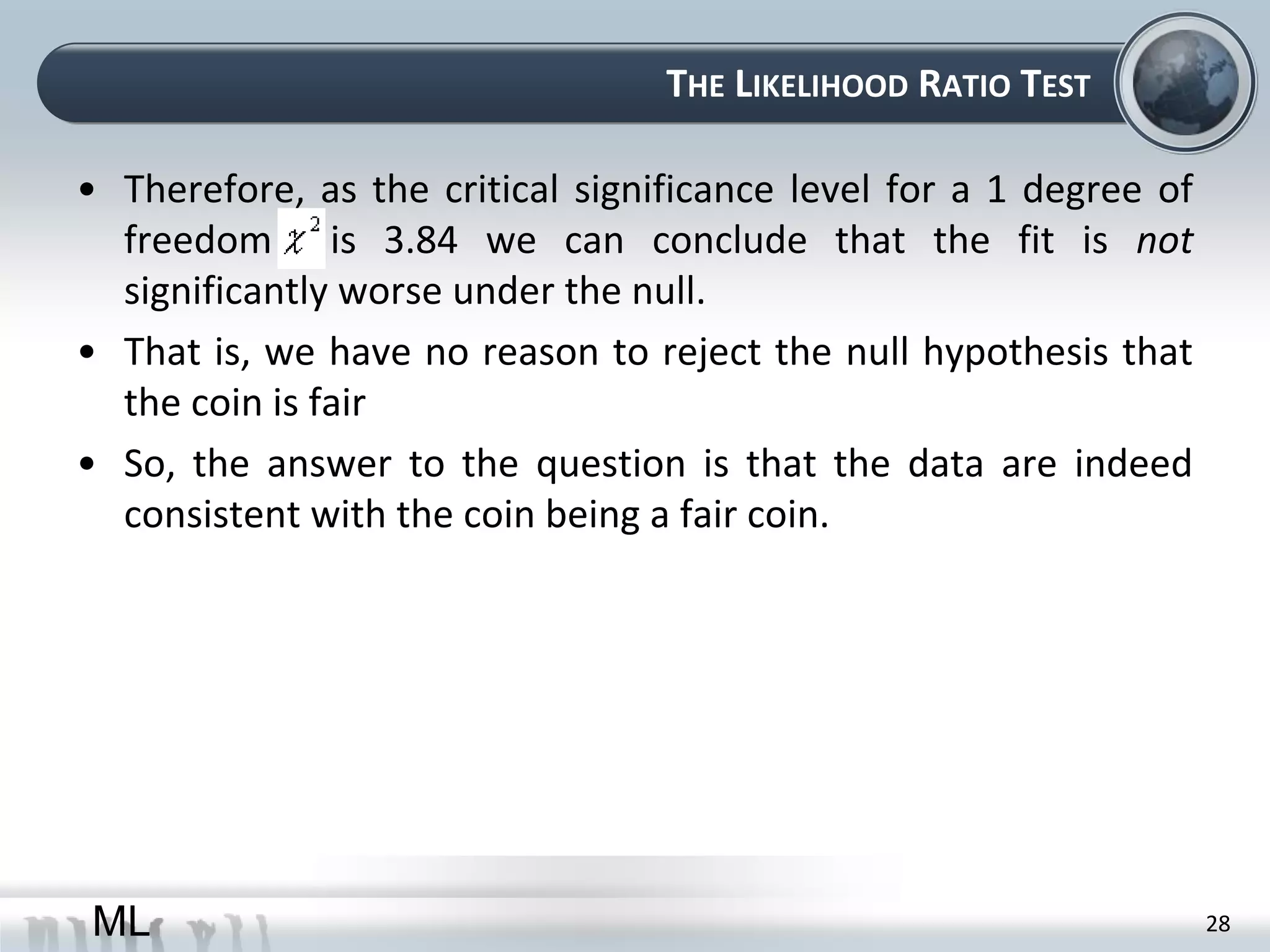
The Likelihood Ratio Test28Therefore, as the critical significance level for a 1 degree of freedom 	is 3.84 we can conclude that the fit is not significantly worse under the null.That is, we have no reason to reject the null hypothesis that the coin is fairSo, the answer to the question is that the data are indeed consistent with the coin being a fair coin.

Introduction to Maximum Likelihood Estimator

  • 1.
  • 2.
    OutlineIntroduction probability modelsparameters conditional probability binomial probability distributionModel-fitting likelihood maximum likelihood estimation parameter space 2
  • 3.
    OutlineMLE in Practiceanalytic approachsnumerical optimsiation algorithms log-likelihood identification local minima Likelihood ratio test alternate and null hypothesis chi-squared significance testing degrees of freedom 3
  • 4.
    IntroductionProbabilityThe concept oflikelihood is closely related to the more common concept of probabilityFor example, for an unbiased coin, the probability of observing heads is 0.5 for every tossThis is taken to mean that if a coin were tossed a large number of times then we would expect, on average, to find half of the time the coin landed heads, half of the time tails4
  • 5.
    IntroductionModels: parameters anddistributionsWhen we speak about the probability of observing events such as the outcome of a toss of a coin, we are implicitly assuming some kind of modelIn the case of a coin, the model would state that there is some certain, fixed probability for the particular outcomesThis model would have one parameter, p the probability of the coin landing on headsIf the coin is fair, then p=0.55
  • 6.
    IntroductionConditional probabilityThe notionof conditional probability allows us to incorporate other potentially important variablesMathematically, we write P( X | Y) meaning the probability of X conditional on Y or given Y6
  • 7.
    IntroductionConditional probabilityThe probabilityof an outcome will be conditional upon the parameter values of this model. In the case of the coin toss, P (H | p=0.5)where H is the event of obtaining a head and p is the model parameter, set at 0.57
  • 8.
    IntroductionConditional probabilitySay wetoss a coin a number of times and record the number of times it lands on headsThe probability distribution that describes just this kind of scenario is called the binomial probability distribution. It is written as follows : n= total number of coin tosses h = number of heads obtained p = probability of obtaining a head on any one toss8
  • 9.
    Model-fittingThe concept oflikelihoodIf the probability of an event X dependent on model parameters p is written P ( X | p ) then we would talk about the likelihood L ( p | X )That is, the likelihood of the parameters given the dataThe aim of maximum likelihood estimation is to find the parameter value(s) that makes the observed data most likely9
  • 10.
    Model-fittingThe concept oflikelihoodIn the case of data analysis, we have already observed all the data: once they have been observed they are fixed, there is no 'probabilistic' part to them anymore (the word data comes from the Latin word meaning 'given') We are much more interested in the likelihood of the model parameters that underlay the fixed data.ProbabilityKnowing parameters -> Prediction of outcomeLikelihoodObservation of data -> Estimation of parameters10
  • 11.
    Model-fittingA simple exampleof MLEHow would we go about this in a simple coin toss experiment?That is, rather than assume that p is a certain value (0.5) we might wish to find the maximum likelihood estimate (MLE) of p, given a specific dataset. Beyond parameter estimation, the likelihood framework allows us to make tests of parameter values. For example, we might want to ask whether or not the estimated p differs significantly from 0.5 or not. This test is essentially asking: is there evidence that the coin is biased? We will see how such tests can be performed when we introduce the concept of a likelihood ratio testbelow.11
  • 12.
    Model-fittingA simple exampleof MLESay we toss a coin 100 times and observe 56 heads and 44 tails. Instead of assuming that p is 0.5, we want to find the MLE for p. Then we want to ask whether or not this value differs significantly from 0.50How do we do this? We find the value for p that makes the observed data most likelyAs mentioned, the observed data are now fixed. They will be constants that are plugged into our binomial probability model :- n = 100 (total number of tosses) h = 56 (total number of heads) 12
  • 13.
    Model-fittingA simple exampleof MLEImagine that p was 0.5. Plugging this value into our probability model as follows :- But what if p was 0.52 instead? So from this we can conclude that p is more likely to be 0.52 than 0.513
  • 14.
    Model-fittingA simple exampleof MLEWe can tabulate the likelihood for different parameter values to find the maximum likelihood estimate of p: p L------------------- 0.48 0.0222 0.50 0.0389 0.52 0.0581 0.54 0.0739 0.56 0.0801 0.58 0.0738 0.60 0.0576 0.62 0.037814
  • 15.
    Model-fittingA simple exampleof MLEIf we graph these data across the full range of possible values for p we see the following likelihood surface15
  • 16.
    MLE in PracticeAnalyticMLE Sometimes we can write a simple equation that describes the likelihood surface (e.g. the line we plotted in the coin tossing example) that can be differentiatedIn this case, we can find the maximum of this curve by setting the first derivative to zeroThat is, this represents the peak of a curve, where the gradient of the curve turns from being positive to negative (going left to right). In theory, this will represent the maximum likelihood estimate of the parameter. 16
  • 17.
    MLE in PracticeNumericalMLE If the model is complex and involves many parameters and/or complex probability functions (e.g. the normal probability distribution)We cannot, or choose not, to write an equation that can be differentiated to find the MLE parameter estimatesIn this scenario, it is also typically not feasible to evaluate the likelihood at all points in the parameter spaceof the problem as we did in the coin toss exampleIn that example, the parameter space was only one-dimensional (i.e. only one parameter) and ranged between 0 and 1 because p can theoretically take any value between 0 and 117
  • 18.
    MLE in PracticeNumericalMLE If we just evaluate the likelihood for a finite number of parameter valuesFor example, we chose to evaluate the likelihood at steps of 0.02. But we could have chosen steps of 0.01, of 0.001, of 0.000000001, etc. In theory and practice, one has to set a minimum toleranceby which you are happy for your estimates to be outThis is why computers are essential for these types of problems: they can tabulate lots and lots of values very quickly and therefore achieve a much finer resolution18
  • 19.
    MLE in PracticeNumericalMLEIf the model has more than one parameter, the parameter space will grow very quickly indeedThe job of an optimization algorithm is to quickly find the set of parameter values that make the observed data most likelyThe 'hotter-colder' information these algorithms utilize essentially comes from the way in which the likelihood changes as the they move across the parameter space19
  • 20.
    MLE in PracticeOtherPractical ConsiderationsRemoving the constant Log-likelihood 20
  • 21.
    MLE in PracticeRemovingthe constant Recall the likelihood function for the binomial distribution: Note that the values representing the data will be fixed: these are n and hIn this case, the binomial 'co-efficient' depends only upon these constants. Because it does not depend on the value of the parameter p we can essentially ignore this first termSo we are generally interested not in the absolute value of the likelihood but rather in the ratio between two likelihoods21
  • 22.
    MLE in PracticeLog-likelihoodThe main reason for this is computational rather than theoreticalIf you multiply lots of very small numbers together (say all less than 0.0001) then you will very quickly end up with a number that is too small to be represented by any calculator or computer as different from zeroThis situation will often occur in calculating likelihoods, when we are often multiplying the probabilities of lots of rare but independent events together to calculate the joint probability22
  • 23.
    MLE in PracticeLog-likelihoodWeoptimize the log-likelihood (minimizethe negative log-likelihood) with respect to the model parametersMost optimization procedures tend to be formulated in terms of minimization rather than maximizationFor the coin toss example, we can also plot the-log-likelihood23
  • 24.
    MLE in PracticeModelidentification It is worth noting that it is not always possible to find one set of parameter values that uniquely optimizes the log-likelihoodThis may occur if there are too many parameters being estimated for the type of data that has been collected. Such a model is said to be 'under-identified'24
  • 25.
    MLE in PracticeLocalMinimaModel fitting is an iterative procedure: the user has to specify a set of starting values for the parameters 25
  • 26.
    The Likelihood RatioTestThe likelihood ratio test provides the means for comparing the likelihood of the data under one hypothesis (the alternate hypothesis) against the likelihood of the data under another, more restricted hypothesis (the nullhypothesis)For example, we may wish to ask: was the coin we tossed 100 times fair? This is rephrased as: Alternate hypothesis (HA) : p does not equal 0.50 Null hypothesis (H0) : p equals 0.50The likelihood ratio test answers this question: are the data significantly less likely to have arisen if the null hypothesis is true than if the alternate hypothesis is true? 26
  • 27.
    The Likelihood RatioTest27We proceed by calculating the likelihood under the alternate hypothesis, then under the null, then we calculate test the difference between these two likelihoods 2 (LLA - LL0) The difference between the likelihoods is multiplied by a factor of 2 for technical reasons, so that this quantity will be distributed as the familiar statisticThis can then be assessed for statistical significance using standard significance levelsThe degrees of freedom for the test will equal the difference in the number of parameters being estimated under the alternate and null models
  • 28.
    The Likelihood RatioTest28In the case of the coin, we estimate one parameter under the alternate (p) and none under the null (as p is fixed) so the has 1 degree of freedomAlternate Null-----------------------------------------------------------p 0.56 0.50 Likelihood 0.0801 0.0389Log Likelihood -2.524 -3.247------------------------------------------------------------- 2(LA - L0) = 2 * ( -2.524 + 3.247) = 1.446 
  • 29.
    The Likelihood RatioTest28Therefore, as the critical significance level for a 1 degree of freedom is 3.84 we can conclude that the fit is not significantly worse under the null.That is, we have no reason to reject the null hypothesis that the coin is fairSo, the answer to the question is that the data are indeed consistent with the coin being a fair coin.