Logistic Regression
Legal Notices and Disclaimers
This presentation is for informational purposes only. INTEL MAKES NO WARRANTIES,
EXPRESS OR IMPLIED, IN THIS SUMMARY.
Intel technologies’ features and benefits depend on system configuration and may require
enabled hardware, software or service activation. Performance varies depending on system
configuration. Check with your system manufacturer or retailer or learn more at intel.com.
This sample source code is released under the Intel Sample Source Code License Agreement.
Intel and the Intel logo are trademarks of Intel Corporation in the U.S. and/or other countries.
*Other names and brands may be claimed as the property of others.
Copyright © 2017, Intel Corporation. All rights reserved.
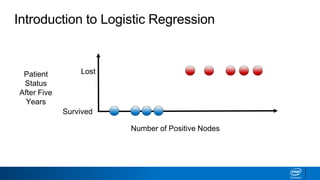
Introduction to Logistic Regression
Number of Positive Nodes
Patient
Status
After Five
Years
Survived
Lost
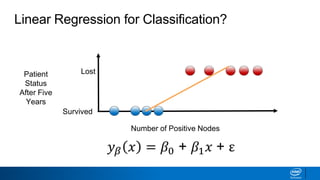
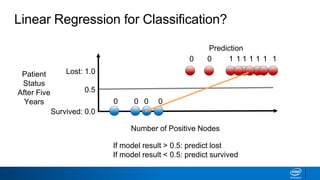
Linear Regression for Classification?
Number of Positive Nodes
Survived
LostPatient
Status
After Five
Years
𝑦 𝛽 𝑥 = 𝛽0 + 𝛽1 𝑥 + ε
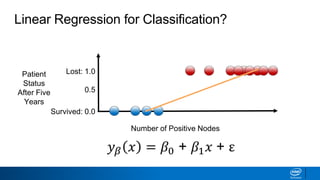
Linear Regression for Classification?
Number of Positive Nodes
Survived: 0.0
Lost: 1.0Patient
Status
After Five
Years
0.5
𝑦 𝛽 𝑥 = 𝛽0 + 𝛽1 𝑥 + ε
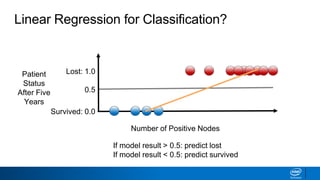
Linear Regression for Classification?
Number of Positive Nodes
Survived: 0.0
Lost: 1.0Patient
Status
After Five
Years
If model result > 0.5: predict lost
If model result < 0.5: predict survived
0.5
Linear Regression for Classification?
Number of Positive Nodes
Survived: 0.0
Lost: 1.0Patient
Status
After Five
Years
If model result > 0.5: predict lost
If model result < 0.5: predict survived
0.5
0 0
0000
1 1 1 1 1 1 1
Prediction
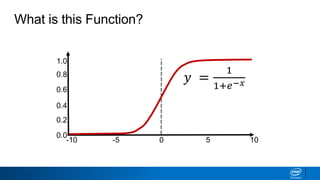
What is this Function?
0.0
1.0
0.2
0.4
0.6
0.8
0-5-10 5 10
𝑦 =
1
1+𝑒−𝑥
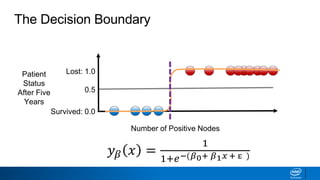
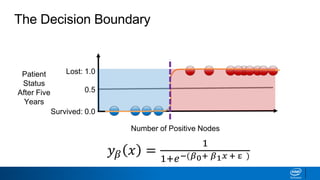
The Decision Boundary
Number of Positive Nodes
Survived: 0.0
Lost: 1.0Patient
Status
After Five
Years
0.5
𝑦 𝛽 𝑥 =
1
1+𝑒−(𝛽0+ 𝛽1 𝑥 + ε )
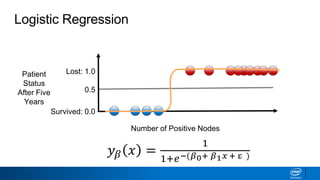
Logistic Regression
Number of Positive Nodes
Survived: 0.0
Lost: 1.0Patient
Status
After Five
Years
0.5
𝑦 𝛽 𝑥 =
1
1+𝑒−(𝛽0+ 𝛽1 𝑥 + ε )
The Decision Boundary
Number of Positive Nodes
Survived: 0.0
Lost: 1.0Patient
Status
After Five
Years
0.5
𝑦 𝛽 𝑥 =
1
1+𝑒−(𝛽0+ 𝛽1 𝑥 + ε )
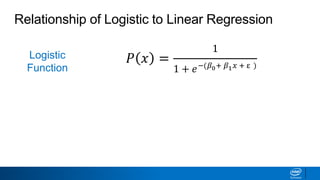
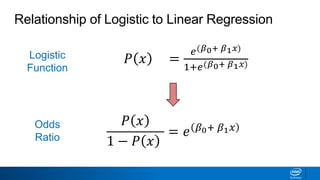
Relationship of Logistic to Linear Regression
Logistic
Function
𝑃 𝑥 =
1
1 + 𝑒−(𝛽0+ 𝛽1 𝑥 + ε )
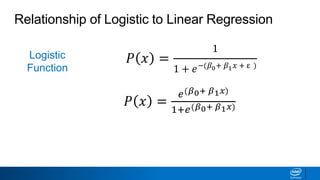
Relationship of Logistic to Linear Regression
Logistic
Function
𝑃 𝑥 =
1
1 + 𝑒−(𝛽0+ 𝛽1 𝑥 + ε )
𝑃 𝑥 =
𝑒(𝛽0+ 𝛽1 𝑥)
1+𝑒(𝛽0+ 𝛽1 𝑥)
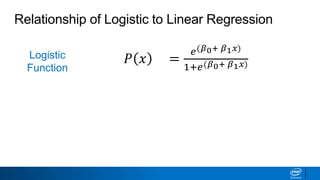
Relationship of Logistic to Linear Regression
Logistic
Function
𝑃 𝑥 =
𝑒(𝛽0+ 𝛽1 𝑥)
1+𝑒(𝛽0+ 𝛽1 𝑥)
Relationship of Logistic to Linear Regression
𝑃 𝑥 =
𝑒(𝛽0+ 𝛽1 𝑥)
1+𝑒(𝛽0+ 𝛽1 𝑥)
𝑃 𝑥
1 − 𝑃 𝑥
= 𝑒 𝛽0+ 𝛽1 𝑥
Logistic
Function
Odds
Ratio
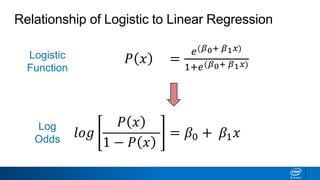
𝑙𝑜𝑔
𝑃 𝑥
1 − 𝑃 𝑥
= 𝛽0 + 𝛽1 𝑥
Relationship of Logistic to Linear Regression
𝑃 𝑥 =
𝑒(𝛽0+ 𝛽1 𝑥)
1+𝑒(𝛽0+ 𝛽1 𝑥)
Logistic
Function
Log
Odds
𝑙𝑜𝑔
𝑃 𝑥
1 − 𝑃 𝑥
= 𝛽0 + 𝛽1 𝑥
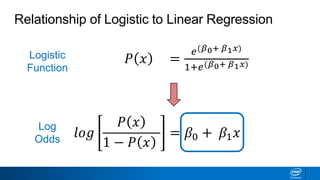
Relationship of Logistic to Linear Regression
𝑃 𝑥 =
𝑒(𝛽0+ 𝛽1 𝑥)
1+𝑒(𝛽0+ 𝛽1 𝑥)
Logistic
Function
Log
Odds
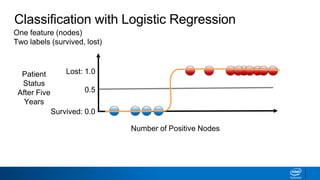
Classification with Logistic Regression
Number of Positive Nodes
Survived: 0.0
Lost: 1.0Patient
Status
After Five
Years
0.5
One feature (nodes)
Two labels (survived, lost)
Number of Malignant Nodes
0
Age
60
40
20
10 20
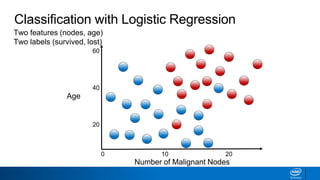
Two features (nodes, age)
Two labels (survived, lost)
Classification with Logistic Regression
Number of Malignant Nodes
0
Age
60
40
20
10 20
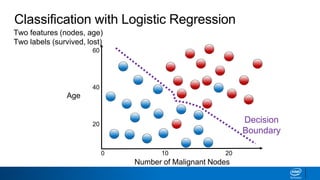
Two features (nodes, age)
Two labels (survived, lost)
Classification with Logistic Regression
Decision
Boundary
Number of Malignant Nodes
0
Age
60
40
20
10 20
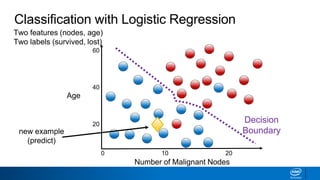
Two features (nodes, age)
Two labels (survived, lost)
new example
(predict)
Classification with Logistic Regression
Decision
Boundary
Number of Malignant Nodes
0
Age
60
40
20
10 20
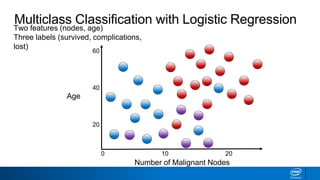
Two features (nodes, age)
Three labels (survived, complications,
lost)
Multiclass Classification with Logistic Regression
Number of Malignant Nodes
0
Age
60
40
20
10 20
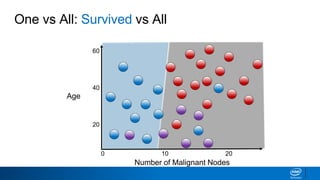
One vs All: Survived vs All
Number of Malignant Nodes
0
Age
60
40
20
10 20
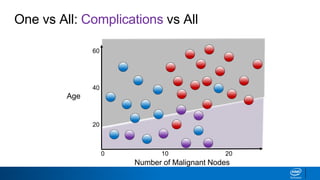
One vs All: Complications vs All
Number of Malignant Nodes
0
Age
60
40
20
10 20
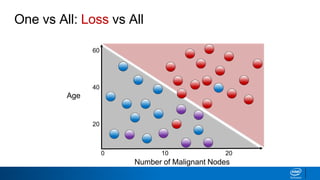
One vs All: Loss vs All
Number of Malignant Nodes
0
Age
60
40
20
10 20
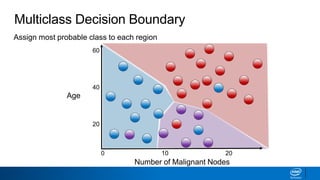
Assign most probable class to each region
Multiclass Decision Boundary
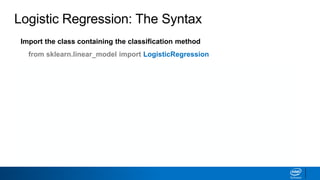
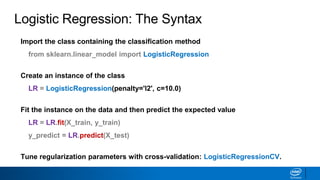
Import the class containing the classification method
from sklearn.linear_model import LogisticRegression
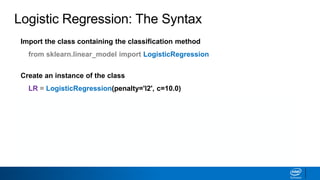
Create an instance of the class
LR = LogisticRegression(penalty='l2', c=10.0)
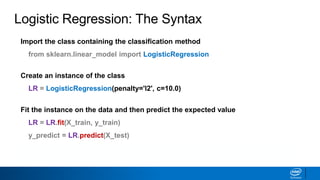
Fit the instance on the data and then predict the expected value
LR = LR.fit(X_train, y_train)
y_predict = LR.predict(X_test)
Tune regularization parameters with cross-validation: LogisticRegressionCV.
Logistic Regression: The Syntax
Import the class containing the classification method
from sklearn.linear_model import LogisticRegression
Create an instance of the class
LR = LogisticRegression(penalty='l2', c=10.0)
Fit the instance on the data and then predict the expected value
LR = LR.fit(X_train, y_train)
y_predict = LR.predict(X_test)
Tune regularization parameters with cross-validation: LogisticRegressionCV.
Logistic Regression: The Syntax
Import the class containing the classification method
from sklearn.linear_model import LogisticRegression
Create an instance of the class
LR = LogisticRegression(penalty='l2', c=10.0)
Fit the instance on the data and then predict the expected value
LR = LR.fit(X_train, y_train)
y_predict = LR.predict(X_test)
Tune regularization parameters with cross-validation: LogisticRegressionCV.
Logistic Regression: The Syntax
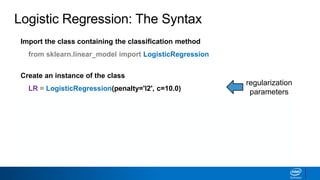
regularization
parameters
Import the class containing the classification method
from sklearn.linear_model import LogisticRegression
Create an instance of the class
LR = LogisticRegression(penalty='l2', c=10.0)
Fit the instance on the data and then predict the expected value
LR = LR.fit(X_train, y_train)
y_predict = LR.predict(X_test)
Tune regularization parameters with cross-validation: LogisticRegressionCV.
Logistic Regression: The Syntax
Import the class containing the classification method
from sklearn.linear_model import LogisticRegression
Create an instance of the class
LR = LogisticRegression(penalty='l2', c=10.0)
Fit the instance on the data and then predict the expected value
LR = LR.fit(X_train, y_train)
y_predict = LR.predict(X_test)
Tune regularization parameters with cross-validation: LogisticRegressionCV.
Classification Error Metrics
• You are asked to build a classifier for leukemia
• Training data: 1% patients with leukemia, 99% healthy
• Measure accuracy: total % of predictions that are
correct
Choosing the Right Error Measurement
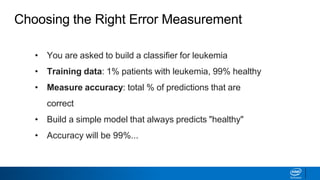
• You are asked to build a classifier for leukemia
• Training data: 1% patients with leukemia, 99% healthy
• Measure accuracy: total % of predictions that are
correct
• Build a simple model that always predicts "healthy"
• Accuracy will be 99%...
Choosing the Right Error Measurement
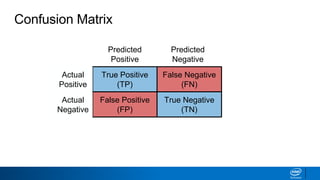
Predicted
Positive
Predicted
Negative
True Positive
(TP)
False Negative
(FN)
Actual
Positive
False Positive
(FP)
True Negative
(TN)
Actual
Negative
Confusion MatrixConfusion Matrix
Predicted
Positive
Predicted
Negative
True Positive
(TP)
False Negative
(FN)
Actual
Positive
False Positive
(FP)
True Negative
(TN)
Actual
Negative
Type I Error
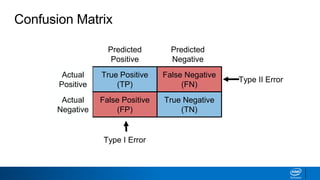
Confusion MatrixConfusion Matrix
Type II Error
Predicted
Positive
Predicted
Negative
True Positive
(TP)
False Negative
(FN)
Actual
Positive
False Positive
(FP)
True Negative
(TN)
Actual
Negative
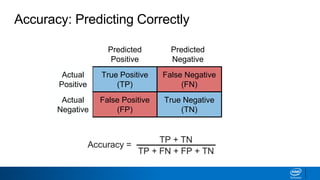
Confusion MatrixAccuracy: Predicting Correctly
Accuracy =
TP + TN
TP + FN + FP + TN
Predicted
Positive
Predicted
Negative
True Positive
(TP)
False Negative
(FN)
Actual
Positive
False Positive
(FP)
True Negative
(TN)
Actual
Negative
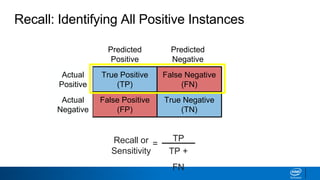
Confusion MatrixRecall: Identifying All Positive Instances
Recall or
Sensitivity
TP
TP +
FN
=
Predicted
Positive
Predicted
Negative
True Positive
(TP)
False Negative
(FN)
Actual
Positive
False Positive
(FP)
True Negative
(TN)
Actual
Negative
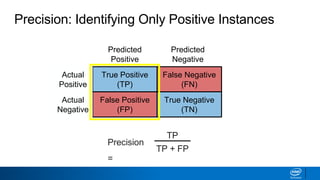
Confusion MatrixPrecision: Identifying Only Positive Instances
Precision
=
TP
TP + FP
Predicted
Positive
Predicted
Negative
True Positive
(TP)
False Negative
(FN)
Actual
Positive
False Positive
(FP)
True Negative
(TN)
Actual
Negative
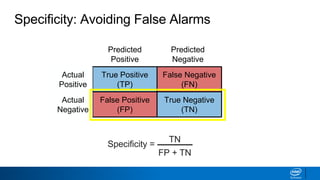
Confusion MatrixSpecificity: Avoiding False Alarms
Specificity =
TN
FP + TN
Predicted
Positive
Predicted
Negative
True Positive
(TP)
False Negative
(FN)
Actual
Positive
False Positive
(FP)
True Negative
(TN)
Actual
Negative
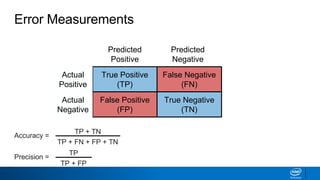
Confusion MatrixError Measurements
Accuracy =
TP + TN
TP + FN + FP + TN
Precision =
TP
TP + FP
Predicted
Positive
Predicted
Negative
True Positive
(TP)
False Negative
(FN)
Actual
Positive
False Positive
(FP)
True Negative
(TN)
Actual
Negative
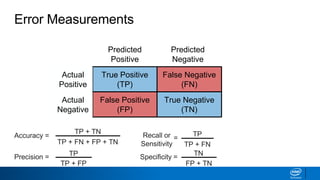
Confusion MatrixError Measurements
Accuracy =
TP + TN
TP + FN + FP + TN
Precision = TP
TP + FP
Specificity =
TN
FP + TN
Recall or
Sensitivity
TP
TP + FN
=
Predicted
Positive
Predicted
Negative
True Positive
(TP)
False Negative
(FN)
Actual
Positive
False Positive
(FP)
True Negative
(TN)
Actual
Negative
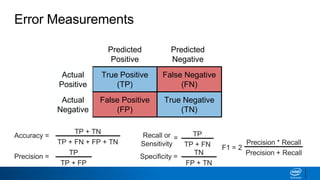
Confusion MatrixError Measurements
Accuracy =
TP + TN
TP + FN + FP + TN
Precision =
TP
TP + FP
Specificity =
TN
FP + TN
Recall or
Sensitivity
TP
TP + FN
=
F1 = 2
Precision * Recall
Precision + Recall
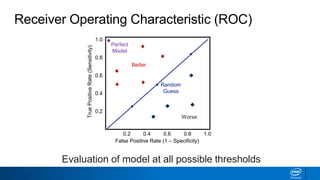
Random
Guess
Worse
Better
0.2
0.4
0.6
0.8
1.0
0.2 0.4 0.6 0.8 1.0
Receiver Operating Characteristic (ROC)
Evaluation of model at all possible thresholds
Perfect
Model
False Positive Rate (1 – Specificity)
TruePositiveRate(Sensitivity)
Measures total area under ROC curve
False Positive Rate (1 – Specificity)
TruePositiveRate(Sensitivity)
AUC 0.5
AUC 0.75
AUC 0.9
0.2
0.4
0.6
0.8
1.0
0.2 0.4 0.6 0.8 1.0
Area Under Curve (AUC)
Recall
Precision
0.2
0.4
0.6
0.8
1.0
0.2 0.4 0.6 0.8 1.0
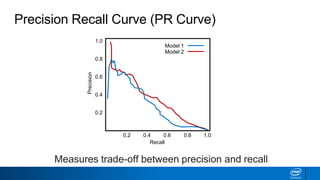
Precision Recall Curve (PR Curve)
Model 1
Model 2
Measures trade-off between precision and recall
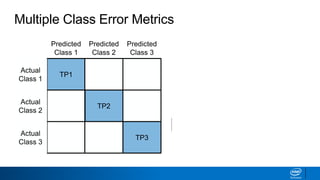
Multiple Class Error Metrics
Accuracy =
TP1 + TP2 + TP3
𝐼𝑛𝑐𝑜𝑟𝑟𝑒𝑐𝑡
𝐶𝑙𝑎𝑠𝑠𝑖𝑓𝑖𝑐𝑎𝑡𝑖𝑜𝑛𝑠
Predicted
Class 1
Predicted
Class 2
TP1
Actual
Class 1
TP2
Actual
Class 2
Predicted
Class 3
Actual
Class 3
TP3
Most multi-class error
metrics are similar to
binary versions—
just expand elements
as a sum
Incorrect
Classifications
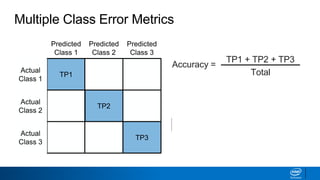
Multiple Class Error Metrics
Accuracy =
TP1 + TP2 + TP3
Predicted
Class 1
Predicted
Class 2
TP1
Actual
Class 1
TP2
Actual
Class 2
Predicted
Class 3
Actual
Class 3
TP3
Most multi-class error
metrics are similar to
binary versions—
just expand elements
as a sum
Total
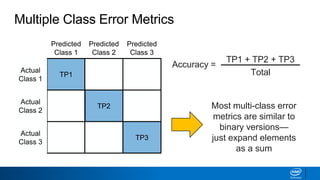
Multiple Class Error Metrics
Predicted
Class 1
Predicted
Class 2
TP1
Actual
Class 1
TP2
Actual
Class 2
Predicted
Class 3
Actual
Class 3
TP3
Most multi-class error
metrics are similar to
binary versions—
just expand elements
as a sum
Accuracy =
TP1 + TP2 + TP3
Total
Import the desired error function
from sklearn.metrics import accuracy_score
Classification Error Metrics: The Syntax
Import the desired error function
from sklearn.metrics import accuracy_score
Calculate the error on the test and predicted data sets
accuracy_value = accuracy_score(y_test, y_pred)
Classification Error Metrics: The Syntax
Import the desired error function
from sklearn.metrics import accuracy_score
Calculate the error on the test and predicted data sets
accuracy_value = accuracy_score(y_test, y_pred)
Lots of other error metrics and diagnostic tools:
from sklearn.metrics import precision_score, recall_score,
f1_score, roc_auc_score,
confusion_matrix, roc_curve,
precision_recall_curve
Classification Error Metrics: The Syntax
Ml3 logistic regression-and_classification_error_metrics

Ml3 logistic regression-and_classification_error_metrics

  • 1.
  • 2.
    Legal Notices andDisclaimers This presentation is for informational purposes only. INTEL MAKES NO WARRANTIES, EXPRESS OR IMPLIED, IN THIS SUMMARY. Intel technologies’ features and benefits depend on system configuration and may require enabled hardware, software or service activation. Performance varies depending on system configuration. Check with your system manufacturer or retailer or learn more at intel.com. This sample source code is released under the Intel Sample Source Code License Agreement. Intel and the Intel logo are trademarks of Intel Corporation in the U.S. and/or other countries. *Other names and brands may be claimed as the property of others. Copyright © 2017, Intel Corporation. All rights reserved.
  • 3.
    Introduction to LogisticRegression Number of Positive Nodes Patient Status After Five Years Survived Lost
  • 4.
    Linear Regression forClassification? Number of Positive Nodes Survived LostPatient Status After Five Years 𝑦 𝛽 𝑥 = 𝛽0 + 𝛽1 𝑥 + ε
  • 5.
    Linear Regression forClassification? Number of Positive Nodes Survived: 0.0 Lost: 1.0Patient Status After Five Years 0.5 𝑦 𝛽 𝑥 = 𝛽0 + 𝛽1 𝑥 + ε
  • 6.
    Linear Regression forClassification? Number of Positive Nodes Survived: 0.0 Lost: 1.0Patient Status After Five Years If model result > 0.5: predict lost If model result < 0.5: predict survived 0.5
  • 7.
    Linear Regression forClassification? Number of Positive Nodes Survived: 0.0 Lost: 1.0Patient Status After Five Years If model result > 0.5: predict lost If model result < 0.5: predict survived 0.5 0 0 0000 1 1 1 1 1 1 1 Prediction
  • 8.
    What is thisFunction? 0.0 1.0 0.2 0.4 0.6 0.8 0-5-10 5 10 𝑦 = 1 1+𝑒−𝑥
  • 9.
    The Decision Boundary Numberof Positive Nodes Survived: 0.0 Lost: 1.0Patient Status After Five Years 0.5 𝑦 𝛽 𝑥 = 1 1+𝑒−(𝛽0+ 𝛽1 𝑥 + ε )
  • 10.
    Logistic Regression Number ofPositive Nodes Survived: 0.0 Lost: 1.0Patient Status After Five Years 0.5 𝑦 𝛽 𝑥 = 1 1+𝑒−(𝛽0+ 𝛽1 𝑥 + ε )
  • 11.
    The Decision Boundary Numberof Positive Nodes Survived: 0.0 Lost: 1.0Patient Status After Five Years 0.5 𝑦 𝛽 𝑥 = 1 1+𝑒−(𝛽0+ 𝛽1 𝑥 + ε )
  • 12.
    Relationship of Logisticto Linear Regression Logistic Function 𝑃 𝑥 = 1 1 + 𝑒−(𝛽0+ 𝛽1 𝑥 + ε )
  • 13.
    Relationship of Logisticto Linear Regression Logistic Function 𝑃 𝑥 = 1 1 + 𝑒−(𝛽0+ 𝛽1 𝑥 + ε ) 𝑃 𝑥 = 𝑒(𝛽0+ 𝛽1 𝑥) 1+𝑒(𝛽0+ 𝛽1 𝑥)
  • 14.
    Relationship of Logisticto Linear Regression Logistic Function 𝑃 𝑥 = 𝑒(𝛽0+ 𝛽1 𝑥) 1+𝑒(𝛽0+ 𝛽1 𝑥)
  • 15.
    Relationship of Logisticto Linear Regression 𝑃 𝑥 = 𝑒(𝛽0+ 𝛽1 𝑥) 1+𝑒(𝛽0+ 𝛽1 𝑥) 𝑃 𝑥 1 − 𝑃 𝑥 = 𝑒 𝛽0+ 𝛽1 𝑥 Logistic Function Odds Ratio
  • 16.
    𝑙𝑜𝑔 𝑃 𝑥 1 −𝑃 𝑥 = 𝛽0 + 𝛽1 𝑥 Relationship of Logistic to Linear Regression 𝑃 𝑥 = 𝑒(𝛽0+ 𝛽1 𝑥) 1+𝑒(𝛽0+ 𝛽1 𝑥) Logistic Function Log Odds
  • 17.
    𝑙𝑜𝑔 𝑃 𝑥 1 −𝑃 𝑥 = 𝛽0 + 𝛽1 𝑥 Relationship of Logistic to Linear Regression 𝑃 𝑥 = 𝑒(𝛽0+ 𝛽1 𝑥) 1+𝑒(𝛽0+ 𝛽1 𝑥) Logistic Function Log Odds
  • 18.
    Classification with LogisticRegression Number of Positive Nodes Survived: 0.0 Lost: 1.0Patient Status After Five Years 0.5 One feature (nodes) Two labels (survived, lost)
  • 19.
    Number of MalignantNodes 0 Age 60 40 20 10 20 Two features (nodes, age) Two labels (survived, lost) Classification with Logistic Regression
  • 20.
    Number of MalignantNodes 0 Age 60 40 20 10 20 Two features (nodes, age) Two labels (survived, lost) Classification with Logistic Regression Decision Boundary
  • 21.
    Number of MalignantNodes 0 Age 60 40 20 10 20 Two features (nodes, age) Two labels (survived, lost) new example (predict) Classification with Logistic Regression Decision Boundary
  • 22.
    Number of MalignantNodes 0 Age 60 40 20 10 20 Two features (nodes, age) Three labels (survived, complications, lost) Multiclass Classification with Logistic Regression
  • 23.
    Number of MalignantNodes 0 Age 60 40 20 10 20 One vs All: Survived vs All
  • 24.
    Number of MalignantNodes 0 Age 60 40 20 10 20 One vs All: Complications vs All
  • 25.
    Number of MalignantNodes 0 Age 60 40 20 10 20 One vs All: Loss vs All
  • 26.
    Number of MalignantNodes 0 Age 60 40 20 10 20 Assign most probable class to each region Multiclass Decision Boundary
  • 27.
    Import the classcontaining the classification method from sklearn.linear_model import LogisticRegression Create an instance of the class LR = LogisticRegression(penalty='l2', c=10.0) Fit the instance on the data and then predict the expected value LR = LR.fit(X_train, y_train) y_predict = LR.predict(X_test) Tune regularization parameters with cross-validation: LogisticRegressionCV. Logistic Regression: The Syntax
  • 28.
    Import the classcontaining the classification method from sklearn.linear_model import LogisticRegression Create an instance of the class LR = LogisticRegression(penalty='l2', c=10.0) Fit the instance on the data and then predict the expected value LR = LR.fit(X_train, y_train) y_predict = LR.predict(X_test) Tune regularization parameters with cross-validation: LogisticRegressionCV. Logistic Regression: The Syntax
  • 29.
    Import the classcontaining the classification method from sklearn.linear_model import LogisticRegression Create an instance of the class LR = LogisticRegression(penalty='l2', c=10.0) Fit the instance on the data and then predict the expected value LR = LR.fit(X_train, y_train) y_predict = LR.predict(X_test) Tune regularization parameters with cross-validation: LogisticRegressionCV. Logistic Regression: The Syntax regularization parameters
  • 30.
    Import the classcontaining the classification method from sklearn.linear_model import LogisticRegression Create an instance of the class LR = LogisticRegression(penalty='l2', c=10.0) Fit the instance on the data and then predict the expected value LR = LR.fit(X_train, y_train) y_predict = LR.predict(X_test) Tune regularization parameters with cross-validation: LogisticRegressionCV. Logistic Regression: The Syntax
  • 31.
    Logistic Regression: TheSyntax Import the class containing the classification method from sklearn.linear_model import LogisticRegression Create an instance of the class LR = LogisticRegression(penalty='l2', c=10.0) Fit the instance on the data and then predict the expected value LR = LR.fit(X_train, y_train) y_predict = LR.predict(X_test) Tune regularization parameters with cross-validation: LogisticRegressionCV.
  • 33.
  • 34.
    • You areasked to build a classifier for leukemia • Training data: 1% patients with leukemia, 99% healthy • Measure accuracy: total % of predictions that are correct Choosing the Right Error Measurement
  • 35.
    • You areasked to build a classifier for leukemia • Training data: 1% patients with leukemia, 99% healthy • Measure accuracy: total % of predictions that are correct • Build a simple model that always predicts "healthy" • Accuracy will be 99%... Choosing the Right Error Measurement
  • 36.
    Predicted Positive Predicted Negative True Positive (TP) False Negative (FN) Actual Positive FalsePositive (FP) True Negative (TN) Actual Negative Confusion MatrixConfusion Matrix
  • 37.
    Predicted Positive Predicted Negative True Positive (TP) False Negative (FN) Actual Positive FalsePositive (FP) True Negative (TN) Actual Negative Type I Error Confusion MatrixConfusion Matrix Type II Error
  • 38.
    Predicted Positive Predicted Negative True Positive (TP) False Negative (FN) Actual Positive FalsePositive (FP) True Negative (TN) Actual Negative Confusion MatrixAccuracy: Predicting Correctly Accuracy = TP + TN TP + FN + FP + TN
  • 39.
    Predicted Positive Predicted Negative True Positive (TP) False Negative (FN) Actual Positive FalsePositive (FP) True Negative (TN) Actual Negative Confusion MatrixRecall: Identifying All Positive Instances Recall or Sensitivity TP TP + FN =
  • 40.
    Predicted Positive Predicted Negative True Positive (TP) False Negative (FN) Actual Positive FalsePositive (FP) True Negative (TN) Actual Negative Confusion MatrixPrecision: Identifying Only Positive Instances Precision = TP TP + FP
  • 41.
    Predicted Positive Predicted Negative True Positive (TP) False Negative (FN) Actual Positive FalsePositive (FP) True Negative (TN) Actual Negative Confusion MatrixSpecificity: Avoiding False Alarms Specificity = TN FP + TN
  • 42.
    Predicted Positive Predicted Negative True Positive (TP) False Negative (FN) Actual Positive FalsePositive (FP) True Negative (TN) Actual Negative Confusion MatrixError Measurements Accuracy = TP + TN TP + FN + FP + TN Precision = TP TP + FP
  • 43.
    Predicted Positive Predicted Negative True Positive (TP) False Negative (FN) Actual Positive FalsePositive (FP) True Negative (TN) Actual Negative Confusion MatrixError Measurements Accuracy = TP + TN TP + FN + FP + TN Precision = TP TP + FP Specificity = TN FP + TN Recall or Sensitivity TP TP + FN =
  • 44.
    Predicted Positive Predicted Negative True Positive (TP) False Negative (FN) Actual Positive FalsePositive (FP) True Negative (TN) Actual Negative Confusion MatrixError Measurements Accuracy = TP + TN TP + FN + FP + TN Precision = TP TP + FP Specificity = TN FP + TN Recall or Sensitivity TP TP + FN = F1 = 2 Precision * Recall Precision + Recall
  • 45.
    Random Guess Worse Better 0.2 0.4 0.6 0.8 1.0 0.2 0.4 0.60.8 1.0 Receiver Operating Characteristic (ROC) Evaluation of model at all possible thresholds Perfect Model False Positive Rate (1 – Specificity) TruePositiveRate(Sensitivity)
  • 46.
    Measures total areaunder ROC curve False Positive Rate (1 – Specificity) TruePositiveRate(Sensitivity) AUC 0.5 AUC 0.75 AUC 0.9 0.2 0.4 0.6 0.8 1.0 0.2 0.4 0.6 0.8 1.0 Area Under Curve (AUC)
  • 47.
    Recall Precision 0.2 0.4 0.6 0.8 1.0 0.2 0.4 0.60.8 1.0 Precision Recall Curve (PR Curve) Model 1 Model 2 Measures trade-off between precision and recall
  • 48.
    Multiple Class ErrorMetrics Accuracy = TP1 + TP2 + TP3 𝐼𝑛𝑐𝑜𝑟𝑟𝑒𝑐𝑡 𝐶𝑙𝑎𝑠𝑠𝑖𝑓𝑖𝑐𝑎𝑡𝑖𝑜𝑛𝑠 Predicted Class 1 Predicted Class 2 TP1 Actual Class 1 TP2 Actual Class 2 Predicted Class 3 Actual Class 3 TP3 Most multi-class error metrics are similar to binary versions— just expand elements as a sum Incorrect Classifications
  • 49.
    Multiple Class ErrorMetrics Accuracy = TP1 + TP2 + TP3 Predicted Class 1 Predicted Class 2 TP1 Actual Class 1 TP2 Actual Class 2 Predicted Class 3 Actual Class 3 TP3 Most multi-class error metrics are similar to binary versions— just expand elements as a sum Total
  • 50.
    Multiple Class ErrorMetrics Predicted Class 1 Predicted Class 2 TP1 Actual Class 1 TP2 Actual Class 2 Predicted Class 3 Actual Class 3 TP3 Most multi-class error metrics are similar to binary versions— just expand elements as a sum Accuracy = TP1 + TP2 + TP3 Total
  • 51.
    Import the desirederror function from sklearn.metrics import accuracy_score Classification Error Metrics: The Syntax
  • 52.
    Import the desirederror function from sklearn.metrics import accuracy_score Calculate the error on the test and predicted data sets accuracy_value = accuracy_score(y_test, y_pred) Classification Error Metrics: The Syntax
  • 53.
    Import the desirederror function from sklearn.metrics import accuracy_score Calculate the error on the test and predicted data sets accuracy_value = accuracy_score(y_test, y_pred) Lots of other error metrics and diagnostic tools: from sklearn.metrics import precision_score, recall_score, f1_score, roc_auc_score, confusion_matrix, roc_curve, precision_recall_curve Classification Error Metrics: The Syntax