Logistic Regression
Analysis
-By
PIE TUTORS
…your statistical partner…
www.pietutors.com
OUTLINE
• Introduction
• Assumptions
• Model development
• Example
• References
Introduction
• Logistic Regression is a statistical method for analyzing a dataset
in which there are one or more independent variables that
determine an outcome. The outcome is measured with a
dichotomous variable, where there are only two possible outcomes.
• The goal of logistic regression is to find the best fitting model to
describe the relationship between the dichotomous characteristic of
interest, and a set of independent variables.
• Logistic Regression generates the coefficients of a formula to
predict a Logit Transformation of the probability of presence of the
characteristic of interest.
Assumptions
• Assumes a linear relationship between the logit of the IVs and
DVs.
• Absence of multi-collinearity.
• Normal distribution is not assumed for the dependent variable as
well as for errors.
• Larger samples are needed than for linear regression.
• The dependent variable must be a dichotomy (2 categories).
• The independent variables need not be interval, nor normally
distributed, nor of equal variance within each group.
Model Development
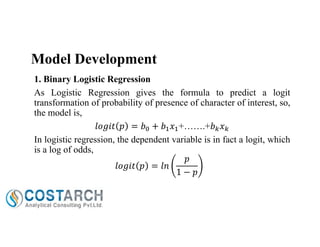
1. Binary Logistic Regression
As Logistic Regression gives the formula to predict a logit
transformation of probability of presence of character of interest, so,
the model is,
+…….+
In logistic regression, the dependent variable is in fact a logit, which
is a log of odds,
1
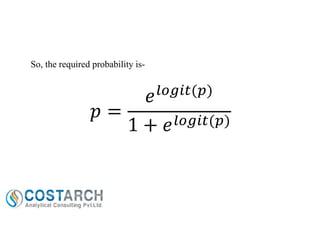
So, the required probability is-
2. Multinomial Logistic Regression
Multinomial logit regression is used when the dependent variable in
question is nominal and for which there are more than two
categories.
Two additional assumptions:1. The multinomial logit model assumes that data are case
specific, that is, each independent variable has a single value for
each case.
2. There is no need for the independent variables to be
statistically independent from each other.
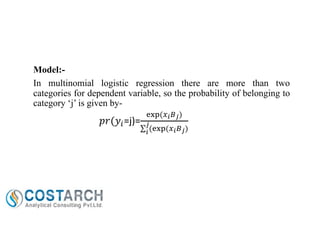
Model:In multinomial logistic regression there are more than two
categories for dependent variable, so the probability of belonging to
category ‘j’ is given by-

=j)=

	
∑
Example
Description:- Entering high school students make program choices
among general program, vocational program and academic
program. Their choice might be modeled using their writing score
and their social economic status.
Description of the data:- The data set contains variables on 200
students. The outcome variable is prog, program type. The predictor
variables are social economic status, ses, a three-level categorical
variable and writing score, write, a continuous variable.
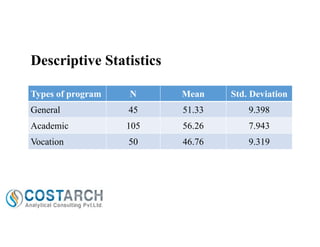
Descriptive Statistics
Types of program

N

Mean

Std. Deviation

General

45

51.33

9.398

Academic

105

56.26

7.943

Vocation

50

46.76

9.319
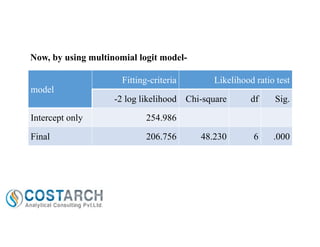
Now, by using multinomial logit modelFitting-criteria

Likelihood ratio test

model
-2 log likelihood Chi-square
Intercept only

206.756

Sig.

6

.000

254.986

Final

df

48.230
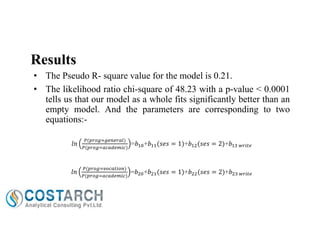
Results
• The Pseudo R- square value for the model is 0.21.
• The likelihood ratio chi-square of 48.23 with a p-value < 0.0001
tells us that our model as a whole fits significantly better than an
empty model. And the parameters are corresponding to two
equations:=

+

1 +

2 +


=

+

1 +

2 +
Parameters
Prog. type

Wald

df

Sig.

Intercept 

1.689

1.896

1

.169

Write 

‐.058

7.320

1

.007

.944

[ses=1]

1.163

5.114

1

.024

3.199

[ses=2]

.630

1.833

1

.176

1.877

[ses=3]

General

B

Exp(B)

0

0

Intercept 

12.361

1

.000

Write 

‐.114

26.139

1

.000

.893

[ses=1]
Vocation 

4.236
.983

2.722

1

.099

2.672

[ses=2]

1.274

6.214

1

.013

3.575

[ses=3]

0

0
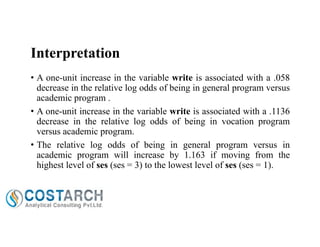
Interpretation
• A one-unit increase in the variable write is associated with a .058
decrease in the relative log odds of being in general program versus
academic program .
• A one-unit increase in the variable write is associated with a .1136
decrease in the relative log odds of being in vocation program
versus academic program.
• The relative log odds of being in general program versus in
academic program will increase by 1.163 if moving from the
highest level of ses (ses = 3) to the lowest level of ses (ses = 1).
References
1. http://www.schatz.sju.edu/multivar/guide/Logistic.pdf
2. http://www.ats.ucla.edu/stat/spss/dae/mlogit.htm

Logistic Regression Analysis

  • 1.
    Logistic Regression Analysis -By PIE TUTORS …yourstatistical partner… www.pietutors.com
  • 2.
    OUTLINE • Introduction • Assumptions •Model development • Example • References
  • 3.
    Introduction • Logistic Regressionis a statistical method for analyzing a dataset in which there are one or more independent variables that determine an outcome. The outcome is measured with a dichotomous variable, where there are only two possible outcomes. • The goal of logistic regression is to find the best fitting model to describe the relationship between the dichotomous characteristic of interest, and a set of independent variables. • Logistic Regression generates the coefficients of a formula to predict a Logit Transformation of the probability of presence of the characteristic of interest.
  • 4.
    Assumptions • Assumes alinear relationship between the logit of the IVs and DVs. • Absence of multi-collinearity. • Normal distribution is not assumed for the dependent variable as well as for errors. • Larger samples are needed than for linear regression. • The dependent variable must be a dichotomy (2 categories). • The independent variables need not be interval, nor normally distributed, nor of equal variance within each group.
  • 5.
    Model Development 1. BinaryLogistic Regression As Logistic Regression gives the formula to predict a logit transformation of probability of presence of character of interest, so, the model is, +…….+ In logistic regression, the dependent variable is in fact a logit, which is a log of odds, 1
  • 6.
    So, the requiredprobability is-
  • 7.
    2. Multinomial LogisticRegression Multinomial logit regression is used when the dependent variable in question is nominal and for which there are more than two categories. Two additional assumptions:1. The multinomial logit model assumes that data are case specific, that is, each independent variable has a single value for each case. 2. There is no need for the independent variables to be statistically independent from each other.
  • 8.
    Model:In multinomial logisticregression there are more than two categories for dependent variable, so the probability of belonging to category ‘j’ is given by- =j)= ∑
  • 9.
    Example Description:- Entering highschool students make program choices among general program, vocational program and academic program. Their choice might be modeled using their writing score and their social economic status. Description of the data:- The data set contains variables on 200 students. The outcome variable is prog, program type. The predictor variables are social economic status, ses, a three-level categorical variable and writing score, write, a continuous variable.
  • 10.
    Descriptive Statistics Types ofprogram N Mean Std. Deviation General 45 51.33 9.398 Academic 105 56.26 7.943 Vocation 50 46.76 9.319
  • 11.
    Now, by usingmultinomial logit modelFitting-criteria Likelihood ratio test model -2 log likelihood Chi-square Intercept only 206.756 Sig. 6 .000 254.986 Final df 48.230
  • 12.
    Results • The PseudoR- square value for the model is 0.21. • The likelihood ratio chi-square of 48.23 with a p-value < 0.0001 tells us that our model as a whole fits significantly better than an empty model. And the parameters are corresponding to two equations:= + 1 + 2 + = + 1 + 2 +
  • 13.
  • 14.
    Interpretation • A one-unitincrease in the variable write is associated with a .058 decrease in the relative log odds of being in general program versus academic program . • A one-unit increase in the variable write is associated with a .1136 decrease in the relative log odds of being in vocation program versus academic program. • The relative log odds of being in general program versus in academic program will increase by 1.163 if moving from the highest level of ses (ses = 3) to the lowest level of ses (ses = 1).
  • 15.