Lizards
By Mr. “3 note days left” Chapman
Lizards make up the largest group of reptiles (60% of reptiles).
They occur on all continents except Antarctica.
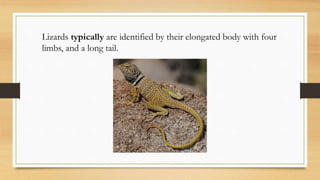
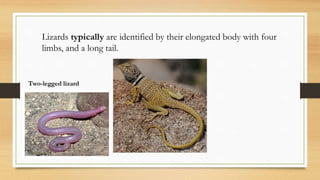
Lizards typically are identified by their elongated body with four
limbs, and a long tail.
Lizards typically are identified by their elongated body with four
limbs, and a long tail.
Two-legged lizard
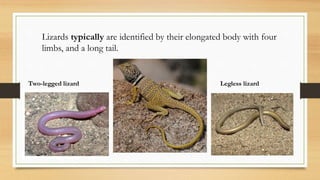
Lizards typically are identified by their elongated body with four
limbs, and a long tail.
Two-legged lizard Legless lizard
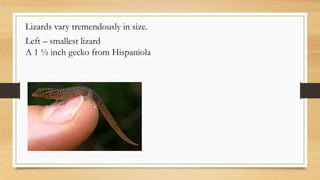
Lizards vary tremendously in size.
Left – smallest lizard
A 1 ½ inch gecko from Hispaniola
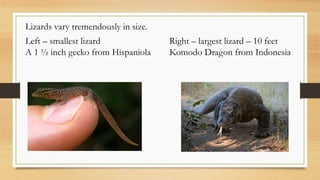
Lizards vary tremendously in size.
Left – smallest lizard Right – largest lizard – 10 feet
A 1 ½ inch gecko from Hispaniola Komodo Dragon from Indonesia
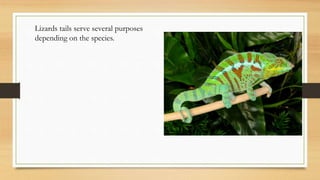
Lizards tails serve several purposes
depending on the species.
Lizards tails serve several purposes
depending on the species.
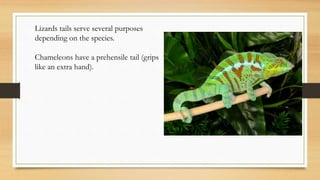
Chameleons have a prehensile tail (grips
like an extra hand).
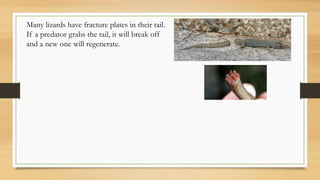
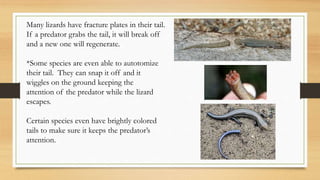
Many lizards have fracture plates in their tail.
If a predator grabs the tail, it will break off
and a new one will regenerate.
Many lizards have fracture plates in their tail.
If a predator grabs the tail, it will break off
and a new one will regenerate.
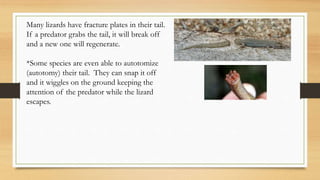
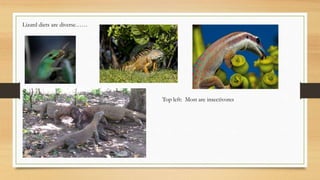
*Some species are even able to autotomize
(autotomy) their tail. They can snap it off
and it wiggles on the ground keeping the
attention of the predator while the lizard
escapes.
Many lizards have fracture plates in their tail.
If a predator grabs the tail, it will break off
and a new one will regenerate.
*Some species are even able to autotomize
their tail. They can snap it off and it
wiggles on the ground keeping the
attention of the predator while the lizard
escapes.
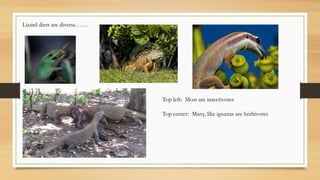
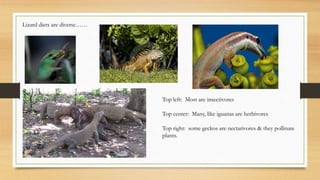
Certain species even have brightly colored
tails to make sure it keeps the predator’s
attention.
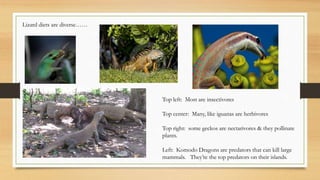
Lizard diets are diverse……
Top left: Most are insectivores
Lizard diets are diverse……
Top left: Most are insectivores
Top center: Many, like iguanas are herbivores
Lizard diets are diverse……
Top left: Most are insectivores
Top center: Many, like iguanas are herbivores
Top right: some geckos are nectarivores & they pollinate
plants.
Lizard diets are diverse……
Top left: Most are insectivores
Top center: Many, like iguanas are herbivores
Top right: some geckos are nectarivores & they pollinate
plants.
Left: Komodo Dragons are predators that can kill large
mammals. They’re the top predators on their islands.
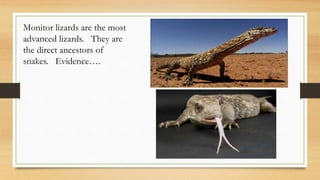
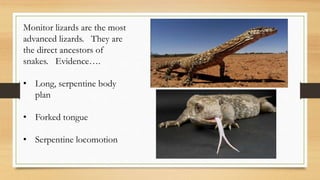
Monitor lizards are the most
advanced lizards. They are
the direct ancestors of
snakes. Evidence….
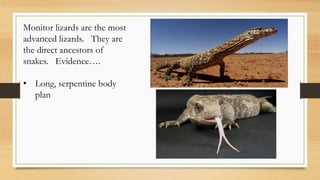
Monitor lizards are the most
advanced lizards. They are
the direct ancestors of
snakes. Evidence….
• Long, serpentine body
plan
Monitor lizards are the most
advanced lizards. They are
the direct ancestors of
snakes. Evidence….
• Long, serpentine body
plan
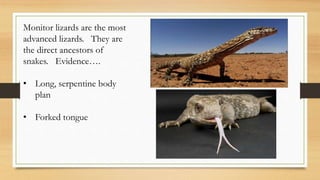
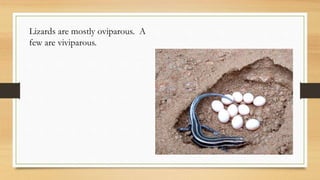
• Forked tongue
Monitor lizards are the most
advanced lizards. They are
the direct ancestors of
snakes. Evidence….
• Long, serpentine body
plan
• Forked tongue
• Serpentine locomotion
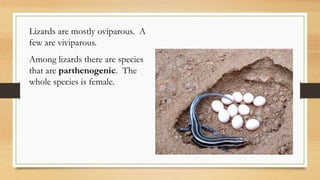
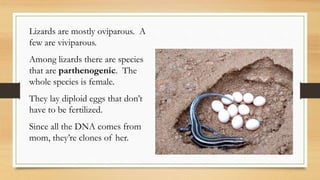
Lizards are mostly oviparous. A
few are viviparous.
Lizards are mostly oviparous. A
few are viviparous.
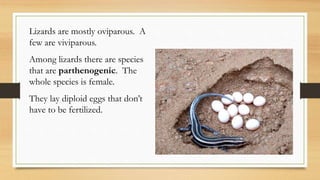
Among lizards there are species
that are parthenogenic. The
whole species is female.
Lizards are mostly oviparous. A
few are viviparous.
Among lizards there are species
that are parthenogenic. The
whole species is female.
They lay diploid eggs that don’t
have to be fertilized.
Lizards are mostly oviparous. A
few are viviparous.
Among lizards there are species
that are parthenogenic. The
whole species is female.
They lay diploid eggs that don’t
have to be fertilized.
Since all the DNA comes from
mom, they’re clones of her.
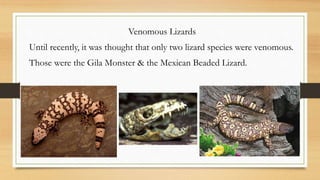
Venomous Lizards
Until recently, it was thought that only two lizard species were venomous.
Those were the Gila Monster & the Mexican Beaded Lizard.
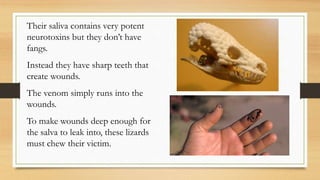
Their saliva contains very potent
neurotoxins but they don’t have
fangs.
Instead they have sharp teeth that
create wounds.
The venom simply runs into the
wounds.
To make wounds deep enough for
the salva to leak into, these lizards
must chew their victim.
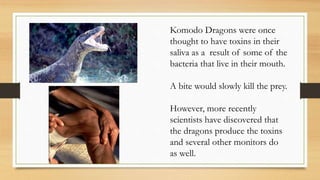
Komodo Dragons were once
thought to have toxins in their
saliva as a result of some of the
bacteria that live in their mouth.
A bite would slowly kill the prey.
However, more recently
scientists have discovered that
the dragons produce the toxins
and several other monitors do
as well.
Some of the proteins found in Gila Monster venom are showing
promise as a treatment for Type II diabetes and certain cancers.
Komodo Dragons bite each other when they fight but the bites never
get infected despite the presence of over 50 species of bacteria in their
saliva.
Some of the proteins in their saliva are proving to be valuable as
sources of antibiotics.

Lizard Notes

  • 1.
    Lizards By Mr. “3note days left” Chapman
  • 2.
    Lizards make upthe largest group of reptiles (60% of reptiles). They occur on all continents except Antarctica.
  • 3.
    Lizards typically areidentified by their elongated body with four limbs, and a long tail.
  • 4.
    Lizards typically areidentified by their elongated body with four limbs, and a long tail. Two-legged lizard
  • 5.
    Lizards typically areidentified by their elongated body with four limbs, and a long tail. Two-legged lizard Legless lizard
  • 6.
    Lizards vary tremendouslyin size. Left – smallest lizard A 1 ½ inch gecko from Hispaniola
  • 7.
    Lizards vary tremendouslyin size. Left – smallest lizard Right – largest lizard – 10 feet A 1 ½ inch gecko from Hispaniola Komodo Dragon from Indonesia
  • 8.
    Lizards tails serveseveral purposes depending on the species.
  • 9.
    Lizards tails serveseveral purposes depending on the species. Chameleons have a prehensile tail (grips like an extra hand).
  • 10.
    Many lizards havefracture plates in their tail. If a predator grabs the tail, it will break off and a new one will regenerate.
  • 11.
    Many lizards havefracture plates in their tail. If a predator grabs the tail, it will break off and a new one will regenerate. *Some species are even able to autotomize (autotomy) their tail. They can snap it off and it wiggles on the ground keeping the attention of the predator while the lizard escapes.
  • 12.
    Many lizards havefracture plates in their tail. If a predator grabs the tail, it will break off and a new one will regenerate. *Some species are even able to autotomize their tail. They can snap it off and it wiggles on the ground keeping the attention of the predator while the lizard escapes. Certain species even have brightly colored tails to make sure it keeps the predator’s attention.
  • 13.
    Lizard diets arediverse…… Top left: Most are insectivores
  • 14.
    Lizard diets arediverse…… Top left: Most are insectivores Top center: Many, like iguanas are herbivores
  • 15.
    Lizard diets arediverse…… Top left: Most are insectivores Top center: Many, like iguanas are herbivores Top right: some geckos are nectarivores & they pollinate plants.
  • 16.
    Lizard diets arediverse…… Top left: Most are insectivores Top center: Many, like iguanas are herbivores Top right: some geckos are nectarivores & they pollinate plants. Left: Komodo Dragons are predators that can kill large mammals. They’re the top predators on their islands.
  • 17.
    Monitor lizards arethe most advanced lizards. They are the direct ancestors of snakes. Evidence….
  • 18.
    Monitor lizards arethe most advanced lizards. They are the direct ancestors of snakes. Evidence…. • Long, serpentine body plan
  • 19.
    Monitor lizards arethe most advanced lizards. They are the direct ancestors of snakes. Evidence…. • Long, serpentine body plan • Forked tongue
  • 20.
    Monitor lizards arethe most advanced lizards. They are the direct ancestors of snakes. Evidence…. • Long, serpentine body plan • Forked tongue • Serpentine locomotion
  • 21.
    Lizards are mostlyoviparous. A few are viviparous.
  • 22.
    Lizards are mostlyoviparous. A few are viviparous. Among lizards there are species that are parthenogenic. The whole species is female.
  • 23.
    Lizards are mostlyoviparous. A few are viviparous. Among lizards there are species that are parthenogenic. The whole species is female. They lay diploid eggs that don’t have to be fertilized.
  • 24.
    Lizards are mostlyoviparous. A few are viviparous. Among lizards there are species that are parthenogenic. The whole species is female. They lay diploid eggs that don’t have to be fertilized. Since all the DNA comes from mom, they’re clones of her.
  • 25.
    Venomous Lizards Until recently,it was thought that only two lizard species were venomous. Those were the Gila Monster & the Mexican Beaded Lizard.
  • 26.
    Their saliva containsvery potent neurotoxins but they don’t have fangs. Instead they have sharp teeth that create wounds. The venom simply runs into the wounds. To make wounds deep enough for the salva to leak into, these lizards must chew their victim.
  • 27.
    Komodo Dragons wereonce thought to have toxins in their saliva as a result of some of the bacteria that live in their mouth. A bite would slowly kill the prey. However, more recently scientists have discovered that the dragons produce the toxins and several other monitors do as well.
  • 28.
    Some of theproteins found in Gila Monster venom are showing promise as a treatment for Type II diabetes and certain cancers. Komodo Dragons bite each other when they fight but the bites never get infected despite the presence of over 50 species of bacteria in their saliva. Some of the proteins in their saliva are proving to be valuable as sources of antibiotics.