Reptiles The most magnificent animals… By Goran Georgiev & Dimitar Drumev 10/3
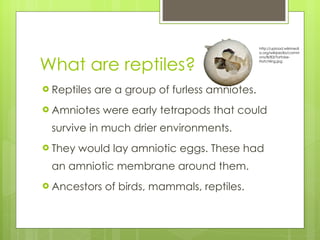
What are reptiles? Reptiles are a group of furless amniotes. Amniotes were early tetrapods that could survive in much drier environments. They would lay amniotic eggs. These had an amniotic membrane around them. Ancestors of birds, mammals, reptiles. http://upload.wikimedia.org/wikipedia/commons/8/83/Tortoise-Hatchling.jpg
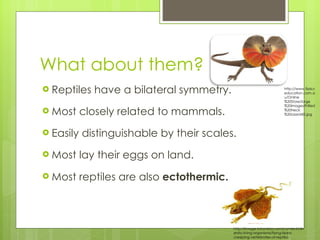
What about them? Reptiles have a bilateral symmetry. Most closely related to mammals. Easily distinguishable by their scales. Most lay their eggs on land. Most reptiles are also  ectothermic. http://www.fizzicseducation.com.au/Online%20Store/large%20images/Frilled%20Neck%20Lizard4D.jpg http://image.tutorvista.com/content/diversity-living-organisms/flying-lizard-creeping-vertebrates-of-reptilia-class.jpeg
Clades There are a lot of extinct reptiles. Generally divided into these 4 orders: Crocodilia  (alligators and crocodiles) - 23 species  Sphenodontia  (tuatar as  from New Zealand)  -  2 species Squamata  ( lizards , snakes, and worm lizards)  ~  7,900 species Testudines  (turtles and tortoises)  ~  300 species
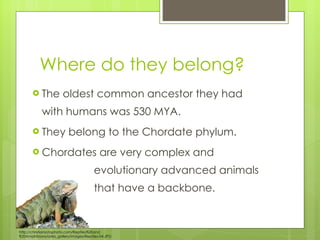
Where do they belong? The oldest common ancestor they had with humans was 530 MYA. They belong to the Chordate phylum. Chordates are very complex and    evolutionary advanced animals  that have a backbone.  http://christiansotophoto.com/Reptiles%20and%20Amphibians/arles_gallery/images/Reptiles-04.JPG
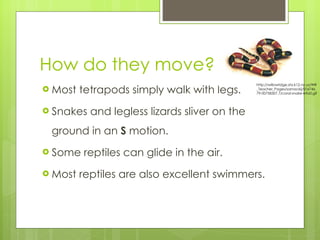
How do they move? Most tetrapods simply walk with legs. Snakes and legless lizards sliver on the ground in an  S  motion.  Some reptiles can glide in the air. Most reptiles are also excellent swimmers. http://willowridge.shs.k12.ny.us/WR_Teacher_Pages/sarnackij/01674679-00758307.7/coral-snake-info0.gif
What about reproduction? Fertilization is internal and then the eggs are laid (or  oviposition ) Some are  viviparous   – they bare live young. Others lay eggs inside themselves, the eggs hatch and then the female gives birth ( gravid ).
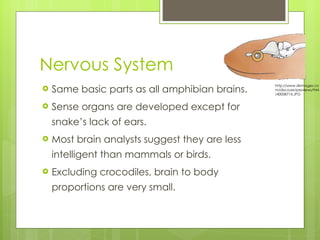
Nervous System Same basic parts as all amphibian brains. Sense organs are developed except for snake’s lack of ears. Most brain analysts suggest they are less intelligent than mammals or birds. Excluding crocodiles, brain to body proportions are very small. http://www.dkimages.com/discover/previews/944/40008714.JPG
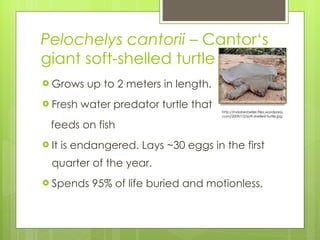
Pelochelys cantorii  – Cantor‘s giant soft-shelled turtle Grows up to 2 meters in length. Fresh water predator turtle that  feeds on fish  It is endangered. Lays ~30 eggs in the first quarter of the year.  Spends 95% of life buried and motionless. http://indobestseller.files.wordpress.com/2009/10/soft-shelled-turtle.jpg
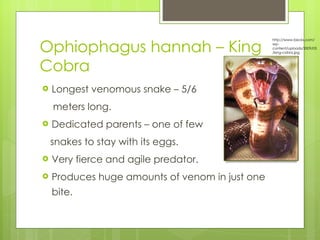
Ophiophagus hannah – King Cobra Longest venomous snake – 5/6 meters long. Dedicated parents – one of few snakes to stay with its eggs. Very fierce and agile predator. Produces huge amounts of venom in just one bite.  http://www.becks.com/wp-content/uploads/2009/05/king-cobra.jpg
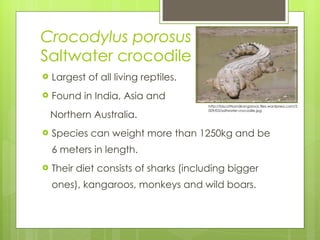
Crocodylus porosus   S altwater crocodile Largest of all living reptiles. Found in India, Asia and  Northern Australia. Species can weight more than 1250kg and be 6 meters in length.  Their diet consists of sharks (including bigger ones), kangaroos, monkeys and wild boars.  http://biscottisandkangaroos.files.wordpress.com/2009/03/saltwater-crocodile.jpg
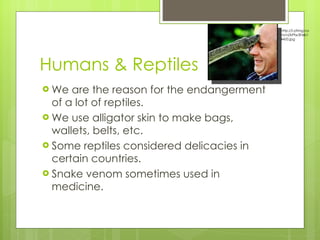
Humans & Reptiles We are the reason for the endangerment of a lot of reptiles. We use alligator skin to make bags, wallets, belts, etc. Some reptiles considered delicacies in certain countries.  Snake venom sometimes used in medicine. http://i.ytimg.com/vi/kPfw3Feb144/0.jpg
Trivia What does the Bulgarian word  рептили ( reptili) mean?  Which statement about snakes is NOT true? A.  Snakes never stop growing. B.  You can tell the age of a rattlesnake by the number of its rattles. C.  Snakes are found on all continents except Antarctica. D.  There are approximately 2700 species of snakes in the world.

Reptiles 10 3 goran drumev

  • 1.
    Reptiles The mostmagnificent animals… By Goran Georgiev & Dimitar Drumev 10/3
  • 2.
    What are reptiles?Reptiles are a group of furless amniotes. Amniotes were early tetrapods that could survive in much drier environments. They would lay amniotic eggs. These had an amniotic membrane around them. Ancestors of birds, mammals, reptiles. http://upload.wikimedia.org/wikipedia/commons/8/83/Tortoise-Hatchling.jpg
  • 3.
    What about them?Reptiles have a bilateral symmetry. Most closely related to mammals. Easily distinguishable by their scales. Most lay their eggs on land. Most reptiles are also ectothermic. http://www.fizzicseducation.com.au/Online%20Store/large%20images/Frilled%20Neck%20Lizard4D.jpg http://image.tutorvista.com/content/diversity-living-organisms/flying-lizard-creeping-vertebrates-of-reptilia-class.jpeg
  • 4.
    Clades There area lot of extinct reptiles. Generally divided into these 4 orders: Crocodilia (alligators and crocodiles) - 23 species Sphenodontia (tuatar as from New Zealand) - 2 species Squamata ( lizards , snakes, and worm lizards) ~ 7,900 species Testudines (turtles and tortoises) ~ 300 species
  • 5.
    Where do theybelong? The oldest common ancestor they had with humans was 530 MYA. They belong to the Chordate phylum. Chordates are very complex and evolutionary advanced animals that have a backbone. http://christiansotophoto.com/Reptiles%20and%20Amphibians/arles_gallery/images/Reptiles-04.JPG
  • 6.
    How do theymove? Most tetrapods simply walk with legs. Snakes and legless lizards sliver on the ground in an S motion. Some reptiles can glide in the air. Most reptiles are also excellent swimmers. http://willowridge.shs.k12.ny.us/WR_Teacher_Pages/sarnackij/01674679-00758307.7/coral-snake-info0.gif
  • 7.
    What about reproduction?Fertilization is internal and then the eggs are laid (or oviposition ) Some are viviparous – they bare live young. Others lay eggs inside themselves, the eggs hatch and then the female gives birth ( gravid ).
  • 8.
    Nervous System Samebasic parts as all amphibian brains. Sense organs are developed except for snake’s lack of ears. Most brain analysts suggest they are less intelligent than mammals or birds. Excluding crocodiles, brain to body proportions are very small. http://www.dkimages.com/discover/previews/944/40008714.JPG
  • 9.
    Pelochelys cantorii – Cantor‘s giant soft-shelled turtle Grows up to 2 meters in length. Fresh water predator turtle that feeds on fish It is endangered. Lays ~30 eggs in the first quarter of the year. Spends 95% of life buried and motionless. http://indobestseller.files.wordpress.com/2009/10/soft-shelled-turtle.jpg
  • 10.
    Ophiophagus hannah –King Cobra Longest venomous snake – 5/6 meters long. Dedicated parents – one of few snakes to stay with its eggs. Very fierce and agile predator. Produces huge amounts of venom in just one bite. http://www.becks.com/wp-content/uploads/2009/05/king-cobra.jpg
  • 11.
    Crocodylus porosus S altwater crocodile Largest of all living reptiles. Found in India, Asia and Northern Australia. Species can weight more than 1250kg and be 6 meters in length. Their diet consists of sharks (including bigger ones), kangaroos, monkeys and wild boars. http://biscottisandkangaroos.files.wordpress.com/2009/03/saltwater-crocodile.jpg
  • 12.
    Humans & ReptilesWe are the reason for the endangerment of a lot of reptiles. We use alligator skin to make bags, wallets, belts, etc. Some reptiles considered delicacies in certain countries. Snake venom sometimes used in medicine. http://i.ytimg.com/vi/kPfw3Feb144/0.jpg
  • 13.
    Trivia What doesthe Bulgarian word рептили ( reptili) mean? Which statement about snakes is NOT true? A.  Snakes never stop growing. B.  You can tell the age of a rattlesnake by the number of its rattles. C.  Snakes are found on all continents except Antarctica. D.  There are approximately 2700 species of snakes in the world.