Order: Squamata
By Mr. “Go Bearcats” Chapman
Lizards
 Who came first lizards or snakes?

 Snakes evolved from lizards.

 It is believed that 95% of living reptiles are
  descendants of early lizards.

 There are about 4,300 species of lizards.
Lizards
 Thigmothermy – is
  the transfer of heat by
  contact with a warm
  surface.

 Most reptiles can
  handle a body
  temperature up to 107
  degrees.
Lizards
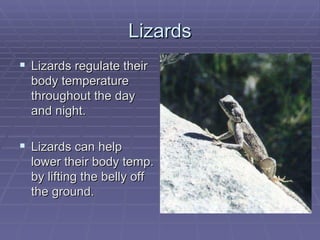
 Lizards regulate their
  body temperature
  throughout the day
  and night.

 Lizards can help
  lower their body temp.
  by lifting the belly off
  the ground.
Lizards
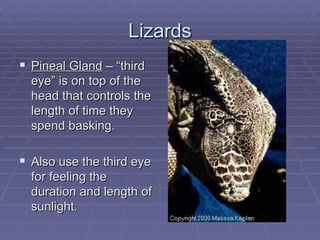
 Pineal Gland – “third
  eye” is on top of the
  head that controls the
  length of time they
  spend basking.

 Also use the third eye
  for feeling the
  duration and length of
  sunlight.
Lizard Legs
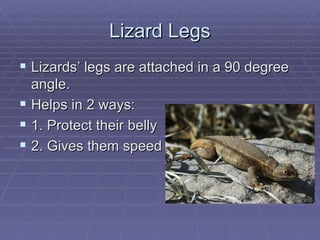
 Lizards’ legs are attached in a 90 degree
  angle.
 Helps in 2 ways:
 1. Protect their belly
 2. Gives them speed
Lizards
 Tails for lizards serve two purposes:
 1. They store fat for the lizard
 2. Their tails can fall off when being
 attacked as a defense mechanism.
Lizards
 There are only 2
  venomous species of
  lizards:

 1. Gila Monster

 2. Beaded Dragon
Lizards Diet
 Lizards eat a variety of food from fruits
  and vegetables to large mammals.

 Iguana’s and Mali Uromastyx are
  herbivores.
Lizards Diet
 Lizards eat a variety of food from fruits
  and vegetables to large mammals.
 Iguana’s and Mali Uromastyx are
  herbivores.
 The majority of lizards are carnivores, and
  eat insects called Insectivores.
 Some like Chameleons' use a long sticky
  tongue to grab insects.
Lizards
 The largest specie is
  the Komodo Dragon.

 Komodo Dragon kills
  its prey with its saliva.

 The dragons saliva is
  filled with bacteria
  that infects the prey
  after being bit.

Lizards notes

  • 1.
    Order: Squamata By Mr.“Go Bearcats” Chapman
  • 2.
    Lizards  Who camefirst lizards or snakes?  Snakes evolved from lizards.  It is believed that 95% of living reptiles are descendants of early lizards.  There are about 4,300 species of lizards.
  • 3.
    Lizards  Thigmothermy –is the transfer of heat by contact with a warm surface.  Most reptiles can handle a body temperature up to 107 degrees.
  • 4.
    Lizards  Lizards regulatetheir body temperature throughout the day and night.  Lizards can help lower their body temp. by lifting the belly off the ground.
  • 6.
    Lizards  Pineal Gland– “third eye” is on top of the head that controls the length of time they spend basking.  Also use the third eye for feeling the duration and length of sunlight.
  • 7.
    Lizard Legs  Lizards’legs are attached in a 90 degree angle.  Helps in 2 ways:  1. Protect their belly  2. Gives them speed
  • 9.
    Lizards  Tails forlizards serve two purposes:  1. They store fat for the lizard  2. Their tails can fall off when being attacked as a defense mechanism.
  • 11.
    Lizards  There areonly 2 venomous species of lizards:  1. Gila Monster  2. Beaded Dragon
  • 12.
    Lizards Diet  Lizardseat a variety of food from fruits and vegetables to large mammals.  Iguana’s and Mali Uromastyx are herbivores.
  • 14.
    Lizards Diet  Lizardseat a variety of food from fruits and vegetables to large mammals.  Iguana’s and Mali Uromastyx are herbivores.  The majority of lizards are carnivores, and eat insects called Insectivores.  Some like Chameleons' use a long sticky tongue to grab insects.
  • 16.
    Lizards  The largestspecie is the Komodo Dragon.  Komodo Dragon kills its prey with its saliva.  The dragons saliva is filled with bacteria that infects the prey after being bit.