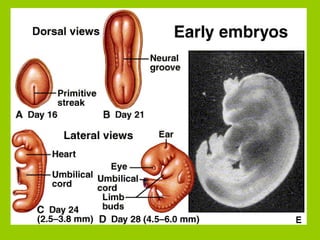
The most recently evolved animalThe most recently evolved animal
phylum is called Chordata.phylum is called Chordata.
Chordates are characterized by …Chordates are characterized by …
1.1. A dorsal, hollow nerve chord.A dorsal, hollow nerve chord.
Chordates are characterized by …Chordates are characterized by …
1.1. A dorsal, hollow nerve chord.A dorsal, hollow nerve chord.
2.2. A dorsal notochord to support theA dorsal notochord to support the
body.body.
Chordates are characterized by …Chordates are characterized by …
1.1. A dorsal, hollow nerve chord.A dorsal, hollow nerve chord.
2.2. A dorsal notochord to support theA dorsal notochord to support the
body.body.
3.3. A post anal tail at some stage ofA post anal tail at some stage of
development.development.
Chordates are characterized by …Chordates are characterized by …
1.1. A dorsal, hollow nerve chord.A dorsal, hollow nerve chord.
2.2. A dorsal notochord to support theA dorsal notochord to support the
body.body.
3.3. A post anal tail at some stage ofA post anal tail at some stage of
development.development.
4.4. Seven pharyngeal clefts (gills) atSeven pharyngeal clefts (gills) at
some stage of development.some stage of development.
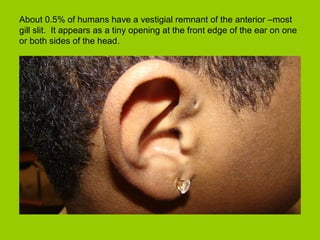
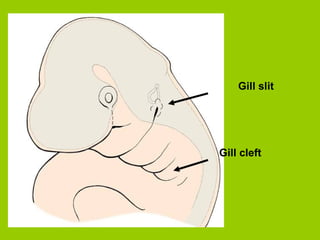
About 0.5% of humans have a vestigial remnant of the anterior –most
gill slit. It appears as a tiny opening at the front edge of the ear on one
or both sides of the head.
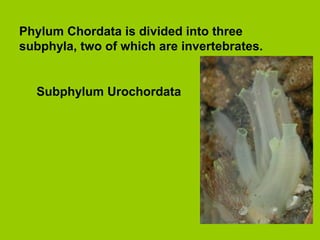
Phylum Chordata is divided into three
subphyla, two of which are invertebrates.
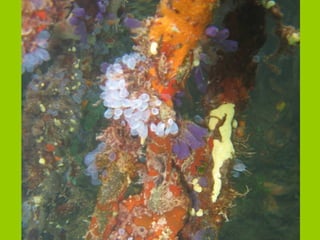
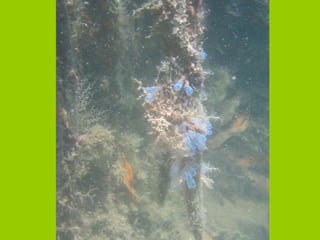
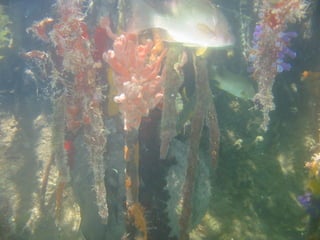
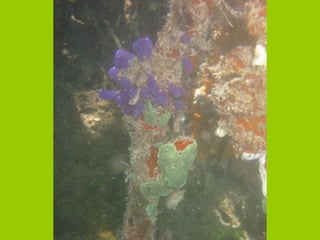
Subphylum Urochordata
Phylum Chordata is divided into three
subphyla, two of which are invertebrates.
Subphylum Urochordata
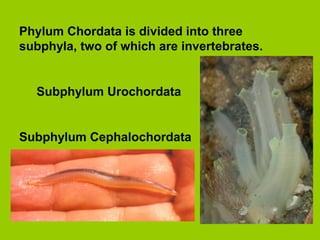
Phylum Chordata is divided into three
subphyla, two of which are invertebrates.
Subphylum Urochordata
Subphylum Cephalochordata
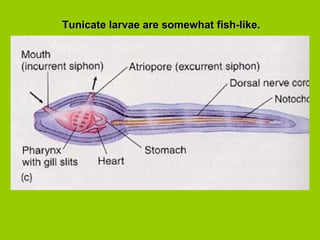
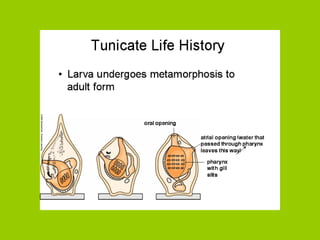
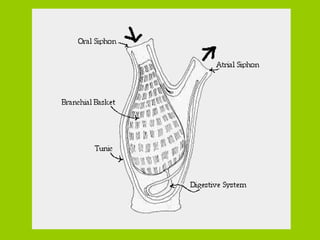
Tunicate larvae are somewhat fish-like.Tunicate larvae are somewhat fish-like.
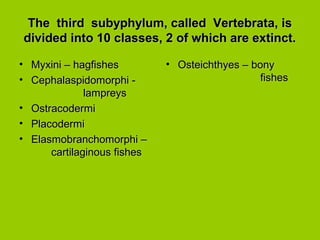
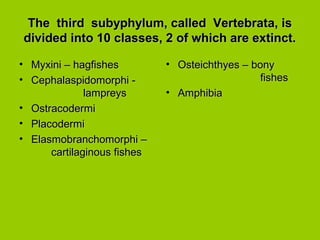
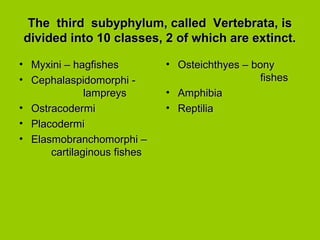
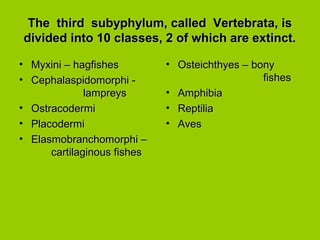
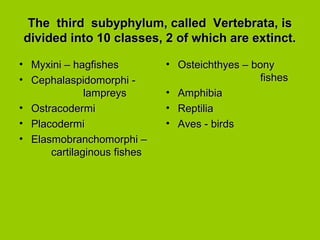
The third subyphylum, called Vertebrata, isThe third subyphylum, called Vertebrata, is
divided into 10 classes, 2 of which are extinct.divided into 10 classes, 2 of which are extinct.
The third subyphylum, called Vertebrata, isThe third subyphylum, called Vertebrata, is
divided into 10 classes, 2 of which are extinct.divided into 10 classes, 2 of which are extinct.
• Myxini – hagfishesMyxini – hagfishes
The third subyphylum, called Vertebrata, isThe third subyphylum, called Vertebrata, is
divided into 10 classes, 2 of which are extinct.divided into 10 classes, 2 of which are extinct.
• Myxini – hagfishesMyxini – hagfishes
• Cephalaspidomorphi -Cephalaspidomorphi -
lampreyslampreys
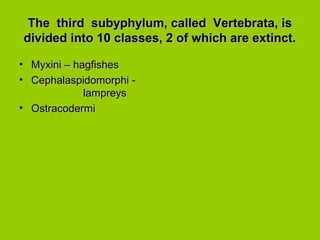
The third subyphylum, called Vertebrata, isThe third subyphylum, called Vertebrata, is
divided into 10 classes, 2 of which are extinct.divided into 10 classes, 2 of which are extinct.
• Myxini – hagfishesMyxini – hagfishes
• Cephalaspidomorphi -Cephalaspidomorphi -
lampreyslampreys
• OstracodermiOstracodermi
The third subyphylum, called Vertebrata, isThe third subyphylum, called Vertebrata, is
divided into 10 classes, 2 of which are extinct.divided into 10 classes, 2 of which are extinct.
• Myxini – hagfishesMyxini – hagfishes
• Cephalaspidomorphi -Cephalaspidomorphi -
lampreyslampreys
• OstracodermiOstracodermi
• PlacodermiPlacodermi
The third subyphylum, called Vertebrata, isThe third subyphylum, called Vertebrata, is
divided into 10 classes, 2 of which are extinct.divided into 10 classes, 2 of which are extinct.
• Myxini – hagfishesMyxini – hagfishes
• Cephalaspidomorphi -Cephalaspidomorphi -
lampreyslampreys
• OstracodermiOstracodermi
• PlacodermiPlacodermi
• Elasmobranchomorphi –Elasmobranchomorphi –
cartilaginous fishescartilaginous fishes
The third subyphylum, called Vertebrata, isThe third subyphylum, called Vertebrata, is
divided into 10 classes, 2 of which are extinct.divided into 10 classes, 2 of which are extinct.
• Myxini – hagfishesMyxini – hagfishes
• Cephalaspidomorphi -Cephalaspidomorphi -
lampreyslampreys
• OstracodermiOstracodermi
• PlacodermiPlacodermi
• Elasmobranchomorphi –Elasmobranchomorphi –
cartilaginous fishescartilaginous fishes
• Osteichthyes – bonyOsteichthyes – bony
fishesfishes
The third subyphylum, called Vertebrata, isThe third subyphylum, called Vertebrata, is
divided into 10 classes, 2 of which are extinct.divided into 10 classes, 2 of which are extinct.
• Myxini – hagfishesMyxini – hagfishes
• Cephalaspidomorphi -Cephalaspidomorphi -
lampreyslampreys
• OstracodermiOstracodermi
• PlacodermiPlacodermi
• Elasmobranchomorphi –Elasmobranchomorphi –
cartilaginous fishescartilaginous fishes
• Osteichthyes – bonyOsteichthyes – bony
fishesfishes
• AmphibiaAmphibia
The third subyphylum, called Vertebrata, isThe third subyphylum, called Vertebrata, is
divided into 10 classes, 2 of which are extinct.divided into 10 classes, 2 of which are extinct.
• Myxini – hagfishesMyxini – hagfishes
• Cephalaspidomorphi -Cephalaspidomorphi -
lampreyslampreys
• OstracodermiOstracodermi
• PlacodermiPlacodermi
• Elasmobranchomorphi –Elasmobranchomorphi –
cartilaginous fishescartilaginous fishes
• Osteichthyes – bonyOsteichthyes – bony
fishesfishes
• AmphibiaAmphibia
• ReptiliaReptilia
The third subyphylum, called Vertebrata, isThe third subyphylum, called Vertebrata, is
divided into 10 classes, 2 of which are extinct.divided into 10 classes, 2 of which are extinct.
• Myxini – hagfishesMyxini – hagfishes
• Cephalaspidomorphi -Cephalaspidomorphi -
lampreyslampreys
• OstracodermiOstracodermi
• PlacodermiPlacodermi
• Elasmobranchomorphi –Elasmobranchomorphi –
cartilaginous fishescartilaginous fishes
• Osteichthyes – bonyOsteichthyes – bony
fishesfishes
• AmphibiaAmphibia
• ReptiliaReptilia
• AvesAves
The third subyphylum, called Vertebrata, isThe third subyphylum, called Vertebrata, is
divided into 10 classes, 2 of which are extinct.divided into 10 classes, 2 of which are extinct.
• Myxini – hagfishesMyxini – hagfishes
• Cephalaspidomorphi -Cephalaspidomorphi -
lampreyslampreys
• OstracodermiOstracodermi
• PlacodermiPlacodermi
• Elasmobranchomorphi –Elasmobranchomorphi –
cartilaginous fishescartilaginous fishes
• Osteichthyes – bonyOsteichthyes – bony
fishesfishes
• AmphibiaAmphibia
• ReptiliaReptilia
• Aves - birdsAves - birds
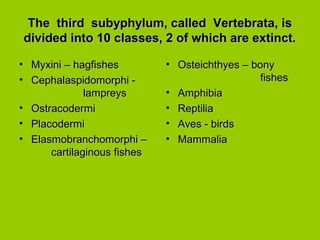
The third subyphylum, called Vertebrata, isThe third subyphylum, called Vertebrata, is
divided into 10 classes, 2 of which are extinct.divided into 10 classes, 2 of which are extinct.
• Myxini – hagfishesMyxini – hagfishes
• Cephalaspidomorphi -Cephalaspidomorphi -
lampreyslampreys
• OstracodermiOstracodermi
• PlacodermiPlacodermi
• Elasmobranchomorphi –Elasmobranchomorphi –
cartilaginous fishescartilaginous fishes
• Osteichthyes – bonyOsteichthyes – bony
fishesfishes
• AmphibiaAmphibia
• ReptiliaReptilia
• Aves - birdsAves - birds
• MammaliaMammalia
The third subyphylum, called Vertebrata, isThe third subyphylum, called Vertebrata, is
divided into 10 classes, 2 of which are extinct.divided into 10 classes, 2 of which are extinct.
• Myxini – hagfishesMyxini – hagfishes
• Cephalaspidomorphi -Cephalaspidomorphi -
lampreyslampreys
• OstracodermiOstracodermi
The third subyphylum, called Vertebrata, isThe third subyphylum, called Vertebrata, is
divided into 10 classes, 2 of which are extinct.divided into 10 classes, 2 of which are extinct.
• Myxini – hagfishesMyxini – hagfishes
• Cephalaspidomorphi -Cephalaspidomorphi -
lampreyslampreys
• OstracodermiOstracodermi
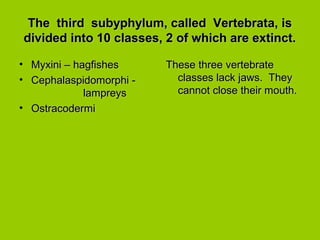
These three vertebrateThese three vertebrate
classes lack jaws. Theyclasses lack jaws. They
cannot close their mouth.cannot close their mouth.
The third subyphylum, called Vertebrata, isThe third subyphylum, called Vertebrata, is
divided into 10 classes, 2 of which are extinct.divided into 10 classes, 2 of which are extinct.
• Myxini – hagfishesMyxini – hagfishes
• Cephalaspidomorphi -Cephalaspidomorphi -
lampreyslampreys
• OstracodermiOstracodermi
These three vertebrateThese three vertebrate
classes lack jaws. Theyclasses lack jaws. They
cannot close their mouth.cannot close their mouth.
Such animals are calledSuch animals are called
AgnathansAgnathans..
The third subyphylum, called Vertebrata, isThe third subyphylum, called Vertebrata, is
divided into 10 classes, 2 of which are extinct.divided into 10 classes, 2 of which are extinct.
• Myxini – hagfishesMyxini – hagfishes
• Cephalaspidomorphi -Cephalaspidomorphi -
lampreyslampreys
• OstracodermiOstracodermi
These three vertebrateThese three vertebrate
classes lack jaws. Theyclasses lack jaws. They
cannot close their mouth.cannot close their mouth.
Such animals are calledSuch animals are called
AgnathansAgnathans..
A – withoutA – without
The third subyphylum, called Vertebrata, isThe third subyphylum, called Vertebrata, is
divided into 10 classes, 2 of which are extinct.divided into 10 classes, 2 of which are extinct.
• Myxini – hagfishesMyxini – hagfishes
• Cephalaspidomorphi -Cephalaspidomorphi -
lampreyslampreys
• OstracodermiOstracodermi
These three vertebrateThese three vertebrate
classes lack jaws. Theyclasses lack jaws. They
cannot close their mouth.cannot close their mouth.
Such animals are calledSuch animals are called
AgnathansAgnathans..
A – withoutA – without
gnath - jawgnath - jaw
The remaining seven classes (one of which is
extinct) have jaws.
The remaining seven classes (one of which is
extinct) have jaws. Vertebrates with jaws are
called gnathostomes.
The remaining seven classes (one of which is
extinct) have jaws. Vertebrates with jaws are
called gnathostomes.
Gnath – jaws
The remaining seven classes (one of which is
extinct) have jaws. Vertebrates with jaws are
called gnathostomes.
Gnath – jaws
Stome – hole (referring to the mouth)
The remaining seven classes (one of which is
extinct) have jaws. Vertebrates with jaws are
called gnathostomes.
Gnath – jaws
Stome – hole (referring to the mouth)
Literally a mouth with jaws.
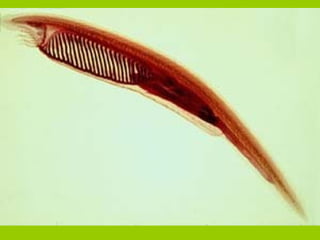
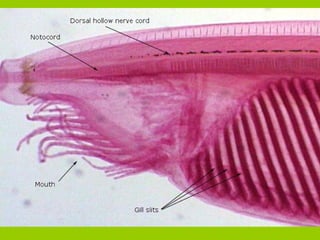
Gill slit
Gill cleft
If you think about this, it means thatIf you think about this, it means that
you are closely related to tunicatesyou are closely related to tunicates
and amphioxus as a spider is to anand amphioxus as a spider is to an
insect.insect.

Early Chordate introduction Notes

  • 1.
    The most recentlyevolved animalThe most recently evolved animal phylum is called Chordata.phylum is called Chordata.
  • 2.
    Chordates are characterizedby …Chordates are characterized by …
  • 3.
    Chordates are characterizedby …Chordates are characterized by … 1.1. A dorsal, hollow nerve chord.A dorsal, hollow nerve chord.
  • 4.
    Chordates are characterizedby …Chordates are characterized by … 1.1. A dorsal, hollow nerve chord.A dorsal, hollow nerve chord. 2.2. A dorsal notochord to support theA dorsal notochord to support the body.body.
  • 5.
    Chordates are characterizedby …Chordates are characterized by … 1.1. A dorsal, hollow nerve chord.A dorsal, hollow nerve chord. 2.2. A dorsal notochord to support theA dorsal notochord to support the body.body. 3.3. A post anal tail at some stage ofA post anal tail at some stage of development.development.
  • 6.
    Chordates are characterizedby …Chordates are characterized by … 1.1. A dorsal, hollow nerve chord.A dorsal, hollow nerve chord. 2.2. A dorsal notochord to support theA dorsal notochord to support the body.body. 3.3. A post anal tail at some stage ofA post anal tail at some stage of development.development. 4.4. Seven pharyngeal clefts (gills) atSeven pharyngeal clefts (gills) at some stage of development.some stage of development.
  • 7.
    About 0.5% ofhumans have a vestigial remnant of the anterior –most gill slit. It appears as a tiny opening at the front edge of the ear on one or both sides of the head.
  • 8.
    Phylum Chordata isdivided into three subphyla, two of which are invertebrates. Subphylum Urochordata
  • 9.
    Phylum Chordata isdivided into three subphyla, two of which are invertebrates. Subphylum Urochordata
  • 10.
    Phylum Chordata isdivided into three subphyla, two of which are invertebrates. Subphylum Urochordata Subphylum Cephalochordata
  • 11.
    Tunicate larvae aresomewhat fish-like.Tunicate larvae are somewhat fish-like.
  • 22.
    The third subyphylum,called Vertebrata, isThe third subyphylum, called Vertebrata, is divided into 10 classes, 2 of which are extinct.divided into 10 classes, 2 of which are extinct.
  • 23.
    The third subyphylum,called Vertebrata, isThe third subyphylum, called Vertebrata, is divided into 10 classes, 2 of which are extinct.divided into 10 classes, 2 of which are extinct. • Myxini – hagfishesMyxini – hagfishes
  • 24.
    The third subyphylum,called Vertebrata, isThe third subyphylum, called Vertebrata, is divided into 10 classes, 2 of which are extinct.divided into 10 classes, 2 of which are extinct. • Myxini – hagfishesMyxini – hagfishes • Cephalaspidomorphi -Cephalaspidomorphi - lampreyslampreys
  • 25.
    The third subyphylum,called Vertebrata, isThe third subyphylum, called Vertebrata, is divided into 10 classes, 2 of which are extinct.divided into 10 classes, 2 of which are extinct. • Myxini – hagfishesMyxini – hagfishes • Cephalaspidomorphi -Cephalaspidomorphi - lampreyslampreys • OstracodermiOstracodermi
  • 26.
    The third subyphylum,called Vertebrata, isThe third subyphylum, called Vertebrata, is divided into 10 classes, 2 of which are extinct.divided into 10 classes, 2 of which are extinct. • Myxini – hagfishesMyxini – hagfishes • Cephalaspidomorphi -Cephalaspidomorphi - lampreyslampreys • OstracodermiOstracodermi • PlacodermiPlacodermi
  • 27.
    The third subyphylum,called Vertebrata, isThe third subyphylum, called Vertebrata, is divided into 10 classes, 2 of which are extinct.divided into 10 classes, 2 of which are extinct. • Myxini – hagfishesMyxini – hagfishes • Cephalaspidomorphi -Cephalaspidomorphi - lampreyslampreys • OstracodermiOstracodermi • PlacodermiPlacodermi • Elasmobranchomorphi –Elasmobranchomorphi – cartilaginous fishescartilaginous fishes
  • 28.
    The third subyphylum,called Vertebrata, isThe third subyphylum, called Vertebrata, is divided into 10 classes, 2 of which are extinct.divided into 10 classes, 2 of which are extinct. • Myxini – hagfishesMyxini – hagfishes • Cephalaspidomorphi -Cephalaspidomorphi - lampreyslampreys • OstracodermiOstracodermi • PlacodermiPlacodermi • Elasmobranchomorphi –Elasmobranchomorphi – cartilaginous fishescartilaginous fishes • Osteichthyes – bonyOsteichthyes – bony fishesfishes
  • 29.
    The third subyphylum,called Vertebrata, isThe third subyphylum, called Vertebrata, is divided into 10 classes, 2 of which are extinct.divided into 10 classes, 2 of which are extinct. • Myxini – hagfishesMyxini – hagfishes • Cephalaspidomorphi -Cephalaspidomorphi - lampreyslampreys • OstracodermiOstracodermi • PlacodermiPlacodermi • Elasmobranchomorphi –Elasmobranchomorphi – cartilaginous fishescartilaginous fishes • Osteichthyes – bonyOsteichthyes – bony fishesfishes • AmphibiaAmphibia
  • 30.
    The third subyphylum,called Vertebrata, isThe third subyphylum, called Vertebrata, is divided into 10 classes, 2 of which are extinct.divided into 10 classes, 2 of which are extinct. • Myxini – hagfishesMyxini – hagfishes • Cephalaspidomorphi -Cephalaspidomorphi - lampreyslampreys • OstracodermiOstracodermi • PlacodermiPlacodermi • Elasmobranchomorphi –Elasmobranchomorphi – cartilaginous fishescartilaginous fishes • Osteichthyes – bonyOsteichthyes – bony fishesfishes • AmphibiaAmphibia • ReptiliaReptilia
  • 31.
    The third subyphylum,called Vertebrata, isThe third subyphylum, called Vertebrata, is divided into 10 classes, 2 of which are extinct.divided into 10 classes, 2 of which are extinct. • Myxini – hagfishesMyxini – hagfishes • Cephalaspidomorphi -Cephalaspidomorphi - lampreyslampreys • OstracodermiOstracodermi • PlacodermiPlacodermi • Elasmobranchomorphi –Elasmobranchomorphi – cartilaginous fishescartilaginous fishes • Osteichthyes – bonyOsteichthyes – bony fishesfishes • AmphibiaAmphibia • ReptiliaReptilia • AvesAves
  • 32.
    The third subyphylum,called Vertebrata, isThe third subyphylum, called Vertebrata, is divided into 10 classes, 2 of which are extinct.divided into 10 classes, 2 of which are extinct. • Myxini – hagfishesMyxini – hagfishes • Cephalaspidomorphi -Cephalaspidomorphi - lampreyslampreys • OstracodermiOstracodermi • PlacodermiPlacodermi • Elasmobranchomorphi –Elasmobranchomorphi – cartilaginous fishescartilaginous fishes • Osteichthyes – bonyOsteichthyes – bony fishesfishes • AmphibiaAmphibia • ReptiliaReptilia • Aves - birdsAves - birds
  • 33.
    The third subyphylum,called Vertebrata, isThe third subyphylum, called Vertebrata, is divided into 10 classes, 2 of which are extinct.divided into 10 classes, 2 of which are extinct. • Myxini – hagfishesMyxini – hagfishes • Cephalaspidomorphi -Cephalaspidomorphi - lampreyslampreys • OstracodermiOstracodermi • PlacodermiPlacodermi • Elasmobranchomorphi –Elasmobranchomorphi – cartilaginous fishescartilaginous fishes • Osteichthyes – bonyOsteichthyes – bony fishesfishes • AmphibiaAmphibia • ReptiliaReptilia • Aves - birdsAves - birds • MammaliaMammalia
  • 34.
    The third subyphylum,called Vertebrata, isThe third subyphylum, called Vertebrata, is divided into 10 classes, 2 of which are extinct.divided into 10 classes, 2 of which are extinct. • Myxini – hagfishesMyxini – hagfishes • Cephalaspidomorphi -Cephalaspidomorphi - lampreyslampreys • OstracodermiOstracodermi
  • 35.
    The third subyphylum,called Vertebrata, isThe third subyphylum, called Vertebrata, is divided into 10 classes, 2 of which are extinct.divided into 10 classes, 2 of which are extinct. • Myxini – hagfishesMyxini – hagfishes • Cephalaspidomorphi -Cephalaspidomorphi - lampreyslampreys • OstracodermiOstracodermi These three vertebrateThese three vertebrate classes lack jaws. Theyclasses lack jaws. They cannot close their mouth.cannot close their mouth.
  • 36.
    The third subyphylum,called Vertebrata, isThe third subyphylum, called Vertebrata, is divided into 10 classes, 2 of which are extinct.divided into 10 classes, 2 of which are extinct. • Myxini – hagfishesMyxini – hagfishes • Cephalaspidomorphi -Cephalaspidomorphi - lampreyslampreys • OstracodermiOstracodermi These three vertebrateThese three vertebrate classes lack jaws. Theyclasses lack jaws. They cannot close their mouth.cannot close their mouth. Such animals are calledSuch animals are called AgnathansAgnathans..
  • 37.
    The third subyphylum,called Vertebrata, isThe third subyphylum, called Vertebrata, is divided into 10 classes, 2 of which are extinct.divided into 10 classes, 2 of which are extinct. • Myxini – hagfishesMyxini – hagfishes • Cephalaspidomorphi -Cephalaspidomorphi - lampreyslampreys • OstracodermiOstracodermi These three vertebrateThese three vertebrate classes lack jaws. Theyclasses lack jaws. They cannot close their mouth.cannot close their mouth. Such animals are calledSuch animals are called AgnathansAgnathans.. A – withoutA – without
  • 38.
    The third subyphylum,called Vertebrata, isThe third subyphylum, called Vertebrata, is divided into 10 classes, 2 of which are extinct.divided into 10 classes, 2 of which are extinct. • Myxini – hagfishesMyxini – hagfishes • Cephalaspidomorphi -Cephalaspidomorphi - lampreyslampreys • OstracodermiOstracodermi These three vertebrateThese three vertebrate classes lack jaws. Theyclasses lack jaws. They cannot close their mouth.cannot close their mouth. Such animals are calledSuch animals are called AgnathansAgnathans.. A – withoutA – without gnath - jawgnath - jaw
  • 39.
    The remaining sevenclasses (one of which is extinct) have jaws.
  • 40.
    The remaining sevenclasses (one of which is extinct) have jaws. Vertebrates with jaws are called gnathostomes.
  • 41.
    The remaining sevenclasses (one of which is extinct) have jaws. Vertebrates with jaws are called gnathostomes. Gnath – jaws
  • 42.
    The remaining sevenclasses (one of which is extinct) have jaws. Vertebrates with jaws are called gnathostomes. Gnath – jaws Stome – hole (referring to the mouth)
  • 43.
    The remaining sevenclasses (one of which is extinct) have jaws. Vertebrates with jaws are called gnathostomes. Gnath – jaws Stome – hole (referring to the mouth) Literally a mouth with jaws.
  • 47.
  • 49.
    If you thinkabout this, it means thatIf you think about this, it means that you are closely related to tunicatesyou are closely related to tunicates and amphioxus as a spider is to anand amphioxus as a spider is to an insect.insect.