Early Fish Evolution
• Phylum Chordata
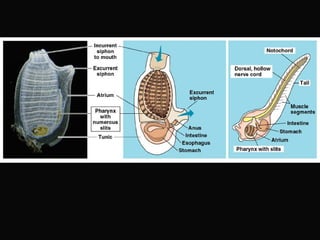
• Subphylum Urochordata
• Phylum Chordata
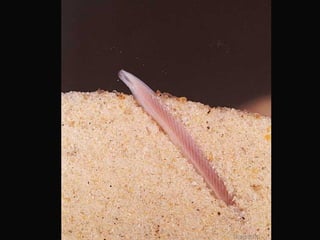
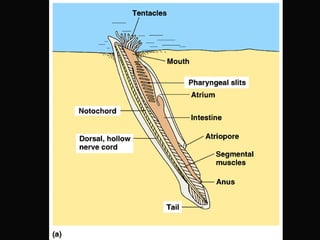
• Subphylum Cephalochordata
Fish History
• Phylum Chordata
• Subphylum Vertebrata
Jawless Fishes
Class: Myxini - Hagfishes
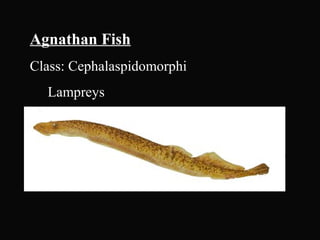
Class: Cephalaspidomorphi – Lampreys
Class: Ostracodermi – Ostracoderms,
jawless fishes with plate covered skin
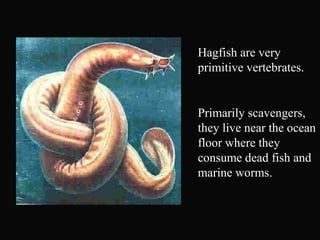
Hagfish are very
primitive vertebrates.
Primarily scavengers,
they live near the ocean
floor where they
consume dead fish and
marine worms.
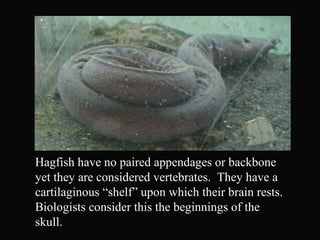
Hagfish have no paired appendages or backbone
yet they are considered vertebrates. They have a
cartilaginous “shelf” upon which their brain rests.
Biologists consider this the beginnings of the
skull.
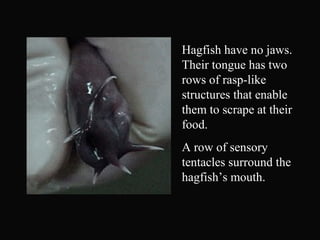
Hagfish have no jaws.
Their tongue has two
rows of rasp-like
structures that enable
them to scrape at their
food.
A row of sensory
tentacles surround the
hagfish’s mouth.
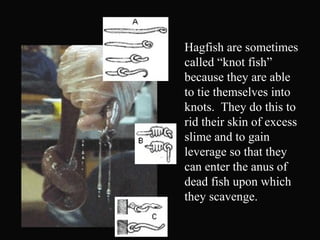
Hagfish are sometimes
called “knot fish”
because they are able
to tie themselves into
knots. They do this to
rid their skin of excess
slime and to gain
leverage so that they
can enter the anus of
dead fish upon which
they scavenge.
Agnathan Fish
Class: Cephalaspidomorphi
Lampreys
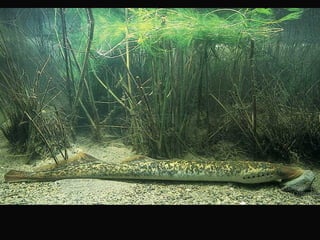
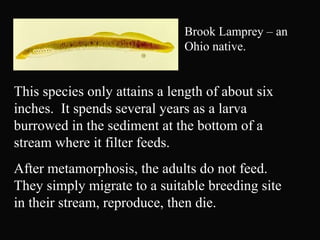
Brook Lamprey – an
Ohio native.
This species only attains a length of about six
inches. It spends several years as a larva
burrowed in the sediment at the bottom of a
stream where it filter feeds.
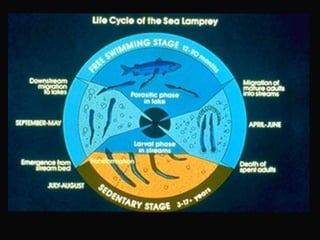
After metamorphosis, the adults do not feed.
They simply migrate to a suitable breeding site
in their stream, reproduce, then die.
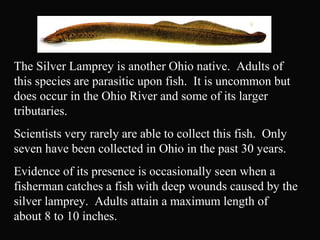
The Silver Lamprey is another Ohio native. Adults of
this species are parasitic upon fish. It is uncommon but
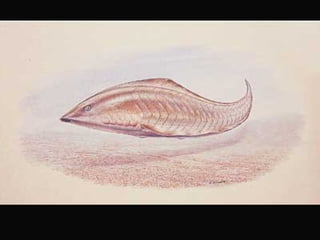
does occur in the Ohio River and some of its larger
tributaries.
Scientists very rarely are able to collect this fish. Only
seven have been collected in Ohio in the past 30 years.
Evidence of its presence is occasionally seen when a
fisherman catches a fish with deep wounds caused by the
silver lamprey. Adults attain a maximum length of
about 8 to 10 inches.
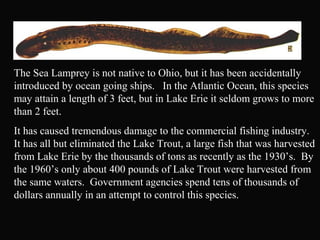
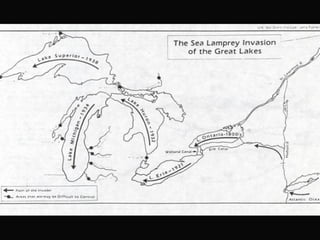
The Sea Lamprey is not native to Ohio, but it has been accidentally
introduced by ocean going ships. In the Atlantic Ocean, this species
may attain a length of 3 feet, but in Lake Erie it seldom grows to more
than 2 feet.
It has caused tremendous damage to the commercial fishing industry.
It has all but eliminated the Lake Trout, a large fish that was harvested
from Lake Erie by the thousands of tons as recently as the 1930’s. By
the 1960’s only about 400 pounds of Lake Trout were harvested from
the same waters. Government agencies spend tens of thousands of
dollars annually in an attempt to control this species.
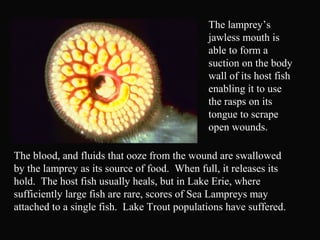
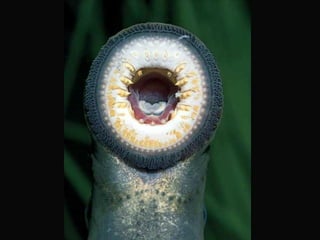
The lamprey’s
jawless mouth is
able to form a
suction on the body
wall of its host fish
enabling it to use
the rasps on its
tongue to scrape
open wounds.
The blood, and fluids that ooze from the wound are swallowed
by the lamprey as its source of food. When full, it releases its
hold. The host fish usually heals, but in Lake Erie, where
sufficiently large fish are rare, scores of Sea Lampreys may
attached to a single fish. Lake Trout populations have suffered.
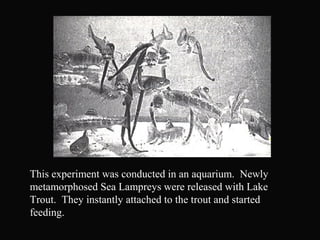
This experiment was conducted in an aquarium. Newly
metamorphosed Sea Lampreys were released with Lake
Trout. They instantly attached to the trout and started
feeding.
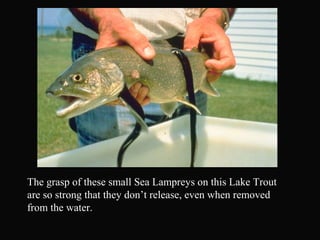
The grasp of these small Sea Lampreys on this Lake Trout
are so strong that they don’t release, even when removed
from the water.
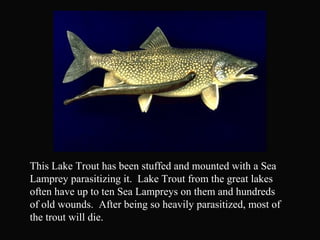
This Lake Trout has been stuffed and mounted with a Sea
Lamprey parasitizing it. Lake Trout from the great lakes
often have up to ten Sea Lampreys on them and hundreds
of old wounds. After being so heavily parasitized, most of
the trout will die.
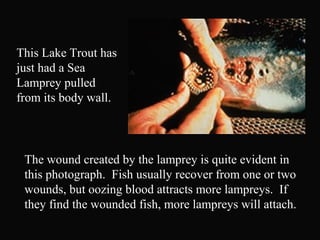
This Lake Trout has
just had a Sea
Lamprey pulled
from its body wall.
The wound created by the lamprey is quite evident in
this photograph. Fish usually recover from one or two
wounds, but oozing blood attracts more lampreys. If
they find the wounded fish, more lampreys will attach.
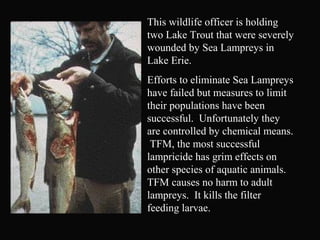
This wildlife officer is holding
two Lake Trout that were severely
wounded by Sea Lampreys in
Lake Erie.
Efforts to eliminate Sea Lampreys
have failed but measures to limit
their populations have been
successful. Unfortunately they
are controlled by chemical means.
TFM, the most successful
lampricide has grim effects on
other species of aquatic animals.
TFM causes no harm to adult
lampreys. It kills the filter
feeding larvae.
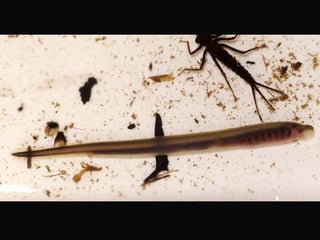
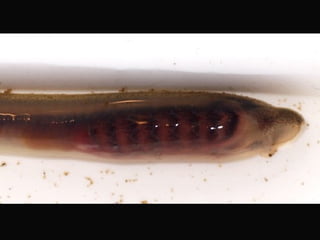
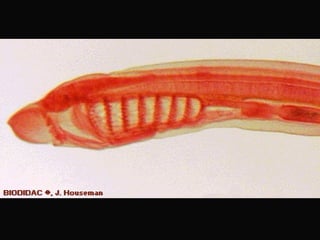
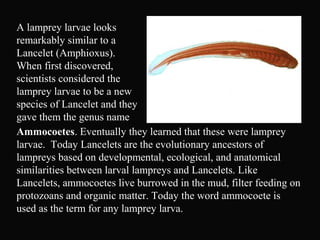
A lamprey larvae looks
remarkably similar to a
Lancelet (Amphioxus).
When first discovered,
scientists considered the
lamprey larvae to be a new
species of Lancelet and they
gave them the genus name
Ammocoetes. Eventually they learned that these were lamprey
larvae. Today Lancelets are the evolutionary ancestors of
lampreys based on developmental, ecological, and anatomical
similarities between larval lampreys and Lancelets. Like
Lancelets, ammocoetes live burrowed in the mud, filter feeding on
protozoans and organic matter. Today the word ammocoete is
used as the term for any lamprey larva.
Fish History
• Phylum Chordata
• Subphylum Vertebrata
• Class Ostracodermi
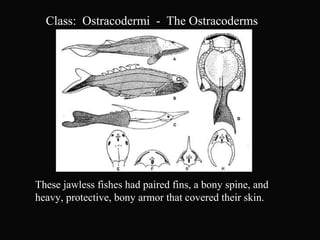
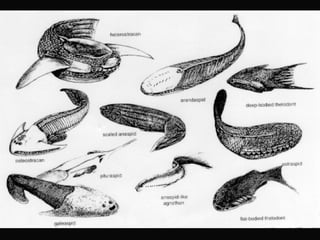
Class: Ostracodermi - The Ostracoderms
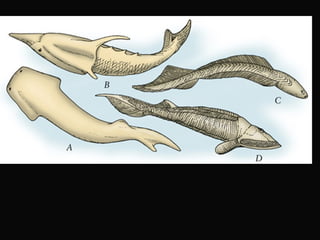
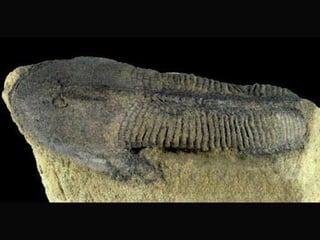
These jawless fishes had paired fins, a bony spine, and
heavy, protective, bony armor that covered their skin.
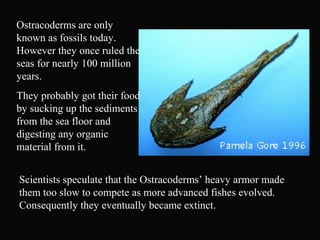
Ostracoderms are only
known as fossils today.
However they once ruled the
seas for nearly 100 million
years.
They probably got their food
by sucking up the sediments
from the sea floor and
digesting any organic
material from it.
Scientists speculate that the Ostracoderms’ heavy armor made
them too slow to compete as more advanced fishes evolved.
Consequently they eventually became extinct.
Fish History
• Phylum Chordata
• Subphylum Vertebrata
• Class Placodermi
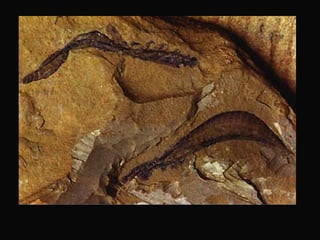
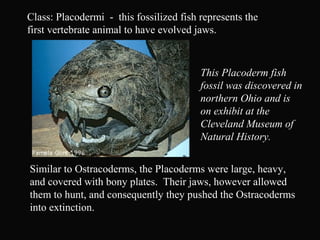
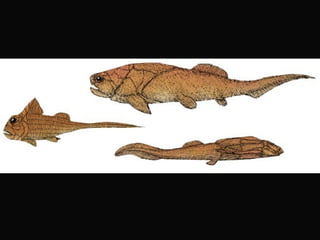
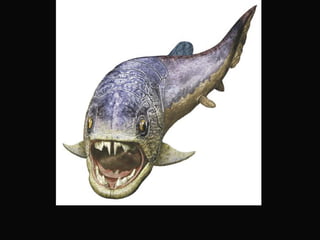
Class: Placodermi - this fossilized fish represents the
first vertebrate animal to have evolved jaws.
Similar to Ostracoderms, the Placoderms were large, heavy,
and covered with bony plates. Their jaws, however allowed
them to hunt, and consequently they pushed the Ostracoderms
into extinction.
This Placoderm fish
fossil was discovered in
northern Ohio and is
on exhibit at the
Cleveland Museum of
Natural History.
The word Agnatha used to be a Class that included
lampreys and hagfishes, boneless, jawless fishes.
However they are divided into the Classes: Myxini
and Cephalaspidomorphi today.
Although it isn’t a taxonomic term, the word
Agnatha is still used by biologists to describe any
jawless vertebrates.
A – without gnath – jaws
Gnathostomes are vertebrate animals that do
have jaws.
Gnath – jaw
Stome – hole or opening
Gnathostome means opening (mouth) with
jaws.

Agnathan Fish Notes

  • 1.
    Early Fish Evolution •Phylum Chordata • Subphylum Urochordata
  • 3.
    • Phylum Chordata •Subphylum Cephalochordata
  • 6.
    Fish History • PhylumChordata • Subphylum Vertebrata
  • 7.
    Jawless Fishes Class: Myxini- Hagfishes Class: Cephalaspidomorphi – Lampreys Class: Ostracodermi – Ostracoderms, jawless fishes with plate covered skin
  • 8.
    Hagfish are very primitivevertebrates. Primarily scavengers, they live near the ocean floor where they consume dead fish and marine worms.
  • 9.
    Hagfish have nopaired appendages or backbone yet they are considered vertebrates. They have a cartilaginous “shelf” upon which their brain rests. Biologists consider this the beginnings of the skull.
  • 10.
    Hagfish have nojaws. Their tongue has two rows of rasp-like structures that enable them to scrape at their food. A row of sensory tentacles surround the hagfish’s mouth.
  • 11.
    Hagfish are sometimes called“knot fish” because they are able to tie themselves into knots. They do this to rid their skin of excess slime and to gain leverage so that they can enter the anus of dead fish upon which they scavenge.
  • 12.
  • 18.
    Brook Lamprey –an Ohio native. This species only attains a length of about six inches. It spends several years as a larva burrowed in the sediment at the bottom of a stream where it filter feeds. After metamorphosis, the adults do not feed. They simply migrate to a suitable breeding site in their stream, reproduce, then die.
  • 19.
    The Silver Lampreyis another Ohio native. Adults of this species are parasitic upon fish. It is uncommon but does occur in the Ohio River and some of its larger tributaries. Scientists very rarely are able to collect this fish. Only seven have been collected in Ohio in the past 30 years. Evidence of its presence is occasionally seen when a fisherman catches a fish with deep wounds caused by the silver lamprey. Adults attain a maximum length of about 8 to 10 inches.
  • 20.
    The Sea Lampreyis not native to Ohio, but it has been accidentally introduced by ocean going ships. In the Atlantic Ocean, this species may attain a length of 3 feet, but in Lake Erie it seldom grows to more than 2 feet. It has caused tremendous damage to the commercial fishing industry. It has all but eliminated the Lake Trout, a large fish that was harvested from Lake Erie by the thousands of tons as recently as the 1930’s. By the 1960’s only about 400 pounds of Lake Trout were harvested from the same waters. Government agencies spend tens of thousands of dollars annually in an attempt to control this species.
  • 22.
    The lamprey’s jawless mouthis able to form a suction on the body wall of its host fish enabling it to use the rasps on its tongue to scrape open wounds. The blood, and fluids that ooze from the wound are swallowed by the lamprey as its source of food. When full, it releases its hold. The host fish usually heals, but in Lake Erie, where sufficiently large fish are rare, scores of Sea Lampreys may attached to a single fish. Lake Trout populations have suffered.
  • 24.
    This experiment wasconducted in an aquarium. Newly metamorphosed Sea Lampreys were released with Lake Trout. They instantly attached to the trout and started feeding.
  • 25.
    The grasp ofthese small Sea Lampreys on this Lake Trout are so strong that they don’t release, even when removed from the water.
  • 26.
    This Lake Trouthas been stuffed and mounted with a Sea Lamprey parasitizing it. Lake Trout from the great lakes often have up to ten Sea Lampreys on them and hundreds of old wounds. After being so heavily parasitized, most of the trout will die.
  • 27.
    This Lake Trouthas just had a Sea Lamprey pulled from its body wall. The wound created by the lamprey is quite evident in this photograph. Fish usually recover from one or two wounds, but oozing blood attracts more lampreys. If they find the wounded fish, more lampreys will attach.
  • 28.
    This wildlife officeris holding two Lake Trout that were severely wounded by Sea Lampreys in Lake Erie. Efforts to eliminate Sea Lampreys have failed but measures to limit their populations have been successful. Unfortunately they are controlled by chemical means. TFM, the most successful lampricide has grim effects on other species of aquatic animals. TFM causes no harm to adult lampreys. It kills the filter feeding larvae.
  • 30.
    A lamprey larvaelooks remarkably similar to a Lancelet (Amphioxus). When first discovered, scientists considered the lamprey larvae to be a new species of Lancelet and they gave them the genus name Ammocoetes. Eventually they learned that these were lamprey larvae. Today Lancelets are the evolutionary ancestors of lampreys based on developmental, ecological, and anatomical similarities between larval lampreys and Lancelets. Like Lancelets, ammocoetes live burrowed in the mud, filter feeding on protozoans and organic matter. Today the word ammocoete is used as the term for any lamprey larva.
  • 31.
    Fish History • PhylumChordata • Subphylum Vertebrata • Class Ostracodermi
  • 32.
    Class: Ostracodermi -The Ostracoderms These jawless fishes had paired fins, a bony spine, and heavy, protective, bony armor that covered their skin.
  • 37.
    Ostracoderms are only knownas fossils today. However they once ruled the seas for nearly 100 million years. They probably got their food by sucking up the sediments from the sea floor and digesting any organic material from it. Scientists speculate that the Ostracoderms’ heavy armor made them too slow to compete as more advanced fishes evolved. Consequently they eventually became extinct.
  • 38.
    Fish History • PhylumChordata • Subphylum Vertebrata • Class Placodermi
  • 39.
    Class: Placodermi -this fossilized fish represents the first vertebrate animal to have evolved jaws. Similar to Ostracoderms, the Placoderms were large, heavy, and covered with bony plates. Their jaws, however allowed them to hunt, and consequently they pushed the Ostracoderms into extinction. This Placoderm fish fossil was discovered in northern Ohio and is on exhibit at the Cleveland Museum of Natural History.
  • 42.
    The word Agnathaused to be a Class that included lampreys and hagfishes, boneless, jawless fishes. However they are divided into the Classes: Myxini and Cephalaspidomorphi today. Although it isn’t a taxonomic term, the word Agnatha is still used by biologists to describe any jawless vertebrates. A – without gnath – jaws
  • 43.
    Gnathostomes are vertebrateanimals that do have jaws. Gnath – jaw Stome – hole or opening Gnathostome means opening (mouth) with jaws.