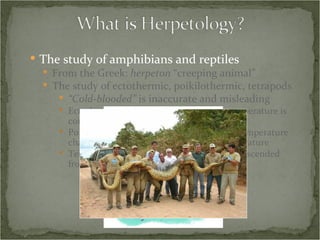
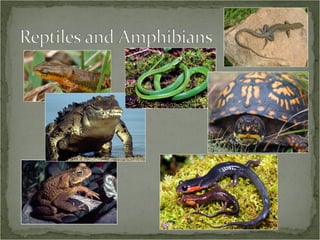
The study of amphibians and reptiles From the Greek:  herpeton  “creeping animal” The study of ectothermic, poikilothermic, tetrapods “ Cold-blooded”  is inaccurate and misleading Ectothermic: An organism whose body temperature is controlled by external factors Poikilothermic: An organism whose body temperature changes in concert with the ambient temperature Tetrapod: An organism having 4 limbs or descended from an organism with 4 limbs
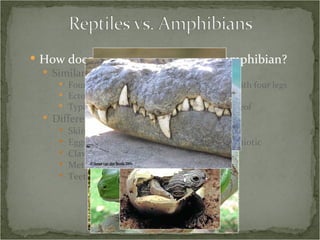
How does a reptile compare to an amphibian? Similarities: Four-legged, or descended from a creature with four legs Ectothermic Typically egg-layers, or some derivation thereof Differences: Skin texture Eggs – coverings and amniotic vs. non-amniotic Claws Metamorphosis Teeth
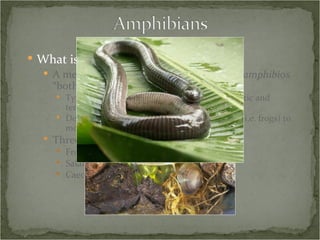
What is an amphibian? A member of the class Amphibia (Greek:  amphibios  “both lives” or “two lives”) Typically divides its life into two stages – aquatic and terrestrial Does not refer to the ability of some animals  (i.e. frogs) to move from one habitat to the other with ease Three orders Frogs (and toads) Salamanders (and newts) Caecilians
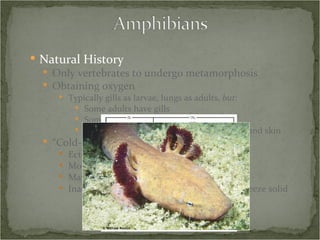
Natural History Only vertebrates to undergo metamorphosis Obtaining oxygen Typically gills as larvae, lungs as adults,  but: Some adults have gills Some adults have no lungs All take in oxygen through mouth, throat, and skin “ Cold-blooded” Ectothermic & poikilothermic Move to regulate body heat May spend large parts of year underground Inactive in cold weather, some extremities freeze solid
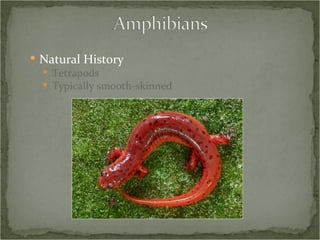
Natural History Tetrapods Typically smooth-skinned
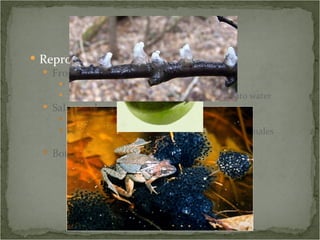
Reproduction Frogs Typically external Sperm and eggs released at the same time into water Salamanders Typically internal Males produce spermatophore from which females absorb sperm Both produce jelly-like eggs
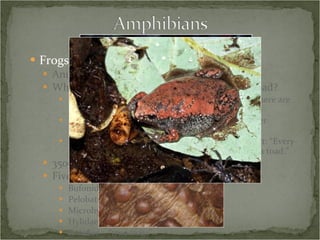
Frogs and Toads Anura – from the Latin “ without tail ” What’s the difference between a frog and a toad? No clear cut definition in scientific uses, though there are in general use. Typically more terrestrial, with shorter legs, stouter bodies, and rougher, “wartier” skin Some consider toads to be a subset of frogs, so that: “Every toad is a type of frog, but not every type of frog is a toad.” 3500 species worldwide Five families in the Southern Appalachians Bufonidae – “true toads” Pelobatidae – “spadefoot toads” Microhylidae – “narrow-mouthed toads” Hylidae – “tree frogs” Ranidae – “true frogs”
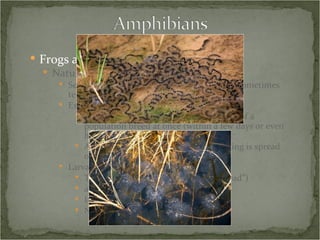
Frogs and Toads Natural History Sexual selection based on vocalizations and sometimes territory Explosive vs. prolonged breeding Wood frogs are explosive – all members of a population breed at once (within a few days or even hours) American toads are prolonged – breeding is spread over a longer period of time  Larvae Tadpole (Middle English for “toad’s head”) aka “pollywog” (“wiggling head”) Internal gills No legs (in first stages)
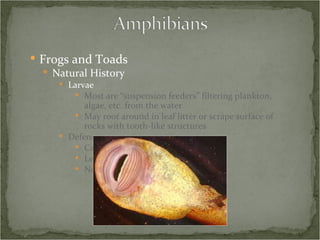
Frogs and Toads Natural History Larvae Most are “suspension feeders” filtering plankton, algae, etc. from the water May root around in leaf litter or scrape surface of rocks with tooth-like structures Defense Camouflage Leaping Noxious or toxic secretions
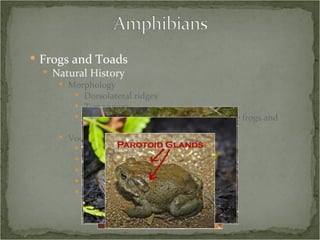
Frogs and Toads Natural History Morphology Dorsolateral ridges Tympanum Parotoid glands (mostly toads, but some frogs and salamanders) Vocalizations Advertisement – most obvious Aggressive Courtship Release Defensive
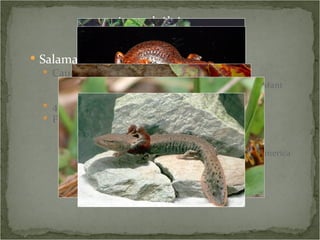
Salamanders Caudata – from the Latin for “ with tail ” Some use Urodela (Greek, “ tail visible”  to refer to extant species, and Caudata to refer to all salamanders) 420+ species worldwide Five families in the Smokies Cryptobranchidae – eastern hellbender Plethodontidae – lungless salamanders Largest family worldwide, most species in N. America Ambystomidae – mole salamanders Salamandridae – red-spotted newt Proteidae – common mudpuppy
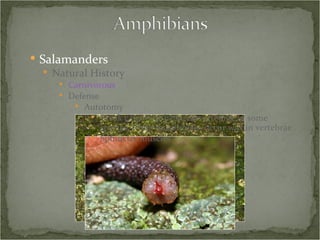
Salamanders Natural History Carnivorous Defense Autotomy Break can occur between vertebrae in some species, while most breaks occur within vertebrae Sphincter muscles
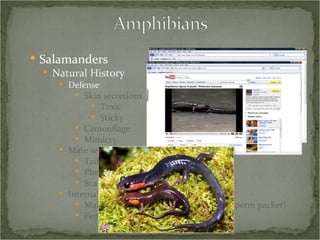
Salamanders Natural History Defense Skin secretions Toxic Sticky Camouflage Mimicry Mate selection Tail (and other) displays Pheremones Scat-sniffing Internal fertilization Males leave behind a spermatophore (sperm packet) Females pick up packet through cloaca
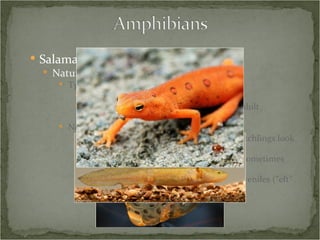
Salamanders Natural History Typical life cycle Egg, larvae, juvenile, adult Egg and larvae are aquatic, juvenile and adult terrestrial Non-typical life cycles All terrestrial – no aquatic larval stage, hatchlings look just like miniature adults All aquatic – adults remain fully aquatic, sometimes retaining larval features Newts – aquatic as larvae, terrestrial as juveniles (“eft” stage,) aquatic as adults
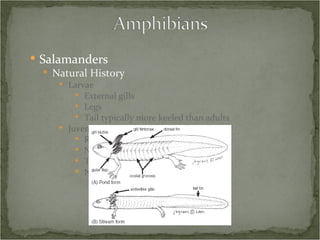
Salamanders Natural History Larvae External gills Legs Tail typically more keeled than adults Juvenile Resemble miniature adults No eyelids Thinner skin Not sexually mature
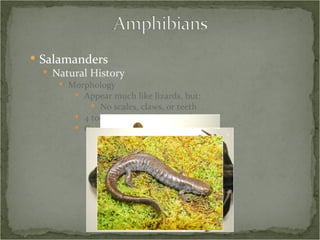
Salamanders Natural History Morphology Appear much like lizards, but: No scales, claws, or teeth 4 toes in front, 5 in back Costal grooves
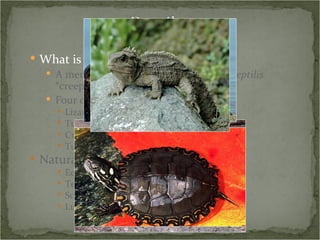
What is a reptile? A member of the class Reptilia (Latin:  reptilis  “creeping”) Four orders Lizards and snakes Turtles Crocodilians Tuataras Natural History Ectothermic Tetrapods Scaly skin Lungs
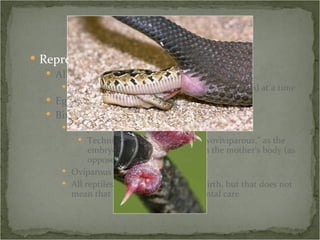
Reproduction All have internal fertilization Hemipenis – two sided, but only one side is used at a time Eggs are leathery Birth Viviparous (live birth) Technically a subtype called “ovoviviparous,” as the embryos develop within eggs in the mother’s body (as opposed to a womb) Oviparous (egg layers) All reptiles are independent from birth, but that does not mean that they do not receive parental care
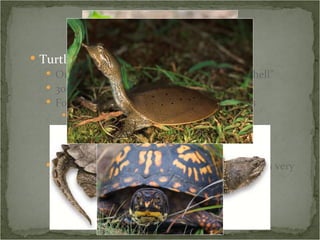
Turtles Order Testudines – from the Latin  testa , “shell” 300+ species worldwide Four families in the Southern Appalachians Chelydridae – snapping turtles Emydidae – box and pond turtles Kinosternidae – mud and musk turtles Trionychidae – softshell turtles Common ancestor shared with other reptiles is very ancient – some argue that turtles belong in a completely separate group
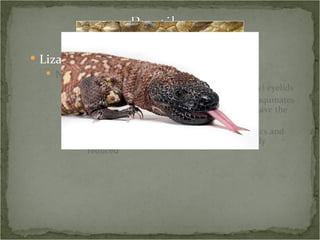
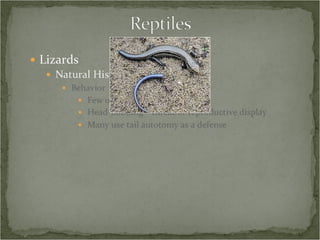
Lizards Natural History  Morphology External ear openings, nostrils, and (typically) eyelids Jacobson’s organ (more highly developed in squmates than in most other animals, though snakes have the most highly developed of all) Legless lizards retain lizard-like characteristics and have pelvic structures, though they are greatly reduced
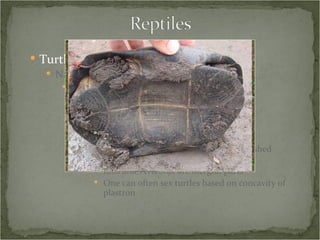
Turtles Natural History Morphology Color vision, excellent night vision Shell Upper  ‘carapace’ Lower ‘plastron’ Individual pieces are scutes, which are shed periodically Ribs and vertebrae are integral parts One can often sex turtles based on concavity of plastron
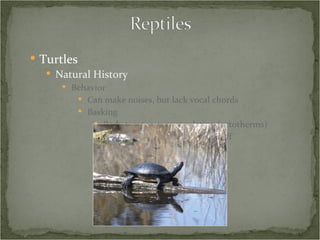
Turtles Natural History Behavior Can make noises, but lack vocal chords Basking Body temperature regulation (ectotherms) Encouraging parasites to drop off Reduce algal growth Vitamin D
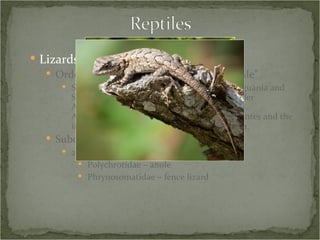
Lizards and Snakes Order Squamata – from the Latin for “scale” Squamata is further divided into suborders Iguania and Scleroglossa.  Sclerglossa contains the suborder Autarchoglossa (and others such as Gekkota).  Autarchoglossa contains the suborders Serpentes and the infraorders Scinicomorpha and Anguimorpha. Suborder Iguania 2 families in the Smokies Polychrotidae – anole Phrynosomatidae – fence lizard
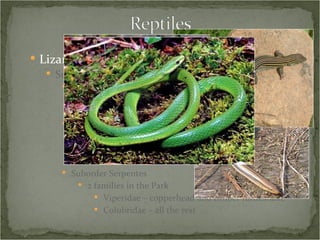
Lizards and Snakes Suborder  Autarchoglossa Infraorder Anguimorhpa 1 family in the Park Anguidae – glass lizard Infraorder Scincomorpha 2 families in the Park Teiidae – racerunner Scincidae – skinks Suborder Serpentes 2 families in the Park Viperidae – copperhead and timber rattlesnake Colubridae – all the rest
 
Snakes Order Squamata Suborder Scleroglossa Suborder Autarchoglossa Suborder Serpentes 2700+ species worldwide Evolved lack of limbs from a common ancestor in a separate evolutionary line than legless lizards The family Colubridae make up some 2/3 of modern snake species worldwide
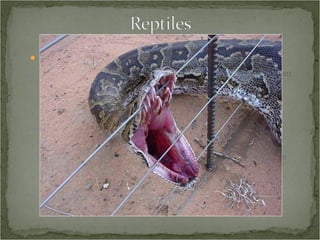
Snakes  Natural History -  Morphology Highly developed Jacobson’s organ, with stereo scent detection 6 rows of teeth 2 on top jaw 2 on bottom jaw 2 on roof of mouth Sharp and curved backwards Vary between species, allowing specific teeth to function in special ways, including injecting or channeling venom
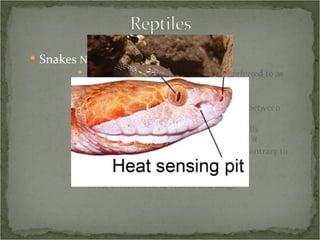
Snakes  Natural History -  Morphology Skin sheds in one piece as they grow, referred to as “ecdysis” New layer forms beneath old Fluid from lymphatic system spreads between layers Eye turns milky from the liquid that fills underneath the clear scale that covers it Does NOT happen on a yearly basis, contrary to popular belief Heat sensing pits – family Viperidae only Some colubrids have venom and fangs
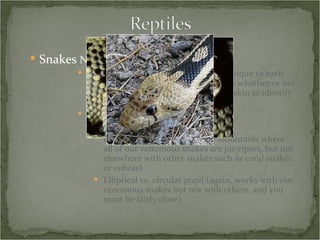
Snakes  Natural History  Morphology The pattern of scales on the body is unique to each species, so it can be used to determine whether or not a snake is venomous, or to use a shed skin to identify a species Venomous vs. Non-venomous Head shape (can be confusing) Facial pits (works here in the mountains where all of our venomous snakes are pit vipers, but not elsewhere with other snakes such as coral snakes or cobras) Elliptical vs. circular pupil (again, works with our venomous snakes but not with others, and you must be fairly close)
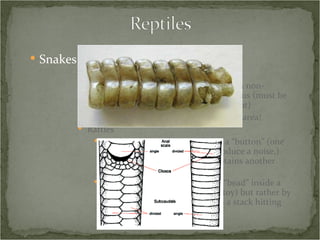
Snakes - Natural History -  Morphology Venomous vs. non-venomous Scales posterior to cloaca – paired in non-venomous snakes, single in venomous (must be really close, and again, not consistent) Know the venomous snakes in your area! Rattles Rattlesnakes are born with just a “button” (one layer of the rattle, unable to produce a noise,) each time the snake sheds it obtains another layer The noise is not produced by a “bead” inside a hollow structure (like a child’s toy) but rather by loosely connected layers within a stack hitting each other as the tail vibrates
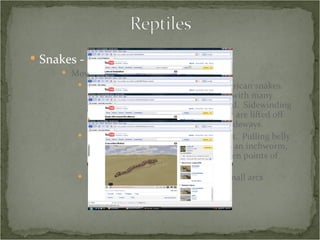
Snakes -  Behavior Movement Lateral undulation – most North American snakes.  Pushing off the ground or vegetation with many points of contact, propelling it forward.  Sidewinding is a version in which parts of the body are lifted off the ground and moved forward and sideways. Rectilinear motion – big, heavy snakes.  Pulling belly scales across the ground.  Almost like an inchworm, but with very, very small “arcs” between points of contact. Concertina – body compresses into small arcs laterally, then straightens.
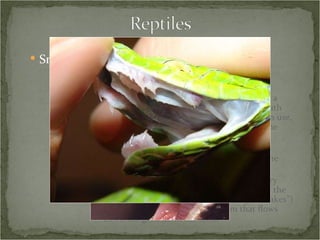
Snakes -  Feeding All are carnivorous Envenomation Viperids have long, hollow teeth located on a short maxillary bone at the front of the mouth that can rotate back and forth.  When not in use, the fangs can therefore rotate back out of the way. Elapids (family Elapidae – cobras, corals, mambas) have fixed, hollow fangs, also at the front of the mouth. Venomous colubrids (of which there are very few) possess grooved fangs in the middle of the mouth (often referred to as “rear-fanged snakes”) that deliver a typically mild venom that flows down the grooves in the teeth
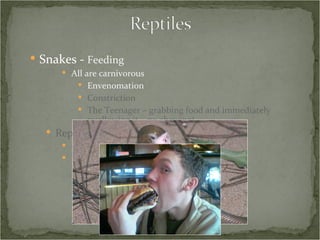
Snakes -  Feeding All are carnivorous Envenomation Constriction The Teenager – grabbing food and immediately swallowing it – no chewing! Reproduction Oviparous Viviparous – technically ovoviviparous
 

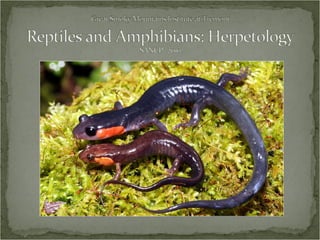
Herpetology sancp2010

  • 1.
  • 2.
    The study ofamphibians and reptiles From the Greek: herpeton “creeping animal” The study of ectothermic, poikilothermic, tetrapods “ Cold-blooded” is inaccurate and misleading Ectothermic: An organism whose body temperature is controlled by external factors Poikilothermic: An organism whose body temperature changes in concert with the ambient temperature Tetrapod: An organism having 4 limbs or descended from an organism with 4 limbs
  • 3.
    How does areptile compare to an amphibian? Similarities: Four-legged, or descended from a creature with four legs Ectothermic Typically egg-layers, or some derivation thereof Differences: Skin texture Eggs – coverings and amniotic vs. non-amniotic Claws Metamorphosis Teeth
  • 4.
    What is anamphibian? A member of the class Amphibia (Greek: amphibios “both lives” or “two lives”) Typically divides its life into two stages – aquatic and terrestrial Does not refer to the ability of some animals (i.e. frogs) to move from one habitat to the other with ease Three orders Frogs (and toads) Salamanders (and newts) Caecilians
  • 5.
    Natural History Onlyvertebrates to undergo metamorphosis Obtaining oxygen Typically gills as larvae, lungs as adults, but: Some adults have gills Some adults have no lungs All take in oxygen through mouth, throat, and skin “ Cold-blooded” Ectothermic & poikilothermic Move to regulate body heat May spend large parts of year underground Inactive in cold weather, some extremities freeze solid
  • 6.
    Natural History TetrapodsTypically smooth-skinned
  • 7.
    Reproduction Frogs Typicallyexternal Sperm and eggs released at the same time into water Salamanders Typically internal Males produce spermatophore from which females absorb sperm Both produce jelly-like eggs
  • 8.
    Frogs and ToadsAnura – from the Latin “ without tail ” What’s the difference between a frog and a toad? No clear cut definition in scientific uses, though there are in general use. Typically more terrestrial, with shorter legs, stouter bodies, and rougher, “wartier” skin Some consider toads to be a subset of frogs, so that: “Every toad is a type of frog, but not every type of frog is a toad.” 3500 species worldwide Five families in the Southern Appalachians Bufonidae – “true toads” Pelobatidae – “spadefoot toads” Microhylidae – “narrow-mouthed toads” Hylidae – “tree frogs” Ranidae – “true frogs”
  • 9.
    Frogs and ToadsNatural History Sexual selection based on vocalizations and sometimes territory Explosive vs. prolonged breeding Wood frogs are explosive – all members of a population breed at once (within a few days or even hours) American toads are prolonged – breeding is spread over a longer period of time Larvae Tadpole (Middle English for “toad’s head”) aka “pollywog” (“wiggling head”) Internal gills No legs (in first stages)
  • 10.
    Frogs and ToadsNatural History Larvae Most are “suspension feeders” filtering plankton, algae, etc. from the water May root around in leaf litter or scrape surface of rocks with tooth-like structures Defense Camouflage Leaping Noxious or toxic secretions
  • 11.
    Frogs and ToadsNatural History Morphology Dorsolateral ridges Tympanum Parotoid glands (mostly toads, but some frogs and salamanders) Vocalizations Advertisement – most obvious Aggressive Courtship Release Defensive
  • 12.
    Salamanders Caudata –from the Latin for “ with tail ” Some use Urodela (Greek, “ tail visible” to refer to extant species, and Caudata to refer to all salamanders) 420+ species worldwide Five families in the Smokies Cryptobranchidae – eastern hellbender Plethodontidae – lungless salamanders Largest family worldwide, most species in N. America Ambystomidae – mole salamanders Salamandridae – red-spotted newt Proteidae – common mudpuppy
  • 13.
    Salamanders Natural HistoryCarnivorous Defense Autotomy Break can occur between vertebrae in some species, while most breaks occur within vertebrae Sphincter muscles
  • 14.
    Salamanders Natural HistoryDefense Skin secretions Toxic Sticky Camouflage Mimicry Mate selection Tail (and other) displays Pheremones Scat-sniffing Internal fertilization Males leave behind a spermatophore (sperm packet) Females pick up packet through cloaca
  • 15.
    Salamanders Natural HistoryTypical life cycle Egg, larvae, juvenile, adult Egg and larvae are aquatic, juvenile and adult terrestrial Non-typical life cycles All terrestrial – no aquatic larval stage, hatchlings look just like miniature adults All aquatic – adults remain fully aquatic, sometimes retaining larval features Newts – aquatic as larvae, terrestrial as juveniles (“eft” stage,) aquatic as adults
  • 16.
    Salamanders Natural HistoryLarvae External gills Legs Tail typically more keeled than adults Juvenile Resemble miniature adults No eyelids Thinner skin Not sexually mature
  • 17.
    Salamanders Natural HistoryMorphology Appear much like lizards, but: No scales, claws, or teeth 4 toes in front, 5 in back Costal grooves
  • 18.
    What is areptile? A member of the class Reptilia (Latin: reptilis “creeping”) Four orders Lizards and snakes Turtles Crocodilians Tuataras Natural History Ectothermic Tetrapods Scaly skin Lungs
  • 19.
    Reproduction All haveinternal fertilization Hemipenis – two sided, but only one side is used at a time Eggs are leathery Birth Viviparous (live birth) Technically a subtype called “ovoviviparous,” as the embryos develop within eggs in the mother’s body (as opposed to a womb) Oviparous (egg layers) All reptiles are independent from birth, but that does not mean that they do not receive parental care
  • 20.
    Turtles Order Testudines– from the Latin testa , “shell” 300+ species worldwide Four families in the Southern Appalachians Chelydridae – snapping turtles Emydidae – box and pond turtles Kinosternidae – mud and musk turtles Trionychidae – softshell turtles Common ancestor shared with other reptiles is very ancient – some argue that turtles belong in a completely separate group
  • 21.
    Lizards Natural History Morphology External ear openings, nostrils, and (typically) eyelids Jacobson’s organ (more highly developed in squmates than in most other animals, though snakes have the most highly developed of all) Legless lizards retain lizard-like characteristics and have pelvic structures, though they are greatly reduced
  • 22.
    Turtles Natural HistoryMorphology Color vision, excellent night vision Shell Upper ‘carapace’ Lower ‘plastron’ Individual pieces are scutes, which are shed periodically Ribs and vertebrae are integral parts One can often sex turtles based on concavity of plastron
  • 23.
    Turtles Natural HistoryBehavior Can make noises, but lack vocal chords Basking Body temperature regulation (ectotherms) Encouraging parasites to drop off Reduce algal growth Vitamin D
  • 24.
    Lizards and SnakesOrder Squamata – from the Latin for “scale” Squamata is further divided into suborders Iguania and Scleroglossa. Sclerglossa contains the suborder Autarchoglossa (and others such as Gekkota). Autarchoglossa contains the suborders Serpentes and the infraorders Scinicomorpha and Anguimorpha. Suborder Iguania 2 families in the Smokies Polychrotidae – anole Phrynosomatidae – fence lizard
  • 25.
    Lizards and SnakesSuborder Autarchoglossa Infraorder Anguimorhpa 1 family in the Park Anguidae – glass lizard Infraorder Scincomorpha 2 families in the Park Teiidae – racerunner Scincidae – skinks Suborder Serpentes 2 families in the Park Viperidae – copperhead and timber rattlesnake Colubridae – all the rest
  • 26.
  • 27.
    Snakes Order SquamataSuborder Scleroglossa Suborder Autarchoglossa Suborder Serpentes 2700+ species worldwide Evolved lack of limbs from a common ancestor in a separate evolutionary line than legless lizards The family Colubridae make up some 2/3 of modern snake species worldwide
  • 28.
    Snakes NaturalHistory - Morphology Highly developed Jacobson’s organ, with stereo scent detection 6 rows of teeth 2 on top jaw 2 on bottom jaw 2 on roof of mouth Sharp and curved backwards Vary between species, allowing specific teeth to function in special ways, including injecting or channeling venom
  • 29.
    Snakes NaturalHistory - Morphology Skin sheds in one piece as they grow, referred to as “ecdysis” New layer forms beneath old Fluid from lymphatic system spreads between layers Eye turns milky from the liquid that fills underneath the clear scale that covers it Does NOT happen on a yearly basis, contrary to popular belief Heat sensing pits – family Viperidae only Some colubrids have venom and fangs
  • 30.
    Snakes NaturalHistory Morphology The pattern of scales on the body is unique to each species, so it can be used to determine whether or not a snake is venomous, or to use a shed skin to identify a species Venomous vs. Non-venomous Head shape (can be confusing) Facial pits (works here in the mountains where all of our venomous snakes are pit vipers, but not elsewhere with other snakes such as coral snakes or cobras) Elliptical vs. circular pupil (again, works with our venomous snakes but not with others, and you must be fairly close)
  • 31.
    Snakes - NaturalHistory - Morphology Venomous vs. non-venomous Scales posterior to cloaca – paired in non-venomous snakes, single in venomous (must be really close, and again, not consistent) Know the venomous snakes in your area! Rattles Rattlesnakes are born with just a “button” (one layer of the rattle, unable to produce a noise,) each time the snake sheds it obtains another layer The noise is not produced by a “bead” inside a hollow structure (like a child’s toy) but rather by loosely connected layers within a stack hitting each other as the tail vibrates
  • 32.
    Snakes - Behavior Movement Lateral undulation – most North American snakes. Pushing off the ground or vegetation with many points of contact, propelling it forward. Sidewinding is a version in which parts of the body are lifted off the ground and moved forward and sideways. Rectilinear motion – big, heavy snakes. Pulling belly scales across the ground. Almost like an inchworm, but with very, very small “arcs” between points of contact. Concertina – body compresses into small arcs laterally, then straightens.
  • 33.
    Snakes - Feeding All are carnivorous Envenomation Viperids have long, hollow teeth located on a short maxillary bone at the front of the mouth that can rotate back and forth. When not in use, the fangs can therefore rotate back out of the way. Elapids (family Elapidae – cobras, corals, mambas) have fixed, hollow fangs, also at the front of the mouth. Venomous colubrids (of which there are very few) possess grooved fangs in the middle of the mouth (often referred to as “rear-fanged snakes”) that deliver a typically mild venom that flows down the grooves in the teeth
  • 34.
    Snakes - Feeding All are carnivorous Envenomation Constriction The Teenager – grabbing food and immediately swallowing it – no chewing! Reproduction Oviparous Viviparous – technically ovoviviparous
  • 35.