Group members:
Serene Ittikunnath M1244
Tushar Kharate M1254
Wasif Parkar M1261
LINTNER AND MM DIVIDEND
MODELS
LINTNER DIVIDEND POLICY
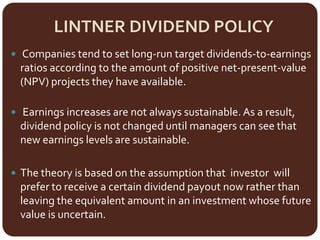
 Companies tend to set long-run target dividends-to-earnings
ratios according to the amount of positive net-present-value
(NPV) projects they have available.
 Earnings increases are not always sustainable. As a result,
dividend policy is not changed until managers can see that
new earnings levels are sustainable.
 The theory is based on the assumption that investor will
prefer to receive a certain dividend payout now rather than
leaving the equivalent amount in an investment whose future
value is uncertain.
FORMULA
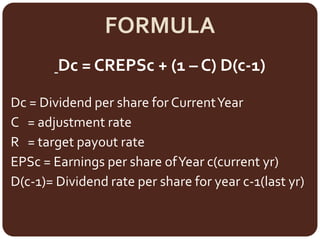
Dc = CREPSc + (1 – C) D(c-1)
Dc = Dividend per share for CurrentYear
C = adjustment rate
R = target payout rate
EPSc = Earnings per share ofYear c(current yr)
D(c-1)= Dividend rate per share for year c-1(last yr)
ILLUSTRATION
Modigliani and Miller(MM) hypothesis
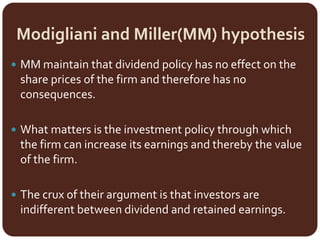
 MM maintain that dividend policy has no effect on the
share prices of the firm and therefore has no
consequences.
 What matters is the investment policy through which
the firm can increase its earnings and thereby the value
of the firm.
 The crux of their argument is that investors are
indifferent between dividend and retained earnings.
FORMULA
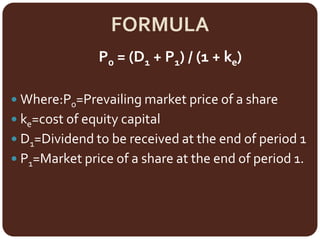
P0 = (D1 + P1) / (1 + ke)
 Where:P0=Prevailing market price of a share
 ke=cost of equity capital
 D1=Dividend to be received at the end of period 1
 P1=Market price of a share at the end of period 1.
ASSUMPTION
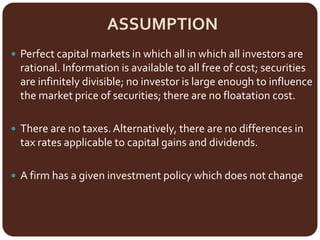
 Perfect capital markets in which all in which all investors are
rational. Information is available to all free of cost; securities
are infinitely divisible; no investor is large enough to influence
the market price of securities; there are no floatation cost.
 There are no taxes.Alternatively, there are no differences in
tax rates applicable to capital gains and dividends.
 A firm has a given investment policy which does not change
ILLUSTRATION
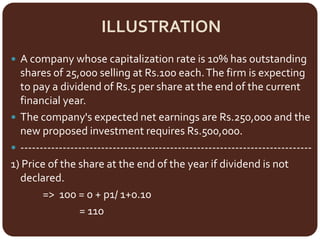
 A company whose capitalization rate is 10% has outstanding
shares of 25,000 selling at Rs.100 each.The firm is expecting
to pay a dividend of Rs.5 per share at the end of the current
financial year.
 The company's expected net earnings are Rs.250,000 and the
new proposed investment requires Rs.500,000.
 ----------------------------------------------------------------------------
1) Price of the share at the end of the year if dividend is not
declared.
=> 100 = 0 + p1/ 1+0.10
= 110
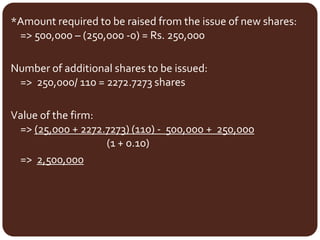
*Amount required to be raised from the issue of new shares:
=> 500,000 – (250,000 -0) = Rs. 250,000
Number of additional shares to be issued:
=> 250,000/ 110 = 2272.7273 shares
Value of the firm:
=> (25,000 + 2272.7273) (110) - 500,000 + 250,000
(1 + 0.10)
=> 2,500,000
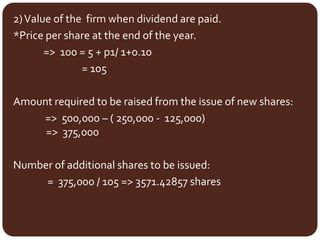
2)Value of the firm when dividend are paid.
*Price per share at the end of the year.
=> 100 = 5 + p1/ 1+0.10
= 105
Amount required to be raised from the issue of new shares:
=> 500,000 – ( 250,000 - 125,000)
=> 375,000
Number of additional shares to be issued:
= 375,000 / 105 => 3571.42857 shares
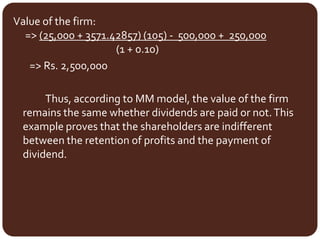
Value of the firm:
=> (25,000 + 3571.42857) (105) - 500,000 + 250,000
(1 + 0.10)
=> Rs. 2,500,000
Thus, according to MM model, the value of the firm
remains the same whether dividends are paid or not.This
example proves that the shareholders are indifferent
between the retention of profits and the payment of
dividend.
LIMITATION
 The assumptions are unrealistic and untenable in practice.
 As a result the conclusion that dividend payments and other
methods of financing exactly offset each other and hence, the
irrelevance of dividends is not a practical proposition.
 The validity of MM approach is open to question on two
counts. (i) Imperfection of capital market (ii) Resolution of
uncertainty.

Lintner and mm dividend models

  • 1.
    Group members: Serene IttikunnathM1244 Tushar Kharate M1254 Wasif Parkar M1261 LINTNER AND MM DIVIDEND MODELS
  • 2.
    LINTNER DIVIDEND POLICY Companies tend to set long-run target dividends-to-earnings ratios according to the amount of positive net-present-value (NPV) projects they have available.  Earnings increases are not always sustainable. As a result, dividend policy is not changed until managers can see that new earnings levels are sustainable.  The theory is based on the assumption that investor will prefer to receive a certain dividend payout now rather than leaving the equivalent amount in an investment whose future value is uncertain.
  • 3.
    FORMULA Dc = CREPSc+ (1 – C) D(c-1) Dc = Dividend per share for CurrentYear C = adjustment rate R = target payout rate EPSc = Earnings per share ofYear c(current yr) D(c-1)= Dividend rate per share for year c-1(last yr)
  • 4.
  • 5.
    Modigliani and Miller(MM)hypothesis  MM maintain that dividend policy has no effect on the share prices of the firm and therefore has no consequences.  What matters is the investment policy through which the firm can increase its earnings and thereby the value of the firm.  The crux of their argument is that investors are indifferent between dividend and retained earnings.
  • 6.
    FORMULA P0 = (D1+ P1) / (1 + ke)  Where:P0=Prevailing market price of a share  ke=cost of equity capital  D1=Dividend to be received at the end of period 1  P1=Market price of a share at the end of period 1.
  • 7.
    ASSUMPTION  Perfect capitalmarkets in which all in which all investors are rational. Information is available to all free of cost; securities are infinitely divisible; no investor is large enough to influence the market price of securities; there are no floatation cost.  There are no taxes.Alternatively, there are no differences in tax rates applicable to capital gains and dividends.  A firm has a given investment policy which does not change
  • 8.
    ILLUSTRATION  A companywhose capitalization rate is 10% has outstanding shares of 25,000 selling at Rs.100 each.The firm is expecting to pay a dividend of Rs.5 per share at the end of the current financial year.  The company's expected net earnings are Rs.250,000 and the new proposed investment requires Rs.500,000.  ---------------------------------------------------------------------------- 1) Price of the share at the end of the year if dividend is not declared. => 100 = 0 + p1/ 1+0.10 = 110
  • 9.
    *Amount required tobe raised from the issue of new shares: => 500,000 – (250,000 -0) = Rs. 250,000 Number of additional shares to be issued: => 250,000/ 110 = 2272.7273 shares Value of the firm: => (25,000 + 2272.7273) (110) - 500,000 + 250,000 (1 + 0.10) => 2,500,000
  • 10.
    2)Value of thefirm when dividend are paid. *Price per share at the end of the year. => 100 = 5 + p1/ 1+0.10 = 105 Amount required to be raised from the issue of new shares: => 500,000 – ( 250,000 - 125,000) => 375,000 Number of additional shares to be issued: = 375,000 / 105 => 3571.42857 shares
  • 11.
    Value of thefirm: => (25,000 + 3571.42857) (105) - 500,000 + 250,000 (1 + 0.10) => Rs. 2,500,000 Thus, according to MM model, the value of the firm remains the same whether dividends are paid or not.This example proves that the shareholders are indifferent between the retention of profits and the payment of dividend.
  • 12.
    LIMITATION  The assumptionsare unrealistic and untenable in practice.  As a result the conclusion that dividend payments and other methods of financing exactly offset each other and hence, the irrelevance of dividends is not a practical proposition.  The validity of MM approach is open to question on two counts. (i) Imperfection of capital market (ii) Resolution of uncertainty.