Leveraged Buy Outs
LBO-Definition It involves the use of a large amount of debt to purchase a firm. LBOs are clear-cut example of a financial merger undertaken to create a high-debt private corporation with improved cash flows and value. Typically, in an LBO, 80% or more of the purchase price is financed with debt. A large part of the borrowing is secured by the acquired firm’s assets.
Features of an LBO Candidate An attractive candidate for acquisition via LBO should possess the following attributes: It must have a good position in the industry with sound profit history. It should have a relatively low level of debt and high level of “bankable” assets. It must have stable and predictable cash flows that are adequate to meet interest and principal payments on the debt and provide adequate working capital.
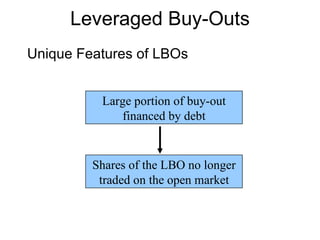
Leveraged Buy-Outs Unique Features of LBOs Large portion of buy-out financed by debt Shares of the LBO no longer traded on the open market
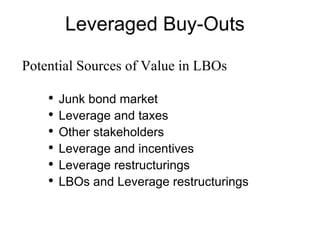
Leveraged Buy-Outs Junk bond market Leverage and taxes Other stakeholders Leverage and incentives Leverage restructurings LBOs and Leverage restructurings Potential Sources of Value in LBOs
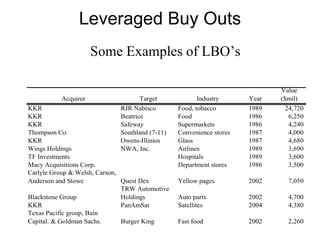
Leveraged Buy Outs Some Examples of LBO’s
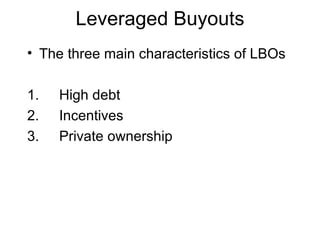
Leveraged Buyouts The three main characteristics of LBOs 1.  High debt 2. Incentives 3. Private ownership
Tata-Corus Deal A Brief Analysis
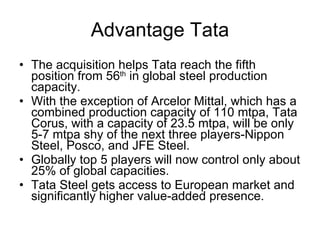
Advantage Tata The acquisition helps Tata reach the fifth position from 56 th  in global steel production capacity. With the exception of Arcelor Mittal, which has a combined production capacity of 110 mtpa, Tata Corus, with a capacity of 23.5 mtpa, will be only 5-7 mtpa shy of the next three players-Nippon Steel, Posco, and JFE Steel. Globally top 5 players will now control only about 25% of global capacities. Tata Steel gets access to European market and significantly higher value-added presence.
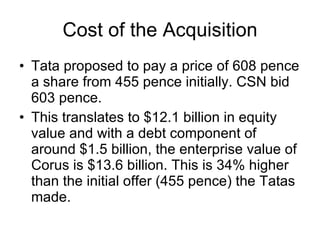
Cost of the Acquisition Tata proposed to pay a price of 608 pence a share from 455 pence initially. CSN bid 603 pence. This translates to $12.1 billion in equity value and with a debt component of around $1.5 billion, the enterprise value of Corus is $13.6 billion. This is 34% higher than the initial offer (455 pence) the Tatas made.
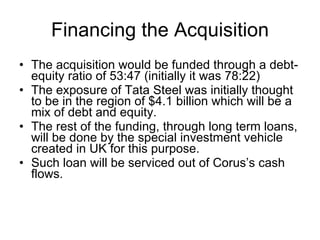
Financing the Acquisition The acquisition would be funded through a debt-equity ratio of 53:47 (initially it was 78:22) The exposure of Tata Steel was initially thought to be in the region of $4.1 billion which will be a mix of debt and equity. The rest of the funding, through long term loans, will be done by the special investment vehicle created in UK for this purpose. Such loan will be serviced out of Corus’s cash flows.
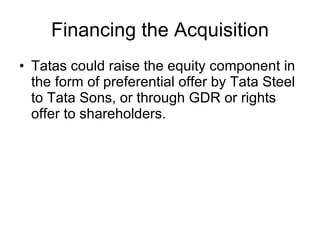
Financing the Acquisition Tatas could raise the equity component in the form of preferential offer by Tata Steel to Tata Sons, or through GDR or rights offer to shareholders.
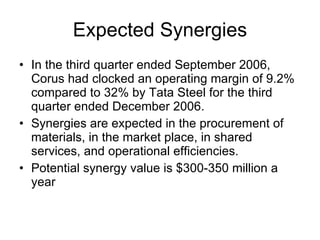
Expected Synergies In the third quarter ended September 2006, Corus had clocked an operating margin of 9.2% compared to 32% by Tata Steel for the third quarter ended December 2006. Synergies are expected in the procurement of materials, in the market place, in shared services, and operational efficiencies. Potential synergy value is $300-350 million a year
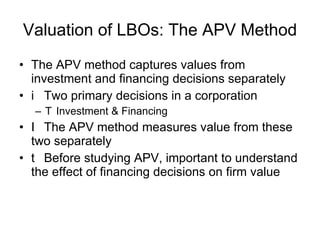
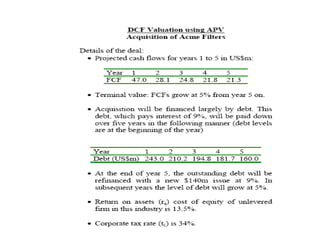
Valuation of LBOs: The APV Method The APV method captures values from investment and financing decisions separately 􀂄  Two primary decisions in a corporation 􀂉  Investment & Financing 􀂄  The APV method measures value from these two separately 􀂄  Before studying APV, important to understand the effect of financing decisions on firm value
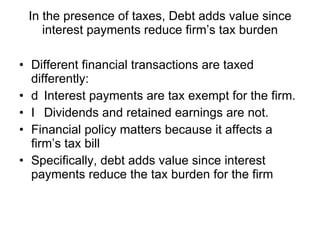
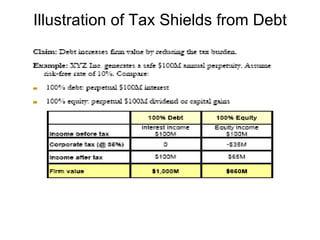
In the presence of taxes, Debt adds value since interest payments reduce firm’s tax burden Different financial transactions are taxed differently: 􀂉  Interest payments are tax exempt for the firm. 􀂉  Dividends and retained earnings are not. Financial policy matters because it affects a firm’s tax bill Specifically, debt adds value since interest payments reduce the tax burden for the firm
Illustration of Tax Shields from Debt
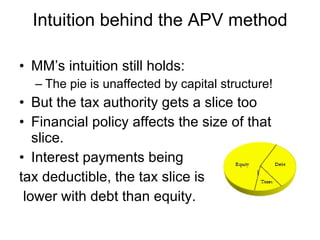
Intuition behind the APV method MM’s intuition still holds: The pie is unaffected by capital structure! But the tax authority gets a slice too Financial policy affects the size of that slice. Interest payments being tax deductible, the tax slice is lower with debt than equity.
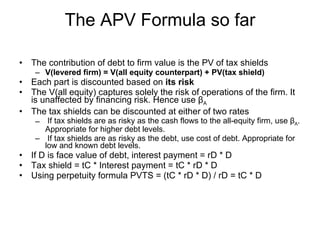
The APV Formula so far The contribution of debt to firm value is the PV of tax shields V(levered firm) = V(all equity counterpart) + PV(tax shield) Each part is discounted based on  its risk The V(all equity) captures solely the risk of operations of the firm. It is unaffected by financing risk. Hence use β A The tax shields can be discounted at either of two rates If tax shields are as risky as the cash flows to the all-equity firm, use β A . Appropriate for higher debt levels. If tax shields are as risky as the debt, use cost of debt. Appropriate for low and known debt levels. If D is face value of debt, interest payment = rD * D Tax shield = tC * Interest payment = tC * rD * D Using perpetuity formula PVTS = (tC * rD * D) / rD = tC * D
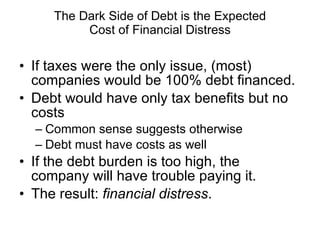
The Dark Side of Debt is the Expected Cost of Financial Distress If taxes were the only issue, (most) companies would be 100% debt financed. Debt would have only tax benefits but no costs Common sense suggests otherwise Debt must have costs as well If the debt burden is too high, the company will have trouble paying it. The result:  financial distress .
Full APV formula 􀂄  The value of a leveraged firm is: V(with debt) = V(all equity) + PV[tax shield] – PV[costs of distress] PV(costs of distress) depends on: Probability of distress Magnitude of costs encountered if distress occurs This is the full APV formula
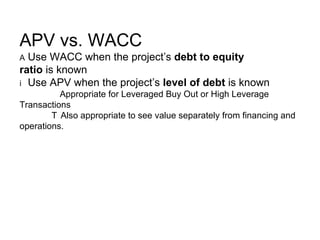
APV vs. WACC 􀂄  Use WACC when the project’s  debt to equity ratio  is known 􀂄  Use APV when the project’s  level of debt  is known   􀂉  Appropriate for Leveraged Buy Out or High Leverage Transactions 􀂉  Also appropriate to see value separately from financing and operations.
 

Leveraged buy outs

  • 1.
  • 2.
    LBO-Definition It involvesthe use of a large amount of debt to purchase a firm. LBOs are clear-cut example of a financial merger undertaken to create a high-debt private corporation with improved cash flows and value. Typically, in an LBO, 80% or more of the purchase price is financed with debt. A large part of the borrowing is secured by the acquired firm’s assets.
  • 3.
    Features of anLBO Candidate An attractive candidate for acquisition via LBO should possess the following attributes: It must have a good position in the industry with sound profit history. It should have a relatively low level of debt and high level of “bankable” assets. It must have stable and predictable cash flows that are adequate to meet interest and principal payments on the debt and provide adequate working capital.
  • 4.
    Leveraged Buy-Outs UniqueFeatures of LBOs Large portion of buy-out financed by debt Shares of the LBO no longer traded on the open market
  • 5.
    Leveraged Buy-Outs Junkbond market Leverage and taxes Other stakeholders Leverage and incentives Leverage restructurings LBOs and Leverage restructurings Potential Sources of Value in LBOs
  • 6.
    Leveraged Buy OutsSome Examples of LBO’s
  • 7.
    Leveraged Buyouts Thethree main characteristics of LBOs 1. High debt 2. Incentives 3. Private ownership
  • 8.
    Tata-Corus Deal ABrief Analysis
  • 9.
    Advantage Tata Theacquisition helps Tata reach the fifth position from 56 th in global steel production capacity. With the exception of Arcelor Mittal, which has a combined production capacity of 110 mtpa, Tata Corus, with a capacity of 23.5 mtpa, will be only 5-7 mtpa shy of the next three players-Nippon Steel, Posco, and JFE Steel. Globally top 5 players will now control only about 25% of global capacities. Tata Steel gets access to European market and significantly higher value-added presence.
  • 10.
    Cost of theAcquisition Tata proposed to pay a price of 608 pence a share from 455 pence initially. CSN bid 603 pence. This translates to $12.1 billion in equity value and with a debt component of around $1.5 billion, the enterprise value of Corus is $13.6 billion. This is 34% higher than the initial offer (455 pence) the Tatas made.
  • 11.
    Financing the AcquisitionThe acquisition would be funded through a debt-equity ratio of 53:47 (initially it was 78:22) The exposure of Tata Steel was initially thought to be in the region of $4.1 billion which will be a mix of debt and equity. The rest of the funding, through long term loans, will be done by the special investment vehicle created in UK for this purpose. Such loan will be serviced out of Corus’s cash flows.
  • 12.
    Financing the AcquisitionTatas could raise the equity component in the form of preferential offer by Tata Steel to Tata Sons, or through GDR or rights offer to shareholders.
  • 13.
    Expected Synergies Inthe third quarter ended September 2006, Corus had clocked an operating margin of 9.2% compared to 32% by Tata Steel for the third quarter ended December 2006. Synergies are expected in the procurement of materials, in the market place, in shared services, and operational efficiencies. Potential synergy value is $300-350 million a year
  • 14.
    Valuation of LBOs:The APV Method The APV method captures values from investment and financing decisions separately 􀂄 Two primary decisions in a corporation 􀂉 Investment & Financing 􀂄 The APV method measures value from these two separately 􀂄 Before studying APV, important to understand the effect of financing decisions on firm value
  • 15.
    In the presenceof taxes, Debt adds value since interest payments reduce firm’s tax burden Different financial transactions are taxed differently: 􀂉 Interest payments are tax exempt for the firm. 􀂉 Dividends and retained earnings are not. Financial policy matters because it affects a firm’s tax bill Specifically, debt adds value since interest payments reduce the tax burden for the firm
  • 16.
    Illustration of TaxShields from Debt
  • 17.
    Intuition behind theAPV method MM’s intuition still holds: The pie is unaffected by capital structure! But the tax authority gets a slice too Financial policy affects the size of that slice. Interest payments being tax deductible, the tax slice is lower with debt than equity.
  • 18.
    The APV Formulaso far The contribution of debt to firm value is the PV of tax shields V(levered firm) = V(all equity counterpart) + PV(tax shield) Each part is discounted based on its risk The V(all equity) captures solely the risk of operations of the firm. It is unaffected by financing risk. Hence use β A The tax shields can be discounted at either of two rates If tax shields are as risky as the cash flows to the all-equity firm, use β A . Appropriate for higher debt levels. If tax shields are as risky as the debt, use cost of debt. Appropriate for low and known debt levels. If D is face value of debt, interest payment = rD * D Tax shield = tC * Interest payment = tC * rD * D Using perpetuity formula PVTS = (tC * rD * D) / rD = tC * D
  • 19.
    The Dark Sideof Debt is the Expected Cost of Financial Distress If taxes were the only issue, (most) companies would be 100% debt financed. Debt would have only tax benefits but no costs Common sense suggests otherwise Debt must have costs as well If the debt burden is too high, the company will have trouble paying it. The result: financial distress .
  • 20.
    Full APV formula􀂄 The value of a leveraged firm is: V(with debt) = V(all equity) + PV[tax shield] – PV[costs of distress] PV(costs of distress) depends on: Probability of distress Magnitude of costs encountered if distress occurs This is the full APV formula
  • 21.
    APV vs. WACC􀂄 Use WACC when the project’s debt to equity ratio is known 􀂄 Use APV when the project’s level of debt is known 􀂉 Appropriate for Leveraged Buy Out or High Leverage Transactions 􀂉 Also appropriate to see value separately from financing and operations.
  • 22.