DIVIDEND DECISIONS
INTRODUCTION Dividend decision is the one of the decisions of Financial Mgt. It decides the proportion of equity earnings to be paid to equity share holders & the remaining proportion of net earning are retained in the firm  Payment of dividend is has two opposing effects. It increases dividend there by stock price rise It reduce the funds available for invt.
DIVIDEND THEORIES Relevance Theory : > Walter’s Model  > Gordon’s Model Irrelevance Theory : > Miller & Modigliani Hypothesis ( MM Approach)
Relevance Theory  According to relevance theory dividend decisions affects value of firm thus it is called relevance theory. Walter’s Model’s theory : This model is based on  1) Return on investment OR Internal rate of return (r). 2) Cost of capital OR Required rate of return. Here, the model divides the firm into three groups Growth firms Normal firms  Declining firms
Gordon’s Model : According to this model a firm share price is dependent on dividend pay out ratio. > Assumptions :   The firm is all equity firm.  All investment projects are financed by exclusively retained earnings. The rate of return firms is constant. The cost of capital remains constant.  The firm has perpetual life. There are no corporate taxes.
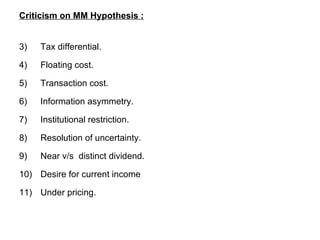
Criticism on MM Hypothesis : Tax differential. Floating cost. Transaction cost. Information asymmetry. Institutional restriction. Resolution of uncertainty. Near v/s  distinct dividend. Desire for current income Under pricing.
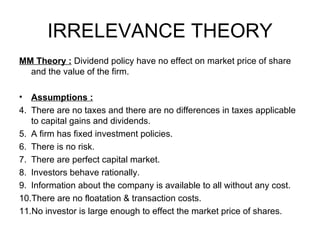
IRRELEVANCE THEORY MM Theory :  Dividend policy have no effect on market price of share and the value of the firm. Assumptions :   There are no taxes and there are no differences in taxes applicable to capital gains and dividends. A firm has fixed investment policies. There is no risk. There are perfect capital market. Investors behave rationally. Information about the company is available to all without any cost. There are no floatation & transaction costs. No investor is large enough to effect the market price of shares.
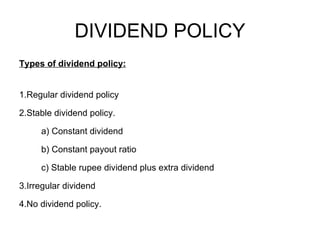
DIVIDEND POLICY Types of dividend policy:   1.Regular dividend policy 2.Stable dividend policy. a) Constant dividend b) Constant payout ratio c) Stable rupee dividend plus extra dividend 3.Irregular dividend 4.No dividend policy.
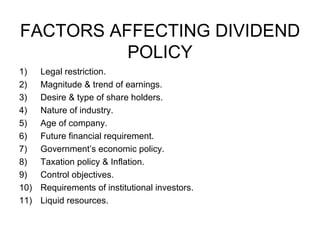
FACTORS AFFECTING DIVIDEND POLICY Legal restriction. Magnitude & trend of earnings. Desire & type of share holders. Nature of industry. Age of company. Future financial requirement. Government’s economic policy. Taxation policy & Inflation. Control objectives. Requirements of institutional investors. Liquid resources.
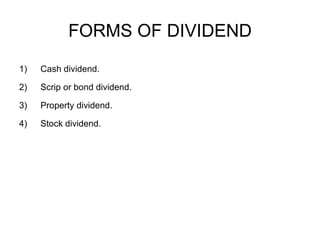
FORMS OF DIVIDEND Cash dividend. Scrip or bond dividend. Property dividend. Stock dividend.

Dividend decisions

  • 1.
  • 2.
    INTRODUCTION Dividend decisionis the one of the decisions of Financial Mgt. It decides the proportion of equity earnings to be paid to equity share holders & the remaining proportion of net earning are retained in the firm Payment of dividend is has two opposing effects. It increases dividend there by stock price rise It reduce the funds available for invt.
  • 3.
    DIVIDEND THEORIES RelevanceTheory : > Walter’s Model > Gordon’s Model Irrelevance Theory : > Miller & Modigliani Hypothesis ( MM Approach)
  • 4.
    Relevance Theory According to relevance theory dividend decisions affects value of firm thus it is called relevance theory. Walter’s Model’s theory : This model is based on 1) Return on investment OR Internal rate of return (r). 2) Cost of capital OR Required rate of return. Here, the model divides the firm into three groups Growth firms Normal firms Declining firms
  • 5.
    Gordon’s Model :According to this model a firm share price is dependent on dividend pay out ratio. > Assumptions : The firm is all equity firm. All investment projects are financed by exclusively retained earnings. The rate of return firms is constant. The cost of capital remains constant. The firm has perpetual life. There are no corporate taxes.
  • 6.
    Criticism on MMHypothesis : Tax differential. Floating cost. Transaction cost. Information asymmetry. Institutional restriction. Resolution of uncertainty. Near v/s distinct dividend. Desire for current income Under pricing.
  • 7.
    IRRELEVANCE THEORY MMTheory : Dividend policy have no effect on market price of share and the value of the firm. Assumptions : There are no taxes and there are no differences in taxes applicable to capital gains and dividends. A firm has fixed investment policies. There is no risk. There are perfect capital market. Investors behave rationally. Information about the company is available to all without any cost. There are no floatation & transaction costs. No investor is large enough to effect the market price of shares.
  • 8.
    DIVIDEND POLICY Typesof dividend policy: 1.Regular dividend policy 2.Stable dividend policy. a) Constant dividend b) Constant payout ratio c) Stable rupee dividend plus extra dividend 3.Irregular dividend 4.No dividend policy.
  • 9.
    FACTORS AFFECTING DIVIDENDPOLICY Legal restriction. Magnitude & trend of earnings. Desire & type of share holders. Nature of industry. Age of company. Future financial requirement. Government’s economic policy. Taxation policy & Inflation. Control objectives. Requirements of institutional investors. Liquid resources.
  • 10.
    FORMS OF DIVIDENDCash dividend. Scrip or bond dividend. Property dividend. Stock dividend.