CHAPTER: DIVIDEND POLICY AND
        FIRM VALUE


PRESENTED BY:
VIKRAM RAJAI
RAJKUMAR PRAJAPATI
DIVYAKANT CHOPADA
CONTENTS


   DIVIDEND POLICY
   FIVE SECTIONS OF DIVIDEND
    POLICY
DIVIDEND POLICY
   WHY DIVIDEND POLICY ?
Dividend policy of a firm determines what
proportion of earnings is paid to
shareholders by way of dividends and
what proportion is ploughed back in the
firm for investment purposes.
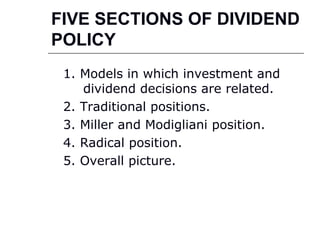
FIVE SECTIONS OF DIVIDEND
POLICY
 1. Models in which investment and
    dividend decisions are related.
 2. Traditional positions.
 3. Miller and Modigliani position.
 4. Radical position.
 5. Overall picture.
1. Models in which investment and dividend
decisions are related.

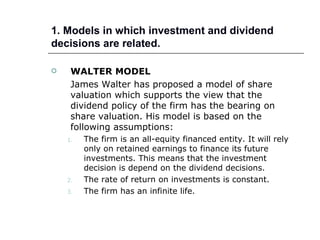
    WALTER MODEL
     James Walter has proposed a model of share
     valuation which supports the view that the
     dividend policy of the firm has the bearing on
     share valuation. His model is based on the
     following assumptions:
    1.   The firm is an all-equity financed entity. It will rely
         only on retained earnings to finance its future
         investments. This means that the investment
         decision is depend on the dividend decisions.
    2.   The rate of return on investments is constant.
    3.   The firm has an infinite life.
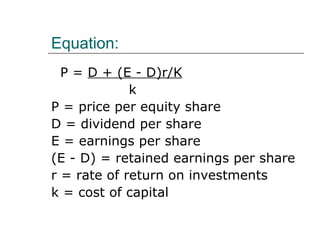
Equation:
  P = D + (E - D)r/K
             k
P = price per equity share
D = dividend per share
E = earnings per share
(E - D) = retained earnings per share
r = rate of return on investments
k = cost of capital
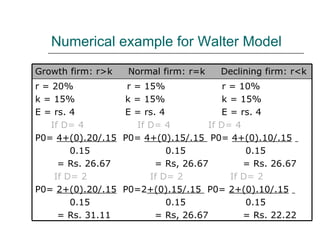
Numerical example for Walter Model
Growth firm: r>k    Normal firm: r=k    Declining firm: r<k
r = 20%             r = 15%              r = 10%
k = 15%            k = 15%               k = 15%
E = rs. 4          E = rs. 4            E = rs. 4
   If D= 4            If D= 4        If D= 4
P0= 4+(0).20/.15   P0= 4+(0).15/.15 P0= 4+(0).10/.15
        0.15                 0.15              0.15
     = Rs. 26.67          = Rs, 26.67         = Rs. 26.67
    If D= 2              If D= 2           If D= 2
P0= 2+(0).20/.15   P0=2+(0).15/.15 P0= 2+(0).10/.15
        0.15                 0.15              0.15
     = Rs. 31.11          = Rs, 26.67         = Rs. 22.22
1. Models in which investment and
dividend decisions are related. (cont.)

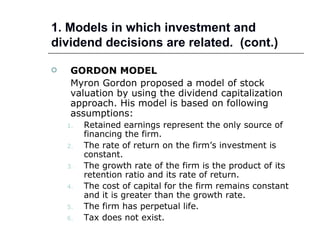
    GORDON MODEL
     Myron Gordon proposed a model of stock
     valuation by using the dividend capitalization
     approach. His model is based on following
     assumptions:
    1.   Retained earnings represent the only source of
         financing the firm.
    2.   The rate of return on the firm’s investment is
         constant.
    3.   The growth rate of the firm is the product of its
         retention ratio and its rate of return.
    4.   The cost of capital for the firm remains constant
         and it is greater than the growth rate.
    5.   The firm has perpetual life.
    6.   Tax does not exist.
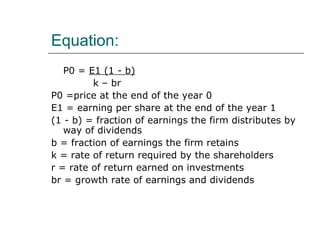
Equation:
   P0 = E1 (1 - b)
         k – br
P0 =price at the end of the year 0
E1 = earning per share at the end of the year 1
(1 - b) = fraction of earnings the firm distributes by
   way of dividends
b = fraction of earnings the firm retains
k = rate of return required by the shareholders
r = rate of return earned on investments
br = growth rate of earnings and dividends
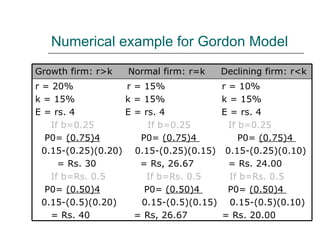
Numerical example for Gordon Model
Growth firm: r>k   Normal firm: r=k      Declining firm: r<k
r = 20%            r = 15%               r = 10%
k = 15%            k = 15%               k = 15%
E = rs. 4          E = rs. 4             E = rs. 4
    If b=0.25           If b=0.25          If b=0.25
   P0= (0.75)4        P0= (0.75)4             P0= (0.75)4
  0.15-(0.25)(0.20) 0.15-(0.25)(0.15)     0.15-(0.25)(0.10)
      = Rs. 30        = Rs, 26.67          = Rs. 24.00
    If b=Rs. 0.5        If b=Rs. 0.5       If b=Rs. 0.5
   P0= (0.50)4         P0= (0.50)4         P0= (0.50)4
  0.15-(0.5)(0.20)    0.15-(0.5)(0.15)     0.15-(0.5)(0.10)
    = Rs. 40         = Rs, 26.67         = Rs. 20.00
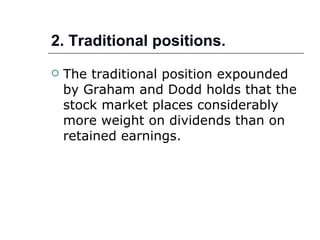
2. Traditional positions.
   The traditional position expounded
    by Graham and Dodd holds that the
    stock market places considerably
    more weight on dividends than on
    retained earnings.
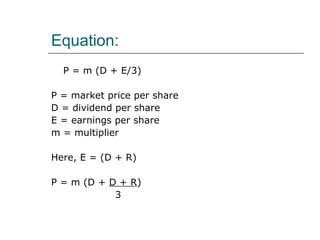
Equation:
  P = m (D + E/3)

P = market price per share
D = dividend per share
E = earnings per share
m = multiplier

Here, E = (D + R)

P = m (D + D + R)
            3
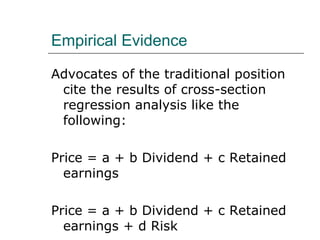
Empirical Evidence

Advocates of the traditional position
 cite the results of cross-section
 regression analysis like the
 following:

Price = a + b Dividend + c Retained
  earnings

Price = a + b Dividend + c Retained
  earnings + d Risk
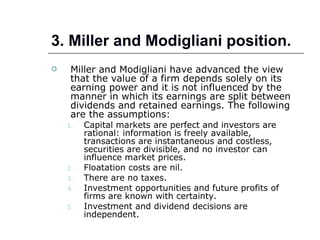
3. Miller and Modigliani position.
    Miller and Modigliani have advanced the view
     that the value of a firm depends solely on its
     earning power and it is not influenced by the
     manner in which its earnings are split between
     dividends and retained earnings. The following
     are the assumptions:
    1.   Capital markets are perfect and investors are
         rational: information is freely available,
         transactions are instantaneous and costless,
         securities are divisible, and no investor can
         influence market prices.
    2.   Floatation costs are nil.
    3.   There are no taxes.
    4.   Investment opportunities and future profits of
         firms are known with certainty.
    5.   Investment and dividend decisions are
         independent.
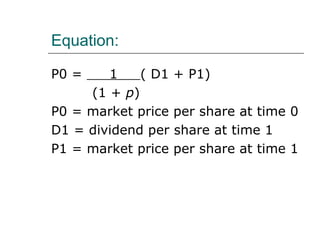
Equation:

P0 =    1    ( D1   + P1)
     (1 + p)
P0 = market price   per share at time 0
D1 = dividend per   share at time 1
P1 = market price   per share at time 1
Criticisms of MM Position
   Information About Prospects
   Uncertainty and Fluctuations
   Offering of Additional Equity at Lower
    Prices
   Issue Cost
   Transaction Cost
   Differential Rates of Taxes
   Rationing: Self-imposed or Market-
    imposed
   Unwise Investments
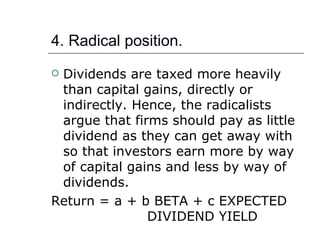
4. Radical position.
Dividends are taxed more heavily
 than capital gains, directly or
 indirectly. Hence, the radicalists
 argue that firms should pay as little
 dividend as they can get away with
 so that investors earn more by way
 of capital gains and less by way of
 dividends.
Return = a + b BETA + c EXPECTED
               DIVIDEND YIELD
5. Overall picture.
   Dividend policy and share value are
    two broad schools of thoughts

       Perfect market

       Imperfect market
Divident policy

Divident policy

  • 1.
    CHAPTER: DIVIDEND POLICYAND FIRM VALUE PRESENTED BY: VIKRAM RAJAI RAJKUMAR PRAJAPATI DIVYAKANT CHOPADA
  • 2.
    CONTENTS  DIVIDEND POLICY  FIVE SECTIONS OF DIVIDEND POLICY
  • 3.
    DIVIDEND POLICY WHY DIVIDEND POLICY ? Dividend policy of a firm determines what proportion of earnings is paid to shareholders by way of dividends and what proportion is ploughed back in the firm for investment purposes.
  • 4.
    FIVE SECTIONS OFDIVIDEND POLICY 1. Models in which investment and dividend decisions are related. 2. Traditional positions. 3. Miller and Modigliani position. 4. Radical position. 5. Overall picture.
  • 5.
    1. Models inwhich investment and dividend decisions are related.  WALTER MODEL James Walter has proposed a model of share valuation which supports the view that the dividend policy of the firm has the bearing on share valuation. His model is based on the following assumptions: 1. The firm is an all-equity financed entity. It will rely only on retained earnings to finance its future investments. This means that the investment decision is depend on the dividend decisions. 2. The rate of return on investments is constant. 3. The firm has an infinite life.
  • 6.
    Equation: P= D + (E - D)r/K k P = price per equity share D = dividend per share E = earnings per share (E - D) = retained earnings per share r = rate of return on investments k = cost of capital
  • 7.
    Numerical example forWalter Model Growth firm: r>k Normal firm: r=k Declining firm: r<k r = 20% r = 15% r = 10% k = 15% k = 15% k = 15% E = rs. 4 E = rs. 4 E = rs. 4 If D= 4 If D= 4 If D= 4 P0= 4+(0).20/.15 P0= 4+(0).15/.15 P0= 4+(0).10/.15 0.15 0.15 0.15 = Rs. 26.67 = Rs, 26.67 = Rs. 26.67 If D= 2 If D= 2 If D= 2 P0= 2+(0).20/.15 P0=2+(0).15/.15 P0= 2+(0).10/.15 0.15 0.15 0.15 = Rs. 31.11 = Rs, 26.67 = Rs. 22.22
  • 8.
    1. Models inwhich investment and dividend decisions are related. (cont.)  GORDON MODEL Myron Gordon proposed a model of stock valuation by using the dividend capitalization approach. His model is based on following assumptions: 1. Retained earnings represent the only source of financing the firm. 2. The rate of return on the firm’s investment is constant. 3. The growth rate of the firm is the product of its retention ratio and its rate of return. 4. The cost of capital for the firm remains constant and it is greater than the growth rate. 5. The firm has perpetual life. 6. Tax does not exist.
  • 9.
    Equation: P0 = E1 (1 - b) k – br P0 =price at the end of the year 0 E1 = earning per share at the end of the year 1 (1 - b) = fraction of earnings the firm distributes by way of dividends b = fraction of earnings the firm retains k = rate of return required by the shareholders r = rate of return earned on investments br = growth rate of earnings and dividends
  • 10.
    Numerical example forGordon Model Growth firm: r>k Normal firm: r=k Declining firm: r<k r = 20% r = 15% r = 10% k = 15% k = 15% k = 15% E = rs. 4 E = rs. 4 E = rs. 4 If b=0.25 If b=0.25 If b=0.25 P0= (0.75)4 P0= (0.75)4 P0= (0.75)4 0.15-(0.25)(0.20) 0.15-(0.25)(0.15) 0.15-(0.25)(0.10) = Rs. 30 = Rs, 26.67 = Rs. 24.00 If b=Rs. 0.5 If b=Rs. 0.5 If b=Rs. 0.5 P0= (0.50)4 P0= (0.50)4 P0= (0.50)4 0.15-(0.5)(0.20) 0.15-(0.5)(0.15) 0.15-(0.5)(0.10) = Rs. 40 = Rs, 26.67 = Rs. 20.00
  • 11.
    2. Traditional positions.  The traditional position expounded by Graham and Dodd holds that the stock market places considerably more weight on dividends than on retained earnings.
  • 12.
    Equation: P= m (D + E/3) P = market price per share D = dividend per share E = earnings per share m = multiplier Here, E = (D + R) P = m (D + D + R) 3
  • 13.
    Empirical Evidence Advocates ofthe traditional position cite the results of cross-section regression analysis like the following: Price = a + b Dividend + c Retained earnings Price = a + b Dividend + c Retained earnings + d Risk
  • 14.
    3. Miller andModigliani position.  Miller and Modigliani have advanced the view that the value of a firm depends solely on its earning power and it is not influenced by the manner in which its earnings are split between dividends and retained earnings. The following are the assumptions: 1. Capital markets are perfect and investors are rational: information is freely available, transactions are instantaneous and costless, securities are divisible, and no investor can influence market prices. 2. Floatation costs are nil. 3. There are no taxes. 4. Investment opportunities and future profits of firms are known with certainty. 5. Investment and dividend decisions are independent.
  • 15.
    Equation: P0 = 1 ( D1 + P1) (1 + p) P0 = market price per share at time 0 D1 = dividend per share at time 1 P1 = market price per share at time 1
  • 16.
    Criticisms of MMPosition  Information About Prospects  Uncertainty and Fluctuations  Offering of Additional Equity at Lower Prices  Issue Cost  Transaction Cost  Differential Rates of Taxes  Rationing: Self-imposed or Market- imposed  Unwise Investments
  • 17.
    4. Radical position. Dividendsare taxed more heavily than capital gains, directly or indirectly. Hence, the radicalists argue that firms should pay as little dividend as they can get away with so that investors earn more by way of capital gains and less by way of dividends. Return = a + b BETA + c EXPECTED DIVIDEND YIELD
  • 18.
    5. Overall picture.  Dividend policy and share value are two broad schools of thoughts  Perfect market  Imperfect market