Presentation on:
FINANCIAL MANAGEMENT
By:-
SALMAN UL FARISY .C.A
SHAHEER.K.P
SANJAY KUMAR K
TOPIC:
Dividend policy meaning :
Dividend policy is concerned with financial policies
regarding paying cash dividend in the present or paying
an increased dividend at a later stage.
• Dividend Policies involve the decisions, whether-
– To retain earnings for capital investment and other
purposes; or
– To distribute earnings in the form of dividend among
shareholders; or
– To retain some earning and to distribute remaining
earnings to shareholders.
Dividend models used in Indian corporate
sectors
Walter’s Model
Gordon’s Model
Modigliani-Miller Model
Walter's model
Walter's model shows the relevance of dividend policy and its
bearing on the value of the share.
Assumptions of the Walter model
•Retained earnings are the only source of financing investments
in the firm, there is no external finance involved.
•The cost of capital, k e and the rate of return on investment, r
are constant i.e. even if new investments decisions are taken,
the risks of the business remains same.
•The firm's life is endless i.e. there is no closing down.
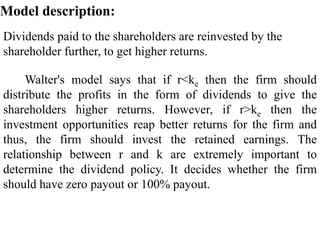
Dividends paid to the shareholders are reinvested by the
shareholder further, to get higher returns.
Model description:
Walter's model says that if r<ke then the firm should
distribute the profits in the form of dividends to give the
shareholders higher returns. However, if r>ke then the
investment opportunities reap better returns for the firm and
thus, the firm should invest the retained earnings. The
relationship between r and k are extremely important to
determine the dividend policy. It decides whether the firm
should have zero payout or 100% payout.
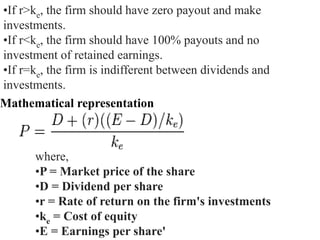
•If r>ke, the firm should have zero payout and make
investments.
•If r<ke, the firm should have 100% payouts and no
investment of retained earnings.
•If r=ke, the firm is indifferent between dividends and
investments.
Mathematical representation
where,
•P = Market price of the share
•D = Dividend per share
•r = Rate of return on the firm's investments
•ke = Cost of equity
•E = Earnings per share'
The market price of the share consists of the sum total of:
•the present value of an infinite stream of dividends
•the present value of an infinite stream of returns on
investments made from retained earnings.
Gordon's Model
Myron J. Gordon has also supported dividend relevance and
believes in regular dividends affecting the share price of the
firm.
The Assumptions of the Gordon model
Gordon's assumptions are similar to the ones given by Walter.
However, there are two additional assumptions proposed by
him :
•The product of retention ratio b and the rate of return r gives
us the growth rate of the firm g.
•The cost of capital ke, is not only constant but greater than the
growth rate i.e. ke>g.
Model description:
Investors are risk averse and believe that incomes from
dividends are certain rather than incomes from future capital
gains, therefore they predict future capital gains to be risky
propositions. They discount the future capital gains at a higher
rate than the firm's earnings, thereby evaluating a higher value
of the share. In short, when retention rate increases, they require
a higher discounting rate. Gordon has given a model similar to
Waltematical formula to determine price of the share.
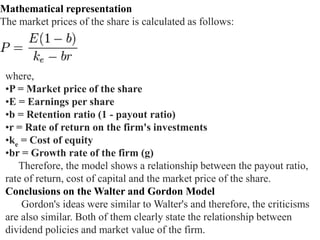
Mathematical representation
The market prices of the share is calculated as follows:
where,
•P = Market price of the share
•E = Earnings per share
•b = Retention ratio (1 - payout ratio)
•r = Rate of return on the firm's investments
•ke = Cost of equity
•br = Growth rate of the firm (g)
Therefore, the model shows a relationship between the payout ratio,
rate of return, cost of capital and the market price of the share.
Conclusions on the Walter and Gordon Model
Gordon's ideas were similar to Walter's and therefore, the criticisms
are also similar. Both of them clearly state the relationship between
dividend policies and market value of the firm.
Modigliani-Miller theorem
The Modigliani–Miller theorem states that the division
of retained earnings between new investment and
dividends do not influence the value of the firm. It is
the investment pattern and consequently the earnings
of the firm which affect the share price or the value of
the firm.
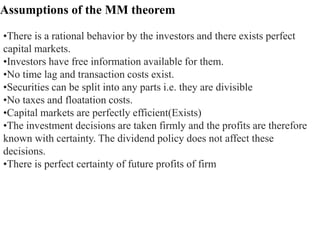
Assumptions of the MM theorem
•There is a rational behavior by the investors and there exists perfect
capital markets.
•Investors have free information available for them.
•No time lag and transaction costs exist.
•Securities can be split into any parts i.e. they are divisible
•No taxes and floatation costs.
•Capital markets are perfectly efficient(Exists)
•The investment decisions are taken firmly and the profits are therefore
known with certainty. The dividend policy does not affect these
decisions.
•There is perfect certainty of future profits of firm
Model description
The dividend irrelevancy in this model exists because
shareholders are indifferent between paying out dividends and
investing retained earnings in new opportunities
The firm finances opportunities either through retained
earnings or by issuing new shares to raise capital
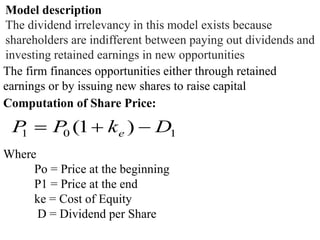
Computation of Share Price:
101 )1( DkPP e 
Where
Po = Price at the beginning
P1 = Price at the end
ke = Cost of Equity
D = Dividend per Share
Corporate dividend practice in India
• The typical dividend policy of most firm is to retain between
1/3 to half of the net earnings and distribute the remaining
amount to share holders.
•Companies in India specify dividends in term of a dividend
rate which is percentage of the paid up capital per share
Factors affecting the Dividend Policy
1) Firm’s Investment Opportunities And
Financial Needs
2) Shareholder’s Expectations
3) Legal Restrictions
4) Liquidity
5) Financial Condition And Borrowing Capacity
6) Access To Capital Market
7) Control
FORMS OF DIVIDEND
CASH DIVIDEND:
BONUS SHARES:
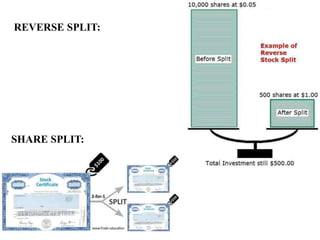
REVERSE SPLIT:
SHARE SPLIT:
Financial management

Financial management

  • 1.
    Presentation on: FINANCIAL MANAGEMENT By:- SALMANUL FARISY .C.A SHAHEER.K.P SANJAY KUMAR K
  • 2.
  • 3.
    Dividend policy meaning: Dividend policy is concerned with financial policies regarding paying cash dividend in the present or paying an increased dividend at a later stage. • Dividend Policies involve the decisions, whether- – To retain earnings for capital investment and other purposes; or – To distribute earnings in the form of dividend among shareholders; or – To retain some earning and to distribute remaining earnings to shareholders.
  • 4.
    Dividend models usedin Indian corporate sectors Walter’s Model Gordon’s Model Modigliani-Miller Model
  • 5.
    Walter's model Walter's modelshows the relevance of dividend policy and its bearing on the value of the share. Assumptions of the Walter model •Retained earnings are the only source of financing investments in the firm, there is no external finance involved. •The cost of capital, k e and the rate of return on investment, r are constant i.e. even if new investments decisions are taken, the risks of the business remains same. •The firm's life is endless i.e. there is no closing down.
  • 6.
    Dividends paid tothe shareholders are reinvested by the shareholder further, to get higher returns. Model description: Walter's model says that if r<ke then the firm should distribute the profits in the form of dividends to give the shareholders higher returns. However, if r>ke then the investment opportunities reap better returns for the firm and thus, the firm should invest the retained earnings. The relationship between r and k are extremely important to determine the dividend policy. It decides whether the firm should have zero payout or 100% payout.
  • 7.
    •If r>ke, thefirm should have zero payout and make investments. •If r<ke, the firm should have 100% payouts and no investment of retained earnings. •If r=ke, the firm is indifferent between dividends and investments. Mathematical representation where, •P = Market price of the share •D = Dividend per share •r = Rate of return on the firm's investments •ke = Cost of equity •E = Earnings per share'
  • 8.
    The market priceof the share consists of the sum total of: •the present value of an infinite stream of dividends •the present value of an infinite stream of returns on investments made from retained earnings.
  • 9.
    Gordon's Model Myron J.Gordon has also supported dividend relevance and believes in regular dividends affecting the share price of the firm. The Assumptions of the Gordon model Gordon's assumptions are similar to the ones given by Walter. However, there are two additional assumptions proposed by him : •The product of retention ratio b and the rate of return r gives us the growth rate of the firm g. •The cost of capital ke, is not only constant but greater than the growth rate i.e. ke>g.
  • 10.
    Model description: Investors arerisk averse and believe that incomes from dividends are certain rather than incomes from future capital gains, therefore they predict future capital gains to be risky propositions. They discount the future capital gains at a higher rate than the firm's earnings, thereby evaluating a higher value of the share. In short, when retention rate increases, they require a higher discounting rate. Gordon has given a model similar to Waltematical formula to determine price of the share.
  • 11.
    Mathematical representation The marketprices of the share is calculated as follows: where, •P = Market price of the share •E = Earnings per share •b = Retention ratio (1 - payout ratio) •r = Rate of return on the firm's investments •ke = Cost of equity •br = Growth rate of the firm (g) Therefore, the model shows a relationship between the payout ratio, rate of return, cost of capital and the market price of the share. Conclusions on the Walter and Gordon Model Gordon's ideas were similar to Walter's and therefore, the criticisms are also similar. Both of them clearly state the relationship between dividend policies and market value of the firm.
  • 12.
    Modigliani-Miller theorem The Modigliani–Millertheorem states that the division of retained earnings between new investment and dividends do not influence the value of the firm. It is the investment pattern and consequently the earnings of the firm which affect the share price or the value of the firm.
  • 13.
    Assumptions of theMM theorem •There is a rational behavior by the investors and there exists perfect capital markets. •Investors have free information available for them. •No time lag and transaction costs exist. •Securities can be split into any parts i.e. they are divisible •No taxes and floatation costs. •Capital markets are perfectly efficient(Exists) •The investment decisions are taken firmly and the profits are therefore known with certainty. The dividend policy does not affect these decisions. •There is perfect certainty of future profits of firm
  • 14.
    Model description The dividendirrelevancy in this model exists because shareholders are indifferent between paying out dividends and investing retained earnings in new opportunities The firm finances opportunities either through retained earnings or by issuing new shares to raise capital Computation of Share Price: 101 )1( DkPP e  Where Po = Price at the beginning P1 = Price at the end ke = Cost of Equity D = Dividend per Share
  • 15.
    Corporate dividend practicein India • The typical dividend policy of most firm is to retain between 1/3 to half of the net earnings and distribute the remaining amount to share holders. •Companies in India specify dividends in term of a dividend rate which is percentage of the paid up capital per share Factors affecting the Dividend Policy 1) Firm’s Investment Opportunities And Financial Needs 2) Shareholder’s Expectations 3) Legal Restrictions 4) Liquidity 5) Financial Condition And Borrowing Capacity 6) Access To Capital Market 7) Control
  • 16.
    FORMS OF DIVIDEND CASHDIVIDEND: BONUS SHARES:
  • 17.