Presented by
Dharmender kumar
   Dividend Policy refers to the explicit or implicit decision of
    the Board of Directors regarding the amount of residual
    earnings (past or present) that should be distributed to
    the shareholders of the corporation.

•   This decision is considered a financing decision because
    the profits of the corporation are an important source of
    financing available to the firm.
 Firm has 2 choices
  • Pay dividend
  • Reinvest funds instead of paying out
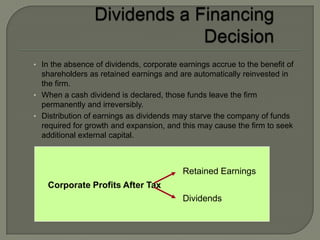
• In the absence of dividends, corporate earnings accrue to the benefit of
  shareholders as retained earnings and are automatically reinvested in
  the firm.
• When a cash dividend is declared, those funds leave the firm
  permanently and irreversibly.
• Distribution of earnings as dividends may starve the company of funds
  required for growth and expansion, and this may cause the firm to seek
  additional external capital.


                                          Retained Earnings
    Corporate Profits After Tax
                                          Dividends
   There is no legal obligation for firms to pay dividends to
    common shareholders
   Shareholders cannot force a Board of Directors to
    declare a dividend, and courts will not interfere with the
    BOD’s right to make the dividend decision.
   THEORY OF IRRELEVANCE
      1. Residual approach
      2. Miller and Modgilani approach
   THEORY OF RELEVANCE
       1. Walter’s approach
       2. Gorden approach
 Dividend    irrelevance theory is one of the
  major theories concerning dividend policy
  in an enterprise. It was first developed by
  Franco Modigliani and Merton Miller in a
  famous seminal paper in1961.
 The authors claimed that neither the price
  of firm's stock nor its cost of capital are
  affected by its dividend policy.
 This theory contain two theories.
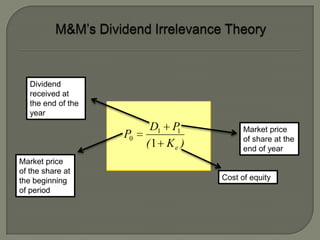
 According  to M-M, under a perfect market
 situation, the dividend policy of a firm is
 irrelevant, as it does not affect the value of
 the firm.
Dividend
   received at
   the end of the
   year
                          D1 P1          Market price
                    P0                   of share at the
                         (1 Ke )         end of year
Market price
of the share at
the beginning                      Cost of equity
of period
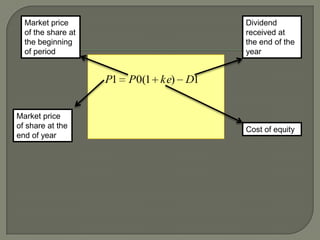
Market price                        Dividend
  of the share at                     received at
  the beginning                       the end of the
  of period                           year


                    P1 P 0(1 ke) D1


Market price
of share at the                       Cost of equity
end of year
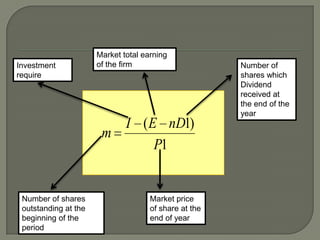
Market total earning
Investment            of the firm                      Number of
require                                                shares which
                                                       Dividend
                                                       received at
                                                       the end of the
                                                       year
                         I ( E nD1)
                       m
                              P1


 Number of shares                    Market price
 outstanding at the                  of share at the
 beginning of the                    end of year
 period
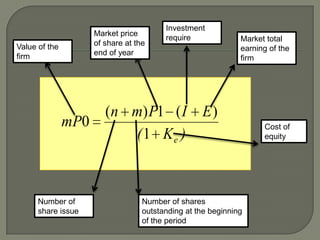
Investment
                     Market price
                                         require              Market total
Value of the         of share at the
                                                              earning of the
firm                 end of year
                                                              firm


                        (n m) P1 ( I E )
               mP0                                                  Cost of
                           (1 Ke )                                  equity


      Number of                    Number of shares
      share issue                  outstanding at the beginning
                                   of the period
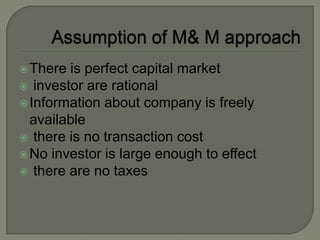
 There is perfect capital market
 investor are rational
 Information about company is freely
  available
 there is no transaction cost
 No investor is large enough to effect
 there are no taxes
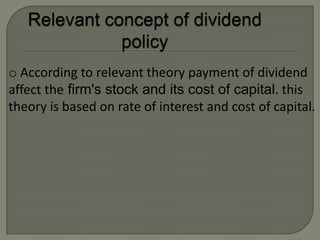
o According to relevant theory payment of dividend
affect the firm's stock and its cost of capital. this
theory is based on rate of interest and cost of capital.
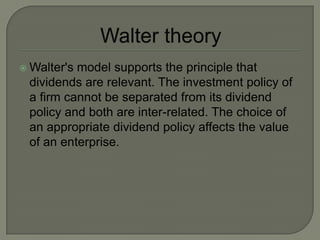
 Walter'smodel supports the principle that
 dividends are relevant. The investment policy of
 a firm cannot be separated from its dividend
 policy and both are inter-related. The choice of
 an appropriate dividend policy affects the value
 of an enterprise.
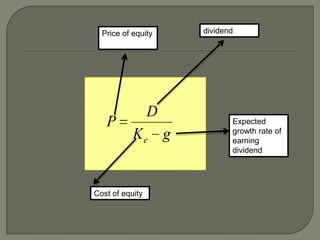
Price of equity    dividend


                 D
   P                        Expected
           Ke g             growth rate of
                            earning
                            dividend


Cost of equity
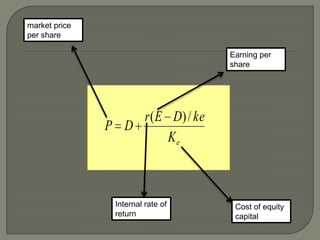
market price
per share

                                   Earning per
                                   share


                   r ( E D) / ke
               P D
                         Ke


                Internal rate of    Cost of equity
                return              capital
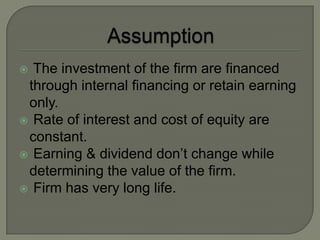
 The investment of the firm are financed
 through internal financing or retain earning
 only.
 Rate of interest and cost of equity are
 constant.
 Earning & dividend don’t change while
 determining the value of the firm.
 Firm has very long life.
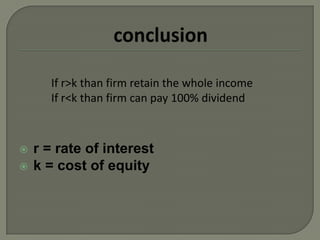
If r>k than firm retain the whole income
      If r<k than firm can pay 100% dividend


   r = rate of interest
   k = cost of equity
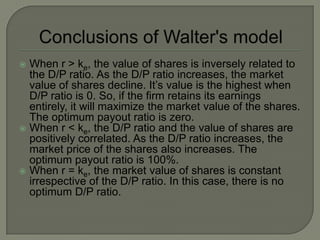
 When r > ke, the value of shares is inversely related to
  the D/P ratio. As the D/P ratio increases, the market
  value of shares decline. It’s value is the highest when
  D/P ratio is 0. So, if the firm retains its earnings
  entirely, it will maximize the market value of the shares.
  The optimum payout ratio is zero.
 When r < ke, the D/P ratio and the value of shares are
  positively correlated. As the D/P ratio increases, the
  market price of the shares also increases. The
  optimum payout ratio is 100%.
 When r = ke, the market value of shares is constant
  irrespective of the D/P ratio. In this case, there is no
  optimum D/P ratio.
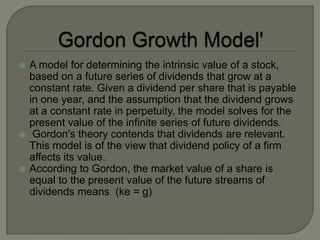
   A model for determining the intrinsic value of a stock,
    based on a future series of dividends that grow at a
    constant rate. Given a dividend per share that is payable
    in one year, and the assumption that the dividend grows
    at a constant rate in perpetuity, the model solves for the
    present value of the infinite series of future dividends.
    Gordon's theory contends that dividends are relevant.
    This model is of the view that dividend policy of a firm
    affects its value.
   According to Gordon, the market value of a share is
    equal to the present value of the future streams of
    dividends means (ke = g)
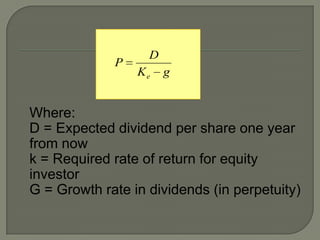
D
             P
                 Ke    g


Where:
D = Expected dividend per share one year
from now
k = Required rate of return for equity
investor
G = Growth rate in dividends (in perpetuity)
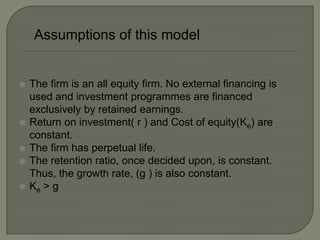
Assumptions of this model


   The firm is an all equity firm. No external financing is
    used and investment programmes are financed
    exclusively by retained earnings.
   Return on investment( r ) and Cost of equity(Ke) are
    constant.
   The firm has perpetual life.
   The retention ratio, once decided upon, is constant.
    Thus, the growth rate, (g ) is also constant.
   Ke > g
THANKS

Presentation on dividend policy

  • 1.
  • 2.
    Dividend Policy refers to the explicit or implicit decision of the Board of Directors regarding the amount of residual earnings (past or present) that should be distributed to the shareholders of the corporation. • This decision is considered a financing decision because the profits of the corporation are an important source of financing available to the firm.
  • 3.
     Firm has2 choices • Pay dividend • Reinvest funds instead of paying out
  • 4.
    • In theabsence of dividends, corporate earnings accrue to the benefit of shareholders as retained earnings and are automatically reinvested in the firm. • When a cash dividend is declared, those funds leave the firm permanently and irreversibly. • Distribution of earnings as dividends may starve the company of funds required for growth and expansion, and this may cause the firm to seek additional external capital. Retained Earnings Corporate Profits After Tax Dividends
  • 5.
    There is no legal obligation for firms to pay dividends to common shareholders  Shareholders cannot force a Board of Directors to declare a dividend, and courts will not interfere with the BOD’s right to make the dividend decision.
  • 6.
    THEORY OF IRRELEVANCE 1. Residual approach 2. Miller and Modgilani approach  THEORY OF RELEVANCE  1. Walter’s approach  2. Gorden approach
  • 7.
     Dividend irrelevance theory is one of the major theories concerning dividend policy in an enterprise. It was first developed by Franco Modigliani and Merton Miller in a famous seminal paper in1961.  The authors claimed that neither the price of firm's stock nor its cost of capital are affected by its dividend policy.  This theory contain two theories.
  • 8.
     According to M-M, under a perfect market situation, the dividend policy of a firm is irrelevant, as it does not affect the value of the firm.
  • 9.
    Dividend received at the end of the year D1 P1 Market price P0 of share at the (1 Ke ) end of year Market price of the share at the beginning Cost of equity of period
  • 10.
    Market price Dividend of the share at received at the beginning the end of the of period year P1 P 0(1 ke) D1 Market price of share at the Cost of equity end of year
  • 11.
    Market total earning Investment of the firm Number of require shares which Dividend received at the end of the year I ( E nD1) m P1 Number of shares Market price outstanding at the of share at the beginning of the end of year period
  • 12.
    Investment Market price require Market total Value of the of share at the earning of the firm end of year firm (n m) P1 ( I E ) mP0 Cost of (1 Ke ) equity Number of Number of shares share issue outstanding at the beginning of the period
  • 13.
     There isperfect capital market  investor are rational  Information about company is freely available  there is no transaction cost  No investor is large enough to effect  there are no taxes
  • 14.
    o According torelevant theory payment of dividend affect the firm's stock and its cost of capital. this theory is based on rate of interest and cost of capital.
  • 15.
     Walter'smodel supportsthe principle that dividends are relevant. The investment policy of a firm cannot be separated from its dividend policy and both are inter-related. The choice of an appropriate dividend policy affects the value of an enterprise.
  • 16.
    Price of equity dividend D P Expected Ke g growth rate of earning dividend Cost of equity
  • 17.
    market price per share Earning per share r ( E D) / ke P D Ke Internal rate of Cost of equity return capital
  • 18.
     The investmentof the firm are financed through internal financing or retain earning only.  Rate of interest and cost of equity are constant.  Earning & dividend don’t change while determining the value of the firm.  Firm has very long life.
  • 19.
    If r>k thanfirm retain the whole income If r<k than firm can pay 100% dividend  r = rate of interest  k = cost of equity
  • 20.
     When r> ke, the value of shares is inversely related to the D/P ratio. As the D/P ratio increases, the market value of shares decline. It’s value is the highest when D/P ratio is 0. So, if the firm retains its earnings entirely, it will maximize the market value of the shares. The optimum payout ratio is zero.  When r < ke, the D/P ratio and the value of shares are positively correlated. As the D/P ratio increases, the market price of the shares also increases. The optimum payout ratio is 100%.  When r = ke, the market value of shares is constant irrespective of the D/P ratio. In this case, there is no optimum D/P ratio.
  • 21.
    A model for determining the intrinsic value of a stock, based on a future series of dividends that grow at a constant rate. Given a dividend per share that is payable in one year, and the assumption that the dividend grows at a constant rate in perpetuity, the model solves for the present value of the infinite series of future dividends.  Gordon's theory contends that dividends are relevant. This model is of the view that dividend policy of a firm affects its value.  According to Gordon, the market value of a share is equal to the present value of the future streams of dividends means (ke = g)
  • 22.
    D P Ke g Where: D = Expected dividend per share one year from now k = Required rate of return for equity investor G = Growth rate in dividends (in perpetuity)
  • 23.
    Assumptions of thismodel  The firm is an all equity firm. No external financing is used and investment programmes are financed exclusively by retained earnings.  Return on investment( r ) and Cost of equity(Ke) are constant.  The firm has perpetual life.  The retention ratio, once decided upon, is constant. Thus, the growth rate, (g ) is also constant.  Ke > g
  • 24.