 “ A dividend is a distribution to shareholders out
of
profit or reserve available for this purpose”.
What is Dividend?
Types of Dividend
On the basis of types of
share
 Equity Dividend
 Preference
Dividend
On the basis of
mode of
payment
 Cash dividend
 Stock dividend
 Bond dividend
 Property dividend
 Composite dividend
 INTERIM DIVIDEND
 REGULAR
DIVIDEND
 SPECIAL DIVIDEND
ON THE BASIS OF TIME
OF PAYMENT
What is Dividend Policy
:“Dividend policy determines the division
of earnings between payments to
shareholders and retained earnings”.
Funds requirement
Liquidity
Access to external sources of financing
Shareholder preference
Difference in the cost of external equity and retained
earnings Control
Taxes
DIVIDEND
THEORIE
S
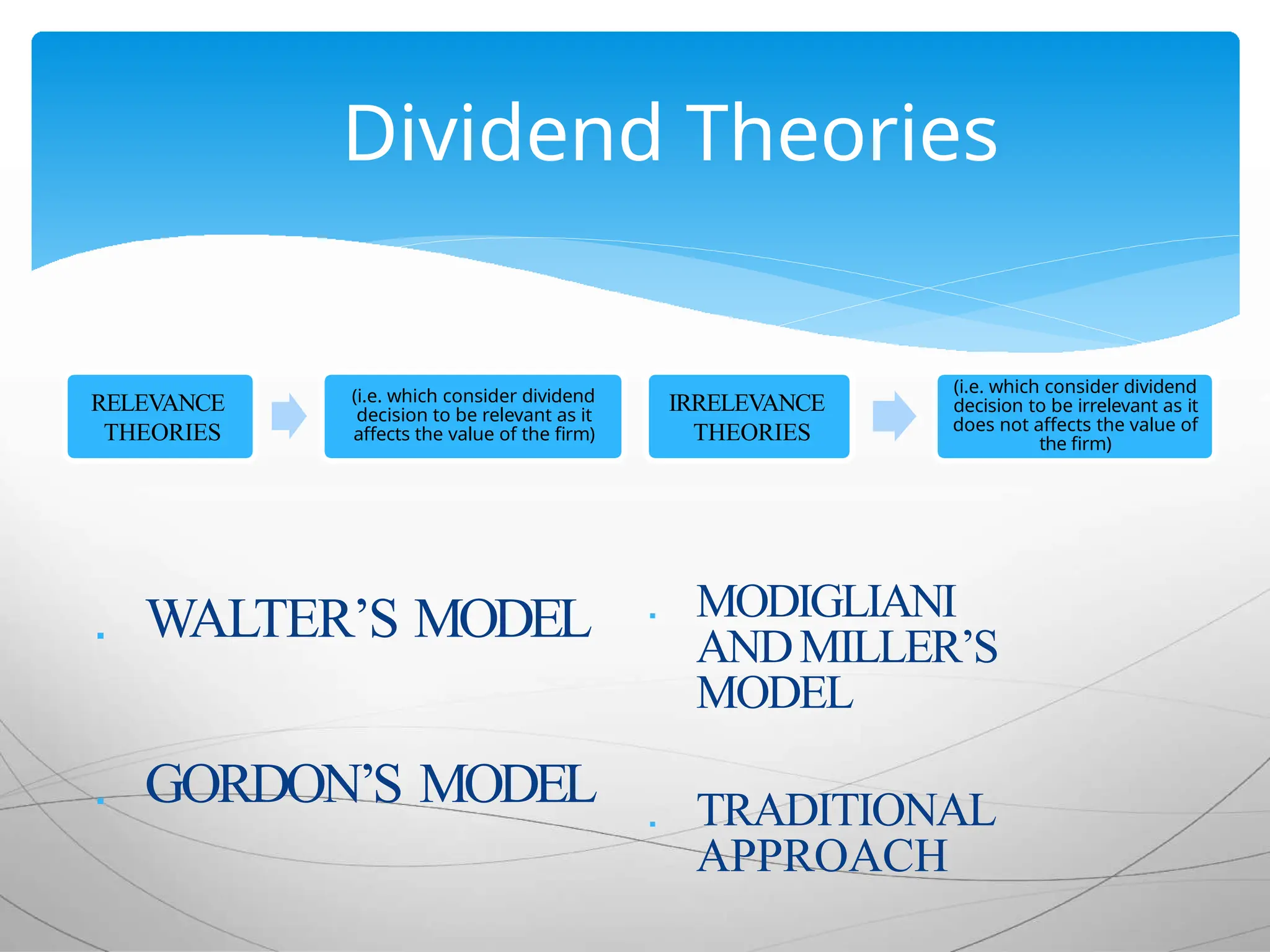
Dividend Theories
RELEVANCE
THEORIES
(i.e. which consider dividend
decision to be relevant as it
affects the value of the firm)
 WALTER’S MODEL
 GORDON’S MODEL
IRRELEVANCE
THEORIES
(i.e. which consider dividend
decision to be irrelevant as it
does not affects the value of
the firm)
 MODIGLIANI
ANDMILLER’S
MODEL
 TRADITIONAL
APPROACH
RELEVANCE
THEORIES
 PROF. JAMES E WALTER ARGUED THAT IN THE
LONG RUN THE SHARE PRICE REFLECT ONL
Y THE
PRESENT VALUE OF EXPECTED DIVIDENDS.
RETENTIONS INFLUENCE STOCK PRICE ONLY
THROUGH THEIR EFFECT ON FUTURE DIVIDENDS.
WALTER HAS FORMULATED THIS AND USED THE
DIVIDEND TO OPTIMIZE THE WEALTH OF THE
EQUITY SHAREHOLDERS.
WALTER’S MODEL
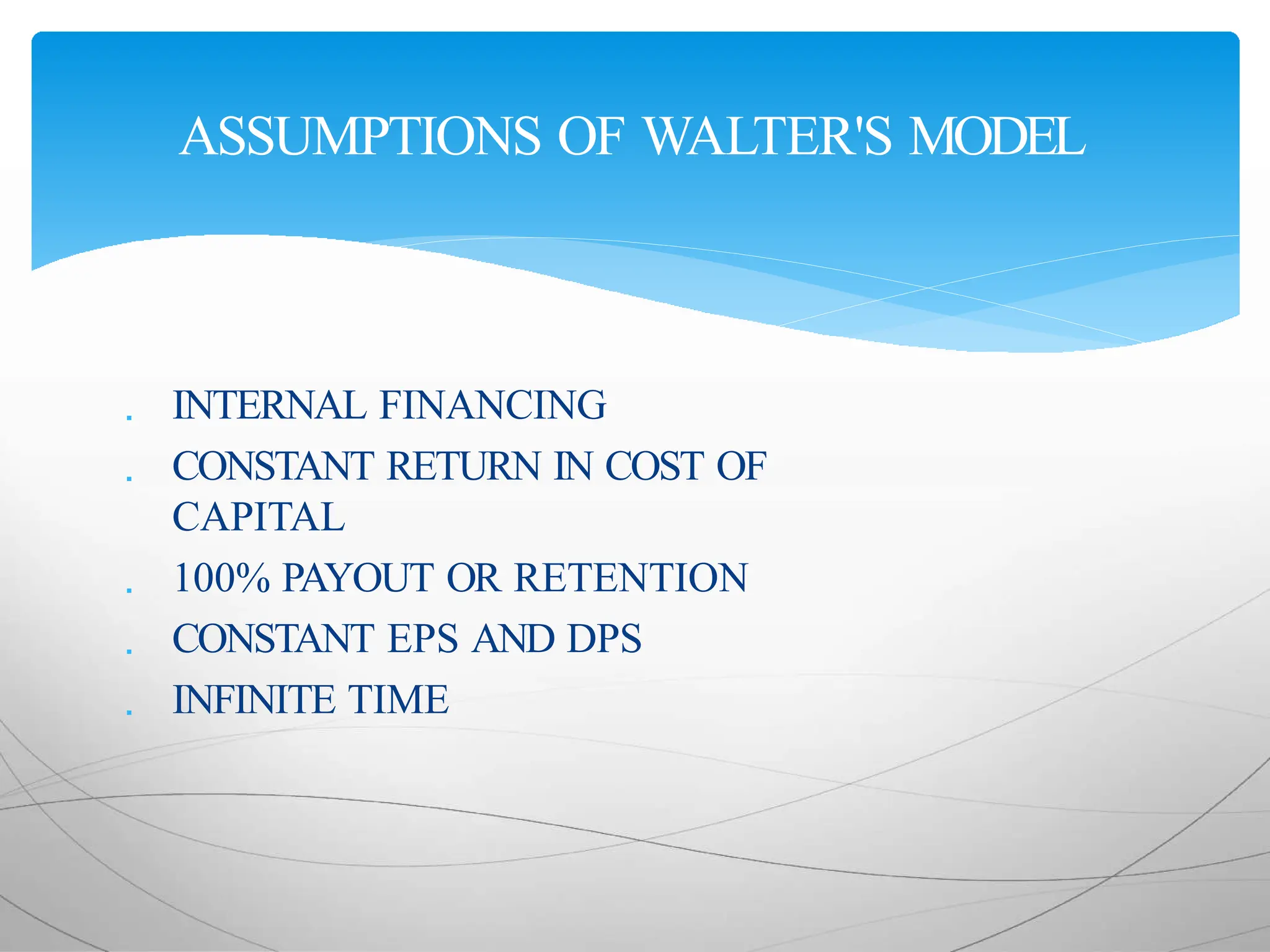
 INTERNAL FINANCING
 CONSTANT RETURN IN COST OF
CAPITAL
 100% PAYOUT OR RETENTION
 CONSTANT EPS AND DPS
 INFINITE TIME
ASSUMPTIONS OF WALTER'S MODEL
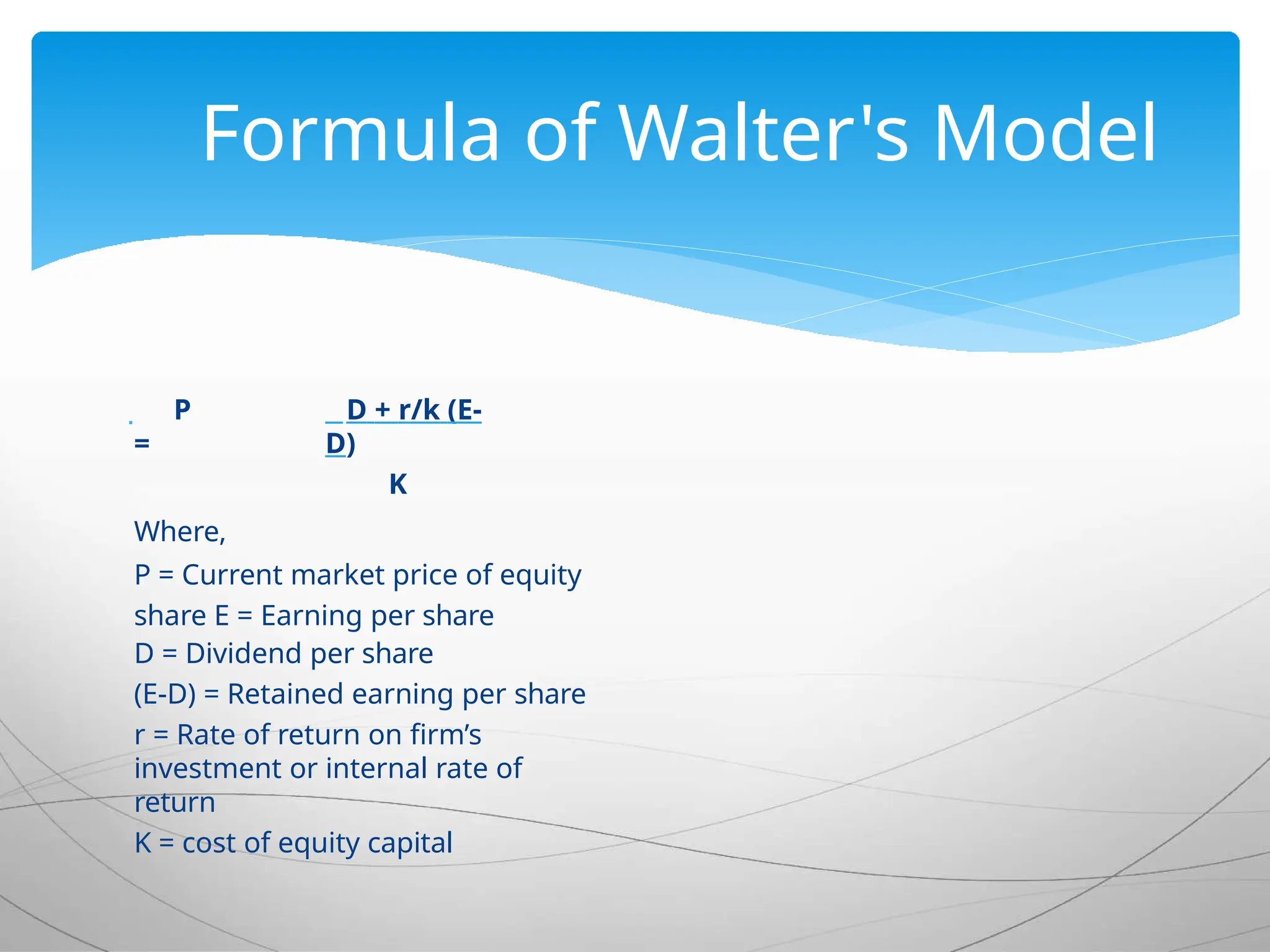
 P
=
D + r/k (E-
D)
K
Where,
P = Current market price of equity
share E = Earning per share
D = Dividend per share
(E-D) = Retained earning per share
r = Rate of return on firm’s
investment or internal rate of
return
K = cost of equity capital
Formula of Walter's Model
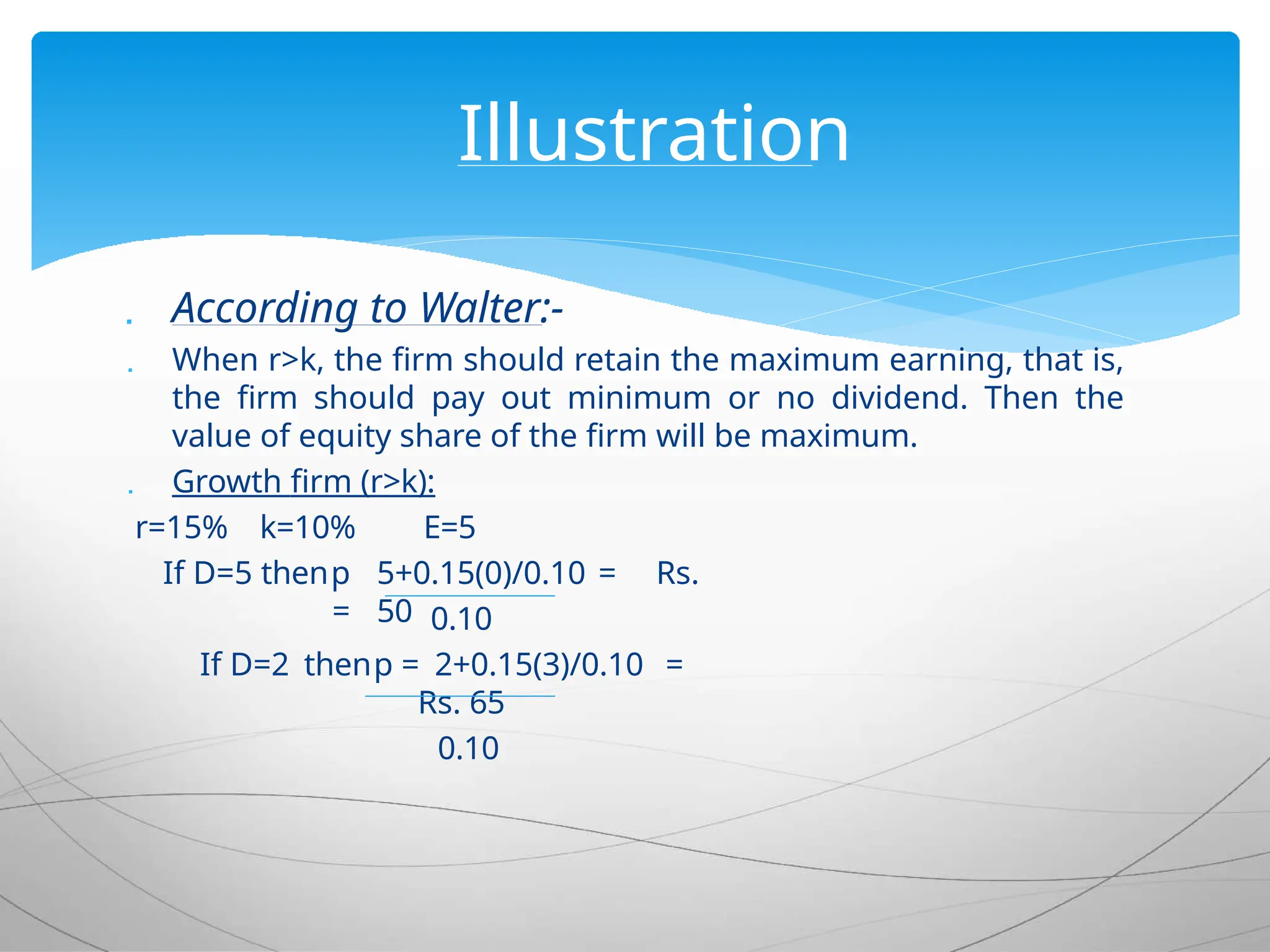
 According to Walter:-
 When r>k, the firm should retain the maximum earning, that is,
the firm should pay out minimum or no dividend. Then the
value of equity share of the firm will be maximum.
 Growth firm (r>k):
r=15% k=10%
If D=5 thenp
=
E=5
5+0.15(0)/0.10 = Rs.
50 0.10
If D=2 thenp = 2+0.15(3)/0.10 =
Rs. 65
0.10
Illustration
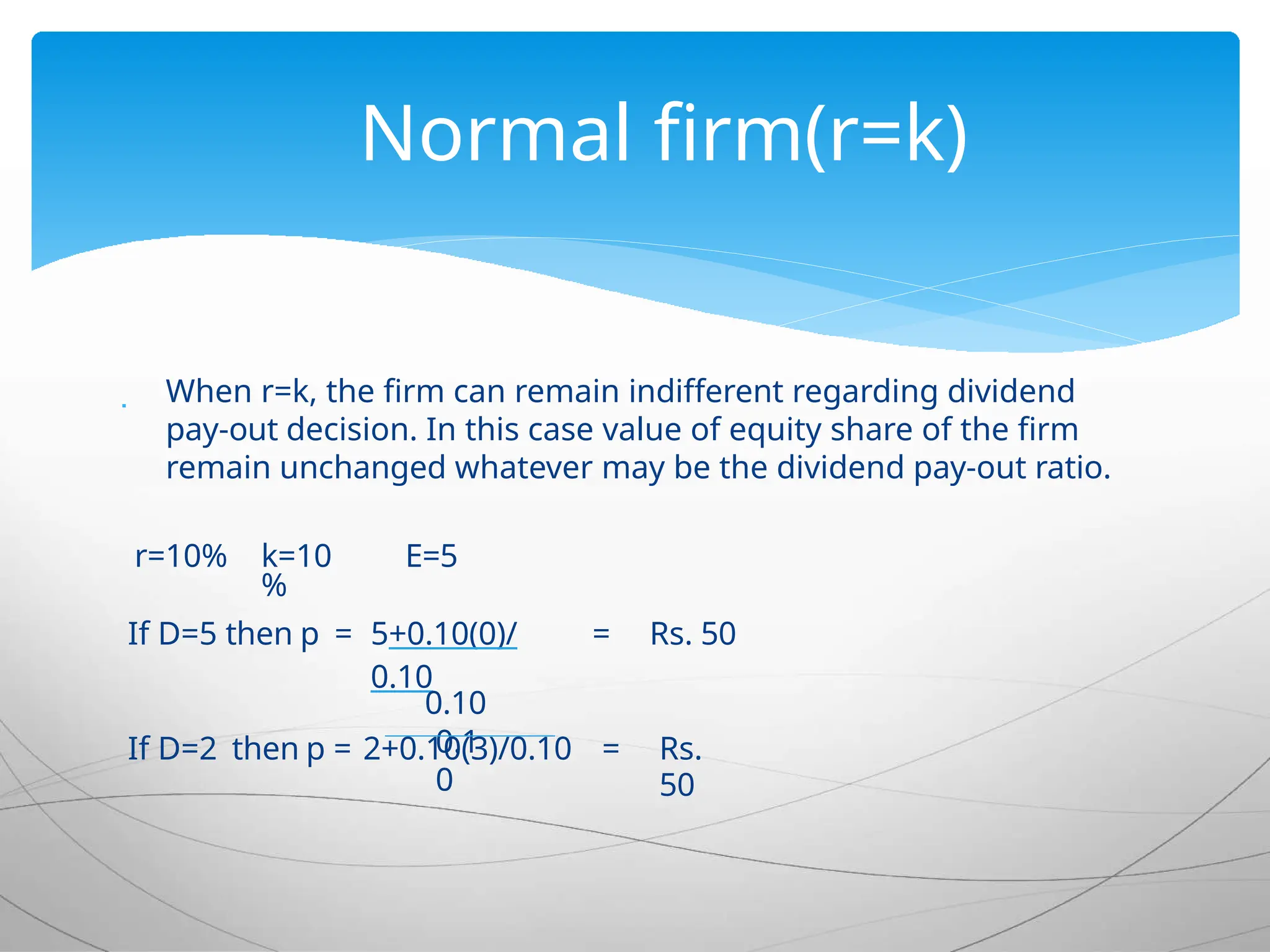
 When r=k, the firm can remain indifferent regarding dividend
pay-out decision. In this case value of equity share of the firm
remain unchanged whatever may be the dividend pay-out ratio.
r=10% k=10
%
E=5
If D=5 then p = 5+0.10(0)/
0.10
= Rs. 50
0.10
If D=2 then p = 2+0.10(3)/0.10 = Rs.
50
0.1
0
Normal firm(r=k)
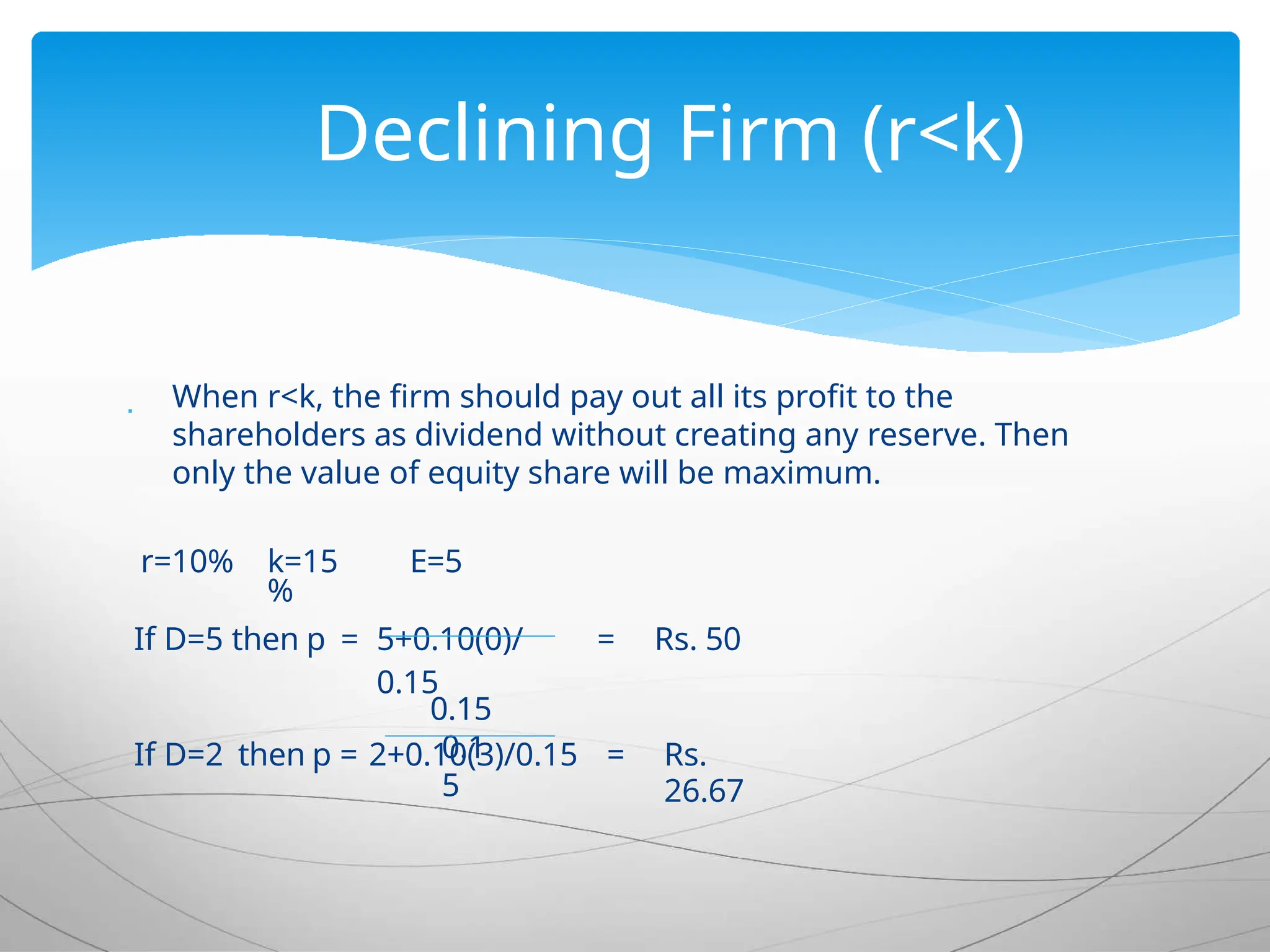
 When r<k, the firm should pay out all its profit to the
shareholders as dividend without creating any reserve. Then
only the value of equity share will be maximum.
r=10% k=15
%
E=5
If D=5 then p = 5+0.10(0)/
0.15
= Rs. 50
0.15
If D=2 then p = 2+0.10(3)/0.15 = Rs.
26.67
0.1
5
Declining Firm (r<k)
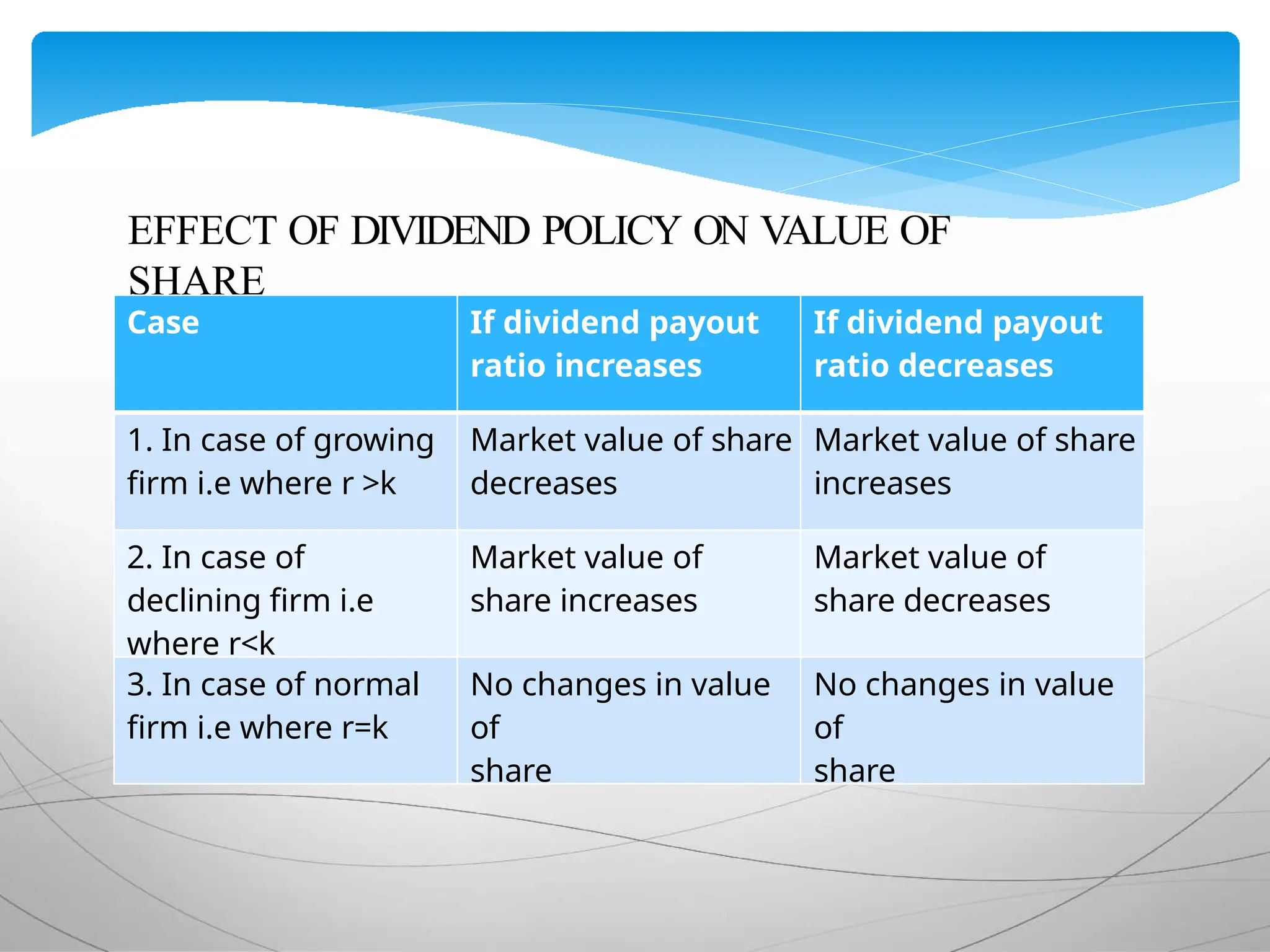
EFFECT OF DIVIDEND POLICY ON VALUE OF
SHARE
Case If dividend payout
ratio increases
If dividend payout
ratio decreases
1. In case of growing
firm i.e where r >k
Market value of share
decreases
Market value of share
increases
2. In case of
declining firm i.e
where r<k
Market value of
share increases
Market value of
share decreases
3. In case of normal
firm i.e where r=k
No changes in value
of
share
No changes in value
of
share
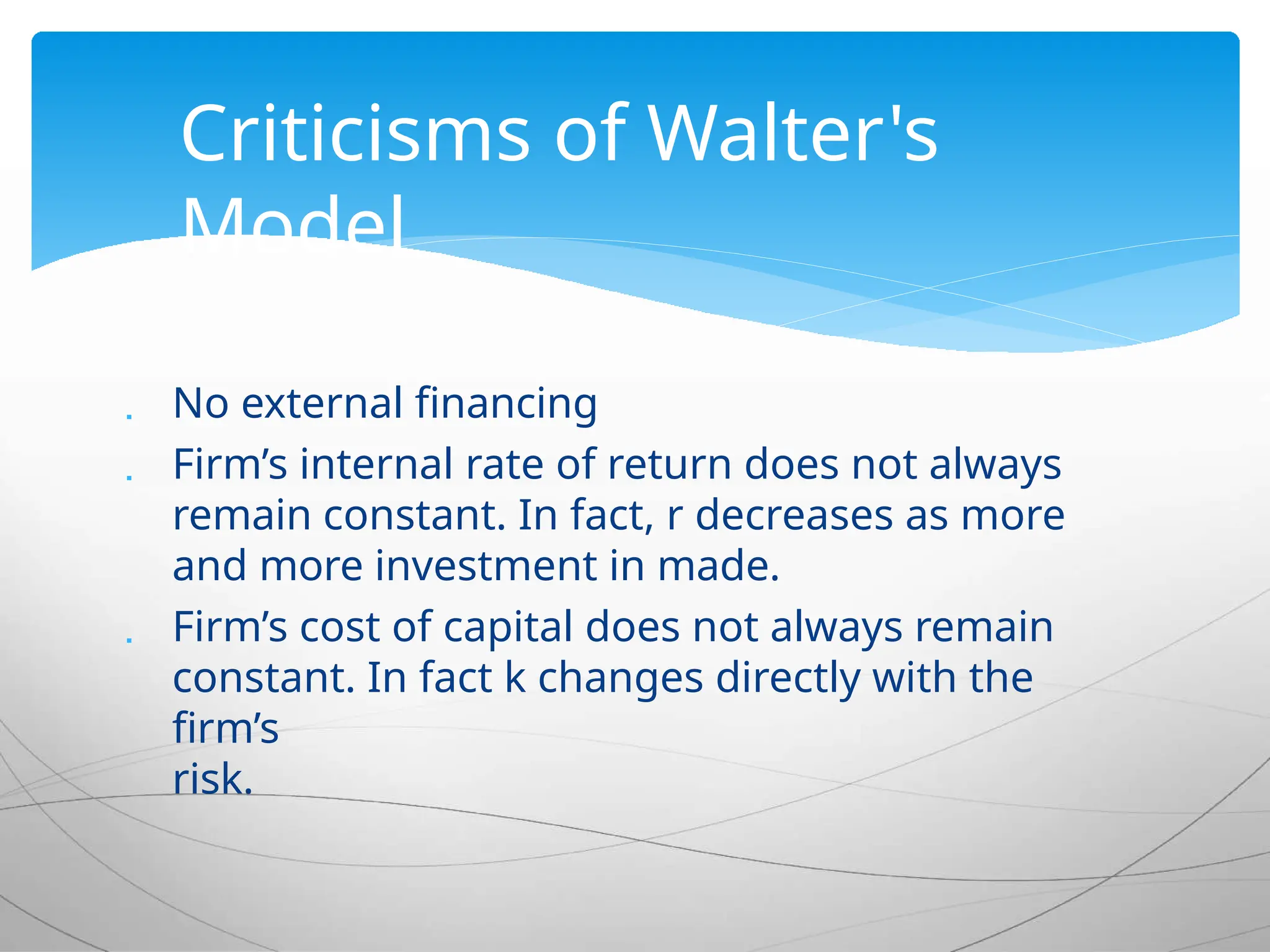
 No external financing
 Firm’s internal rate of return does not always
remain constant. In fact, r decreases as more
and more investment in made.
 Firm’s cost of capital does not always remain
constant. In fact k changes directly with the
firm’s
risk.
Criticisms of Walter's
Model
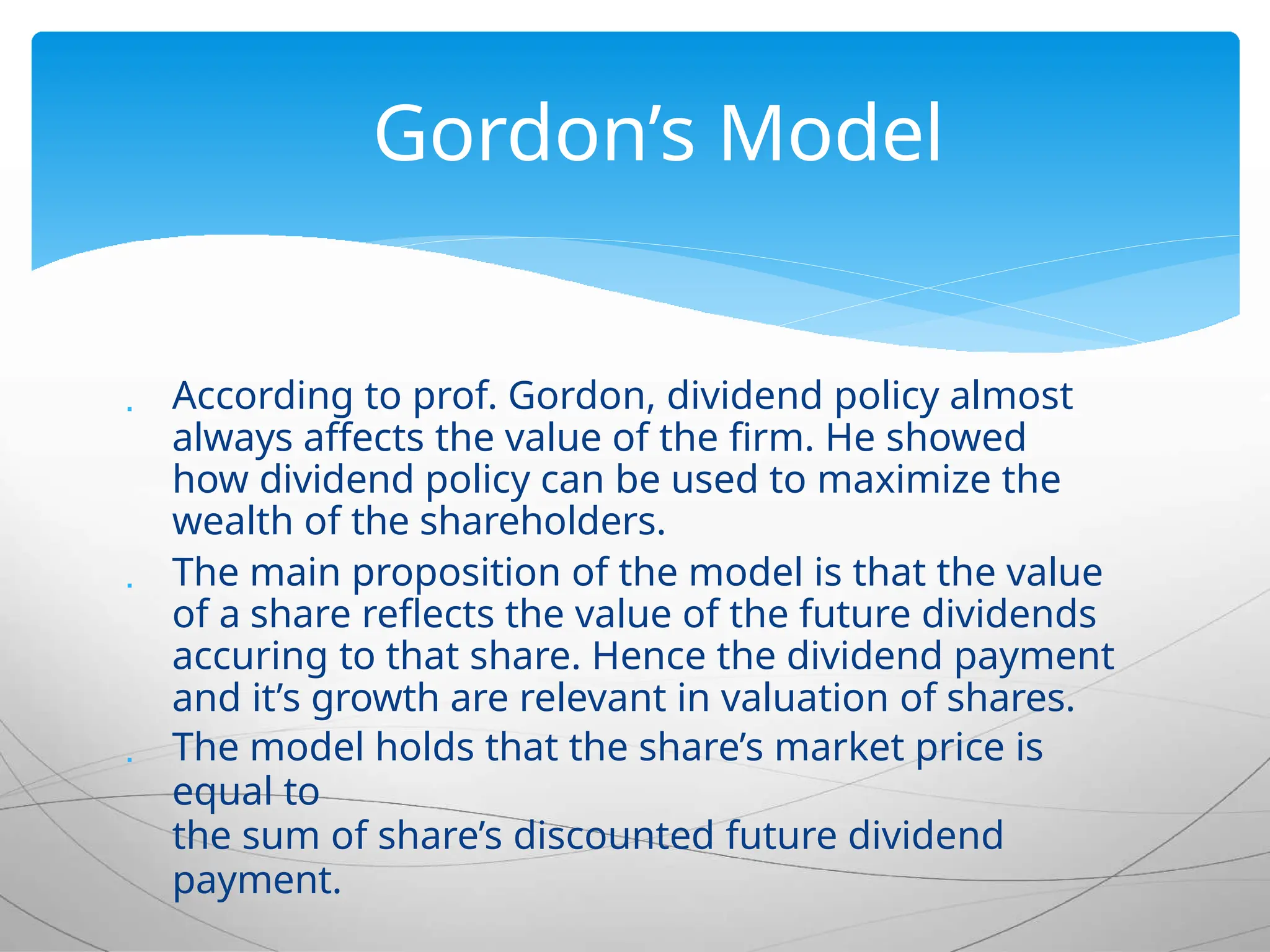
 According to prof. Gordon, dividend policy almost
always affects the value of the firm. He showed
how dividend policy can be used to maximize the
wealth of the shareholders.
 The main proposition of the model is that the value
of a share reflects the value of the future dividends
accuring to that share. Hence the dividend payment
and it’s growth are relevant in valuation of shares.
 The model holds that the share’s market price is
equal to
the sum of share’s discounted future dividend
payment.
Gordon’s Model
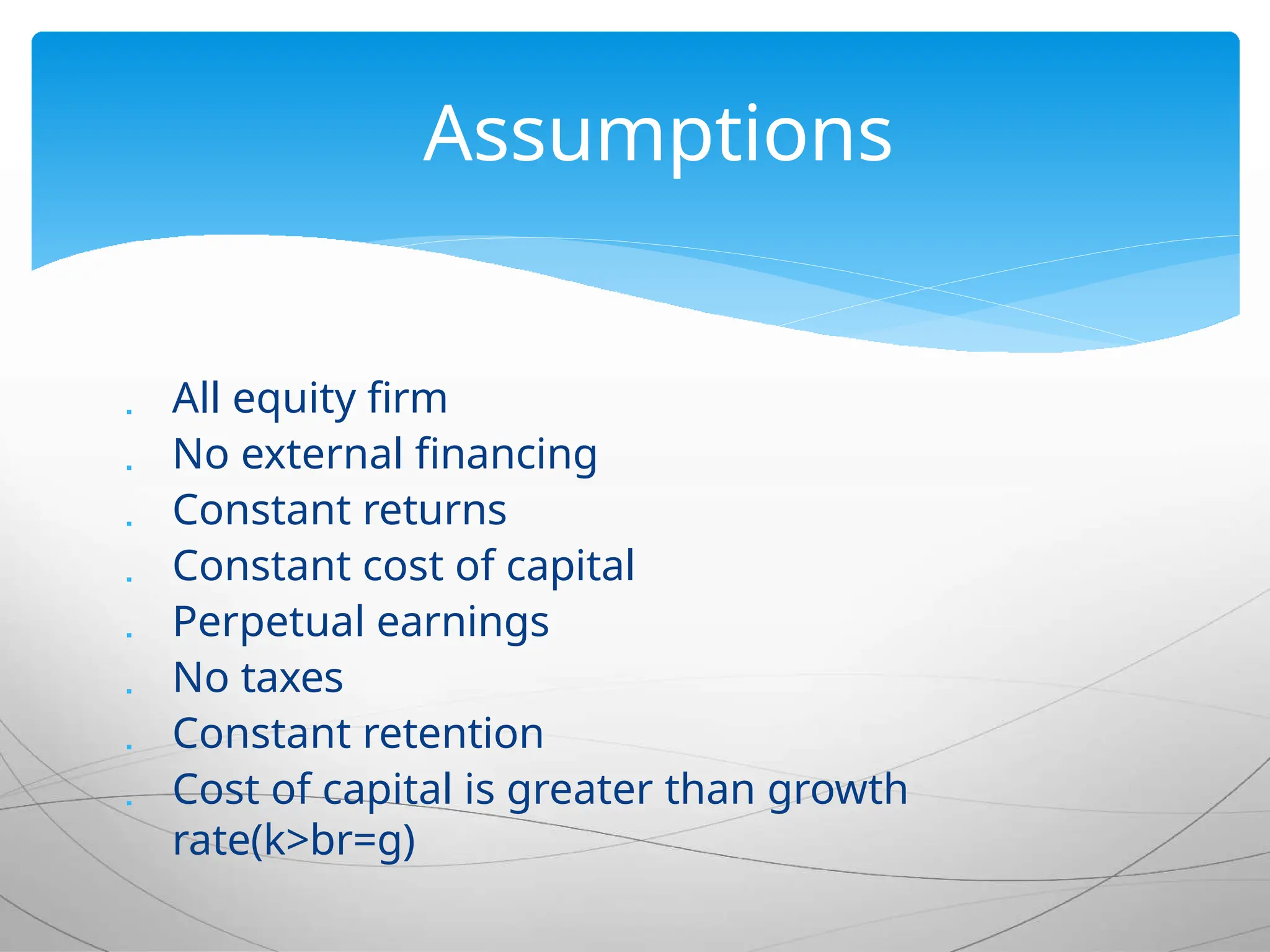
 All equity firm
 No external financing
 Constant returns
 Constant cost of capital
 Perpetual earnings
 No taxes
 Constant retention
 Cost of capital is greater than growth
rate(k>br=g)
Assumptions
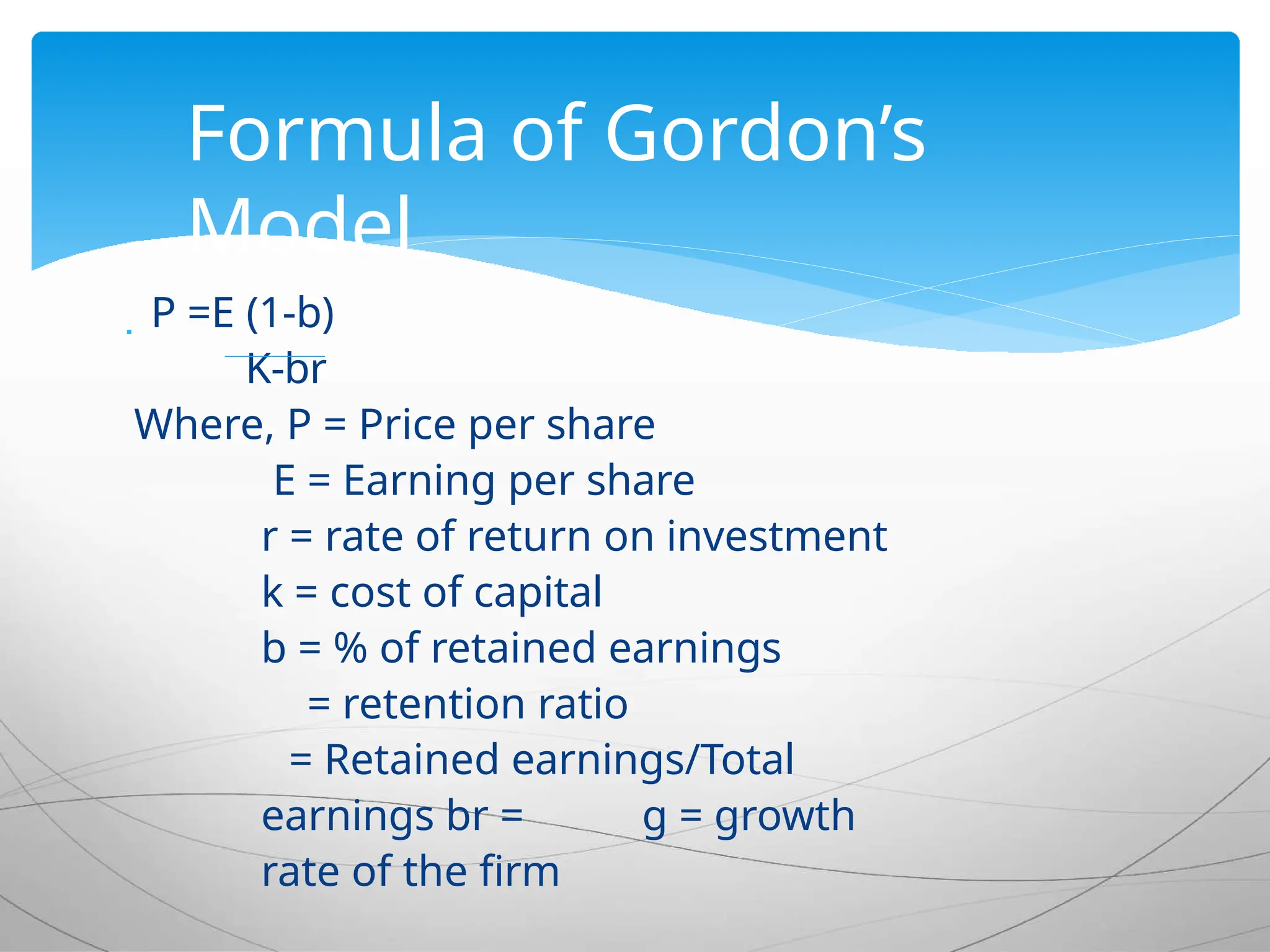
 P =E (1-b)
K-br
Where, P = Price per share
E = Earning per share
r = rate of return on investment
k = cost of capital
b = % of retained earnings
= retention ratio
= Retained earnings/Total
earnings br = g = growth
rate of the firm
Formula of Gordon’s
Model
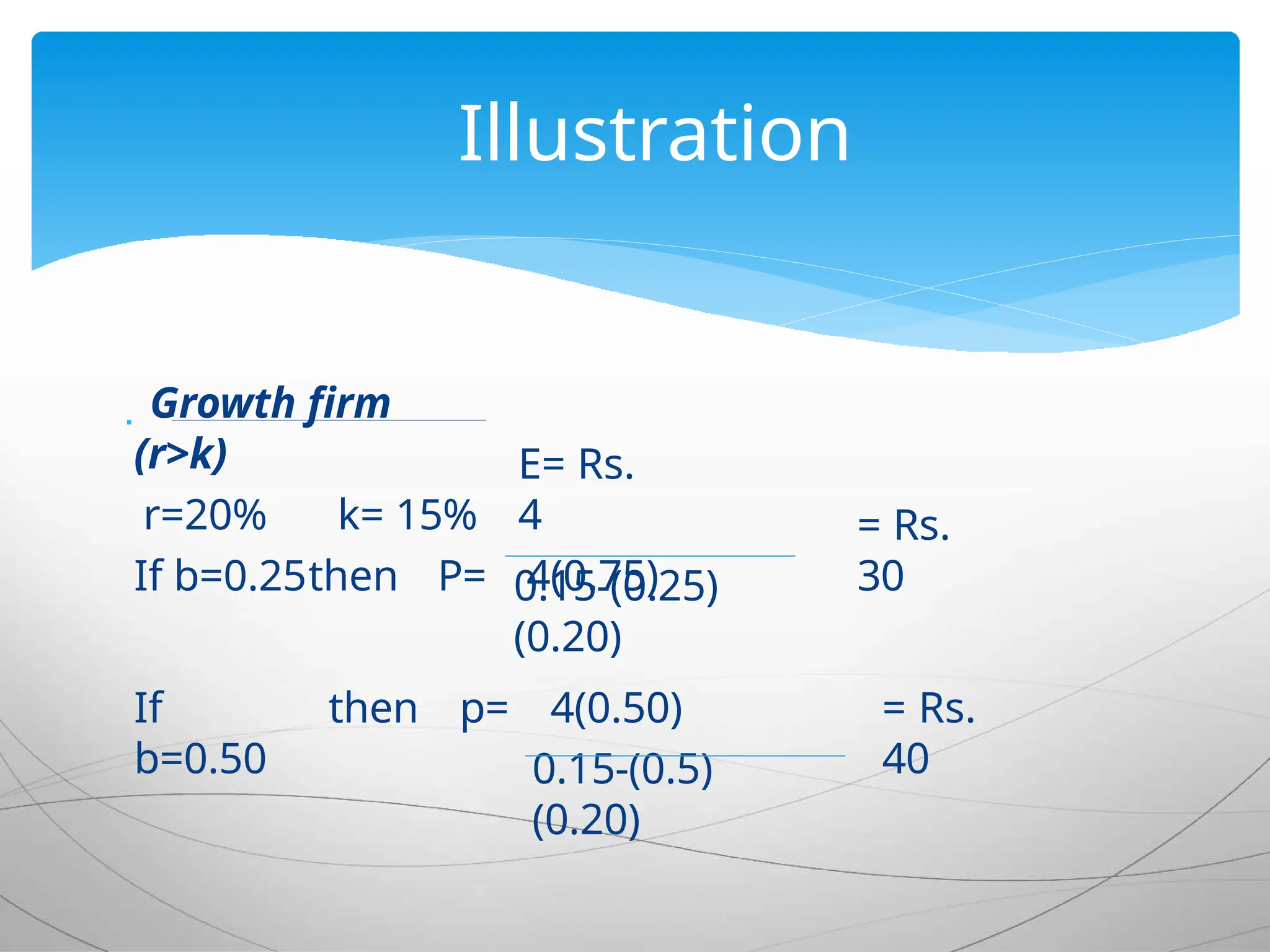
 Growth firm
(r>k)
r=20% k= 15%
If b=0.25then P=
E= Rs.
4
4(0.75)
= Rs.
30
0.15-(0.25)
(0.20)
If
b=0.50
= Rs.
40
then p= 4(0.50)
0.15-(0.5)
(0.20)
Illustration
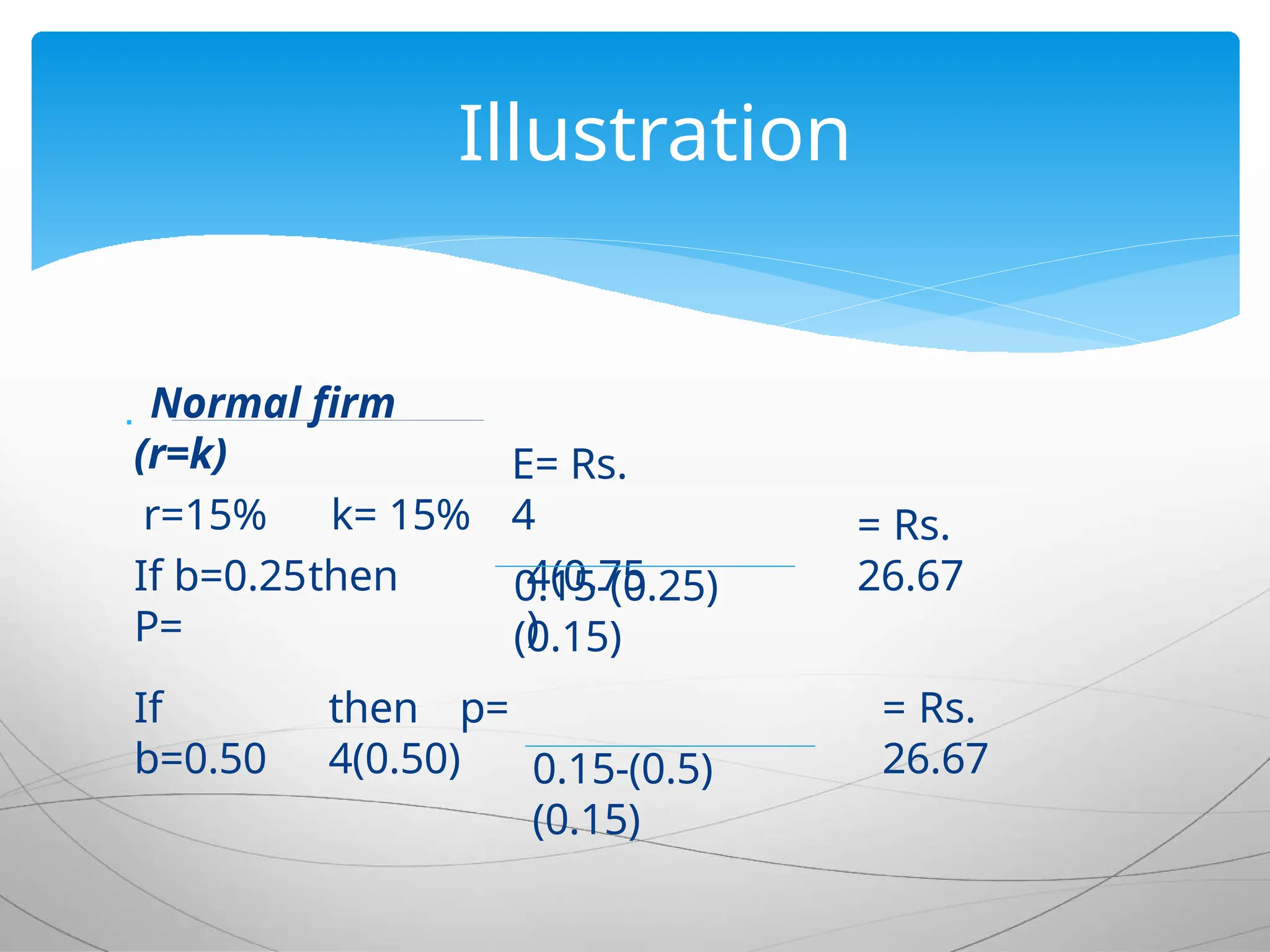
 Normal firm
(r=k)
r=15% k= 15%
If b=0.25then
P=
E= Rs.
4
4(0.75
)
= Rs.
26.67
0.15-(0.25)
(0.15)
If
b=0.50
then p=
4(0.50)
= Rs.
26.67
0.15-(0.5)
(0.15)
Illustration
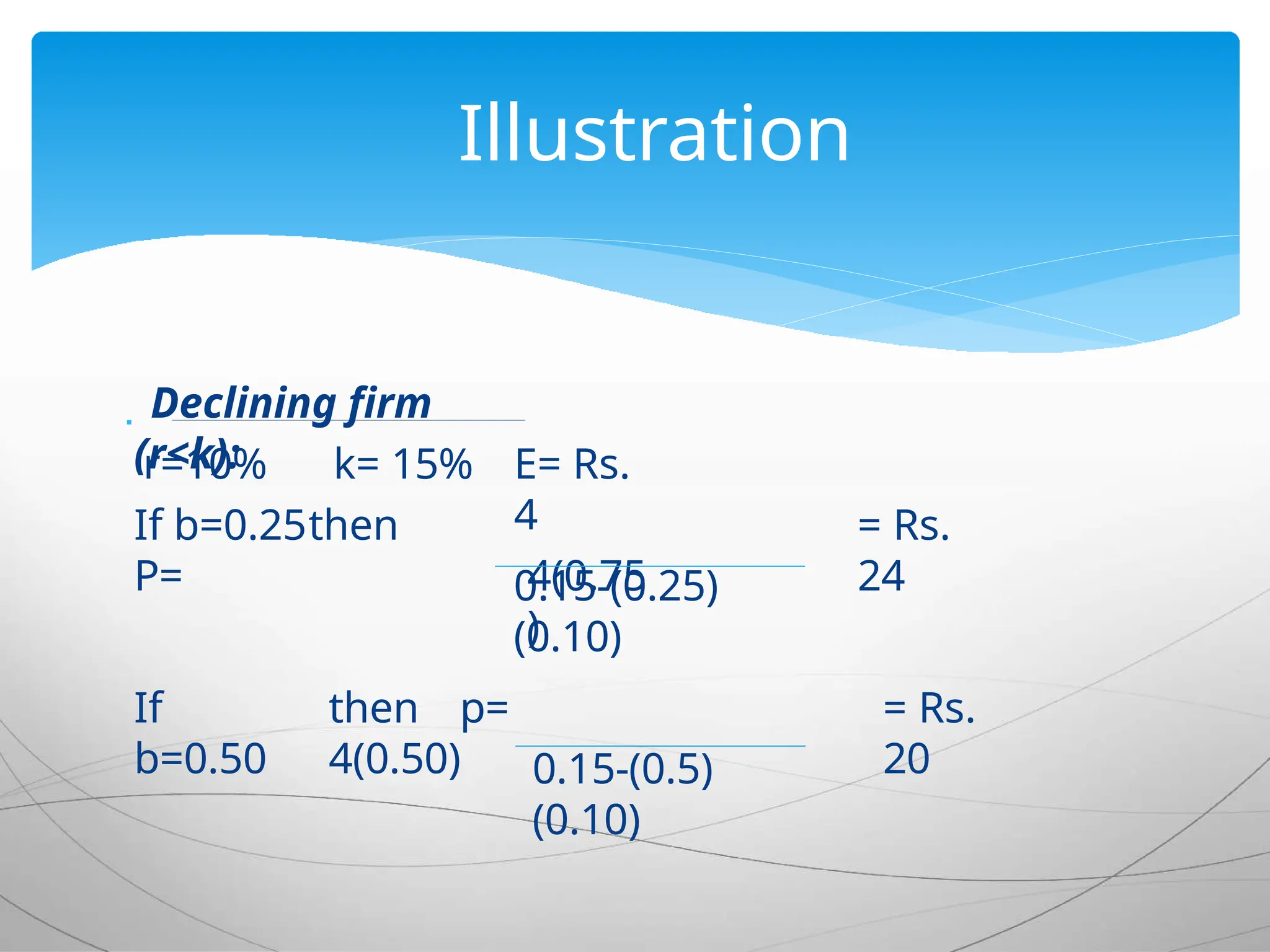
 Declining firm
(r<k):
r=10% k= 15%
If b=0.25then
P=
E= Rs.
4
4(0.75
)
= Rs.
24
0.15-(0.25)
(0.10)
If
b=0.50
then p=
4(0.50)
= Rs.
20
0.15-(0.5)
(0.10)
Illustration
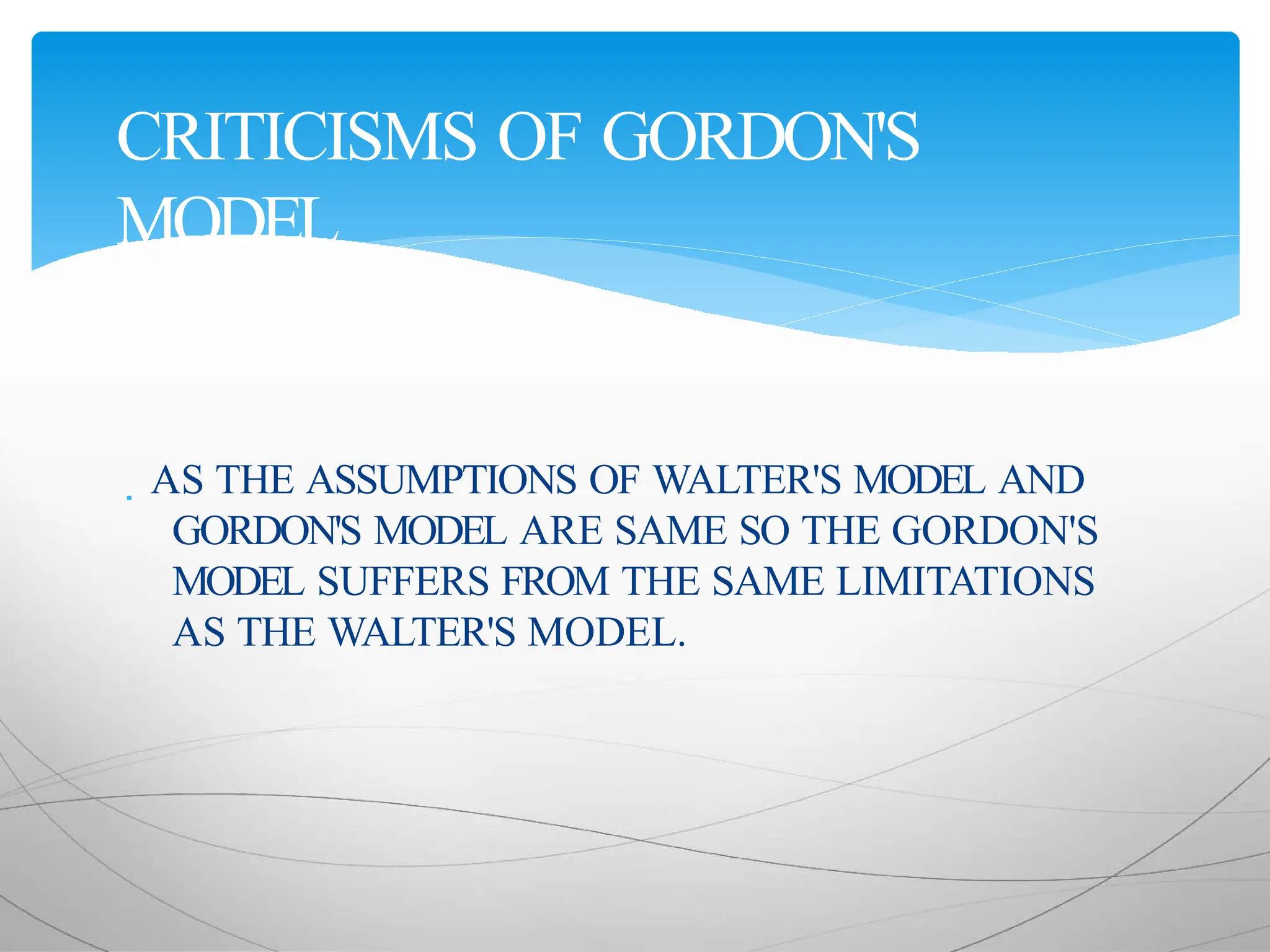
 AS THE ASSUMPTIONS OF WALTER'S MODEL AND
GORDON'S MODEL ARE SAME SO THE GORDON'S
MODEL SUFFERS FROM THE SAME LIMITATIONS
AS THE WALTER'S MODEL.
CRITICISMS OF GORDON'S
MODEL
IRRELEVANCE
THEORIES
 M-M Hypothesis provides the irrelevant concept of
dividend in comprehensive manner. According to
them, the dividend policy of a firm does not have
any effect on the price of share of a firm, i.e., it
does not affect the shareholders wealth.
Modigliani-Miller Hypothesis
for Dividend policy:-
 Existence of perfect capital market.
 Taxes do no exist.
 Investors behave rationally.
 Investment policy of the firm do not
change.
 Risk and uncertainty does not exist.
Assumptions:-
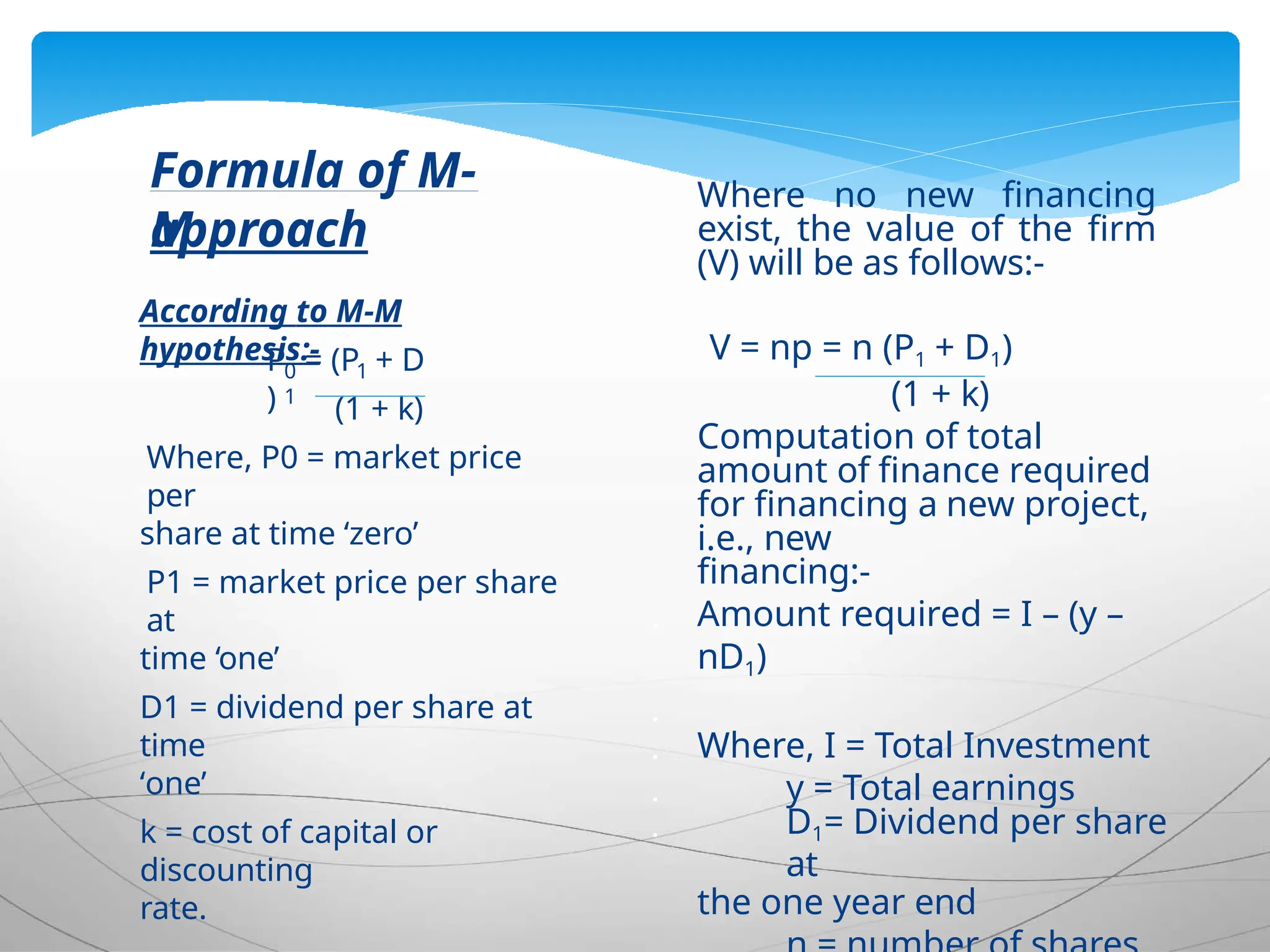
0 1
1
P = (P + D
) (1 + k)
Where, P0 = market price
per
share at time ‘zero’
P1 = market price per share
at
time ‘one’
D1 = dividend per share at
time
‘one’
k = cost of capital or
discounting
rate.
Formula of M-
M
approach
According to M-M
hypothesis:-
Where no new financing
exist, the value of the firm
(V) will be as follows:-

 V = np = n (P1 + D1)
 (1 + k)
 Computation of total
amount of finance required
for financing a new project,
i.e., new
financing:-
 Amount required = I – (y –
nD1)

 Where, I = Total Investment
 y = Total earnings
 D1= Dividend per share
at
the one year end

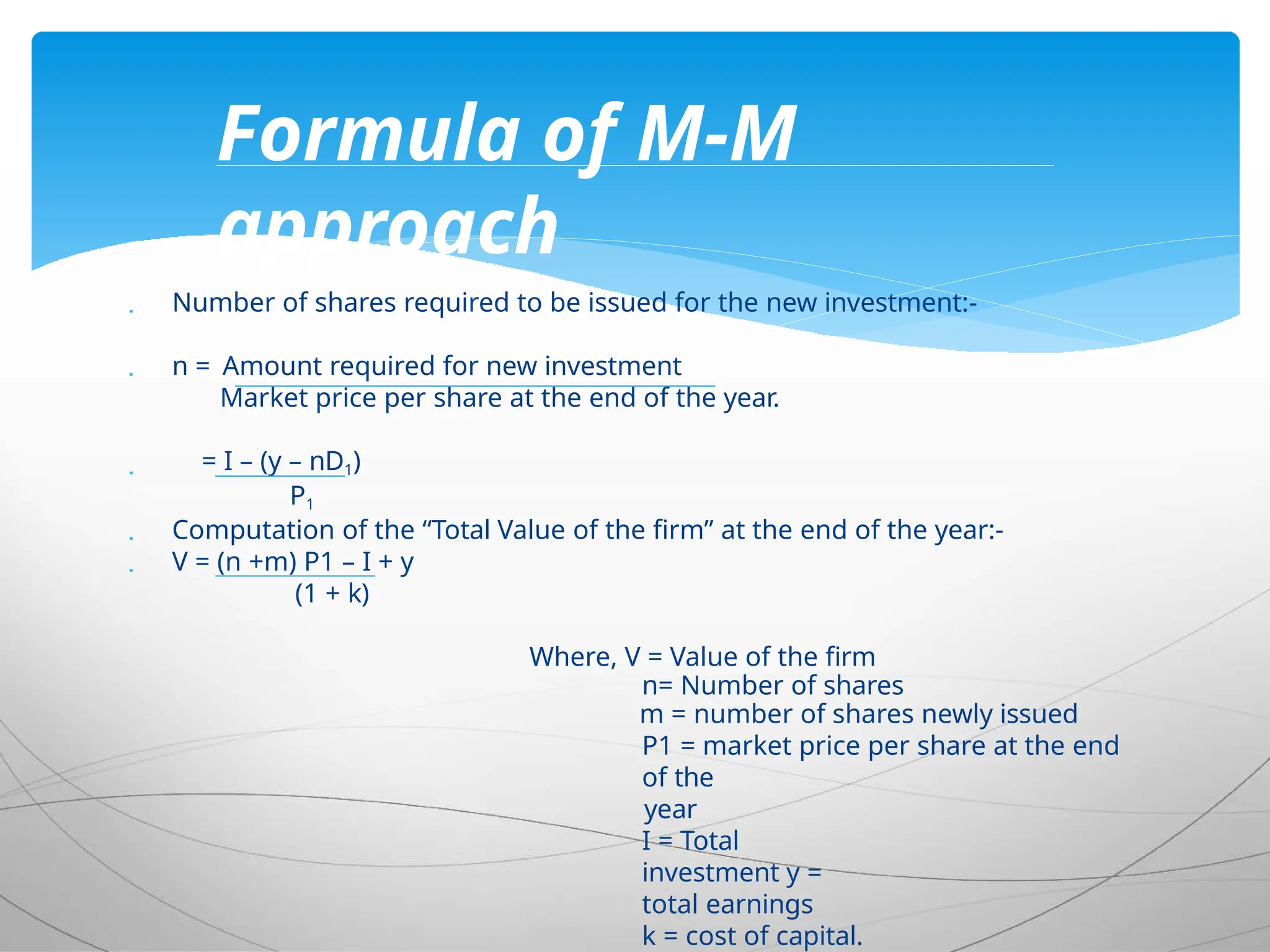
 Number of shares required to be issued for the new investment:-
 n = Amount required for new investment
Market price per share at the end of the year.
 = I – (y – nD1)
P1
 Computation of the “Total Value of the firm” at the end of the year:-
 V = (n +m) P1 – I + y
(1 + k)
Where, V = Value of the firm
n= Number of shares
m = number of shares newly issued
P1 = market price per share at the end
of the
year
I = Total
investment y =
total earnings
k = cost of capital.
Formula of M-M
approach
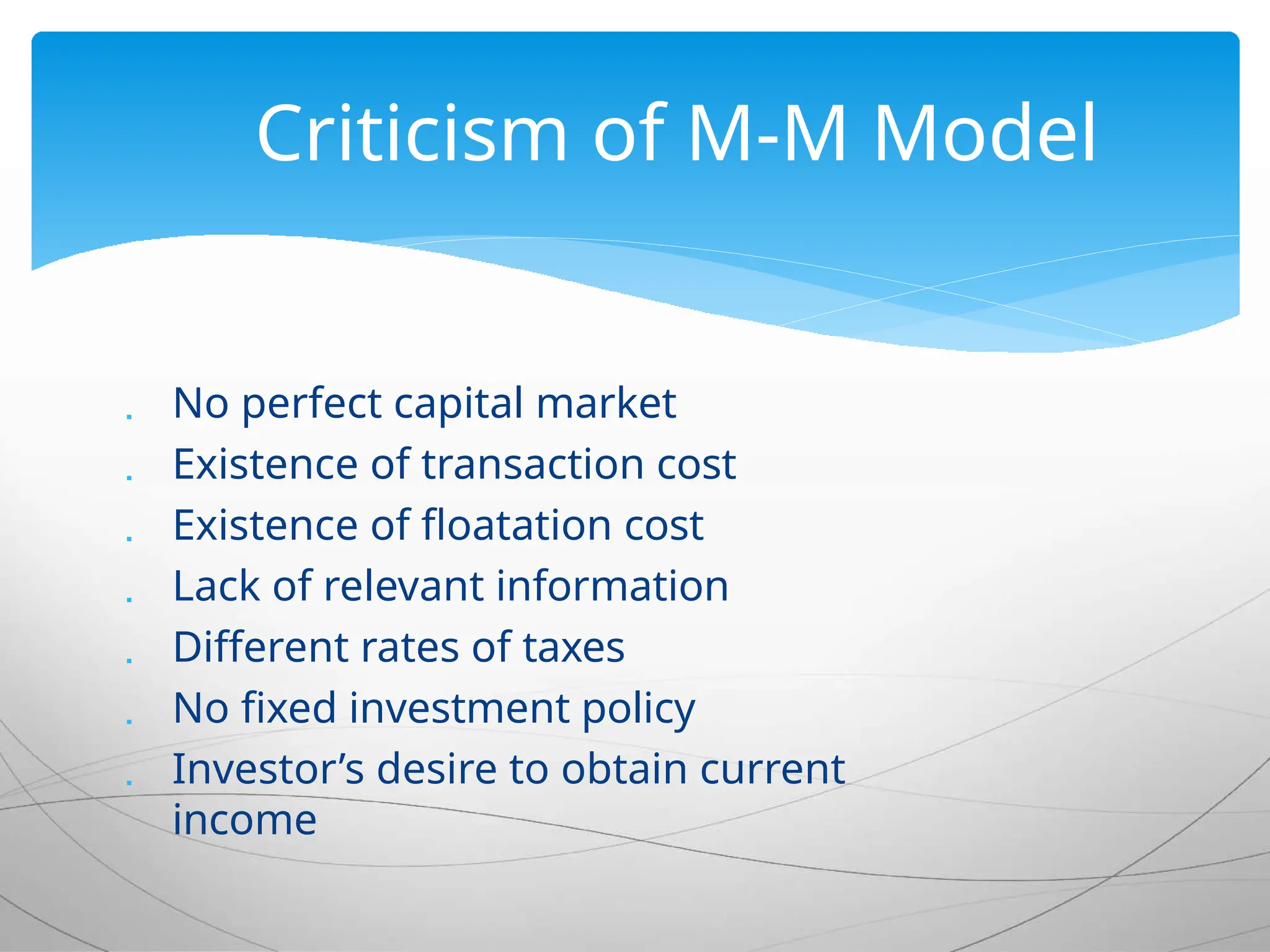
 No perfect capital market
 Existence of transaction cost
 Existence of floatation cost
 Lack of relevant information
 Different rates of taxes
 No fixed investment policy
 Investor’s desire to obtain current
income
Criticism of M-M Model
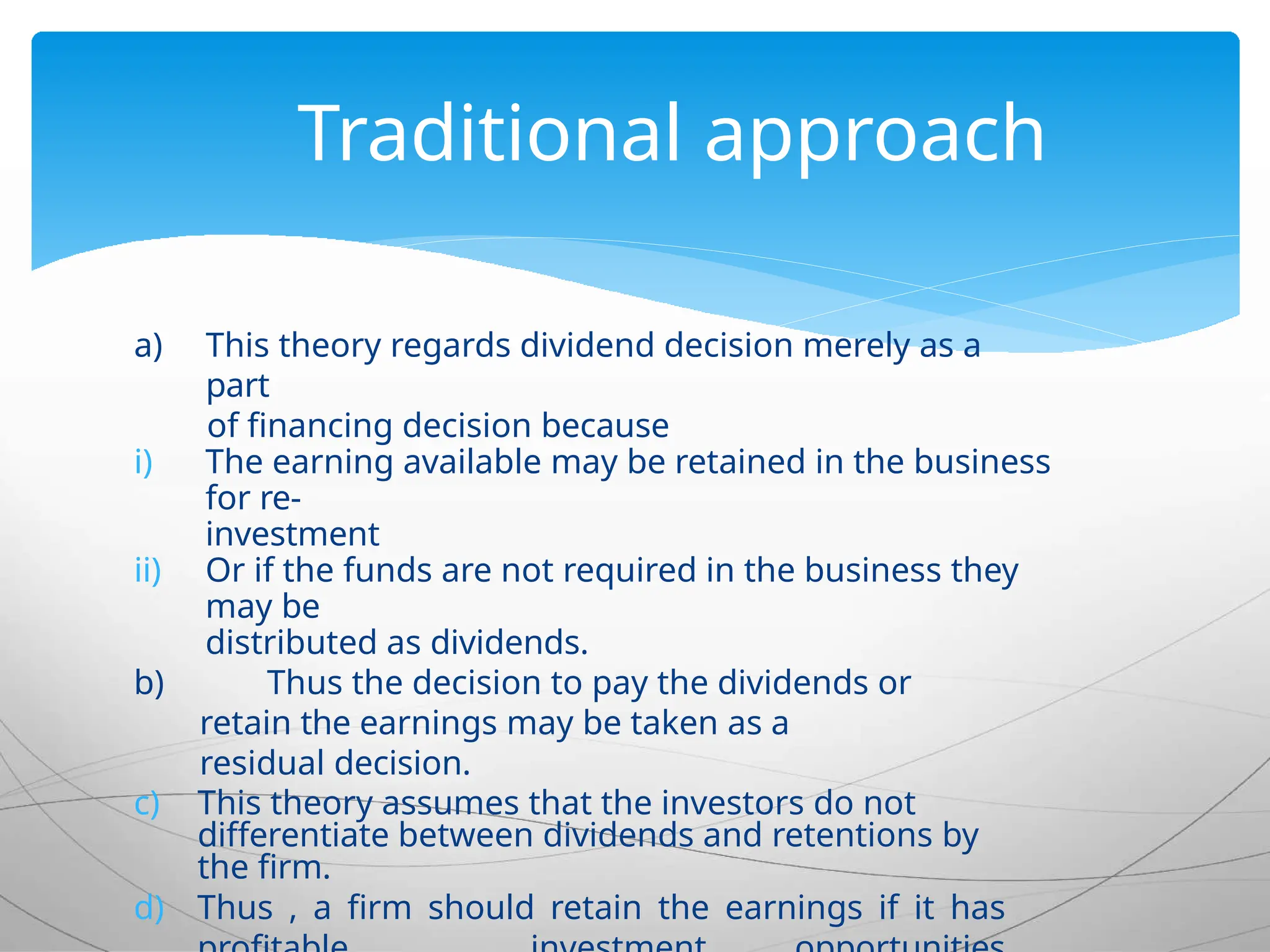
a) This theory regards dividend decision merely as a
part
of financing decision because
i) The earning available may be retained in the business
for re-
investment
ii) Or if the funds are not required in the business they
may be
distributed as dividends.
b) Thus the decision to pay the dividends or
retain the earnings may be taken as a
residual decision.
c) This theory assumes that the investors do not
differentiate between dividends and retentions by
the firm.
d) Thus , a firm should retain the earnings if it has
Traditional approach
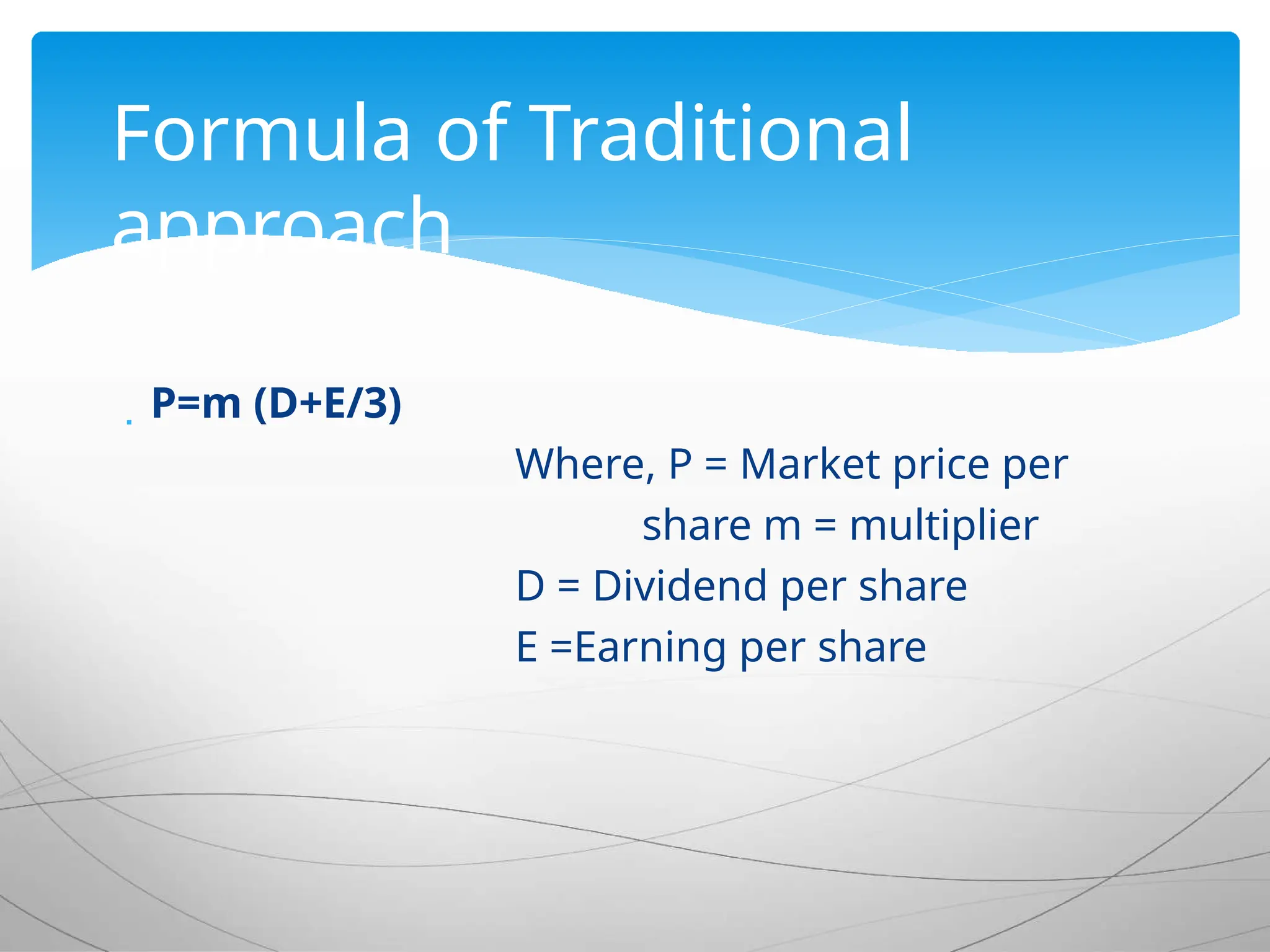
 P=m (D+E/3)
Where, P = Market price per
share m = multiplier
D = Dividend per share
E =Earning per share
Formula of Traditional
approach
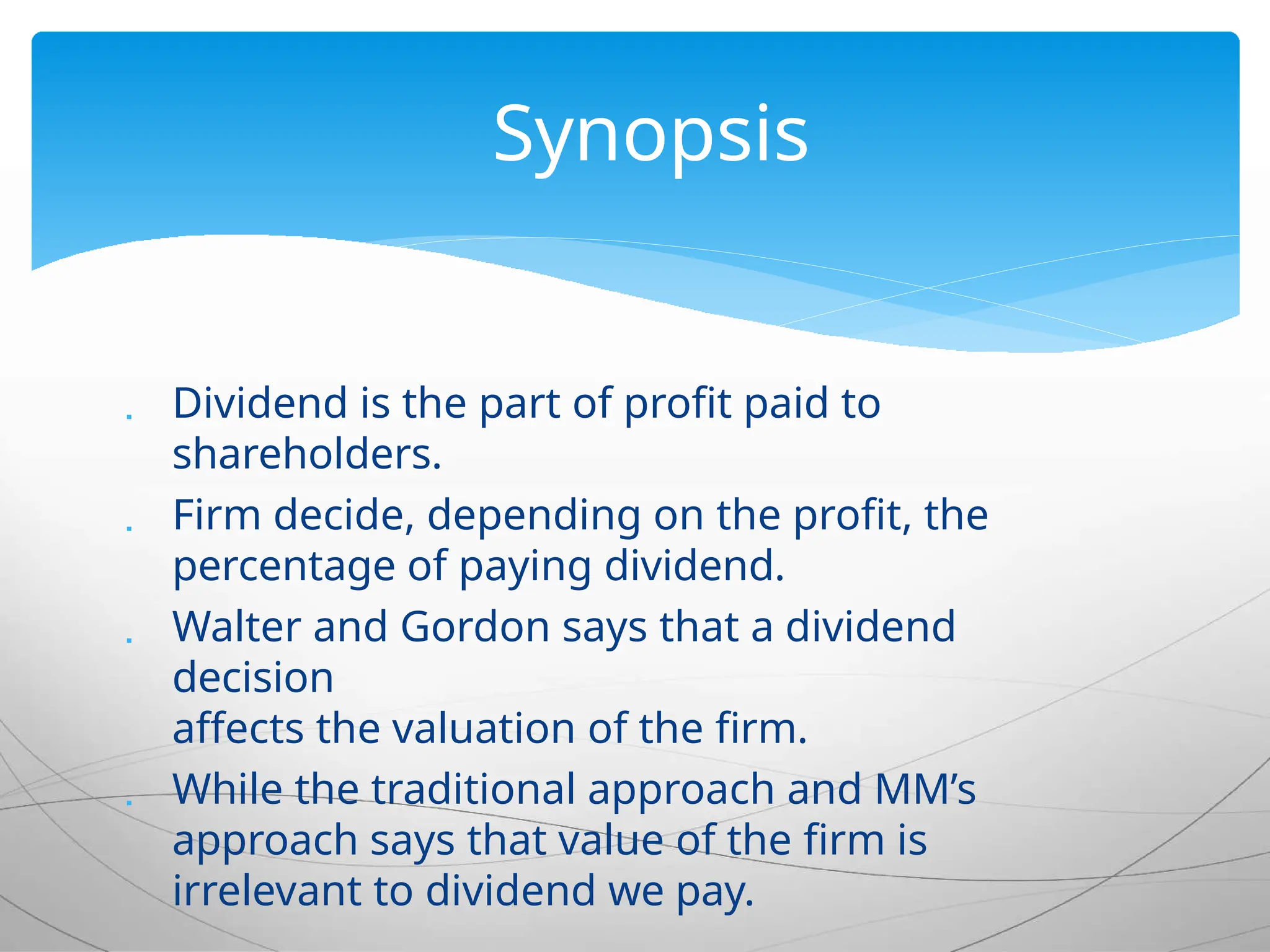
 Dividend is the part of profit paid to
shareholders.
 Firm decide, depending on the profit, the
percentage of paying dividend.
 Walter and Gordon says that a dividend
decision
affects the valuation of the firm.
 While the traditional approach and MM’s
approach says that value of the firm is
irrelevant to dividend we pay.
Synopsis

UNIT- 1 Divided Policy, Types, Theories and Formula

  • 1.
     “ Adividend is a distribution to shareholders out of profit or reserve available for this purpose”. What is Dividend?
  • 2.
    Types of Dividend Onthe basis of types of share  Equity Dividend  Preference Dividend On the basis of mode of payment  Cash dividend  Stock dividend  Bond dividend  Property dividend  Composite dividend
  • 3.
     INTERIM DIVIDEND REGULAR DIVIDEND  SPECIAL DIVIDEND ON THE BASIS OF TIME OF PAYMENT
  • 4.
    What is DividendPolicy :“Dividend policy determines the division of earnings between payments to shareholders and retained earnings”.
  • 5.
    Funds requirement Liquidity Access toexternal sources of financing Shareholder preference Difference in the cost of external equity and retained earnings Control Taxes
  • 6.
  • 7.
    Dividend Theories RELEVANCE THEORIES (i.e. whichconsider dividend decision to be relevant as it affects the value of the firm)  WALTER’S MODEL  GORDON’S MODEL IRRELEVANCE THEORIES (i.e. which consider dividend decision to be irrelevant as it does not affects the value of the firm)  MODIGLIANI ANDMILLER’S MODEL  TRADITIONAL APPROACH
  • 8.
  • 9.
     PROF. JAMESE WALTER ARGUED THAT IN THE LONG RUN THE SHARE PRICE REFLECT ONL Y THE PRESENT VALUE OF EXPECTED DIVIDENDS. RETENTIONS INFLUENCE STOCK PRICE ONLY THROUGH THEIR EFFECT ON FUTURE DIVIDENDS. WALTER HAS FORMULATED THIS AND USED THE DIVIDEND TO OPTIMIZE THE WEALTH OF THE EQUITY SHAREHOLDERS. WALTER’S MODEL
  • 10.
     INTERNAL FINANCING CONSTANT RETURN IN COST OF CAPITAL  100% PAYOUT OR RETENTION  CONSTANT EPS AND DPS  INFINITE TIME ASSUMPTIONS OF WALTER'S MODEL
  • 11.
     P = D +r/k (E- D) K Where, P = Current market price of equity share E = Earning per share D = Dividend per share (E-D) = Retained earning per share r = Rate of return on firm’s investment or internal rate of return K = cost of equity capital Formula of Walter's Model
  • 12.
     According toWalter:-  When r>k, the firm should retain the maximum earning, that is, the firm should pay out minimum or no dividend. Then the value of equity share of the firm will be maximum.  Growth firm (r>k): r=15% k=10% If D=5 thenp = E=5 5+0.15(0)/0.10 = Rs. 50 0.10 If D=2 thenp = 2+0.15(3)/0.10 = Rs. 65 0.10 Illustration
  • 13.
     When r=k,the firm can remain indifferent regarding dividend pay-out decision. In this case value of equity share of the firm remain unchanged whatever may be the dividend pay-out ratio. r=10% k=10 % E=5 If D=5 then p = 5+0.10(0)/ 0.10 = Rs. 50 0.10 If D=2 then p = 2+0.10(3)/0.10 = Rs. 50 0.1 0 Normal firm(r=k)
  • 14.
     When r<k,the firm should pay out all its profit to the shareholders as dividend without creating any reserve. Then only the value of equity share will be maximum. r=10% k=15 % E=5 If D=5 then p = 5+0.10(0)/ 0.15 = Rs. 50 0.15 If D=2 then p = 2+0.10(3)/0.15 = Rs. 26.67 0.1 5 Declining Firm (r<k)
  • 15.
    EFFECT OF DIVIDENDPOLICY ON VALUE OF SHARE Case If dividend payout ratio increases If dividend payout ratio decreases 1. In case of growing firm i.e where r >k Market value of share decreases Market value of share increases 2. In case of declining firm i.e where r<k Market value of share increases Market value of share decreases 3. In case of normal firm i.e where r=k No changes in value of share No changes in value of share
  • 16.
     No externalfinancing  Firm’s internal rate of return does not always remain constant. In fact, r decreases as more and more investment in made.  Firm’s cost of capital does not always remain constant. In fact k changes directly with the firm’s risk. Criticisms of Walter's Model
  • 17.
     According toprof. Gordon, dividend policy almost always affects the value of the firm. He showed how dividend policy can be used to maximize the wealth of the shareholders.  The main proposition of the model is that the value of a share reflects the value of the future dividends accuring to that share. Hence the dividend payment and it’s growth are relevant in valuation of shares.  The model holds that the share’s market price is equal to the sum of share’s discounted future dividend payment. Gordon’s Model
  • 18.
     All equityfirm  No external financing  Constant returns  Constant cost of capital  Perpetual earnings  No taxes  Constant retention  Cost of capital is greater than growth rate(k>br=g) Assumptions
  • 19.
     P =E(1-b) K-br Where, P = Price per share E = Earning per share r = rate of return on investment k = cost of capital b = % of retained earnings = retention ratio = Retained earnings/Total earnings br = g = growth rate of the firm Formula of Gordon’s Model
  • 20.
     Growth firm (r>k) r=20%k= 15% If b=0.25then P= E= Rs. 4 4(0.75) = Rs. 30 0.15-(0.25) (0.20) If b=0.50 = Rs. 40 then p= 4(0.50) 0.15-(0.5) (0.20) Illustration
  • 21.
     Normal firm (r=k) r=15%k= 15% If b=0.25then P= E= Rs. 4 4(0.75 ) = Rs. 26.67 0.15-(0.25) (0.15) If b=0.50 then p= 4(0.50) = Rs. 26.67 0.15-(0.5) (0.15) Illustration
  • 22.
     Declining firm (r<k): r=10%k= 15% If b=0.25then P= E= Rs. 4 4(0.75 ) = Rs. 24 0.15-(0.25) (0.10) If b=0.50 then p= 4(0.50) = Rs. 20 0.15-(0.5) (0.10) Illustration
  • 23.
     AS THEASSUMPTIONS OF WALTER'S MODEL AND GORDON'S MODEL ARE SAME SO THE GORDON'S MODEL SUFFERS FROM THE SAME LIMITATIONS AS THE WALTER'S MODEL. CRITICISMS OF GORDON'S MODEL
  • 24.
  • 25.
     M-M Hypothesisprovides the irrelevant concept of dividend in comprehensive manner. According to them, the dividend policy of a firm does not have any effect on the price of share of a firm, i.e., it does not affect the shareholders wealth. Modigliani-Miller Hypothesis for Dividend policy:-
  • 26.
     Existence ofperfect capital market.  Taxes do no exist.  Investors behave rationally.  Investment policy of the firm do not change.  Risk and uncertainty does not exist. Assumptions:-
  • 27.
    0 1 1 P =(P + D ) (1 + k) Where, P0 = market price per share at time ‘zero’ P1 = market price per share at time ‘one’ D1 = dividend per share at time ‘one’ k = cost of capital or discounting rate. Formula of M- M approach According to M-M hypothesis:- Where no new financing exist, the value of the firm (V) will be as follows:-   V = np = n (P1 + D1)  (1 + k)  Computation of total amount of finance required for financing a new project, i.e., new financing:-  Amount required = I – (y – nD1)   Where, I = Total Investment  y = Total earnings  D1= Dividend per share at the one year end 
  • 28.
     Number ofshares required to be issued for the new investment:-  n = Amount required for new investment Market price per share at the end of the year.  = I – (y – nD1) P1  Computation of the “Total Value of the firm” at the end of the year:-  V = (n +m) P1 – I + y (1 + k) Where, V = Value of the firm n= Number of shares m = number of shares newly issued P1 = market price per share at the end of the year I = Total investment y = total earnings k = cost of capital. Formula of M-M approach
  • 29.
     No perfectcapital market  Existence of transaction cost  Existence of floatation cost  Lack of relevant information  Different rates of taxes  No fixed investment policy  Investor’s desire to obtain current income Criticism of M-M Model
  • 30.
    a) This theoryregards dividend decision merely as a part of financing decision because i) The earning available may be retained in the business for re- investment ii) Or if the funds are not required in the business they may be distributed as dividends. b) Thus the decision to pay the dividends or retain the earnings may be taken as a residual decision. c) This theory assumes that the investors do not differentiate between dividends and retentions by the firm. d) Thus , a firm should retain the earnings if it has Traditional approach
  • 31.
     P=m (D+E/3) Where,P = Market price per share m = multiplier D = Dividend per share E =Earning per share Formula of Traditional approach
  • 32.
     Dividend isthe part of profit paid to shareholders.  Firm decide, depending on the profit, the percentage of paying dividend.  Walter and Gordon says that a dividend decision affects the valuation of the firm.  While the traditional approach and MM’s approach says that value of the firm is irrelevant to dividend we pay. Synopsis