DIVIDEND THEORIES
• Dividend (retention) decision an important
financing decision
– New issue of shares for raising funds
– Dividend decision and value of the firm
– Wealth maximization objective
• Conflict in opinion - Dividend decision will affect
and will not affect value of the firm
Theories can be divided into two broad categories
I. Will not affect or irrelevance concept or theories of
irrelevance , and
II. Will affect or relevance concept of dividend or
theories of relevance
I- THEORIES OF IRRELEVANCE
A. Residual Approach
 Dividend decision is a part of financing decision
 Will not affect value of the firm
 Dividend or retention depends upon the profitable
opportunity
 If the firm has profitable opportunity, it has to retain
and if no it has to pay dividend. Thus, it is a residual
decision
 The firm has to compare the ROI and Cost of Capital
 If ROI > Cost of capital the firm has to retain
 if the ROI < Cost of Capital it has to pay dividend.
Shareholders can invest outside the business and earn
more
B- Modigliani - Miller Approach
More comprehensive theory
 Dividend decisions will not affect market value of
shares or wealth
Value of the firm is determined by the earning
capacity and investment policy
Splitting of earnings into dividend and retained
earnings will not affect value of the firm
Argues that “under conditions of perfect capital
markets, rational investors, absence of tax
discrimination between dividend and capital
appreciation, given the firm’s investment policy,
its dividend policy may have no influence on the
market price of the shares”
Assumptions Modigliani - Miller Approach
1. Perfect capital market
2. Investors behave rationally
3. Information about the company is available at
free of cost
4. No floatation and taxation costs
5. Individual investors cannot influence the market
6. No tax differentiation between dividend and
capital appreciation
7. The firm follows rigid investment policy
8. There is no risk or uncertainty with regard to the
future of the firm (removed latter)
Arguments of Modigliani - Miller
 Increase in the value of the firm due to the payment of
dividend will offset by the decline in the market price of shares
due to external financing. Thus, there will be no change in the
wealth of shareholders
 The firm’s investment opportunities can be financed through
a. External financing or
b. Internal financing
 If dividend is paid, the firm has to depend external sources,
which increases the number of shares or interest charges
 Thus, gain by dividend payment is neutralized by reduction or
fall in the market price of shares due to reduction in the future
EPS
According to them, the market price of shares in the
beginning of a period is equal to the present value of
dividends paid at the end of the period plus the market
price of the shares at the end of the period
Where P0 = Price of the share at the beginning
D1 = Dividend at the end
P1 = Price of the share at the end
Ke = Cost of equity or equity capitalization
rate
P1 = P0 (1+Ke) – D1
Value of the firm if new shares are not issued
where n= number of shares
MM hypothesis can be explained through another angle,
assuming that investment required by the firm on
account of payment of dividend is financed out of the
new issue of equity shares. Thus, the number of new
equity shares to be issued (m) will be equal to
Where
I = Investment required
E = Total Earnings of the firm during the
period
P1= Market price of the share at the end
n = Number of shares outstanding at the
beginning
D1 = Dividend to be paid at the end
Value of the firm, when new shares are issued
Where
nP0 = Value of the firm
Ke = Cost of equity
Criticisms
• Perfect capital market does not exist
• Information about the company is not freely available
• Firms have to incur floatation costs
• Existence of tax differentiation
• Firms do not follow rigid dividend policy
• Investors have to pay brokerage, fees, commission etc
• Share holders may prefer current income (dividend)
II - THE RELEVANCE CONCEPT
 Dividend will affect value of the firm – dividend is an
indicator of profitability – higher the dividend the more
will be the profitability and thus, value of the firm
Two popular theories or models
1. The Walter's Model and (2) The Gordon's Model
1. Walter’s Model
 Proposed by Prof. James Walter, and argues that
dividend policy or decisions will affect value of the firm
 According to him, the relationship between the firm’s
rate of return (r), its cost of capital (k) determine the
dividend policy, which will maximize the value of
shares
Assumptions
• The firm finances all investments through
retained earnings (internal financing), no new
shares or debts for raising funds
• Rate of return (r), cost of capital (k), are constant
• 100% of the earnings are either retained or
distributed (100% payout or retention)
• Constant EPS and Dividend. However, the values
can be changed for determining the results
• Indefinite time – the firm has a very long or
indefinite life
Market Price Per Share
Where
P = Market price per share
DIV = Dividend Per Share
EPS = Earnings Per Share
r= Firms Average Rate Of Return
k = Firms Cost Of Capital or Capitalization Rate
According to the above formula price of share depends upon two
sources of income –
(i) The present value of infinite stream of constant dividend
(DIV/K) and
(ii) The present value of infinite steam of capital gains (r (EPS-
DIV)/K)/K
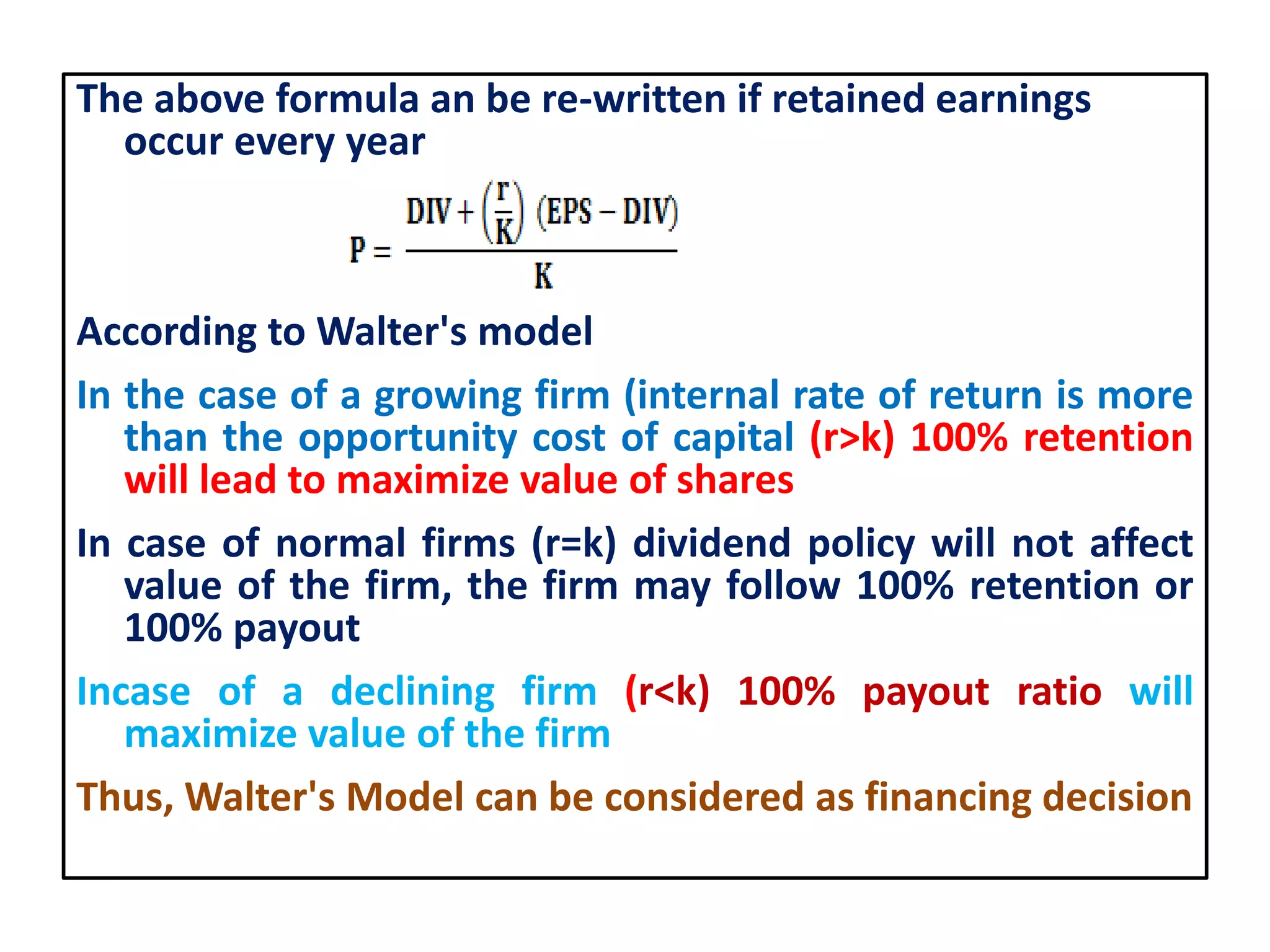
The above formula an be re-written if retained earnings
occur every year
According to Walter's model
In the case of a growing firm (internal rate of return is more
than the opportunity cost of capital (r>k) 100% retention
will lead to maximize value of shares
In case of normal firms (r=k) dividend policy will not affect
value of the firm, the firm may follow 100% retention or
100% payout
Incase of a declining firm (r<k) 100% payout ratio will
maximize value of the firm
Thus, Walter's Model can be considered as financing decision
Criticisms against Walter's Model
• Assumptions form the major criticisms
• No external financing
• Constant rate of return (r)
• Constant opportunity cost of capital (k)
2- Gordon’s Model (Dividend - Capitalization Model)
 Dividend policy will affect value of shares
 Market value of share is equal to the present value an
infinite stream of dividends received by share holders
 DPS is expected to grow when earning are retained
Assumptions
• All-equity firm, no debt financing
• No external financing; retained earning is used to finance
expansion
• Constant return, the Internal rate of return (r) is constant
• Constant cost of capital (k)
• The firm and its earnings are perpetual
• No corporate taxes
• Constant retention (retention ratio ‘b’ is constant; thus
growth rate (g= br) is also constant
• Cost of capital is greater than growth rate (k>g)
According to this theory
Where
DIV1= Expected dividend at the end
k= cost of equity, g= growth rate
E= EPS; b = retention ratio; br = g = growth rate;
Do = Dividend per share at the beginning
According to Gordon's model
• The market value of share (Po), increases with
the retention ratio (b) for firms with growth
opportunities (r>k)
• The market value of share (Po) increases with the
payout ratio (1-b) for declining firms (r<K)
• The market value of share is not affected by
dividend policy when r=k
Conclusions of Gordon’s model is more or less
similar to that of Walter's. This is due to the
similarity in assumptions. Thus, Gordon's model
also face the criticisms as that of Walter's
Gordon’s Revised Model
One of the major criticism leveled against the
Gordon's model is the assumption of cost of
capital remains constant. But this is not right.
Further, according to the model when r=k, the
dividend decision will not affect value of shares.
Because of risk and uncertainty shareholders
prefer to receive Re one today than receiving the
same in future as capital gain (one bird in hand is
better than five in bushes). This is known as bird-
in-the-hand argument.
Thus, in such firms, it is better to set out higher
payout ratio to make the shareholders happy

Dividend theories

  • 2.
    DIVIDEND THEORIES • Dividend(retention) decision an important financing decision – New issue of shares for raising funds – Dividend decision and value of the firm – Wealth maximization objective • Conflict in opinion - Dividend decision will affect and will not affect value of the firm Theories can be divided into two broad categories I. Will not affect or irrelevance concept or theories of irrelevance , and II. Will affect or relevance concept of dividend or theories of relevance
  • 3.
    I- THEORIES OFIRRELEVANCE A. Residual Approach  Dividend decision is a part of financing decision  Will not affect value of the firm  Dividend or retention depends upon the profitable opportunity  If the firm has profitable opportunity, it has to retain and if no it has to pay dividend. Thus, it is a residual decision  The firm has to compare the ROI and Cost of Capital  If ROI > Cost of capital the firm has to retain  if the ROI < Cost of Capital it has to pay dividend. Shareholders can invest outside the business and earn more
  • 4.
    B- Modigliani -Miller Approach More comprehensive theory  Dividend decisions will not affect market value of shares or wealth Value of the firm is determined by the earning capacity and investment policy Splitting of earnings into dividend and retained earnings will not affect value of the firm Argues that “under conditions of perfect capital markets, rational investors, absence of tax discrimination between dividend and capital appreciation, given the firm’s investment policy, its dividend policy may have no influence on the market price of the shares”
  • 5.
    Assumptions Modigliani -Miller Approach 1. Perfect capital market 2. Investors behave rationally 3. Information about the company is available at free of cost 4. No floatation and taxation costs 5. Individual investors cannot influence the market 6. No tax differentiation between dividend and capital appreciation 7. The firm follows rigid investment policy 8. There is no risk or uncertainty with regard to the future of the firm (removed latter)
  • 6.
    Arguments of Modigliani- Miller  Increase in the value of the firm due to the payment of dividend will offset by the decline in the market price of shares due to external financing. Thus, there will be no change in the wealth of shareholders  The firm’s investment opportunities can be financed through a. External financing or b. Internal financing  If dividend is paid, the firm has to depend external sources, which increases the number of shares or interest charges  Thus, gain by dividend payment is neutralized by reduction or fall in the market price of shares due to reduction in the future EPS
  • 7.
    According to them,the market price of shares in the beginning of a period is equal to the present value of dividends paid at the end of the period plus the market price of the shares at the end of the period Where P0 = Price of the share at the beginning D1 = Dividend at the end P1 = Price of the share at the end Ke = Cost of equity or equity capitalization rate P1 = P0 (1+Ke) – D1 Value of the firm if new shares are not issued where n= number of shares
  • 8.
    MM hypothesis canbe explained through another angle, assuming that investment required by the firm on account of payment of dividend is financed out of the new issue of equity shares. Thus, the number of new equity shares to be issued (m) will be equal to Where I = Investment required E = Total Earnings of the firm during the period P1= Market price of the share at the end n = Number of shares outstanding at the beginning D1 = Dividend to be paid at the end
  • 9.
    Value of thefirm, when new shares are issued Where nP0 = Value of the firm Ke = Cost of equity Criticisms • Perfect capital market does not exist • Information about the company is not freely available • Firms have to incur floatation costs • Existence of tax differentiation • Firms do not follow rigid dividend policy • Investors have to pay brokerage, fees, commission etc • Share holders may prefer current income (dividend)
  • 10.
    II - THERELEVANCE CONCEPT  Dividend will affect value of the firm – dividend is an indicator of profitability – higher the dividend the more will be the profitability and thus, value of the firm Two popular theories or models 1. The Walter's Model and (2) The Gordon's Model 1. Walter’s Model  Proposed by Prof. James Walter, and argues that dividend policy or decisions will affect value of the firm  According to him, the relationship between the firm’s rate of return (r), its cost of capital (k) determine the dividend policy, which will maximize the value of shares
  • 11.
    Assumptions • The firmfinances all investments through retained earnings (internal financing), no new shares or debts for raising funds • Rate of return (r), cost of capital (k), are constant • 100% of the earnings are either retained or distributed (100% payout or retention) • Constant EPS and Dividend. However, the values can be changed for determining the results • Indefinite time – the firm has a very long or indefinite life
  • 12.
    Market Price PerShare Where P = Market price per share DIV = Dividend Per Share EPS = Earnings Per Share r= Firms Average Rate Of Return k = Firms Cost Of Capital or Capitalization Rate According to the above formula price of share depends upon two sources of income – (i) The present value of infinite stream of constant dividend (DIV/K) and (ii) The present value of infinite steam of capital gains (r (EPS- DIV)/K)/K
  • 13.
    The above formulaan be re-written if retained earnings occur every year According to Walter's model In the case of a growing firm (internal rate of return is more than the opportunity cost of capital (r>k) 100% retention will lead to maximize value of shares In case of normal firms (r=k) dividend policy will not affect value of the firm, the firm may follow 100% retention or 100% payout Incase of a declining firm (r<k) 100% payout ratio will maximize value of the firm Thus, Walter's Model can be considered as financing decision
  • 14.
    Criticisms against Walter'sModel • Assumptions form the major criticisms • No external financing • Constant rate of return (r) • Constant opportunity cost of capital (k)
  • 15.
    2- Gordon’s Model(Dividend - Capitalization Model)  Dividend policy will affect value of shares  Market value of share is equal to the present value an infinite stream of dividends received by share holders  DPS is expected to grow when earning are retained Assumptions • All-equity firm, no debt financing • No external financing; retained earning is used to finance expansion • Constant return, the Internal rate of return (r) is constant • Constant cost of capital (k) • The firm and its earnings are perpetual • No corporate taxes • Constant retention (retention ratio ‘b’ is constant; thus growth rate (g= br) is also constant • Cost of capital is greater than growth rate (k>g)
  • 16.
    According to thistheory Where DIV1= Expected dividend at the end k= cost of equity, g= growth rate E= EPS; b = retention ratio; br = g = growth rate; Do = Dividend per share at the beginning
  • 17.
    According to Gordon'smodel • The market value of share (Po), increases with the retention ratio (b) for firms with growth opportunities (r>k) • The market value of share (Po) increases with the payout ratio (1-b) for declining firms (r<K) • The market value of share is not affected by dividend policy when r=k Conclusions of Gordon’s model is more or less similar to that of Walter's. This is due to the similarity in assumptions. Thus, Gordon's model also face the criticisms as that of Walter's
  • 18.
    Gordon’s Revised Model Oneof the major criticism leveled against the Gordon's model is the assumption of cost of capital remains constant. But this is not right. Further, according to the model when r=k, the dividend decision will not affect value of shares. Because of risk and uncertainty shareholders prefer to receive Re one today than receiving the same in future as capital gain (one bird in hand is better than five in bushes). This is known as bird- in-the-hand argument. Thus, in such firms, it is better to set out higher payout ratio to make the shareholders happy