DIVIDEND DECISIONPRESENTED BY  :-VERACIOUS GROUPLeader:- vasantparakhiya
COLORS OF RAINBOWSVASANT –IntroductionDEEP –Dividend TheoriesBHAVIKA–Modigliani Miller Hypothesis &               Assumptions of Walter’s modelMEET -Dividend PoliciesASHISH-Dividend Policy & Share ValuationISHWER -Corporate Dividend Practices in IndiaVASANT  –Summary & Conclusion
After studying Dividend Decision you should be able to:Understand the dividend retention versus distribution dilemma faced by the firm. Explain the Modigliani and Miller (M&M) argument that dividends are irrelevant. Explain the counterarguments to M&M - that dividends do matter. Identify and discuss the factors affecting a firm's dividend and retention of earnings policy. Define, compare, and justify cash dividends, stock dividends, stock splits, and reverse stock splits. Define “stock repurchase” and explain why (and how) a firm might repurchase stock.Summarize the standard cash dividend payment procedures and critical dates.Define and discuss dividend reinvestment plans (DRIPs).
Dividend PolicyPassive Versus Active Dividend PoliciesFactors Influencing Dividend PolicyDividend StabilityStock Dividends and Stock SplitsStock RepurchaseAdministrative Considerations
Dividends as a Passive ResidualCan the payment of cash dividends affect shareholder wealth?If so, what dividend-payout ratio will maximize shareholder wealth?The firm uses earnings plus the additional financing that the increased equity can support to finance any expected positive-NPV projects.Any unused earnings are paid out in the form of dividends.  This describes a passive dividend policy.
Irrelevance of DividendsA.  Current dividends versus retention of earningsM&M contend that the effect of dividend  payments on shareholder wealth is exactly offset by other means of financing.The dividend plus the “new” stock price after dilution exactly equals the stock price prior to the dividend distribution.
Irrelevance of DividendsB.  Conservation of valueM&M and the total-value principle ensures that the sum of market value plus current dividends of two firms identical in all respects other than dividend-payout ratios will be the same.Investors can “create” any dividend policy they desire by selling shares when the dividend payout is too low or buying shares when the dividend payout is excessive.
Relevance of DividendsA.  Preference for dividendsUncertainty surrounding future company profitability leads certain investors to prefer the certainty of current dividends.Investors prefer “large” dividends.Investors do not like to manufacture “homemade” dividends, but prefer the company to distribute them directly.
Relevance of DividendsB.  Taxes on the investorCapital gains taxes are deferred until the actual sale of stock.  This creates a timing option.Capital gains are preferred to dividends, everything else equal.  Thus, high dividend-yielding stocks should sell at a discount to generate a higher before-tax rate of return.Certain institutional investors pay no tax.
Relevance of DividendsB.  Taxes on the investor (continued)Corporations can typically exclude 70% of dividend income from taxation.  Thus, corporations generally prefer to receive dividends rather than capital gains.The result is clienteles of investors with different dividend preferences.  In equilibrium, there will be the proper distribution of firms with differing dividend policies to exactly meet the needs of investors.Thus, dividend-payout decisions are irrelevant.
Walters ModelAssumptionsValuationOptimum Payout RatioCriticism
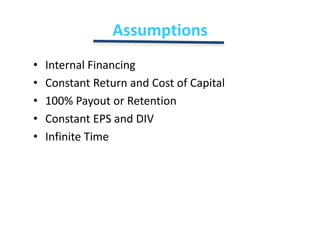
AssumptionsInternal FinancingConstant Return and Cost of Capital100% Payout or RetentionConstant EPS and DIVInfinite Time
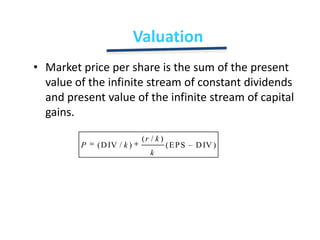
Market price per share is the sum of the present value of the infinite stream of constant dividends and present value of the infinite stream of capital gains.Valuation
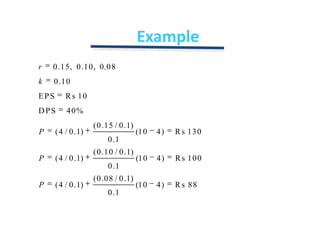
Example
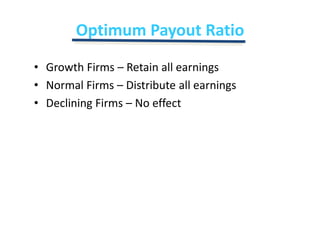
Optimum Payout RatioGrowth Firms – Retain all earningsNormal Firms – Distribute all earningsDeclining Firms – No effect
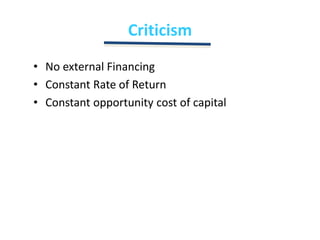
CriticismNo external FinancingConstant Rate of ReturnConstant opportunity cost of capital
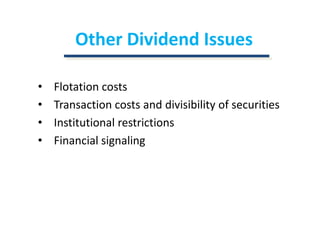
Other Dividend IssuesFlotation costsTransaction costs and divisibility of securitiesInstitutional restrictionsFinancial signaling
Empirical Testing of Dividend PolicyTax EffectDividends are taxed more heavily (in PV terms) than capital gains, so before-tax returns should be higher for high-dividend-paying firms.Empirical results are mixed -- recently the evidence is largely consistent with dividend neutrality.Financial SignalingExpect that increases (decreases) in dividends lead to positive (negative) excess stock returns.Empirical results are consistent with these expectations.
Implications for Corporate PolicyEstablish a policy that will maximize shareholder wealth.Distribute excess funds to shareholders and stabilize the absolute amount of dividends if necessary (passive).Payouts greater than excess funds should occur only in an environment that has a net preference for dividends.
Implications for Corporate PolicyThere is a positive value associated with a modest dividend.  Could be due to institutional restrictions or signaling effects.Dividends in excess of the passive policy does not appear to lead to share price improvement because of taxes and flotation costs.
Factors Influencing Dividend PolicyLegal RulesCapital Impairment Rule-- many states prohibit the payment of dividends if these dividends impair “capital” (usually either par value of common stock or par plus additional paid-in capital).Incorporation in some states (notably Delaware) allows a firm to use the “fair value,” rather than “book value,” of its assets when judging whether a dividend impairs “capital.”
Factors Influencing Dividend PolicyLegal RulesInsolvency Rule-- some states prohibit the payment of cash dividends if the company is insolvent under either a “fair market valuation” or “equitable” sense.Undue Retention of Earnings Rule-- prohibits the undue retention of earnings in excess of the present and future investment needs of the firm.
Factors Influencing Dividend PolicyOther Issues to ConsiderFunding Needs of the FirmLiquidityAbility to BorrowRestrictions in Debt Contracts (protective covenants)Control
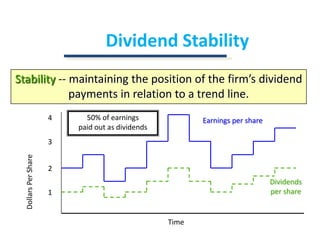
Dividend StabilityStability -- maintaining the position of the firm’s dividend payments in relation to a trend line.50% of earningspaid out as dividends4Earnings per share3Dollars Per Share2Dividendsper share1Time
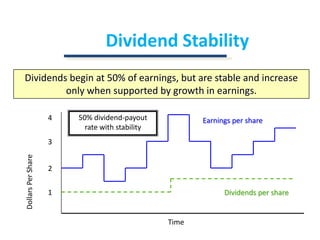
Dividend StabilityDividends begin at 50% of earnings, but are stable and increase only when supported by growth in earnings.50% dividend-payoutrate with stability4Earnings per share3Dollars Per Share21Dividends per shareTime
Valuation of Dividend StabilityInformation content-- management may be able to affect the expectations of investors through the informational content of dividends.  A stable dividend suggests that the company expects stable or growing dividends in the future.Current income desires-- some investors who desire a specific periodic income will prefer a company with stable dividends to one with unstable dividends.Institutional considerations-- a stable dividend may permit certain institutional investors to buy the common stock as they meet the requirements to be placed on the organizations “approved list.”
Types of DividendsRegular DividendThe dividend that is normally expected to be paid by the firm.Extra dividendA nonrecurring dividend paid to shareholders in addition to the regular dividend.  It is brought about by special circumstances.
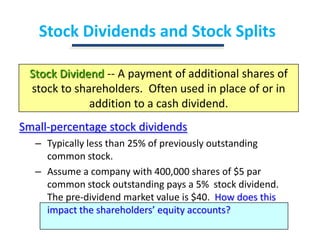
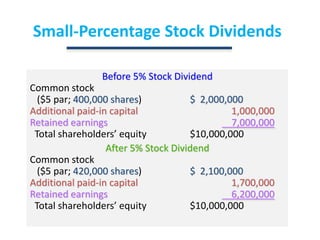
Stock Dividends and Stock SplitsStock Dividend -- A payment of additional shares of stock to shareholders.  Often used in place of or in addition to a cash dividend.Small-percentage stock dividendsTypically less than 25% of previously outstanding common stock.Assume a company with 400,000 shares of $5 par common stock outstanding pays a 5%  stock dividend.  The pre-dividend market value is $40.  How does this impact the shareholders’ equity accounts?
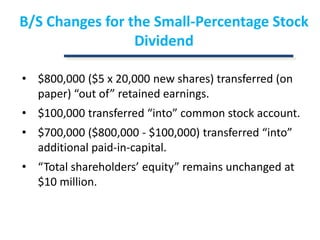
B/S Changes for the Small-Percentage Stock Dividend$800,000 ($5 x 20,000 new shares) transferred (on paper) “out of” retained earnings.$100,000 transferred “into” common stock account.$700,000 ($800,000 - $100,000) transferred “into” additional paid-in-capital.“Total shareholders’ equity” remains unchanged at $10 million.
Small-Percentage Stock DividendsBefore 5% Stock DividendCommon stock    ($5 par; 400,000 shares)		$  2,000,000Additional paid-in capital			    1,000,000Retained earnings				    7,000,000Total shareholders’ equity		$10,000,000After 5% Stock DividendCommon stock    ($5 par; 420,000 shares)		$  2,100,000Additional paid-in capital			    1,700,000Retained earnings				    6,200,000Total shareholders’ equity		$10,000,000
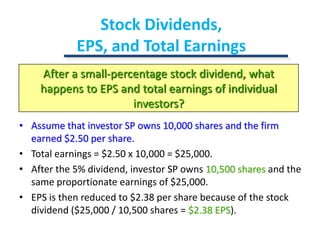
Stock Dividends, EPS, and Total EarningsAfter a small-percentage stock dividend, what happens to EPS and total earnings of individual investors?Assume that investor SP owns 10,000 shares and the firm earned $2.50 per share.Total earnings = $2.50 x 10,000 = $25,000.After the 5% dividend, investor SP owns 10,500 shares and the same proportionate earnings of $25,000.EPS is then reduced to $2.38 per share because of the stock dividend ($25,000 / 10,500 shares = $2.38 EPS).
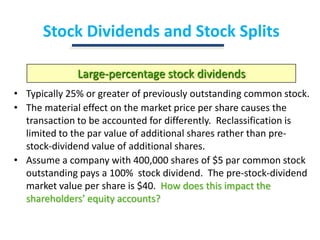
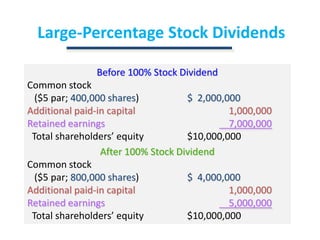
Stock Dividends and Stock SplitsLarge-percentage stock dividendsTypically 25% or greater of previously outstanding common stock.The material effect on the market price per share causes the transaction to be accounted for differently.  Reclassification is limited to the par value of additional shares rather than pre-stock-dividend value of additional shares.Assume a company with 400,000 shares of $5 par common stock outstanding pays a 100%  stock dividend.  The pre-stock-dividend market value per share is $40.  How does this impact the shareholders’ equity accounts?
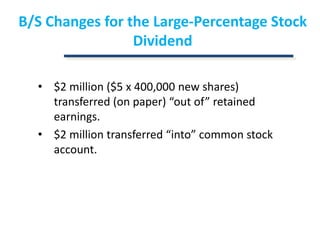
B/S Changes for the Large-Percentage Stock Dividend$2 million ($5 x 400,000 new shares) transferred (on paper) “out of” retained earnings.$2 million transferred “into” common stock account.
Large-Percentage Stock DividendsBefore 100% Stock DividendCommon stock    ($5 par; 400,000 shares)		$  2,000,000Additional paid-in capital			    1,000,000Retained earnings				    7,000,000Total shareholders’ equity		$10,000,000After 100% Stock DividendCommon stock    ($5 par; 800,000 shares)		$  4,000,000Additional paid-in capital			    1,000,000Retained earnings				    5,000,000Total shareholders’ equity		$10,000,000
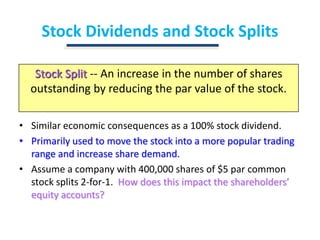
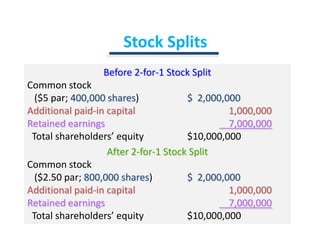
Stock Dividends and Stock SplitsStock Split-- An increase in the number of shares outstanding by reducing the par value of the stock.Similar economic consequences as a 100% stock dividend.Primarily used to move the stock into a more popular trading range and increase share demand.Assume a company with 400,000 shares of $5 par common stock splits 2-for-1.  How does this impact the shareholders’ equity accounts?
Stock SplitsBefore 2-for-1 Stock SplitCommon stock    ($5 par; 400,000 shares)		$  2,000,000Additional paid-in capital			    1,000,000Retained earnings				    7,000,000Total shareholders’ equity		$10,000,000After 2-for-1 Stock SplitCommon stock    ($2.50 par; 800,000 shares)		$  2,000,000Additional paid-in capital			    1,000,000Retained earnings				    7,000,000Total shareholders’ equity		$10,000,000
Value to Investors of Stock Dividends or Stock SplitsEffect on investor total wealthEffect on investor psycheEffect on cash dividendsMore popular trading rangeInformational content
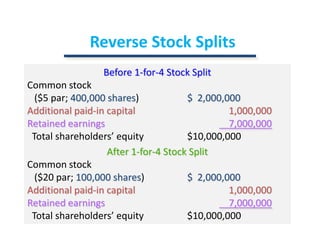
Stock Dividends and Stock SplitsReverse Stock Split-- A stock split in which the number of shares outstanding is decreased.Used to move the stock into a more popular trading range and increase share demand.Usually signals negative information to the market upon its announcement (consistent with empirical evidence).Assume a company with 400,000 shares of $5 par common stock splits 1-for-4.  How does this impact the shareholders’ equity accounts?
Reverse Stock SplitsBefore 1-for-4 Stock SplitCommon stock    ($5 par; 400,000 shares)		$  2,000,000Additional paid-in capital			    1,000,000Retained earnings				    7,000,000Total shareholders’ equity		$10,000,000After 1-for-4 Stock SplitCommon stock    ($20 par; 100,000 shares)		$  2,000,000Additional paid-in capital			    1,000,000Retained earnings				    7,000,000Total shareholders’ equity		$10,000,000
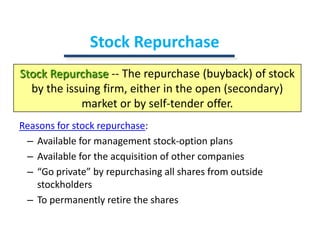
Stock RepurchaseStock Repurchase-- The repurchase (buyback) of stock by the issuing firm, either in the open (secondary) market or by self-tender offer.Reasons for stock repurchase:Available for management stock-option plansAvailable for the acquisition of other companies“Go private” by repurchasing all shares from outside stockholdersTo permanently retire the shares
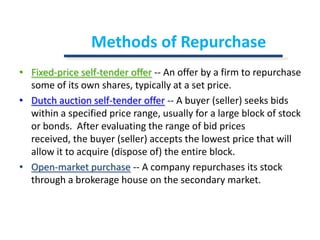
Methods of RepurchaseFixed-price self-tender offer-- An offer by a firm to repurchase some of its own shares, typically at a set price.Dutch auction self-tender offer-- A buyer (seller) seeks bids within a specified price range, usually for a large block of stock or bonds.  After evaluating the range of bid prices received, the buyer (seller) accepts the lowest price that will allow it to acquire (dispose of) the entire block.Open-market purchase-- A company repurchases its stock through a brokerage house on the secondary market.
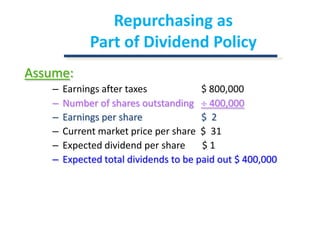
Repurchasing as Part of Dividend PolicyAssume:Earnings after taxes		       $ 800,000Number of shares outstanding   ¸ 400,000Earnings per share 		       $  2Current market price per share  $  31Expected dividend per share       $ 1Expected total dividendsto be paid out$ 400,000
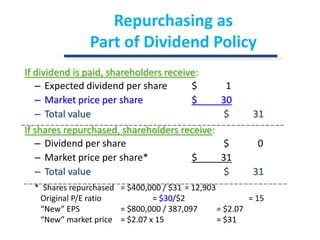
Repurchasing as Part of Dividend PolicyIf dividend is paid, shareholders receive:Expected dividend per share	   $            1Market price per share 		   $          30Total value				   $          31If shares repurchased, shareholders receive:Dividend per share			   $            0Market price per share* 		   $          31Total value				   $          31*  Shares repurchased 	= $400,000 / $31 	= 12,903   Original P/E ratio 		= $30/$2 		= 15   “New” EPS		= $800,000 / 387,097	= $2.07   “New” market price	= $2.07 x 15		= $31
Summary of Repurchasing as Part of Dividend PolicyThe capital gain arising from the repurchase (stock rising from $30 to $31) exactly equals the dividend ($1) that would have otherwise been paid.This result holds in the absence of taxes and transaction costs.To the taxable investor, capital gains (repurchases) are favored to dividend income as the tax on the capital gain is postponed until the actual sale of the common shares.
Summary of Repurchasing as Part of Dividend PolicyStock repurchases are most relevant for firms with large amounts of excess cash that might otherwise generate a significant taxable transaction to investors.Firms must be careful not to make regularly occurring repurchases or the IRS may consider the capital gains as dividends for tax purposes.
Investment or Financing Decision?Investing DecisionNot really, as stock that is repurchased is held as treasury stock and does not provide an expected return like other investments.Financing DecisionIt possesses capital structure or dividend policy motivations.For example, a repurchase immediately changes the debt-to-equity ratio (higher financial leverage).
Possible Signaling EffectRepurchases have a positive signaling effect.For example, if the stock is undervalued management may tender for shares at a “premium.”  This signals that the share prices are undervalued.Dutch-auction self-tenders have less signaling power likely due to a smaller tender premium.Open-market purchases have only a modest positive signaling effect likely due to many programs being instituted after significant share price declines.
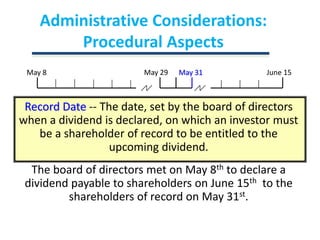
Administrative Considerations:  Procedural AspectsMay 8May 29May 31June 15Record Date -- The date, set by the board of directors when a dividend is declared, on which an investor must be a shareholder of record to be entitled to the upcoming dividend.The board of directors met on May 8th to declare a dividend payable to shareholders on June 15th  to the shareholders of record on May 31st.
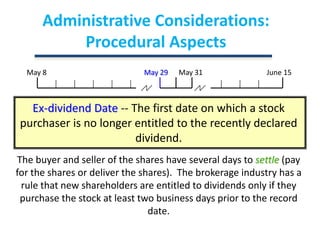
Administrative Considerations:  Procedural AspectsMay 8May 29May 31June 15Ex-dividend Date -- The first date on which a stock purchaser is no longer entitled to the recently declared dividend.The buyer and seller of the shares have several days to settle (pay for the shares or deliver the shares).  The brokerage industry has a rule that new shareholders are entitled to dividends only if they purchase the stock at least two business days prior to the record date.
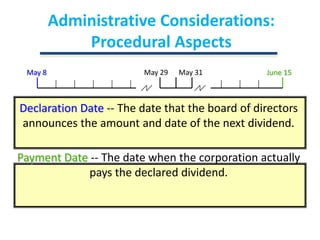
Administrative Considerations:  Procedural AspectsMay 8May 29May 31June 15Declaration Date -- The date that the board of directors announces the amount and date of the next dividend.Payment Date -- The date when the corporation actually pays the declared dividend.
Dividend Reinvestment PlansDividend Reinvestment Plan (DRIP) -- An optional plan allowing shareholders to automatically reinvest dividend payments in additional shares of the company’s stock.The firm can use existing stock.  A trustee (e.g., a bank) purchases the stock on the open market and credits current shareholders with the new shares.The firm can issue new stock.  This method raises “new” funds for the firm.  The plan essentially reduces the effective dividend-payout ratio.Some plans offer discounts and eliminate brokerage costs for current shareholders.
Thanks For WatchingPlease ShareCheck out more great forwards atvparakhiya@rediffmail.com
Dividend Decision

Dividend Decision

  • 1.
    DIVIDEND DECISIONPRESENTED BY :-VERACIOUS GROUPLeader:- vasantparakhiya
  • 2.
    COLORS OF RAINBOWSVASANT–IntroductionDEEP –Dividend TheoriesBHAVIKA–Modigliani Miller Hypothesis & Assumptions of Walter’s modelMEET -Dividend PoliciesASHISH-Dividend Policy & Share ValuationISHWER -Corporate Dividend Practices in IndiaVASANT –Summary & Conclusion
  • 3.
    After studying DividendDecision you should be able to:Understand the dividend retention versus distribution dilemma faced by the firm. Explain the Modigliani and Miller (M&M) argument that dividends are irrelevant. Explain the counterarguments to M&M - that dividends do matter. Identify and discuss the factors affecting a firm's dividend and retention of earnings policy. Define, compare, and justify cash dividends, stock dividends, stock splits, and reverse stock splits. Define “stock repurchase” and explain why (and how) a firm might repurchase stock.Summarize the standard cash dividend payment procedures and critical dates.Define and discuss dividend reinvestment plans (DRIPs).
  • 4.
    Dividend PolicyPassive VersusActive Dividend PoliciesFactors Influencing Dividend PolicyDividend StabilityStock Dividends and Stock SplitsStock RepurchaseAdministrative Considerations
  • 5.
    Dividends as aPassive ResidualCan the payment of cash dividends affect shareholder wealth?If so, what dividend-payout ratio will maximize shareholder wealth?The firm uses earnings plus the additional financing that the increased equity can support to finance any expected positive-NPV projects.Any unused earnings are paid out in the form of dividends. This describes a passive dividend policy.
  • 6.
    Irrelevance of DividendsA. Current dividends versus retention of earningsM&M contend that the effect of dividend payments on shareholder wealth is exactly offset by other means of financing.The dividend plus the “new” stock price after dilution exactly equals the stock price prior to the dividend distribution.
  • 7.
    Irrelevance of DividendsB. Conservation of valueM&M and the total-value principle ensures that the sum of market value plus current dividends of two firms identical in all respects other than dividend-payout ratios will be the same.Investors can “create” any dividend policy they desire by selling shares when the dividend payout is too low or buying shares when the dividend payout is excessive.
  • 8.
    Relevance of DividendsA. Preference for dividendsUncertainty surrounding future company profitability leads certain investors to prefer the certainty of current dividends.Investors prefer “large” dividends.Investors do not like to manufacture “homemade” dividends, but prefer the company to distribute them directly.
  • 9.
    Relevance of DividendsB. Taxes on the investorCapital gains taxes are deferred until the actual sale of stock. This creates a timing option.Capital gains are preferred to dividends, everything else equal. Thus, high dividend-yielding stocks should sell at a discount to generate a higher before-tax rate of return.Certain institutional investors pay no tax.
  • 10.
    Relevance of DividendsB. Taxes on the investor (continued)Corporations can typically exclude 70% of dividend income from taxation. Thus, corporations generally prefer to receive dividends rather than capital gains.The result is clienteles of investors with different dividend preferences. In equilibrium, there will be the proper distribution of firms with differing dividend policies to exactly meet the needs of investors.Thus, dividend-payout decisions are irrelevant.
  • 11.
  • 12.
    AssumptionsInternal FinancingConstant Returnand Cost of Capital100% Payout or RetentionConstant EPS and DIVInfinite Time
  • 13.
    Market price pershare is the sum of the present value of the infinite stream of constant dividends and present value of the infinite stream of capital gains.Valuation
  • 14.
  • 15.
    Optimum Payout RatioGrowthFirms – Retain all earningsNormal Firms – Distribute all earningsDeclining Firms – No effect
  • 16.
    CriticismNo external FinancingConstantRate of ReturnConstant opportunity cost of capital
  • 17.
    Other Dividend IssuesFlotationcostsTransaction costs and divisibility of securitiesInstitutional restrictionsFinancial signaling
  • 18.
    Empirical Testing ofDividend PolicyTax EffectDividends are taxed more heavily (in PV terms) than capital gains, so before-tax returns should be higher for high-dividend-paying firms.Empirical results are mixed -- recently the evidence is largely consistent with dividend neutrality.Financial SignalingExpect that increases (decreases) in dividends lead to positive (negative) excess stock returns.Empirical results are consistent with these expectations.
  • 19.
    Implications for CorporatePolicyEstablish a policy that will maximize shareholder wealth.Distribute excess funds to shareholders and stabilize the absolute amount of dividends if necessary (passive).Payouts greater than excess funds should occur only in an environment that has a net preference for dividends.
  • 20.
    Implications for CorporatePolicyThere is a positive value associated with a modest dividend. Could be due to institutional restrictions or signaling effects.Dividends in excess of the passive policy does not appear to lead to share price improvement because of taxes and flotation costs.
  • 21.
    Factors Influencing DividendPolicyLegal RulesCapital Impairment Rule-- many states prohibit the payment of dividends if these dividends impair “capital” (usually either par value of common stock or par plus additional paid-in capital).Incorporation in some states (notably Delaware) allows a firm to use the “fair value,” rather than “book value,” of its assets when judging whether a dividend impairs “capital.”
  • 22.
    Factors Influencing DividendPolicyLegal RulesInsolvency Rule-- some states prohibit the payment of cash dividends if the company is insolvent under either a “fair market valuation” or “equitable” sense.Undue Retention of Earnings Rule-- prohibits the undue retention of earnings in excess of the present and future investment needs of the firm.
  • 23.
    Factors Influencing DividendPolicyOther Issues to ConsiderFunding Needs of the FirmLiquidityAbility to BorrowRestrictions in Debt Contracts (protective covenants)Control
  • 24.
    Dividend StabilityStability --maintaining the position of the firm’s dividend payments in relation to a trend line.50% of earningspaid out as dividends4Earnings per share3Dollars Per Share2Dividendsper share1Time
  • 25.
    Dividend StabilityDividends beginat 50% of earnings, but are stable and increase only when supported by growth in earnings.50% dividend-payoutrate with stability4Earnings per share3Dollars Per Share21Dividends per shareTime
  • 26.
    Valuation of DividendStabilityInformation content-- management may be able to affect the expectations of investors through the informational content of dividends. A stable dividend suggests that the company expects stable or growing dividends in the future.Current income desires-- some investors who desire a specific periodic income will prefer a company with stable dividends to one with unstable dividends.Institutional considerations-- a stable dividend may permit certain institutional investors to buy the common stock as they meet the requirements to be placed on the organizations “approved list.”
  • 27.
    Types of DividendsRegularDividendThe dividend that is normally expected to be paid by the firm.Extra dividendA nonrecurring dividend paid to shareholders in addition to the regular dividend. It is brought about by special circumstances.
  • 28.
    Stock Dividends andStock SplitsStock Dividend -- A payment of additional shares of stock to shareholders. Often used in place of or in addition to a cash dividend.Small-percentage stock dividendsTypically less than 25% of previously outstanding common stock.Assume a company with 400,000 shares of $5 par common stock outstanding pays a 5% stock dividend. The pre-dividend market value is $40. How does this impact the shareholders’ equity accounts?
  • 29.
    B/S Changes forthe Small-Percentage Stock Dividend$800,000 ($5 x 20,000 new shares) transferred (on paper) “out of” retained earnings.$100,000 transferred “into” common stock account.$700,000 ($800,000 - $100,000) transferred “into” additional paid-in-capital.“Total shareholders’ equity” remains unchanged at $10 million.
  • 30.
    Small-Percentage Stock DividendsBefore5% Stock DividendCommon stock ($5 par; 400,000 shares) $ 2,000,000Additional paid-in capital 1,000,000Retained earnings 7,000,000Total shareholders’ equity $10,000,000After 5% Stock DividendCommon stock ($5 par; 420,000 shares) $ 2,100,000Additional paid-in capital 1,700,000Retained earnings 6,200,000Total shareholders’ equity $10,000,000
  • 31.
    Stock Dividends, EPS,and Total EarningsAfter a small-percentage stock dividend, what happens to EPS and total earnings of individual investors?Assume that investor SP owns 10,000 shares and the firm earned $2.50 per share.Total earnings = $2.50 x 10,000 = $25,000.After the 5% dividend, investor SP owns 10,500 shares and the same proportionate earnings of $25,000.EPS is then reduced to $2.38 per share because of the stock dividend ($25,000 / 10,500 shares = $2.38 EPS).
  • 32.
    Stock Dividends andStock SplitsLarge-percentage stock dividendsTypically 25% or greater of previously outstanding common stock.The material effect on the market price per share causes the transaction to be accounted for differently. Reclassification is limited to the par value of additional shares rather than pre-stock-dividend value of additional shares.Assume a company with 400,000 shares of $5 par common stock outstanding pays a 100% stock dividend. The pre-stock-dividend market value per share is $40. How does this impact the shareholders’ equity accounts?
  • 33.
    B/S Changes forthe Large-Percentage Stock Dividend$2 million ($5 x 400,000 new shares) transferred (on paper) “out of” retained earnings.$2 million transferred “into” common stock account.
  • 34.
    Large-Percentage Stock DividendsBefore100% Stock DividendCommon stock ($5 par; 400,000 shares) $ 2,000,000Additional paid-in capital 1,000,000Retained earnings 7,000,000Total shareholders’ equity $10,000,000After 100% Stock DividendCommon stock ($5 par; 800,000 shares) $ 4,000,000Additional paid-in capital 1,000,000Retained earnings 5,000,000Total shareholders’ equity $10,000,000
  • 35.
    Stock Dividends andStock SplitsStock Split-- An increase in the number of shares outstanding by reducing the par value of the stock.Similar economic consequences as a 100% stock dividend.Primarily used to move the stock into a more popular trading range and increase share demand.Assume a company with 400,000 shares of $5 par common stock splits 2-for-1. How does this impact the shareholders’ equity accounts?
  • 36.
    Stock SplitsBefore 2-for-1Stock SplitCommon stock ($5 par; 400,000 shares) $ 2,000,000Additional paid-in capital 1,000,000Retained earnings 7,000,000Total shareholders’ equity $10,000,000After 2-for-1 Stock SplitCommon stock ($2.50 par; 800,000 shares) $ 2,000,000Additional paid-in capital 1,000,000Retained earnings 7,000,000Total shareholders’ equity $10,000,000
  • 37.
    Value to Investorsof Stock Dividends or Stock SplitsEffect on investor total wealthEffect on investor psycheEffect on cash dividendsMore popular trading rangeInformational content
  • 38.
    Stock Dividends andStock SplitsReverse Stock Split-- A stock split in which the number of shares outstanding is decreased.Used to move the stock into a more popular trading range and increase share demand.Usually signals negative information to the market upon its announcement (consistent with empirical evidence).Assume a company with 400,000 shares of $5 par common stock splits 1-for-4. How does this impact the shareholders’ equity accounts?
  • 39.
    Reverse Stock SplitsBefore1-for-4 Stock SplitCommon stock ($5 par; 400,000 shares) $ 2,000,000Additional paid-in capital 1,000,000Retained earnings 7,000,000Total shareholders’ equity $10,000,000After 1-for-4 Stock SplitCommon stock ($20 par; 100,000 shares) $ 2,000,000Additional paid-in capital 1,000,000Retained earnings 7,000,000Total shareholders’ equity $10,000,000
  • 40.
    Stock RepurchaseStock Repurchase--The repurchase (buyback) of stock by the issuing firm, either in the open (secondary) market or by self-tender offer.Reasons for stock repurchase:Available for management stock-option plansAvailable for the acquisition of other companies“Go private” by repurchasing all shares from outside stockholdersTo permanently retire the shares
  • 41.
    Methods of RepurchaseFixed-priceself-tender offer-- An offer by a firm to repurchase some of its own shares, typically at a set price.Dutch auction self-tender offer-- A buyer (seller) seeks bids within a specified price range, usually for a large block of stock or bonds. After evaluating the range of bid prices received, the buyer (seller) accepts the lowest price that will allow it to acquire (dispose of) the entire block.Open-market purchase-- A company repurchases its stock through a brokerage house on the secondary market.
  • 42.
    Repurchasing as Partof Dividend PolicyAssume:Earnings after taxes $ 800,000Number of shares outstanding ¸ 400,000Earnings per share $ 2Current market price per share $ 31Expected dividend per share $ 1Expected total dividendsto be paid out$ 400,000
  • 43.
    Repurchasing as Partof Dividend PolicyIf dividend is paid, shareholders receive:Expected dividend per share $ 1Market price per share $ 30Total value $ 31If shares repurchased, shareholders receive:Dividend per share $ 0Market price per share* $ 31Total value $ 31* Shares repurchased = $400,000 / $31 = 12,903 Original P/E ratio = $30/$2 = 15 “New” EPS = $800,000 / 387,097 = $2.07 “New” market price = $2.07 x 15 = $31
  • 44.
    Summary of Repurchasingas Part of Dividend PolicyThe capital gain arising from the repurchase (stock rising from $30 to $31) exactly equals the dividend ($1) that would have otherwise been paid.This result holds in the absence of taxes and transaction costs.To the taxable investor, capital gains (repurchases) are favored to dividend income as the tax on the capital gain is postponed until the actual sale of the common shares.
  • 45.
    Summary of Repurchasingas Part of Dividend PolicyStock repurchases are most relevant for firms with large amounts of excess cash that might otherwise generate a significant taxable transaction to investors.Firms must be careful not to make regularly occurring repurchases or the IRS may consider the capital gains as dividends for tax purposes.
  • 46.
    Investment or FinancingDecision?Investing DecisionNot really, as stock that is repurchased is held as treasury stock and does not provide an expected return like other investments.Financing DecisionIt possesses capital structure or dividend policy motivations.For example, a repurchase immediately changes the debt-to-equity ratio (higher financial leverage).
  • 47.
    Possible Signaling EffectRepurchaseshave a positive signaling effect.For example, if the stock is undervalued management may tender for shares at a “premium.” This signals that the share prices are undervalued.Dutch-auction self-tenders have less signaling power likely due to a smaller tender premium.Open-market purchases have only a modest positive signaling effect likely due to many programs being instituted after significant share price declines.
  • 48.
    Administrative Considerations: Procedural AspectsMay 8May 29May 31June 15Record Date -- The date, set by the board of directors when a dividend is declared, on which an investor must be a shareholder of record to be entitled to the upcoming dividend.The board of directors met on May 8th to declare a dividend payable to shareholders on June 15th to the shareholders of record on May 31st.
  • 49.
    Administrative Considerations: Procedural AspectsMay 8May 29May 31June 15Ex-dividend Date -- The first date on which a stock purchaser is no longer entitled to the recently declared dividend.The buyer and seller of the shares have several days to settle (pay for the shares or deliver the shares). The brokerage industry has a rule that new shareholders are entitled to dividends only if they purchase the stock at least two business days prior to the record date.
  • 50.
    Administrative Considerations: Procedural AspectsMay 8May 29May 31June 15Declaration Date -- The date that the board of directors announces the amount and date of the next dividend.Payment Date -- The date when the corporation actually pays the declared dividend.
  • 51.
    Dividend Reinvestment PlansDividendReinvestment Plan (DRIP) -- An optional plan allowing shareholders to automatically reinvest dividend payments in additional shares of the company’s stock.The firm can use existing stock. A trustee (e.g., a bank) purchases the stock on the open market and credits current shareholders with the new shares.The firm can issue new stock. This method raises “new” funds for the firm. The plan essentially reduces the effective dividend-payout ratio.Some plans offer discounts and eliminate brokerage costs for current shareholders.
  • 52.
    Thanks For WatchingPleaseShareCheck out more great forwards atvparakhiya@rediffmail.com