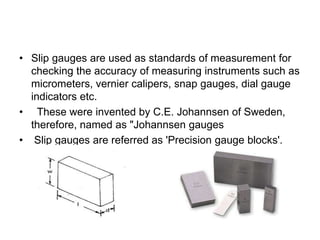
• Slip gauges are used as standards of measurement for
checking the accuracy of measuring instruments such as
micrometers, vernier calipers, snap gauges, dial gauge
indicators etc.
• These were invented by C.E. Johannsen of Sweden,
therefore, named as "Johannsen gauges
• Slip gauges are referred as 'Precision gauge blocks'.
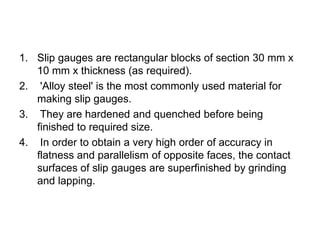
1. Slip gauges are rectangular blocks of section 30 mm x
10 mm x thickness (as required).
2. 'Alloy steel' is the most commonly used material for
making slip gauges.
3. They are hardened and quenched before being
finished to required size.
4. In order to obtain a very high order of accuracy in
flatness and parallelism of opposite faces, the contact
surfaces of slip gauges are superfinished by grinding
and lapping.
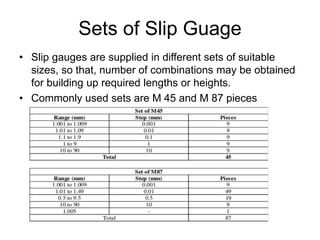
Sets of Slip Guage
• Slip gauges are supplied in different sets of suitable
sizes, so that, number of combinations may be obtained
for building up required lengths or heights.
• Commonly used sets are M 45 and M 87 pieces
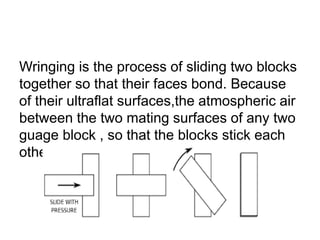
Wringing is the process of sliding two blocks
together so that their faces bond. Because
of their ultraflat surfaces,the atmospheric air
between the two mating surfaces of any two
guage block , so that the blocks stick each
other due to vaccum
1. They universally accepted as a “Standard of length”.
2. They used for direct precise measurement where
accuracy of work piece being measure is high.
3. They used with high-magnification comparators, to
establish the size of the gauge blocks.
4. They are used for checking the accuracy of measuring
instruments.
5. They are used to setting up a comparator to specific
dimension.
6. They are used to check a batch of components quickly
and accurately.
SLIP GUAGE

SLIP GUAGE

  • 1.
    • Slip gaugesare used as standards of measurement for checking the accuracy of measuring instruments such as micrometers, vernier calipers, snap gauges, dial gauge indicators etc. • These were invented by C.E. Johannsen of Sweden, therefore, named as "Johannsen gauges • Slip gauges are referred as 'Precision gauge blocks'.
  • 2.
    1. Slip gaugesare rectangular blocks of section 30 mm x 10 mm x thickness (as required). 2. 'Alloy steel' is the most commonly used material for making slip gauges. 3. They are hardened and quenched before being finished to required size. 4. In order to obtain a very high order of accuracy in flatness and parallelism of opposite faces, the contact surfaces of slip gauges are superfinished by grinding and lapping.
  • 4.
    Sets of SlipGuage • Slip gauges are supplied in different sets of suitable sizes, so that, number of combinations may be obtained for building up required lengths or heights. • Commonly used sets are M 45 and M 87 pieces
  • 5.
    Wringing is theprocess of sliding two blocks together so that their faces bond. Because of their ultraflat surfaces,the atmospheric air between the two mating surfaces of any two guage block , so that the blocks stick each other due to vaccum
  • 6.
    1. They universallyaccepted as a “Standard of length”. 2. They used for direct precise measurement where accuracy of work piece being measure is high. 3. They used with high-magnification comparators, to establish the size of the gauge blocks. 4. They are used for checking the accuracy of measuring instruments. 5. They are used to setting up a comparator to specific dimension. 6. They are used to check a batch of components quickly and accurately.