-PAARTH GUPTA
 A Gear is one of the important machine tool elements which is an
integral and inevitable part of power transmission system.
 A gear is a round blank having teeth along its periphery.
 They are used to transfer power or torque from prime mover to the
place where it is to be used.
 The most commonly used forms of gear teeth are:
 Involute
 Cycloidal
 The involute gears also called as straight tooth or spur gears. The
cycloidal gears are used in heavy and impact loads. The involute
rack has straight teeth. The involute pressure angle is either 20° or
1. Spur gear
 Cylindrical gear whose tooth traces is straight line. These are used for transmitting power
between parallel shafts.
2. Spiral gear
 The tooth of the gear traces curved lines.
3. Helical gears
 These gears used to transmit the power between parallel shafts as well as nonparallel and
non-intersecting shafts. It is a cylindrical gear whose tooth traces is straight line.
4. Bevel gears:
 The tooth traces are straight-line generators of cone. The teeth are cut on the conical
surface. It is used to connect the shafts at right angles.
5. Worm and Worm wheel:
 It is used to connect the shafts whose axes are non-parallel and non-intersecting.
6. Rack and Pinion:
 Rack gears are straight spur gears with infinite radius.
 Base circle
 Outside circle
 Pitch circle
 Root circle
 Addendum
 Dedendum
 Module
 Circular pitch
 Tooth
thickness
 Face
 Flank
 In broader sense the gears can be manufactured by the following
three methods:-
 CASTING
 PLASTIC MOULDING
 MACHINING
1. Profile error: - The maximum distance of any point on the tooth
profile form to the design profile.
2. Pitch error: - Difference between actual and design pitch
3. Cyclic error: - Error occurs in each revolution of gear
4. Run out: - Total range of reading of a fixed indicator with the contact
points applied to a surface rotated, without axial movement, about a
fixed axis.
5. Eccentricity: - Half the radial run out
6. Wobble: - Run out measured parallel to. the axis of rotation at a
specified distance from the axis
7. Radial run out: - Run out measured along a perpendicular to the
axis of rotation.
8. Undulation: - Periodical departure of the actual tooth surface from
the design surface.
9. Axial run out: - Run out measured parallel to the axis of rotation at a
speed.
 Gears are the devices meant for power transmission. For proper
working the gears should be measured and inspected in each steps
as:
 Raw materials.
 Machining the blanks.
 Heat treatment.
 The cutting and finishing operations.
 The accuracy depends on:
 The measuring equipment available.
 Inspecting the dimensions and the surface for getting a designed
thread.
 Two types:-
1. Analytical: slow process which check all individual elements.
Less preferred
2. Functional: carrying out running test with master and deciding.
Much preferred
1. MEASUREMENT OF RUNOUT:
• Runout is measured by a specified probe
such as a cylinder, ball, cone, rack, or gear
teeth.
• Measurement is made perpendicular to the
surface of revolution.
• A common method of runout inspection, is
by a single-probe check, shown in Fig.
• Uses an indicator with a single probe
whose diameter makes contact with the
flanks of adjacent teeth in the area of the
pitch circle.
Single-probe check
2. PITCH MEASUREMENT:
• There are two ways for measuring the pitch.
1. Point to point measurement (i.e. One tooth point to next toot point)
2. Direct angular measurement
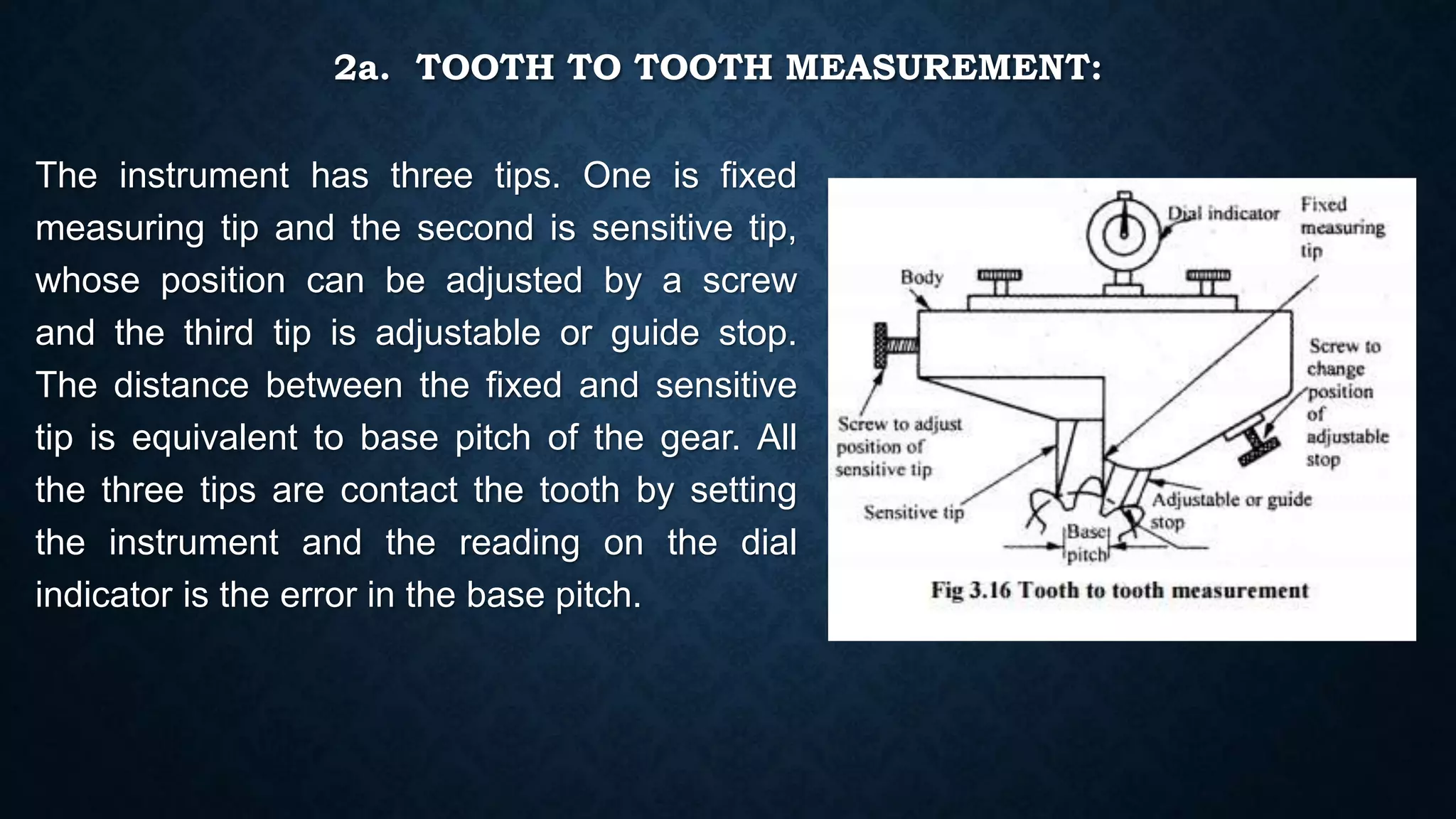
2a. TOOTH TO TOOTH MEASUREMENT:
The instrument has three tips. One is fixed
measuring tip and the second is sensitive tip,
whose position can be adjusted by a screw
and the third tip is adjustable or guide stop.
The distance between the fixed and sensitive
tip is equivalent to base pitch of the gear. All
the three tips are contact the tooth by setting
the instrument and the reading on the dial
indicator is the error in the base pitch.
2b. DIRECT ANGULAR MEASUREMENT:
It is the simplest method for measuring the error by using set dial gauge against a
tooth. in this method the position of a suitable point on a tooth is measured after the
gear has been indexed by a suitable angle. If the gear is not indexed through the
angular pitch the reading differs from the original reading. The difference between
these is the cumulative pitch error.
3. PROFILE CHECKING:
• The methods used for profile checking is
1. Optical projection method.
2. Involute measuring machine.
3a. OPTICAL PROJECTION METHOD:
The profile of the gear projected on the screen by optical lens and then projected
value is compared with master profile.
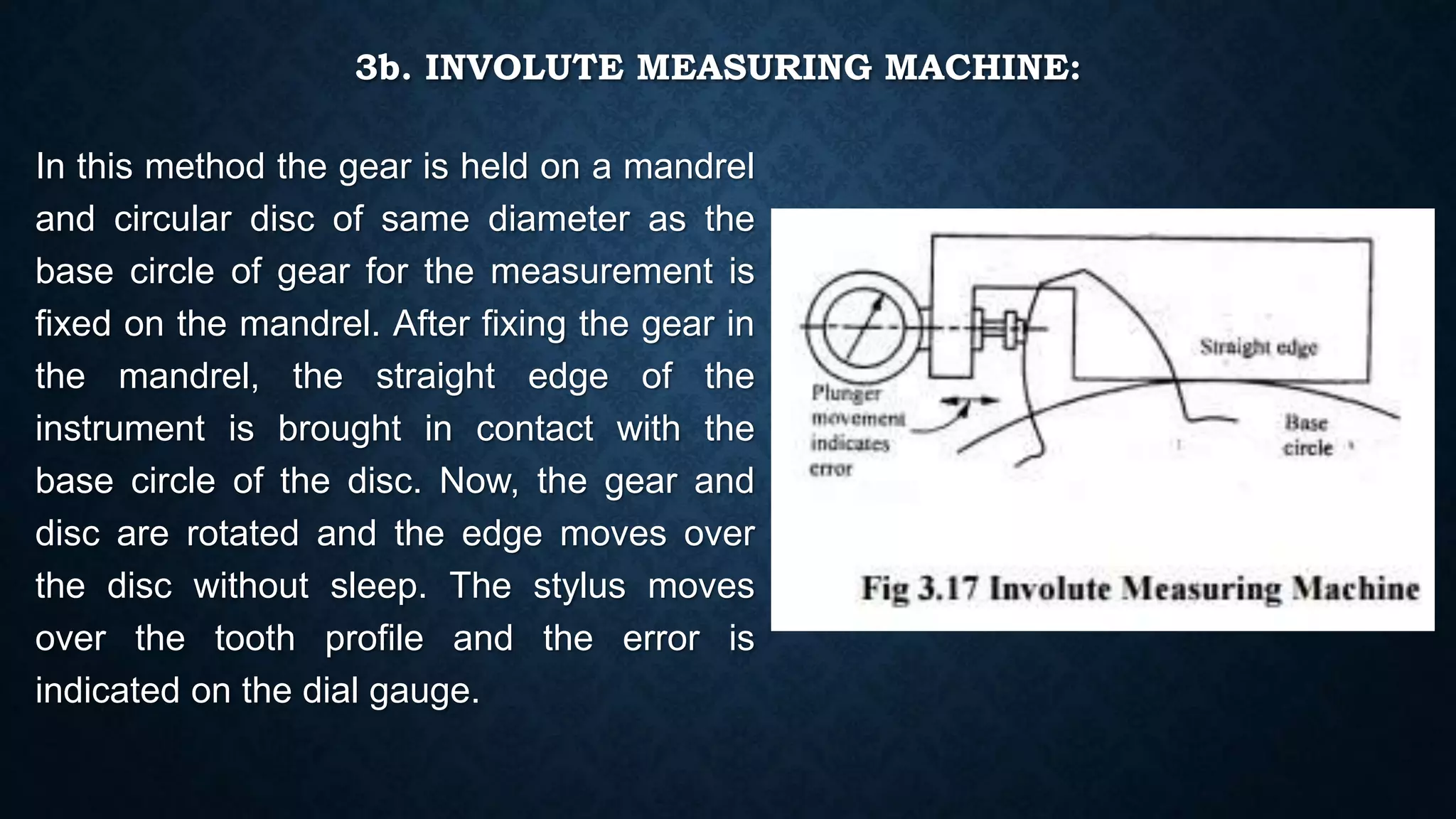
3b. INVOLUTE MEASURING MACHINE:
In this method the gear is held on a mandrel
and circular disc of same diameter as the
base circle of gear for the measurement is
fixed on the mandrel. After fixing the gear in
the mandrel, the straight edge of the
instrument is brought in contact with the
base circle of the disc. Now, the gear and
disc are rotated and the edge moves over
the disc without sleep. The stylus moves
over the tooth profile and the error is
indicated on the dial gauge.
4. MEASUREMENT OF CONCENTRICITY:
• In setting of gears the centre about which the gear is mounded should be coincident
with the centre from which the gear is generated. It is easy to check the concentricity
of the gear by mounting the gear between centres and measuring the variation in
height of a roller placed between the successive teeth. Finally the variation in reading
will be a function of the eccentricity present.
5. ALIGNMENT CHECKING:
• It is done by placing a parallel bar between the gear teeth and the gear being
mounted between centres. Finally the readings are taken at the two ends of the bar
and difference in reading is the misalignment.
6. LEAD CHECKING:
• It is checked by lead checking instruments. Actually lead is the axial advance of a
helix for one complete turn. The lead checking instruments are advances a probe
along a tooth surface, parallel to the axis when the gear rotates.
7. BACKLASH CHECKING:
• Backlash is the distance through which a gear can be rotated to bring its nonworking
flank in contact with the teeth of mating gear. Numerical values of backlash are
measured at the tightest point of mesh on the pitch circle.
• There are two types of backlash
1. Circumferential backlash
2. Normal backlas
• The determination of backlash is, first one of the two gears of the pair is locked, while
other is rotated forward and backward and by the comparator the maximum
displacement is measured. The stylus of comparator is locked near the reference
cylinder and a tangent to this is called circular backlash.
•
8. TOOTH THICKNESS MEASUREMENT:
• Tooth thickness is generally measured at pitch circle and also in most cases the
chordal thickness measurement is carried out i.e. the chord joining the intersection of
the tooth profile with the pitch circle.
• The methods which are used for measuring the gear tooth thickness is
a) Gear tooth vernier caliper method (Chordal thickness method)
b) Base tangent method.
c) Constant chord method.
d) Measurement over pins or balls.
8a. GEAR TOOTH VERNIER METHOD:
• It’s very conveniently measured by a gear tooth vernier
caliper.
• The gear tooth vernier has two vernier scales and they are
set for the width (w) of the tooth and the depth (d) from the
top.
• Each of which is adjusted independently by adjusting screw
on graduated bars.
• It measures the tooth thickness at the pitch line.
• It can also measure chordal addendum, the distance from
top to chord.
• Only used to verify the theoretical measurements.
ADVANTAGES AND LIMITATIONS:
• This method is simple and inexpensive.
• However it needs different setting for a variation in number of teeth for a given
pitch.
• Accuracy is limited by the least count of instrument.
• The wear during use is concentrated on the two jaws.
• The calliper has to be calibrated at regular intervals to maintain the accuracy of
measurement.
8b. BASE TANGENT METHOD:
• The limitation of gear tooth Vernier calliper can be overcome by measuring the
• span of a convenient number of teeth with a reviewed calliper .
• In this method the span of a convenient number of teeth is measured with the help of
a David brown tangent comparator or a micro meter with flanged anvils .
• The anvils in the comparator are first set of the base tangent length with the help of
slip gauges .
• The distance is adjusted by setting the fixed anvils at a desired place with the help of
locking ring and setting tubes .
• Then the slip gauges are replaced by the gear which is to be measured and again
the reading are taken by the comparator as shown in figure .
• It depends only on one Vernier reading unlike gear tooth Vernier calliper where we required too
readings .
• This measured values of base tangent length is less than compared with the calculated value , the
difference between the calculated value and measured value gives the error in the tooth thickness .
• The number of teeth over which the measurement is to be made for particular gear is selected from the
gear Handbook .
ADVANTAGES AND LIMITATIONS:
8c. GEAR TOOTH VERNIER METHOD:
• Defined as “The chord joining those points, on opposite faces of tooth, which make
contact with the mating teeth when the centerline of the tooth lies on the line of the
gear centers”.
• Constant chord measured where the tooth flank touches the flank of the basic rack.
• The teeth of the rack are straight and inclined to their Centre line at the pressure
angle.
• Tooth thickness of rack along pitch line is equal to the arc tooth thickness of gear
round its pitch circle.
• Property used :“The gear tooth and rack space are in contact in the symmetrical
position at the points of contact of the flanks, the chord is constant at this point
irrespective of the system of gear in mesh”.
• For all number of teeth value of constant chord
is same.
• It readily lends itself to a form of comparator
which more sensitive than the gear tooth vernier
ADVANTAGES AND LIMITATIONS:
 Two carriages one fixed and other movable are mounted on the base
 The movable carriage is spring loaded towards the fixed carriage
 Two spindles are mounted in a parallel plane on each carriage and
are made to suit the bore of the gear wheels
 A dial gauge is made to rest against the movable carriage
 The two gears in mesh are then rotated by hand and variations in the
dial gauge readings are observed
1. Accuracy±0.001mm
2. Maximum gear diameter is 300mm
3. Errors are not clearly identified:
4. Measurement dependent upon the master gear.
5. Low friction in the movement of the floating carriage.
Measurement of gears

Measurement of gears

  • 1.
  • 2.
     A Gearis one of the important machine tool elements which is an integral and inevitable part of power transmission system.  A gear is a round blank having teeth along its periphery.  They are used to transfer power or torque from prime mover to the place where it is to be used.  The most commonly used forms of gear teeth are:  Involute  Cycloidal  The involute gears also called as straight tooth or spur gears. The cycloidal gears are used in heavy and impact loads. The involute rack has straight teeth. The involute pressure angle is either 20° or
  • 3.
    1. Spur gear Cylindrical gear whose tooth traces is straight line. These are used for transmitting power between parallel shafts. 2. Spiral gear  The tooth of the gear traces curved lines. 3. Helical gears  These gears used to transmit the power between parallel shafts as well as nonparallel and non-intersecting shafts. It is a cylindrical gear whose tooth traces is straight line. 4. Bevel gears:  The tooth traces are straight-line generators of cone. The teeth are cut on the conical surface. It is used to connect the shafts at right angles. 5. Worm and Worm wheel:  It is used to connect the shafts whose axes are non-parallel and non-intersecting. 6. Rack and Pinion:  Rack gears are straight spur gears with infinite radius.
  • 4.
     Base circle Outside circle  Pitch circle  Root circle  Addendum  Dedendum  Module  Circular pitch  Tooth thickness  Face  Flank
  • 5.
     In broadersense the gears can be manufactured by the following three methods:-  CASTING  PLASTIC MOULDING  MACHINING
  • 7.
    1. Profile error:- The maximum distance of any point on the tooth profile form to the design profile. 2. Pitch error: - Difference between actual and design pitch 3. Cyclic error: - Error occurs in each revolution of gear 4. Run out: - Total range of reading of a fixed indicator with the contact points applied to a surface rotated, without axial movement, about a fixed axis. 5. Eccentricity: - Half the radial run out
  • 8.
    6. Wobble: -Run out measured parallel to. the axis of rotation at a specified distance from the axis 7. Radial run out: - Run out measured along a perpendicular to the axis of rotation. 8. Undulation: - Periodical departure of the actual tooth surface from the design surface. 9. Axial run out: - Run out measured parallel to the axis of rotation at a speed.
  • 9.
     Gears arethe devices meant for power transmission. For proper working the gears should be measured and inspected in each steps as:  Raw materials.  Machining the blanks.  Heat treatment.  The cutting and finishing operations.  The accuracy depends on:  The measuring equipment available.
  • 10.
     Inspecting thedimensions and the surface for getting a designed thread.  Two types:- 1. Analytical: slow process which check all individual elements. Less preferred 2. Functional: carrying out running test with master and deciding. Much preferred
  • 11.
    1. MEASUREMENT OFRUNOUT: • Runout is measured by a specified probe such as a cylinder, ball, cone, rack, or gear teeth. • Measurement is made perpendicular to the surface of revolution. • A common method of runout inspection, is by a single-probe check, shown in Fig. • Uses an indicator with a single probe whose diameter makes contact with the flanks of adjacent teeth in the area of the pitch circle. Single-probe check
  • 12.
    2. PITCH MEASUREMENT: •There are two ways for measuring the pitch. 1. Point to point measurement (i.e. One tooth point to next toot point) 2. Direct angular measurement
  • 13.
    2a. TOOTH TOTOOTH MEASUREMENT: The instrument has three tips. One is fixed measuring tip and the second is sensitive tip, whose position can be adjusted by a screw and the third tip is adjustable or guide stop. The distance between the fixed and sensitive tip is equivalent to base pitch of the gear. All the three tips are contact the tooth by setting the instrument and the reading on the dial indicator is the error in the base pitch.
  • 14.
    2b. DIRECT ANGULARMEASUREMENT: It is the simplest method for measuring the error by using set dial gauge against a tooth. in this method the position of a suitable point on a tooth is measured after the gear has been indexed by a suitable angle. If the gear is not indexed through the angular pitch the reading differs from the original reading. The difference between these is the cumulative pitch error.
  • 15.
    3. PROFILE CHECKING: •The methods used for profile checking is 1. Optical projection method. 2. Involute measuring machine. 3a. OPTICAL PROJECTION METHOD: The profile of the gear projected on the screen by optical lens and then projected value is compared with master profile.
  • 16.
    3b. INVOLUTE MEASURINGMACHINE: In this method the gear is held on a mandrel and circular disc of same diameter as the base circle of gear for the measurement is fixed on the mandrel. After fixing the gear in the mandrel, the straight edge of the instrument is brought in contact with the base circle of the disc. Now, the gear and disc are rotated and the edge moves over the disc without sleep. The stylus moves over the tooth profile and the error is indicated on the dial gauge.
  • 17.
    4. MEASUREMENT OFCONCENTRICITY: • In setting of gears the centre about which the gear is mounded should be coincident with the centre from which the gear is generated. It is easy to check the concentricity of the gear by mounting the gear between centres and measuring the variation in height of a roller placed between the successive teeth. Finally the variation in reading will be a function of the eccentricity present. 5. ALIGNMENT CHECKING: • It is done by placing a parallel bar between the gear teeth and the gear being mounted between centres. Finally the readings are taken at the two ends of the bar and difference in reading is the misalignment.
  • 18.
    6. LEAD CHECKING: •It is checked by lead checking instruments. Actually lead is the axial advance of a helix for one complete turn. The lead checking instruments are advances a probe along a tooth surface, parallel to the axis when the gear rotates.
  • 19.
    7. BACKLASH CHECKING: •Backlash is the distance through which a gear can be rotated to bring its nonworking flank in contact with the teeth of mating gear. Numerical values of backlash are measured at the tightest point of mesh on the pitch circle. • There are two types of backlash 1. Circumferential backlash 2. Normal backlas • The determination of backlash is, first one of the two gears of the pair is locked, while other is rotated forward and backward and by the comparator the maximum displacement is measured. The stylus of comparator is locked near the reference cylinder and a tangent to this is called circular backlash. •
  • 20.
    8. TOOTH THICKNESSMEASUREMENT: • Tooth thickness is generally measured at pitch circle and also in most cases the chordal thickness measurement is carried out i.e. the chord joining the intersection of the tooth profile with the pitch circle. • The methods which are used for measuring the gear tooth thickness is a) Gear tooth vernier caliper method (Chordal thickness method) b) Base tangent method. c) Constant chord method. d) Measurement over pins or balls.
  • 21.
    8a. GEAR TOOTHVERNIER METHOD: • It’s very conveniently measured by a gear tooth vernier caliper. • The gear tooth vernier has two vernier scales and they are set for the width (w) of the tooth and the depth (d) from the top. • Each of which is adjusted independently by adjusting screw on graduated bars. • It measures the tooth thickness at the pitch line. • It can also measure chordal addendum, the distance from top to chord. • Only used to verify the theoretical measurements.
  • 23.
    ADVANTAGES AND LIMITATIONS: •This method is simple and inexpensive. • However it needs different setting for a variation in number of teeth for a given pitch. • Accuracy is limited by the least count of instrument. • The wear during use is concentrated on the two jaws. • The calliper has to be calibrated at regular intervals to maintain the accuracy of measurement.
  • 24.
    8b. BASE TANGENTMETHOD: • The limitation of gear tooth Vernier calliper can be overcome by measuring the • span of a convenient number of teeth with a reviewed calliper . • In this method the span of a convenient number of teeth is measured with the help of a David brown tangent comparator or a micro meter with flanged anvils . • The anvils in the comparator are first set of the base tangent length with the help of slip gauges . • The distance is adjusted by setting the fixed anvils at a desired place with the help of locking ring and setting tubes . • Then the slip gauges are replaced by the gear which is to be measured and again the reading are taken by the comparator as shown in figure .
  • 25.
    • It dependsonly on one Vernier reading unlike gear tooth Vernier calliper where we required too readings . • This measured values of base tangent length is less than compared with the calculated value , the difference between the calculated value and measured value gives the error in the tooth thickness . • The number of teeth over which the measurement is to be made for particular gear is selected from the gear Handbook . ADVANTAGES AND LIMITATIONS:
  • 26.
    8c. GEAR TOOTHVERNIER METHOD: • Defined as “The chord joining those points, on opposite faces of tooth, which make contact with the mating teeth when the centerline of the tooth lies on the line of the gear centers”. • Constant chord measured where the tooth flank touches the flank of the basic rack. • The teeth of the rack are straight and inclined to their Centre line at the pressure angle. • Tooth thickness of rack along pitch line is equal to the arc tooth thickness of gear round its pitch circle. • Property used :“The gear tooth and rack space are in contact in the symmetrical position at the points of contact of the flanks, the chord is constant at this point irrespective of the system of gear in mesh”.
  • 27.
    • For allnumber of teeth value of constant chord is same. • It readily lends itself to a form of comparator which more sensitive than the gear tooth vernier ADVANTAGES AND LIMITATIONS:
  • 28.
     Two carriagesone fixed and other movable are mounted on the base  The movable carriage is spring loaded towards the fixed carriage  Two spindles are mounted in a parallel plane on each carriage and are made to suit the bore of the gear wheels  A dial gauge is made to rest against the movable carriage  The two gears in mesh are then rotated by hand and variations in the dial gauge readings are observed
  • 29.
    1. Accuracy±0.001mm 2. Maximumgear diameter is 300mm 3. Errors are not clearly identified: 4. Measurement dependent upon the master gear. 5. Low friction in the movement of the floating carriage.