12.3 Limiting Reagent and Percent Yield >12.3 Limiting Reagent and Percent Yield >
1 Copyright © Pearson Education, Inc., or its affiliates. All Rights Reserved.
Chapter 12
Limiting Reagent and
Percent Yield
12.3 Limiting Reagent and Percent Yield >12.3 Limiting Reagent and Percent Yield >
2 Copyright © Pearson Education, Inc., or its affiliates. All Rights Reserved.
CHEMISTRY & YOUCHEMISTRY & YOU
What determines how much product
you can make?
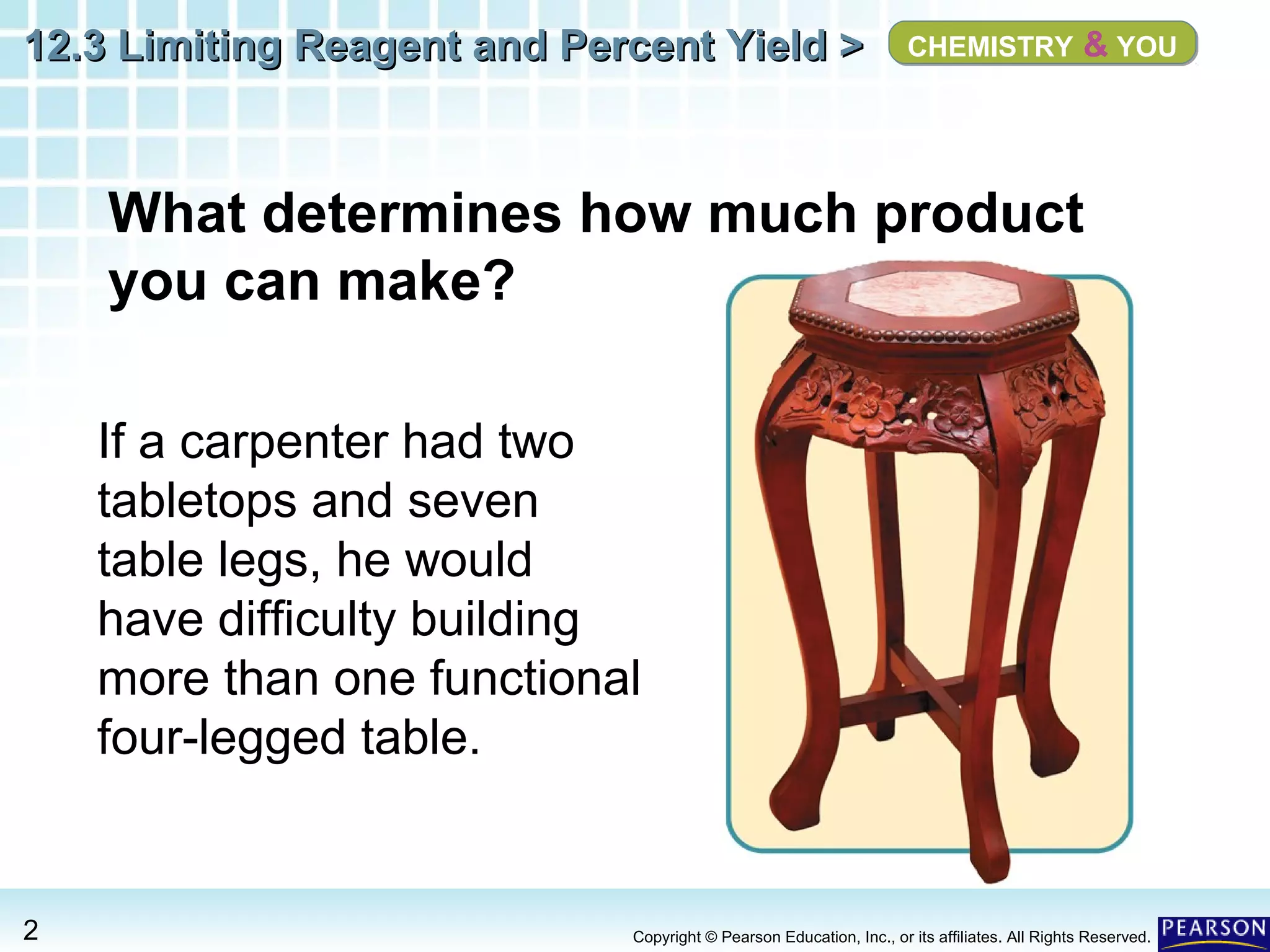
If a carpenter had two
tabletops and seven
table legs, he would
have difficulty building
more than one functional
four-legged table.
12.3 Limiting Reagent and Percent Yield >12.3 Limiting Reagent and Percent Yield >
3 Copyright © Pearson Education, Inc., or its affiliates. All Rights Reserved.
Limiting andLimiting and
Excess ReagentsExcess Reagents
Limiting and Excess Reagents
How is the amount of product in
a reaction affected by an
insufficient quantity of any of the
reactants?
12.3 Limiting Reagent and Percent Yield >12.3 Limiting Reagent and Percent Yield >
4 Copyright © Pearson Education, Inc., or its affiliates. All Rights Reserved.
Limiting andLimiting and
Excess ReagentsExcess Reagents
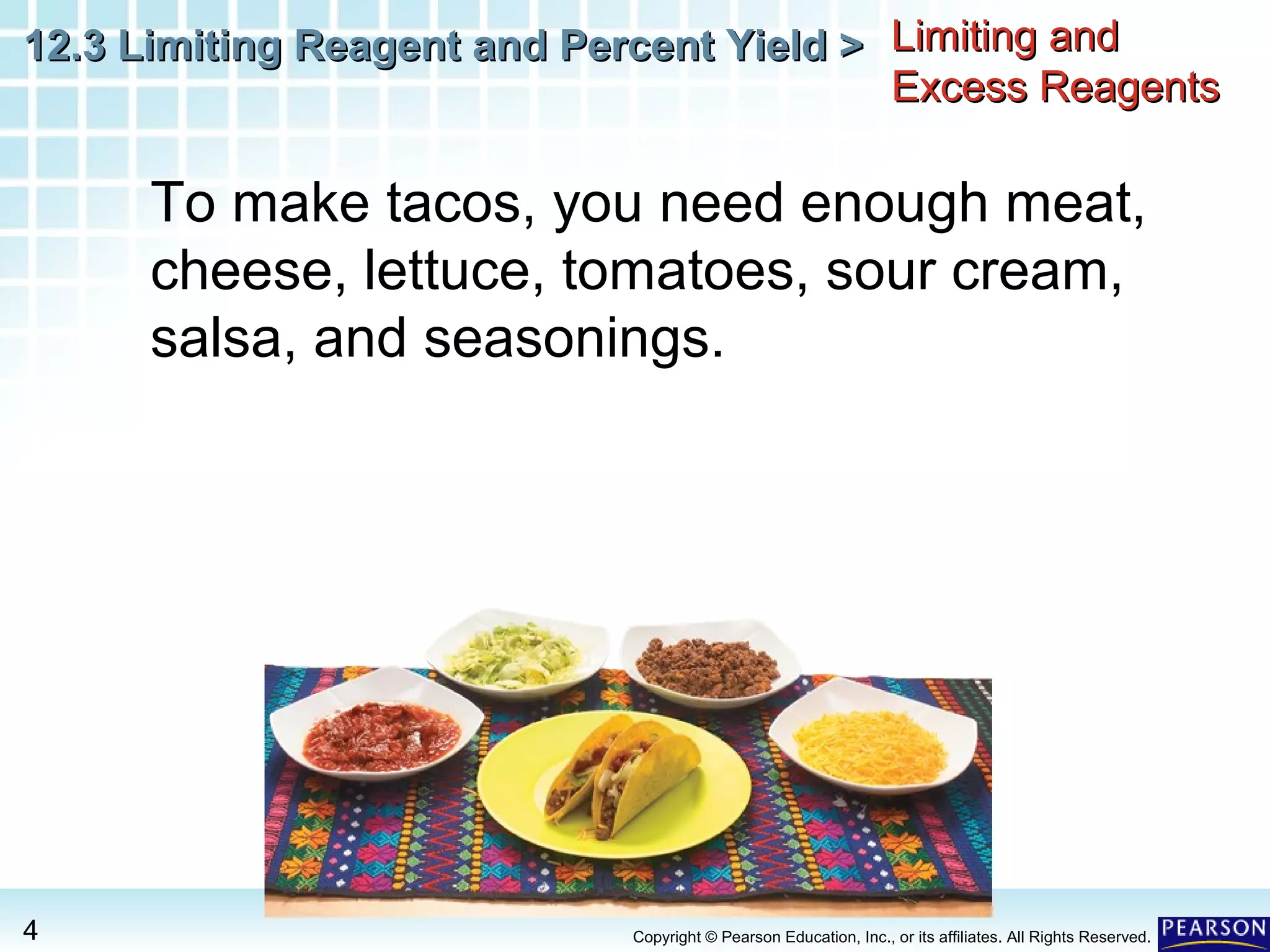
To make tacos, you need enough meat,
cheese, lettuce, tomatoes, sour cream,
salsa, and seasonings.
12.3 Limiting Reagent and Percent Yield >12.3 Limiting Reagent and Percent Yield >
5 Copyright © Pearson Education, Inc., or its affiliates. All Rights Reserved.
Limiting andLimiting and
Excess ReagentsExcess Reagents
To make tacos, you need enough meat,
cheese, lettuce, tomatoes, sour cream,
salsa, and seasonings.
• If you have only 2 taco shells, the quantity of
taco shells will limit the number of tacos you can
make.
12.3 Limiting Reagent and Percent Yield >12.3 Limiting Reagent and Percent Yield >
6 Copyright © Pearson Education, Inc., or its affiliates. All Rights Reserved.
Limiting andLimiting and
Excess ReagentsExcess Reagents
To make tacos, you need enough meat,
cheese, lettuce, tomatoes, sour cream,
salsa, and seasonings.
• If you have only 2 taco shells, the quantity of
taco shells will limit the number of tacos you can
make.
• Thus, the taco shells are the limiting ingredient.
12.3 Limiting Reagent and Percent Yield >12.3 Limiting Reagent and Percent Yield >
7 Copyright © Pearson Education, Inc., or its affiliates. All Rights Reserved.
Limiting andLimiting and
Excess ReagentsExcess Reagents
In a chemical reaction, an insufficient
quantity of any of the reactants will
limit the amount of product that forms.
12.3 Limiting Reagent and Percent Yield >12.3 Limiting Reagent and Percent Yield >
8 Copyright © Pearson Education, Inc., or its affiliates. All Rights Reserved.
Limiting andLimiting and
Excess ReagentsExcess Reagents
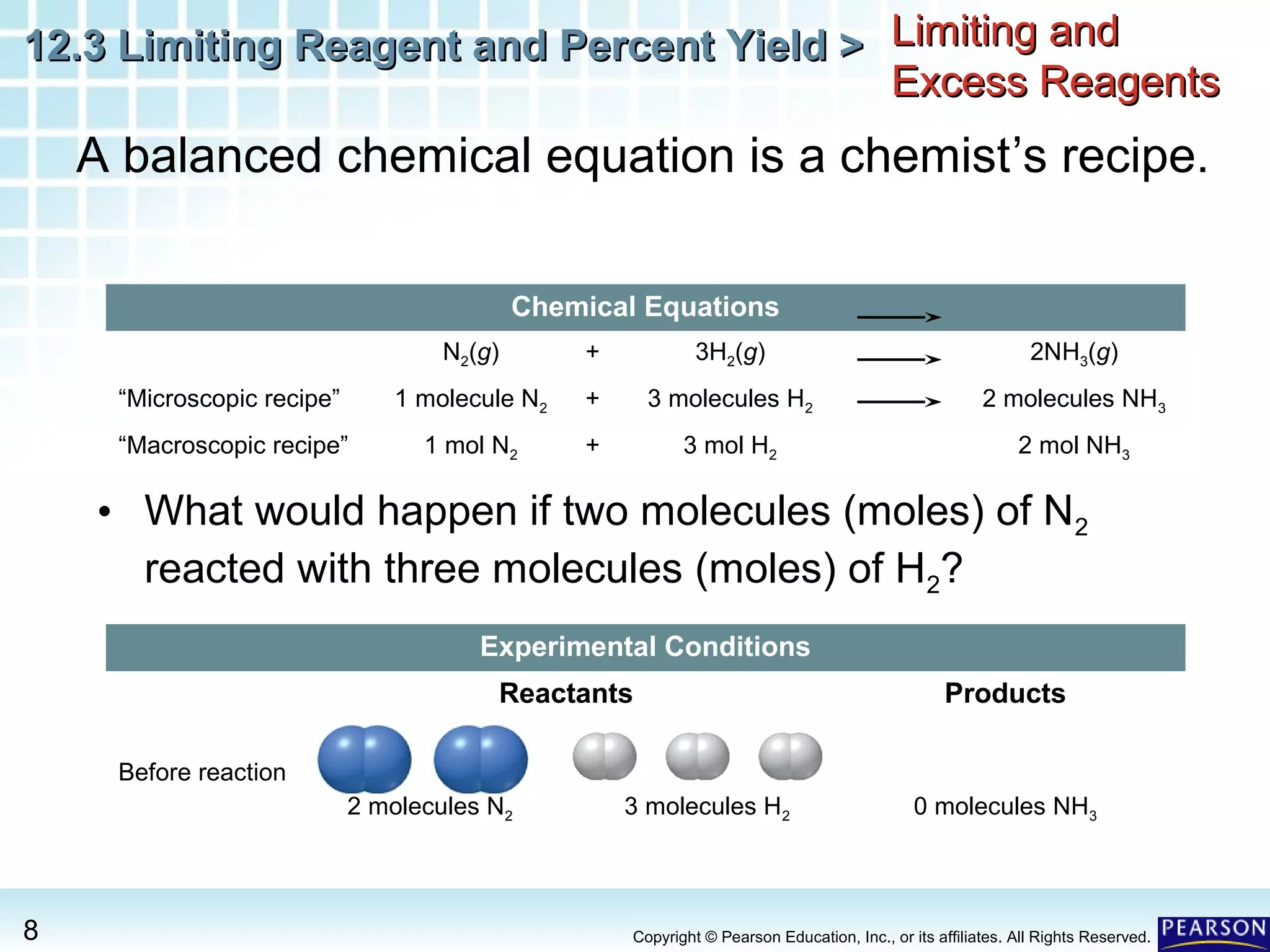
A balanced chemical equation is a chemist’s recipe.
• What would happen if two molecules (moles) of N2
reacted with three molecules (moles) of H2?
Experimental Conditions
Reactants Products
Before reaction
2 molecules N2 3 molecules H2 0 molecules NH3
Chemical Equations
N2(g) + 3H2(g) 2NH3(g)
“Microscopic recipe” 1 molecule N2 + 3 molecules H2 2 molecules NH3
“Macroscopic recipe” 1 mol N2 + 3 mol H2 2 mol NH3
12.3 Limiting Reagent and Percent Yield >12.3 Limiting Reagent and Percent Yield >
9 Copyright © Pearson Education, Inc., or its affiliates. All Rights Reserved.
Limiting andLimiting and
Excess ReagentsExcess Reagents
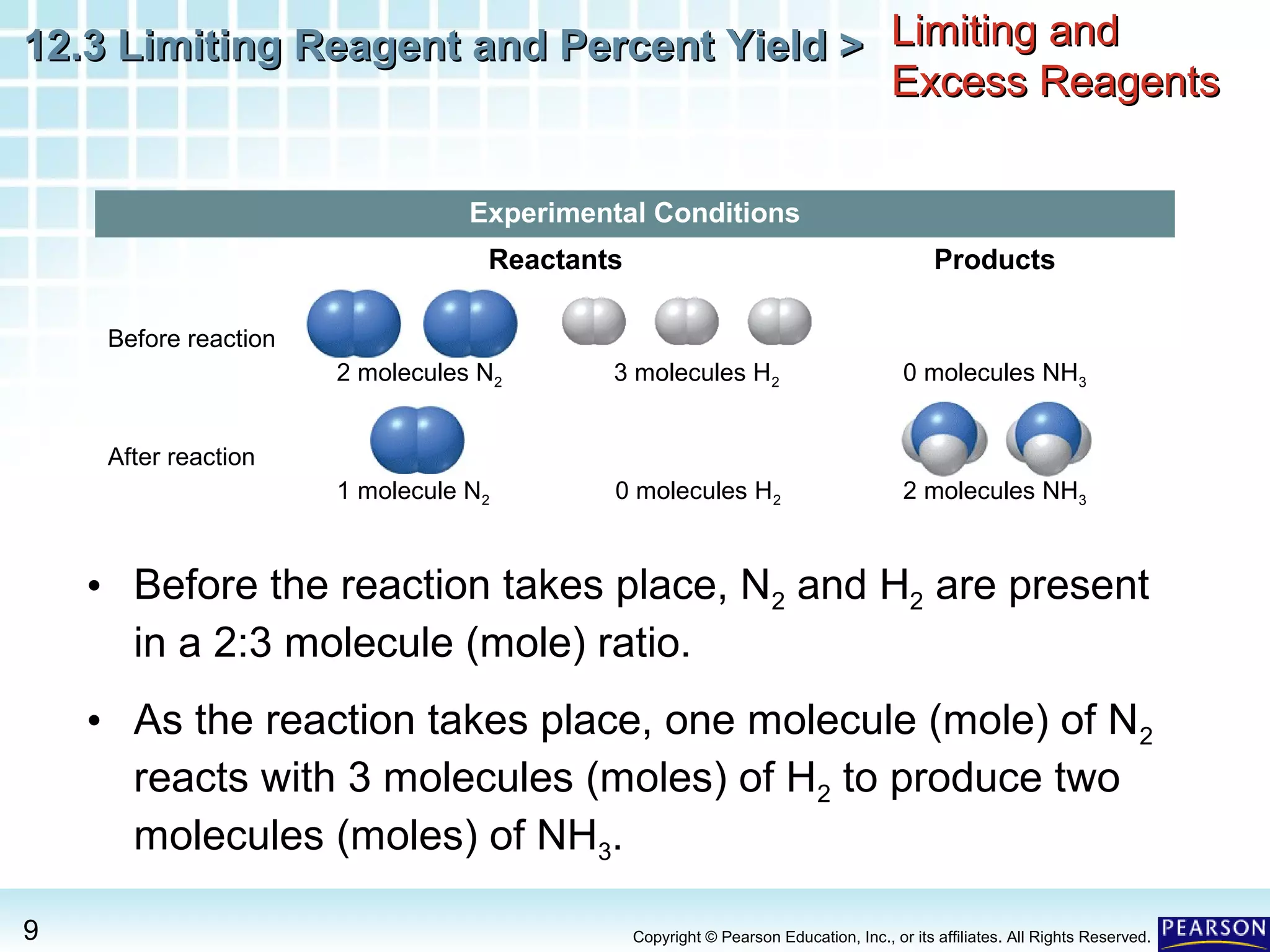
• Before the reaction takes place, N2 and H2 are present
in a 2:3 molecule (mole) ratio.
• As the reaction takes place, one molecule (mole) of N2
reacts with 3 molecules (moles) of H2 to produce two
molecules (moles) of NH3.
Experimental Conditions
Reactants Products
Before reaction
2 molecules N2 3 molecules H2 0 molecules NH3
After reaction
1 molecule N2 0 molecules H2 2 molecules NH3
12.3 Limiting Reagent and Percent Yield >12.3 Limiting Reagent and Percent Yield >
10 Copyright © Pearson Education, Inc., or its affiliates. All Rights Reserved.
Limiting andLimiting and
Excess ReagentsExcess Reagents
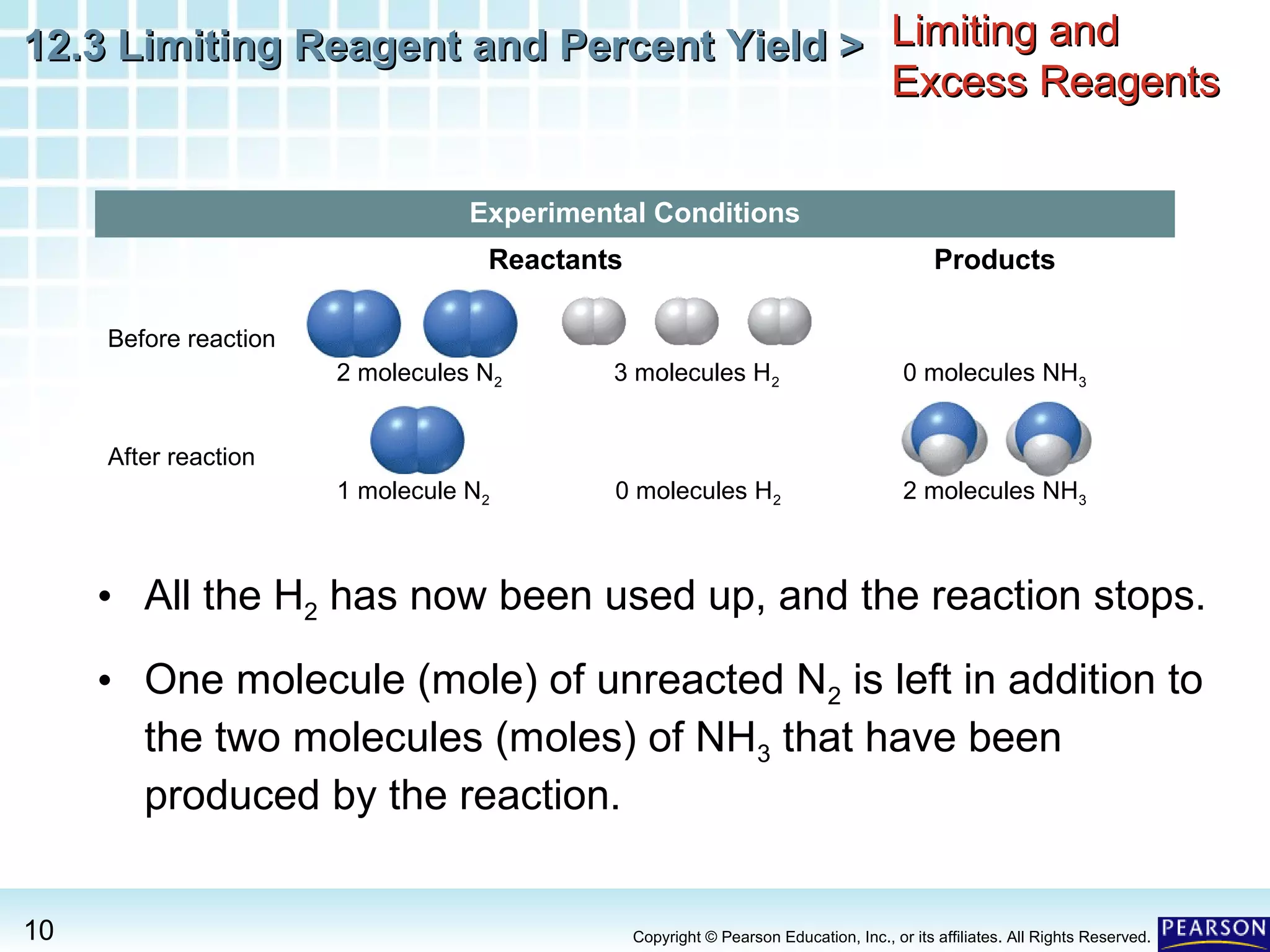
Experimental Conditions
Reactants Products
Before reaction
2 molecules N2 3 molecules H2 0 molecules NH3
After reaction
1 molecule N2 0 molecules H2 2 molecules NH3
• All the H2 has now been used up, and the reaction stops.
• One molecule (mole) of unreacted N2 is left in addition to
the two molecules (moles) of NH3 that have been
produced by the reaction.
12.3 Limiting Reagent and Percent Yield >12.3 Limiting Reagent and Percent Yield >
11 Copyright © Pearson Education, Inc., or its affiliates. All Rights Reserved.
Limiting andLimiting and
Excess ReagentsExcess Reagents
Experimental Conditions
Reactants Products
Before reaction
2 molecules N2 3 molecules H2 0 molecules NH3
After reaction
1 molecule N2 0 molecules H2 2 molecules NH3
• In this reaction, only the hydrogen is completely used up.
• H2 is the limiting reagent, or the reactant that
determines the amount of product that can be formed by
a reaction.
12.3 Limiting Reagent and Percent Yield >12.3 Limiting Reagent and Percent Yield >
12 Copyright © Pearson Education, Inc., or its affiliates. All Rights Reserved.
Limiting andLimiting and
Excess ReagentsExcess Reagents
Experimental Conditions
Reactants Products
Before reaction
2 molecules N2 3 molecules H2 0 molecules NH3
After reaction
1 molecule N2 0 molecules H2 2 molecules NH3
• The reactant that is not completely used up in a
reaction is called the excess reagent.
• In this example, nitrogen is the excess reagent
because some nitrogen remains unreacted.
12.3 Limiting Reagent and Percent Yield >12.3 Limiting Reagent and Percent Yield >
13 Copyright © Pearson Education, Inc., or its affiliates. All Rights Reserved.
Copper reacts with sulfur to form
copper(I) sulfide according to the
following balanced equation:
2Cu(s) + S(s) → Cu2S(s)
What is the limiting reagent when
80.0 g Cu reacts with 25.0 g S?
Sample Problem 12.8Sample Problem 12.8
Determining the Limiting Reagent in a Reaction
12.3 Limiting Reagent and Percent Yield >12.3 Limiting Reagent and Percent Yield >
14 Copyright © Pearson Education, Inc., or its affiliates. All Rights Reserved.
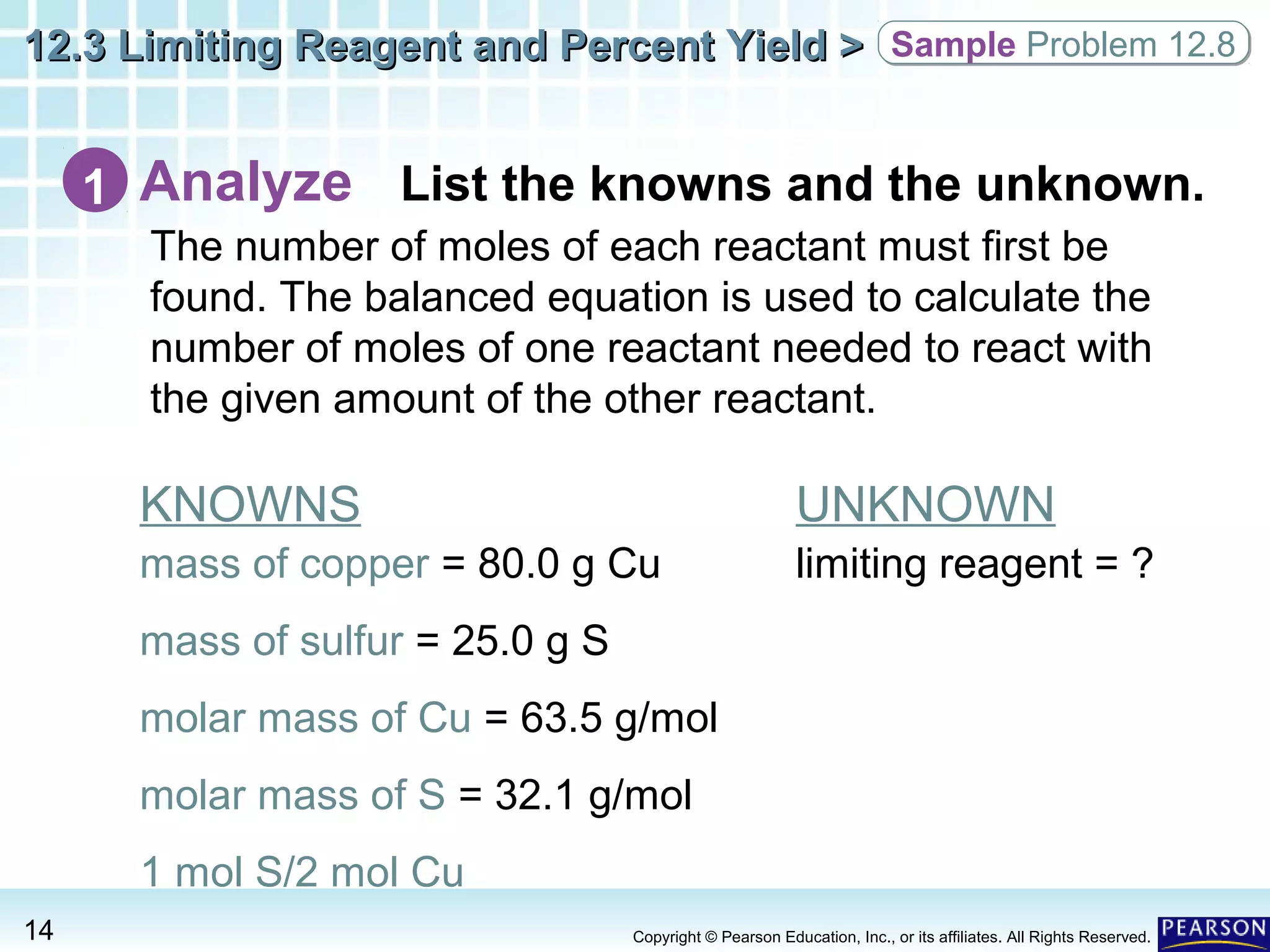
Analyze List the knowns and the unknown.1
The number of moles of each reactant must first be
found. The balanced equation is used to calculate the
number of moles of one reactant needed to react with
the given amount of the other reactant.
KNOWNS
mass of copper = 80.0 g Cu
mass of sulfur = 25.0 g S
molar mass of Cu = 63.5 g/mol
molar mass of S = 32.1 g/mol
1 mol S/2 mol Cu
UNKNOWN
limiting reagent = ?
Sample Problem 12.8Sample Problem 12.8
12.3 Limiting Reagent and Percent Yield >12.3 Limiting Reagent and Percent Yield >
15 Copyright © Pearson Education, Inc., or its affiliates. All Rights Reserved.
Start with one of the reactants and
convert from mass to moles.
Calculate Solve for the unknown.2
Sample Problem 12.8Sample Problem 12.8
80.0 g Cu × = 1.26 mol Cu63.5 g Cu
1 mol Cu
12.3 Limiting Reagent and Percent Yield >12.3 Limiting Reagent and Percent Yield >
16 Copyright © Pearson Education, Inc., or its affiliates. All Rights Reserved.
Then, convert the mass of the other
reactant to moles.
Calculate Solve for the unknown.2
Sample Problem 12.8Sample Problem 12.8
25.0 g S × = 0.779 mol S32.1 g S
1 mol S
12.3 Limiting Reagent and Percent Yield >12.3 Limiting Reagent and Percent Yield >
17 Copyright © Pearson Education, Inc., or its affiliates. All Rights Reserved.
Now, convert moles of Cu to moles of S
needed to react with 1.25 moles of Cu.
Calculate Solve for the unknown.2
Sample Problem 12.8Sample Problem 12.8
1.26 mol Cu × = 0.630 mol S2 mol Cu
1 mol S
Given
quantity
Mole
ratio
Needed
amount
12.3 Limiting Reagent and Percent Yield >12.3 Limiting Reagent and Percent Yield >
18 Copyright © Pearson Education, Inc., or its affiliates. All Rights Reserved.
Calculate Solve for the unknown.2
Sample Problem 12.8Sample Problem 12.8
Compare the amount of sulfur needed with the
given amount of sulfur.
0.630 mol S (amount needed to react)
<0.779 mol S (given amount)
Sulfur is in excess, so copper is the
limiting reagent.
It doesn’t matter which reactant you use. If you
used the actual amount of moles of S to find
the amount of copper needed, then you would
still identify copper as the limiting reagent.
12.3 Limiting Reagent and Percent Yield >12.3 Limiting Reagent and Percent Yield >
19 Copyright © Pearson Education, Inc., or its affiliates. All Rights Reserved.
Since the ratio of the given mol Cu to mol S
was less than the ratio (2:1) from the
balanced equation, copper should be the
limiting reagent.
Evaluate Do the results make sense?3
Sample Problem 12.8Sample Problem 12.8
12.3 Limiting Reagent and Percent Yield >12.3 Limiting Reagent and Percent Yield >
20 Copyright © Pearson Education, Inc., or its affiliates. All Rights Reserved.
Percent YieldPercent Yield
Percent Yield
What does the percent yield of
a reaction measure?
• A batting
average is
actually a
percent yield.
12.3 Limiting Reagent and Percent Yield >12.3 Limiting Reagent and Percent Yield >
21 Copyright © Pearson Education, Inc., or its affiliates. All Rights Reserved.
Percent YieldPercent Yield
When a balanced chemical equation is
used to calculate the amount of product that
will form during a reaction, the calculated
value represents the theoretical yield.
• The theoretical yield is the maximum amount
of product that could be formed from given
amounts of reactants.
• The amount of product that actually forms
when the reaction is carried out in the
laboratory is called the actual yield.
12.3 Limiting Reagent and Percent Yield >12.3 Limiting Reagent and Percent Yield >
22 Copyright © Pearson Education, Inc., or its affiliates. All Rights Reserved.
Percent YieldPercent Yield
The percent yield is the ratio of the actual
yield to the theoretical yield expressed as a
percent.
Because the actual yield of a chemical reaction
is often less than the theoretical yield, the
percent yield is often less than 100%.
percent yield =
actual yield
theoretical yield
× 100%
12.3 Limiting Reagent and Percent Yield >12.3 Limiting Reagent and Percent Yield >
23 Copyright © Pearson Education, Inc., or its affiliates. All Rights Reserved.
The percent yield is a measure of
the efficiency of a reaction carried
out in the laboratory.
Percent YieldPercent Yield
12.3 Limiting Reagent and Percent Yield >12.3 Limiting Reagent and Percent Yield >
24 Copyright © Pearson Education, Inc., or its affiliates. All Rights Reserved.
The percent yield is a measure of
the efficiency of a reaction carried
out in the laboratory.
Percent YieldPercent Yield
The mass
of the
reactant is
measured.
The mass of
one of the
products, the
actual yield,
is measured.
The percent
yield is
calculated.
The reactant
is heated.
12.3 Limiting Reagent and Percent Yield >12.3 Limiting Reagent and Percent Yield >
25 Copyright © Pearson Education, Inc., or its affiliates. All Rights Reserved.
Percent YieldPercent Yield
Many factors cause percent yields to be
less than 100%.
• Reactions do not always go to completion; when a
reaction is incomplete, less than the calculated amount
of product is formed.
• Impure reactants and competing side reactions may
cause unwanted products to form.
• Actual yield can be lower than the theoretical yield due
to a loss of product during filtration or in transferring
between containers.
• If reactants or products have not been carefully
measured, a percent yield of 100% is unlikely.

Limiting Reagents and Percent Yield

  • 1.
    12.3 Limiting Reagentand Percent Yield >12.3 Limiting Reagent and Percent Yield > 1 Copyright © Pearson Education, Inc., or its affiliates. All Rights Reserved. Chapter 12 Limiting Reagent and Percent Yield
  • 2.
    12.3 Limiting Reagentand Percent Yield >12.3 Limiting Reagent and Percent Yield > 2 Copyright © Pearson Education, Inc., or its affiliates. All Rights Reserved. CHEMISTRY & YOUCHEMISTRY & YOU What determines how much product you can make? If a carpenter had two tabletops and seven table legs, he would have difficulty building more than one functional four-legged table.
  • 3.
    12.3 Limiting Reagentand Percent Yield >12.3 Limiting Reagent and Percent Yield > 3 Copyright © Pearson Education, Inc., or its affiliates. All Rights Reserved. Limiting andLimiting and Excess ReagentsExcess Reagents Limiting and Excess Reagents How is the amount of product in a reaction affected by an insufficient quantity of any of the reactants?
  • 4.
    12.3 Limiting Reagentand Percent Yield >12.3 Limiting Reagent and Percent Yield > 4 Copyright © Pearson Education, Inc., or its affiliates. All Rights Reserved. Limiting andLimiting and Excess ReagentsExcess Reagents To make tacos, you need enough meat, cheese, lettuce, tomatoes, sour cream, salsa, and seasonings.
  • 5.
    12.3 Limiting Reagentand Percent Yield >12.3 Limiting Reagent and Percent Yield > 5 Copyright © Pearson Education, Inc., or its affiliates. All Rights Reserved. Limiting andLimiting and Excess ReagentsExcess Reagents To make tacos, you need enough meat, cheese, lettuce, tomatoes, sour cream, salsa, and seasonings. • If you have only 2 taco shells, the quantity of taco shells will limit the number of tacos you can make.
  • 6.
    12.3 Limiting Reagentand Percent Yield >12.3 Limiting Reagent and Percent Yield > 6 Copyright © Pearson Education, Inc., or its affiliates. All Rights Reserved. Limiting andLimiting and Excess ReagentsExcess Reagents To make tacos, you need enough meat, cheese, lettuce, tomatoes, sour cream, salsa, and seasonings. • If you have only 2 taco shells, the quantity of taco shells will limit the number of tacos you can make. • Thus, the taco shells are the limiting ingredient.
  • 7.
    12.3 Limiting Reagentand Percent Yield >12.3 Limiting Reagent and Percent Yield > 7 Copyright © Pearson Education, Inc., or its affiliates. All Rights Reserved. Limiting andLimiting and Excess ReagentsExcess Reagents In a chemical reaction, an insufficient quantity of any of the reactants will limit the amount of product that forms.
  • 8.
    12.3 Limiting Reagentand Percent Yield >12.3 Limiting Reagent and Percent Yield > 8 Copyright © Pearson Education, Inc., or its affiliates. All Rights Reserved. Limiting andLimiting and Excess ReagentsExcess Reagents A balanced chemical equation is a chemist’s recipe. • What would happen if two molecules (moles) of N2 reacted with three molecules (moles) of H2? Experimental Conditions Reactants Products Before reaction 2 molecules N2 3 molecules H2 0 molecules NH3 Chemical Equations N2(g) + 3H2(g) 2NH3(g) “Microscopic recipe” 1 molecule N2 + 3 molecules H2 2 molecules NH3 “Macroscopic recipe” 1 mol N2 + 3 mol H2 2 mol NH3
  • 9.
    12.3 Limiting Reagentand Percent Yield >12.3 Limiting Reagent and Percent Yield > 9 Copyright © Pearson Education, Inc., or its affiliates. All Rights Reserved. Limiting andLimiting and Excess ReagentsExcess Reagents • Before the reaction takes place, N2 and H2 are present in a 2:3 molecule (mole) ratio. • As the reaction takes place, one molecule (mole) of N2 reacts with 3 molecules (moles) of H2 to produce two molecules (moles) of NH3. Experimental Conditions Reactants Products Before reaction 2 molecules N2 3 molecules H2 0 molecules NH3 After reaction 1 molecule N2 0 molecules H2 2 molecules NH3
  • 10.
    12.3 Limiting Reagentand Percent Yield >12.3 Limiting Reagent and Percent Yield > 10 Copyright © Pearson Education, Inc., or its affiliates. All Rights Reserved. Limiting andLimiting and Excess ReagentsExcess Reagents Experimental Conditions Reactants Products Before reaction 2 molecules N2 3 molecules H2 0 molecules NH3 After reaction 1 molecule N2 0 molecules H2 2 molecules NH3 • All the H2 has now been used up, and the reaction stops. • One molecule (mole) of unreacted N2 is left in addition to the two molecules (moles) of NH3 that have been produced by the reaction.
  • 11.
    12.3 Limiting Reagentand Percent Yield >12.3 Limiting Reagent and Percent Yield > 11 Copyright © Pearson Education, Inc., or its affiliates. All Rights Reserved. Limiting andLimiting and Excess ReagentsExcess Reagents Experimental Conditions Reactants Products Before reaction 2 molecules N2 3 molecules H2 0 molecules NH3 After reaction 1 molecule N2 0 molecules H2 2 molecules NH3 • In this reaction, only the hydrogen is completely used up. • H2 is the limiting reagent, or the reactant that determines the amount of product that can be formed by a reaction.
  • 12.
    12.3 Limiting Reagentand Percent Yield >12.3 Limiting Reagent and Percent Yield > 12 Copyright © Pearson Education, Inc., or its affiliates. All Rights Reserved. Limiting andLimiting and Excess ReagentsExcess Reagents Experimental Conditions Reactants Products Before reaction 2 molecules N2 3 molecules H2 0 molecules NH3 After reaction 1 molecule N2 0 molecules H2 2 molecules NH3 • The reactant that is not completely used up in a reaction is called the excess reagent. • In this example, nitrogen is the excess reagent because some nitrogen remains unreacted.
  • 13.
    12.3 Limiting Reagentand Percent Yield >12.3 Limiting Reagent and Percent Yield > 13 Copyright © Pearson Education, Inc., or its affiliates. All Rights Reserved. Copper reacts with sulfur to form copper(I) sulfide according to the following balanced equation: 2Cu(s) + S(s) → Cu2S(s) What is the limiting reagent when 80.0 g Cu reacts with 25.0 g S? Sample Problem 12.8Sample Problem 12.8 Determining the Limiting Reagent in a Reaction
  • 14.
    12.3 Limiting Reagentand Percent Yield >12.3 Limiting Reagent and Percent Yield > 14 Copyright © Pearson Education, Inc., or its affiliates. All Rights Reserved. Analyze List the knowns and the unknown.1 The number of moles of each reactant must first be found. The balanced equation is used to calculate the number of moles of one reactant needed to react with the given amount of the other reactant. KNOWNS mass of copper = 80.0 g Cu mass of sulfur = 25.0 g S molar mass of Cu = 63.5 g/mol molar mass of S = 32.1 g/mol 1 mol S/2 mol Cu UNKNOWN limiting reagent = ? Sample Problem 12.8Sample Problem 12.8
  • 15.
    12.3 Limiting Reagentand Percent Yield >12.3 Limiting Reagent and Percent Yield > 15 Copyright © Pearson Education, Inc., or its affiliates. All Rights Reserved. Start with one of the reactants and convert from mass to moles. Calculate Solve for the unknown.2 Sample Problem 12.8Sample Problem 12.8 80.0 g Cu × = 1.26 mol Cu63.5 g Cu 1 mol Cu
  • 16.
    12.3 Limiting Reagentand Percent Yield >12.3 Limiting Reagent and Percent Yield > 16 Copyright © Pearson Education, Inc., or its affiliates. All Rights Reserved. Then, convert the mass of the other reactant to moles. Calculate Solve for the unknown.2 Sample Problem 12.8Sample Problem 12.8 25.0 g S × = 0.779 mol S32.1 g S 1 mol S
  • 17.
    12.3 Limiting Reagentand Percent Yield >12.3 Limiting Reagent and Percent Yield > 17 Copyright © Pearson Education, Inc., or its affiliates. All Rights Reserved. Now, convert moles of Cu to moles of S needed to react with 1.25 moles of Cu. Calculate Solve for the unknown.2 Sample Problem 12.8Sample Problem 12.8 1.26 mol Cu × = 0.630 mol S2 mol Cu 1 mol S Given quantity Mole ratio Needed amount
  • 18.
    12.3 Limiting Reagentand Percent Yield >12.3 Limiting Reagent and Percent Yield > 18 Copyright © Pearson Education, Inc., or its affiliates. All Rights Reserved. Calculate Solve for the unknown.2 Sample Problem 12.8Sample Problem 12.8 Compare the amount of sulfur needed with the given amount of sulfur. 0.630 mol S (amount needed to react) <0.779 mol S (given amount) Sulfur is in excess, so copper is the limiting reagent. It doesn’t matter which reactant you use. If you used the actual amount of moles of S to find the amount of copper needed, then you would still identify copper as the limiting reagent.
  • 19.
    12.3 Limiting Reagentand Percent Yield >12.3 Limiting Reagent and Percent Yield > 19 Copyright © Pearson Education, Inc., or its affiliates. All Rights Reserved. Since the ratio of the given mol Cu to mol S was less than the ratio (2:1) from the balanced equation, copper should be the limiting reagent. Evaluate Do the results make sense?3 Sample Problem 12.8Sample Problem 12.8
  • 20.
    12.3 Limiting Reagentand Percent Yield >12.3 Limiting Reagent and Percent Yield > 20 Copyright © Pearson Education, Inc., or its affiliates. All Rights Reserved. Percent YieldPercent Yield Percent Yield What does the percent yield of a reaction measure? • A batting average is actually a percent yield.
  • 21.
    12.3 Limiting Reagentand Percent Yield >12.3 Limiting Reagent and Percent Yield > 21 Copyright © Pearson Education, Inc., or its affiliates. All Rights Reserved. Percent YieldPercent Yield When a balanced chemical equation is used to calculate the amount of product that will form during a reaction, the calculated value represents the theoretical yield. • The theoretical yield is the maximum amount of product that could be formed from given amounts of reactants. • The amount of product that actually forms when the reaction is carried out in the laboratory is called the actual yield.
  • 22.
    12.3 Limiting Reagentand Percent Yield >12.3 Limiting Reagent and Percent Yield > 22 Copyright © Pearson Education, Inc., or its affiliates. All Rights Reserved. Percent YieldPercent Yield The percent yield is the ratio of the actual yield to the theoretical yield expressed as a percent. Because the actual yield of a chemical reaction is often less than the theoretical yield, the percent yield is often less than 100%. percent yield = actual yield theoretical yield × 100%
  • 23.
    12.3 Limiting Reagentand Percent Yield >12.3 Limiting Reagent and Percent Yield > 23 Copyright © Pearson Education, Inc., or its affiliates. All Rights Reserved. The percent yield is a measure of the efficiency of a reaction carried out in the laboratory. Percent YieldPercent Yield
  • 24.
    12.3 Limiting Reagentand Percent Yield >12.3 Limiting Reagent and Percent Yield > 24 Copyright © Pearson Education, Inc., or its affiliates. All Rights Reserved. The percent yield is a measure of the efficiency of a reaction carried out in the laboratory. Percent YieldPercent Yield The mass of the reactant is measured. The mass of one of the products, the actual yield, is measured. The percent yield is calculated. The reactant is heated.
  • 25.
    12.3 Limiting Reagentand Percent Yield >12.3 Limiting Reagent and Percent Yield > 25 Copyright © Pearson Education, Inc., or its affiliates. All Rights Reserved. Percent YieldPercent Yield Many factors cause percent yields to be less than 100%. • Reactions do not always go to completion; when a reaction is incomplete, less than the calculated amount of product is formed. • Impure reactants and competing side reactions may cause unwanted products to form. • Actual yield can be lower than the theoretical yield due to a loss of product during filtration or in transferring between containers. • If reactants or products have not been carefully measured, a percent yield of 100% is unlikely.