✓ Stoichiometry is a section of chemistry that
involves using relationships between
reactants and/or products in a chemical
reaction to determine desired quantitative
data.
✓ Excess reagent/reactant is a reactant that
is not used up when the reaction is
finished.
✓ Limiting reagent/reactant is a reagent that
is completely used up or reacted.
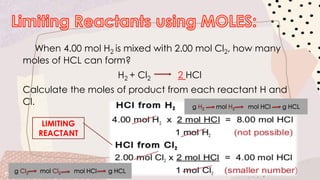
When 4.00 mol H2 is mixed with 2.00 mol Cl2, how many
moles of HCL can form?
H2 + Cl2 2 HCl
Calculate the moles of product from each reactant H and
Cl.
LIMITING
REACTANT
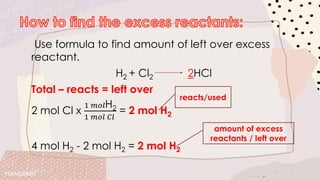
Use formula to find amount of left over excess
reactant.
H2 + Cl2 2HCl
Total – reacts = left over
2 mol Cl x
1 𝑚𝑜𝑙H2
1 𝑚𝑜𝑙 𝐶𝑙
= 2 mol H2
4 mol H2 - 2 mol H2 = 2 mol H2
reacts/used
amount of excess
reactants / left over
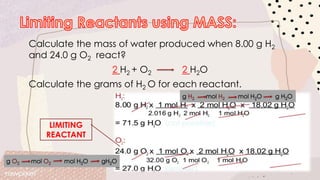
Calculate the mass of water produced when 8.00 g H2
and 24.0 g O2 react?
2 H2 + O2 2 H2O
Calculate the grams of H2 O for each reactant.
LIMITING
REACTANT
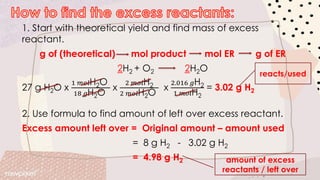
1. Start with theoretical yield and find mass of excess
reactant.
g of (theoretical) mol product mol ER g of ER
2H2 + O2 2H2O
27 g H2O x
1 𝑚𝑜𝑙H2O
18 𝑔H2O
x
2 𝑚𝑜𝑙H2
2 𝑚𝑜𝑙H2O
x
2.016 𝑔H2
1 𝑚𝑜𝑙H2
= 3.02 g H2
2. Use formula to find amount of left over excess reactant.
Excess amount left over = Original amount – amount used
= 8 g H2 - 3.02 g H2
= 4.98 g H2
reacts/used
amount of excess
reactants / left over
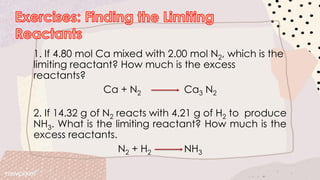
1. If 4.80 mol Ca mixed with 2.00 mol N2, which is the
limiting reactant? How much is the excess
reactants?
Ca + N2 Ca3 N2
2. If 14.32 g of N2 reacts with 4.21 g of H2 to produce
NH3. What is the limiting reactant? How much is the
excess reactants.
N2 + H2 NH3
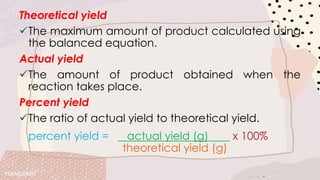
Theoretical yield
✓The maximum amount of product calculated using
the balanced equation.
Actual yield
✓The amount of product obtained when the
reaction takes place.
Percent yield
✓The ratio of actual yield to theoretical yield.
percent yield = actual yield (g) x 100%
theoretical yield (g)
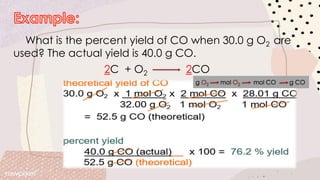
What is the percent yield of CO when 30.0 g O2 are
used? The actual yield is 40.0 g CO.
2C + O2 2CO
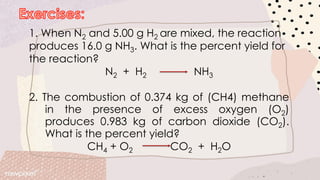
1. When N2 and 5.00 g H2 are mixed, the reaction
produces 16.0 g NH3. What is the percent yield for
the reaction?
N2 + H2 NH3
2. The combustion of 0.374 kg of (CH4) methane
in the presence of excess oxygen (O2)
produces 0.983 kg of carbon dioxide (CO2).
What is the percent yield?
CH4 + O2 CO2 + H2O
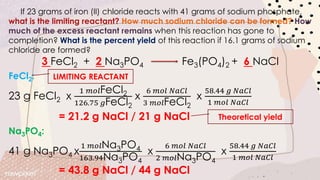
If 23 grams of iron (II) chloride reacts with 41 grams of sodium phosphate,
what is the limiting reactant? How much sodium chloride can be formed? How
much of the excess reactant remains when this reaction has gone to
completion? What is the percent yield of this reaction if 16.1 grams of sodium
chloride are formed?
3 FeCl2 + 2 Na3PO4 Fe3(PO4)2 + 6 NaCl
FeCl2:
23 g FeCl2 x
1 𝑚𝑜𝑙FeCl2
126.75 𝑔FeCl2
x
6 𝑚𝑜𝑙 𝑁𝑎𝐶𝑙
3 𝑚𝑜𝑙FeCl2
x
58.44 𝑔 𝑁𝑎𝐶𝑙
1 𝑚𝑜𝑙 𝑁𝑎𝐶𝑙
= 21.2 g NaCl / 21 g NaCl
Na3PO4:
41 g Na3PO4 x
1 𝑚𝑜𝑙Na3PO4
163.94Na3PO4
x
6 𝑚𝑜𝑙 𝑁𝑎𝐶𝑙
2 𝑚𝑜𝑙Na3PO4
x
58.44 𝑔 𝑁𝑎𝐶𝑙
1 𝑚𝑜𝑙 𝑁𝑎𝐶𝑙
= 43.8 g NaCl / 44 g NaCl
LIMITING REACTANT
Theoretical yield
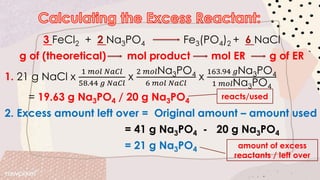
3 FeCl2 + 2 Na3PO4 Fe3(PO4)2 + 6 NaCl
g of (theoretical) mol product mol ER g of ER
1. 21 g NaCl x
1 𝑚𝑜𝑙 𝑁𝑎𝐶𝑙
58.44 𝑔 𝑁𝑎𝐶𝑙
x
2 𝑚𝑜𝑙Na3PO4
6 𝑚𝑜𝑙 𝑁𝑎𝐶𝑙
x
163.94 𝑔Na3PO4
1 𝑚𝑜𝑙Na3PO4
= 19.63 g Na3PO4 / 20 g Na3PO4
2. Excess amount left over = Original amount – amount used
= 41 g Na3PO4 - 20 g Na3PO4
= 21 g Na3PO4
reacts/used
amount of excess
reactants / left over
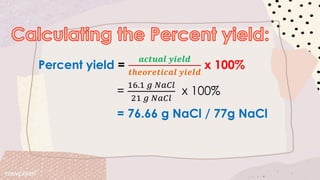
Percent yield =
𝒂𝒄𝒕𝒖𝒂𝒍 𝒚𝒊𝒆𝒍𝒅
𝒕𝒉𝒆𝒐𝒓𝒆𝒕𝒊𝒄𝒂𝒍 𝒚𝒊𝒆𝒍𝒅
x 100%
=
16.1 𝑔 𝑁𝑎𝐶𝑙
21 𝑔 𝑁𝑎𝐶𝑙
x 100%
= 76.66 g NaCl / 77g NaCl
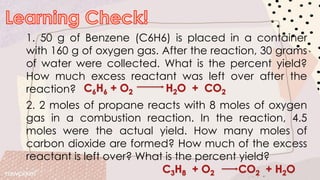
1. 50 g of Benzene (C6H6) is placed in a container
with 160 g of oxygen gas. After the reaction, 30 grams
of water were collected. What is the percent yield?
How much excess reactant was left over after the
reaction?
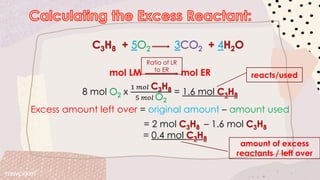
2. 2 moles of propane reacts with 8 moles of oxygen
gas in a combustion reaction. In the reaction, 4.5
moles were the actual yield. How many moles of
carbon dioxide are formed? How much of the excess
reactant is left over? What is the percent yield?
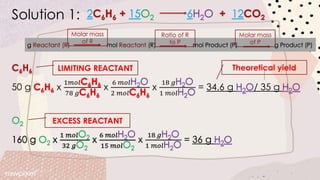
Solution 1::
50 g x
1𝑚𝑜𝑙
78 𝑔
x
6 𝑚𝑜𝑙
2 𝑚𝑜𝑙
x
18 𝑔
1 𝑚𝑜𝑙
= 34.6 g / 35 g
Theoretical yield
LIMITING REACTANT
EXCESS REACTANT
Molar mass
of R
Ratio of R
to P
Molar mass
of P
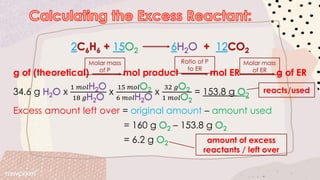
g of (theoretical) mol product mol ER g of ER
34.6 g x
1 𝑚𝑜𝑙
18 𝑔
x
15 𝑚𝑜𝑙
6 𝑚𝑜𝑙
x
32 𝑔
1 𝑚𝑜𝑙
= 153.8 g
Excess amount left over = original amount – amount used
= 160 g – 153.8 g
= 6.2 g
reacts/used
amount of excess
reactants / left over
Ratio of P
to ER
Molar mass
of P
Molar mass
of ER
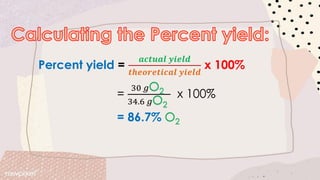
Percent yield =
𝒂𝒄𝒕𝒖𝒂𝒍 𝒚𝒊𝒆𝒍𝒅
𝒕𝒉𝒆𝒐𝒓𝒆𝒕𝒊𝒄𝒂𝒍 𝒚𝒊𝒆𝒍𝒅
x 100%
=
30 𝑔
34.6 𝑔
x 100%
= 86.7%
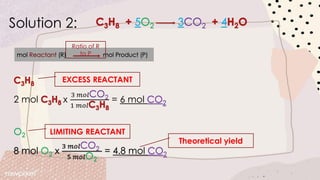
Solution 2::
2 mol x
3 𝑚𝑜𝑙
1 𝑚𝑜𝑙
= 6 mol
Theoretical yield
LIMITING REACTANT
EXCESS REACTANT
Ratio of R
to P
mol LM mol ER
8 mol x
1 𝑚𝑜𝑙
5 𝑚𝑜𝑙
= 1.6 mol
Excess amount left over = original amount – amount used
= 2 mol – 1.6 mol
= 0.4 mol
reacts/used
amount of excess
reactants / left over
Ratio of LR
to ER
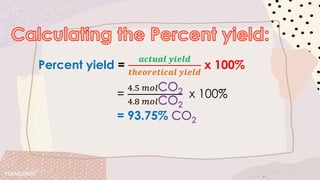
Percent yield =
𝒂𝒄𝒕𝒖𝒂𝒍 𝒚𝒊𝒆𝒍𝒅
𝒕𝒉𝒆𝒐𝒓𝒆𝒕𝒊𝒄𝒂𝒍 𝒚𝒊𝒆𝒍𝒅
x 100%
=
4.5 𝑚𝑜𝑙
4.8 𝑚𝑜𝑙
x 100%
= 93.75%

526128650-Limiting-Reactants-and-the-Product-Formed.pdf

  • 2.
    ✓ Stoichiometry isa section of chemistry that involves using relationships between reactants and/or products in a chemical reaction to determine desired quantitative data. ✓ Excess reagent/reactant is a reactant that is not used up when the reaction is finished. ✓ Limiting reagent/reactant is a reagent that is completely used up or reacted.
  • 4.
    When 4.00 molH2 is mixed with 2.00 mol Cl2, how many moles of HCL can form? H2 + Cl2 2 HCl Calculate the moles of product from each reactant H and Cl. LIMITING REACTANT
  • 5.
    Use formula tofind amount of left over excess reactant. H2 + Cl2 2HCl Total – reacts = left over 2 mol Cl x 1 𝑚𝑜𝑙H2 1 𝑚𝑜𝑙 𝐶𝑙 = 2 mol H2 4 mol H2 - 2 mol H2 = 2 mol H2 reacts/used amount of excess reactants / left over
  • 6.
    Calculate the massof water produced when 8.00 g H2 and 24.0 g O2 react? 2 H2 + O2 2 H2O Calculate the grams of H2 O for each reactant. LIMITING REACTANT
  • 7.
    1. Start withtheoretical yield and find mass of excess reactant. g of (theoretical) mol product mol ER g of ER 2H2 + O2 2H2O 27 g H2O x 1 𝑚𝑜𝑙H2O 18 𝑔H2O x 2 𝑚𝑜𝑙H2 2 𝑚𝑜𝑙H2O x 2.016 𝑔H2 1 𝑚𝑜𝑙H2 = 3.02 g H2 2. Use formula to find amount of left over excess reactant. Excess amount left over = Original amount – amount used = 8 g H2 - 3.02 g H2 = 4.98 g H2 reacts/used amount of excess reactants / left over
  • 8.
    1. If 4.80mol Ca mixed with 2.00 mol N2, which is the limiting reactant? How much is the excess reactants? Ca + N2 Ca3 N2 2. If 14.32 g of N2 reacts with 4.21 g of H2 to produce NH3. What is the limiting reactant? How much is the excess reactants. N2 + H2 NH3
  • 10.
    Theoretical yield ✓The maximumamount of product calculated using the balanced equation. Actual yield ✓The amount of product obtained when the reaction takes place. Percent yield ✓The ratio of actual yield to theoretical yield. percent yield = actual yield (g) x 100% theoretical yield (g)
  • 11.
    What is thepercent yield of CO when 30.0 g O2 are used? The actual yield is 40.0 g CO. 2C + O2 2CO
  • 12.
    1. When N2and 5.00 g H2 are mixed, the reaction produces 16.0 g NH3. What is the percent yield for the reaction? N2 + H2 NH3 2. The combustion of 0.374 kg of (CH4) methane in the presence of excess oxygen (O2) produces 0.983 kg of carbon dioxide (CO2). What is the percent yield? CH4 + O2 CO2 + H2O
  • 13.
    If 23 gramsof iron (II) chloride reacts with 41 grams of sodium phosphate, what is the limiting reactant? How much sodium chloride can be formed? How much of the excess reactant remains when this reaction has gone to completion? What is the percent yield of this reaction if 16.1 grams of sodium chloride are formed? 3 FeCl2 + 2 Na3PO4 Fe3(PO4)2 + 6 NaCl FeCl2: 23 g FeCl2 x 1 𝑚𝑜𝑙FeCl2 126.75 𝑔FeCl2 x 6 𝑚𝑜𝑙 𝑁𝑎𝐶𝑙 3 𝑚𝑜𝑙FeCl2 x 58.44 𝑔 𝑁𝑎𝐶𝑙 1 𝑚𝑜𝑙 𝑁𝑎𝐶𝑙 = 21.2 g NaCl / 21 g NaCl Na3PO4: 41 g Na3PO4 x 1 𝑚𝑜𝑙Na3PO4 163.94Na3PO4 x 6 𝑚𝑜𝑙 𝑁𝑎𝐶𝑙 2 𝑚𝑜𝑙Na3PO4 x 58.44 𝑔 𝑁𝑎𝐶𝑙 1 𝑚𝑜𝑙 𝑁𝑎𝐶𝑙 = 43.8 g NaCl / 44 g NaCl LIMITING REACTANT Theoretical yield
  • 14.
    3 FeCl2 +2 Na3PO4 Fe3(PO4)2 + 6 NaCl g of (theoretical) mol product mol ER g of ER 1. 21 g NaCl x 1 𝑚𝑜𝑙 𝑁𝑎𝐶𝑙 58.44 𝑔 𝑁𝑎𝐶𝑙 x 2 𝑚𝑜𝑙Na3PO4 6 𝑚𝑜𝑙 𝑁𝑎𝐶𝑙 x 163.94 𝑔Na3PO4 1 𝑚𝑜𝑙Na3PO4 = 19.63 g Na3PO4 / 20 g Na3PO4 2. Excess amount left over = Original amount – amount used = 41 g Na3PO4 - 20 g Na3PO4 = 21 g Na3PO4 reacts/used amount of excess reactants / left over
  • 15.
    Percent yield = 𝒂𝒄𝒕𝒖𝒂𝒍𝒚𝒊𝒆𝒍𝒅 𝒕𝒉𝒆𝒐𝒓𝒆𝒕𝒊𝒄𝒂𝒍 𝒚𝒊𝒆𝒍𝒅 x 100% = 16.1 𝑔 𝑁𝑎𝐶𝑙 21 𝑔 𝑁𝑎𝐶𝑙 x 100% = 76.66 g NaCl / 77g NaCl
  • 16.
    1. 50 gof Benzene (C6H6) is placed in a container with 160 g of oxygen gas. After the reaction, 30 grams of water were collected. What is the percent yield? How much excess reactant was left over after the reaction? 2. 2 moles of propane reacts with 8 moles of oxygen gas in a combustion reaction. In the reaction, 4.5 moles were the actual yield. How many moles of carbon dioxide are formed? How much of the excess reactant is left over? What is the percent yield?
  • 17.
    Solution 1:: 50 gx 1𝑚𝑜𝑙 78 𝑔 x 6 𝑚𝑜𝑙 2 𝑚𝑜𝑙 x 18 𝑔 1 𝑚𝑜𝑙 = 34.6 g / 35 g Theoretical yield LIMITING REACTANT EXCESS REACTANT Molar mass of R Ratio of R to P Molar mass of P
  • 18.
    g of (theoretical)mol product mol ER g of ER 34.6 g x 1 𝑚𝑜𝑙 18 𝑔 x 15 𝑚𝑜𝑙 6 𝑚𝑜𝑙 x 32 𝑔 1 𝑚𝑜𝑙 = 153.8 g Excess amount left over = original amount – amount used = 160 g – 153.8 g = 6.2 g reacts/used amount of excess reactants / left over Ratio of P to ER Molar mass of P Molar mass of ER
  • 19.
    Percent yield = 𝒂𝒄𝒕𝒖𝒂𝒍𝒚𝒊𝒆𝒍𝒅 𝒕𝒉𝒆𝒐𝒓𝒆𝒕𝒊𝒄𝒂𝒍 𝒚𝒊𝒆𝒍𝒅 x 100% = 30 𝑔 34.6 𝑔 x 100% = 86.7%
  • 20.
    Solution 2:: 2 molx 3 𝑚𝑜𝑙 1 𝑚𝑜𝑙 = 6 mol Theoretical yield LIMITING REACTANT EXCESS REACTANT Ratio of R to P
  • 21.
    mol LM molER 8 mol x 1 𝑚𝑜𝑙 5 𝑚𝑜𝑙 = 1.6 mol Excess amount left over = original amount – amount used = 2 mol – 1.6 mol = 0.4 mol reacts/used amount of excess reactants / left over Ratio of LR to ER
  • 22.
    Percent yield = 𝒂𝒄𝒕𝒖𝒂𝒍𝒚𝒊𝒆𝒍𝒅 𝒕𝒉𝒆𝒐𝒓𝒆𝒕𝒊𝒄𝒂𝒍 𝒚𝒊𝒆𝒍𝒅 x 100% = 4.5 𝑚𝑜𝑙 4.8 𝑚𝑜𝑙 x 100% = 93.75%