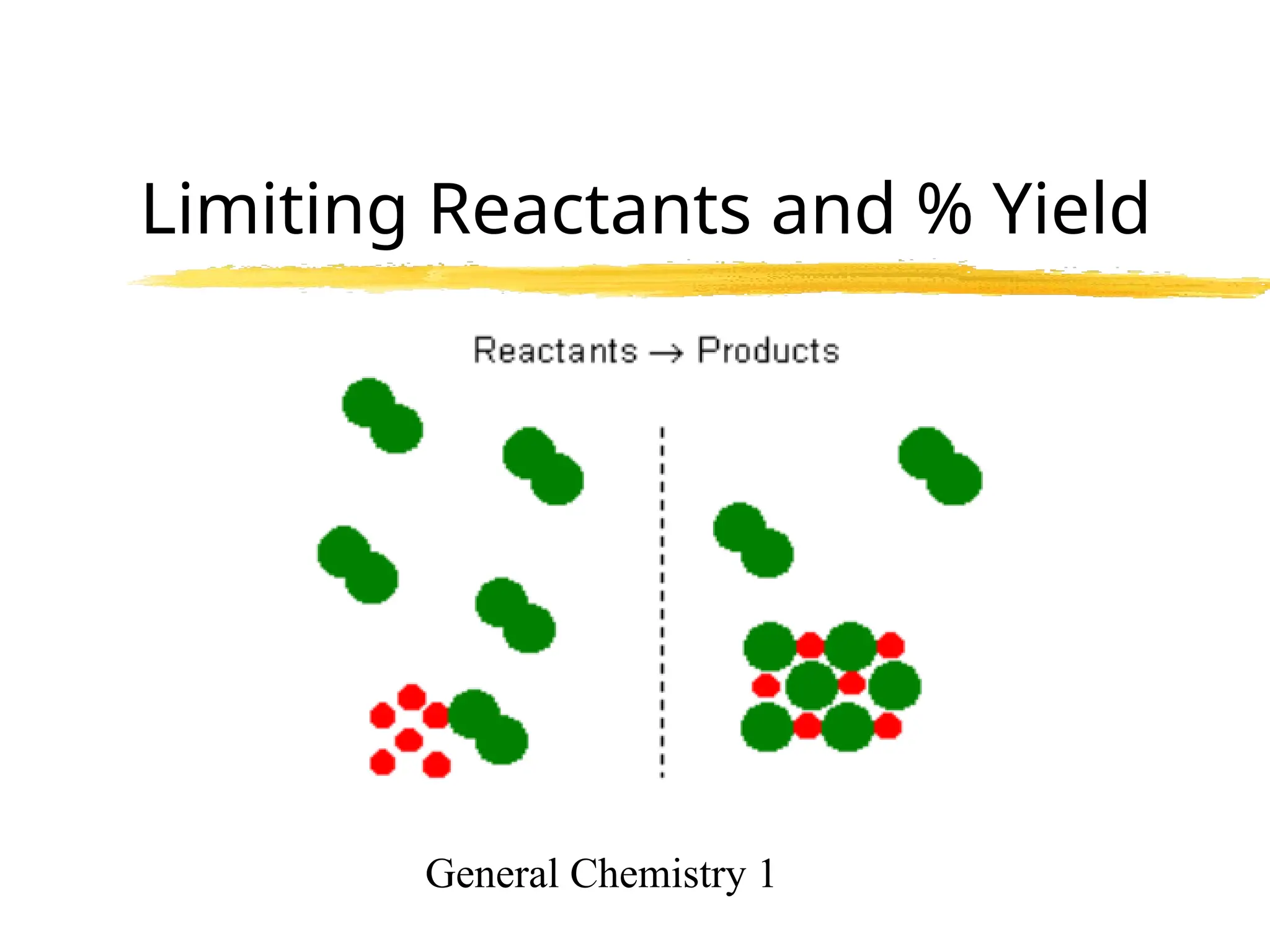
Limiting Reactants and % Yield
General Chemistry 1
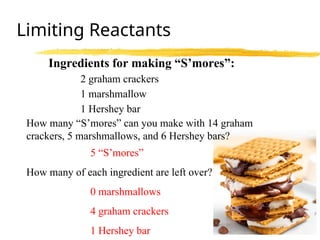
Limiting Reactants
Ingredients for making “S’mores”:
2 graham crackers
1 marshmallow
1 Hershey bar
How many “S’mores” can you make with 14 graham
crackers, 5 marshmallows, and 6 Hershey bars?
5 “S’mores”
How many of each ingredient are left over?
0 marshmallows
4 graham crackers
1 Hershey bar
Limiting Reactant
 The limiting reactant is the reactant
which controls the rate of reaction or
the amount of product that can be
made
 The reactant that gets totally used up
in a rxn; it’s the reactant you run out of.
(It “limits” the rxn.)
 The limiting reactant is determined
using stoichiometric relationships
Excess
 The reactant that you have more than
you need to perform a chemical
reaction is called the excess reactant
 It is not completely used up in a
chemical reaction.
 Any reactant that is not totally used up
in a rxn; you still have some of it left after
the rxn stops.
Here’s an example
 You are making ham and cheese sandwiches
and you have:
 5 pieces of ham
 5 pieces of cheese
 8 pieces of bread
 Which of these ingredients do you have more
than enough of (excess reactant)?
 Which of these do you not have enough of
(limiting reactant?
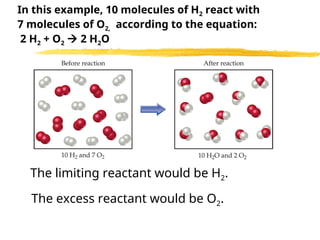
In this example, 10 molecules of H2 react with
7 molecules of O2, according to the equation:
2 H2 + O2  2 H2O
The limiting reactant would be H2.
The excess reactant would be O2.
Limiting Reactant Problems
You are given the initial amounts of the reactants in a rxn,
and must determine: a) which reactant is the limiting reactant.
You also should be able to determine: b) how much product is
produced, and c) how much of the excess reactant is left over.
**a) To determine which reactant is the limiting reactant:**
•Find out how much product can be made from the 1st
reactant
•Find out how much product can be made from the 2nd reactan
•Which ever reactant produces the LEAST product is the
limiting reactant.
(In other words: You need to do two mass-mass problems
to figure out the limiting reactant.)
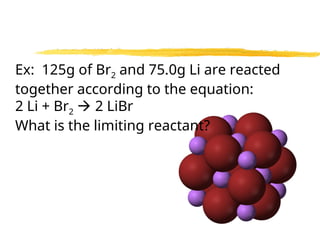
Ex: 125g of Br2 and 75.0g Li are reacted
together according to the equation:
2 Li + Br2  2 LiBr
What is the limiting reactant?
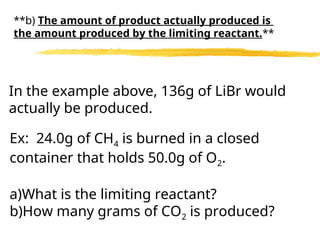
**b) The amount of product actually produced is
the amount produced by the limiting reactant.**
In the example above, 136g of LiBr would
actually be produced.
Ex: 24.0g of CH4 is burned in a closed
container that holds 50.0g of O2.
a)What is the limiting reactant?
b)How many grams of CO2 is produced?
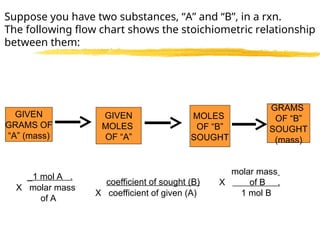
GIVEN
GRAMS OF
“A” (mass)
GIVEN
MOLES
OF “A”
1 mol A .
X molar mass
of A
MOLES
OF “B”
SOUGHT
coefficient of sought (B)
X coefficient of given (A)
GRAMS
OF “B”
SOUGHT
(mass)
molar mass
X of B .
1 mol B
Suppose you have two substances, “A” and “B”, in a rxn.
The following flow chart shows the stoichiometric relationship
between them:
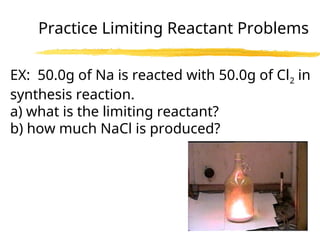
EX: 50.0g of Na is reacted with 50.0g of Cl2 in
synthesis reaction.
a) what is the limiting reactant?
b) how much NaCl is produced?
Practice Limiting Reactant Problems
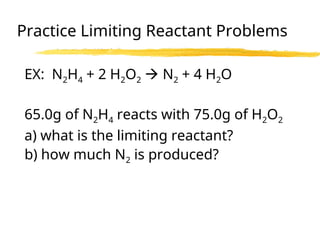
EX: N2H4 + 2 H2O2  N2 + 4 H2O
65.0g of N2H4 reacts with 75.0g of H2O2
a) what is the limiting reactant?
b) how much N2 is produced?
Practice Limiting Reactant Problems
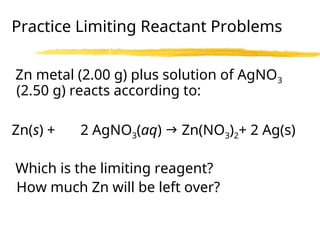
Zn metal (2.00 g) plus solution of AgNO3
(2.50 g) reacts according to:
Zn(s) + 2 AgNO3(aq)  Zn(NO3)2+ 2 Ag(s)
Which is the limiting reagent?
How much Zn will be left over?
Practice Limiting Reactant Problems
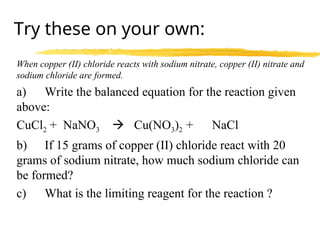
Try these on your own:
When copper (II) chloride reacts with sodium nitrate, copper (II) nitrate and
sodium chloride are formed.
a) Write the balanced equation for the reaction given
above:
CuCl2 + NaNO3  Cu(NO3)2 + NaCl
b) If 15 grams of copper (II) chloride react with 20
grams of sodium nitrate, how much sodium chloride can
be formed?
c) What is the limiting reagent for the reaction ?
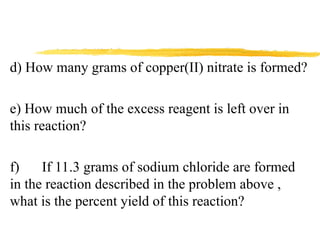
d) How many grams of copper(II) nitrate is formed?
e) How much of the excess reagent is left over in
this reaction?
f) If 11.3 grams of sodium chloride are formed
in the reaction described in the problem above ,
what is the percent yield of this reaction?
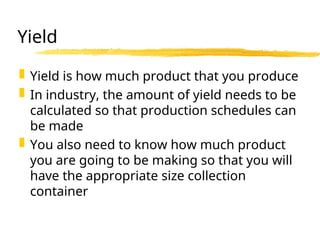
Yield
 Yield is how much product that you produce
 In industry, the amount of yield needs to be
calculated so that production schedules can
be made
 You also need to know how much product
you are going to be making so that you will
have the appropriate size collection
container
Real or Not?
 Actual yield refers to the amount of
product that is actually generated
 Theoretical yield refers to the amount
of product that you expect to generate
Calculating Yield
 In order to calculate the theoretical yield
you need to
 Write a balanced chemical equation.
 Calculate the amount of product produced
from each reactant individually.
 The reactant that produces the least amount
of product is the limiting reactant.
 The reactant that you have enough of is the
excess reactant.
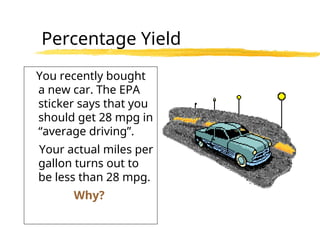
Percentage Yield
You recently bought
a new car. The EPA
sticker says that you
should get 28 mpg in
“average driving”.
Your actual miles per
gallon turns out to
be less than 28 mpg.
Why?
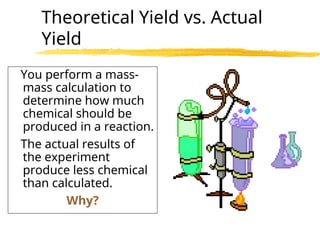
Theoretical Yield vs. Actual
Yield
You perform a mass-
mass calculation to
determine how much
chemical should be
produced in a reaction.
The actual results of
the experiment
produce less chemical
than calculated.
Why?
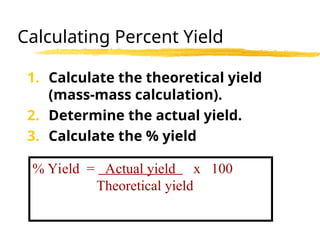
Calculating Percent Yield
1. Calculate the theoretical yield
(mass-mass calculation).
2. Determine the actual yield.
3. Calculate the % yield
% Yield = Actual yield x 100
Theoretical yield
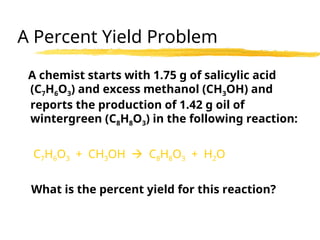
A Percent Yield Problem
A chemist starts with 1.75 g of salicylic acid
(C7H6O3) and excess methanol (CH3OH) and
reports the production of 1.42 g oil of
wintergreen (C8H8O3) in the following reaction:
C7H6O3 + CH3OH  C8H8O3 + H2O
What is the percent yield for this reaction?
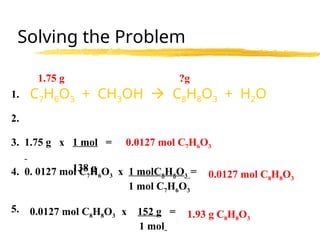
Solving the Problem
C7H6O3 + CH3OH  C8H8O3 + H2O
1.
2.
1.75 g ?g
3. 1.75 g x 1 mol =
138 g
0.0127 mol C7H6O3
4. 0. 0127 mol C7H6O3 x 1 molC8H8O3 =
1 mol C7H6O3
0.0127 mol C8H8O3
5. 0.0127 mol C8H8O3 x 152 g =
1 mol
1.93 g C8H8O3
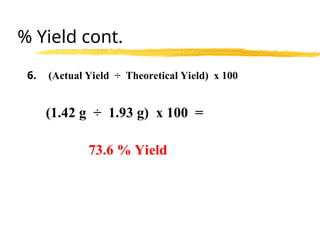
% Yield cont.
6. (Actual Yield ÷ Theoretical Yield) x 100
(1.42 g ÷ 1.93 g) x 100 =
73.6 % Yield
Practice Problems
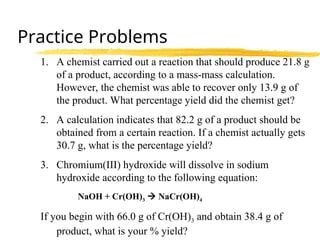
1. A chemist carried out a reaction that should produce 21.8 g
of a product, according to a mass-mass calculation.
However, the chemist was able to recover only 13.9 g of
the product. What percentage yield did the chemist get?
2. A calculation indicates that 82.2 g of a product should be
obtained from a certain reaction. If a chemist actually gets
30.7 g, what is the percentage yield?
3. Chromium(III) hydroxide will dissolve in sodium
hydroxide according to the following equation:
NaOH + Cr(OH)3  NaCr(OH)4
If you begin with 66.0 g of Cr(OH)3 and obtain 38.4 g of
product, what is your % yield?
Solutions
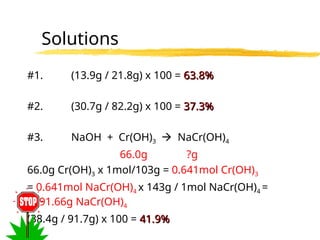
#1. (13.9g / 21.8g) x 100 = 63.8%
63.8%
#2. (30.7g / 82.2g) x 100 = 37.3%
37.3%
#3. NaOH + Cr(OH)3  NaCr(OH)4
66.0g ?g
66.0g Cr(OH)3 x 1mol/103g = 0.641mol Cr(OH)3
= 0.641mol NaCr(OH)4 x 143g / 1mol NaCr(OH)4 =
91.66g NaCr(OH)4
(38.4g / 91.7g) x 100 = 41.9%
41.9%
Practice Problem
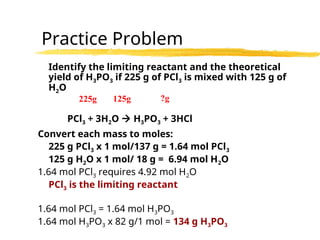
Identify the limiting reactant and the theoretical
yield of H3PO3 if 225 g of PCl3 is mixed with 125 g of
H2O
PCl3 + 3H2O  H3PO3 + 3HCl
Convert each mass to moles:
225 g PCl3 x 1 mol/137 g = 1.64 mol PCl3
125 g H2O x 1 mol/ 18 g = 6.94 mol H2O
1.64 mol PCl3 requires 4.92 mol H2O
PCl3 is the limiting reactant
1.64 mol PCl3 = 1.64 mol H3PO3
1.64 mol H3PO3 x 82 g/1 mol = 134 g H3PO3
225g 125g ?g
Classwork
Homework

Limiting-Reactants Limiting-Reactants ppt

  • 1.
    Limiting Reactants and% Yield General Chemistry 1
  • 2.
    Limiting Reactants Ingredients formaking “S’mores”: 2 graham crackers 1 marshmallow 1 Hershey bar How many “S’mores” can you make with 14 graham crackers, 5 marshmallows, and 6 Hershey bars? 5 “S’mores” How many of each ingredient are left over? 0 marshmallows 4 graham crackers 1 Hershey bar
  • 3.
    Limiting Reactant  Thelimiting reactant is the reactant which controls the rate of reaction or the amount of product that can be made  The reactant that gets totally used up in a rxn; it’s the reactant you run out of. (It “limits” the rxn.)  The limiting reactant is determined using stoichiometric relationships
  • 4.
    Excess  The reactantthat you have more than you need to perform a chemical reaction is called the excess reactant  It is not completely used up in a chemical reaction.  Any reactant that is not totally used up in a rxn; you still have some of it left after the rxn stops.
  • 5.
    Here’s an example You are making ham and cheese sandwiches and you have:  5 pieces of ham  5 pieces of cheese  8 pieces of bread  Which of these ingredients do you have more than enough of (excess reactant)?  Which of these do you not have enough of (limiting reactant?
  • 6.
    In this example,10 molecules of H2 react with 7 molecules of O2, according to the equation: 2 H2 + O2  2 H2O The limiting reactant would be H2. The excess reactant would be O2.
  • 7.
    Limiting Reactant Problems Youare given the initial amounts of the reactants in a rxn, and must determine: a) which reactant is the limiting reactant. You also should be able to determine: b) how much product is produced, and c) how much of the excess reactant is left over. **a) To determine which reactant is the limiting reactant:** •Find out how much product can be made from the 1st reactant •Find out how much product can be made from the 2nd reactan •Which ever reactant produces the LEAST product is the limiting reactant. (In other words: You need to do two mass-mass problems to figure out the limiting reactant.)
  • 8.
    Ex: 125g ofBr2 and 75.0g Li are reacted together according to the equation: 2 Li + Br2  2 LiBr What is the limiting reactant?
  • 9.
    **b) The amountof product actually produced is the amount produced by the limiting reactant.** In the example above, 136g of LiBr would actually be produced. Ex: 24.0g of CH4 is burned in a closed container that holds 50.0g of O2. a)What is the limiting reactant? b)How many grams of CO2 is produced?
  • 10.
    GIVEN GRAMS OF “A” (mass) GIVEN MOLES OF“A” 1 mol A . X molar mass of A MOLES OF “B” SOUGHT coefficient of sought (B) X coefficient of given (A) GRAMS OF “B” SOUGHT (mass) molar mass X of B . 1 mol B Suppose you have two substances, “A” and “B”, in a rxn. The following flow chart shows the stoichiometric relationship between them:
  • 11.
    EX: 50.0g ofNa is reacted with 50.0g of Cl2 in synthesis reaction. a) what is the limiting reactant? b) how much NaCl is produced? Practice Limiting Reactant Problems
  • 12.
    EX: N2H4 +2 H2O2  N2 + 4 H2O 65.0g of N2H4 reacts with 75.0g of H2O2 a) what is the limiting reactant? b) how much N2 is produced? Practice Limiting Reactant Problems
  • 13.
    Zn metal (2.00g) plus solution of AgNO3 (2.50 g) reacts according to: Zn(s) + 2 AgNO3(aq)  Zn(NO3)2+ 2 Ag(s) Which is the limiting reagent? How much Zn will be left over? Practice Limiting Reactant Problems
  • 14.
    Try these onyour own: When copper (II) chloride reacts with sodium nitrate, copper (II) nitrate and sodium chloride are formed. a) Write the balanced equation for the reaction given above: CuCl2 + NaNO3  Cu(NO3)2 + NaCl b) If 15 grams of copper (II) chloride react with 20 grams of sodium nitrate, how much sodium chloride can be formed? c) What is the limiting reagent for the reaction ?
  • 15.
    d) How manygrams of copper(II) nitrate is formed? e) How much of the excess reagent is left over in this reaction? f) If 11.3 grams of sodium chloride are formed in the reaction described in the problem above , what is the percent yield of this reaction?
  • 16.
    Yield  Yield ishow much product that you produce  In industry, the amount of yield needs to be calculated so that production schedules can be made  You also need to know how much product you are going to be making so that you will have the appropriate size collection container
  • 17.
    Real or Not? Actual yield refers to the amount of product that is actually generated  Theoretical yield refers to the amount of product that you expect to generate
  • 18.
    Calculating Yield  Inorder to calculate the theoretical yield you need to  Write a balanced chemical equation.  Calculate the amount of product produced from each reactant individually.  The reactant that produces the least amount of product is the limiting reactant.  The reactant that you have enough of is the excess reactant.
  • 19.
    Percentage Yield You recentlybought a new car. The EPA sticker says that you should get 28 mpg in “average driving”. Your actual miles per gallon turns out to be less than 28 mpg. Why?
  • 20.
    Theoretical Yield vs.Actual Yield You perform a mass- mass calculation to determine how much chemical should be produced in a reaction. The actual results of the experiment produce less chemical than calculated. Why?
  • 21.
    Calculating Percent Yield 1.Calculate the theoretical yield (mass-mass calculation). 2. Determine the actual yield. 3. Calculate the % yield % Yield = Actual yield x 100 Theoretical yield
  • 22.
    A Percent YieldProblem A chemist starts with 1.75 g of salicylic acid (C7H6O3) and excess methanol (CH3OH) and reports the production of 1.42 g oil of wintergreen (C8H8O3) in the following reaction: C7H6O3 + CH3OH  C8H8O3 + H2O What is the percent yield for this reaction?
  • 23.
    Solving the Problem C7H6O3+ CH3OH  C8H8O3 + H2O 1. 2. 1.75 g ?g 3. 1.75 g x 1 mol = 138 g 0.0127 mol C7H6O3 4. 0. 0127 mol C7H6O3 x 1 molC8H8O3 = 1 mol C7H6O3 0.0127 mol C8H8O3 5. 0.0127 mol C8H8O3 x 152 g = 1 mol 1.93 g C8H8O3
  • 24.
    % Yield cont. 6.(Actual Yield ÷ Theoretical Yield) x 100 (1.42 g ÷ 1.93 g) x 100 = 73.6 % Yield
  • 25.
    Practice Problems 1. Achemist carried out a reaction that should produce 21.8 g of a product, according to a mass-mass calculation. However, the chemist was able to recover only 13.9 g of the product. What percentage yield did the chemist get? 2. A calculation indicates that 82.2 g of a product should be obtained from a certain reaction. If a chemist actually gets 30.7 g, what is the percentage yield? 3. Chromium(III) hydroxide will dissolve in sodium hydroxide according to the following equation: NaOH + Cr(OH)3  NaCr(OH)4 If you begin with 66.0 g of Cr(OH)3 and obtain 38.4 g of product, what is your % yield?
  • 26.
    Solutions #1. (13.9g /21.8g) x 100 = 63.8% 63.8% #2. (30.7g / 82.2g) x 100 = 37.3% 37.3% #3. NaOH + Cr(OH)3  NaCr(OH)4 66.0g ?g 66.0g Cr(OH)3 x 1mol/103g = 0.641mol Cr(OH)3 = 0.641mol NaCr(OH)4 x 143g / 1mol NaCr(OH)4 = 91.66g NaCr(OH)4 (38.4g / 91.7g) x 100 = 41.9% 41.9%
  • 27.
    Practice Problem Identify thelimiting reactant and the theoretical yield of H3PO3 if 225 g of PCl3 is mixed with 125 g of H2O PCl3 + 3H2O  H3PO3 + 3HCl Convert each mass to moles: 225 g PCl3 x 1 mol/137 g = 1.64 mol PCl3 125 g H2O x 1 mol/ 18 g = 6.94 mol H2O 1.64 mol PCl3 requires 4.92 mol H2O PCl3 is the limiting reactant 1.64 mol PCl3 = 1.64 mol H3PO3 1.64 mol H3PO3 x 82 g/1 mol = 134 g H3PO3 225g 125g ?g
  • 28.
  • 29.