Limiting and Excess
Reactants
Lesson 7
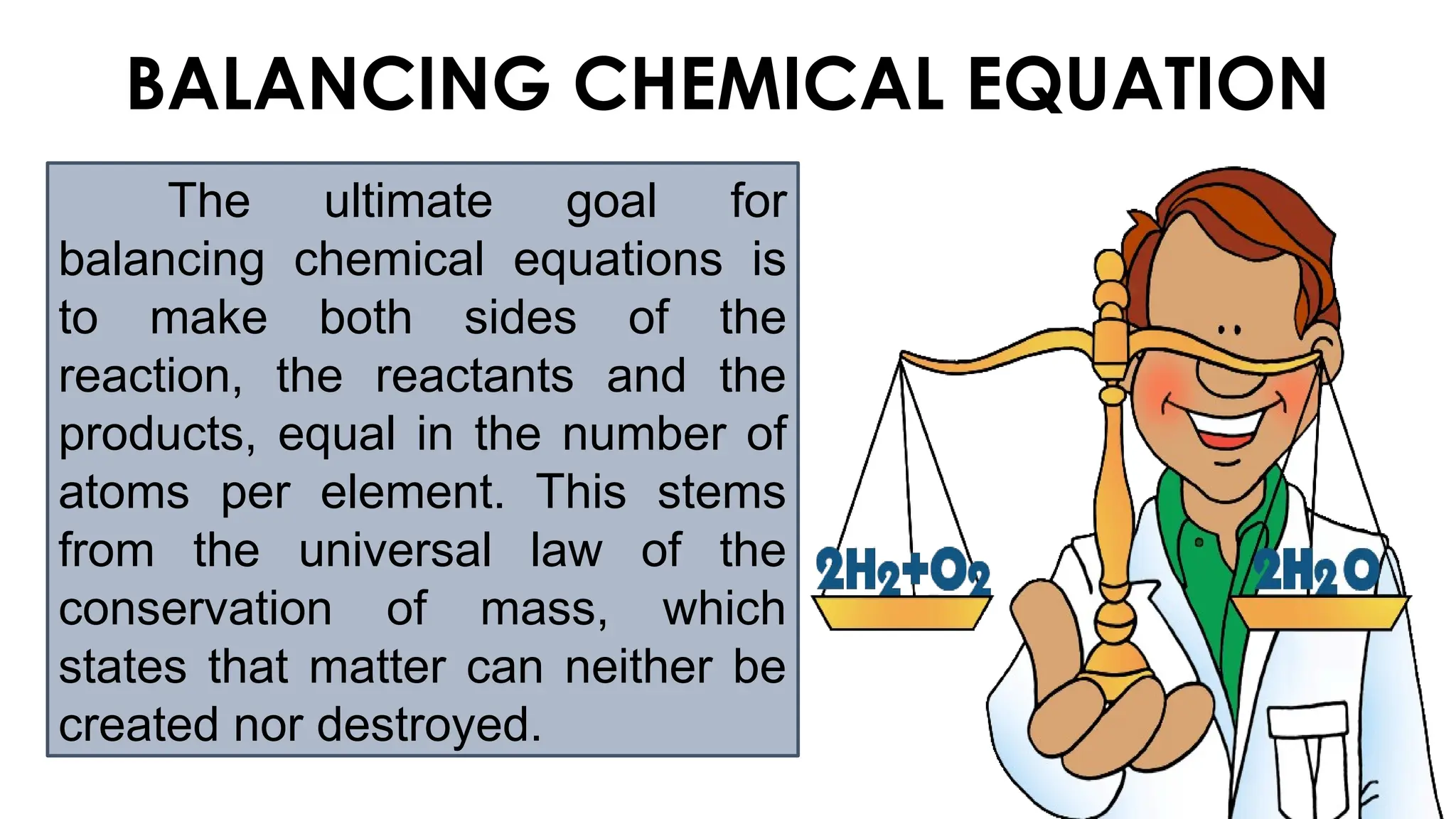
The ultimate goal for
balancing chemical equations is
to make both sides of the
reaction, the reactants and the
products, equal in the number of
atoms per element. This stems
from the universal law of the
conservation of mass, which
states that matter can neither be
created nor destroyed.
BALANCING CHEMICAL EQUATION
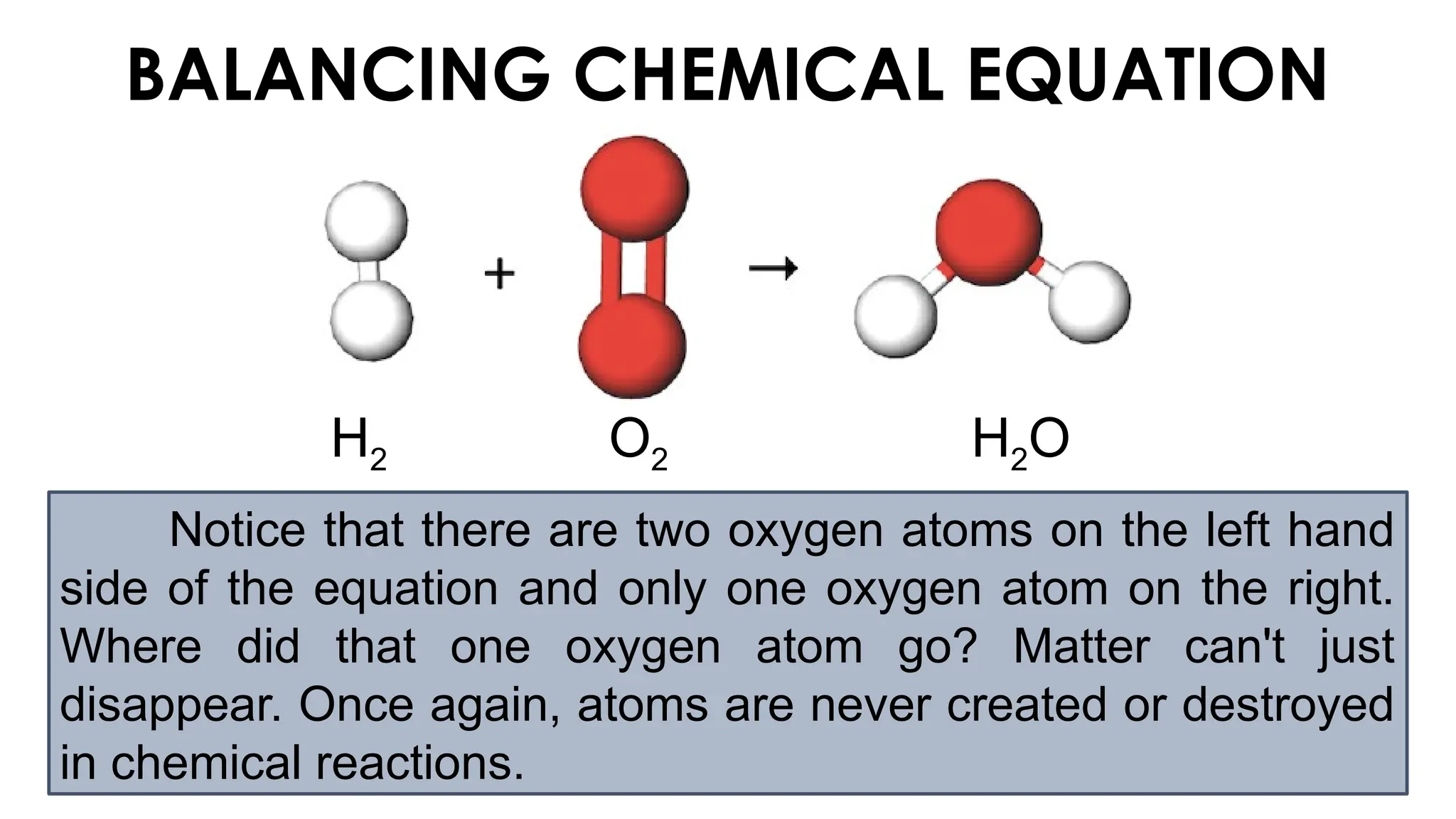
H2 O2 H2O
Notice that there are two oxygen atoms on the left hand
side of the equation and only one oxygen atom on the right.
Where did that one oxygen atom go? Matter can't just
disappear. Once again, atoms are never created or destroyed
in chemical reactions.
BALANCING CHEMICAL EQUATION
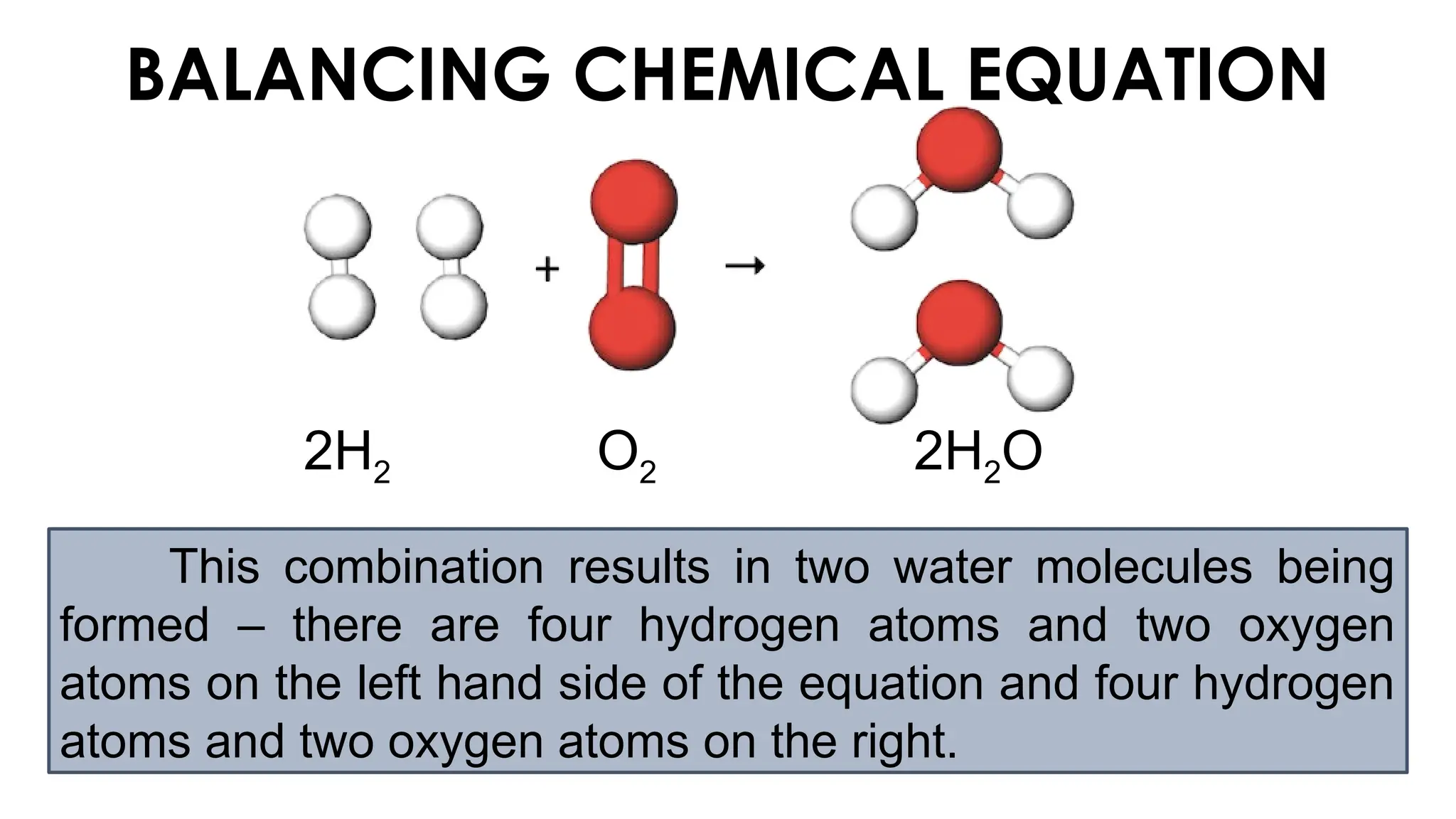
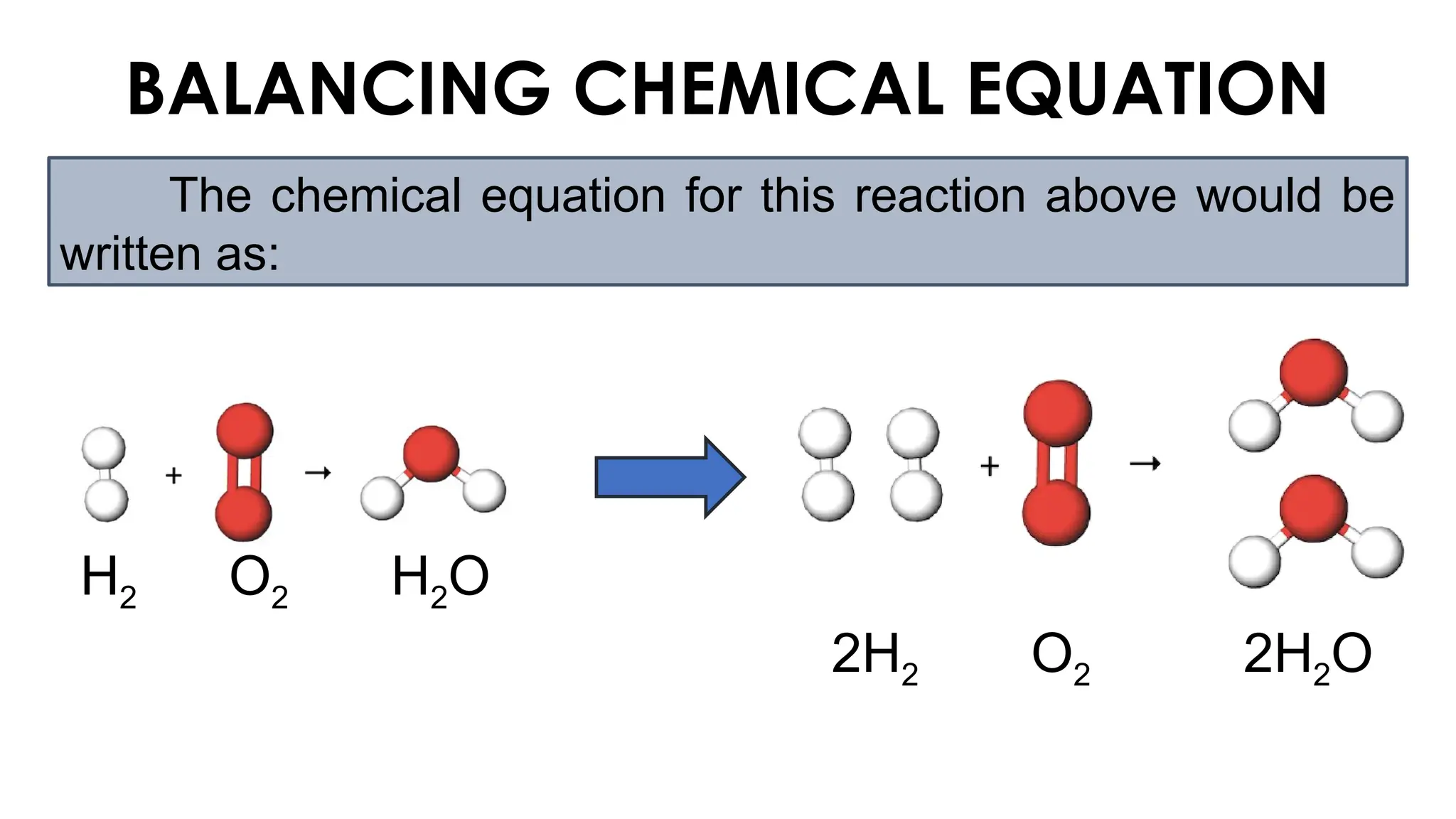
2H2 O2 2H2O
This combination results in two water molecules being
formed – there are four hydrogen atoms and two oxygen
atoms on the left hand side of the equation and four hydrogen
atoms and two oxygen atoms on the right.
BALANCING CHEMICAL EQUATION
2H2 O2 2H2O
The chemical equation for this reaction above would be
written as:
H2 O2 H2O
BALANCING CHEMICAL EQUATION
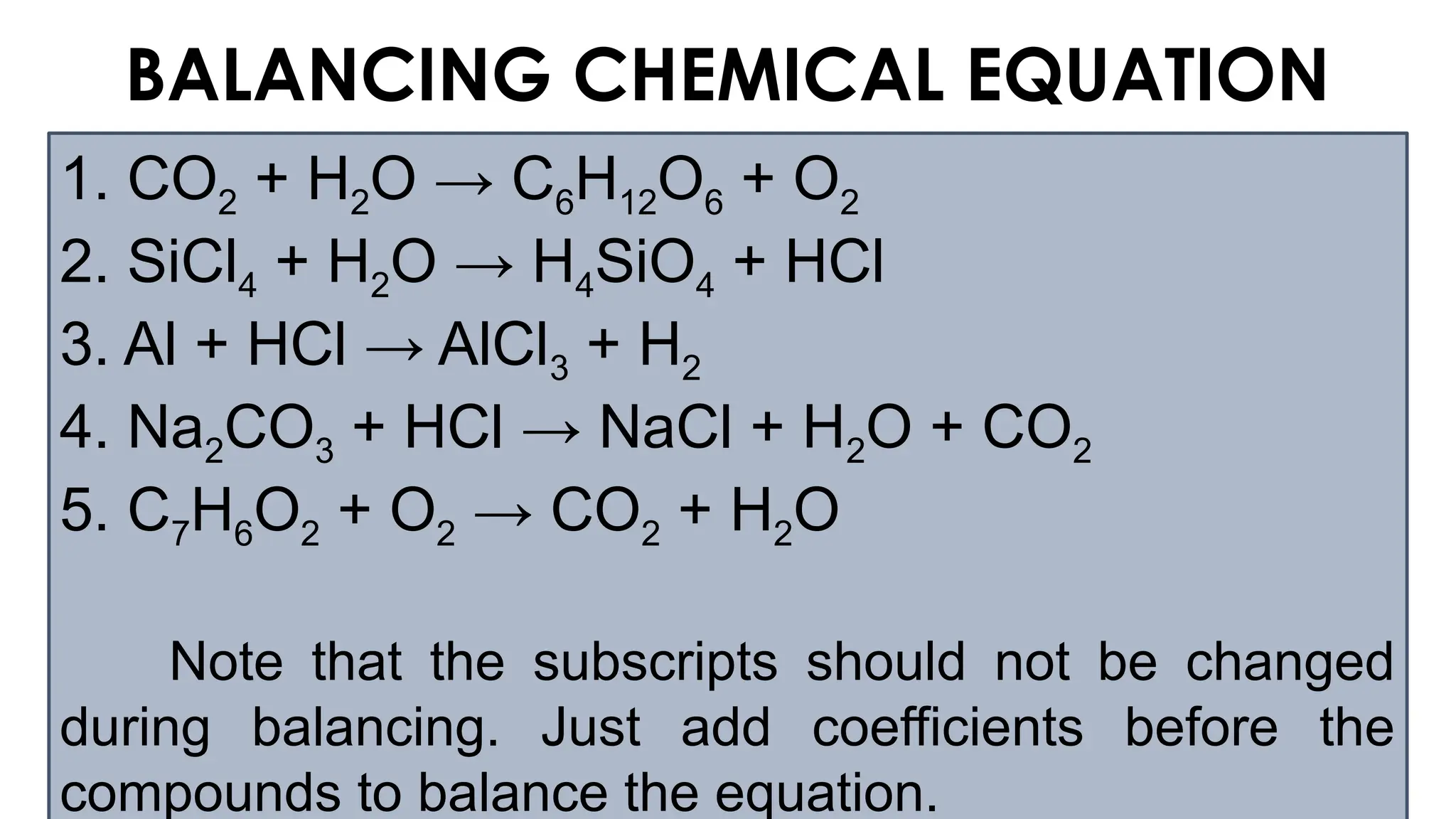
1. CO2 + H2O → C6H12O6 + O2
2. SiCl4 + H2O → H4SiO4 + HCl
3. Al + HCl → AlCl3 + H2
4. Na2CO3 + HCl → NaCl + H2O + CO2
5. C7H6O2 + O2 → CO2 + H2O
Note that the subscripts should not be changed
during balancing. Just add coefficients before the
compounds to balance the equation.
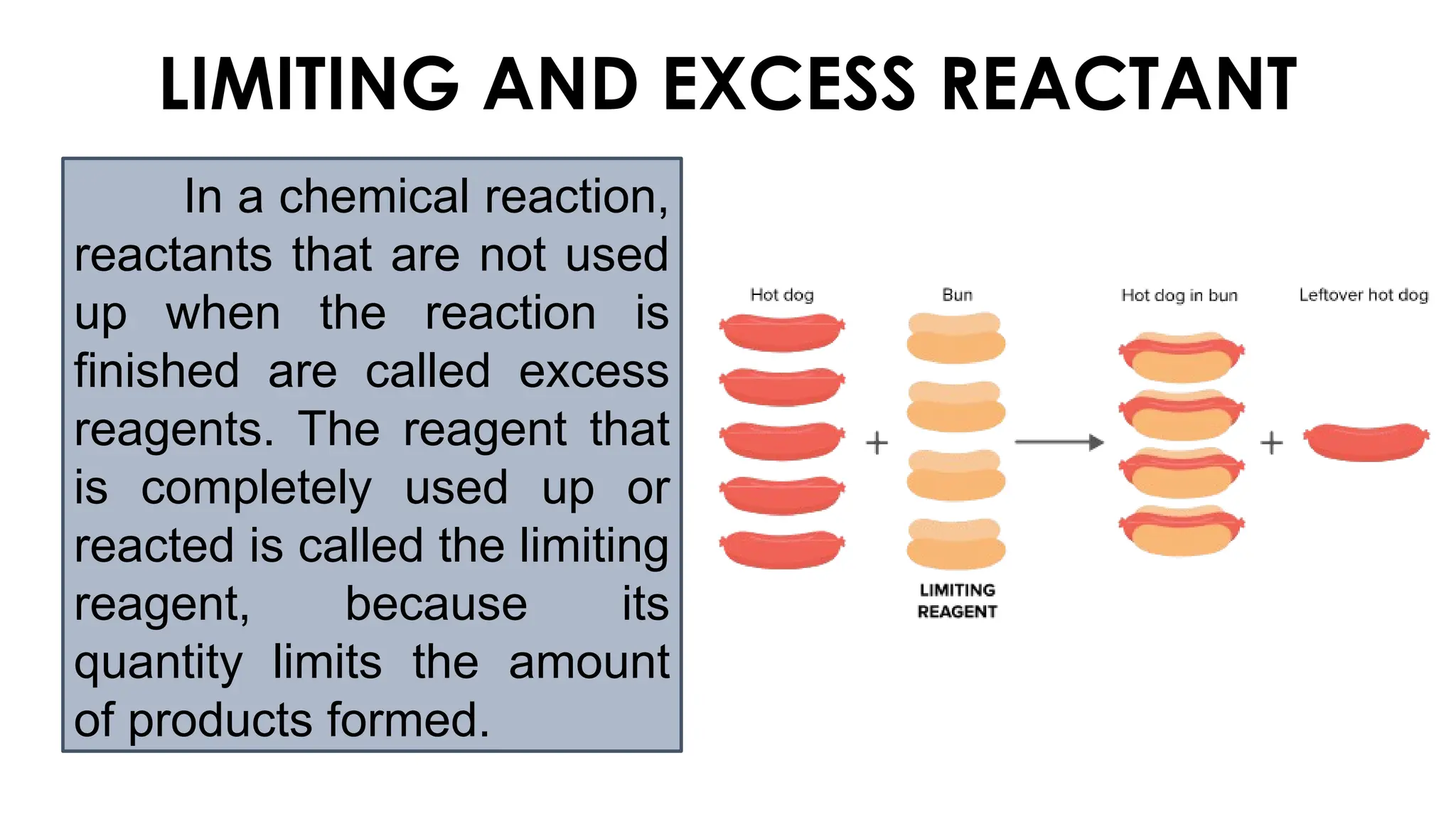
In a chemical reaction,
reactants that are not used
up when the reaction is
finished are called excess
reagents. The reagent that
is completely used up or
reacted is called the limiting
reagent, because its
quantity limits the amount
of products formed.
LIMITING AND EXCESS REACTANT
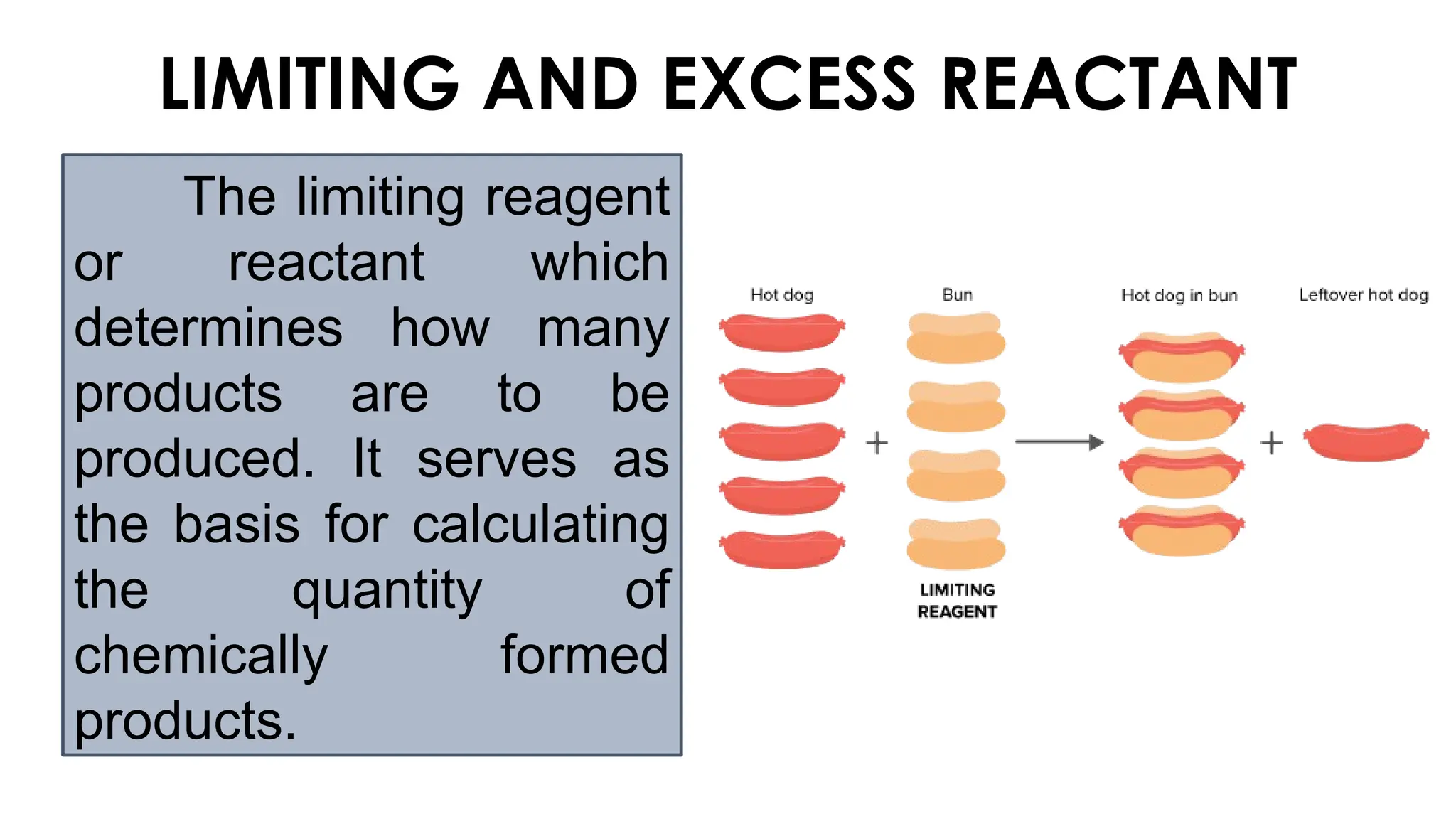
The limiting reagent
or reactant which
determines how many
products are to be
produced. It serves as
the basis for calculating
the quantity of
chemically formed
products.
LIMITING AND EXCESS REACTANT
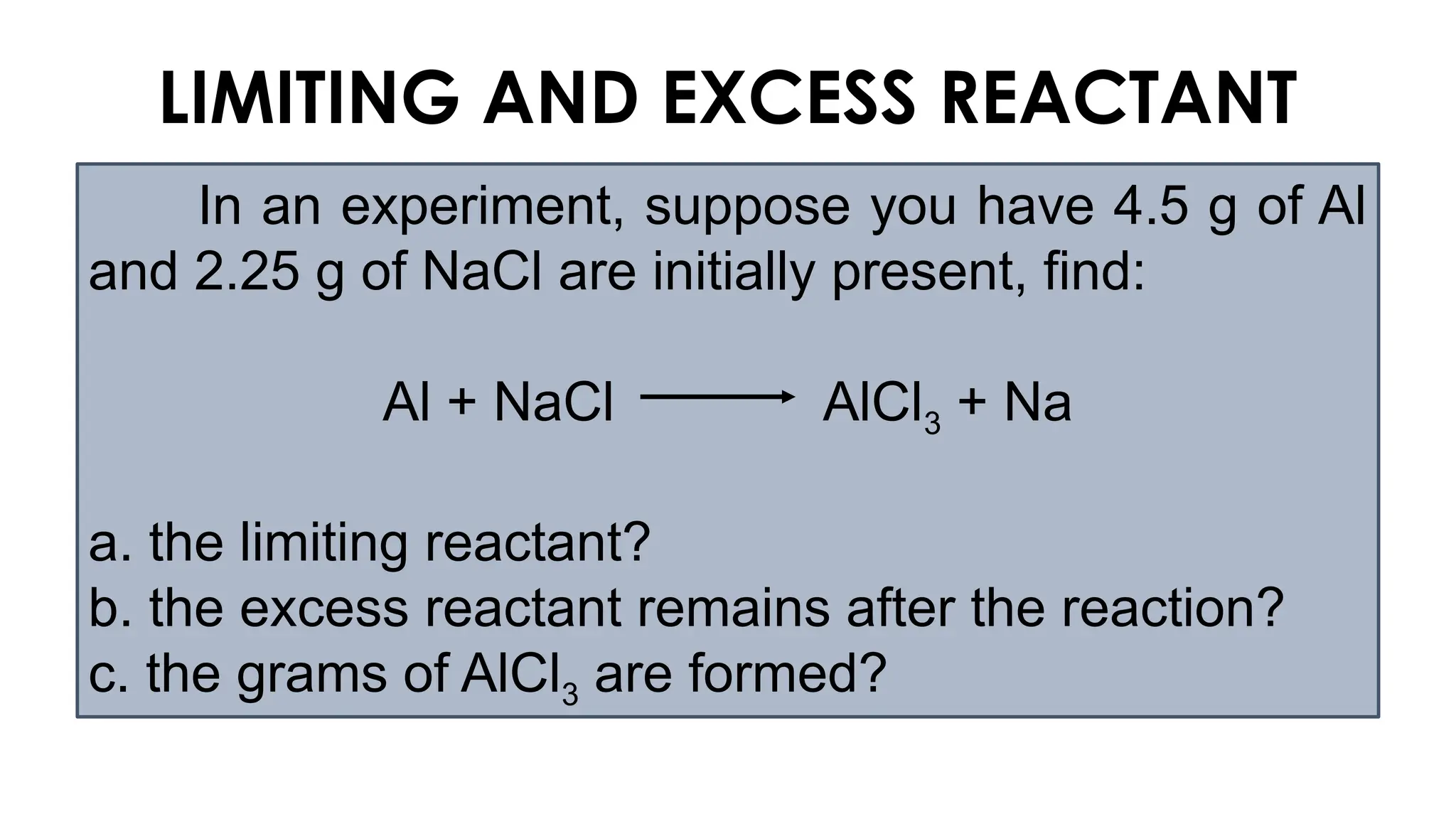
In an experiment, suppose you have 4.5 g of Al
and 2.25 g of NaCl are initially present, find:
Al + NaCl AlCl3 + Na
a. the limiting reactant?
b. the excess reactant remains after the reaction?
c. the grams of AlCl3 are formed?
LIMITING AND EXCESS REACTANT
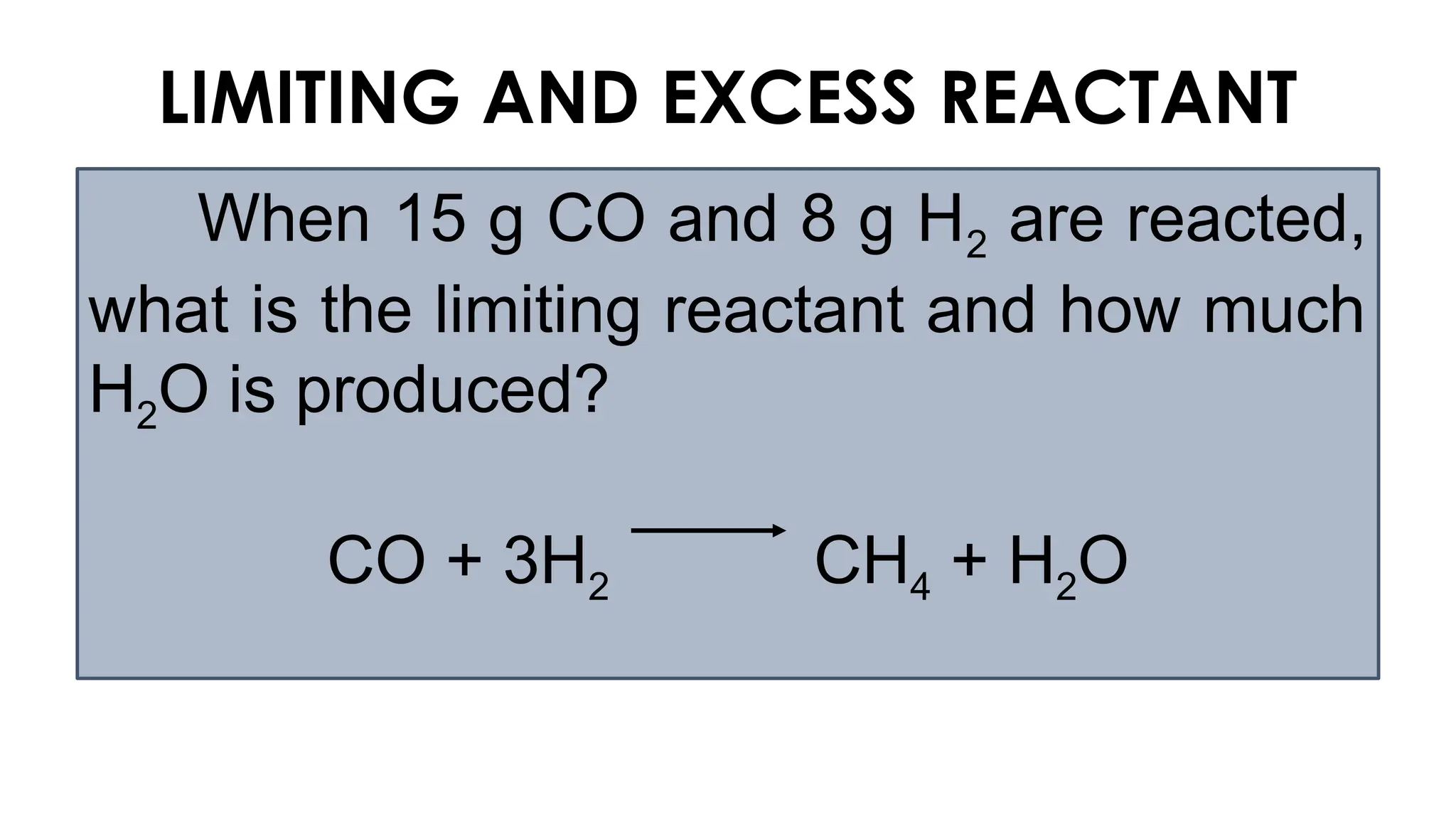
When 15 g CO and 8 g H2 are reacted,
what is the limiting reactant and how much
H2O is produced?
CO + 3H2 CH4 + H2O
LIMITING AND EXCESS REACTANT

LESSON 7 Limiting and Excess Reactants (2).pptx

  • 1.
  • 2.
    The ultimate goalfor balancing chemical equations is to make both sides of the reaction, the reactants and the products, equal in the number of atoms per element. This stems from the universal law of the conservation of mass, which states that matter can neither be created nor destroyed. BALANCING CHEMICAL EQUATION
  • 3.
    BALANCING CHEMICAL EQUATION H2O2 H2O Notice that there are two oxygen atoms on the left hand side of the equation and only one oxygen atom on the right. Where did that one oxygen atom go? Matter can't just disappear. Once again, atoms are never created or destroyed in chemical reactions.
  • 4.
    BALANCING CHEMICAL EQUATION 2H2O2 2H2O This combination results in two water molecules being formed – there are four hydrogen atoms and two oxygen atoms on the left hand side of the equation and four hydrogen atoms and two oxygen atoms on the right.
  • 5.
    BALANCING CHEMICAL EQUATION 2H2O2 2H2O The chemical equation for this reaction above would be written as: H2 O2 H2O
  • 6.
    BALANCING CHEMICAL EQUATION 1.CO2 + H2O → C6H12O6 + O2 2. SiCl4 + H2O → H4SiO4 + HCl 3. Al + HCl → AlCl3 + H2 4. Na2CO3 + HCl → NaCl + H2O + CO2 5. C7H6O2 + O2 → CO2 + H2O Note that the subscripts should not be changed during balancing. Just add coefficients before the compounds to balance the equation.
  • 7.
    In a chemicalreaction, reactants that are not used up when the reaction is finished are called excess reagents. The reagent that is completely used up or reacted is called the limiting reagent, because its quantity limits the amount of products formed. LIMITING AND EXCESS REACTANT
  • 8.
    The limiting reagent orreactant which determines how many products are to be produced. It serves as the basis for calculating the quantity of chemically formed products. LIMITING AND EXCESS REACTANT
  • 9.
    In an experiment,suppose you have 4.5 g of Al and 2.25 g of NaCl are initially present, find: Al + NaCl AlCl3 + Na a. the limiting reactant? b. the excess reactant remains after the reaction? c. the grams of AlCl3 are formed? LIMITING AND EXCESS REACTANT
  • 10.
    When 15 gCO and 8 g H2 are reacted, what is the limiting reactant and how much H2O is produced? CO + 3H2 CH4 + H2O LIMITING AND EXCESS REACTANT