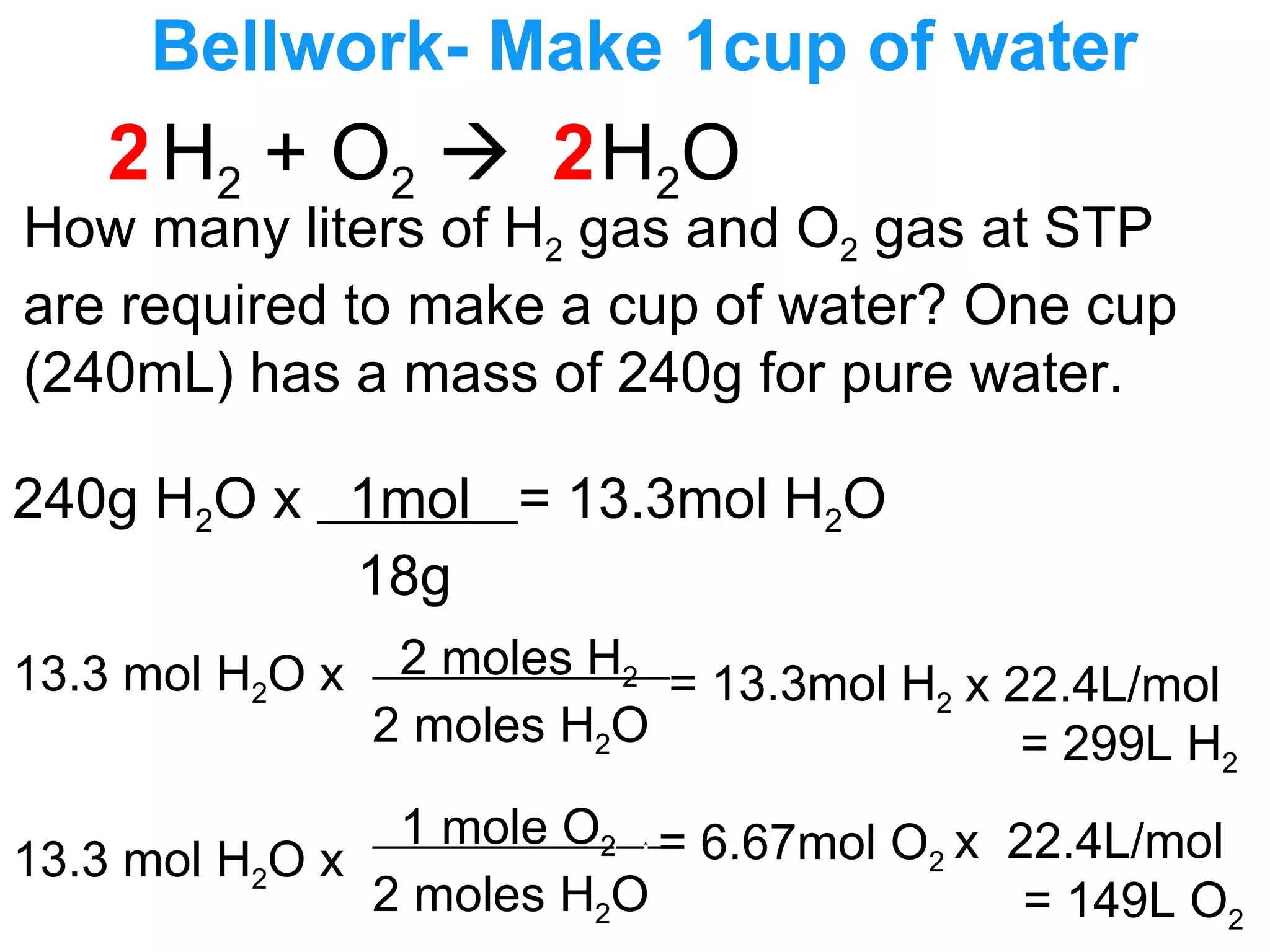
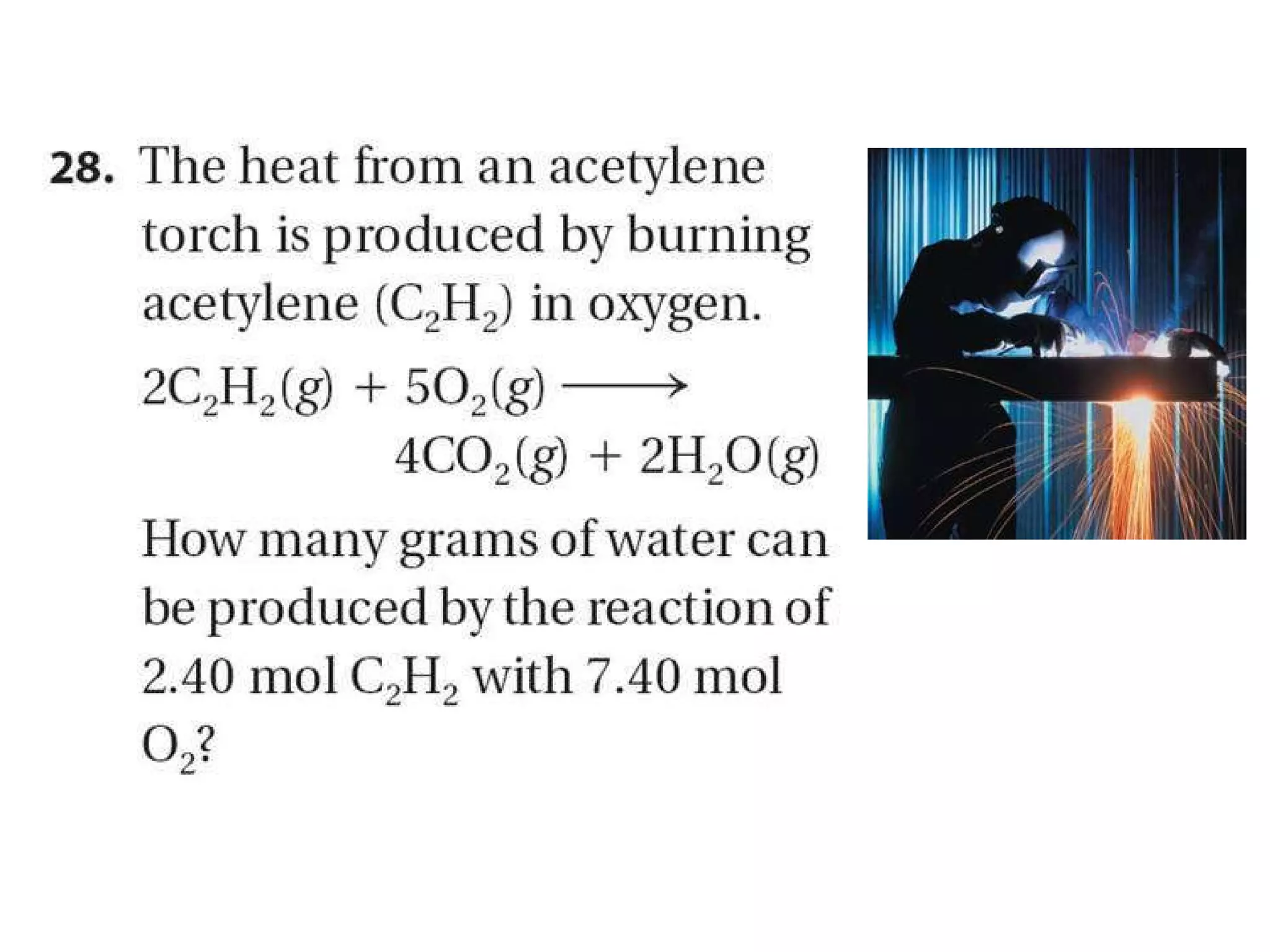
Bellwork- Make 1cup of water H 2  + O 2      H 2 O How many liters of H 2  gas and O 2  gas at STP are required to make a cup of water? One cup (240mL) has a mass of 240g for pure water. 240g H 2 O x  1mol  = 13.3mol H 2 O 18g  13.3 mol H 2 O x 13.3 mol H 2 O x 2 2 2 moles H 2  2 moles H 2 O 1 mole O 2   .   2 moles H 2 O  = 13.3mol H 2 = 6.67mol O 2 x 22.4L/mol = 299L H 2 x  22.4L/mol = 149L O 2
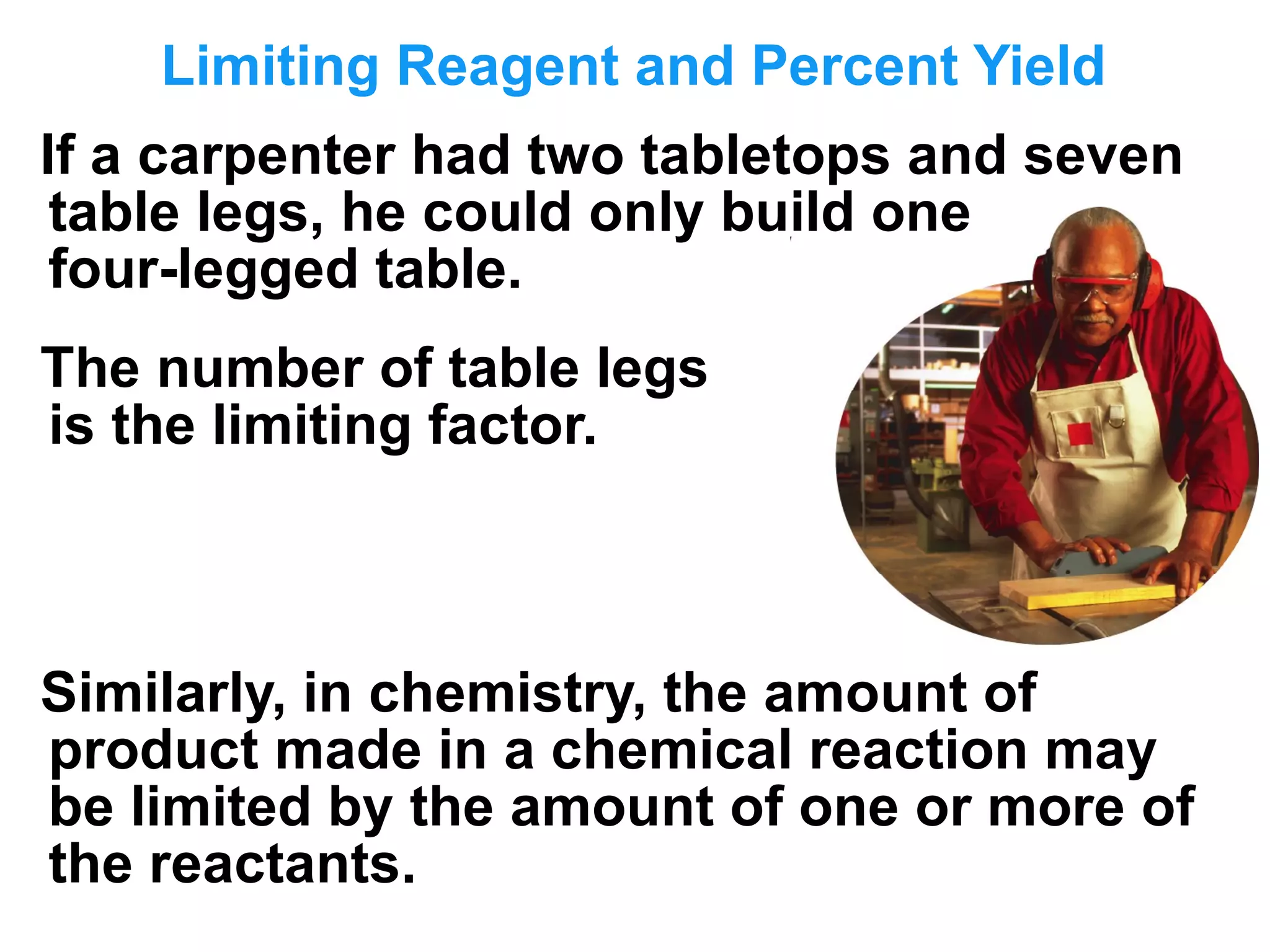
Limiting Reagent and Percent Yield If a carpenter had two tabletops and seven table legs, he cou ld only build one  four-legged table.  The number of table legs    is the limiting factor.  Similarly, in chemistry, the amount of product made in a chemical reaction may be limited by the amount of one or more of the reactants.
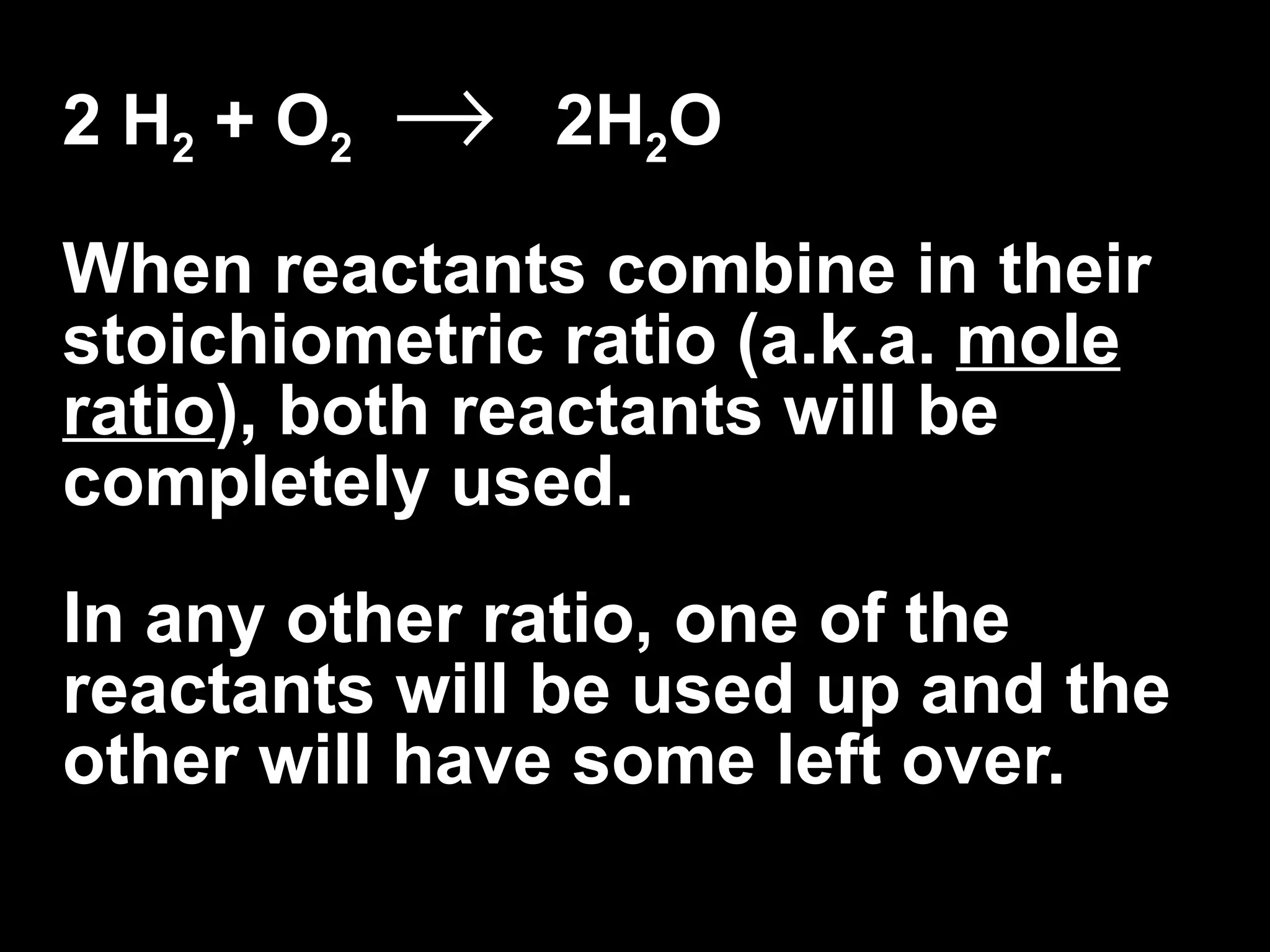
2 H 2  + O 2      2H 2 O When reactants combine in their stoichiometric ratio (a.k.a.  mole ratio ), both reactants will be completely used.  In any other ratio, one of the reactants will be used up and the other will have some left over.
In a chemical reaction, an insufficient quantity of any of the reactants will limit the amount of product that forms.   The  limiting reagent  is the reagent that determines the amount of product that can be formed by a reaction.
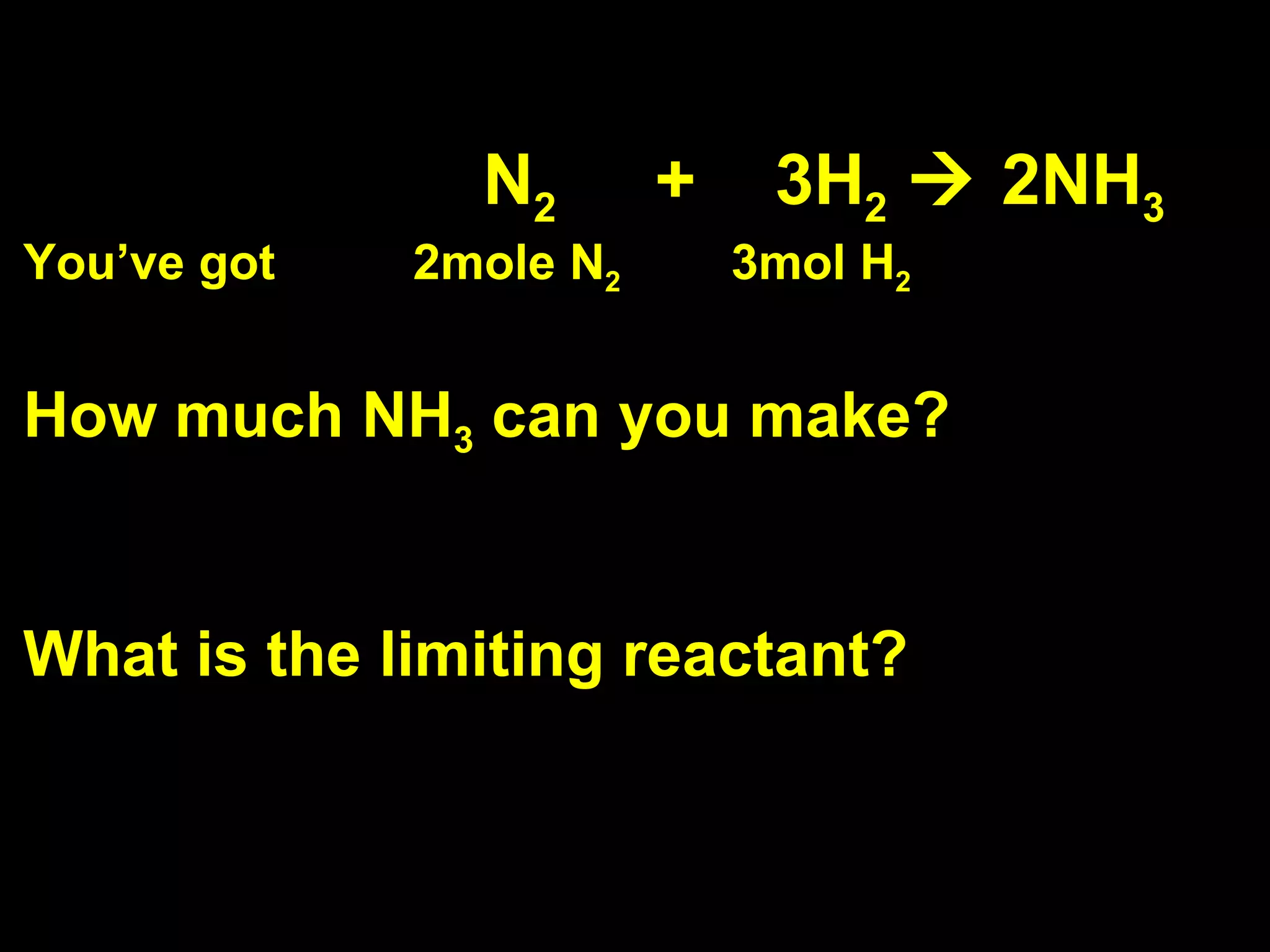
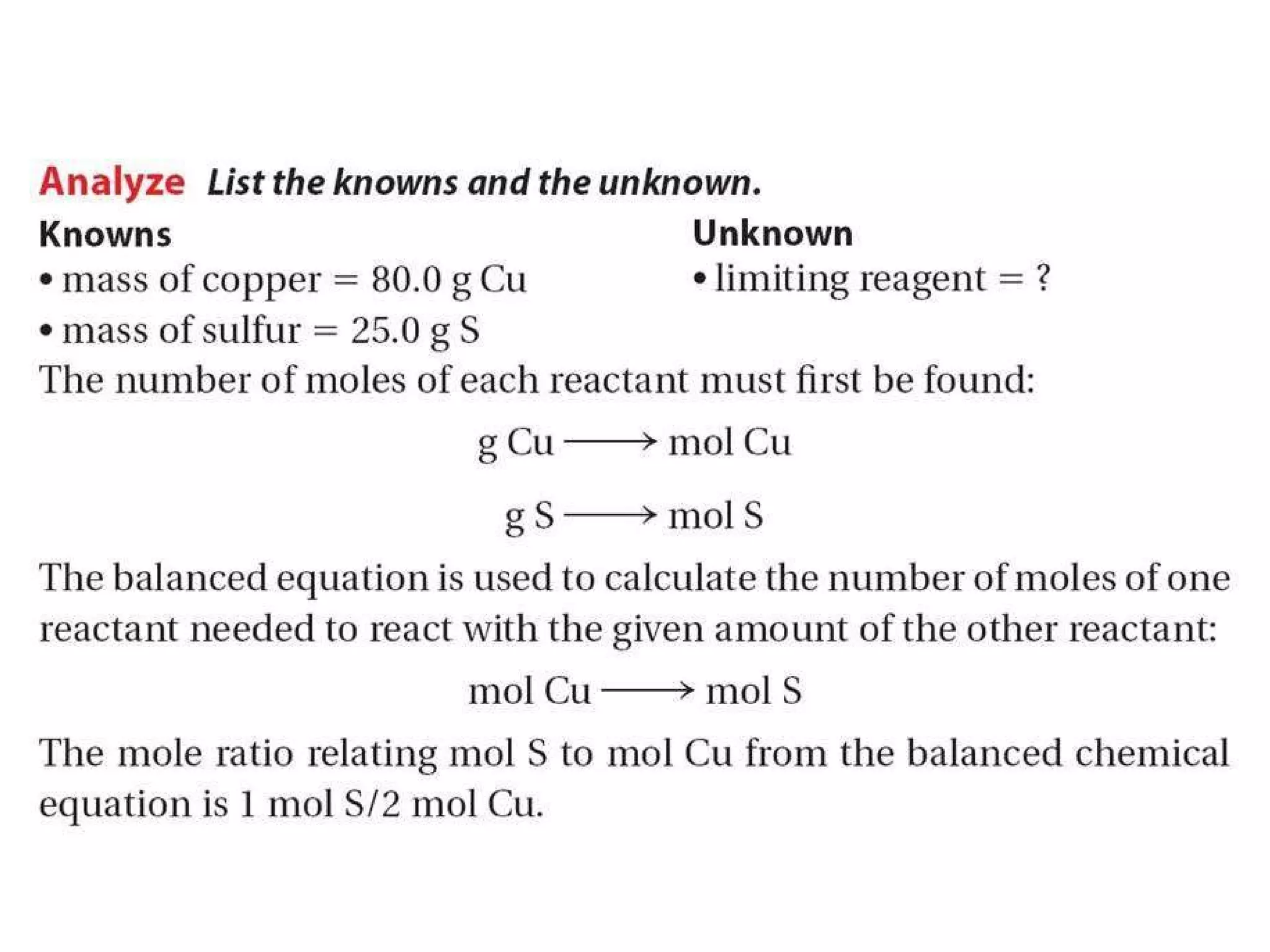
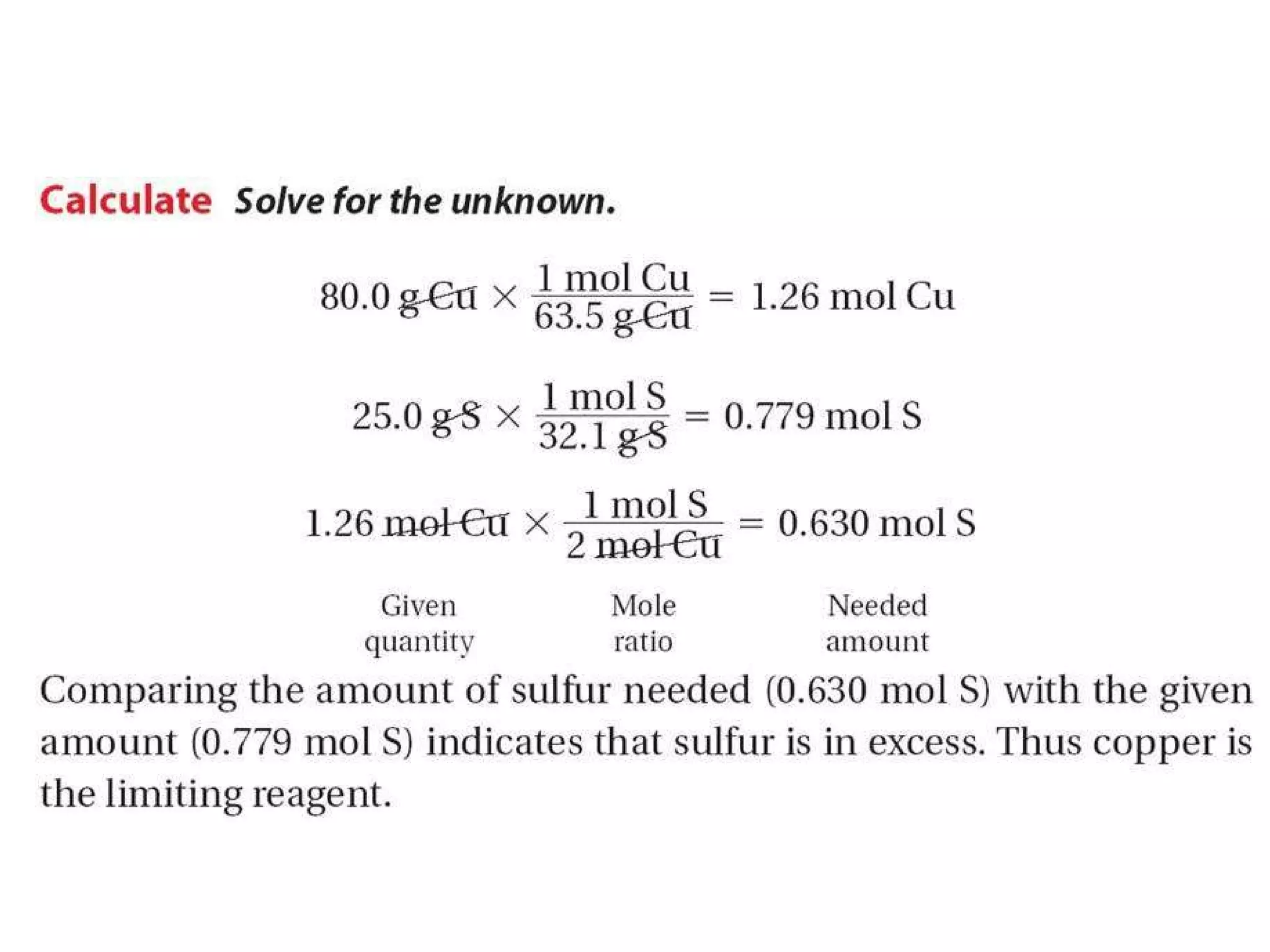
      N 2   +  3H 2     2NH 3 You’ve got  2mole N 2   3mol H 2 How much NH 3  can you make?  What is the limiting reactant?
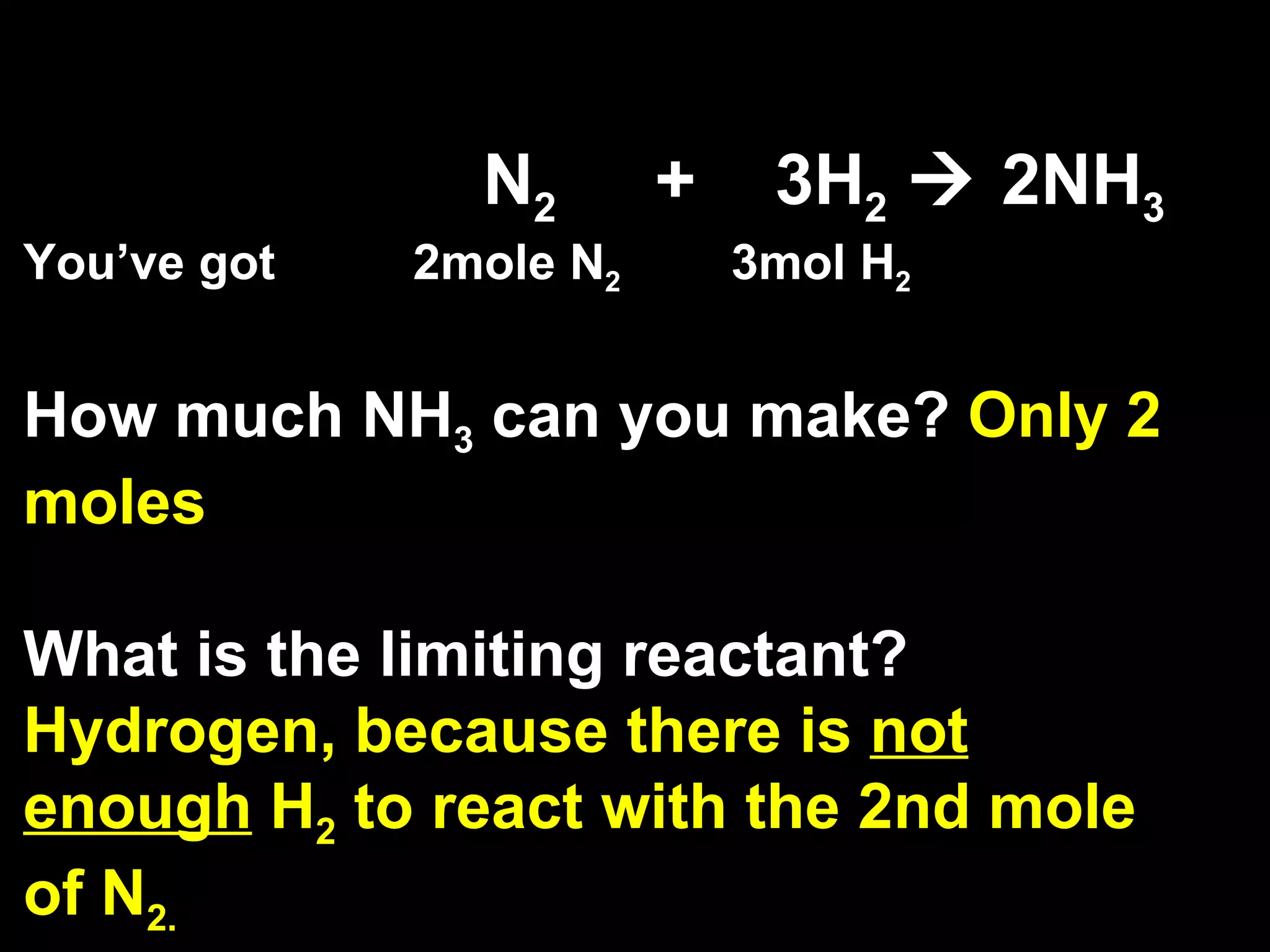
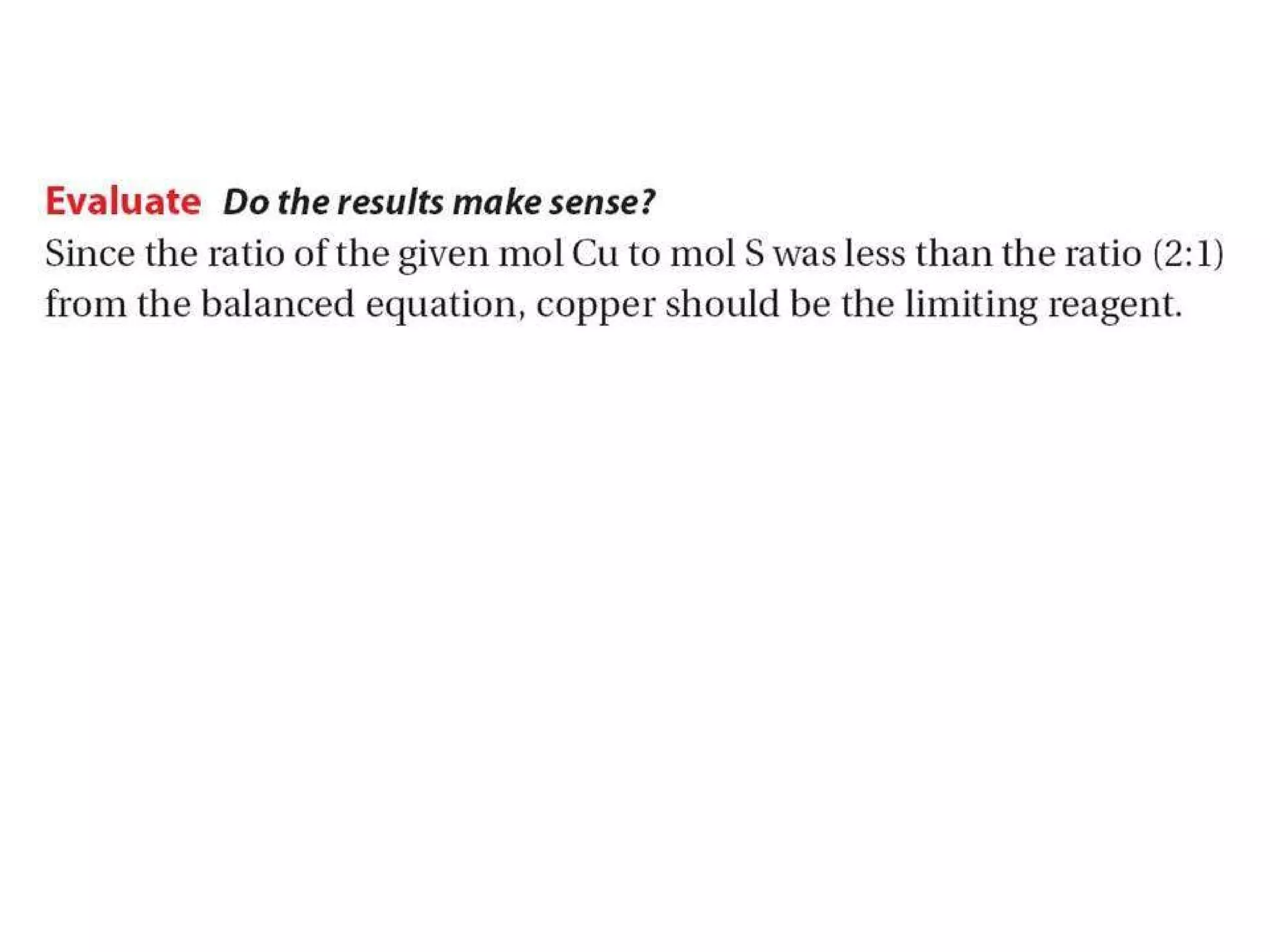
      N 2   +  3H 2     2NH 3 You’ve got  2mole N 2   3mol H 2 How much NH 3  can you make?  Only 2 moles What is the limiting reactant?  Hydrogen, because there is  not enough  H 2  to react with the 2nd mole of N 2.
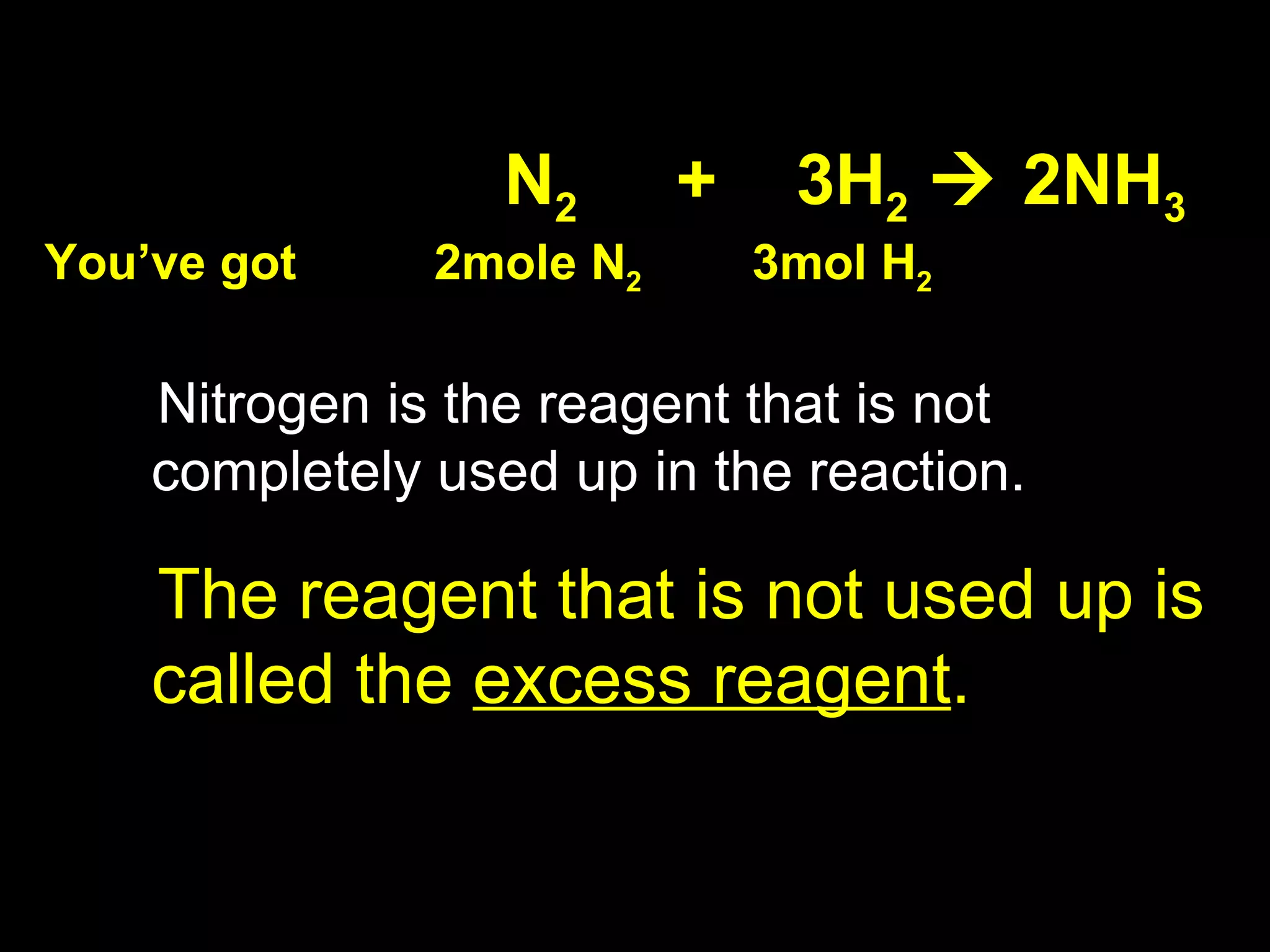
Nitrogen is the reagent that is not completely used up in the reaction.   The reagent that is not used up is called the  excess reagent .       N 2   +  3H 2     2NH 3 You’ve got  2mole N 2   3mol H 2
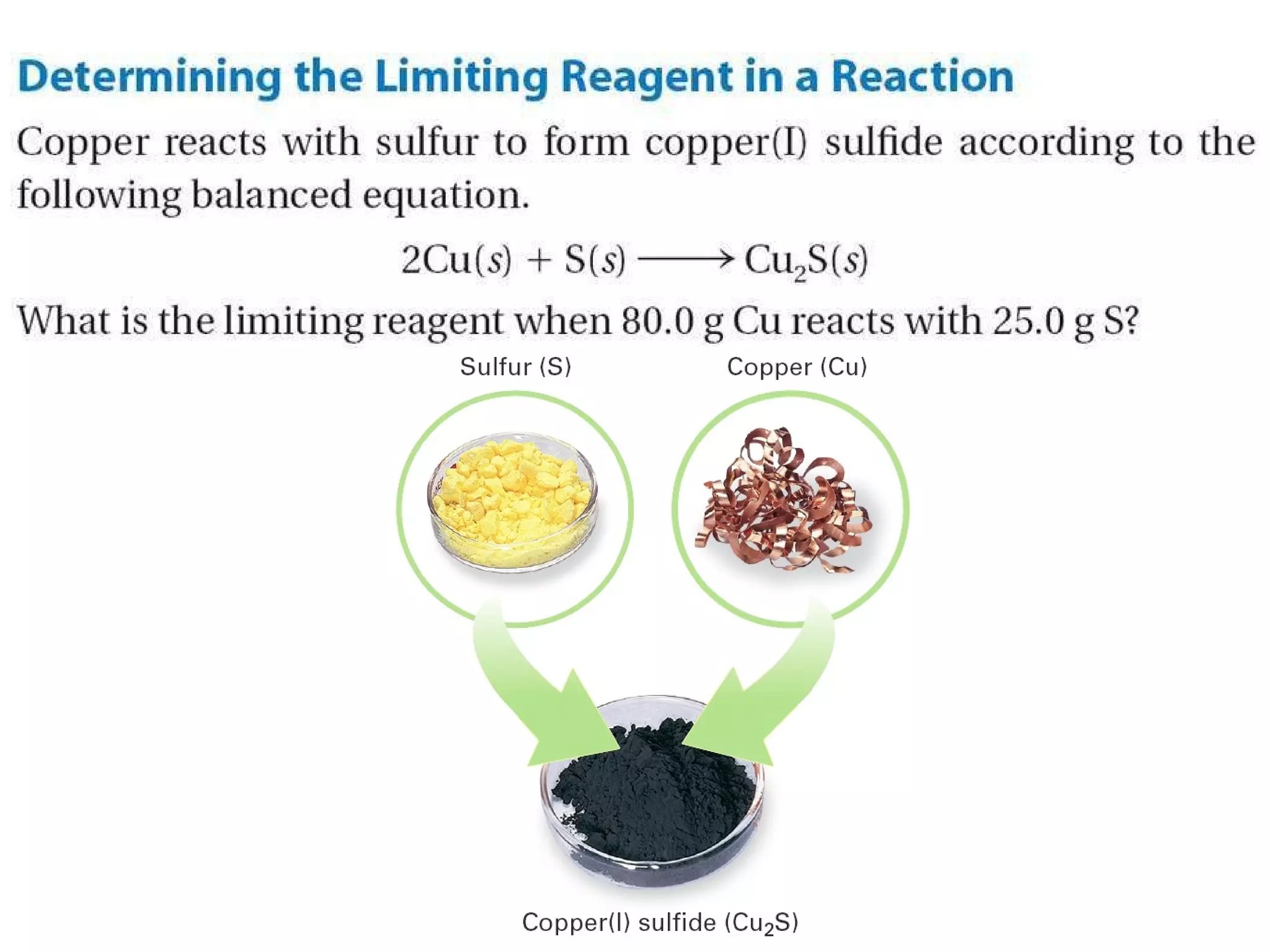
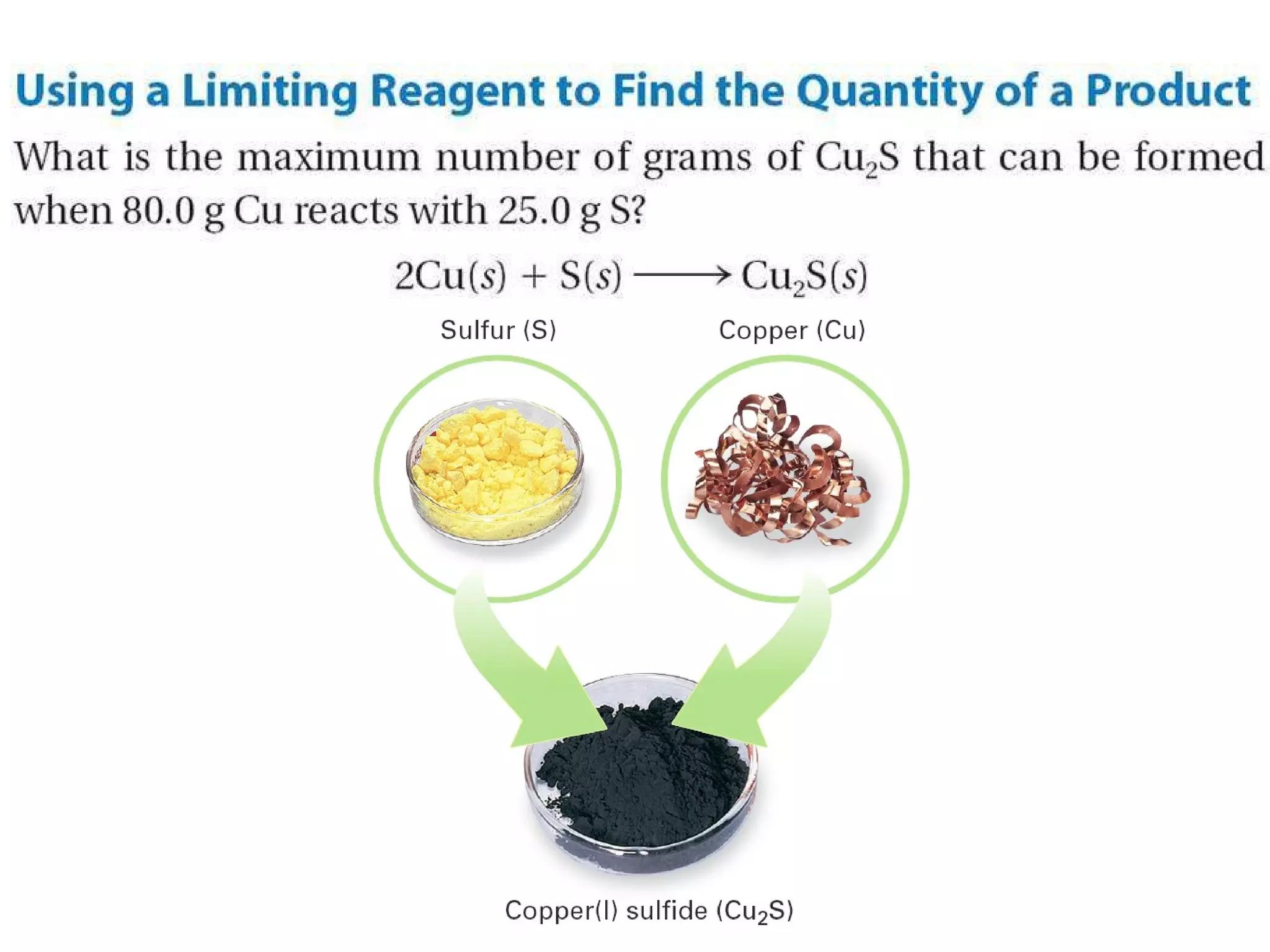
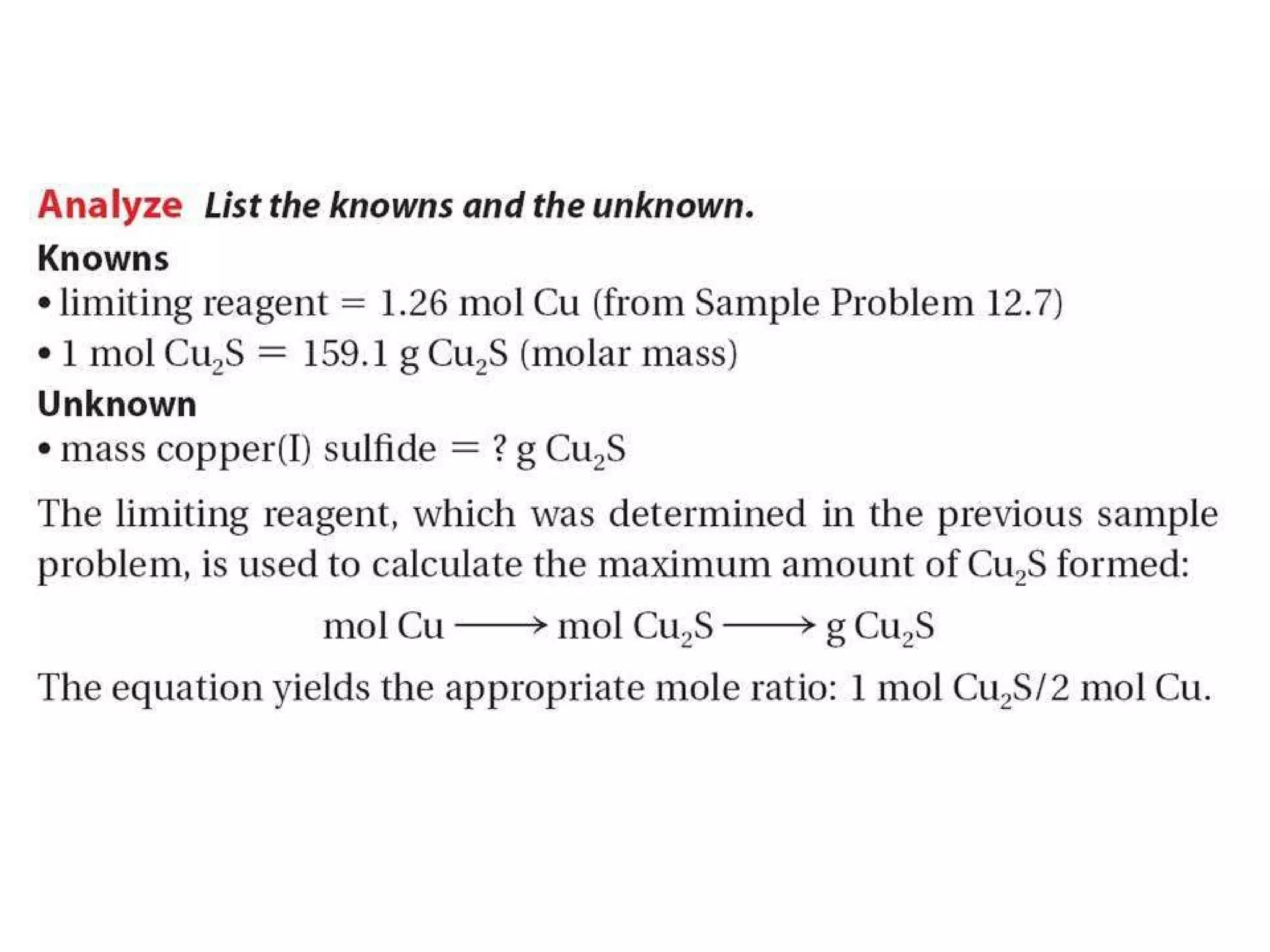
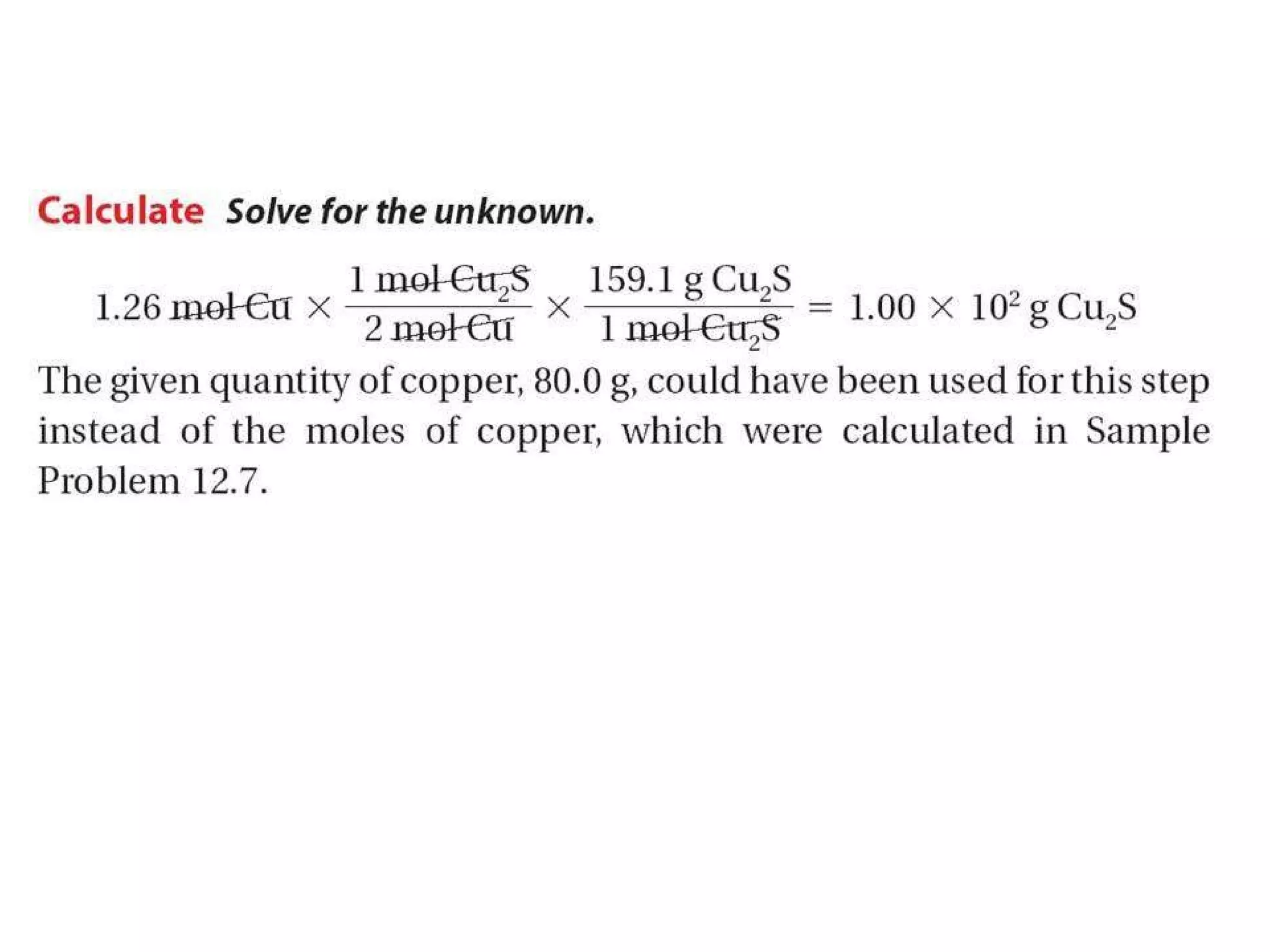
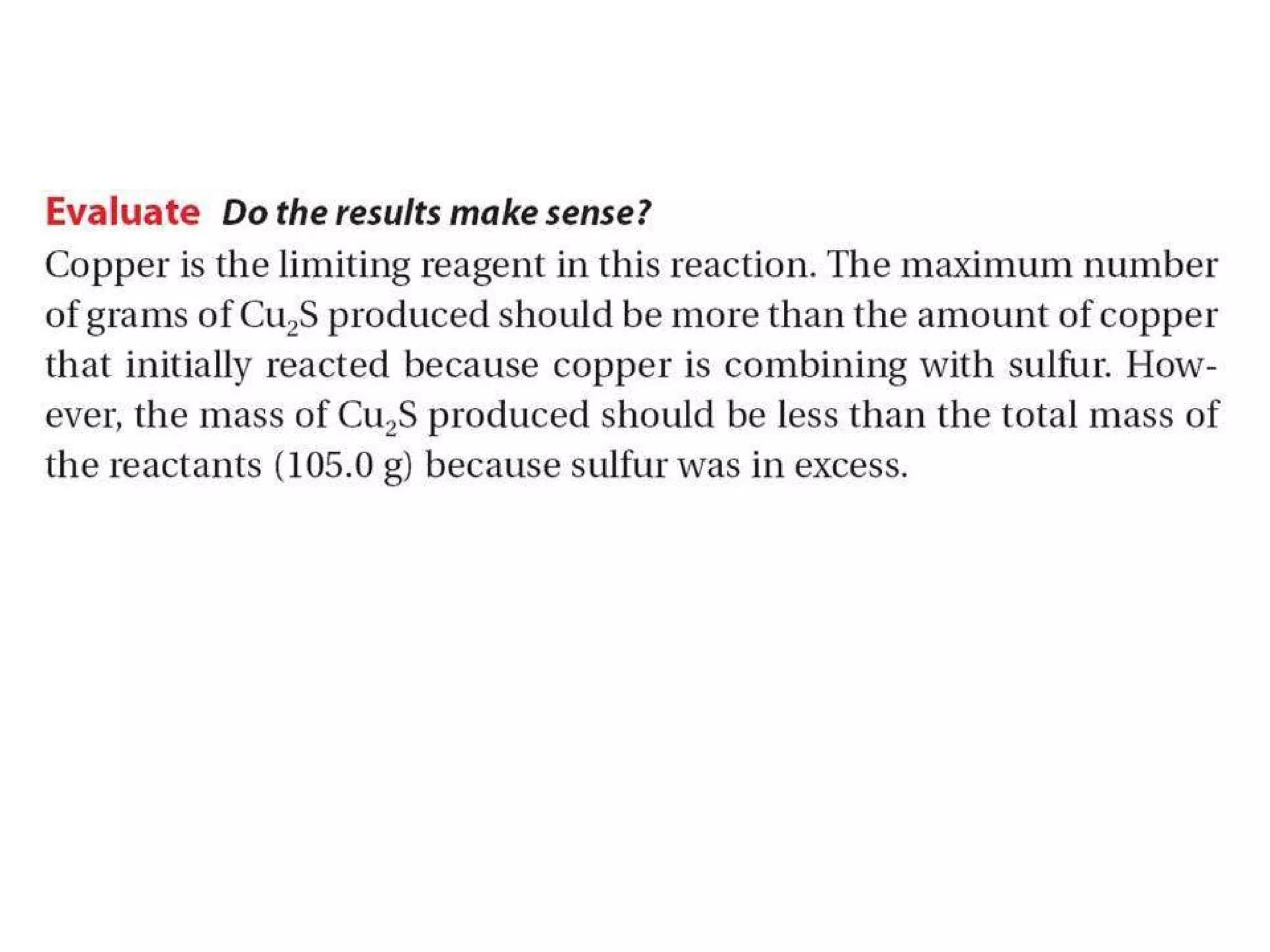
12.7
12.7
12.7
12.7
for Sample Problem 12.7
12.8Q
12.8
12.8
12.8
for Sample Problem 12.8
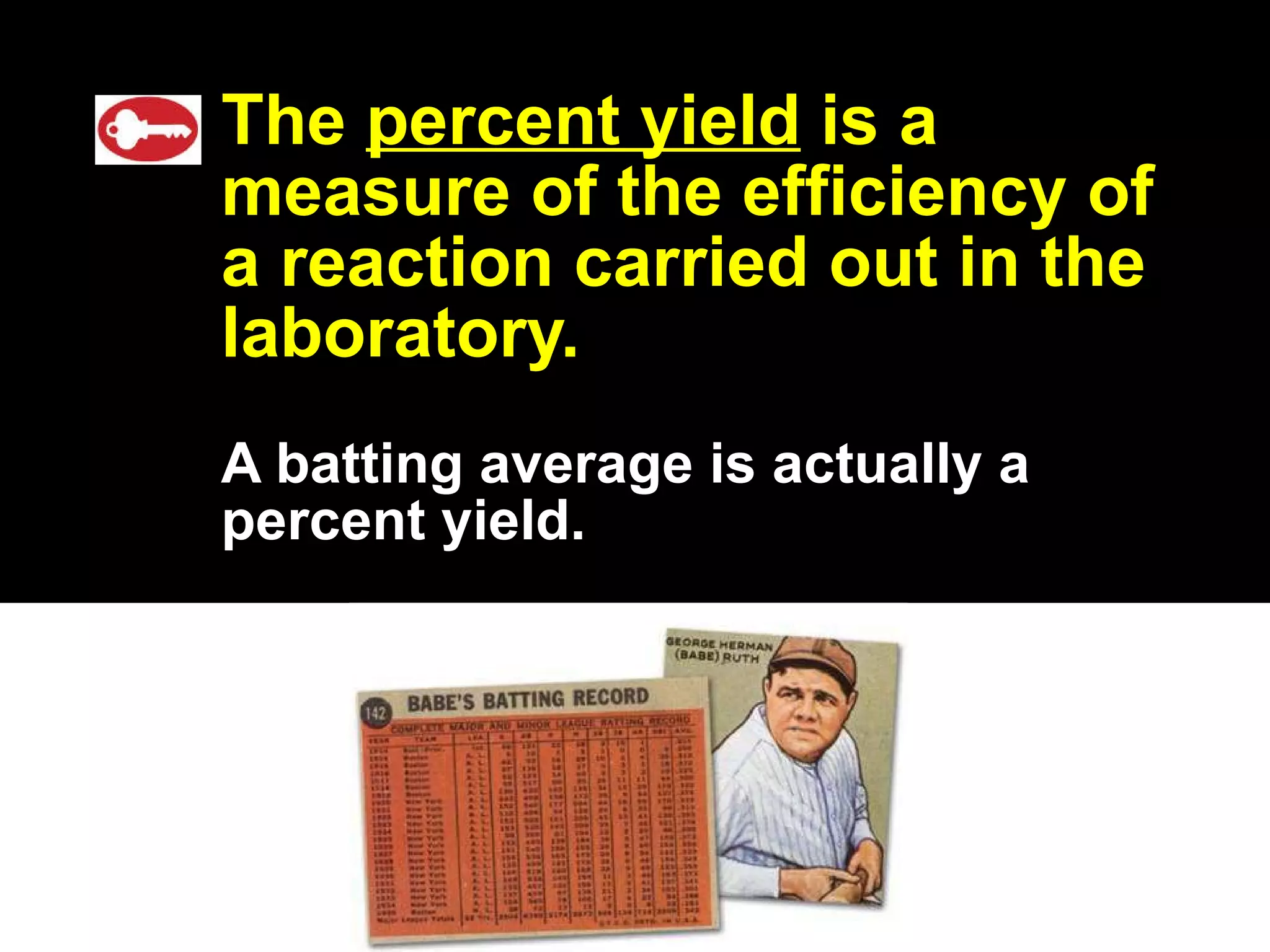
The  percent yield  is a measure of the efficiency of a reaction carried out in the laboratory. A batting average is actually a percent yield.
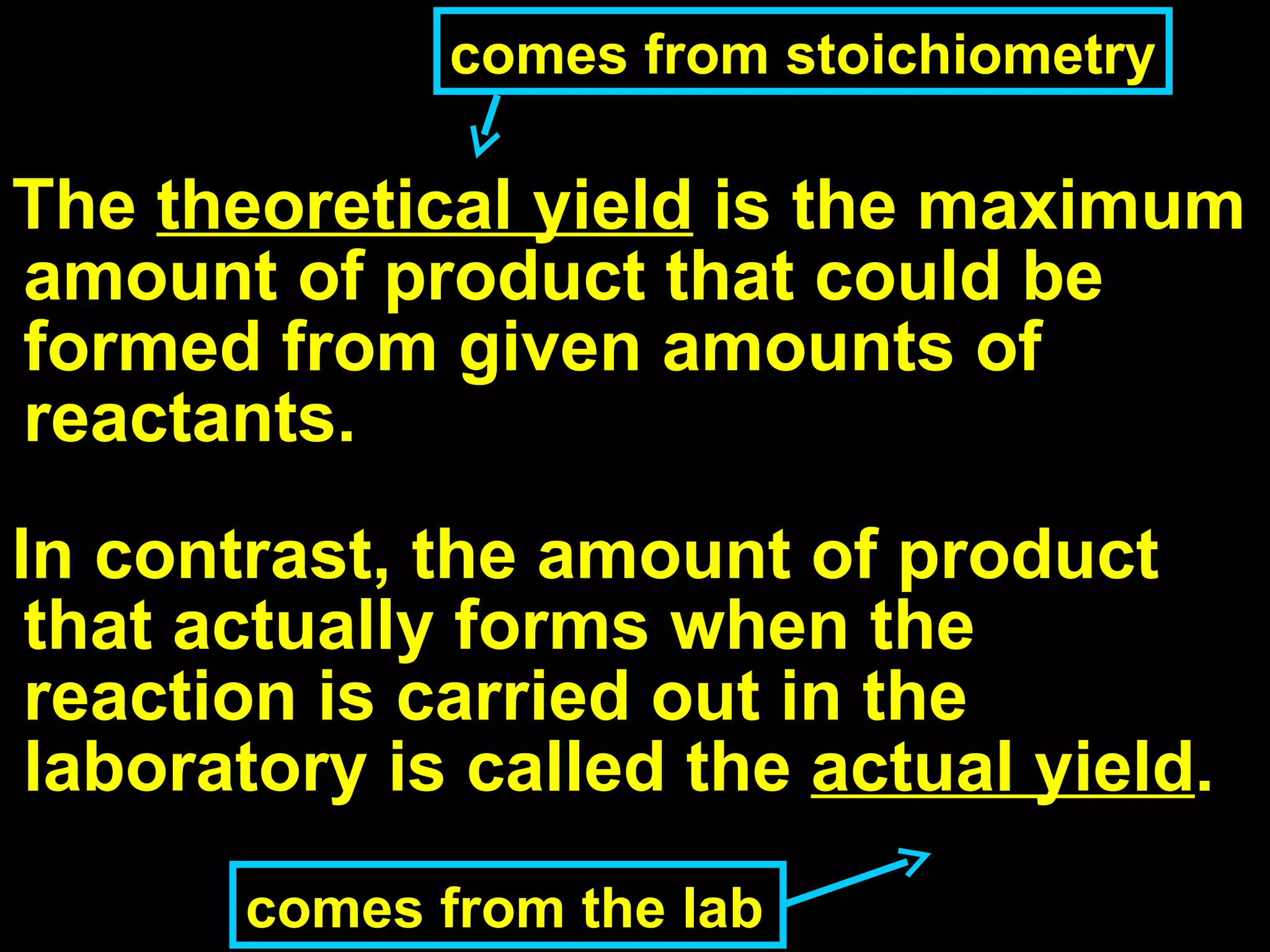
The  theoretical yield  is the maximum amount of product that could be formed from given amounts of reactants.  In contrast, the amount of product that actually forms when the reaction is carried out in the laboratory is called the  actual yield .  comes  from stoichiometry comes from the lab
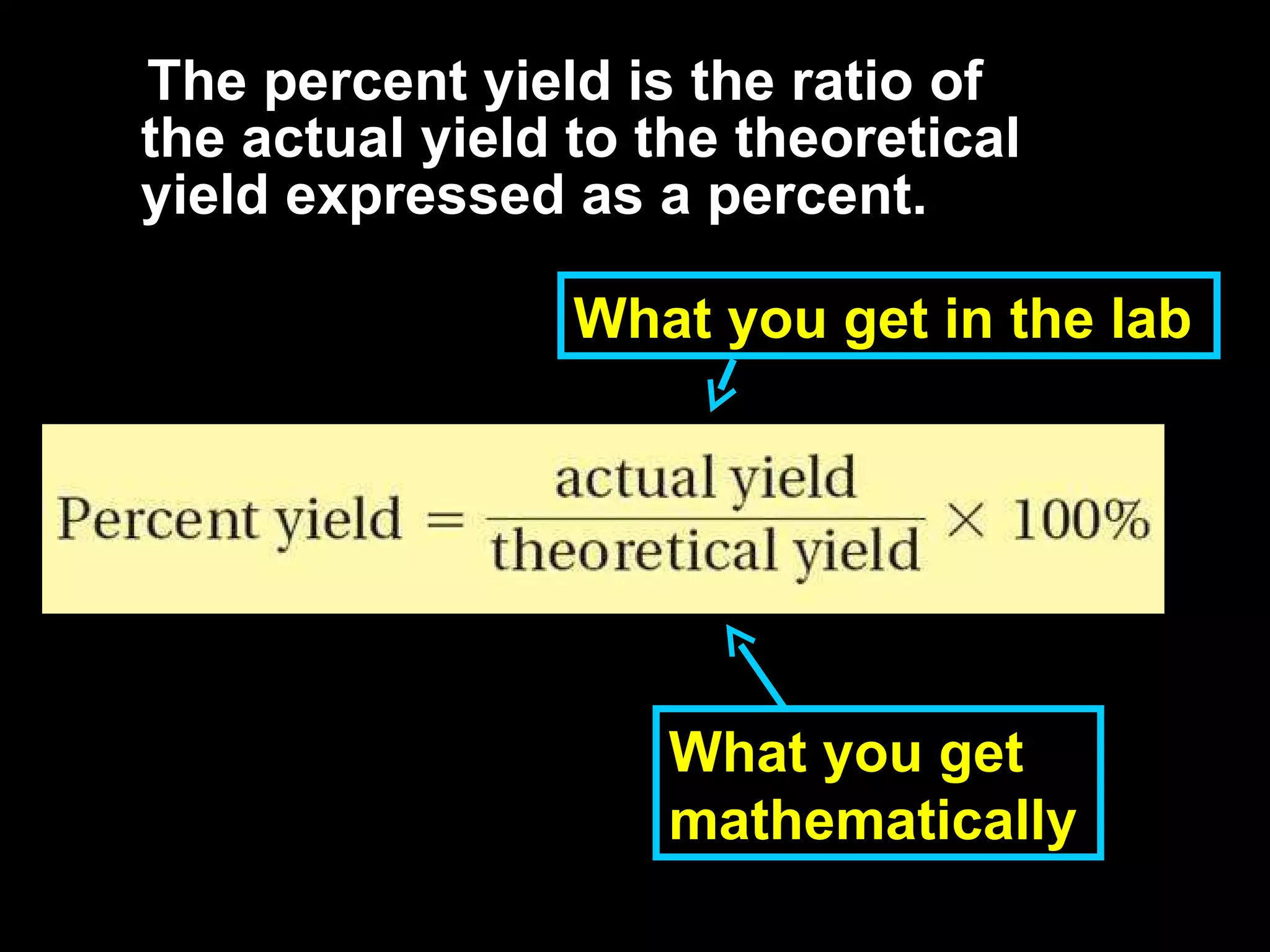
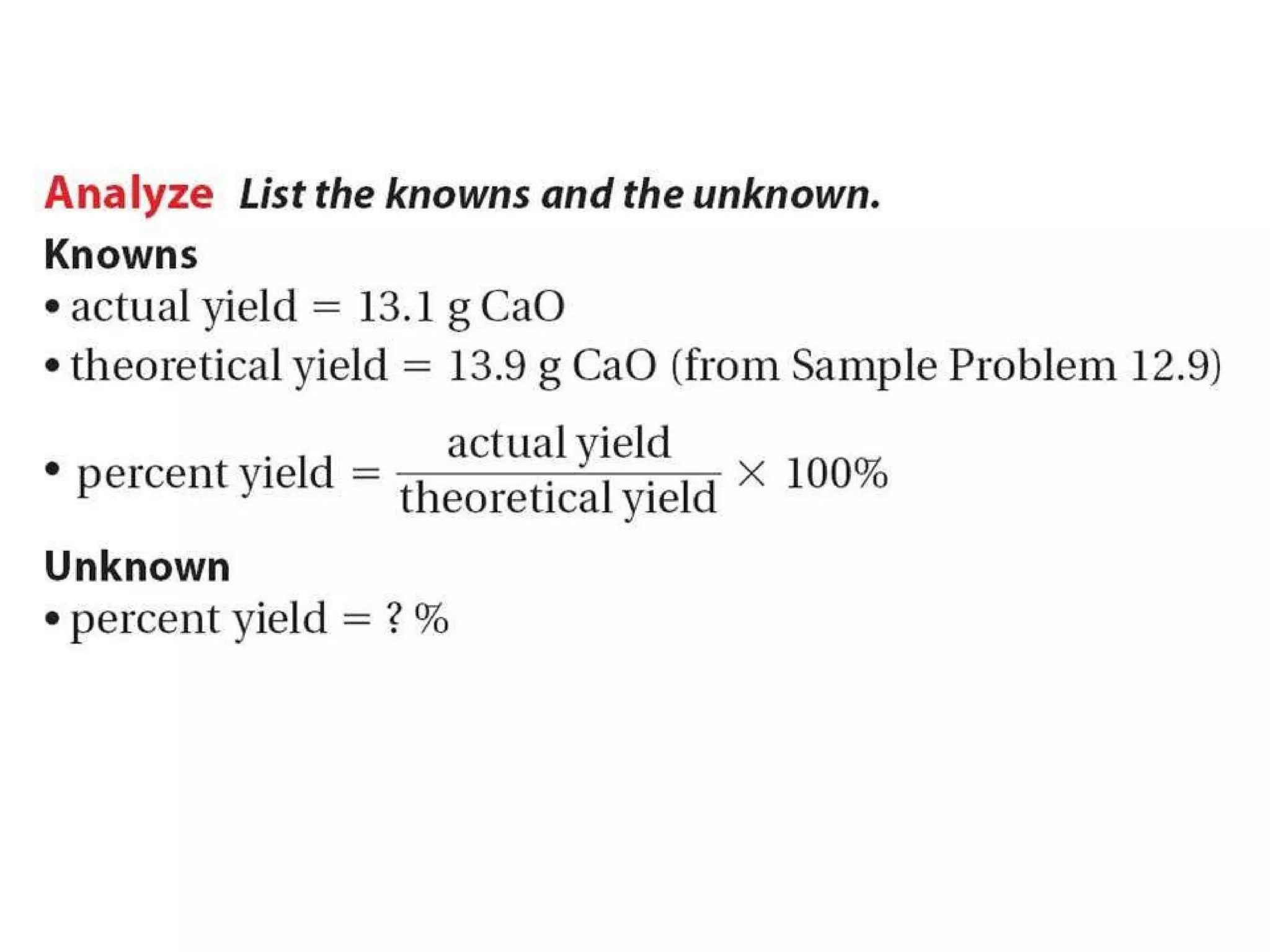
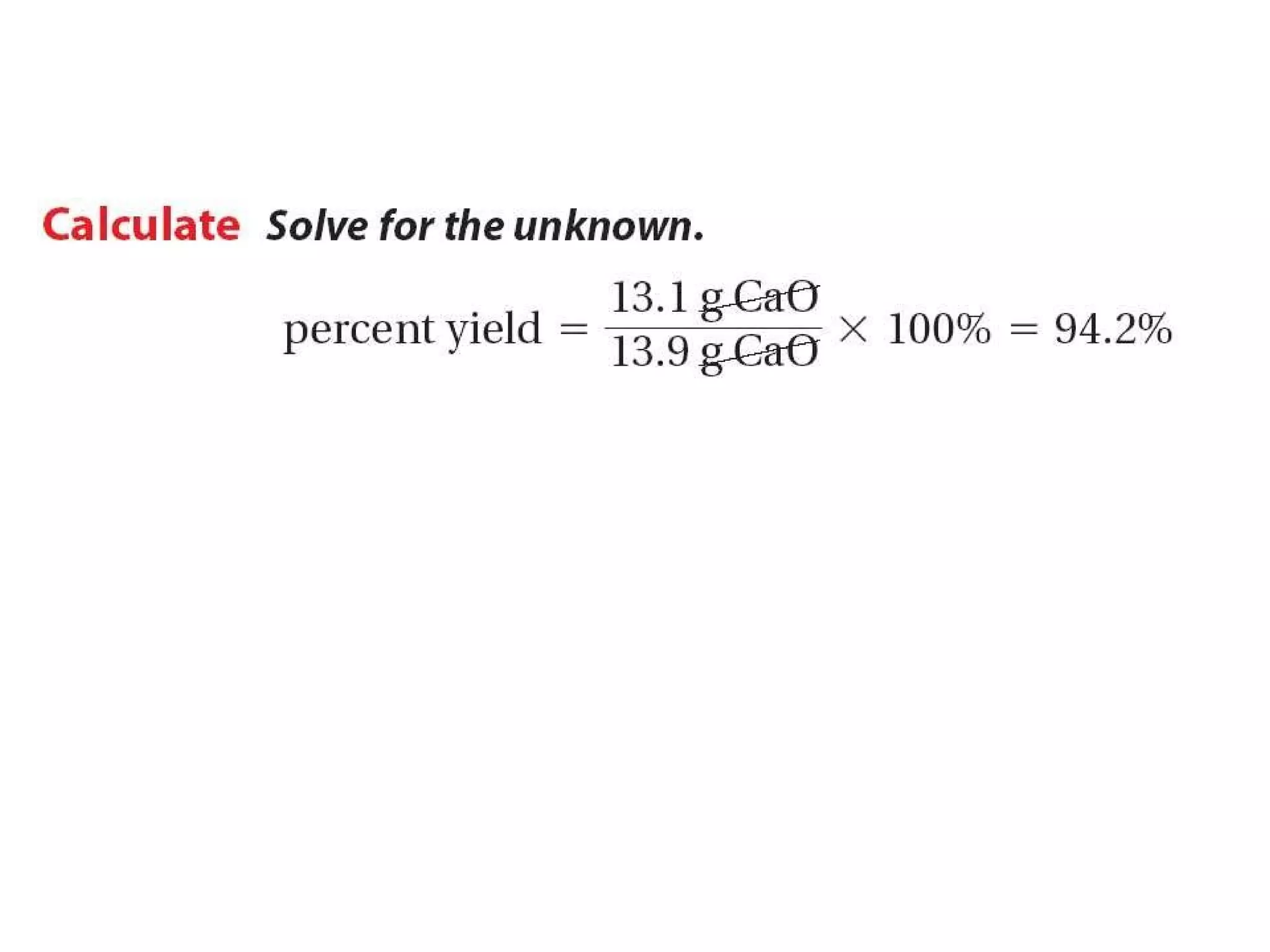
The percent yield is the ratio of the actual yield to the theoretical yield expressed as a percent. What yo u get in the lab What you get mathematically
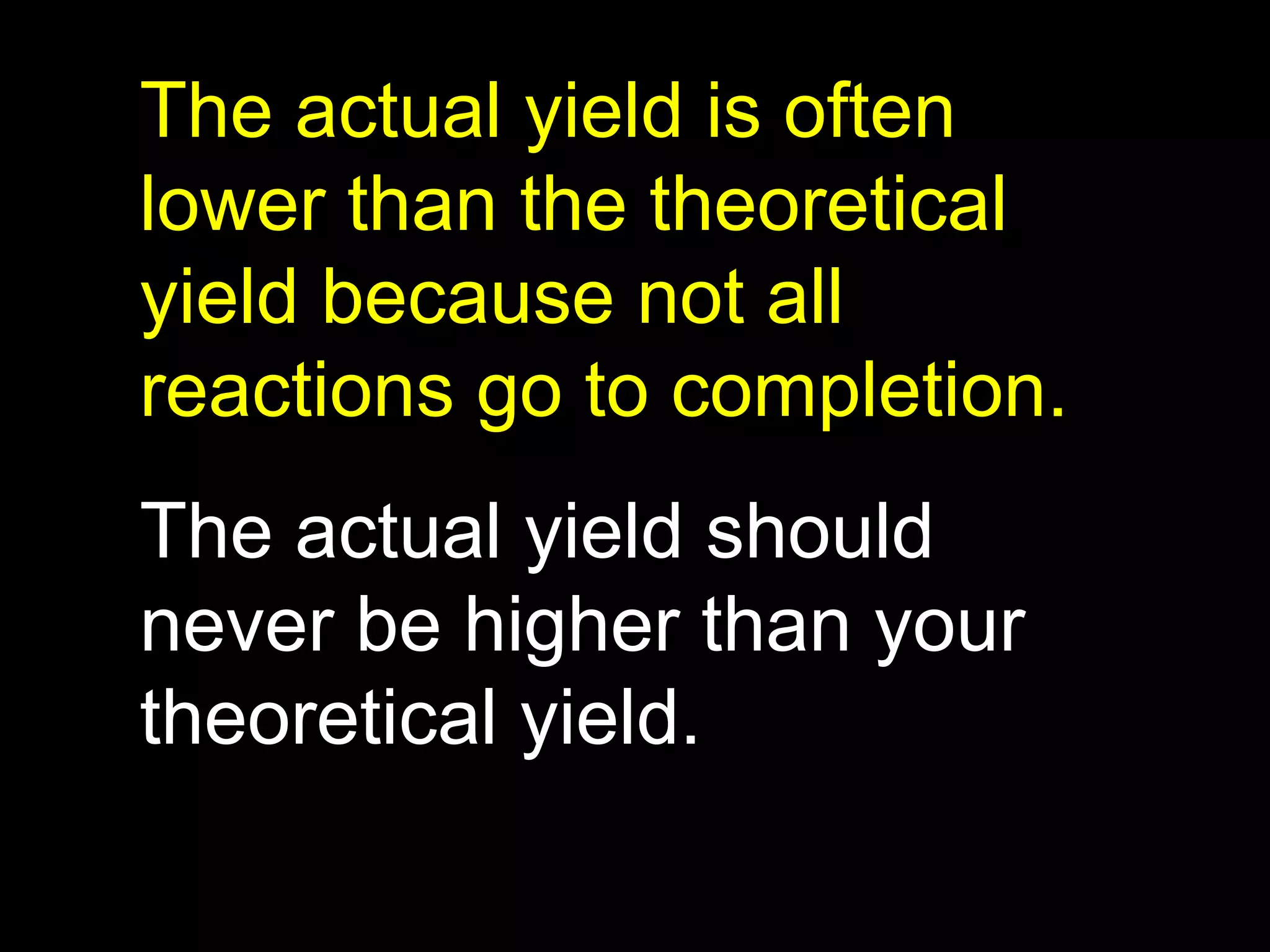
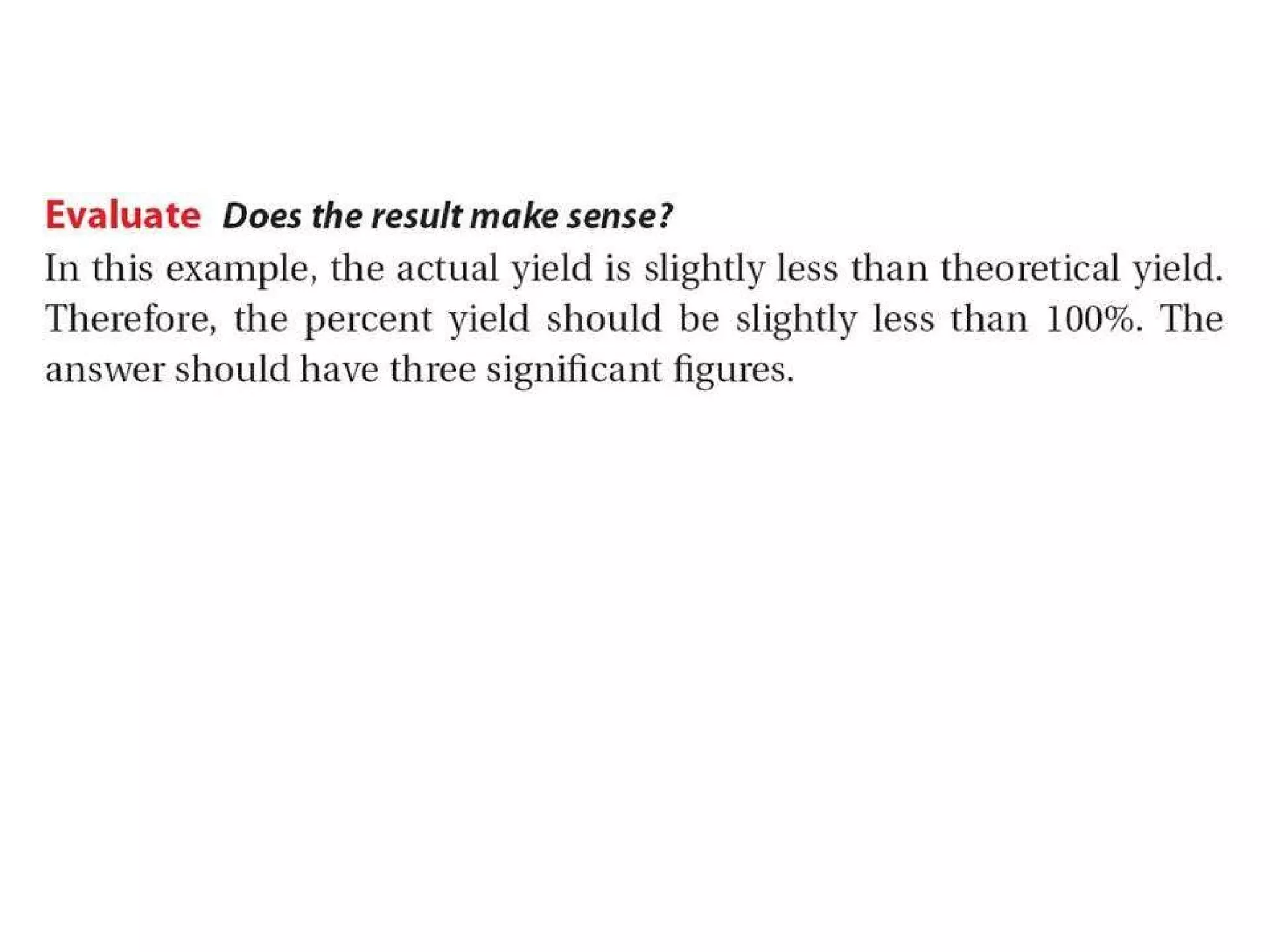
The actual yield is often lower than the theoretical yield because not all reactions go to completion. The actual yield should never be higher than your theoretical yield.
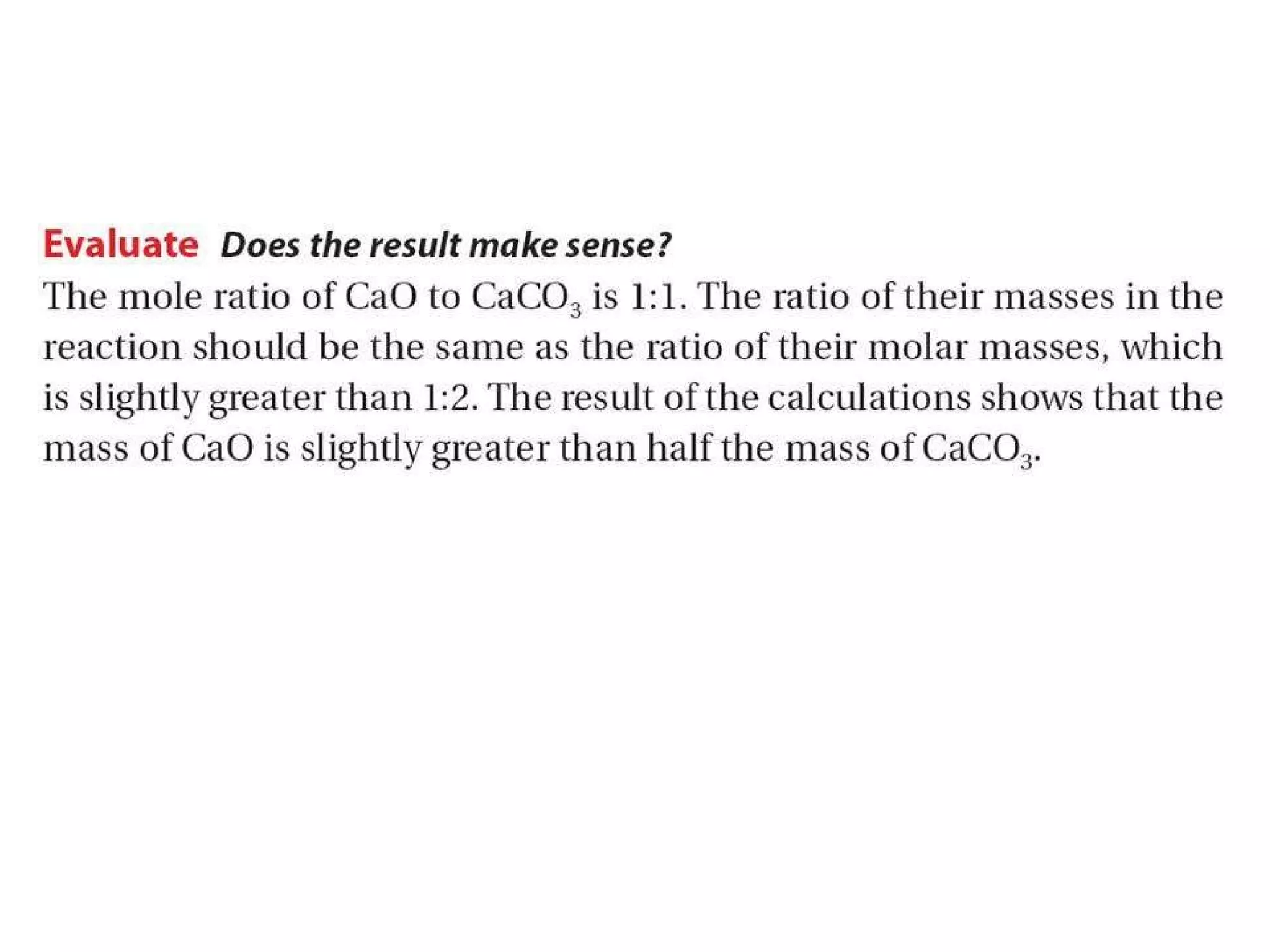
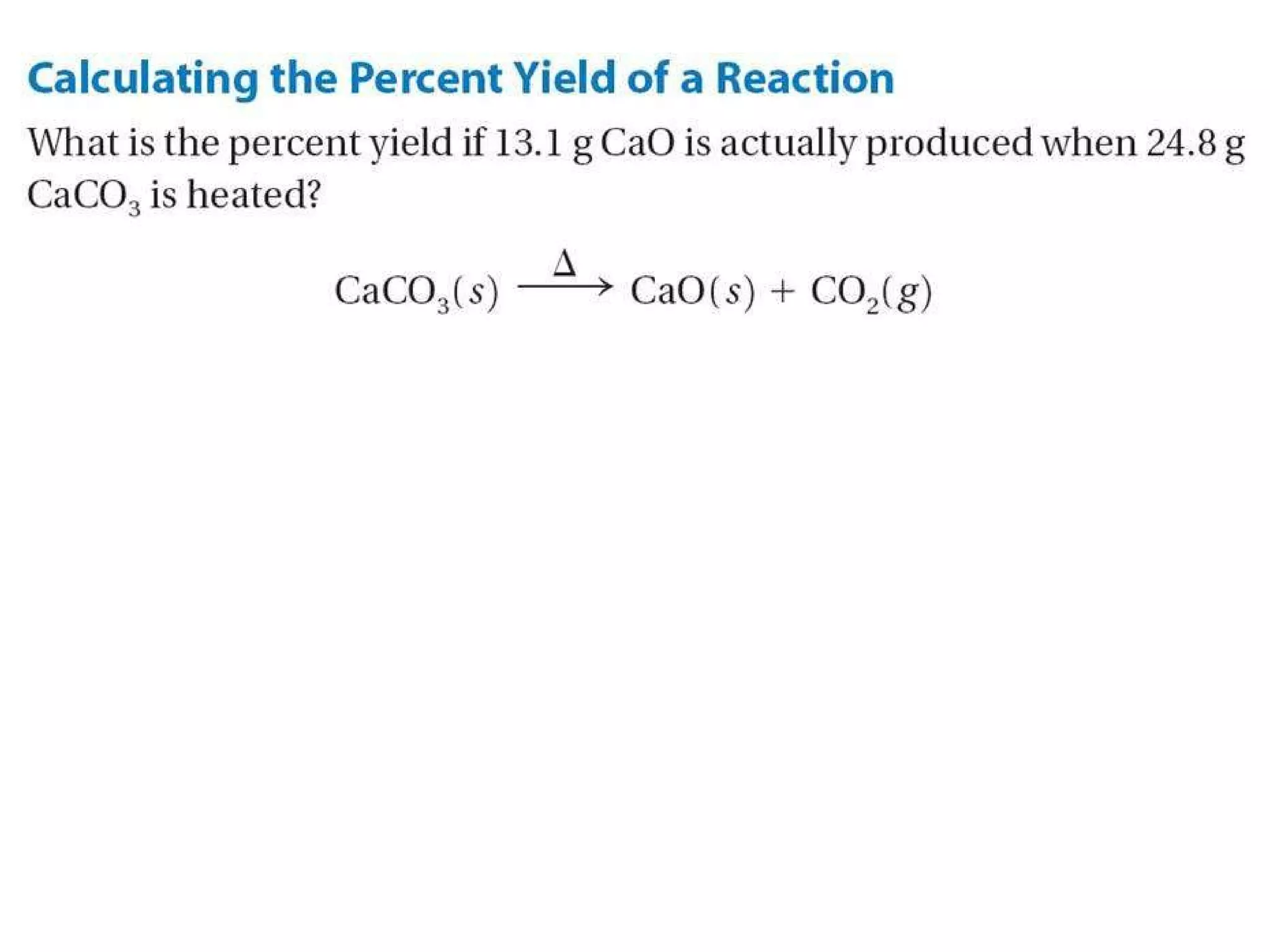
12.9
12.9
12.9
12.9
12.10
12.10
12.10
12.10
for Sample Problem 12.10
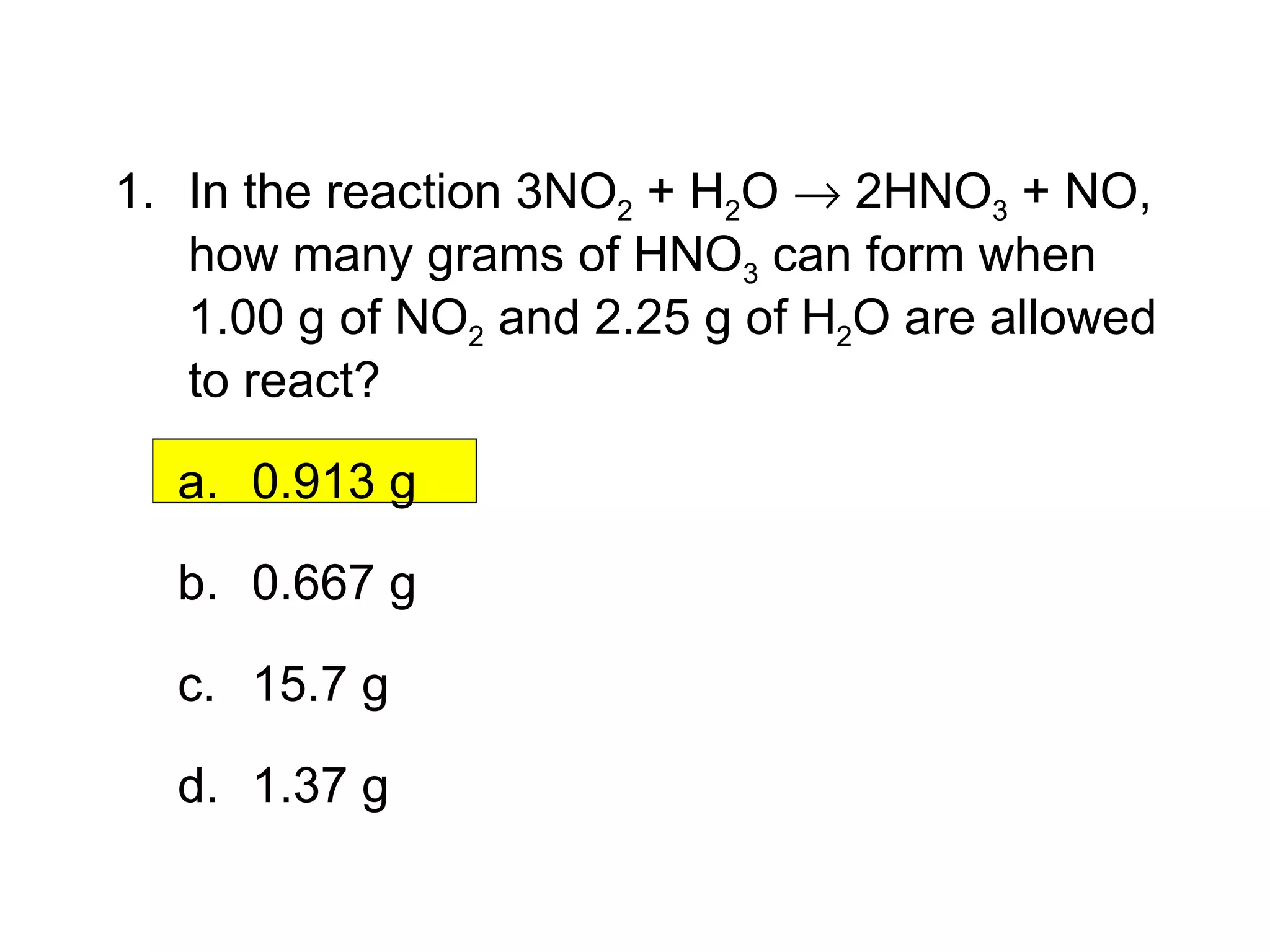
12.3  Section Quiz. 1. In the reaction 3NO 2  + H 2 O    2HNO 3  + NO, how many grams of HNO 3  can form when 1.00 g of NO 2  and 2.25 g of H 2 O are allowed to react? 0.913 g 0.667 g 15.7 g 1.37 g
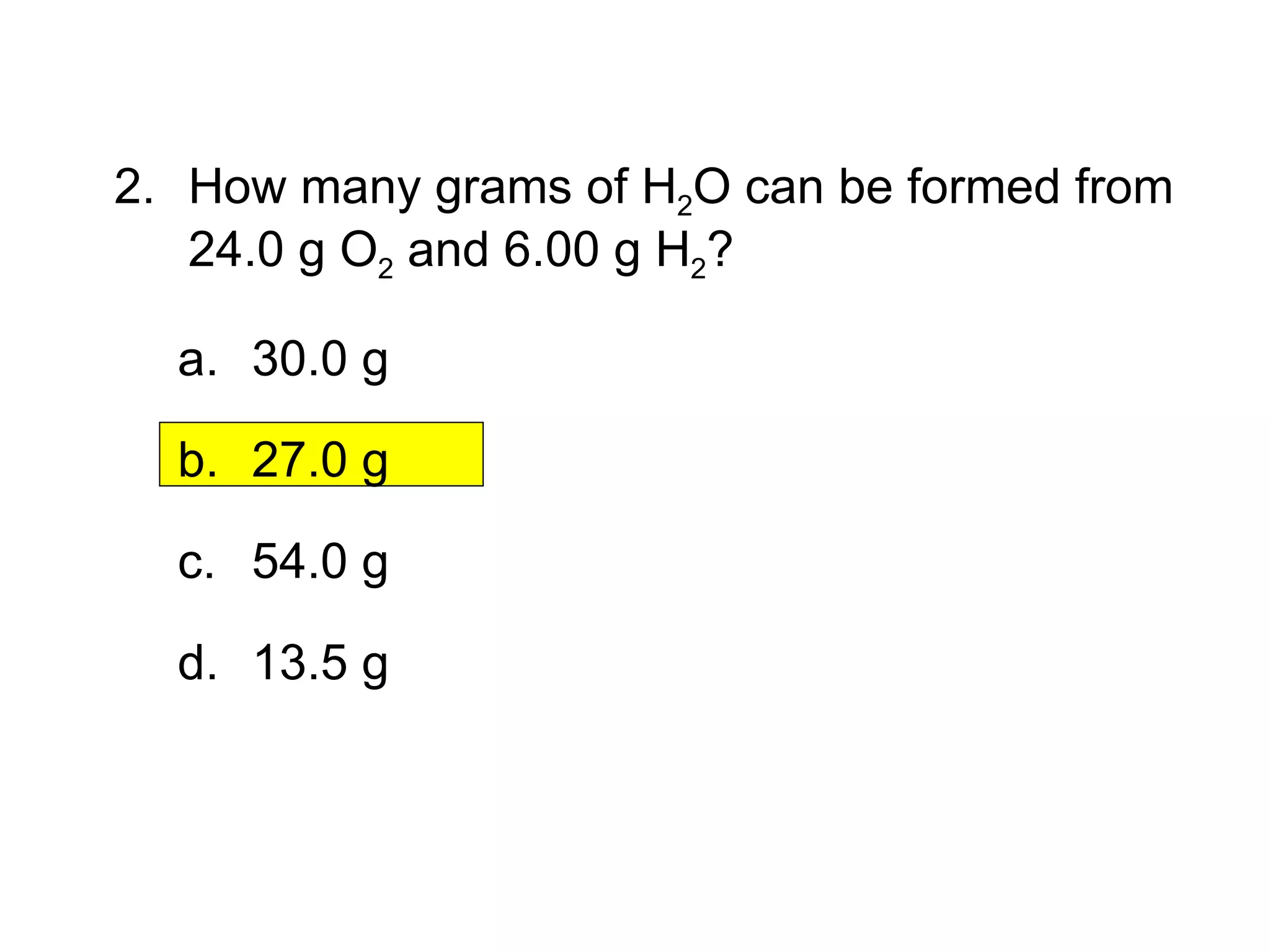
12.3  Section Quiz. 2. How many grams of H 2 O can be formed from 24.0 g O 2  and 6.00 g H 2 ? 30.0 g 27.0 g 54.0 g 13.5 g
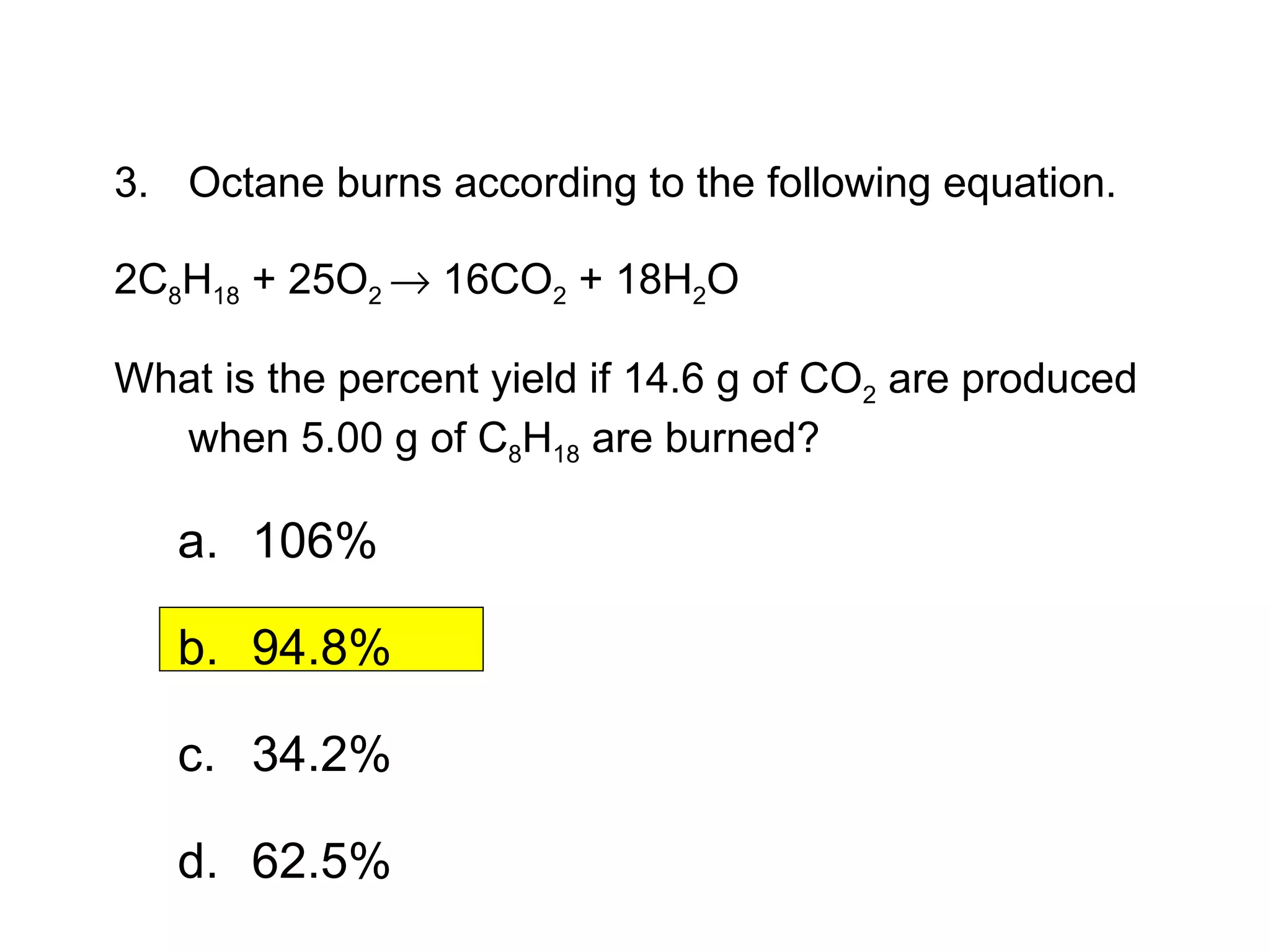
3. Octane burns according to the following equation.  2C 8 H 18  + 25O 2    16CO 2  + 18H 2 O  What is the percent yield if 14.6 g of CO 2  are produced when 5.00 g of C 8 H 18  are burned? 106% 94.8% 34.2% 62.5% 12.3  Section Quiz.

Lecture 12.3- Limiting Reagents and Percent Yield

  • 1.
    Bellwork- Make 1cupof water H 2 + O 2  H 2 O How many liters of H 2 gas and O 2 gas at STP are required to make a cup of water? One cup (240mL) has a mass of 240g for pure water. 240g H 2 O x 1mol = 13.3mol H 2 O 18g 13.3 mol H 2 O x 13.3 mol H 2 O x 2 2 2 moles H 2 2 moles H 2 O 1 mole O 2 . 2 moles H 2 O = 13.3mol H 2 = 6.67mol O 2 x 22.4L/mol = 299L H 2 x 22.4L/mol = 149L O 2
  • 2.
    Limiting Reagent andPercent Yield If a carpenter had two tabletops and seven table legs, he cou ld only build one four-legged table. The number of table legs is the limiting factor. Similarly, in chemistry, the amount of product made in a chemical reaction may be limited by the amount of one or more of the reactants.
  • 3.
    2 H 2 + O 2  2H 2 O When reactants combine in their stoichiometric ratio (a.k.a. mole ratio ), both reactants will be completely used. In any other ratio, one of the reactants will be used up and the other will have some left over.
  • 4.
    In a chemicalreaction, an insufficient quantity of any of the reactants will limit the amount of product that forms. The limiting reagent is the reagent that determines the amount of product that can be formed by a reaction.
  • 5.
    N 2 + 3H 2  2NH 3 You’ve got 2mole N 2 3mol H 2 How much NH 3 can you make? What is the limiting reactant?
  • 6.
    N 2 + 3H 2  2NH 3 You’ve got 2mole N 2 3mol H 2 How much NH 3 can you make? Only 2 moles What is the limiting reactant? Hydrogen, because there is not enough H 2 to react with the 2nd mole of N 2.
  • 7.
    Nitrogen is thereagent that is not completely used up in the reaction. The reagent that is not used up is called the excess reagent . N 2 + 3H 2  2NH 3 You’ve got 2mole N 2 3mol H 2
  • 8.
  • 9.
  • 10.
  • 11.
  • 12.
  • 13.
  • 14.
  • 15.
  • 16.
  • 17.
  • 18.
    The percentyield is a measure of the efficiency of a reaction carried out in the laboratory. A batting average is actually a percent yield.
  • 19.
    The theoreticalyield is the maximum amount of product that could be formed from given amounts of reactants. In contrast, the amount of product that actually forms when the reaction is carried out in the laboratory is called the actual yield . comes from stoichiometry comes from the lab
  • 20.
    The percent yieldis the ratio of the actual yield to the theoretical yield expressed as a percent. What yo u get in the lab What you get mathematically
  • 21.
    The actual yieldis often lower than the theoretical yield because not all reactions go to completion. The actual yield should never be higher than your theoretical yield.
  • 22.
  • 23.
  • 24.
  • 25.
  • 26.
  • 27.
  • 28.
  • 29.
  • 30.
  • 31.
    12.3 SectionQuiz. 1. In the reaction 3NO 2 + H 2 O  2HNO 3 + NO, how many grams of HNO 3 can form when 1.00 g of NO 2 and 2.25 g of H 2 O are allowed to react? 0.913 g 0.667 g 15.7 g 1.37 g
  • 32.
    12.3 SectionQuiz. 2. How many grams of H 2 O can be formed from 24.0 g O 2 and 6.00 g H 2 ? 30.0 g 27.0 g 54.0 g 13.5 g
  • 33.
    3. Octane burnsaccording to the following equation. 2C 8 H 18 + 25O 2  16CO 2 + 18H 2 O What is the percent yield if 14.6 g of CO 2 are produced when 5.00 g of C 8 H 18 are burned? 106% 94.8% 34.2% 62.5% 12.3 Section Quiz.

Editor's Notes

  • #19 A batting average is actually a percent yield.