DIVIDEND POLICY
THEORY AND PRACTICE
INTRODUCTION
 The financial manager must take careful
decisions on how the profits should be
distributed among shareholders.
 It is very crucial part of business concern, bze
these decisions are directly related with the
value of business concern and shareholders
wealth.
MEANING OF DIVIDEND
 Dividend refers to the business concerns net
profits distributed among the shareholders. It
may also be termed as the part of the profit of a
business concern, which is distributed among its
shareholders.
 According to‘insti.of charted Acct.of india’
dividend as a distribution to shareholders out of
profits or reserves available for this purpose.
DIVIDEND DECISIONS
 Dividends refer to that portion of a firm’s net
earnings which are paid out to the shareholders
 Since dividends are distributed out of the profits,
alternative to the payment of dividends is the
retention of the earnings/profits
 The retained earnings constitute an easily
accessible important source of financing the
investment requirement of the firm.
DIVIDEND DECISIONS
 There is, thus a type of inverse relationship
between retained earnings and cash dividends
i.e. larger retentions, lesser dividends and vice
versa
 Dividends decision is a major corporate
decision in the sense that the firm has to chose
between distributing the profits to the
shareholders and ploughing them back into the
business and the choice depends on the effect of
the decision on the firm’s value.
DIVIDEND DECISIONS
 Profitable companies regularly face 3 questions:
1. How much of its free cash flow should it pass
on to shareholders?
2. Should dividends be paid as cash dividend or by
repurchasing stock?
3. Should it maintain a stable, consistent payment
policy or should it let the payment vary as
conditions change
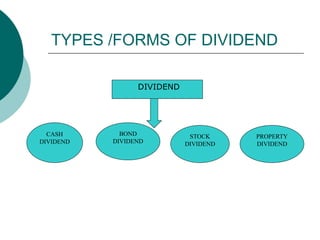
TYPES /FORMS OF DIVIDEND
DIVIDEND
CASH
DIVIDEND
BOND
DIVIDEND
STOCK
DIVIDEND
PROPERTY
DIVIDEND
CASH DIVIDEND
 A cash dividend is money paid to stock holder,
normally out of the corporation’s current earnings or
accumulated profits. Not all companies pay a
dividend usually, the board of determines if a
dividends is desirable their particular company
based upon various financial and economic factors.
Dividend are commonly paid in the form of cash
distributions to the shareholders on a monthly,
quarterly or yearly basis. It is taxable income to the
recipient
BOND DIVIDEND
 Bond dividend is know as scrip
dividend if the company does not have sufficient
funds to pay cash dividend ,the company
promises to pay the shareholder at a future
specific date with the help of issue of bond or
notes.
STOCK DIVIDEND(Bonus Shares)
 It is paid in the form of the company stock due
to raising of more finance. Under this type ,
cash is retained by the business concern. Stock
dividend may be bonus issue. This issue is
given only to the existing shareholders of the
business concerns.
BONUS SHARES
 Bonus shares represents a distribution of
shares in lieu of or in addition to the cash
dividend to the existing shareholders, if the
articles so permit. The shares are issued to the
existing ordinary shareholders in proportion to
their present holdings.
PROPERTY DIVIDEND
 Property dividend are paid in the form of
some assets other than cash. It will distribute
under the exceptional circumstance. This
type of dividend is not published in India
PAY-OUT RATIO
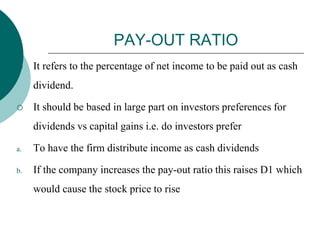
 It refers to the percentage of net income to be paid out as cash
dividend.
 It should be based in large part on investors preferences for
dividends vs capital gains i.e. do investors prefer
a. To have the firm distribute income as cash dividends
b. If the company increases the pay-out ratio this raises D1 which
would cause the stock price to rise
PAY-OUT RATIO
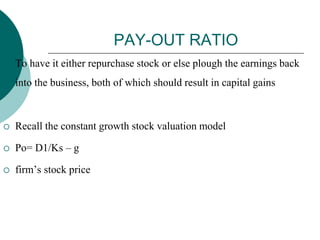
 To have it either repurchase stock or else plough the earnings back
into the business, both of which should result in capital gains
 Recall the constant growth stock valuation model
 Po= D1/Ks – g
 firm’s stock price
PAY-OUT RATIO
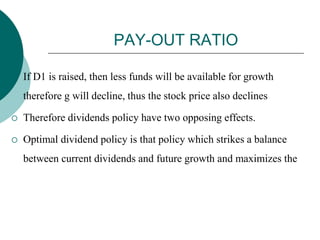
 If D1 is raised, then less funds will be available for growth
therefore g will decline, thus the stock price also declines
 Therefore dividends policy have two opposing effects.
 Optimal dividend policy is that policy which strikes a balance
between current dividends and future growth and maximizes the
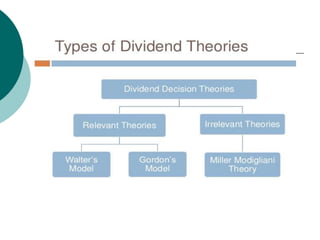
DIVIDEND THEORIES
DIVIDEND IRRELEVANCE THEORY
 This is the theory that a firm’s policy has no
effect in either its value or its cost of capital
 MM argued that a firm’s value is determined
only by its basic earnings power and its business
risk
 They argued that the value of the firm depends
only on its income produced by its assets not on
how this income is split between dividends and
retained earnings
DIVIDEND IRRELEVANCE THEORY
 MM noted that any shareholder can in theory construct his/her
own dividend policy.
 If a firm does not pay dividends a shareholder who wants a 5%
dividend can create it by selling 5% of his/her stock or
 If a company pays a higher dividend than an investor desires ,
the investor can use the unwanted dividends to buy additional
shares of the company’s stock.
DIVIDEND IRRELEVANCE THEORY
 Therefore investors could buy and sell shares, they can create
their own dividend policy without incurring cost, the firm’s policy
would there fore be irrelevant
 Note: investors who want additional dividends must incur
brokerage costs to sell shares and investors who do not want
dividends must first pay taxes on unwanted dividends and incur
brokerage costs to purchase shares with after-tax dividends. Since
taxes and brokerage costs certainly exist, dividend policy may
well be relevant
BIRD-IN-HAND THEORY
 Gordon & Lintner argued that cost
of equity (Ks) decreases as the
dividend pay-out is increased
because investors are less certain of
receiving the capital gains that are
supposed to result from retaining
earnings than they are receiving
from dividend payments
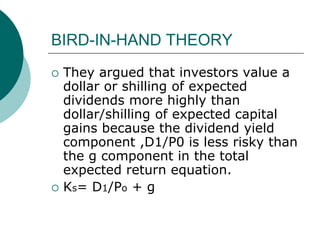
BIRD-IN-HAND THEORY
 They argued that investors value a
dollar or shilling of expected
dividends more highly than
dollar/shilling of expected capital
gains because the dividend yield
component ,D1/P0 is less risky than
the g component in the total
expected return equation.
 Ks= D1/Po + g
BIRD-IN-HAND THEORY
 It is based on the logic that what is
available at present is preferable to what
may be available in the future.
 Basing his model on this argument,
Gordon and Linter argue that the future is
uncertain and the more distant the future
is, the more uncertain it is likely to be.
 Therefore, investors would be inclined to
pay a higher price for shares on which
current dividends are paid
TAX PREFERENCE THEORY
 There are two tax related reasons for thinking
that investors might prefer a low dividend pay-out
to high pay-out:
 Long-term capital gains are generally taxed at
lower rate, whereas dividend income is taxed at
effective rates (marginal rates), therefore wealthy
investors (who own most of the stock and receive
most of the dividends) might prefer to have
companies retain and plough back earnings into
the business
 Taxes are not paid on the gain until a stock is
sold. Due to time value effects the amount of
taxes paid in the future has a lower effective cost
than the amount paid today
TAX PREFERENCE THEORY
 Because of these tax advantages,
investors may prefer to have
companies retain most of their
earnings.
 Therefore investors would be willing
to pay more for low pay-out
companies than for otherwise
similar high pay-out companies
INFROMATION
CONTENT/SIGNALING THEORY
 The theory states that investors regard
dividend changes as signals of
management’s earnings forecasts
 It has been observed that an increase in
dividends is often accompanied by an
increase in the price of the stock, while a
reduction in dividends generally leads to a
stock price decline
 It means therefore that investors prefer
dividends to capital gains
INFROMATION
CONTENT/SIGNALING THEORY
 MM argued that companies are reluctant
to reduce dividends and hence do not
raise unless they anticipate higher
earnings in the future.
 Thus MM argued that a higher than
expected dividend increase is a signal to
investors that the firm’s management
forecasts good future earnings
INFROMATION
CONTENT/SIGNALING THEORY
 Conversely, a dividend reduction or a smaller
than expected increase is a signal that the firm’s
management is forecasting poor earnings in the
future.
 According to MM, therefore investors reactions to
changes in dividend policy do not necessary mean
that investors prefer dividend to retained
earnings.
 Rather, they argued the price changes following
dividends actions simply indicate that there is an
important information or signaling content in
dividend announcements
CLIENTELE EFFECT
 This the tendency of a firm to attract a
set of investors who like its dividend
policy
 Different groups or clienteles of stock
holders prefer dividend payout policies
e.g.
 Retires, the poor and the old etc generally
prefer cash income, so they may want the
firm to payout a high percentage of
earnings.
CLIENTELE EFFECT
 On the other hand, investors in their peak
earnings years might prefer re-
investment, because they have less need
for current investment income and would
simply reinvest dividends received after
paying income taxes on these dividends
 Investors who want current investment
income should own shares in high
dividend payout firms and vice versa
DIVIDEND POLICIES
 STABLE DIVIDEND POLICY
 This is where the dividend growth
rate is predictable
 The shareholders can also be
certain that the current dividend will
not be reduced.
 It may not grow at a stable rate but
management will probably be able
to avoid reducing the dividend
DIVIDEND POLICIES
 RESIDUAL DIVIDEND MODEL
 Dividend paid is equal to net income minus the
amount of retained earnings necessary to finance
the firm’s optimal capital budget
1. The determines the optimal budget
2. Determines the amount of equity needed to
finance that budget given its target capital
structure
3. It uses retained earnings to meet equity
requirements to the extent possible
4. It pays dividends only if more earnings are
available than are needed
STOCK SPLIT
 This is an action taken by a firm to
increase the number of shares
outstanding e.g. doubling the
number of shares outstanding by
giving each stock holder two new
shares for each one formally held
STOCK DIVIDENDS
 This dividend paid in the form of additional
shares of stock rather than cash
 Effects:
1. The price of a stock rises shortly after a company
announces a stock split or stock dividend
2. The price increases are as a result of investors
taking split/dividends as signals of higher future
earnings
3. However if during the next few months it does
not announce an increase in earnings and
dividends , then stock price will go back to the
earlier level
FACTORS AFFECTING DIVIDEND
POLICY
 They may be grouped into four
broad categories:
1. Constraints on dividends
2. Investment opportunities
3. Availability and cost of alternative
sources of capital
4. Effects of dividend policy on cost of
capital
1. CONTRANTS
 BOND HOLDERS. Debt contracts often
limit dividend payments to earnings after
loan was granted
 PREFERRED STOCK RESTRICTIONS.
Common dividends cannot be paid if
company has not omitted its preferred
dividend
 IMPAIREMENT OF CAPITAL RULE.
Dividends payments cannot exceed the
balance sheet item retained earnings. It is
designed to protect creditors
2. INVESTMENT OPPORTUNITIES
1. Number of profitable investment
opportunities available
2. Possibility of accelerating or
delaying projects will permit a
firms to adhere more closely to
stable dividend policy
3. ALTERNATIVE SOURCES OF
CAPITAL
1. Cost of selling new stock. If the floatation are
high it is better to have a low payout ratio and
finance through retained earnings
2. Ability to substitute debt for equity. If a firm can
finance a given level of investment with either
debt or equity. Low flotation cost will permit a
more flexible dividend policy because equity can
either be raised by retained earnings or by selling
new stock
3. Control. If the management is concerned about
maintaining control, it may be reluctant to sell
new stock .
4. EFFECTS OF DIVIDEND POLICY
ON COST OF CAPITAL
 It may be considered in terms of four factors
1. Shareholders desire for current versus future
income
2. Perceived riskiness of dividends versus capital
gains
3. The tax advantage of capital gains over
dividends
4. The information content of dividends
 The important of each factor in terms of its effect
on cost of capital varies from firm to firm
depending on the make-up of its current and
possible future stockholders
 THE END

Ppt on dividend

  • 1.
  • 2.
    INTRODUCTION  The financialmanager must take careful decisions on how the profits should be distributed among shareholders.  It is very crucial part of business concern, bze these decisions are directly related with the value of business concern and shareholders wealth.
  • 3.
    MEANING OF DIVIDEND Dividend refers to the business concerns net profits distributed among the shareholders. It may also be termed as the part of the profit of a business concern, which is distributed among its shareholders.  According to‘insti.of charted Acct.of india’ dividend as a distribution to shareholders out of profits or reserves available for this purpose.
  • 4.
    DIVIDEND DECISIONS  Dividendsrefer to that portion of a firm’s net earnings which are paid out to the shareholders  Since dividends are distributed out of the profits, alternative to the payment of dividends is the retention of the earnings/profits  The retained earnings constitute an easily accessible important source of financing the investment requirement of the firm.
  • 5.
    DIVIDEND DECISIONS  Thereis, thus a type of inverse relationship between retained earnings and cash dividends i.e. larger retentions, lesser dividends and vice versa  Dividends decision is a major corporate decision in the sense that the firm has to chose between distributing the profits to the shareholders and ploughing them back into the business and the choice depends on the effect of the decision on the firm’s value.
  • 6.
    DIVIDEND DECISIONS  Profitablecompanies regularly face 3 questions: 1. How much of its free cash flow should it pass on to shareholders? 2. Should dividends be paid as cash dividend or by repurchasing stock? 3. Should it maintain a stable, consistent payment policy or should it let the payment vary as conditions change
  • 7.
    TYPES /FORMS OFDIVIDEND DIVIDEND CASH DIVIDEND BOND DIVIDEND STOCK DIVIDEND PROPERTY DIVIDEND
  • 8.
    CASH DIVIDEND  Acash dividend is money paid to stock holder, normally out of the corporation’s current earnings or accumulated profits. Not all companies pay a dividend usually, the board of determines if a dividends is desirable their particular company based upon various financial and economic factors. Dividend are commonly paid in the form of cash distributions to the shareholders on a monthly, quarterly or yearly basis. It is taxable income to the recipient
  • 9.
    BOND DIVIDEND  Bonddividend is know as scrip dividend if the company does not have sufficient funds to pay cash dividend ,the company promises to pay the shareholder at a future specific date with the help of issue of bond or notes.
  • 10.
    STOCK DIVIDEND(Bonus Shares) It is paid in the form of the company stock due to raising of more finance. Under this type , cash is retained by the business concern. Stock dividend may be bonus issue. This issue is given only to the existing shareholders of the business concerns.
  • 11.
    BONUS SHARES  Bonusshares represents a distribution of shares in lieu of or in addition to the cash dividend to the existing shareholders, if the articles so permit. The shares are issued to the existing ordinary shareholders in proportion to their present holdings.
  • 12.
    PROPERTY DIVIDEND  Propertydividend are paid in the form of some assets other than cash. It will distribute under the exceptional circumstance. This type of dividend is not published in India
  • 14.
    PAY-OUT RATIO  Itrefers to the percentage of net income to be paid out as cash dividend.  It should be based in large part on investors preferences for dividends vs capital gains i.e. do investors prefer a. To have the firm distribute income as cash dividends b. If the company increases the pay-out ratio this raises D1 which would cause the stock price to rise
  • 15.
    PAY-OUT RATIO  Tohave it either repurchase stock or else plough the earnings back into the business, both of which should result in capital gains  Recall the constant growth stock valuation model  Po= D1/Ks – g  firm’s stock price
  • 16.
    PAY-OUT RATIO  IfD1 is raised, then less funds will be available for growth therefore g will decline, thus the stock price also declines  Therefore dividends policy have two opposing effects.  Optimal dividend policy is that policy which strikes a balance between current dividends and future growth and maximizes the
  • 17.
  • 18.
    DIVIDEND IRRELEVANCE THEORY This is the theory that a firm’s policy has no effect in either its value or its cost of capital  MM argued that a firm’s value is determined only by its basic earnings power and its business risk  They argued that the value of the firm depends only on its income produced by its assets not on how this income is split between dividends and retained earnings
  • 19.
    DIVIDEND IRRELEVANCE THEORY MM noted that any shareholder can in theory construct his/her own dividend policy.  If a firm does not pay dividends a shareholder who wants a 5% dividend can create it by selling 5% of his/her stock or  If a company pays a higher dividend than an investor desires , the investor can use the unwanted dividends to buy additional shares of the company’s stock.
  • 20.
    DIVIDEND IRRELEVANCE THEORY Therefore investors could buy and sell shares, they can create their own dividend policy without incurring cost, the firm’s policy would there fore be irrelevant  Note: investors who want additional dividends must incur brokerage costs to sell shares and investors who do not want dividends must first pay taxes on unwanted dividends and incur brokerage costs to purchase shares with after-tax dividends. Since taxes and brokerage costs certainly exist, dividend policy may well be relevant
  • 21.
    BIRD-IN-HAND THEORY  Gordon& Lintner argued that cost of equity (Ks) decreases as the dividend pay-out is increased because investors are less certain of receiving the capital gains that are supposed to result from retaining earnings than they are receiving from dividend payments
  • 22.
    BIRD-IN-HAND THEORY  Theyargued that investors value a dollar or shilling of expected dividends more highly than dollar/shilling of expected capital gains because the dividend yield component ,D1/P0 is less risky than the g component in the total expected return equation.  Ks= D1/Po + g
  • 23.
    BIRD-IN-HAND THEORY  Itis based on the logic that what is available at present is preferable to what may be available in the future.  Basing his model on this argument, Gordon and Linter argue that the future is uncertain and the more distant the future is, the more uncertain it is likely to be.  Therefore, investors would be inclined to pay a higher price for shares on which current dividends are paid
  • 24.
    TAX PREFERENCE THEORY There are two tax related reasons for thinking that investors might prefer a low dividend pay-out to high pay-out:  Long-term capital gains are generally taxed at lower rate, whereas dividend income is taxed at effective rates (marginal rates), therefore wealthy investors (who own most of the stock and receive most of the dividends) might prefer to have companies retain and plough back earnings into the business  Taxes are not paid on the gain until a stock is sold. Due to time value effects the amount of taxes paid in the future has a lower effective cost than the amount paid today
  • 25.
    TAX PREFERENCE THEORY Because of these tax advantages, investors may prefer to have companies retain most of their earnings.  Therefore investors would be willing to pay more for low pay-out companies than for otherwise similar high pay-out companies
  • 26.
    INFROMATION CONTENT/SIGNALING THEORY  Thetheory states that investors regard dividend changes as signals of management’s earnings forecasts  It has been observed that an increase in dividends is often accompanied by an increase in the price of the stock, while a reduction in dividends generally leads to a stock price decline  It means therefore that investors prefer dividends to capital gains
  • 27.
    INFROMATION CONTENT/SIGNALING THEORY  MMargued that companies are reluctant to reduce dividends and hence do not raise unless they anticipate higher earnings in the future.  Thus MM argued that a higher than expected dividend increase is a signal to investors that the firm’s management forecasts good future earnings
  • 28.
    INFROMATION CONTENT/SIGNALING THEORY  Conversely,a dividend reduction or a smaller than expected increase is a signal that the firm’s management is forecasting poor earnings in the future.  According to MM, therefore investors reactions to changes in dividend policy do not necessary mean that investors prefer dividend to retained earnings.  Rather, they argued the price changes following dividends actions simply indicate that there is an important information or signaling content in dividend announcements
  • 29.
    CLIENTELE EFFECT  Thisthe tendency of a firm to attract a set of investors who like its dividend policy  Different groups or clienteles of stock holders prefer dividend payout policies e.g.  Retires, the poor and the old etc generally prefer cash income, so they may want the firm to payout a high percentage of earnings.
  • 30.
    CLIENTELE EFFECT  Onthe other hand, investors in their peak earnings years might prefer re- investment, because they have less need for current investment income and would simply reinvest dividends received after paying income taxes on these dividends  Investors who want current investment income should own shares in high dividend payout firms and vice versa
  • 31.
    DIVIDEND POLICIES  STABLEDIVIDEND POLICY  This is where the dividend growth rate is predictable  The shareholders can also be certain that the current dividend will not be reduced.  It may not grow at a stable rate but management will probably be able to avoid reducing the dividend
  • 32.
    DIVIDEND POLICIES  RESIDUALDIVIDEND MODEL  Dividend paid is equal to net income minus the amount of retained earnings necessary to finance the firm’s optimal capital budget 1. The determines the optimal budget 2. Determines the amount of equity needed to finance that budget given its target capital structure 3. It uses retained earnings to meet equity requirements to the extent possible 4. It pays dividends only if more earnings are available than are needed
  • 33.
    STOCK SPLIT  Thisis an action taken by a firm to increase the number of shares outstanding e.g. doubling the number of shares outstanding by giving each stock holder two new shares for each one formally held
  • 34.
    STOCK DIVIDENDS  Thisdividend paid in the form of additional shares of stock rather than cash  Effects: 1. The price of a stock rises shortly after a company announces a stock split or stock dividend 2. The price increases are as a result of investors taking split/dividends as signals of higher future earnings 3. However if during the next few months it does not announce an increase in earnings and dividends , then stock price will go back to the earlier level
  • 35.
    FACTORS AFFECTING DIVIDEND POLICY They may be grouped into four broad categories: 1. Constraints on dividends 2. Investment opportunities 3. Availability and cost of alternative sources of capital 4. Effects of dividend policy on cost of capital
  • 36.
    1. CONTRANTS  BONDHOLDERS. Debt contracts often limit dividend payments to earnings after loan was granted  PREFERRED STOCK RESTRICTIONS. Common dividends cannot be paid if company has not omitted its preferred dividend  IMPAIREMENT OF CAPITAL RULE. Dividends payments cannot exceed the balance sheet item retained earnings. It is designed to protect creditors
  • 37.
    2. INVESTMENT OPPORTUNITIES 1.Number of profitable investment opportunities available 2. Possibility of accelerating or delaying projects will permit a firms to adhere more closely to stable dividend policy
  • 38.
    3. ALTERNATIVE SOURCESOF CAPITAL 1. Cost of selling new stock. If the floatation are high it is better to have a low payout ratio and finance through retained earnings 2. Ability to substitute debt for equity. If a firm can finance a given level of investment with either debt or equity. Low flotation cost will permit a more flexible dividend policy because equity can either be raised by retained earnings or by selling new stock 3. Control. If the management is concerned about maintaining control, it may be reluctant to sell new stock .
  • 39.
    4. EFFECTS OFDIVIDEND POLICY ON COST OF CAPITAL  It may be considered in terms of four factors 1. Shareholders desire for current versus future income 2. Perceived riskiness of dividends versus capital gains 3. The tax advantage of capital gains over dividends 4. The information content of dividends  The important of each factor in terms of its effect on cost of capital varies from firm to firm depending on the make-up of its current and possible future stockholders
  • 40.