

Strategic Intent
Presented by
Jaswinder Singh
Strategic Management
• Strategy Management is defined as a dynamic process of
formulation, implementation, evaluation, and control
of strategies to realise the organization’s strategic
intent
Strategic Intent
• It refers to purpose for what organization
strives for. Organization must define “what
they want to do” , “why they want to do”.
• This “why they want to do” underlines the end
result and in management terms it is known
as strategic intent
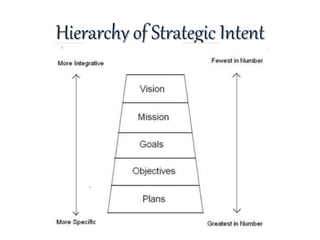
• Strategic Intent has a hierarchy: Vision,
Mission, Goals and Objectives
Hierarchy of Strategic Intent
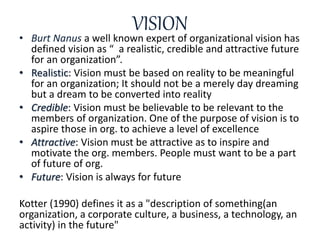
VISION• Burt Nanus a well known expert of organizational vision has
defined vision as “ a realistic, credible and attractive future
for an organization”.
• Realistic: Vision must be based on reality to be meaningful
for an organization; It should not be a merely day dreaming
but a dream to be converted into reality
• Credible: Vision must be believable to be relevant to the
members of organization. One of the purpose of vision is to
aspire those in org. to achieve a level of excellence
• Attractive: Vision must be attractive as to inspire and
motivate the org. members. People must want to be a part
of future of org.
• Future: Vision is always for future
Kotter (1990) defines it as a "description of something(an
organization, a corporate culture, a business, a technology, an
activity) in the future"
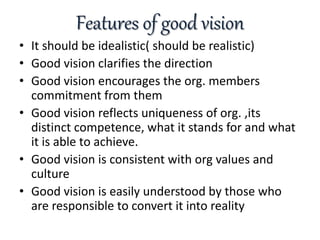
Features of good vision
• It should be idealistic( should be realistic)
• Good vision clarifies the direction
• Good vision encourages the org. members
commitment from them
• Good vision reflects uniqueness of org. ,its
distinct competence, what it stands for and what
it is able to achieve.
• Good vision is consistent with org values and
culture
• Good vision is easily understood by those who
are responsible to convert it into reality
Examples of vision
• Infosys- To be globally respected company that
provides best of breed software solutions by
best-in-class people
• Tata tea- to be India’s foremost tea based
beverage company
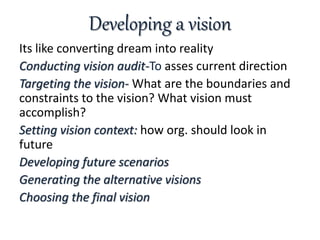
Developing a vision
Its like converting dream into reality
Conducting vision audit-To asses current direction
Targeting the vision- What are the boundaries and
constraints to the vision? What vision must
accomplish?
Setting vision context: how org. should look in
future
Developing future scenarios
Generating the alternative visions
Choosing the final vision
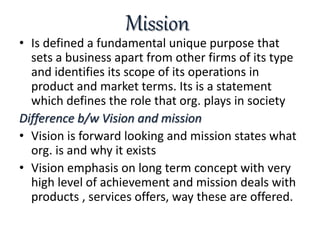
Mission
• Is defined a fundamental unique purpose that
sets a business apart from other firms of its type
and identifies its scope of its operations in
product and market terms. Its is a statement
which defines the role that org. plays in society
Difference b/w Vision and mission
• Vision is forward looking and mission states what
org. is and why it exists
• Vision emphasis on long term concept with very
high level of achievement and mission deals with
products , services offers, way these are offered.
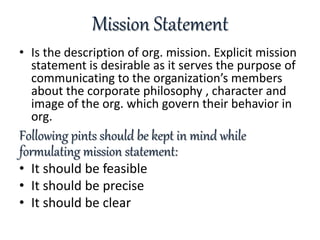
Mission Statement
• Is the description of org. mission. Explicit mission
statement is desirable as it serves the purpose of
communicating to the organization’s members
about the corporate philosophy , character and
image of the org. which govern their behavior in
org.
Following pints should be kept in mind while
formulating mission statement:
• It should be feasible
• It should be precise
• It should be clear
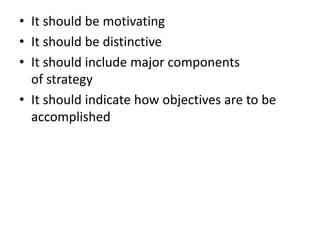
• It should be motivating
• It should be distinctive
• It should include major components
of strategy
• It should indicate how objectives are to be
accomplished
Examples of mission statement
• Infosys: To achieve our objectives in a
environment of fairness, honesty and courtesy
towards our clients, employess, vendors and
society at large
• Tata tea:
o Achieve market and thought leadership for
branded tea in india
o Drive long term profitable growth
o Co create enhanced value for stakeholders
o Make tata tea a great place for work
Business Definition
• Is clear cut statement of the business or a set of
business, the org. engages in presently or wishes
to pursue in future. Then it prescribes the area in
which the org will play compete
• Business can defined along three dimensions–
product, customer and technology.
• Business must reflect two features : Focus and
Differentiation
• Example: HUL business definition: “To meet
everyday needs of people everywhere with
branded products”
Goals and Objectives
• Goals denote what an organization hopes to
accomplish in a future period of time. They represent
the future state or outcome of effort put in now.
• Objectives are the ends that state specifically how the
goals shall be achieved. They are concrete and specific
in contrast to goals that are generalized
• Goals and objectives are the end results which an
organization strives for
• There may be different ways in expressing end result
like market leadership , a certain percentage increase
in sales in particular year
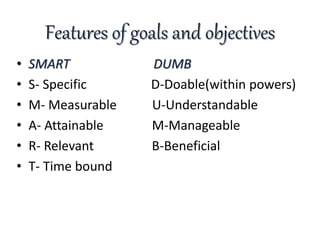
Features of goals and objectives
• SMART DUMB
• S- Specific D-Doable(within powers)
• M- Measurable U-Understandable
• A- Attainable M-Manageable
• R- Relevant B-Beneficial
• T- Time bound
Role of objectives
• Directions for decision making
• Objectives work as motivating force
• Performance standards
• Defines relationship with environment
Characteristics of objectives
• Objectives should be understandable
• Objectives should be concrete and specific
• Objectives should be related to a timeframe
• Objectives should be measurable and
controllable
• Objectives should be challenging
• Different objectives should correlate with each
other
• Objectives should be set within constraints
Issues in objective setting
• Specificity
• Multiplicity
• Periodicity
• Verifiability
• Quality
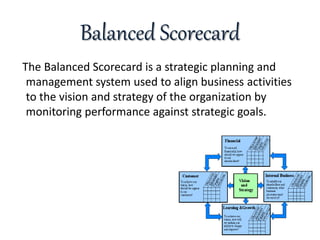
Balanced Scorecard
The Balanced Scorecard is a strategic planning and
management system used to align business activities
to the vision and strategy of the organization by
monitoring performance against strategic goals.
Balanced Scorecard Concept
• Was first published in 1992 by Kaplan and Norton, a
book followed in 1996.
• Traditional performance measurement that only
focus on external accounting data are obsolete.
• The approach is to provide 'balance' to the financial
perspective.
Why Use a Balanced Scorecard?
• Improve organizational performance by measuring
what matters
• Increase focus on strategy and results
• Align organization strategy with workers on a day-to-
day basis
• Focus on the drivers key to future performance
• Improve communication of the organization’s Vision
and Strategy
• Prioritize Projects / Initiatives
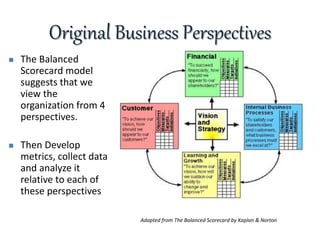
Original Business Perspectives
Adapted from The Balanced Scorecard by Kaplan & Norton
 The Balanced
Scorecard model
suggests that we
view the
organization from 4
perspectives.
 Then Develop
metrics, collect data
and analyze it
relative to each of
these perspectives
Business Perspectives Questions
• Financial
– What must we do to create sustainable economic value?
• Internal Business Process
– To satisfy our stakeholders, what must be our levels of
productivity, efficiency, and quality?
• Learning and Growth
– How does our employee performance management system,
including feedback to employees, support high performance?
• Customer
– What do our customers require from us and how are we doing
according to those requirements?
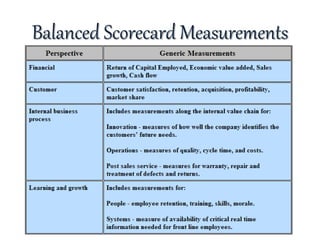
Balanced Scorecard Measurements
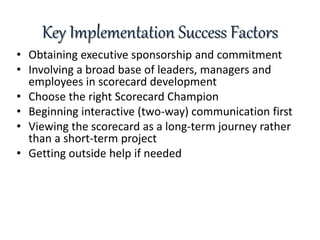
Key Implementation Success Factors
• Obtaining executive sponsorship and commitment
• Involving a broad base of leaders, managers and
employees in scorecard development
• Choose the right Scorecard Champion
• Beginning interactive (two-way) communication first
• Viewing the scorecard as a long-term journey rather
than a short-term project
• Getting outside help if needed
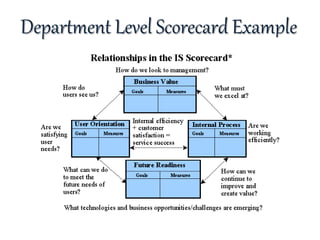
Department Level Scorecard Example
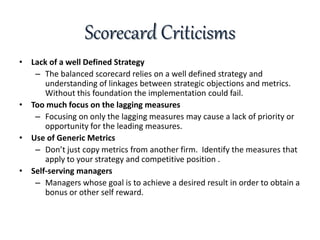
Scorecard Criticisms
• Lack of a well Defined Strategy
– The balanced scorecard relies on a well defined strategy and
understanding of linkages between strategic objections and metrics.
Without this foundation the implementation could fail.
• Too much focus on the lagging measures
– Focusing on only the lagging measures may cause a lack of priority or
opportunity for the leading measures.
• Use of Generic Metrics
– Don’t just copy metrics from another firm. Identify the measures that
apply to your strategy and competitive position .
• Self-serving managers
– Managers whose goal is to achieve a desired result in order to obtain a
bonus or other self reward.
Balanced Scorecard Benefits
• Helps align key performance measures with strategy at all levels of an
organization
• The methodology facilitates communication and understanding of
business goals and strategies at all levels of an organization
• Strategic initiatives that follow "best practices" methodologies that
cascade through the entire organization
• Transforms an organization’s mission statement and strategic plan from a
passive document into the "marching orders" for the organization on a
daily basis.
• It enables executives to truly execute their strategies by identifying what
should be done and measured.
To date, some form of a Balanced Scorecard is used by nearly 60% of Fortune
500 companies
Strategic intent
Strategic intent

Strategic intent

  • 1.
  • 2.
    Strategic Management • StrategyManagement is defined as a dynamic process of formulation, implementation, evaluation, and control of strategies to realise the organization’s strategic intent
  • 3.
    Strategic Intent • Itrefers to purpose for what organization strives for. Organization must define “what they want to do” , “why they want to do”. • This “why they want to do” underlines the end result and in management terms it is known as strategic intent • Strategic Intent has a hierarchy: Vision, Mission, Goals and Objectives
  • 4.
  • 5.
    VISION• Burt Nanusa well known expert of organizational vision has defined vision as “ a realistic, credible and attractive future for an organization”. • Realistic: Vision must be based on reality to be meaningful for an organization; It should not be a merely day dreaming but a dream to be converted into reality • Credible: Vision must be believable to be relevant to the members of organization. One of the purpose of vision is to aspire those in org. to achieve a level of excellence • Attractive: Vision must be attractive as to inspire and motivate the org. members. People must want to be a part of future of org. • Future: Vision is always for future Kotter (1990) defines it as a "description of something(an organization, a corporate culture, a business, a technology, an activity) in the future"
  • 6.
    Features of goodvision • It should be idealistic( should be realistic) • Good vision clarifies the direction • Good vision encourages the org. members commitment from them • Good vision reflects uniqueness of org. ,its distinct competence, what it stands for and what it is able to achieve. • Good vision is consistent with org values and culture • Good vision is easily understood by those who are responsible to convert it into reality
  • 7.
    Examples of vision •Infosys- To be globally respected company that provides best of breed software solutions by best-in-class people • Tata tea- to be India’s foremost tea based beverage company
  • 8.
    Developing a vision Itslike converting dream into reality Conducting vision audit-To asses current direction Targeting the vision- What are the boundaries and constraints to the vision? What vision must accomplish? Setting vision context: how org. should look in future Developing future scenarios Generating the alternative visions Choosing the final vision
  • 9.
    Mission • Is defineda fundamental unique purpose that sets a business apart from other firms of its type and identifies its scope of its operations in product and market terms. Its is a statement which defines the role that org. plays in society Difference b/w Vision and mission • Vision is forward looking and mission states what org. is and why it exists • Vision emphasis on long term concept with very high level of achievement and mission deals with products , services offers, way these are offered.
  • 10.
    Mission Statement • Isthe description of org. mission. Explicit mission statement is desirable as it serves the purpose of communicating to the organization’s members about the corporate philosophy , character and image of the org. which govern their behavior in org. Following pints should be kept in mind while formulating mission statement: • It should be feasible • It should be precise • It should be clear
  • 11.
    • It shouldbe motivating • It should be distinctive • It should include major components of strategy • It should indicate how objectives are to be accomplished
  • 12.
    Examples of missionstatement • Infosys: To achieve our objectives in a environment of fairness, honesty and courtesy towards our clients, employess, vendors and society at large • Tata tea: o Achieve market and thought leadership for branded tea in india o Drive long term profitable growth o Co create enhanced value for stakeholders o Make tata tea a great place for work
  • 13.
    Business Definition • Isclear cut statement of the business or a set of business, the org. engages in presently or wishes to pursue in future. Then it prescribes the area in which the org will play compete • Business can defined along three dimensions– product, customer and technology. • Business must reflect two features : Focus and Differentiation • Example: HUL business definition: “To meet everyday needs of people everywhere with branded products”
  • 14.
    Goals and Objectives •Goals denote what an organization hopes to accomplish in a future period of time. They represent the future state or outcome of effort put in now. • Objectives are the ends that state specifically how the goals shall be achieved. They are concrete and specific in contrast to goals that are generalized • Goals and objectives are the end results which an organization strives for • There may be different ways in expressing end result like market leadership , a certain percentage increase in sales in particular year
  • 15.
    Features of goalsand objectives • SMART DUMB • S- Specific D-Doable(within powers) • M- Measurable U-Understandable • A- Attainable M-Manageable • R- Relevant B-Beneficial • T- Time bound
  • 16.
    Role of objectives •Directions for decision making • Objectives work as motivating force • Performance standards • Defines relationship with environment
  • 17.
    Characteristics of objectives •Objectives should be understandable • Objectives should be concrete and specific • Objectives should be related to a timeframe • Objectives should be measurable and controllable • Objectives should be challenging • Different objectives should correlate with each other • Objectives should be set within constraints
  • 18.
    Issues in objectivesetting • Specificity • Multiplicity • Periodicity • Verifiability • Quality
  • 19.
    Balanced Scorecard The BalancedScorecard is a strategic planning and management system used to align business activities to the vision and strategy of the organization by monitoring performance against strategic goals.
  • 20.
    Balanced Scorecard Concept •Was first published in 1992 by Kaplan and Norton, a book followed in 1996. • Traditional performance measurement that only focus on external accounting data are obsolete. • The approach is to provide 'balance' to the financial perspective.
  • 21.
    Why Use aBalanced Scorecard? • Improve organizational performance by measuring what matters • Increase focus on strategy and results • Align organization strategy with workers on a day-to- day basis • Focus on the drivers key to future performance • Improve communication of the organization’s Vision and Strategy • Prioritize Projects / Initiatives
  • 22.
    Original Business Perspectives Adaptedfrom The Balanced Scorecard by Kaplan & Norton  The Balanced Scorecard model suggests that we view the organization from 4 perspectives.  Then Develop metrics, collect data and analyze it relative to each of these perspectives
  • 23.
    Business Perspectives Questions •Financial – What must we do to create sustainable economic value? • Internal Business Process – To satisfy our stakeholders, what must be our levels of productivity, efficiency, and quality? • Learning and Growth – How does our employee performance management system, including feedback to employees, support high performance? • Customer – What do our customers require from us and how are we doing according to those requirements?
  • 24.
  • 25.
    Key Implementation SuccessFactors • Obtaining executive sponsorship and commitment • Involving a broad base of leaders, managers and employees in scorecard development • Choose the right Scorecard Champion • Beginning interactive (two-way) communication first • Viewing the scorecard as a long-term journey rather than a short-term project • Getting outside help if needed
  • 26.
  • 27.
    Scorecard Criticisms • Lackof a well Defined Strategy – The balanced scorecard relies on a well defined strategy and understanding of linkages between strategic objections and metrics. Without this foundation the implementation could fail. • Too much focus on the lagging measures – Focusing on only the lagging measures may cause a lack of priority or opportunity for the leading measures. • Use of Generic Metrics – Don’t just copy metrics from another firm. Identify the measures that apply to your strategy and competitive position . • Self-serving managers – Managers whose goal is to achieve a desired result in order to obtain a bonus or other self reward.
  • 28.
    Balanced Scorecard Benefits •Helps align key performance measures with strategy at all levels of an organization • The methodology facilitates communication and understanding of business goals and strategies at all levels of an organization • Strategic initiatives that follow "best practices" methodologies that cascade through the entire organization • Transforms an organization’s mission statement and strategic plan from a passive document into the "marching orders" for the organization on a daily basis. • It enables executives to truly execute their strategies by identifying what should be done and measured. To date, some form of a Balanced Scorecard is used by nearly 60% of Fortune 500 companies

Editor's Notes