ANALYSIS OF FINANCIAL
STATEMENTS
Prof. M .B. Thakoor
SYNOPSIS
•
•
•

1)
2)
3)

• 4)
•
•
•
•

5)
6)
7)
8)

MEANING OF FINANCIAL STATEMENT
NATURE OF FINANCIAL STATEMENT
ESSENTIAL QUALITIES OF FINANCIAL
STATEMENT
LIMITATION OF FINANCIAL
STATEMENT
FINANCIAL STATEMENT ANALYSIS
TOOLS & TECHNIQUES OF ANALYSIS
TYPES OF COMPARISON
INTERPRETATION
NATURE OF FINANCIAL
STATEMENT

• The data exhibited by financial statements
are affected by
• a) Recorded facts
• b) Accounting Concepts,
Conventions & Principles
• c) Personal Judgment
Accounting Principles
•
•
•
•
•
•
•
•
•
•
•
•
•

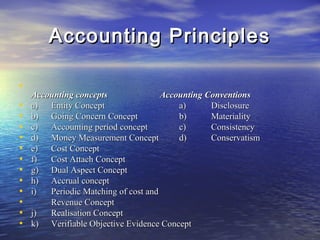
Accounting concepts
Accounting Conventions
a) Entity Concept
a)
Disclosure
b) Going Concern Concept
b)
Materiality
c) Accounting period concept
c)
Consistency
d) Money Measurement Concept
d)
Conservatism
e) Cost Concept
f)
Cost Attach Concept
g) Dual Aspect Concept
h) Accrual concept
i)
Periodic Matching of cost and
Revenue Concept
j)
Realisation Concept
k) Verifiable Objective Evidence Concept
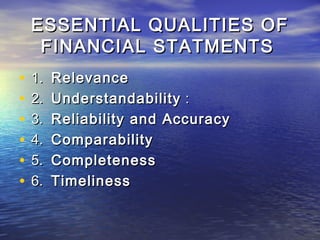
ESSENTIAL QUALITIES OF
FINANCIAL STATMENTS
•
•
•
•
•
•

1.
2.
3.
4.
5.
6.

Relevance
Understandability :
Reliability and Accuracy
Comparability
Completeness
Timeliness
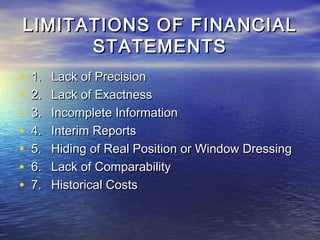
LIMITATIONS OF FINANCIAL
STATEMENTS
•
•
•
•
•
•
•

1.
2.
3.
4.
5.
6.
7.

Lack of Precision
Lack of Exactness
Incomplete Information
Interim Reports
Hiding of Real Position or Window Dressing
Lack of Comparability
Historical Costs
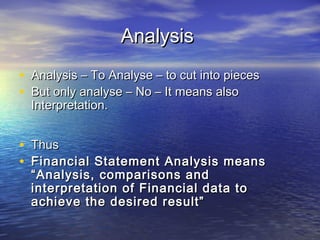
Analysis
• Analysis – To Analyse – to cut into pieces
• But only analyse – No – It means also
Interpretation.

• Thus
• Financial Statement Analysis means
“Analysis, comparisons and
interpretation of Financial data to
achieve the desired result”
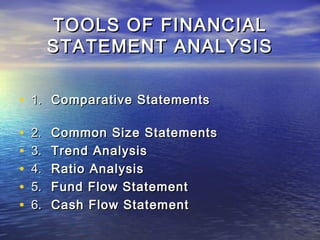
TOOLS OF FINANCIAL
STATEMENT ANALYSIS
• 1. Comparative Statements
•
•
•
•
•

2.
3.
4.
5.
6.

Common Size Statements
Trend Analysis
Ratio Analysis
Fund Flow Statement
Cash Flow Statement
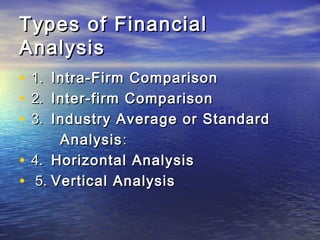
Types of Financial
Analysis
•
•
•

1.
2.
3.

Intra-Firm Comparison
Inter-firm Comparison
Industry Average or Standard
Analysis :
• 4. Horizontal Analysis
• 5. Vertical Analysis
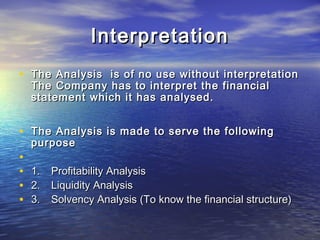
Interpretation
• The Analysis is of no use without interpretation
The Company has to interpret the financial
statement which it has analysed.

• The Analysis is made to serve the following
purpose

•
• 1. Profitability Analysis
• 2. Liquidity Analysis
• 3. Solvency Analysis (To know the financial structure)
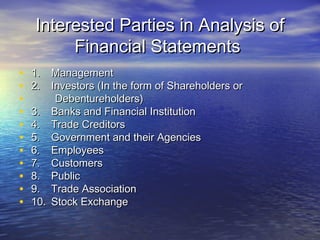
Interested Parties in Analysis of
Financial Statements
•
•
•
•
•
•
•
•
•
•
•

1. Management
2. Investors (In the form of Shareholders or
Debentureholders)
3. Banks and Financial Institution
4. Trade Creditors
5. Government and their Agencies
6. Employees
7. Customers
8. Public
9. Trade Association
10. Stock Exchange
1. Comparative Financial
Statements
• Comparative Financial Statements is a

statement of Financial Position of a
business designed in such a way where a
comparative study is undertaken of
different accounting items, to measure the
performance of a Business Activity.
Types of Comparison
• There are 3 types of Comparison
1) Inter Firm Comparison
•
2) Intra Firm Comparison
•
3) Inter Period Comparison
•
Merits:
• 1) Indicate the Direction of

Financial
Position
• 2) Reveal Nature & Trend:
• 3) Identifying Trouble Spots:

•
Disadvantages:
• 1) Misleading picture, if consistency in accounting principle
•
•
•

not followed.
2) Constant change in price level tender accounting
statement useless for comparison.
3) Inter firm comparison is useless, unless all the firms are
of the same age, size and follow the same principles.
4) If there exists any Abnormal Period between 2 successive
accounting period then it will prove to be a pointless analysis.
2. Common Size
Statements
• It is a Statement in Vertical Form in which
every item of the Financial Statement is
reduced to a common base. This was
introduced with a view to overcome the
limitation of Comparative Statement.
Types of common size
statements.
• (1)Common Size Balance Sheet
• (2)Common Size Income Statement:
Advantages of Common Size
Statement
• 1) It reveals Sources and Application of Funds
•

•

in a nutshell which help in taking decision.
(2) If common size statements of 2 or more
years are compared it indicate the changing
proportion of various components of Assets,
Liabilities, Cost, Net Sale & Profit.
(3) When Inter Firm Comparison is made with
the help of Common size statement it helps in
doing corporate evaluation and Ranking.
Disadvantages of Common
Size Statement
•
•

(1) No Established Standard Proportion:
Common Size Statements are regarded as useless as
there is no established standard proportion of an asset to
the total asset or an item of expense to the net sales.

•
•

(2) Consistency Required:If Financial Statement of a Particular business
organization are not prepared year after year on a
consistent basis comparative study of common size
statement will be misleading
3. Trend Analysis
• Trend Analysis is a statement in vertical

form where the earliest year is taken as
base year and the value of all the items in
the financial statements will be related to
the base year in terms of % where value
of each item in base year will be
considered as 100. Trend % analysis
move in one directions either upward or
downward progression or regression.
Advantages:
• (1) Trend % indicate the increase or decrease
•

with the magnitude of change in % which is
more effective than absolute data.
Ex. If we say profit increases by Rs. 50,000/- it
will be meaningless unless we find by what %
the profit has increased.

• (2) Facilitate efficient comparative study of
financial performance
Limitations:
• (1) It will give a misleading picture if consistency in
•
•
•
•

accounting principle is not followed.
(2) Constant change in price level render accounting
statement useless for comparison.
(3) During inflationary period the data over a period of time
become incomparable, unless the absolute rupee data is
adjusted.
(4) There is always the danger of selecting the base year
which may not be representative, normal & typical.
(5) Trend % should be studied in relation with Absolute
figure otherwise it give misleading picture. For ex. No. of
student where 2, the next year they increased to 4. Now trend
% show 100% increase but absolutely we get clear picture
than trend %.
4. Ratio Analysis
•
•
•
•
•
•
•
•
•
•

TRADITIONAL CLASSIFICATION
BALANCE SHEET RATIOS
(1) Current Ratio
(2) Quick Ratio / Liquid Ratio / Acid Test Ratio.
(3) Super Quick Ratio
(4) Stock to work Capital Ratio
(5) Capital Gearing Ratio
(6) Debt Equity Ratio
(7) Proprietary Ratio
(8) Long Term Borrowing : Total Asset
(9) Fixed Assets : Net Worth.
REVENUE STATEMENT
RATIOS
•
•
•
•
•
•
•

Gross Profit Ratio
Net Profit Ratio
Operating Net Profit Ratio
Operating Ratio
Operating Expenses Ratio
Stock Turnover Ratio
Stock Holding Period
COMBINED RATIOS
•
•
•
•
•
•
•
•

Return on Investment (ROI) or
Return on Capital Employed (ROCE)
Return on Proprietor / Shareholder fund
Return on Equity shareholder fund
Earning per share
Dividend per share
Dividend Payout Ratio
Price Earning Ratio
Interest Coverage Ratio
COMBINED RATIOS
•
•
•
•
•
•
•

Debt : Service Coverage Ratio
Debit Collection period
Debtor Turnover Ratio
Creditor Payment Period
Creditor Turnover Ratio
Preference Dividend Cover
Equity Dividend Cover
BASED ON FUNCTIONS
•
•
•
•
•
•

SOLVENCY RATIOS
Short Term Solvency
Current Ratio
Quick Ratio / Liquid Ratio / Acid Test
Ratio
Super Quick Ratio
Stock : Working Capital Ratio.
Long Term Solvency /
Leverage Ratio /
•
•
•
•
•

Capital Gearing
Debt : Equity Ratio
Proprietary Ratio
Long Term Borrowing: Total Assets
( 1 – Net Worth )/ Total
Assets
• Fixed Asset : Net worth
ACTIVITY RATIO /
TURNOVER RATIOS
• Stock Turn Over Ratio

Stock Holding Period
Debt Collection Period
Debtor Turnover Ratio
Creditor Payment Period
Creditor Turnover Ratio
PROFITABILITY RATIO
•
•
•
•
•
•

In relation to sales
Gross Profit Ratio
Net Profit Ratio
Operating Net Profit Ratio
Operating Ratio
Operating Expenses Ratio.
In relation to capital
employed
•
•
•
•
•
•
•

Return on Interest (ROI) or Return on Capital
Employed (ROLE)
Return on Proprietor / Shareholder funds
Return on Equity Shareholder Fund
Earning per Share
Dividend per Share
Dividend Payout Ratio
Price Earning Ratio
COVERAGE RATIOS
•
•
•
•
•

Interest Coverage Ratio
Preference Dividend Cover
Equity Dividend Cover
Debt Service Coverage Ratio
USER BASED
CLASSIFICATION
•
•
•
•
•
•
•
•

FOR SHORT TERM CREDITORS
(1)
Current Ratio
(2)
Quick / Liquid Ratio / Acid Test Ratio
(3)
Super Quick Ratio
(4)
Stock : Working Capital Ratio
(5)
Stock Turnover Ratio
(6)
Stock Holding Period
(7)
Creditor Payment Period
(8)
Creditor Turnover Ratio
FOR LONG TERM
CREDITORS
•
•
•
•
•
•
•

Capital Gearing Ratio
Debit : Equity Ratio
Proprietary Ratio
Long Term Borrowing : Total Asset Ratio
Fixed Asset : Net worth
Interest Coverage Ratio
Debt Service Coverage Ratio
FOR SHARE HOLDERS
•
•
•
•
•
•
•
•
•

Return on Investment (ROI) or Return on Capital
Employed (ROCE)
Return on Proprietary / Shareholder fund
Return on Equity Shareholder fund
Earning per share
Dividend per share
Dividend payout Ratio
Price Earning Ratio
Preference Dividend Cover
Equity Dividend Cover
FOR MANAGEMENT
•
•
•
•
•
•
•

Return on Investment (ROI) or Return on
Capital Employed (ROCE)
Debtor Turnover Ratio
Debtor Collection Period
Creditor Payment period
Creditor Turnover Ratio
Stock Turnover Ratio
Stock Holding Period
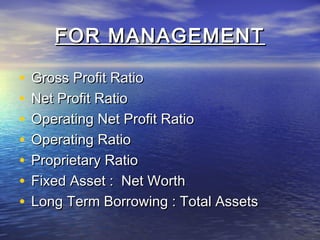
FOR MANAGEMENT
•
•
•
•
•
•
•

Gross Profit Ratio
Net Profit Ratio
Operating Net Profit Ratio
Operating Ratio
Proprietary Ratio
Fixed Asset : Net Worth
Long Term Borrowing : Total Assets

Analysis of financial statements

  • 1.
  • 2.
    SYNOPSIS • • • 1) 2) 3) • 4) • • • • 5) 6) 7) 8) MEANING OFFINANCIAL STATEMENT NATURE OF FINANCIAL STATEMENT ESSENTIAL QUALITIES OF FINANCIAL STATEMENT LIMITATION OF FINANCIAL STATEMENT FINANCIAL STATEMENT ANALYSIS TOOLS & TECHNIQUES OF ANALYSIS TYPES OF COMPARISON INTERPRETATION
  • 3.
    NATURE OF FINANCIAL STATEMENT •The data exhibited by financial statements are affected by • a) Recorded facts • b) Accounting Concepts, Conventions & Principles • c) Personal Judgment
  • 4.
    Accounting Principles • • • • • • • • • • • • • Accounting concepts AccountingConventions a) Entity Concept a) Disclosure b) Going Concern Concept b) Materiality c) Accounting period concept c) Consistency d) Money Measurement Concept d) Conservatism e) Cost Concept f) Cost Attach Concept g) Dual Aspect Concept h) Accrual concept i) Periodic Matching of cost and Revenue Concept j) Realisation Concept k) Verifiable Objective Evidence Concept
  • 5.
    ESSENTIAL QUALITIES OF FINANCIALSTATMENTS • • • • • • 1. 2. 3. 4. 5. 6. Relevance Understandability : Reliability and Accuracy Comparability Completeness Timeliness
  • 6.
    LIMITATIONS OF FINANCIAL STATEMENTS • • • • • • • 1. 2. 3. 4. 5. 6. 7. Lackof Precision Lack of Exactness Incomplete Information Interim Reports Hiding of Real Position or Window Dressing Lack of Comparability Historical Costs
  • 7.
    Analysis • Analysis –To Analyse – to cut into pieces • But only analyse – No – It means also Interpretation. • Thus • Financial Statement Analysis means “Analysis, comparisons and interpretation of Financial data to achieve the desired result”
  • 8.
    TOOLS OF FINANCIAL STATEMENTANALYSIS • 1. Comparative Statements • • • • • 2. 3. 4. 5. 6. Common Size Statements Trend Analysis Ratio Analysis Fund Flow Statement Cash Flow Statement
  • 9.
    Types of Financial Analysis • • • 1. 2. 3. Intra-FirmComparison Inter-firm Comparison Industry Average or Standard Analysis : • 4. Horizontal Analysis • 5. Vertical Analysis
  • 10.
    Interpretation • The Analysisis of no use without interpretation The Company has to interpret the financial statement which it has analysed. • The Analysis is made to serve the following purpose • • 1. Profitability Analysis • 2. Liquidity Analysis • 3. Solvency Analysis (To know the financial structure)
  • 11.
    Interested Parties inAnalysis of Financial Statements • • • • • • • • • • • 1. Management 2. Investors (In the form of Shareholders or Debentureholders) 3. Banks and Financial Institution 4. Trade Creditors 5. Government and their Agencies 6. Employees 7. Customers 8. Public 9. Trade Association 10. Stock Exchange
  • 12.
    1. Comparative Financial Statements •Comparative Financial Statements is a statement of Financial Position of a business designed in such a way where a comparative study is undertaken of different accounting items, to measure the performance of a Business Activity.
  • 13.
    Types of Comparison •There are 3 types of Comparison 1) Inter Firm Comparison • 2) Intra Firm Comparison • 3) Inter Period Comparison •
  • 14.
    Merits: • 1) Indicatethe Direction of Financial Position • 2) Reveal Nature & Trend: • 3) Identifying Trouble Spots: •
  • 15.
    Disadvantages: • 1) Misleadingpicture, if consistency in accounting principle • • • not followed. 2) Constant change in price level tender accounting statement useless for comparison. 3) Inter firm comparison is useless, unless all the firms are of the same age, size and follow the same principles. 4) If there exists any Abnormal Period between 2 successive accounting period then it will prove to be a pointless analysis.
  • 16.
    2. Common Size Statements •It is a Statement in Vertical Form in which every item of the Financial Statement is reduced to a common base. This was introduced with a view to overcome the limitation of Comparative Statement.
  • 17.
    Types of commonsize statements. • (1)Common Size Balance Sheet • (2)Common Size Income Statement:
  • 18.
    Advantages of CommonSize Statement • 1) It reveals Sources and Application of Funds • • in a nutshell which help in taking decision. (2) If common size statements of 2 or more years are compared it indicate the changing proportion of various components of Assets, Liabilities, Cost, Net Sale & Profit. (3) When Inter Firm Comparison is made with the help of Common size statement it helps in doing corporate evaluation and Ranking.
  • 19.
    Disadvantages of Common SizeStatement • • (1) No Established Standard Proportion: Common Size Statements are regarded as useless as there is no established standard proportion of an asset to the total asset or an item of expense to the net sales. • • (2) Consistency Required:If Financial Statement of a Particular business organization are not prepared year after year on a consistent basis comparative study of common size statement will be misleading
  • 20.
    3. Trend Analysis •Trend Analysis is a statement in vertical form where the earliest year is taken as base year and the value of all the items in the financial statements will be related to the base year in terms of % where value of each item in base year will be considered as 100. Trend % analysis move in one directions either upward or downward progression or regression.
  • 21.
    Advantages: • (1) Trend% indicate the increase or decrease • with the magnitude of change in % which is more effective than absolute data. Ex. If we say profit increases by Rs. 50,000/- it will be meaningless unless we find by what % the profit has increased. • (2) Facilitate efficient comparative study of financial performance
  • 22.
    Limitations: • (1) Itwill give a misleading picture if consistency in • • • • accounting principle is not followed. (2) Constant change in price level render accounting statement useless for comparison. (3) During inflationary period the data over a period of time become incomparable, unless the absolute rupee data is adjusted. (4) There is always the danger of selecting the base year which may not be representative, normal & typical. (5) Trend % should be studied in relation with Absolute figure otherwise it give misleading picture. For ex. No. of student where 2, the next year they increased to 4. Now trend % show 100% increase but absolutely we get clear picture than trend %.
  • 23.
    4. Ratio Analysis • • • • • • • • • • TRADITIONALCLASSIFICATION BALANCE SHEET RATIOS (1) Current Ratio (2) Quick Ratio / Liquid Ratio / Acid Test Ratio. (3) Super Quick Ratio (4) Stock to work Capital Ratio (5) Capital Gearing Ratio (6) Debt Equity Ratio (7) Proprietary Ratio (8) Long Term Borrowing : Total Asset (9) Fixed Assets : Net Worth.
  • 24.
    REVENUE STATEMENT RATIOS • • • • • • • Gross ProfitRatio Net Profit Ratio Operating Net Profit Ratio Operating Ratio Operating Expenses Ratio Stock Turnover Ratio Stock Holding Period
  • 25.
    COMBINED RATIOS • • • • • • • • Return onInvestment (ROI) or Return on Capital Employed (ROCE) Return on Proprietor / Shareholder fund Return on Equity shareholder fund Earning per share Dividend per share Dividend Payout Ratio Price Earning Ratio Interest Coverage Ratio
  • 26.
    COMBINED RATIOS • • • • • • • Debt :Service Coverage Ratio Debit Collection period Debtor Turnover Ratio Creditor Payment Period Creditor Turnover Ratio Preference Dividend Cover Equity Dividend Cover
  • 27.
    BASED ON FUNCTIONS • • • • • • SOLVENCYRATIOS Short Term Solvency Current Ratio Quick Ratio / Liquid Ratio / Acid Test Ratio Super Quick Ratio Stock : Working Capital Ratio.
  • 28.
    Long Term Solvency/ Leverage Ratio / • • • • • Capital Gearing Debt : Equity Ratio Proprietary Ratio Long Term Borrowing: Total Assets ( 1 – Net Worth )/ Total Assets • Fixed Asset : Net worth
  • 29.
    ACTIVITY RATIO / TURNOVERRATIOS • Stock Turn Over Ratio Stock Holding Period Debt Collection Period Debtor Turnover Ratio Creditor Payment Period Creditor Turnover Ratio
  • 30.
    PROFITABILITY RATIO • • • • • • In relationto sales Gross Profit Ratio Net Profit Ratio Operating Net Profit Ratio Operating Ratio Operating Expenses Ratio.
  • 31.
    In relation tocapital employed • • • • • • • Return on Interest (ROI) or Return on Capital Employed (ROLE) Return on Proprietor / Shareholder funds Return on Equity Shareholder Fund Earning per Share Dividend per Share Dividend Payout Ratio Price Earning Ratio
  • 32.
    COVERAGE RATIOS • • • • • Interest CoverageRatio Preference Dividend Cover Equity Dividend Cover Debt Service Coverage Ratio
  • 33.
    USER BASED CLASSIFICATION • • • • • • • • FOR SHORTTERM CREDITORS (1) Current Ratio (2) Quick / Liquid Ratio / Acid Test Ratio (3) Super Quick Ratio (4) Stock : Working Capital Ratio (5) Stock Turnover Ratio (6) Stock Holding Period (7) Creditor Payment Period (8) Creditor Turnover Ratio
  • 34.
    FOR LONG TERM CREDITORS • • • • • • • CapitalGearing Ratio Debit : Equity Ratio Proprietary Ratio Long Term Borrowing : Total Asset Ratio Fixed Asset : Net worth Interest Coverage Ratio Debt Service Coverage Ratio
  • 35.
    FOR SHARE HOLDERS • • • • • • • • • Returnon Investment (ROI) or Return on Capital Employed (ROCE) Return on Proprietary / Shareholder fund Return on Equity Shareholder fund Earning per share Dividend per share Dividend payout Ratio Price Earning Ratio Preference Dividend Cover Equity Dividend Cover
  • 36.
    FOR MANAGEMENT • • • • • • • Return onInvestment (ROI) or Return on Capital Employed (ROCE) Debtor Turnover Ratio Debtor Collection Period Creditor Payment period Creditor Turnover Ratio Stock Turnover Ratio Stock Holding Period
  • 37.
    FOR MANAGEMENT • • • • • • • Gross ProfitRatio Net Profit Ratio Operating Net Profit Ratio Operating Ratio Proprietary Ratio Fixed Asset : Net Worth Long Term Borrowing : Total Assets