
Accounting
Standards
AGENDA OFAGENDA OF
PRESENTATIONPRESENTATION
 Introduction of Accounting Standards
 Objectives of Accounting Standards
 Types of Accounting Standards
Introduction

Accounting standards are written
policy documents issued by expert
accounting body or by government or
other regulatory body covering the
aspects of- recognition, treatment,
measurement, presentation and
disclosure of accounting transactions
and events in financial statements.
Accounting Standards InAccounting Standards In
INDIAINDIA
In INDIA, Accounting Standards are issued by ICAI –
Accounting Standards Board(ASB) which was formed on
21st
April,1977 as ICAI being premier accounting body in
the country, took upon itself the leadership role by
constituting the ASB
In India, 32 Accounting Standards are issued as IAS
under NACAS now known as NFRA.
 31Accounting standards in force or useful.
 AS-8 Research and Development is withdrawn pursuant
to AS-26 Intangible assets on 1st
April,2003.
Accounting Standards
in Different Nations
 As per International system, there are 41
Accounting Standards called as IFRS
 Adopted by 8 countries in the world
 70 to 80 countries planning to adhere
IFRS
Evolution and Types
of Accounting
Standards
Accounting Standards Initiation
1. AS 1 to AS 15 1979 to 1995
2. AS 16 to AS 29 2000 to 2007
3. AS 30 to AS 32 Later part of 2007
ObjectivesObjectives
 Standardize the diverse Accounting Policies,
valuation norms and disclosure requirements.
 Eliminate the non-comparability of financial
statements and thereby improving the
reliability of financial statements.
 Eradicate baffling variation in treatment of
accounting aspects
 Facilitate inter-firm and intra-firm comparison
List of
Accounting
Standards
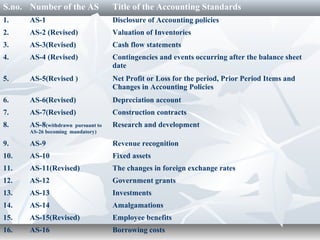
S.no. Number of the AS Title of the Accounting Standards
1. AS-1 Disclosure of Accounting policies
2. AS-2 (Revised) Valuation of Inventories
3. AS-3(Revised) Cash flow statements
4. AS-4 (Revised) Contingencies and events occurring after the balance sheet
date
5. AS-5(Revised ) Net Profit or Loss for the period, Prior Period Items and
Changes in Accounting Policies
6. AS-6(Revised) Depreciation account
7. AS-7(Revised) Construction contracts
8. AS-8(withdrawn pursuant to
AS-26 becoming mandatory)
Research and development
9. AS-9 Revenue recognition
10. AS-10 Fixed assets
11. AS-11(Revised) The changes in foreign exchange rates
12. AS-12 Government grants
13. AS-13 Investments
14. AS-14 Amalgamations
15. AS-15(Revised) Employee benefits
16. AS-16 Borrowing costs
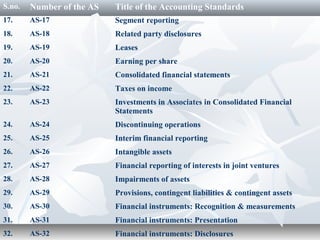
S.no. Number of the AS Title of the Accounting Standards
17. AS-17 Segment reporting
18. AS-18 Related party disclosures
19. AS-19 Leases
20. AS-20 Earning per share
21. AS-21 Consolidated financial statements
22. AS-22 Taxes on income
23. AS-23 Investments in Associates in Consolidated Financial
Statements
24. AS-24 Discontinuing operations
25. AS-25 Interim financial reporting
26. AS-26 Intangible assets
27. AS-27 Financial reporting of interests in joint ventures
28. AS-28 Impairments of assets
29. AS-29 Provisions, contingent liabilities & contingent assets
30. AS-30 Financial instruments: Recognition & measurements
31. AS-31 Financial instruments: Presentation
32. AS-32 Financial instruments: Disclosures
Description OfDescription Of
SomeSome
AccountingAccounting
StandardsStandards
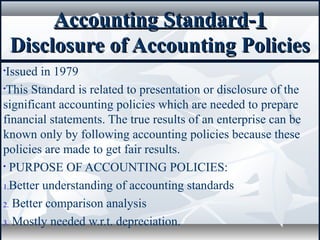
Accounting StandardAccounting Standard--11
Disclosure of Accounting PoliciesDisclosure of Accounting Policies
•Issued in 1979
•This Standard is related to presentation or disclosure of the
significant accounting policies which are needed to prepare
financial statements. The true results of an enterprise can be
known only by following accounting policies because these
policies are made to get fair results.
• PURPOSE OF ACCOUNTING POLICIES:
1.Better understanding of accounting standards
2. Better comparison analysis
3. Mostly needed w.r.t. depreciation.
Accounting StandardAccounting Standard--22
Valuation Of InventoriesValuation Of Inventories
• Revised 1999
• It is a measurement related standard which specifies the
method of consumption of cost of inventories and method
to determine the value of inventories which is to be shown
in financial statements.
•According to this standard, inventory valuation is uniform
and it reduces the alternative choices by different firms.
• the revised standard permits the use of only FIFO or
weighted average cost formula for determining the cost of
inventories.
Accounting StandardAccounting Standard--33
Cash Flow StatementCash Flow Statement
• Revised 1997
•AS-3 deals with the provision about the historical change
in cash position during the accounting period by means of
cash flow statement. Incoming and outgoing of cash act as
a barometer to judge surplus and deficit.
• Cash Flow Statement is Divided in Three Activities:
1. operating activity
2. investing activity
3. financing activity
Accounting StandardAccounting Standard--55
Net Profit or Loss for the Period, Prior PeriodNet Profit or Loss for the Period, Prior Period
Items and Changes in Accounting PoliciesItems and Changes in Accounting Policies
• Revised 1997
• this standard should be applied by an enterprise in
preparing profit and loss from ordinary activities and
extra ordinary activities.
•This standard also deals with prior period items,
changes in accounting estimates and policies.
•These such items should be disclosed in profit and
loss statement as part of NET PROFIT.
Accounting StandardAccounting Standard--66
Depreciation AccountingDepreciation Accounting
• Revised 1994
• This standard deals depreciation accounting.
•It applies to all non-current assets except LAND.
•Necessary to disclose method of depreciation and rate
of depreciation charged.
• Change in method of depreciation should be treated
as change in accounting policies of a business.
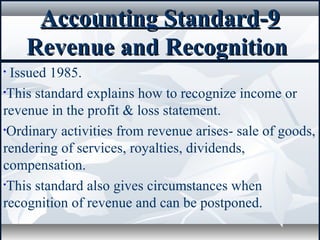
Accounting StandardAccounting Standard--99
Revenue and RecognitionRevenue and Recognition
• Issued 1985.
•This standard explains how to recognize income or
revenue in the profit & loss statement.
•Ordinary activities from revenue arises- sale of goods,
rendering of services, royalties, dividends,
compensation.
•This standard also gives circumstances when
recognition of revenue and can be postponed.
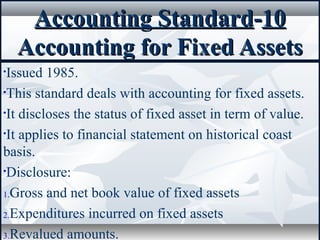
Accounting StandardAccounting Standard--1010
Accounting for Fixed AssetsAccounting for Fixed Assets
•Issued 1985.
•This standard deals with accounting for fixed assets.
•It discloses the status of fixed asset in term of value.
•It applies to financial statement on historical coast
basis.
•Disclosure:
1.Gross and net book value of fixed assets
2.Expenditures incurred on fixed assets
3.Revalued amounts.
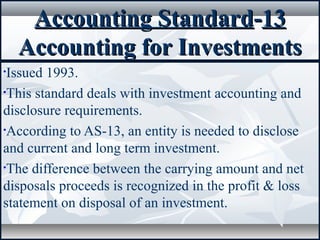
Accounting StandardAccounting Standard--1313
Accounting for InvestmentsAccounting for Investments
•Issued 1993.
•This standard deals with investment accounting and
disclosure requirements.
•According to AS-13, an entity is needed to disclose
and current and long term investment.
•The difference between the carrying amount and net
disposals proceeds is recognized in the profit & loss
statement on disposal of an investment.
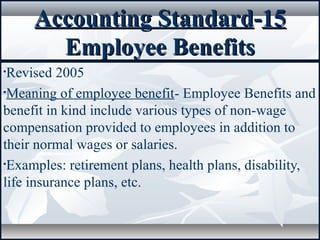
Accounting StandardAccounting Standard--1515
Employee BenefitsEmployee Benefits
•Revised 2005
•Meaning of employee benefit- Employee Benefits and
benefit in kind include various types of non-wage
compensation provided to employees in addition to
their normal wages or salaries.
•Examples: retirement plans, health plans, disability,
life insurance plans, etc.
Accounting StandardAccounting Standard--1919
LeasesLeases
•Issued 2001
•Lease is a contract by which one party conveys land,
property, services, etc to the another for the specific period
of time usually return for a periodic payment.
•A lease is a contract calling for the lessee(user) to pay the
leaser(owner) for a use of assets for a specific period of
time.
•There are two types of lease:
1.Finance lease
2.Operating lease
Accounting StandardAccounting Standard--2020
Earning Per ShareEarning Per Share
•Issued 2001
•Earning per share is a portion of a company’s profit
that is allocated to each outstanding share of common
stock serving as a indicator of company profitability.
The basic formula of :
EPS=net income/average outstanding share
Accounting StandardAccounting Standard--2626
Intangible AssetsIntangible Assets
•Issued 2002
•Intangible assets is an asset that lacks physical
substance and usually very hard to evaluate. It cannot
be destroyed by fire, accidents, disasters.
•It includes patents, copy writes, goodwill, trademark,
trade names.
•It is classified into two broad category:
1.Limited- patents, copy writes and goodwill.
2.Unlimited- trademarks.
Conclusion:Conclusion:
It can be said that AccountingIt can be said that Accounting
Standards helps bring such anStandards helps bring such an
assurance to some extent. It isassurance to some extent. It is
impossible to provide 100%impossible to provide 100%
assurance of the validity ofassurance of the validity of
financial statements through thefinancial statements through the
creation of single set of rules andcreation of single set of rules and
procedures.procedures.
Made by:Made by:
“Group -6”
• MANAH CHHABRA
• URVASHI KAMNANI
• SAMRIDDHI JAIN
• SONALI RAWAT

Accounting standards

  • 1.
  • 2.
    AGENDA OFAGENDA OF PRESENTATIONPRESENTATION Introduction of Accounting Standards  Objectives of Accounting Standards  Types of Accounting Standards
  • 3.
    Introduction  Accounting standards arewritten policy documents issued by expert accounting body or by government or other regulatory body covering the aspects of- recognition, treatment, measurement, presentation and disclosure of accounting transactions and events in financial statements.
  • 4.
    Accounting Standards InAccountingStandards In INDIAINDIA In INDIA, Accounting Standards are issued by ICAI – Accounting Standards Board(ASB) which was formed on 21st April,1977 as ICAI being premier accounting body in the country, took upon itself the leadership role by constituting the ASB In India, 32 Accounting Standards are issued as IAS under NACAS now known as NFRA.  31Accounting standards in force or useful.  AS-8 Research and Development is withdrawn pursuant to AS-26 Intangible assets on 1st April,2003.
  • 5.
    Accounting Standards in DifferentNations  As per International system, there are 41 Accounting Standards called as IFRS  Adopted by 8 countries in the world  70 to 80 countries planning to adhere IFRS
  • 6.
    Evolution and Types ofAccounting Standards Accounting Standards Initiation 1. AS 1 to AS 15 1979 to 1995 2. AS 16 to AS 29 2000 to 2007 3. AS 30 to AS 32 Later part of 2007
  • 7.
    ObjectivesObjectives  Standardize thediverse Accounting Policies, valuation norms and disclosure requirements.  Eliminate the non-comparability of financial statements and thereby improving the reliability of financial statements.  Eradicate baffling variation in treatment of accounting aspects  Facilitate inter-firm and intra-firm comparison
  • 8.
  • 9.
    S.no. Number ofthe AS Title of the Accounting Standards 1. AS-1 Disclosure of Accounting policies 2. AS-2 (Revised) Valuation of Inventories 3. AS-3(Revised) Cash flow statements 4. AS-4 (Revised) Contingencies and events occurring after the balance sheet date 5. AS-5(Revised ) Net Profit or Loss for the period, Prior Period Items and Changes in Accounting Policies 6. AS-6(Revised) Depreciation account 7. AS-7(Revised) Construction contracts 8. AS-8(withdrawn pursuant to AS-26 becoming mandatory) Research and development 9. AS-9 Revenue recognition 10. AS-10 Fixed assets 11. AS-11(Revised) The changes in foreign exchange rates 12. AS-12 Government grants 13. AS-13 Investments 14. AS-14 Amalgamations 15. AS-15(Revised) Employee benefits 16. AS-16 Borrowing costs
  • 10.
    S.no. Number ofthe AS Title of the Accounting Standards 17. AS-17 Segment reporting 18. AS-18 Related party disclosures 19. AS-19 Leases 20. AS-20 Earning per share 21. AS-21 Consolidated financial statements 22. AS-22 Taxes on income 23. AS-23 Investments in Associates in Consolidated Financial Statements 24. AS-24 Discontinuing operations 25. AS-25 Interim financial reporting 26. AS-26 Intangible assets 27. AS-27 Financial reporting of interests in joint ventures 28. AS-28 Impairments of assets 29. AS-29 Provisions, contingent liabilities & contingent assets 30. AS-30 Financial instruments: Recognition & measurements 31. AS-31 Financial instruments: Presentation 32. AS-32 Financial instruments: Disclosures
  • 11.
  • 12.
    Accounting StandardAccounting Standard--11 Disclosureof Accounting PoliciesDisclosure of Accounting Policies •Issued in 1979 •This Standard is related to presentation or disclosure of the significant accounting policies which are needed to prepare financial statements. The true results of an enterprise can be known only by following accounting policies because these policies are made to get fair results. • PURPOSE OF ACCOUNTING POLICIES: 1.Better understanding of accounting standards 2. Better comparison analysis 3. Mostly needed w.r.t. depreciation.
  • 13.
    Accounting StandardAccounting Standard--22 ValuationOf InventoriesValuation Of Inventories • Revised 1999 • It is a measurement related standard which specifies the method of consumption of cost of inventories and method to determine the value of inventories which is to be shown in financial statements. •According to this standard, inventory valuation is uniform and it reduces the alternative choices by different firms. • the revised standard permits the use of only FIFO or weighted average cost formula for determining the cost of inventories.
  • 14.
    Accounting StandardAccounting Standard--33 CashFlow StatementCash Flow Statement • Revised 1997 •AS-3 deals with the provision about the historical change in cash position during the accounting period by means of cash flow statement. Incoming and outgoing of cash act as a barometer to judge surplus and deficit. • Cash Flow Statement is Divided in Three Activities: 1. operating activity 2. investing activity 3. financing activity
  • 15.
    Accounting StandardAccounting Standard--55 NetProfit or Loss for the Period, Prior PeriodNet Profit or Loss for the Period, Prior Period Items and Changes in Accounting PoliciesItems and Changes in Accounting Policies • Revised 1997 • this standard should be applied by an enterprise in preparing profit and loss from ordinary activities and extra ordinary activities. •This standard also deals with prior period items, changes in accounting estimates and policies. •These such items should be disclosed in profit and loss statement as part of NET PROFIT.
  • 16.
    Accounting StandardAccounting Standard--66 DepreciationAccountingDepreciation Accounting • Revised 1994 • This standard deals depreciation accounting. •It applies to all non-current assets except LAND. •Necessary to disclose method of depreciation and rate of depreciation charged. • Change in method of depreciation should be treated as change in accounting policies of a business.
  • 17.
    Accounting StandardAccounting Standard--99 Revenueand RecognitionRevenue and Recognition • Issued 1985. •This standard explains how to recognize income or revenue in the profit & loss statement. •Ordinary activities from revenue arises- sale of goods, rendering of services, royalties, dividends, compensation. •This standard also gives circumstances when recognition of revenue and can be postponed.
  • 18.
    Accounting StandardAccounting Standard--1010 Accountingfor Fixed AssetsAccounting for Fixed Assets •Issued 1985. •This standard deals with accounting for fixed assets. •It discloses the status of fixed asset in term of value. •It applies to financial statement on historical coast basis. •Disclosure: 1.Gross and net book value of fixed assets 2.Expenditures incurred on fixed assets 3.Revalued amounts.
  • 19.
    Accounting StandardAccounting Standard--1313 Accountingfor InvestmentsAccounting for Investments •Issued 1993. •This standard deals with investment accounting and disclosure requirements. •According to AS-13, an entity is needed to disclose and current and long term investment. •The difference between the carrying amount and net disposals proceeds is recognized in the profit & loss statement on disposal of an investment.
  • 20.
    Accounting StandardAccounting Standard--1515 EmployeeBenefitsEmployee Benefits •Revised 2005 •Meaning of employee benefit- Employee Benefits and benefit in kind include various types of non-wage compensation provided to employees in addition to their normal wages or salaries. •Examples: retirement plans, health plans, disability, life insurance plans, etc.
  • 21.
    Accounting StandardAccounting Standard--1919 LeasesLeases •Issued2001 •Lease is a contract by which one party conveys land, property, services, etc to the another for the specific period of time usually return for a periodic payment. •A lease is a contract calling for the lessee(user) to pay the leaser(owner) for a use of assets for a specific period of time. •There are two types of lease: 1.Finance lease 2.Operating lease
  • 22.
    Accounting StandardAccounting Standard--2020 EarningPer ShareEarning Per Share •Issued 2001 •Earning per share is a portion of a company’s profit that is allocated to each outstanding share of common stock serving as a indicator of company profitability. The basic formula of : EPS=net income/average outstanding share
  • 23.
    Accounting StandardAccounting Standard--2626 IntangibleAssetsIntangible Assets •Issued 2002 •Intangible assets is an asset that lacks physical substance and usually very hard to evaluate. It cannot be destroyed by fire, accidents, disasters. •It includes patents, copy writes, goodwill, trademark, trade names. •It is classified into two broad category: 1.Limited- patents, copy writes and goodwill. 2.Unlimited- trademarks.
  • 24.
    Conclusion:Conclusion: It can besaid that AccountingIt can be said that Accounting Standards helps bring such anStandards helps bring such an assurance to some extent. It isassurance to some extent. It is impossible to provide 100%impossible to provide 100% assurance of the validity ofassurance of the validity of financial statements through thefinancial statements through the creation of single set of rules andcreation of single set of rules and procedures.procedures.
  • 25.
    Made by:Made by: “Group-6” • MANAH CHHABRA • URVASHI KAMNANI • SAMRIDDHI JAIN • SONALI RAWAT