Objectives of Financial Management
Prof. Rakesh M
VSMS
Puttur
Objectives of Financial Management
Profit Maximisation:
Profit maximization is basically is a single-period or, at
most, a short-term goal, to be achieved within one year; it is
usually interpreted to mean the maximization of profits within a
given period of time. A corporation may maximize its short-term
profits at the expense of its long-term profitability
Wealth Maximisation:
If the market price of the shares increases, it can be said
that capital (wealth) invested by the shareholders has been
appreciating. On the contrary, fall in the market price of the
shares has an adverse effect on their wealth. Wealth of the
shareholders can be computed by the following formula:
Shareholder’s Current Wealth in a Company.
Changing role of financial Manager
Raising of funds
Investment decisions
Financing Decision
Profit Planning
Understanding Capital Markets
Forex Risk Management
Interface of Financial Management with other
functional areas.
1. Financial Management and Production
Department: The financial management and the
production department are interrelated. The
production department of any firm is concerned
with the production cycle, skilled and unskilled
labour, storage of finished goods, capacity
utilisation, etc. and the cost of production
assumes a substantial portion of the total cost.
The production department has to take various
decisions like replacing machinery, installation of
safety devices, etc. and all the decisions have
financial implications.
2. Financial Management and Material
Department: The financial management and the
material department are also interrelated. Material
department covers the areas such as storage,
maintenance and supply of materials and stores,
procurement etc. The finance manager and
material manager in a firm may come together
while determining Economic Order Quantity,
safety level, storing place requirement, stores
personnel requirement, etc. The costs of all these
aspects are to be evaluated so the finance
manager may come forward to help the material
manager.
3. Financial Management and Personnel
Department: The personnel department is
entrusted with the responsibility of recruitment,
training and placement of the staff. This
department is also concerned with the welfare of
the employees and their families. This department
works with finance manager to evaluate
employees’ welfare, revision of their pay scale,
incentive schemes, etc.
4. Financial Management and Marketing
Department: The marketing department is
concerned with the selling of goods and services
to the customers. It is entrusted with framing
marketing, selling, advertising and other related
policies to achieve the sales target. It is also
required to frame policies to maintain and
increase the market share, to create a brand
name etc. For all this finance is required, so the
finance manager has to play an active role for
interacting with the marketing department.
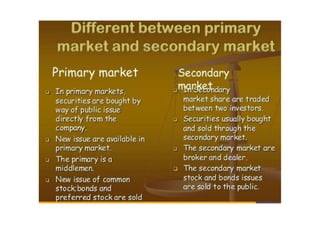
Primary Market
Primary market considered to be very important as it the
place where securities are offered to the public for the first time.
So, it is the place where securities are made.
It may happen that a company may need capital for its
business. Then the company approaches the primary market and
issue shares in an IPO (Initial Public Offering).
Investors buy the company's share and start sharing risk and
returns of the company from then onwards. The company thus gets
the capital it required to carry on investments.
After the capital is raised by the company , it gets listed on
the stock exchange where the stocks can be traded. The shares
are now traded in secondary market
Functions
Origination
- Time of floating the issue
- Type of issue
- Price of the issue
Underwriting
Distribution
Secondary market is the place where the shares are traded after their
initial offering in the primary market. Therefore, the stock market is considered
as secondary market. Bombay Stock Exchange (BSE) and National Stock
Exchange (NSE) are secondary market.
Here, the investors trade among themselves without the involvement of
the issuing company. Typically, in primary market prices are set beforehand by
the issuing company. But in secondary market prices are not set rather they
depend on the forces of demand and supply of the securities.
Maximum trading is done in the secondary market. However, trading in the
secondary market does not have any effect on the capital structure of the
company. The primary market gives the company an opportunity to increase
capital they want to invest.
Secondary market
lA segment of the financial market in which
financial instruments with high liquidity and
very short maturities are traded. The money
market is used by participants as a means
for borrowing and lending in the short term,
from several days to just under a year.
lMONEY MARKET
T-bills
T-bills are short-term securities that mature in one
year or less from their issue date. They are issued
with three-month, six-month and one-year
maturities. T-bills are purchased for a price that is
less than their par (face) value; when they mature,
the government pays the holder the full par value.
Effectively, ther interest is the difference between
the purchase price of the security and what you
get at maturity. For example, if you bought a 90-
day T-bill at $9,800 and held it until maturity, you
would earn $200 on your investment.
CDs
A savings certificate entitling the bearer to receive
interest. A CD bears a maturity date, a specified
fixed interest rate and can be issued in any
denomination. CDs are generally issued by
commercial banks.
For example, let's say that you purchase a
$10,000 CD with an interest rate of 5%
compounded annually and a term of one year. At
year's end, the CD will have grown to $10,500
($10,000 * 1.05).
Commercial paper
Commercial paper is a short-term debt security
issued by financial companies and large
corporations. The corporation promises the buyer
a return, or profit, for making the loan. The return
is stated as an interest rate or percentage of the
loan, such as 5%.
Companies sell commercial paper when they
need a short-term loan to pay for such things as
accounts payable and inventories. The security is
generally sold at a discount, and redeemed at full
value. The gain is the interest payment.
Banker's acceptance
A short-term debt instrument issued by a firm that
is guaranteed by a commercial bank. Banker's
acceptances are issued by firms as part of a
commercial transaction. These instruments are
similar to T-Bills and are frequently used in money
market funds
Forex market
Foreign exchange market is the market in which
foreign currencies are bought and sold. The
buyers and sellers include individuals, firms,
foreign exchange brokers, commercial banks and
the central bank.
Like any other market, foreign exchange market is
a system, not a place. The transactions in this
market are not confined to only one or few foreign
currencies. In fact, there are a large number of
foreign currencies which are traded, converted
and exchanged in the foreign exchange market.
Distinguishing features of foreign
exchange market
Large no of buyers and sellers
Political diversity
Forex Risk
Commodities market
A physical or virtual marketplace for buying,
selling and trading raw or primary products. For
investors' purposes there are currently about 50
major commodity markets worldwide that facilitate
investment trade in nearly 100 primary
commodities.
Commodities are split into two types: hard and
soft commodities. Hard commodities are typically
natural resources that must be mined or extracted
(gold, rubber, oil, etc.), whereas soft commodities
are agricultural products or livestock (corn, wheat,
coffee, sugar, soybeans, pork, etc.)
There are numerous ways to invest in commodities.
lAn investor can purchase stock in corporations
whose business relies on commodities prices
lPurchase mutual funds, index funds or exchange-
traded funds (ETFs) that have a focus on
commodities-related companies.
lThe most direct way of investing in commodities is
by buying into a futures contract.
Stock Market
The stock market lets investors participate in the
financial achievements of the companies whose
shares they hold. When companies are profitable,
stock market investors make money through the
dividends the companies pay out and by selling
appreciated stocks at a profit called a capital gain.
The downside is that investors can lose money if
the companies whose stocks they hold lose
money, the stocks' prices goes down and the
investor sells the stocks at a loss.
Lease
A lease is a contractual arrangement calling for
the lessee (user) to pay the lessor (owner) for use
of an asset. The narrower term rental agreement
can be used to describe a lease in which the asset
is tangible property.
Leasing
Financial Leasing or Capital Leasing
It is a commercial arrangement where:
lThe lessee (customer or borrower) will select an asset
(equipment, vehicle, software)
lThe lessor (finance company) will purchase that asset
lThe lessee will have use of that asset during the lease
lThe lessee will pay a series of rentals or installments for
the use of that asset
lThe lessor will recover a large part or all of the cost of
the asset plus earn interest from the rentals paid by the
lessee
lThe lessee has the option to acquire ownership of the
asset (e.g. paying the last rental, or bargain option
purchase price)
Operating Lease
Operating lease is a contract wherein the owner,
called the Lessor, permits the user, called the
Lesse, to use of an asset for a particular period
which is shorter than the economic life of the
asset without any transfer of ownership rights.
Leveraged Lease
A lease agreement that is partially financed by the lessor
through a third-party financial institution. In a leveraged
lease, the lending company holds the title to the leased
asset, while the lessor creates the agreement with the
lessee and collects the payment. The payments are then
passed on to the lender.
In a leveraged lease, if the lessee stops making
payments to the lessor, then the lessor stops making
payments to the financial institution (lender). This allows
the lender to repossess the property. The lessor may also
have the right to retain the property upon lessee default,
as long as the lessor continues making payments to the
lender.
Sale and Leaseback.
lAn arrangement where the seller of an asset leases back
the same asset from the purchaser. In a leaseback
arrangement, the specifics of the arrangement are made
immediately after the sale of the asset, with the amount
of the payments and the time period specified.
Essentially, the seller of the asset becomes the lessee
and the purchaser becomes the lessor in this
arrangement.
lA leaseback arrangement is useful when companies
need to un-tie the cash invested in an asset for other
investments, but the asset is still needed in order to
operate. Leaseback deals can also provide the seller with
additional tax deductions. The lessor benefits in that they
will receive stable payments for a specified period of
Cross-border leasing
Cross-border leasing is a leasing arrangement
where lessor and lessee are situated in different
countries. This presents significant additional
issues related to tax avoidance and tax shelters
It is international leasing and is referredotherwise
as transactional leasing.
Relates to lease transaction betweendifferent a
lessor and lessee domiciled indifferent countries.
Illustration:-Leasing company in USA makes
available Air Bus on lease to AirIndia.
Hybrid securities
Hybrid securities are a broad group of securities that
combine the elements of the two broader groups of
securities, debt and equity.
Hybrid securities pay a predictable (fixed or floating) rate
of return or dividend until a certain date, at which point
the holder has a number of options including converting
the securities into the underlying share.
Therefore, unlike a share of stock (equity) the holder has
a 'known' cash flow, and, unlike a fixed interest security
(debt) there is an option to convert to the underlying
equity. More common examples include convertible and
converting preference shares.
Types1. Convertible bonds:A bond that can be converted into a
predetermined amount of the company's equity at certain times
during its life, usually at the discretion of the bondholder.
2.Prefered stock: A class of ownership in a corporation that has a
higher claim on the assets and earnings than common stock.
Preferred stock generally has a dividend that must be paid out
before dividends to common stockholders and the shares usually
do not have voting rights.
3.Profit Participating Loans:The profit participating loan is a special
form of a loan. The lender receives a participation in the profits or
turnover of the company in return for the provision of capital. This
participation can be confined to the purpose for which the loan was
provided or pertain to the whole business of the company.
Additionally, fixed interest payments can be included in the
contract.
4. Mezzanine Financing: Mezzanine financing, as
the name implies, is a form of financing that
functions by way of two other financing methods.
It is a financing agreement in which funds are
provided in a traditional loan but the lender can
assume an ownership if the loan is not paid back
on time and in full. Lenders who provide
mezzanine financing particularly look for
companies that have the potential to expand
successfully if equipped with adequate additional
capital.
Other sources of financing
1. Stocks
2. Debentures
3. Term loans
Private Equity: PE is a number of different types of investments
that can be made with private money. These investments may be
made to purchase a company, provide funding for a project, or
simply make a private investment because you aren’t interested
in stocks.
Venture Capital: VC is a specific investment strategy designed to
provide funding for startup companies. It’s a very popular
financing source for technology companies. It allows for fast
growth without needing revenue at an early stage. It’s highly
risky, but can be quite lucrative.
Angel Investing: Before you take your company to venture
capitalists you need to probably get some funding before. You
come to angel investors who provide similar startup financing,
only in smaller denominations. You may only need $100,000, and
for that you won’t find an interested VC firm, but you might find
and angel investor.
Warrants: A warrant is like an option. It gives the
holder the right but not the obligation to buy an
underlying security at a certain price, quantity and
future time. It is unlike an option in that a warrant
is issued by a company, whereas an option is an
instrument of the stock exchange. The security
represented in the warrant (usually share equity)
is delivered by the issuing company instead of by
an investor holding the shares
Warrants are often included in a new debt issue
as a "sweetener" to entice investors.
Convertibles:
Sources of financing
lShares
lDebetures
lTerm loans
lLease financing
lVenture Capital
lAngeel investing
lPrivate equity
lWarrants
lConvertibles
Module 2
TIME VALUE OF MONEY - TVM'
.
DEFINITION OF 'TIME VALUE OF
MONEY - TVM
'
The idea that money available at the present time
is worth more than the same amount in the future
due to its potential earning capacity. This core
principle of finance holds that, provided money
can earn interest, any amount of money is worth
more the sooner it is received.
Also referred to as "present discounted value".
http://www.investopedia.com/video/play/understan
ding-time-value-of-money/
Everyone knows that money deposited in a
savings account will earn interest. Because of this
universal fact, we would prefer to receive money
today rather than the same amount in the future.
For example, assuming a 5% interest rate, $100
invested today will be worth $105 in one year
($100 multiplied by 1.05). Conversely, $100
received one year from now is only worth $95.24
today ($100 divided by 1.05), assuming a 5%
interest rate.
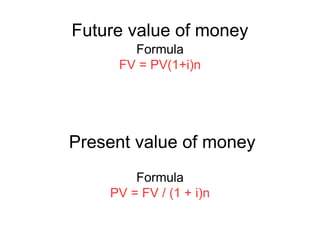
Future value of money
Formula
FV = PV(1+i)n
Present value of money
Formula
PV = FV / (1 + i)n
 Financial management

Financial management

  • 1.
    Objectives of FinancialManagement Prof. Rakesh M VSMS Puttur
  • 2.
    Objectives of FinancialManagement Profit Maximisation: Profit maximization is basically is a single-period or, at most, a short-term goal, to be achieved within one year; it is usually interpreted to mean the maximization of profits within a given period of time. A corporation may maximize its short-term profits at the expense of its long-term profitability Wealth Maximisation: If the market price of the shares increases, it can be said that capital (wealth) invested by the shareholders has been appreciating. On the contrary, fall in the market price of the shares has an adverse effect on their wealth. Wealth of the shareholders can be computed by the following formula: Shareholder’s Current Wealth in a Company.
  • 3.
    Changing role offinancial Manager Raising of funds Investment decisions Financing Decision Profit Planning Understanding Capital Markets Forex Risk Management
  • 4.
    Interface of FinancialManagement with other functional areas. 1. Financial Management and Production Department: The financial management and the production department are interrelated. The production department of any firm is concerned with the production cycle, skilled and unskilled labour, storage of finished goods, capacity utilisation, etc. and the cost of production assumes a substantial portion of the total cost. The production department has to take various decisions like replacing machinery, installation of safety devices, etc. and all the decisions have financial implications.
  • 5.
    2. Financial Managementand Material Department: The financial management and the material department are also interrelated. Material department covers the areas such as storage, maintenance and supply of materials and stores, procurement etc. The finance manager and material manager in a firm may come together while determining Economic Order Quantity, safety level, storing place requirement, stores personnel requirement, etc. The costs of all these aspects are to be evaluated so the finance manager may come forward to help the material manager.
  • 6.
    3. Financial Managementand Personnel Department: The personnel department is entrusted with the responsibility of recruitment, training and placement of the staff. This department is also concerned with the welfare of the employees and their families. This department works with finance manager to evaluate employees’ welfare, revision of their pay scale, incentive schemes, etc.
  • 7.
    4. Financial Managementand Marketing Department: The marketing department is concerned with the selling of goods and services to the customers. It is entrusted with framing marketing, selling, advertising and other related policies to achieve the sales target. It is also required to frame policies to maintain and increase the market share, to create a brand name etc. For all this finance is required, so the finance manager has to play an active role for interacting with the marketing department.
  • 8.
    Primary Market Primary marketconsidered to be very important as it the place where securities are offered to the public for the first time. So, it is the place where securities are made. It may happen that a company may need capital for its business. Then the company approaches the primary market and issue shares in an IPO (Initial Public Offering). Investors buy the company's share and start sharing risk and returns of the company from then onwards. The company thus gets the capital it required to carry on investments. After the capital is raised by the company , it gets listed on the stock exchange where the stocks can be traded. The shares are now traded in secondary market
  • 9.
    Functions Origination - Time offloating the issue - Type of issue - Price of the issue Underwriting Distribution
  • 10.
    Secondary market isthe place where the shares are traded after their initial offering in the primary market. Therefore, the stock market is considered as secondary market. Bombay Stock Exchange (BSE) and National Stock Exchange (NSE) are secondary market. Here, the investors trade among themselves without the involvement of the issuing company. Typically, in primary market prices are set beforehand by the issuing company. But in secondary market prices are not set rather they depend on the forces of demand and supply of the securities. Maximum trading is done in the secondary market. However, trading in the secondary market does not have any effect on the capital structure of the company. The primary market gives the company an opportunity to increase capital they want to invest. Secondary market
  • 13.
    lA segment ofthe financial market in which financial instruments with high liquidity and very short maturities are traded. The money market is used by participants as a means for borrowing and lending in the short term, from several days to just under a year. lMONEY MARKET
  • 14.
    T-bills T-bills are short-termsecurities that mature in one year or less from their issue date. They are issued with three-month, six-month and one-year maturities. T-bills are purchased for a price that is less than their par (face) value; when they mature, the government pays the holder the full par value. Effectively, ther interest is the difference between the purchase price of the security and what you get at maturity. For example, if you bought a 90- day T-bill at $9,800 and held it until maturity, you would earn $200 on your investment.
  • 15.
    CDs A savings certificateentitling the bearer to receive interest. A CD bears a maturity date, a specified fixed interest rate and can be issued in any denomination. CDs are generally issued by commercial banks. For example, let's say that you purchase a $10,000 CD with an interest rate of 5% compounded annually and a term of one year. At year's end, the CD will have grown to $10,500 ($10,000 * 1.05).
  • 16.
    Commercial paper Commercial paperis a short-term debt security issued by financial companies and large corporations. The corporation promises the buyer a return, or profit, for making the loan. The return is stated as an interest rate or percentage of the loan, such as 5%. Companies sell commercial paper when they need a short-term loan to pay for such things as accounts payable and inventories. The security is generally sold at a discount, and redeemed at full value. The gain is the interest payment.
  • 17.
    Banker's acceptance A short-termdebt instrument issued by a firm that is guaranteed by a commercial bank. Banker's acceptances are issued by firms as part of a commercial transaction. These instruments are similar to T-Bills and are frequently used in money market funds
  • 18.
    Forex market Foreign exchangemarket is the market in which foreign currencies are bought and sold. The buyers and sellers include individuals, firms, foreign exchange brokers, commercial banks and the central bank. Like any other market, foreign exchange market is a system, not a place. The transactions in this market are not confined to only one or few foreign currencies. In fact, there are a large number of foreign currencies which are traded, converted and exchanged in the foreign exchange market.
  • 19.
    Distinguishing features offoreign exchange market Large no of buyers and sellers Political diversity Forex Risk
  • 20.
    Commodities market A physicalor virtual marketplace for buying, selling and trading raw or primary products. For investors' purposes there are currently about 50 major commodity markets worldwide that facilitate investment trade in nearly 100 primary commodities. Commodities are split into two types: hard and soft commodities. Hard commodities are typically natural resources that must be mined or extracted (gold, rubber, oil, etc.), whereas soft commodities are agricultural products or livestock (corn, wheat, coffee, sugar, soybeans, pork, etc.)
  • 21.
    There are numerousways to invest in commodities. lAn investor can purchase stock in corporations whose business relies on commodities prices lPurchase mutual funds, index funds or exchange- traded funds (ETFs) that have a focus on commodities-related companies. lThe most direct way of investing in commodities is by buying into a futures contract.
  • 22.
    Stock Market The stockmarket lets investors participate in the financial achievements of the companies whose shares they hold. When companies are profitable, stock market investors make money through the dividends the companies pay out and by selling appreciated stocks at a profit called a capital gain. The downside is that investors can lose money if the companies whose stocks they hold lose money, the stocks' prices goes down and the investor sells the stocks at a loss.
  • 23.
    Lease A lease isa contractual arrangement calling for the lessee (user) to pay the lessor (owner) for use of an asset. The narrower term rental agreement can be used to describe a lease in which the asset is tangible property. Leasing
  • 24.
    Financial Leasing orCapital Leasing It is a commercial arrangement where: lThe lessee (customer or borrower) will select an asset (equipment, vehicle, software) lThe lessor (finance company) will purchase that asset lThe lessee will have use of that asset during the lease lThe lessee will pay a series of rentals or installments for the use of that asset lThe lessor will recover a large part or all of the cost of the asset plus earn interest from the rentals paid by the lessee lThe lessee has the option to acquire ownership of the asset (e.g. paying the last rental, or bargain option purchase price)
  • 25.
    Operating Lease Operating leaseis a contract wherein the owner, called the Lessor, permits the user, called the Lesse, to use of an asset for a particular period which is shorter than the economic life of the asset without any transfer of ownership rights.
  • 26.
    Leveraged Lease A leaseagreement that is partially financed by the lessor through a third-party financial institution. In a leveraged lease, the lending company holds the title to the leased asset, while the lessor creates the agreement with the lessee and collects the payment. The payments are then passed on to the lender. In a leveraged lease, if the lessee stops making payments to the lessor, then the lessor stops making payments to the financial institution (lender). This allows the lender to repossess the property. The lessor may also have the right to retain the property upon lessee default, as long as the lessor continues making payments to the lender.
  • 27.
    Sale and Leaseback. lAnarrangement where the seller of an asset leases back the same asset from the purchaser. In a leaseback arrangement, the specifics of the arrangement are made immediately after the sale of the asset, with the amount of the payments and the time period specified. Essentially, the seller of the asset becomes the lessee and the purchaser becomes the lessor in this arrangement. lA leaseback arrangement is useful when companies need to un-tie the cash invested in an asset for other investments, but the asset is still needed in order to operate. Leaseback deals can also provide the seller with additional tax deductions. The lessor benefits in that they will receive stable payments for a specified period of
  • 28.
    Cross-border leasing Cross-border leasingis a leasing arrangement where lessor and lessee are situated in different countries. This presents significant additional issues related to tax avoidance and tax shelters It is international leasing and is referredotherwise as transactional leasing. Relates to lease transaction betweendifferent a lessor and lessee domiciled indifferent countries. Illustration:-Leasing company in USA makes available Air Bus on lease to AirIndia.
  • 29.
    Hybrid securities Hybrid securitiesare a broad group of securities that combine the elements of the two broader groups of securities, debt and equity. Hybrid securities pay a predictable (fixed or floating) rate of return or dividend until a certain date, at which point the holder has a number of options including converting the securities into the underlying share. Therefore, unlike a share of stock (equity) the holder has a 'known' cash flow, and, unlike a fixed interest security (debt) there is an option to convert to the underlying equity. More common examples include convertible and converting preference shares.
  • 30.
    Types1. Convertible bonds:Abond that can be converted into a predetermined amount of the company's equity at certain times during its life, usually at the discretion of the bondholder. 2.Prefered stock: A class of ownership in a corporation that has a higher claim on the assets and earnings than common stock. Preferred stock generally has a dividend that must be paid out before dividends to common stockholders and the shares usually do not have voting rights. 3.Profit Participating Loans:The profit participating loan is a special form of a loan. The lender receives a participation in the profits or turnover of the company in return for the provision of capital. This participation can be confined to the purpose for which the loan was provided or pertain to the whole business of the company. Additionally, fixed interest payments can be included in the contract.
  • 31.
    4. Mezzanine Financing:Mezzanine financing, as the name implies, is a form of financing that functions by way of two other financing methods. It is a financing agreement in which funds are provided in a traditional loan but the lender can assume an ownership if the loan is not paid back on time and in full. Lenders who provide mezzanine financing particularly look for companies that have the potential to expand successfully if equipped with adequate additional capital.
  • 32.
    Other sources offinancing 1. Stocks 2. Debentures 3. Term loans
  • 33.
    Private Equity: PEis a number of different types of investments that can be made with private money. These investments may be made to purchase a company, provide funding for a project, or simply make a private investment because you aren’t interested in stocks. Venture Capital: VC is a specific investment strategy designed to provide funding for startup companies. It’s a very popular financing source for technology companies. It allows for fast growth without needing revenue at an early stage. It’s highly risky, but can be quite lucrative. Angel Investing: Before you take your company to venture capitalists you need to probably get some funding before. You come to angel investors who provide similar startup financing, only in smaller denominations. You may only need $100,000, and for that you won’t find an interested VC firm, but you might find and angel investor.
  • 34.
    Warrants: A warrantis like an option. It gives the holder the right but not the obligation to buy an underlying security at a certain price, quantity and future time. It is unlike an option in that a warrant is issued by a company, whereas an option is an instrument of the stock exchange. The security represented in the warrant (usually share equity) is delivered by the issuing company instead of by an investor holding the shares Warrants are often included in a new debt issue as a "sweetener" to entice investors. Convertibles:
  • 35.
    Sources of financing lShares lDebetures lTermloans lLease financing lVenture Capital lAngeel investing lPrivate equity lWarrants lConvertibles
  • 36.
    Module 2 TIME VALUEOF MONEY - TVM' .
  • 37.
    DEFINITION OF 'TIMEVALUE OF MONEY - TVM ' The idea that money available at the present time is worth more than the same amount in the future due to its potential earning capacity. This core principle of finance holds that, provided money can earn interest, any amount of money is worth more the sooner it is received. Also referred to as "present discounted value".
  • 38.
  • 39.
    Everyone knows thatmoney deposited in a savings account will earn interest. Because of this universal fact, we would prefer to receive money today rather than the same amount in the future. For example, assuming a 5% interest rate, $100 invested today will be worth $105 in one year ($100 multiplied by 1.05). Conversely, $100 received one year from now is only worth $95.24 today ($100 divided by 1.05), assuming a 5% interest rate.
  • 40.
    Future value ofmoney Formula FV = PV(1+i)n Present value of money Formula PV = FV / (1 + i)n