Statistics  for Management Fundamentals of Hypothesis Testing
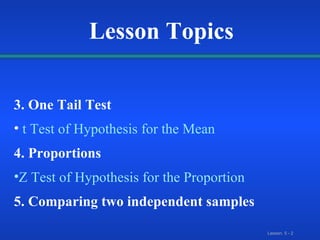
Lesson Topics 3. One Tail Test t Test of Hypothesis for the Mean 4. Proportions Z Test of Hypothesis for the Proportion 5. Comparing two independent samples
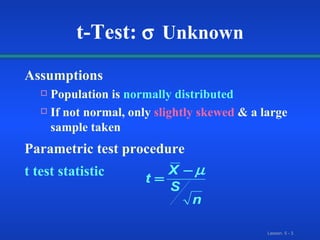
Assumptions Population is   normally distributed If not normal, only   slightly skewed   & a large sample taken Parametric test procedure t test statistic t-Test:   Unknown
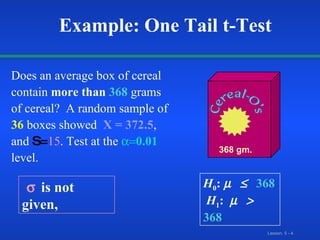
Example: One Tail t-Test Does an average box of cereal   contain  more than   368   grams of cereal?  A random sample of   36   boxes showed   X = 372.5 ,  and  S= 15 .  Test at the    0.01   level. 368 gm. H 0 :    368  H 1 :     368  is not given,
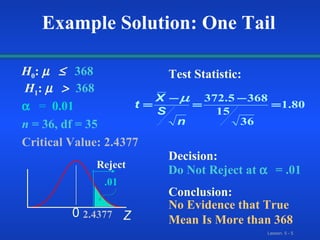
 =  0.01 n  = 36, df = 35 Critical Value: 2.4377 Test Statistic:  Decision: Conclusion: Do Not Reject at    = .01 No Evidence that True Mean Is More than 368 Z 0 2.4377 .01 Reject Example Solution: One Tail H 0 :   368  H 1 :     368
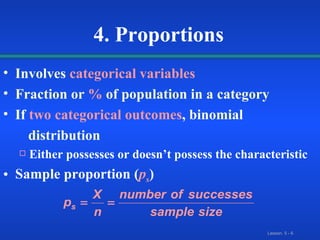
Involves   categorical variables Fraction or   %   of population in a category If   two categorical outcomes , binomial  distribution Either possesses or doesn’t possess the characteristic Sample proportion   ( p s ) 4. Proportions
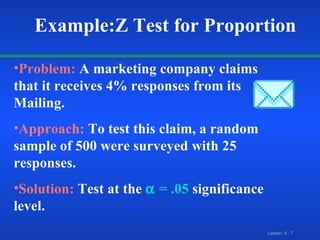
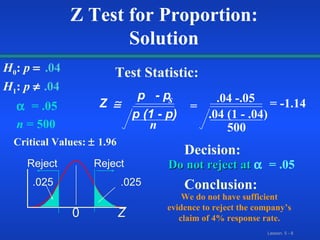
Example:Z Test for Proportion Problem:   A marketing company claims that it receives 4% responses from its Mailing.  Approach:   To test this claim, a random sample of 500 were surveyed with 25 responses.  Solution:   Test at the     = .05   significance level.
   = .05 n  = 500 Do not reject at     = .05 Z Test for Proportion: Solution H 0 :  p    .04   H 1 :  p      .04 Critical Values:    1.96 Test Statistic: Decision: Conclusion: We do not have sufficient evidence to reject the company’s claim of 4% response rate. Z   p  -   p p (1 - p) n s = .04 -.05 .04 (1 - .04) 500 = -1.14 Z 0 Reject Reject .025 .025
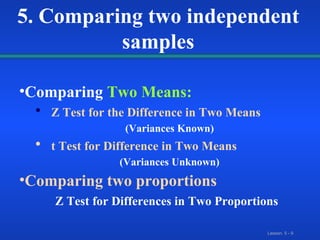
5. Comparing two independent samples Comparing   Two Means: Z Test for the Difference in Two Means  (Variances Known) t Test for Difference in Two Means  (Variances Unknown) Comparing two proportions   Z Test for Differences in Two Proportions
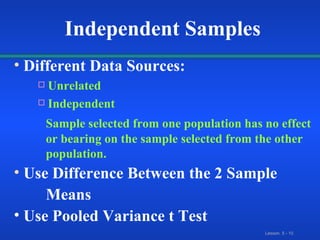
Different Data Sources: Unrelated Independent  Sample selected from one population has no effect  or bearing on the sample selected from the other  population. Use Difference Between the 2 Sample  Means Use Pooled Variance t Test Independent Samples
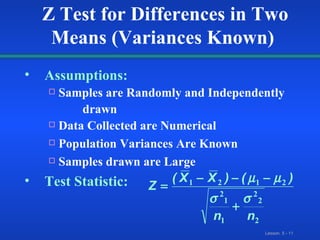
Assumptions: Samples are Randomly and Independently  drawn  Data Collected are Numerical Population Variances Are Known  Samples drawn are Large Test Statistic:   Z Test for Differences in Two Means (Variances Known)
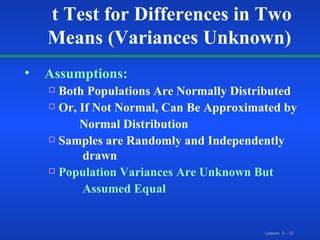
Assumptions: Both Populations Are Normally Distributed Or, If Not Normal, Can Be Approximated by Normal Distribution  Samples are Randomly and Independently  drawn Population Variances Are Unknown But  Assumed Equal t Test for Differences in Two Means (Variances Unknown)
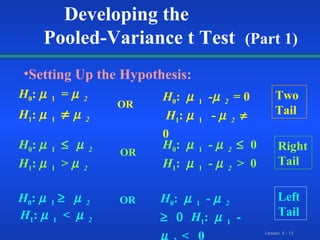
Developing the  Pooled-Variance t Test  (Part 1) Setting Up the Hypothesis: H 0 :   1       2   H 1 :   1   >   2   H 0 :   1   -  2   = 0  H 1 :   1   -   2    0 H 0 :   1   =   2   H 1 :   1       2   H 0 :   1     2  H 0 :   1   -   2      0  H 1 :   1   -   2   >  0 H 0 :   1   -   2      H 1 :   1   -   2  <  0 OR OR OR Left Tail Right Tail Two Tail  H 1 :   1   <   2
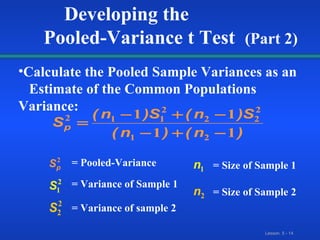
Developing the  Pooled-Variance t Test  (Part 2) Calculate the Pooled Sample Variances as an  Estimate of the Common Populations Variance: = Pooled-Variance = Variance of Sample 1 = Variance of sample 2 = Size of Sample 1 = Size of Sample 2
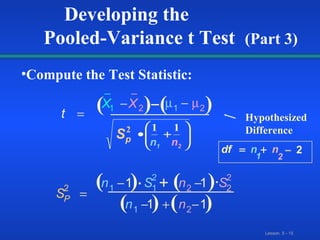
t X X S n S n S n n df n n P                 1 2 1 2 2 1 1 2 2 2 2 1 2 1 2 1 1 1 1 2   Hypothesized Difference Developing the  Pooled-Variance t Test  (Part 3) Compute the Test Statistic: ( ) ) ( ( ) ( ) ( ) ( ) n 1 n 2 _ _
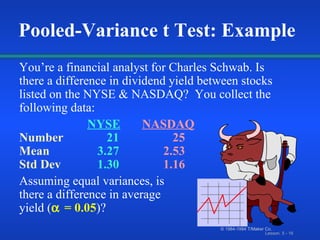
You’re a financial analyst for Charles Schwab. Is there a difference in dividend yield between stocks listed on the NYSE & NASDAQ?  You collect the following data:   NYSE   NASDAQ Number  21 25 Mean 3.27 2.53 Std Dev 1.30 1.16 Assuming equal variances, is there a difference in average  yield (  = 0.05 )? © 1984-1994 T/Maker Co. Pooled-Variance t Test: Example
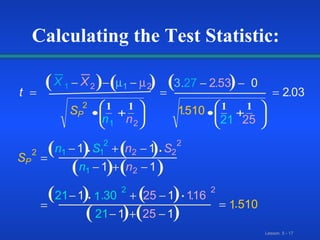
t X X S n n S n S n S n n P P                            1 2 1 2 2 1 2 2 1 1 2 2 2 2 1 2 2 2 3 27 2 53 0 1 510 21 25 2 03 1 1 1 1 21 1 1 30 25 1 1 16 21 1 25 1 1 510   . . . . . . . Calculating the Test Statistic: ( ( ( ( ( ( ( ( ( ( ( ) ) ) ) ) ) ) ) ) ) )
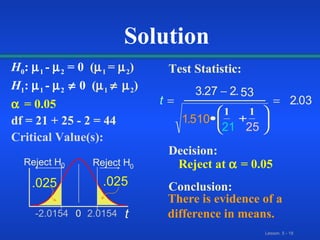
H 0 :   1  -   2  = 0  (  1  =   2 ) H 1 :   1  -   2   0  (  1   2 )  = 0.05 df = 21 + 25 - 2 = 44 Critical Value(s): Test Statistic:  Decision: Conclusion: Reject at    = 0.05 There is evidence of a difference in means. t 0 2.0154 -2.0154 .025 Reject H 0 Reject H 0 .025 t    3 27 2 53 1 510 21 25 2 03 . . . . Solution
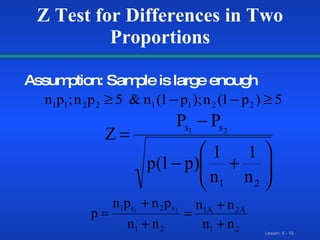
Z Test for Differences in Two Proportions Assumption: Sample is large enough
Lesson Summary Made Connection to Confidence Interval Estimation Performed One Tail and Two Tail Tests Performed t Test of   Hypothesis for the Mean Performed Z Test of Hypothesis for the Proportion Comparing two independent samples

Lesson06_static11

  • 1.
    Statistics forManagement Fundamentals of Hypothesis Testing
  • 2.
    Lesson Topics 3.One Tail Test t Test of Hypothesis for the Mean 4. Proportions Z Test of Hypothesis for the Proportion 5. Comparing two independent samples
  • 3.
    Assumptions Population is normally distributed If not normal, only slightly skewed & a large sample taken Parametric test procedure t test statistic t-Test:  Unknown
  • 4.
    Example: One Tailt-Test Does an average box of cereal contain more than 368 grams of cereal? A random sample of 36 boxes showed X = 372.5 , and  S= 15 . Test at the  0.01 level. 368 gm. H 0 :   368 H 1 :  368  is not given,
  • 5.
     = 0.01 n = 36, df = 35 Critical Value: 2.4377 Test Statistic: Decision: Conclusion: Do Not Reject at  = .01 No Evidence that True Mean Is More than 368 Z 0 2.4377 .01 Reject Example Solution: One Tail H 0 :  368 H 1 :  368
  • 6.
    Involves categorical variables Fraction or % of population in a category If two categorical outcomes , binomial distribution Either possesses or doesn’t possess the characteristic Sample proportion ( p s ) 4. Proportions
  • 7.
    Example:Z Test forProportion Problem: A marketing company claims that it receives 4% responses from its Mailing. Approach: To test this claim, a random sample of 500 were surveyed with 25 responses. Solution: Test at the  = .05 significance level.
  • 8.
    = .05 n = 500 Do not reject at  = .05 Z Test for Proportion: Solution H 0 : p  .04 H 1 : p  .04 Critical Values:  1.96 Test Statistic: Decision: Conclusion: We do not have sufficient evidence to reject the company’s claim of 4% response rate. Z  p - p p (1 - p) n s = .04 -.05 .04 (1 - .04) 500 = -1.14 Z 0 Reject Reject .025 .025
  • 9.
    5. Comparing twoindependent samples Comparing Two Means: Z Test for the Difference in Two Means (Variances Known) t Test for Difference in Two Means (Variances Unknown) Comparing two proportions Z Test for Differences in Two Proportions
  • 10.
    Different Data Sources:Unrelated Independent Sample selected from one population has no effect or bearing on the sample selected from the other population. Use Difference Between the 2 Sample Means Use Pooled Variance t Test Independent Samples
  • 11.
    Assumptions: Samples areRandomly and Independently drawn Data Collected are Numerical Population Variances Are Known Samples drawn are Large Test Statistic: Z Test for Differences in Two Means (Variances Known)
  • 12.
    Assumptions: Both PopulationsAre Normally Distributed Or, If Not Normal, Can Be Approximated by Normal Distribution Samples are Randomly and Independently drawn Population Variances Are Unknown But Assumed Equal t Test for Differences in Two Means (Variances Unknown)
  • 13.
    Developing the Pooled-Variance t Test (Part 1) Setting Up the Hypothesis: H 0 :  1   2 H 1 :  1 >  2 H 0 :  1 -  2 = 0 H 1 :  1 -  2  0 H 0 :  1 =  2 H 1 :  1   2 H 0 :  1   2  H 0 :  1 -  2  0 H 1 :  1 -  2 > 0 H 0 :  1 -  2  H 1 :  1 -  2 < 0 OR OR OR Left Tail Right Tail Two Tail  H 1 :  1 <  2
  • 14.
    Developing the Pooled-Variance t Test (Part 2) Calculate the Pooled Sample Variances as an Estimate of the Common Populations Variance: = Pooled-Variance = Variance of Sample 1 = Variance of sample 2 = Size of Sample 1 = Size of Sample 2
  • 15.
    t X XS n S n S n n df n n P                 1 2 1 2 2 1 1 2 2 2 2 1 2 1 2 1 1 1 1 2   Hypothesized Difference Developing the Pooled-Variance t Test (Part 3) Compute the Test Statistic: ( ) ) ( ( ) ( ) ( ) ( ) n 1 n 2 _ _
  • 16.
    You’re a financialanalyst for Charles Schwab. Is there a difference in dividend yield between stocks listed on the NYSE & NASDAQ? You collect the following data: NYSE NASDAQ Number 21 25 Mean 3.27 2.53 Std Dev 1.30 1.16 Assuming equal variances, is there a difference in average yield (  = 0.05 )? © 1984-1994 T/Maker Co. Pooled-Variance t Test: Example
  • 17.
    t X XS n n S n S n S n n P P                            1 2 1 2 2 1 2 2 1 1 2 2 2 2 1 2 2 2 3 27 2 53 0 1 510 21 25 2 03 1 1 1 1 21 1 1 30 25 1 1 16 21 1 25 1 1 510   . . . . . . . Calculating the Test Statistic: ( ( ( ( ( ( ( ( ( ( ( ) ) ) ) ) ) ) ) ) ) )
  • 18.
    H 0 :  1 -  2 = 0 (  1 =  2 ) H 1 :  1 -  2  0 (  1   2 )  = 0.05 df = 21 + 25 - 2 = 44 Critical Value(s): Test Statistic: Decision: Conclusion: Reject at  = 0.05 There is evidence of a difference in means. t 0 2.0154 -2.0154 .025 Reject H 0 Reject H 0 .025 t    3 27 2 53 1 510 21 25 2 03 . . . . Solution
  • 19.
    Z Test forDifferences in Two Proportions Assumption: Sample is large enough
  • 20.
    Lesson Summary MadeConnection to Confidence Interval Estimation Performed One Tail and Two Tail Tests Performed t Test of Hypothesis for the Mean Performed Z Test of Hypothesis for the Proportion Comparing two independent samples