ŠThe McGraw-Hill Companies, Inc. 2008McGraw-Hill/Irwin
Two-sample Tests of Hypothesis
Chapter 11
2
GOALS
1. Conduct a test of a hypothesis about the
difference between two independent
population means.
2. Conduct a test of a hypothesis about the
difference between two population proportions.
3. Conduct a test of a hypothesis about the mean
difference between paired or dependent
observations.
4. Understand the difference between dependent
and independent samples.
3
Comparing two populations – Some
Examples
1. Is there a difference in the mean value of
residential real estate sold by male agents
and female agents in south Florida?
2. Is there a difference in the mean number of
defects produced on the day and the
afternoon shifts at Kimble Products?
3. Is there a difference in the mean number of
days absent between young workers (under
21 years of age) and older workers (more than
60 years of age) in the fast-food industry?
4
Comparing two populations – Some
Examples (continued)
4. Is there is a difference in the proportion of
Ohio State University graduates and
University of Cincinnati graduates who
pass the state Certified Public Accountant
Examination on their first attempt?
5. Is there an increase in the production rate
if music is piped into the production area?
5
Comparing Two Population Means of
Independent Samples
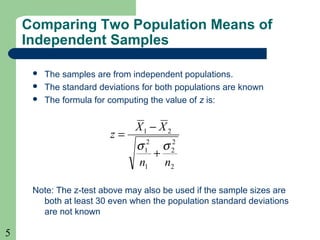
 The samples are from independent populations.
 The standard deviations for both populations are known
 The formula for computing the value of z is:
Note: The z-test above may also be used if the sample sizes are
both at least 30 even when the population standard deviations
are not known
2
2
2
1
2
1
21
nn
XX
z
σσ
+
−
=
6
Comparing Two Population Means of
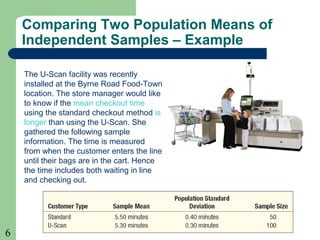
Independent Samples – Example
The U-Scan facility was recently
installed at the Byrne Road Food-Town
location. The store manager would like
to know if the mean checkout time
using the standard checkout method is
longer than using the U-Scan. She
gathered the following sample
information. The time is measured
from when the customer enters the line
until their bags are in the cart. Hence
the time includes both waiting in line
and checking out.
7
EXAMPLE continued
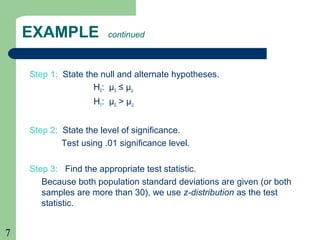
Step 1: State the null and alternate hypotheses.
H0: µS ≤ µU
H1: ÂľS > ÂľU
Step 2: State the level of significance.
Test using .01 significance level.
Step 3: Find the appropriate test statistic.
Because both population standard deviations are given (or both
samples are more than 30), we use z-distribution as the test
statistic.
8
Example continued
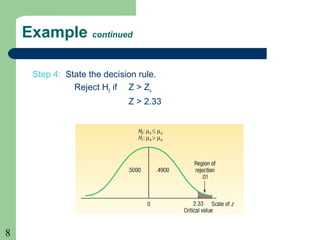
Step 4: State the decision rule.
Reject H0 if Z > ZÎą
Z > 2.33
9
Example continued
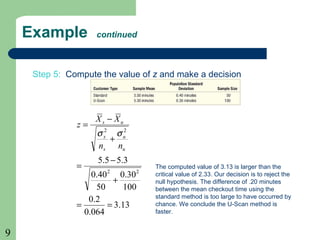
Step 5: Compute the value of z and make a decision
13.3
064.0
2.0
100
30.0
50
40.0
3.55.5
22
22
==
+
−
=
+
−
=
u
u
s
s
us
nn
XX
z
σσ
The computed value of 3.13 is larger than the
critical value of 2.33. Our decision is to reject the
null hypothesis. The difference of .20 minutes
between the mean checkout time using the
standard method is too large to have occurred by
chance. We conclude the U-Scan method is
faster.
10
Two-Sample Tests about Proportions
Here are several examples.
 The vice president of human resources wishes to know whether
there is a difference in the proportion of hourly employees who
miss more than 5 days of work per year at the Atlanta and the
Houston plants.
 General Motors is considering a new design for the Pontiac
Grand Am. The design is shown to a group of potential buyers
under 30 years of age and another group over 60 years of age.
Pontiac wishes to know whether there is a difference in the
proportion of the two groups who like the new design.
 A consultant to the airline industry is investigating the fear of
flying among adults. Specifically, the company wishes to know
whether there is a difference in the proportion of men versus
women who are fearful of flying.
11
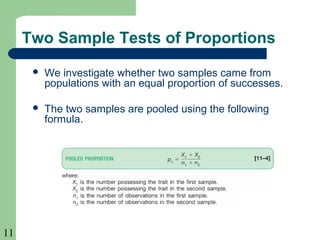
Two Sample Tests of Proportions
 We investigate whether two samples came from
populations with an equal proportion of successes.
 The two samples are pooled using the following
formula.
12
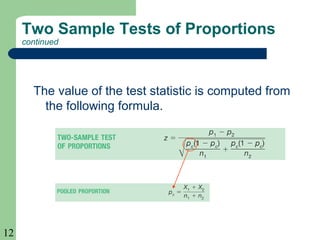
Two Sample Tests of Proportions
continued
The value of the test statistic is computed from
the following formula.
13
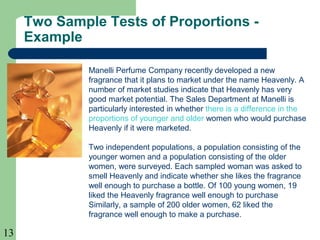
Manelli Perfume Company recently developed a new
fragrance that it plans to market under the name Heavenly. A
number of market studies indicate that Heavenly has very
good market potential. The Sales Department at Manelli is
particularly interested in whether there is a difference in the
proportions of younger and older women who would purchase
Heavenly if it were marketed.
Two independent populations, a population consisting of the
younger women and a population consisting of the older
women, were surveyed. Each sampled woman was asked to
smell Heavenly and indicate whether she likes the fragrance
well enough to purchase a bottle. Of 100 young women, 19
liked the Heavenly fragrance well enough to purchase
Similarly, a sample of 200 older women, 62 liked the
fragrance well enough to make a purchase.
Two Sample Tests of Proportions -
Example
14
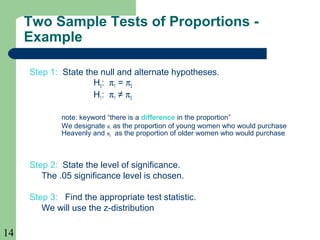
Step 1: State the null and alternate hypotheses.
H0: π1 = π2
H1: π1 ≠ π2
note: keyword “there is a difference in the proportion”
We designate π1 as the proportion of young women who would purchase
Heavenly and π2 as the proportion of older women who would purchase
Step 2: State the level of significance.
The .05 significance level is chosen.
Step 3: Find the appropriate test statistic.
We will use the z-distribution
Two Sample Tests of Proportions -
Example
15
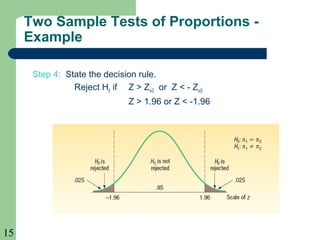
Step 4: State the decision rule.
Reject H0 if Z > ZÎą/2 or Z < - ZÎą/2
Z > 1.96 or Z < -1.96
Two Sample Tests of Proportions -
Example
16
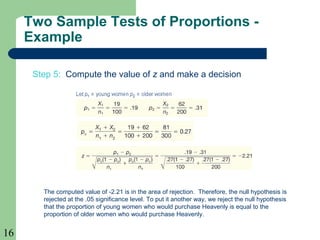
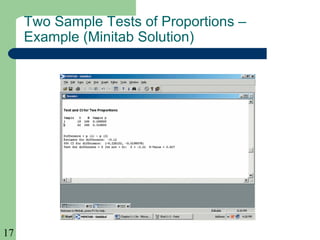
Step 5: Compute the value of z and make a decision
The computed value of -2.21 is in the area of rejection. Therefore, the null hypothesis is
rejected at the .05 significance level. To put it another way, we reject the null hypothesis
that the proportion of young women who would purchase Heavenly is equal to the
proportion of older women who would purchase Heavenly.
Two Sample Tests of Proportions -
Example
17
Two Sample Tests of Proportions –
Example (Minitab Solution)
18
Comparing Population Means with Unknown
Population Standard Deviations (the Pooled t-test)
The t distribution is used as the test statistic if one
or more of the samples have less than 30
observations. The required assumptions are:
1. Both populations must follow the normal
distribution.
2. The populations must have equal standard
deviations.
3. The samples are from independent populations.
19
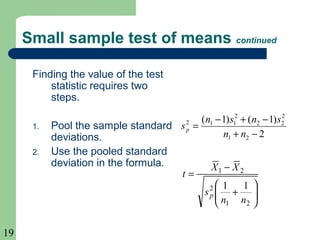
Small sample test of means continued
Finding the value of the test
statistic requires two
steps.
1. Pool the sample standard
deviations.
2. Use the pooled standard
deviation in the formula.
2
)1()1(
21
2
22
2
112
−+
−+−
=
nn
snsn
sp






+
−
=
21
2
21
11
nn
s
XX
t
p
20
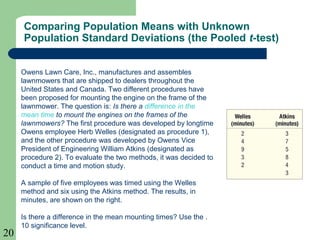
Owens Lawn Care, Inc., manufactures and assembles
lawnmowers that are shipped to dealers throughout the
United States and Canada. Two different procedures have
been proposed for mounting the engine on the frame of the
lawnmower. The question is: Is there a difference in the
mean time to mount the engines on the frames of the
lawnmowers? The first procedure was developed by longtime
Owens employee Herb Welles (designated as procedure 1),
and the other procedure was developed by Owens Vice
President of Engineering William Atkins (designated as
procedure 2). To evaluate the two methods, it was decided to
conduct a time and motion study.
A sample of five employees was timed using the Welles
method and six using the Atkins method. The results, in
minutes, are shown on the right.
Is there a difference in the mean mounting times? Use the .
10 significance level.
Comparing Population Means with Unknown
Population Standard Deviations (the Pooled t-test)
21
Step 1: State the null and alternate hypotheses.
H0: Âľ1 = Âľ2
H1: µ1 ≠ µ2
Step 2: State the level of significance. The .10 significance level is
stated in the problem.
Step 3: Find the appropriate test statistic.
Because the population standard deviations are not known but are
assumed to be equal, we use the pooled t-test.
Comparing Population Means with Unknown Population
Standard Deviations (the Pooled t-test) - Example
22
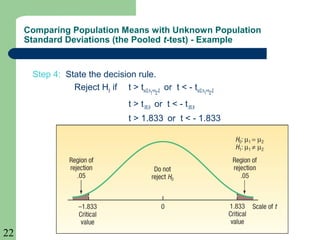
Step 4: State the decision rule.
Reject H0 if t > tÎą/2,n1+n2-2 or t < - tÎą/2,n1+n2-2
t > t.05,9 or t < - t.05,9
t > 1.833 or t < - 1.833
Comparing Population Means with Unknown Population
Standard Deviations (the Pooled t-test) - Example
23
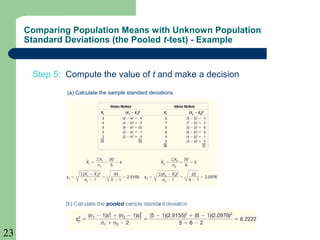
Step 5: Compute the value of t and make a decision
(a) Calculate the sample standard deviations
Comparing Population Means with Unknown Population
Standard Deviations (the Pooled t-test) - Example
24
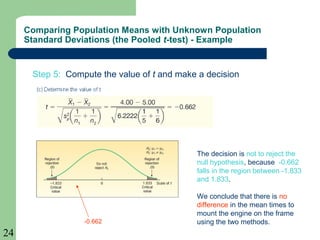
Step 5: Compute the value of t and make a decision
Comparing Population Means with Unknown Population
Standard Deviations (the Pooled t-test) - Example
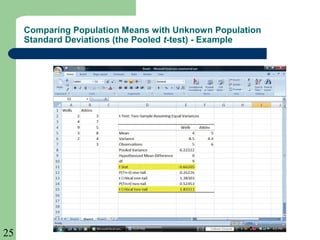
-0.662
The decision is not to reject the
null hypothesis, because -0.662
falls in the region between -1.833
and 1.833.
We conclude that there is no
difference in the mean times to
mount the engine on the frame
using the two methods.
25
Comparing Population Means with Unknown Population
Standard Deviations (the Pooled t-test) - Example
26
Two-Sample Tests of Hypothesis:
Dependent Samples
Dependent samples are samples that are paired or
related in some fashion.
For example:
– If you wished to buy a car you would look at the
same car at two (or more) different dealerships
and compare the prices.
– If you wished to measure the effectiveness of a
new diet you would weigh the dieters at the start
and at the finish of the program.
27
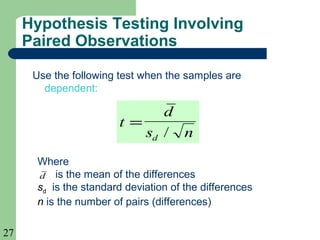
Hypothesis Testing Involving
Paired Observations
Use the following test when the samples are
dependent:
t
d
s nd
=
/
d
Where
is the mean of the differences
sd is the standard deviation of the differences
n is the number of pairs (differences)
28
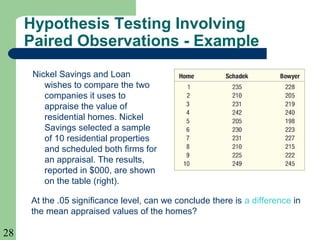
Nickel Savings and Loan
wishes to compare the two
companies it uses to
appraise the value of
residential homes. Nickel
Savings selected a sample
of 10 residential properties
and scheduled both firms for
an appraisal. The results,
reported in $000, are shown
on the table (right).
Hypothesis Testing Involving
Paired Observations - Example
At the .05 significance level, can we conclude there is a difference in
the mean appraised values of the homes?
29
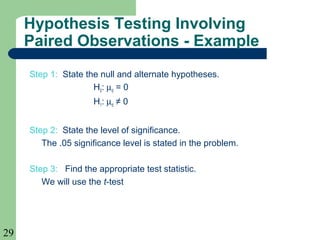
Step 1: State the null and alternate hypotheses.
H0: Âľd = 0
H1: µd ≠ 0
Step 2: State the level of significance.
The .05 significance level is stated in the problem.
Step 3: Find the appropriate test statistic.
We will use the t-test
Hypothesis Testing Involving
Paired Observations - Example
30
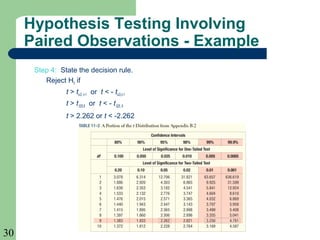
Step 4: State the decision rule.
Reject H0 if
t > tÎą/2, n-1 or t < - tÎą/2,n-1
t > t.025,9 or t < - t.025, 9
t > 2.262 or t < -2.262
Hypothesis Testing Involving
Paired Observations - Example
31
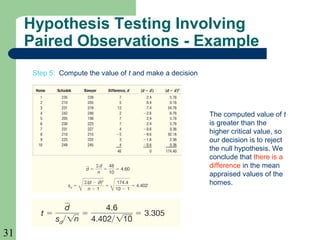
Step 5: Compute the value of t and make a decision
The computed value of t
is greater than the
higher critical value, so
our decision is to reject
the null hypothesis. We
conclude that there is a
difference in the mean
appraised values of the
homes.
Hypothesis Testing Involving
Paired Observations - Example
32
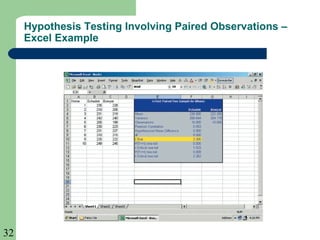
Hypothesis Testing Involving Paired Observations –
Excel Example
33
End of Chapter 11

Chapter 11

  • 1.
    ŠThe McGraw-Hill Companies,Inc. 2008McGraw-Hill/Irwin Two-sample Tests of Hypothesis Chapter 11
  • 2.
    2 GOALS 1. Conduct atest of a hypothesis about the difference between two independent population means. 2. Conduct a test of a hypothesis about the difference between two population proportions. 3. Conduct a test of a hypothesis about the mean difference between paired or dependent observations. 4. Understand the difference between dependent and independent samples.
  • 3.
    3 Comparing two populations– Some Examples 1. Is there a difference in the mean value of residential real estate sold by male agents and female agents in south Florida? 2. Is there a difference in the mean number of defects produced on the day and the afternoon shifts at Kimble Products? 3. Is there a difference in the mean number of days absent between young workers (under 21 years of age) and older workers (more than 60 years of age) in the fast-food industry?
  • 4.
    4 Comparing two populations– Some Examples (continued) 4. Is there is a difference in the proportion of Ohio State University graduates and University of Cincinnati graduates who pass the state Certified Public Accountant Examination on their first attempt? 5. Is there an increase in the production rate if music is piped into the production area?
  • 5.
    5 Comparing Two PopulationMeans of Independent Samples  The samples are from independent populations.  The standard deviations for both populations are known  The formula for computing the value of z is: Note: The z-test above may also be used if the sample sizes are both at least 30 even when the population standard deviations are not known 2 2 2 1 2 1 21 nn XX z σσ + − =
  • 6.
    6 Comparing Two PopulationMeans of Independent Samples – Example The U-Scan facility was recently installed at the Byrne Road Food-Town location. The store manager would like to know if the mean checkout time using the standard checkout method is longer than using the U-Scan. She gathered the following sample information. The time is measured from when the customer enters the line until their bags are in the cart. Hence the time includes both waiting in line and checking out.
  • 7.
    7 EXAMPLE continued Step 1:State the null and alternate hypotheses. H0: µS ≤ µU H1: µS > µU Step 2: State the level of significance. Test using .01 significance level. Step 3: Find the appropriate test statistic. Because both population standard deviations are given (or both samples are more than 30), we use z-distribution as the test statistic.
  • 8.
    8 Example continued Step 4:State the decision rule. Reject H0 if Z > ZÎą Z > 2.33
  • 9.
    9 Example continued Step 5:Compute the value of z and make a decision 13.3 064.0 2.0 100 30.0 50 40.0 3.55.5 22 22 == + − = + − = u u s s us nn XX z σσ The computed value of 3.13 is larger than the critical value of 2.33. Our decision is to reject the null hypothesis. The difference of .20 minutes between the mean checkout time using the standard method is too large to have occurred by chance. We conclude the U-Scan method is faster.
  • 10.
    10 Two-Sample Tests aboutProportions Here are several examples.  The vice president of human resources wishes to know whether there is a difference in the proportion of hourly employees who miss more than 5 days of work per year at the Atlanta and the Houston plants.  General Motors is considering a new design for the Pontiac Grand Am. The design is shown to a group of potential buyers under 30 years of age and another group over 60 years of age. Pontiac wishes to know whether there is a difference in the proportion of the two groups who like the new design.  A consultant to the airline industry is investigating the fear of flying among adults. Specifically, the company wishes to know whether there is a difference in the proportion of men versus women who are fearful of flying.
  • 11.
    11 Two Sample Testsof Proportions  We investigate whether two samples came from populations with an equal proportion of successes.  The two samples are pooled using the following formula.
  • 12.
    12 Two Sample Testsof Proportions continued The value of the test statistic is computed from the following formula.
  • 13.
    13 Manelli Perfume Companyrecently developed a new fragrance that it plans to market under the name Heavenly. A number of market studies indicate that Heavenly has very good market potential. The Sales Department at Manelli is particularly interested in whether there is a difference in the proportions of younger and older women who would purchase Heavenly if it were marketed. Two independent populations, a population consisting of the younger women and a population consisting of the older women, were surveyed. Each sampled woman was asked to smell Heavenly and indicate whether she likes the fragrance well enough to purchase a bottle. Of 100 young women, 19 liked the Heavenly fragrance well enough to purchase Similarly, a sample of 200 older women, 62 liked the fragrance well enough to make a purchase. Two Sample Tests of Proportions - Example
  • 14.
    14 Step 1: Statethe null and alternate hypotheses. H0: π1 = π2 H1: π1 ≠ π2 note: keyword “there is a difference in the proportion” We designate π1 as the proportion of young women who would purchase Heavenly and π2 as the proportion of older women who would purchase Step 2: State the level of significance. The .05 significance level is chosen. Step 3: Find the appropriate test statistic. We will use the z-distribution Two Sample Tests of Proportions - Example
  • 15.
    15 Step 4: Statethe decision rule. Reject H0 if Z > ZÎą/2 or Z < - ZÎą/2 Z > 1.96 or Z < -1.96 Two Sample Tests of Proportions - Example
  • 16.
    16 Step 5: Computethe value of z and make a decision The computed value of -2.21 is in the area of rejection. Therefore, the null hypothesis is rejected at the .05 significance level. To put it another way, we reject the null hypothesis that the proportion of young women who would purchase Heavenly is equal to the proportion of older women who would purchase Heavenly. Two Sample Tests of Proportions - Example
  • 17.
    17 Two Sample Testsof Proportions – Example (Minitab Solution)
  • 18.
    18 Comparing Population Meanswith Unknown Population Standard Deviations (the Pooled t-test) The t distribution is used as the test statistic if one or more of the samples have less than 30 observations. The required assumptions are: 1. Both populations must follow the normal distribution. 2. The populations must have equal standard deviations. 3. The samples are from independent populations.
  • 19.
    19 Small sample testof means continued Finding the value of the test statistic requires two steps. 1. Pool the sample standard deviations. 2. Use the pooled standard deviation in the formula. 2 )1()1( 21 2 22 2 112 −+ −+− = nn snsn sp       + − = 21 2 21 11 nn s XX t p
  • 20.
    20 Owens Lawn Care,Inc., manufactures and assembles lawnmowers that are shipped to dealers throughout the United States and Canada. Two different procedures have been proposed for mounting the engine on the frame of the lawnmower. The question is: Is there a difference in the mean time to mount the engines on the frames of the lawnmowers? The first procedure was developed by longtime Owens employee Herb Welles (designated as procedure 1), and the other procedure was developed by Owens Vice President of Engineering William Atkins (designated as procedure 2). To evaluate the two methods, it was decided to conduct a time and motion study. A sample of five employees was timed using the Welles method and six using the Atkins method. The results, in minutes, are shown on the right. Is there a difference in the mean mounting times? Use the . 10 significance level. Comparing Population Means with Unknown Population Standard Deviations (the Pooled t-test)
  • 21.
    21 Step 1: Statethe null and alternate hypotheses. H0: µ1 = µ2 H1: µ1 ≠ µ2 Step 2: State the level of significance. The .10 significance level is stated in the problem. Step 3: Find the appropriate test statistic. Because the population standard deviations are not known but are assumed to be equal, we use the pooled t-test. Comparing Population Means with Unknown Population Standard Deviations (the Pooled t-test) - Example
  • 22.
    22 Step 4: Statethe decision rule. Reject H0 if t > tÎą/2,n1+n2-2 or t < - tÎą/2,n1+n2-2 t > t.05,9 or t < - t.05,9 t > 1.833 or t < - 1.833 Comparing Population Means with Unknown Population Standard Deviations (the Pooled t-test) - Example
  • 23.
    23 Step 5: Computethe value of t and make a decision (a) Calculate the sample standard deviations Comparing Population Means with Unknown Population Standard Deviations (the Pooled t-test) - Example
  • 24.
    24 Step 5: Computethe value of t and make a decision Comparing Population Means with Unknown Population Standard Deviations (the Pooled t-test) - Example -0.662 The decision is not to reject the null hypothesis, because -0.662 falls in the region between -1.833 and 1.833. We conclude that there is no difference in the mean times to mount the engine on the frame using the two methods.
  • 25.
    25 Comparing Population Meanswith Unknown Population Standard Deviations (the Pooled t-test) - Example
  • 26.
    26 Two-Sample Tests ofHypothesis: Dependent Samples Dependent samples are samples that are paired or related in some fashion. For example: – If you wished to buy a car you would look at the same car at two (or more) different dealerships and compare the prices. – If you wished to measure the effectiveness of a new diet you would weigh the dieters at the start and at the finish of the program.
  • 27.
    27 Hypothesis Testing Involving PairedObservations Use the following test when the samples are dependent: t d s nd = / d Where is the mean of the differences sd is the standard deviation of the differences n is the number of pairs (differences)
  • 28.
    28 Nickel Savings andLoan wishes to compare the two companies it uses to appraise the value of residential homes. Nickel Savings selected a sample of 10 residential properties and scheduled both firms for an appraisal. The results, reported in $000, are shown on the table (right). Hypothesis Testing Involving Paired Observations - Example At the .05 significance level, can we conclude there is a difference in the mean appraised values of the homes?
  • 29.
    29 Step 1: Statethe null and alternate hypotheses. H0: µd = 0 H1: µd ≠ 0 Step 2: State the level of significance. The .05 significance level is stated in the problem. Step 3: Find the appropriate test statistic. We will use the t-test Hypothesis Testing Involving Paired Observations - Example
  • 30.
    30 Step 4: Statethe decision rule. Reject H0 if t > tÎą/2, n-1 or t < - tÎą/2,n-1 t > t.025,9 or t < - t.025, 9 t > 2.262 or t < -2.262 Hypothesis Testing Involving Paired Observations - Example
  • 31.
    31 Step 5: Computethe value of t and make a decision The computed value of t is greater than the higher critical value, so our decision is to reject the null hypothesis. We conclude that there is a difference in the mean appraised values of the homes. Hypothesis Testing Involving Paired Observations - Example
  • 32.
    32 Hypothesis Testing InvolvingPaired Observations – Excel Example
  • 33.