Quantitative Methods
Varsha Varde
Varsha Varde 2
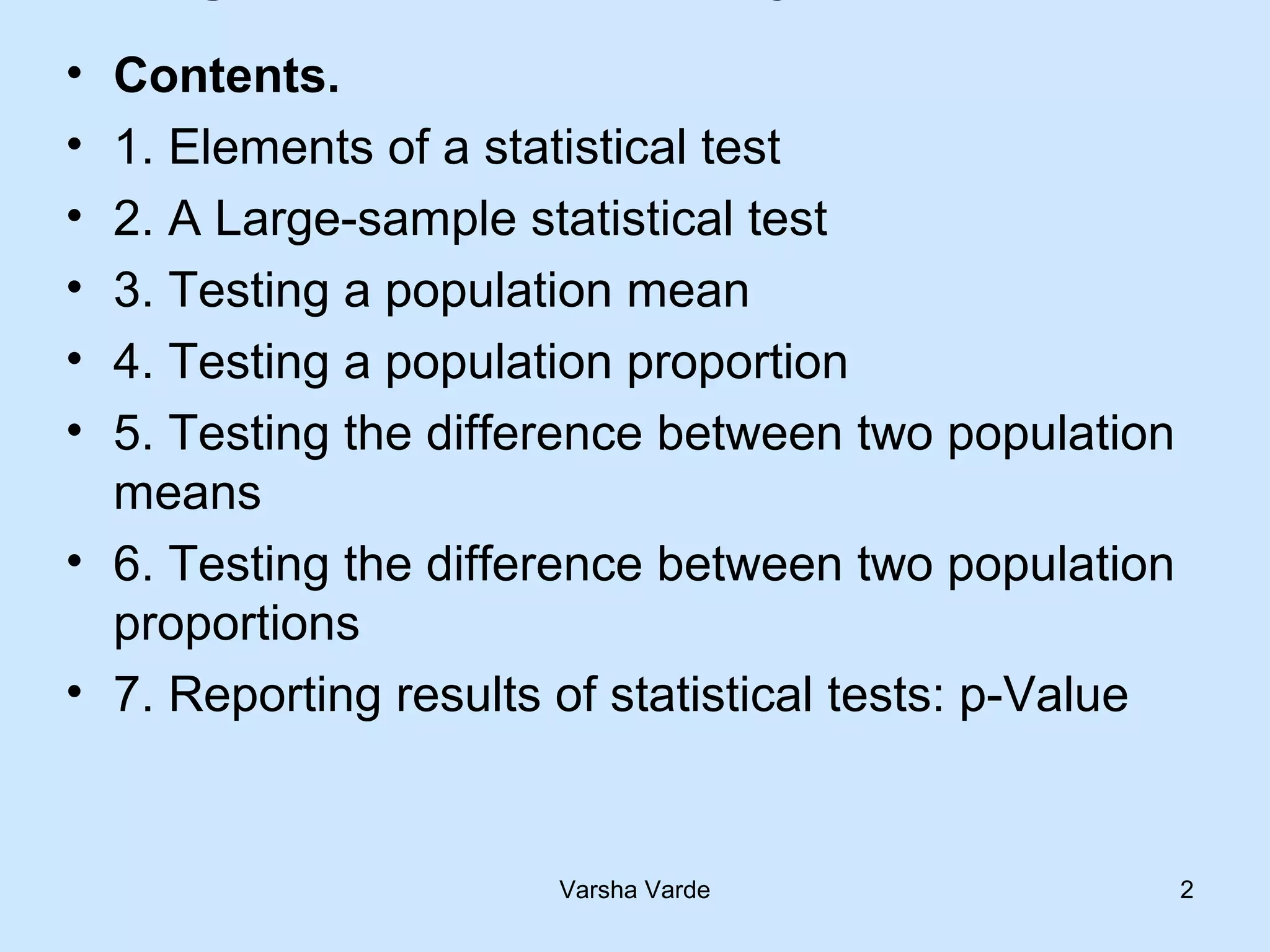
• Contents.
• 1. Elements of a statistical test
• 2. A Large-sample statistical test
• 3. Testing a population mean
• 4. Testing a population proportion
• 5. Testing the difference between two population
means
• 6. Testing the difference between two population
proportions
• 7. Reporting results of statistical tests: p-Value
Varsha Varde 3
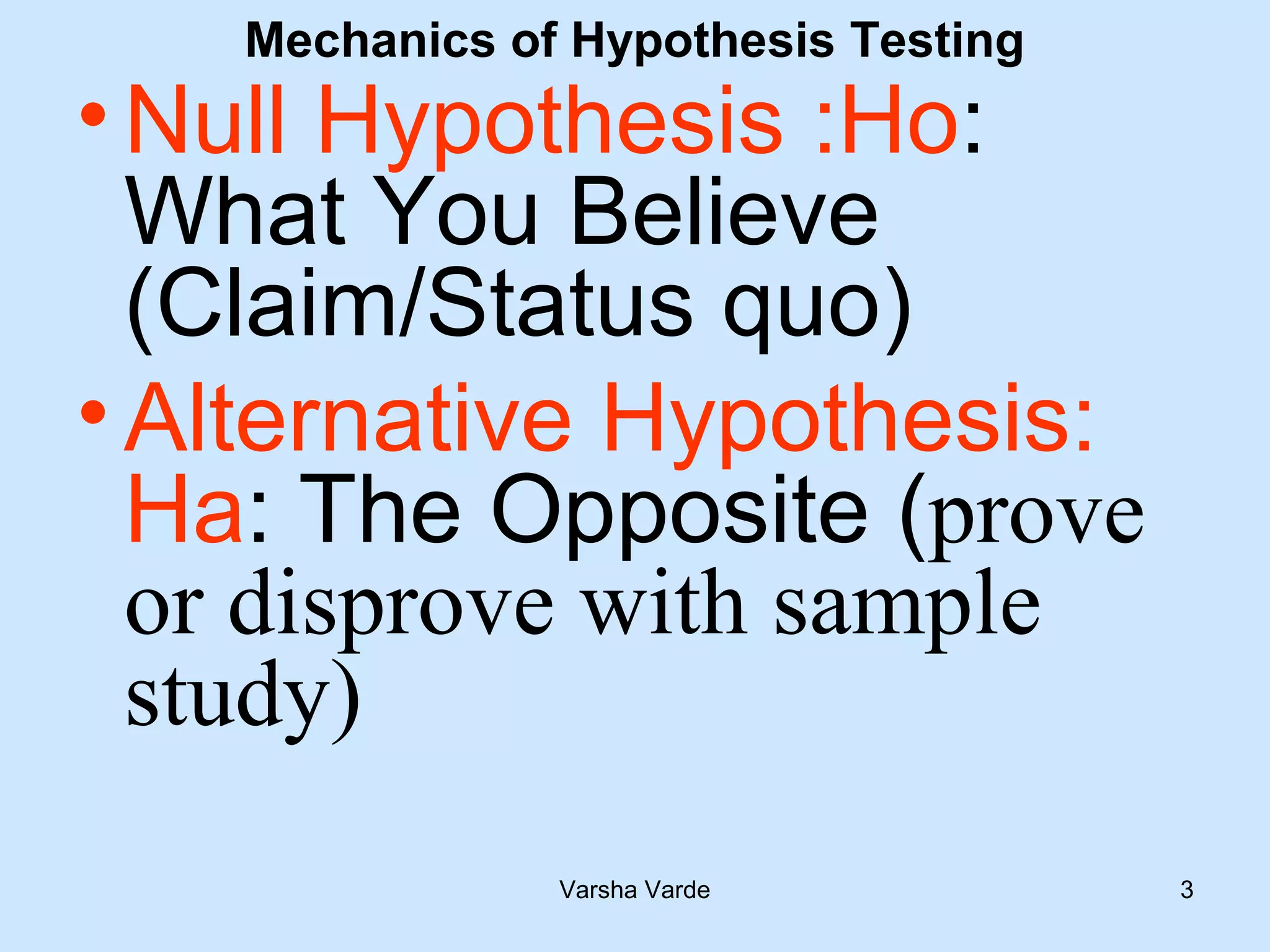
Mechanics of Hypothesis Testing
•Null Hypothesis :Ho:
What You Believe
(Claim/Status quo)
•Alternative Hypothesis:
Ha: The Opposite (prove
or disprove with sample
study)
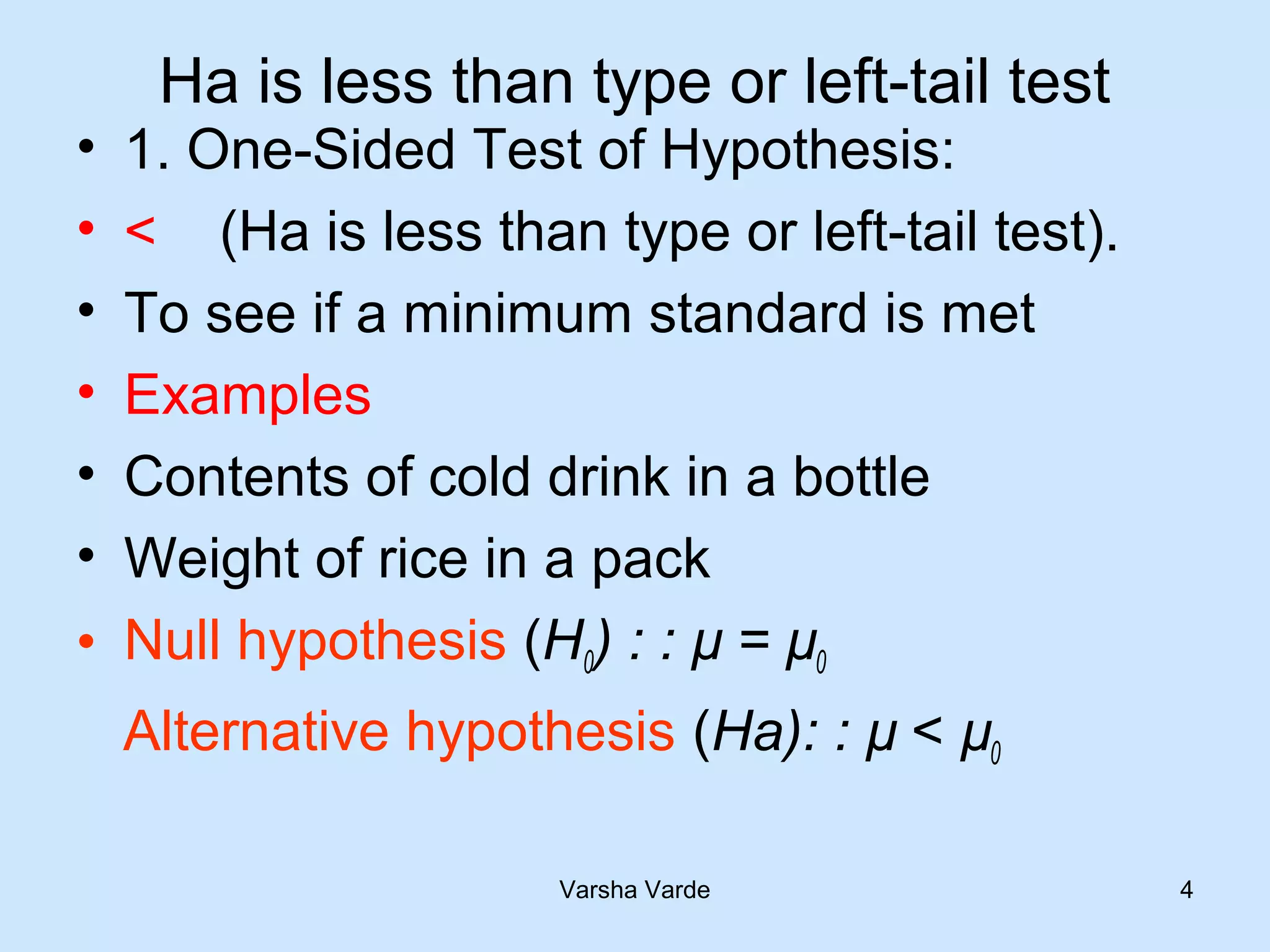
Ha is less than type or left-tail test
• 1. One-Sided Test of Hypothesis:
• < (Ha is less than type or left-tail test).
• To see if a minimum standard is met
• Examples
• Contents of cold drink in a bottle
• Weight of rice in a pack
• Null hypothesis (H0) : : µ = µ0
Alternative hypothesis (Ha): : µ < µ0
Varsha Varde 4
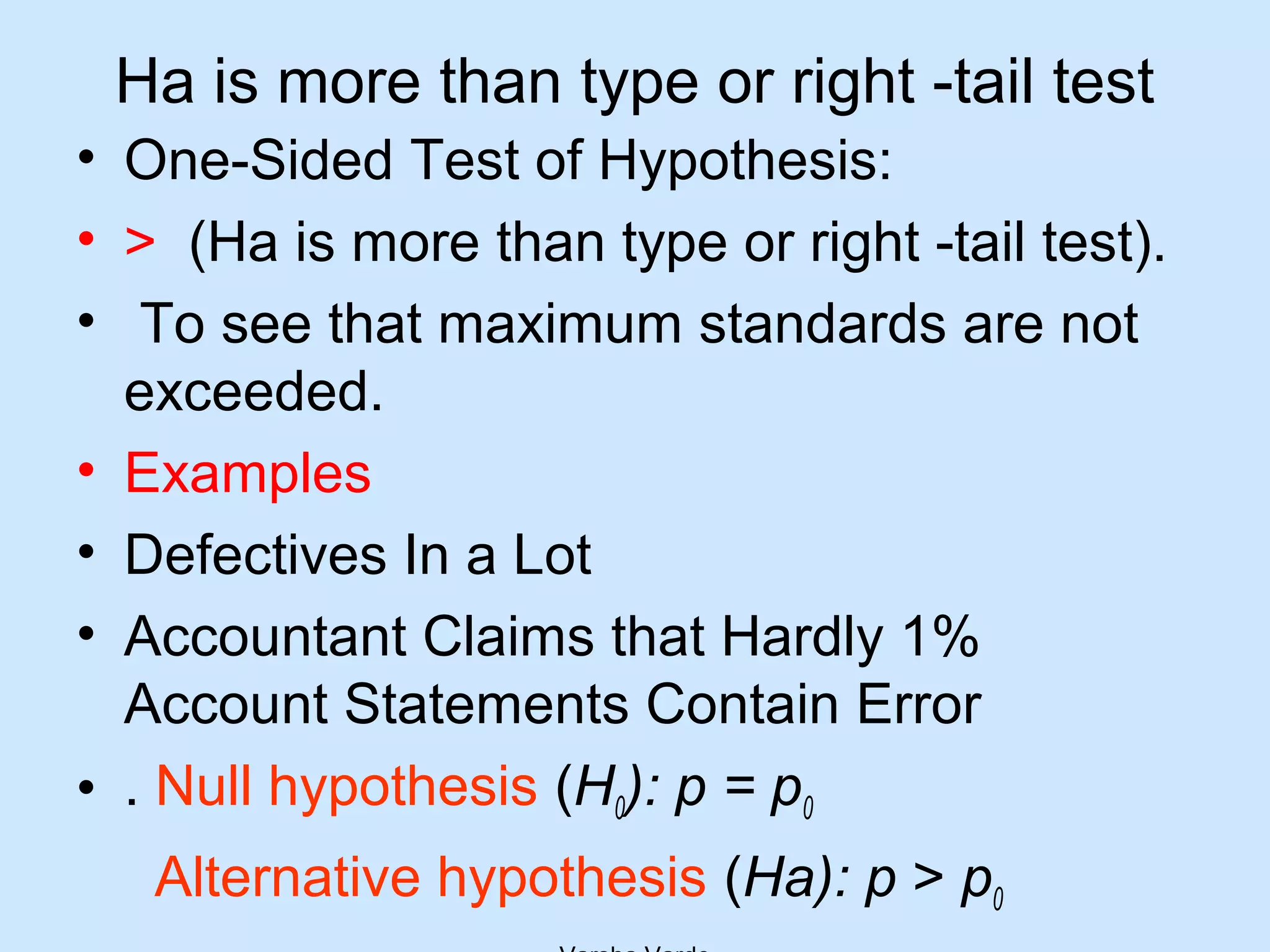
Ha is more than type or right -tail test
• One-Sided Test of Hypothesis:
• > (Ha is more than type or right -tail test).
• To see that maximum standards are not
exceeded.
• Examples
• Defectives In a Lot
• Accountant Claims that Hardly 1%
Account Statements Contain Error
• . Null hypothesis (H0): p = p0
Alternative hypothesis (Ha): p > p0
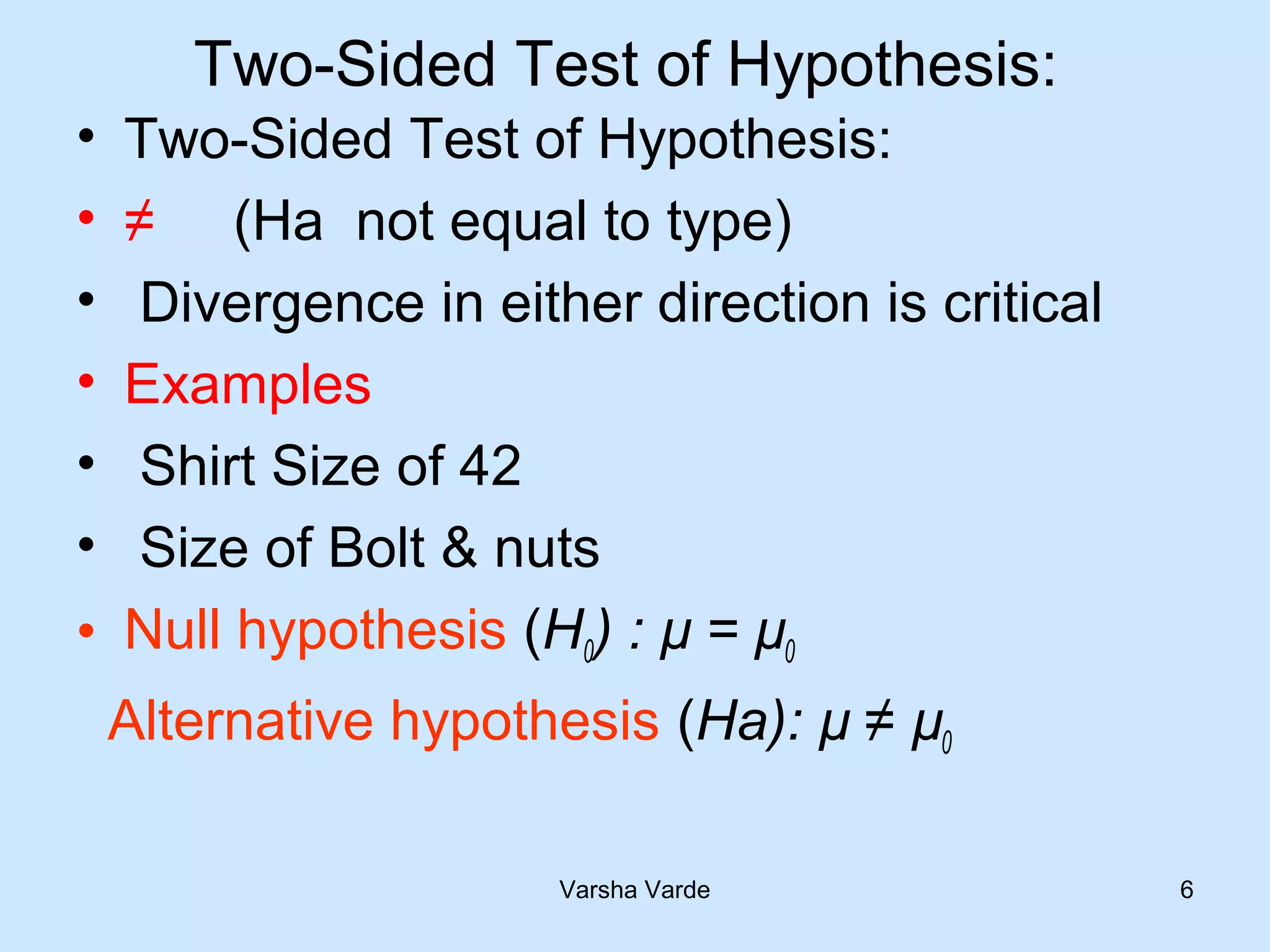
Two-Sided Test of Hypothesis:
• Two-Sided Test of Hypothesis:
• ≠ (Ha not equal to type)
• Divergence in either direction is critical
• Examples
• Shirt Size of 42
• Size of Bolt & nuts
• Null hypothesis (H0) : µ = µ0
Alternative hypothesis (Ha): µ ≠ µ0
Varsha Varde 6
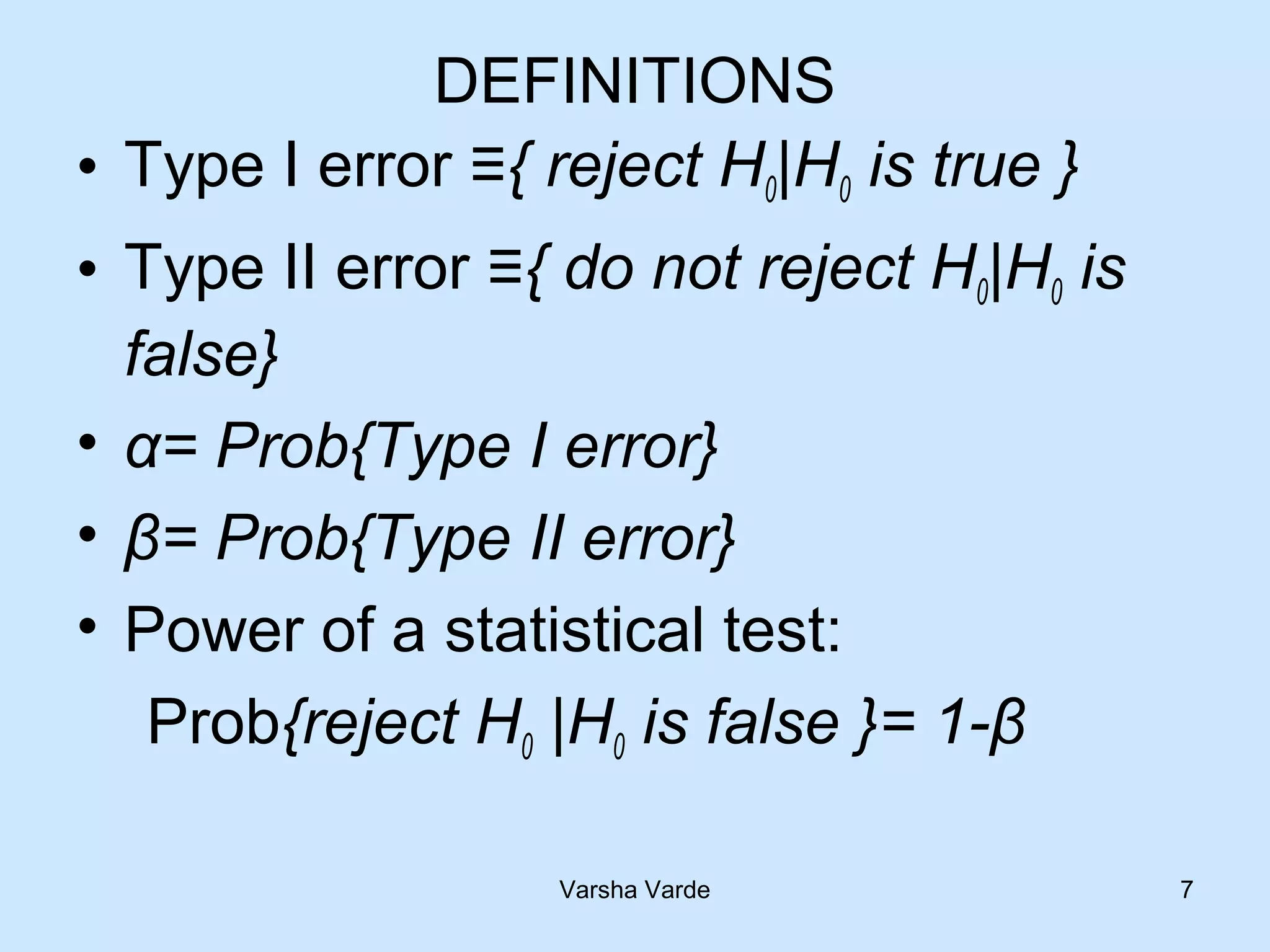
DEFINITIONS
• Type I error ≡{ reject H0|H0 is true }
• Type II error ≡{ do not reject H0|H0 is
false}
• α= Prob{Type I error}
• β= Prob{Type II error}
• Power of a statistical test:
Prob{reject H0 |H0 is false }= 1-β
Varsha Varde 7
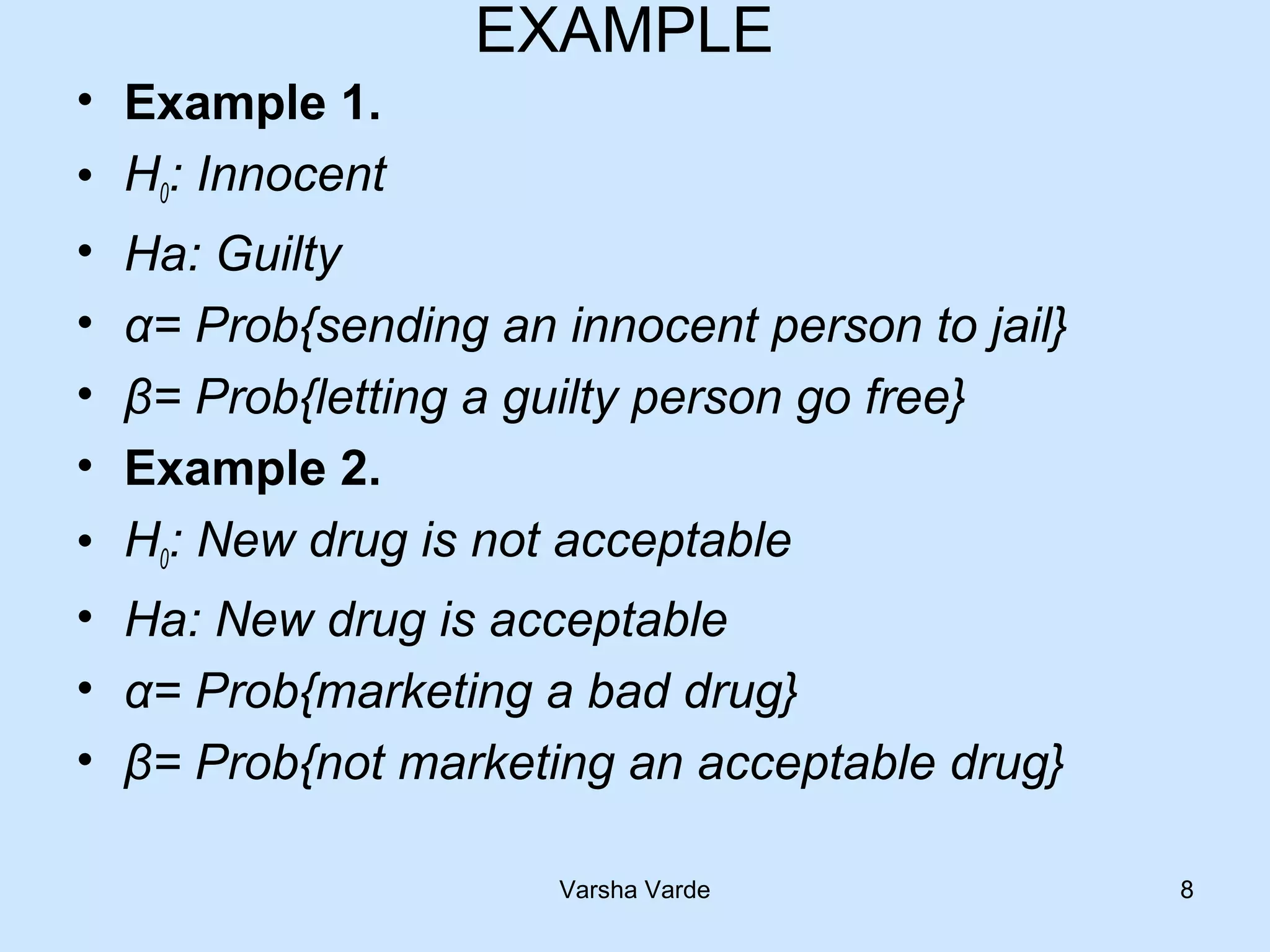
EXAMPLE
• Example 1.
• H0: Innocent
• Ha: Guilty
• α= Prob{sending an innocent person to jail}
• β= Prob{letting a guilty person go free}
• Example 2.
• H0: New drug is not acceptable
• Ha: New drug is acceptable
• α= Prob{marketing a bad drug}
• β= Prob{not marketing an acceptable drug}
Varsha Varde 8
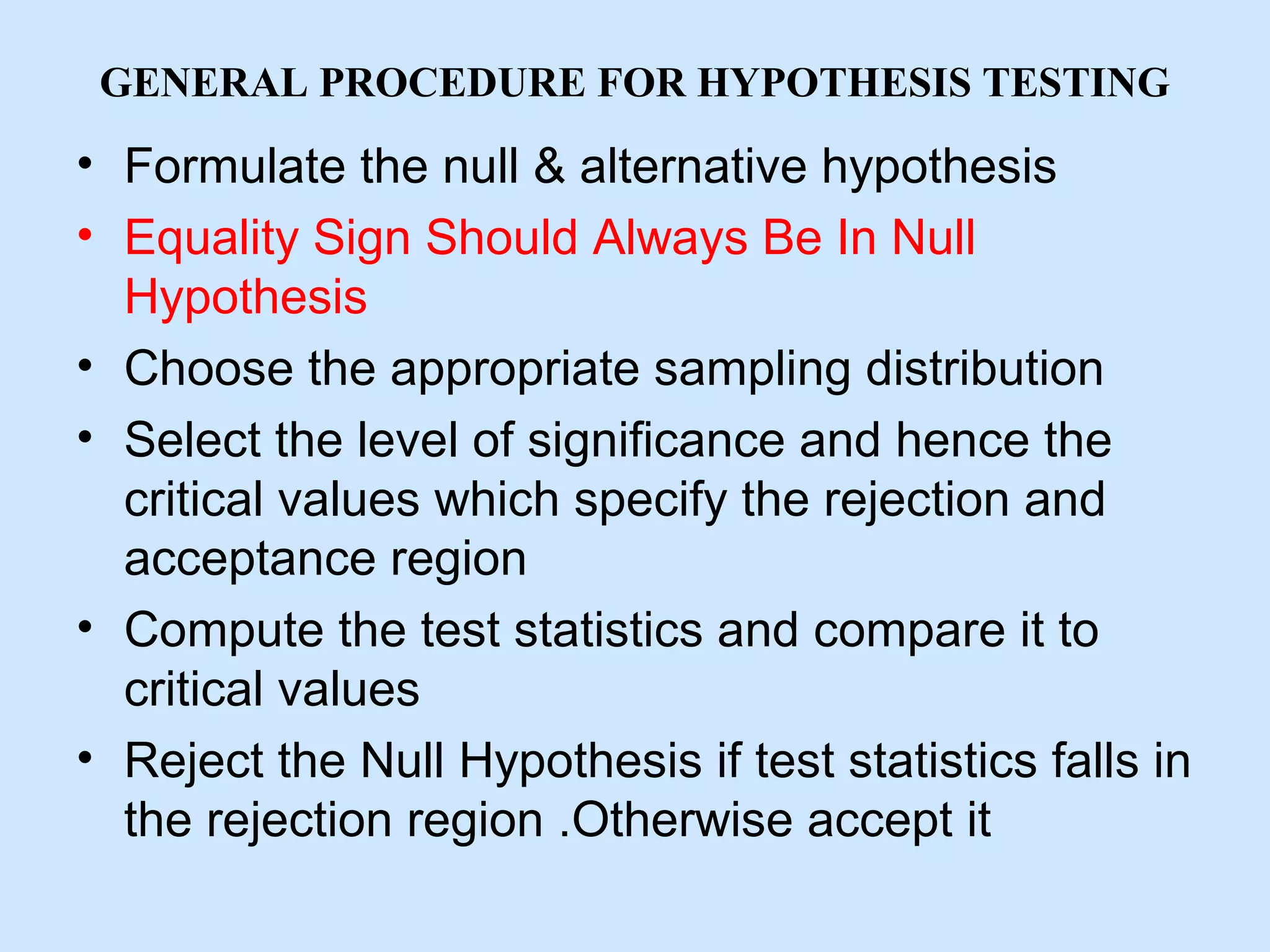
GENERAL PROCEDURE FOR HYPOTHESIS TESTING
• Formulate the null & alternative hypothesis
• Equality Sign Should Always Be In Null
Hypothesis
• Choose the appropriate sampling distribution
• Select the level of significance and hence the
critical values which specify the rejection and
acceptance region
• Compute the test statistics and compare it to
critical values
• Reject the Null Hypothesis if test statistics falls in
the rejection region .Otherwise accept it
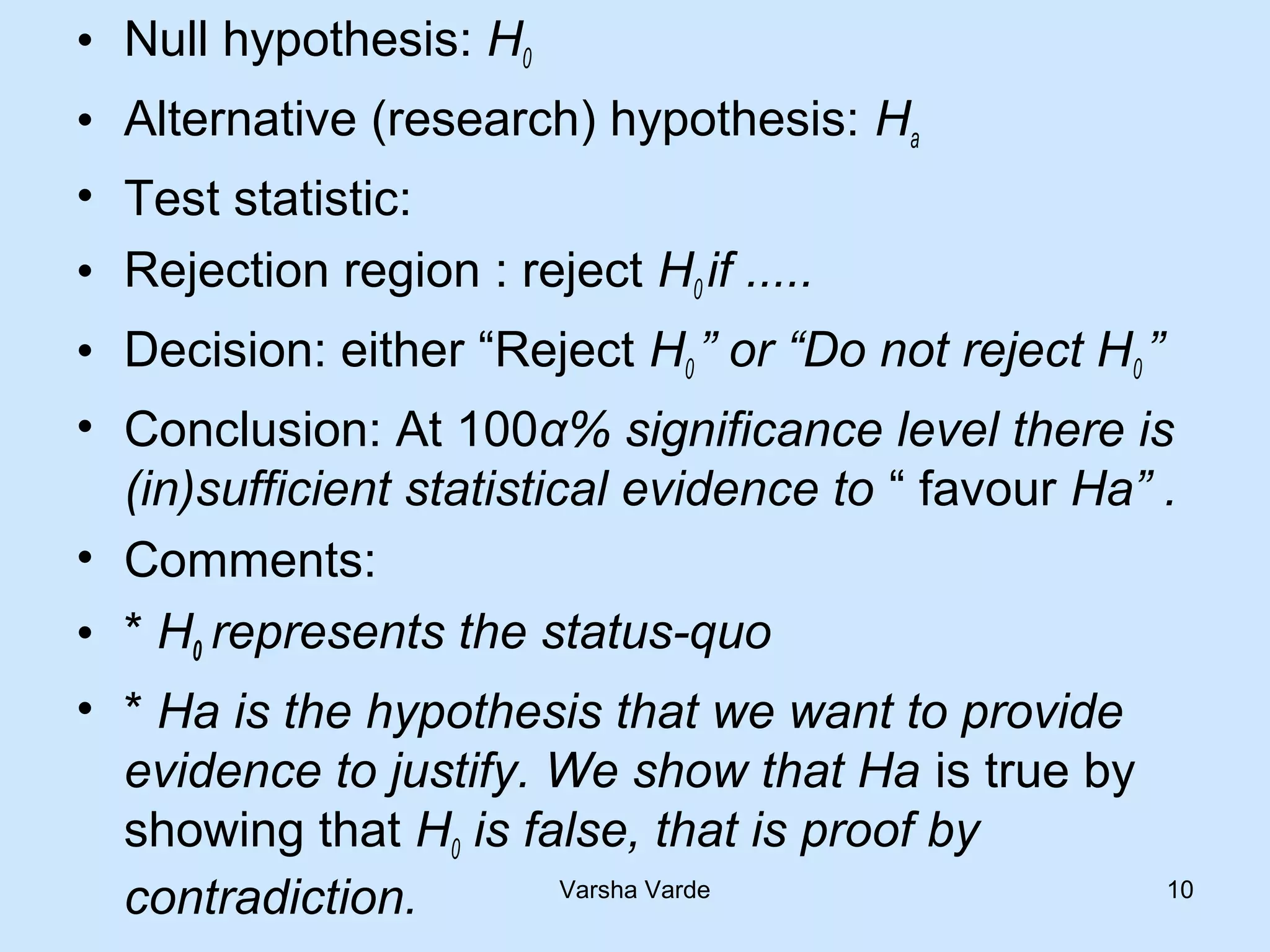
• Null hypothesis: H0
• Alternative (research) hypothesis: Ha
• Test statistic:
• Rejection region : reject H0 if .....
• Decision: either “Reject H0 ” or “Do not reject H0 ”
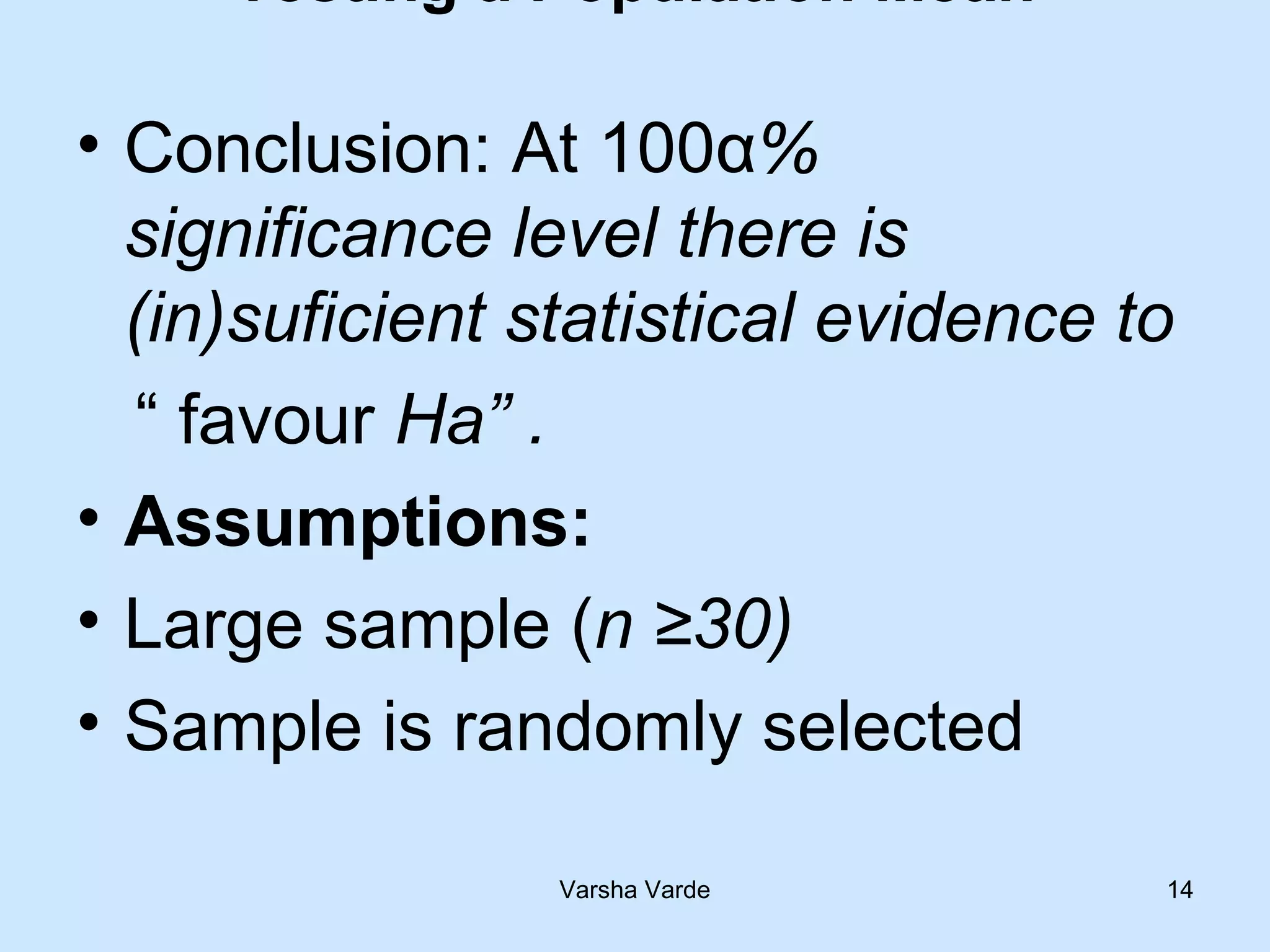
• Conclusion: At 100α% significance level there is
(in)sufficient statistical evidence to “ favour Ha” .
• Comments:
• * H0 represents the status-quo
• * Ha is the hypothesis that we want to provide
evidence to justify. We show that Ha is true by
showing that H0 is false, that is proof by
contradiction. Varsha Varde 10
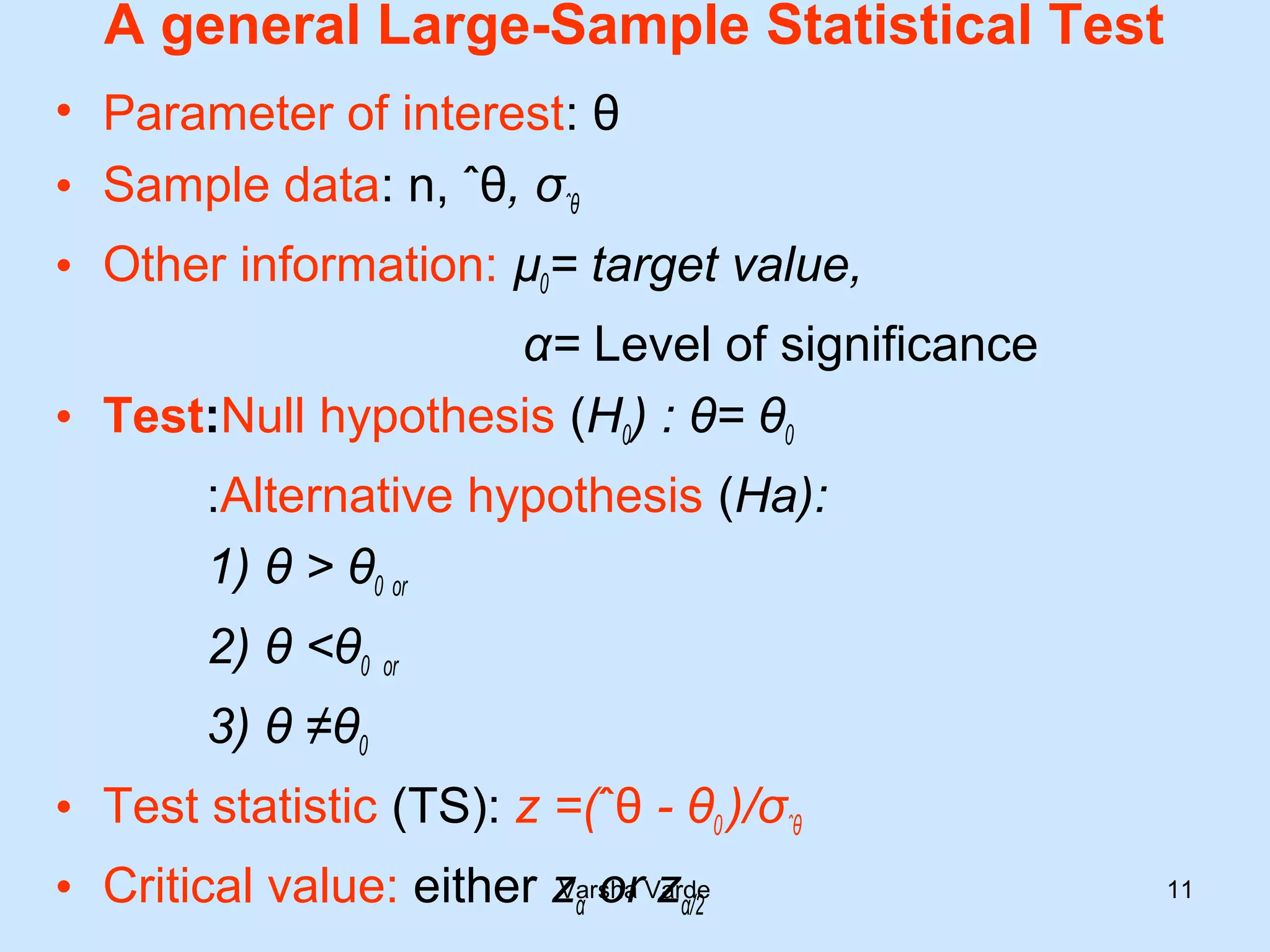
A general Large-Sample Statistical Test
• Parameter of interest: θ
• Sample data: n, ˆθ, σˆθ
• Other information: µ0= target value,
α= Level of significance
• Test:Null hypothesis (H0) : θ= θ0
:Alternative hypothesis (Ha):
1) θ > θ0 or
2) θ <θ0 or
3) θ ≠θ0
• Test statistic (TS): z =(ˆθ - θ0 )/σˆθ
• Critical value: either zα or zα/2
Varsha Varde 11
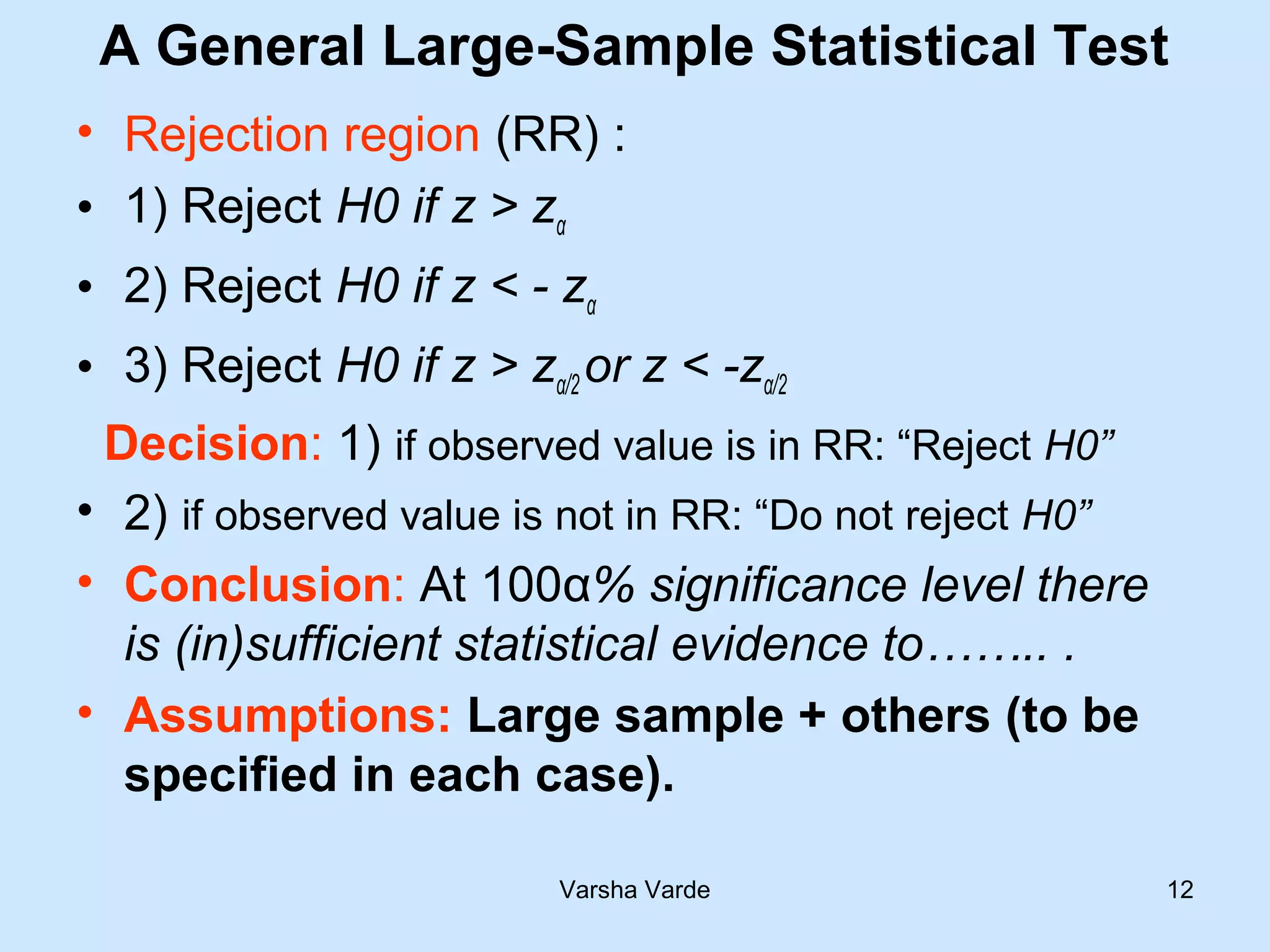
A General Large-Sample Statistical Test
• Rejection region (RR) :
• 1) Reject H0 if z > zα
• 2) Reject H0 if z < - zα
• 3) Reject H0 if z > zα/2 or z < -zα/2
Decision: 1) if observed value is in RR: “Reject H0”
• 2) if observed value is not in RR: “Do not reject H0”
• Conclusion: At 100α% significance level there
is (in)sufficient statistical evidence to…….. .
• Assumptions: Large sample + others (to be
specified in each case).
Varsha Varde 12
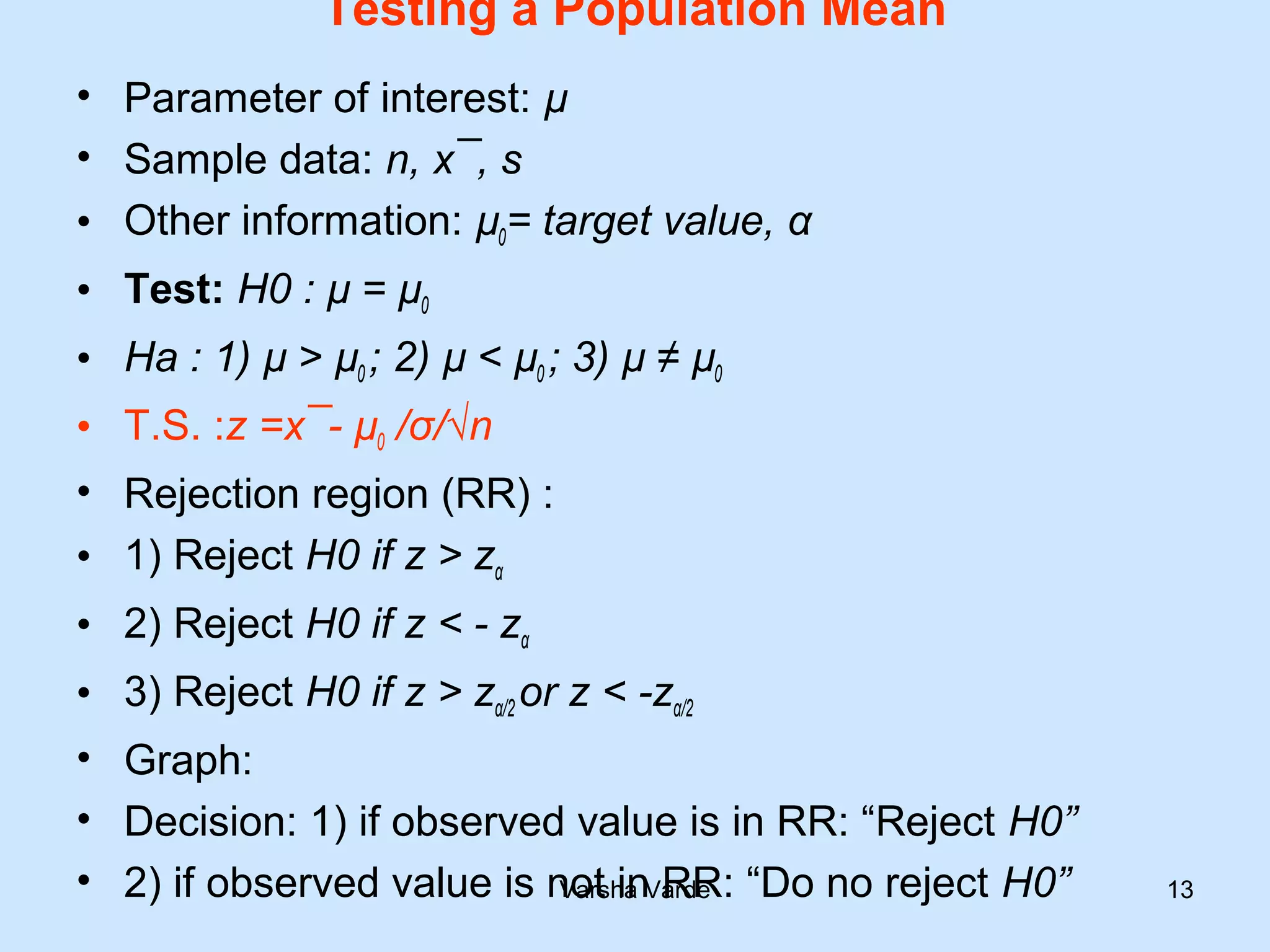
Testing a Population Mean
• Parameter of interest: µ
• Sample data: n, x¯, s
• Other information: µ0= target value, α
• Test: H0 : µ = µ0
• Ha : 1) µ > µ0 ; 2) µ < µ0 ; 3) µ ≠ µ0
• T.S. :z =x¯- µ0 /σ/√n
• Rejection region (RR) :
• 1) Reject H0 if z > zα
• 2) Reject H0 if z < - zα
• 3) Reject H0 if z > zα/2 or z < -zα/2
• Graph:
• Decision: 1) if observed value is in RR: “Reject H0”
• 2) if observed value is not in RR: “Do no reject H0”Varsha Varde 13
Testing a Population Mean
• Conclusion: At 100α%
significance level there is
(in)suficient statistical evidence to
“ favour Ha” .
• Assumptions:
• Large sample (n ≥30)
• Sample is randomly selected
Varsha Varde 14
EXAMPLE
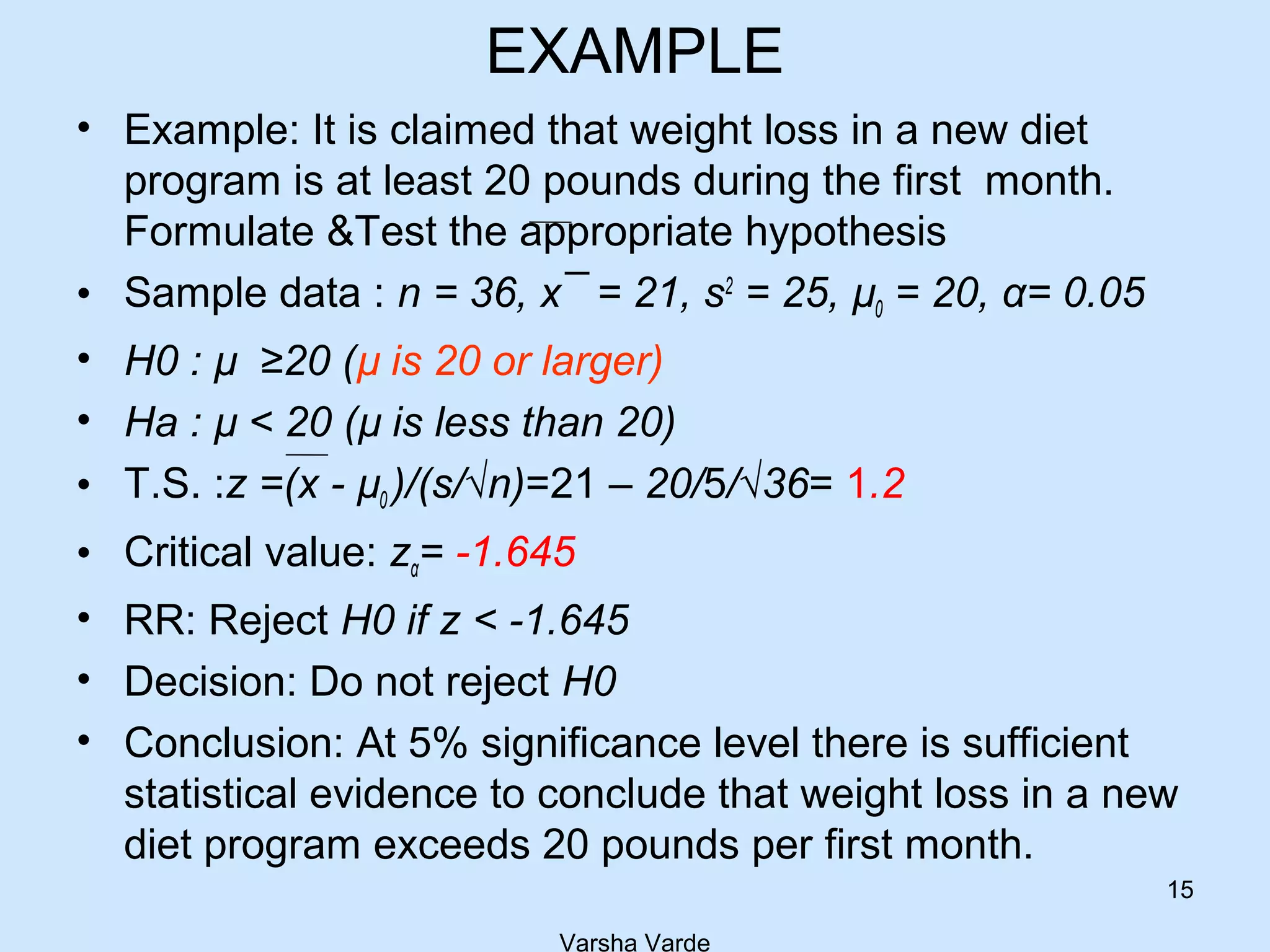
• Example: It is claimed that weight loss in a new diet
program is at least 20 pounds during the first month.
Formulate &Test the appropriate hypothesis
• Sample data : n = 36, x¯ = 21, s2
= 25, µ0 = 20, α= 0.05
• H0 : µ ≥20 (µ is 20 or larger)
• Ha : µ < 20 (µ is less than 20)
• T.S. :z =(x - µ0 )/(s/√n)=21 – 20/5/√36= 1.2
• Critical value: zα= -1.645
• RR: Reject H0 if z < -1.645
• Decision: Do not reject H0
• Conclusion: At 5% significance level there is sufficient
statistical evidence to conclude that weight loss in a new
diet program exceeds 20 pounds per first month.
Varsha Varde
15
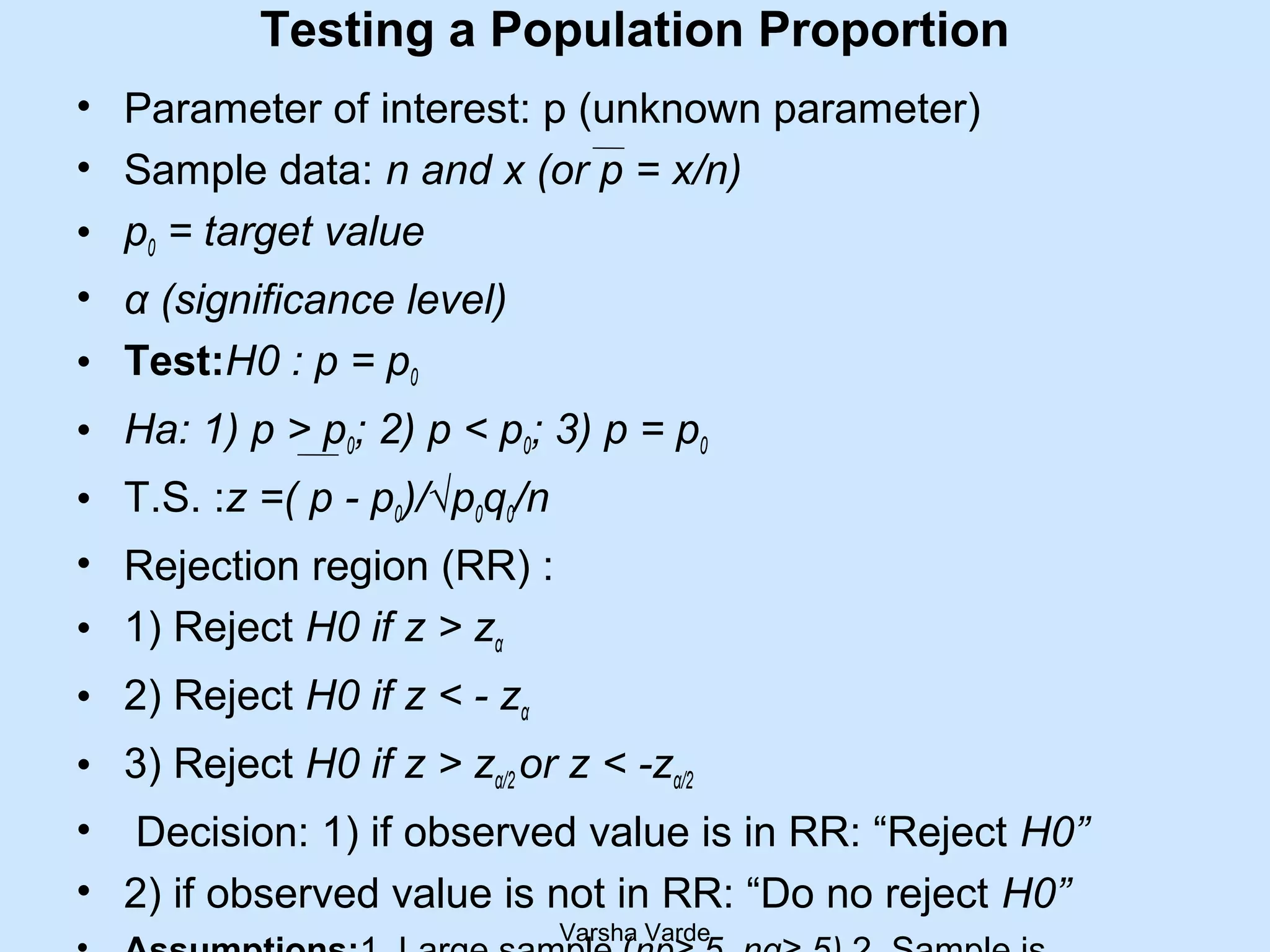
Testing a Population Proportion
• Parameter of interest: p (unknown parameter)
• Sample data: n and x (or p = x/n)
• p0 = target value
• α (significance level)
• Test:H0 : p = p0
• Ha: 1) p > p0; 2) p < p0; 3) p = p0
• T.S. :z =( p - p0)/√p0q0/n
• Rejection region (RR) :
• 1) Reject H0 if z > zα
• 2) Reject H0 if z < - zα
• 3) Reject H0 if z > zα/2 or z < -zα/2
• Decision: 1) if observed value is in RR: “Reject H0”
• 2) if observed value is not in RR: “Do no reject H0”
Varsha Varde
Example
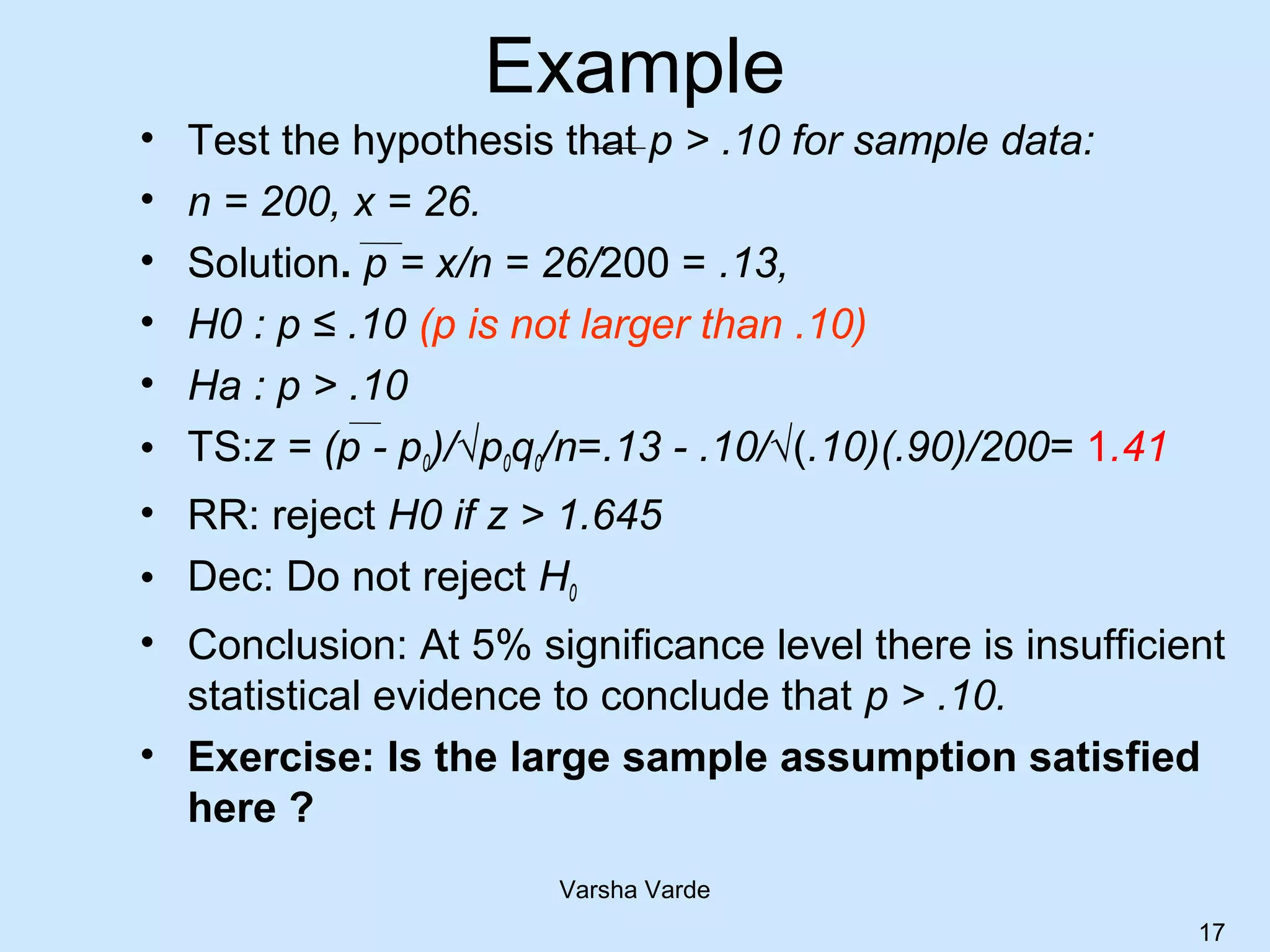
• Test the hypothesis that p > .10 for sample data:
• n = 200, x = 26.
• Solution. p = x/n = 26/200 = .13,
• H0 : p ≤ .10 (p is not larger than .10)
• Ha : p > .10
• TS:z = (p - p0)/√p0q0/n=.13 - .10/√(.10)(.90)/200= 1.41
• RR: reject H0 if z > 1.645
• Dec: Do not reject H0
• Conclusion: At 5% significance level there is insufficient
statistical evidence to conclude that p > .10.
• Exercise: Is the large sample assumption satisfied
here ?
Varsha Varde
17
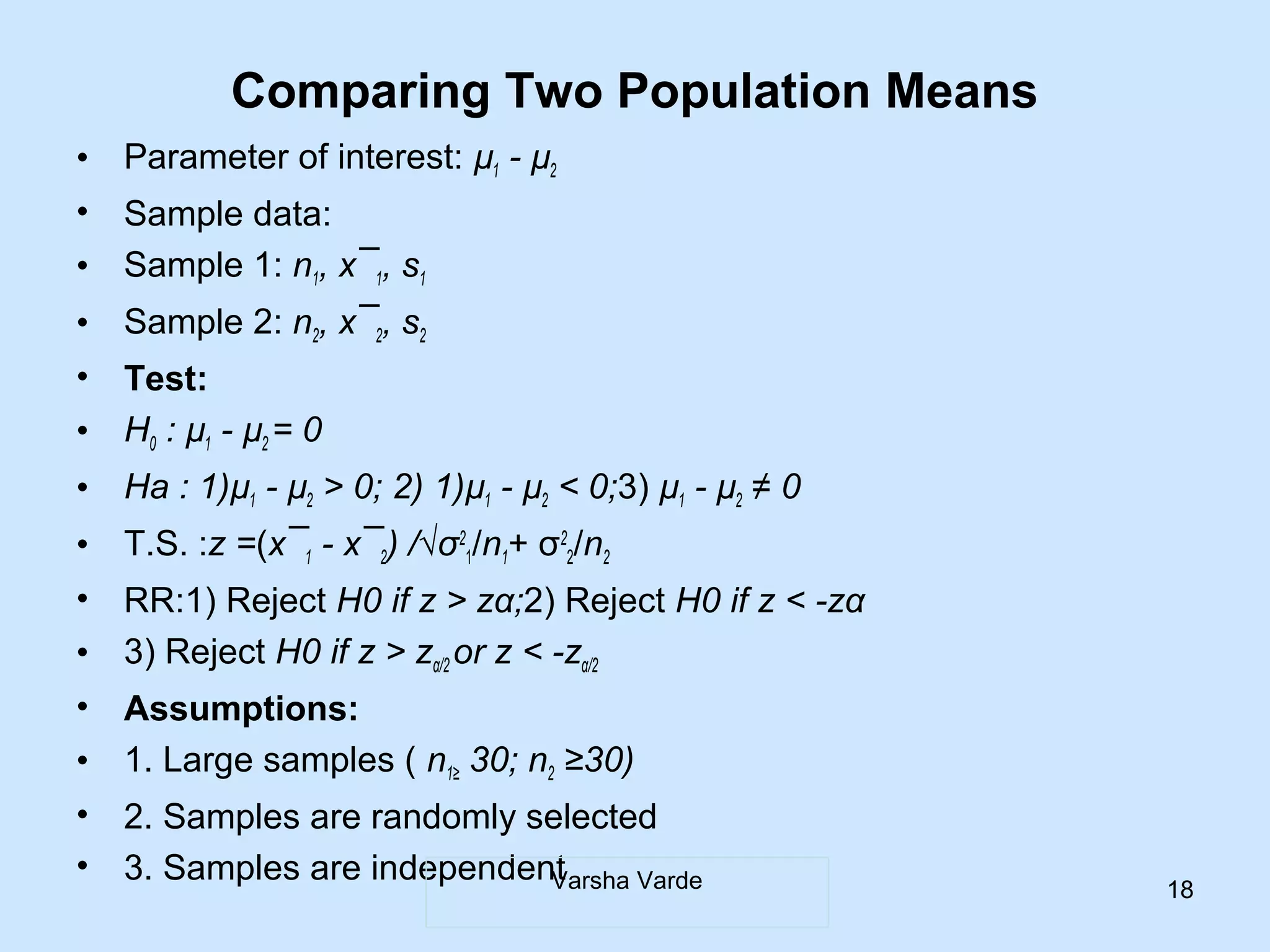
Comparing Two Population Means
• Parameter of interest: µ1 - µ2
• Sample data:
• Sample 1: n1, x¯1, s1
• Sample 2: n2, x¯2, s2
• Test:
• H0 : µ1 - µ2 = 0
• Ha : 1)µ1 - µ2 > 0; 2) 1)µ1 - µ2 < 0;3) µ1 - µ2 ≠ 0
• T.S. :z =(x¯1 - x¯2) /√σ2
1/n1+ σ2
2/n2
• RR:1) Reject H0 if z > zα;2) Reject H0 if z < -zα
• 3) Reject H0 if z > zα/2 or z < -zα/2
• Assumptions:
• 1. Large samples ( n1≥ 30; n2 ≥30)
• 2. Samples are randomly selected
• 3. Samples are independentVarsha Varde 18
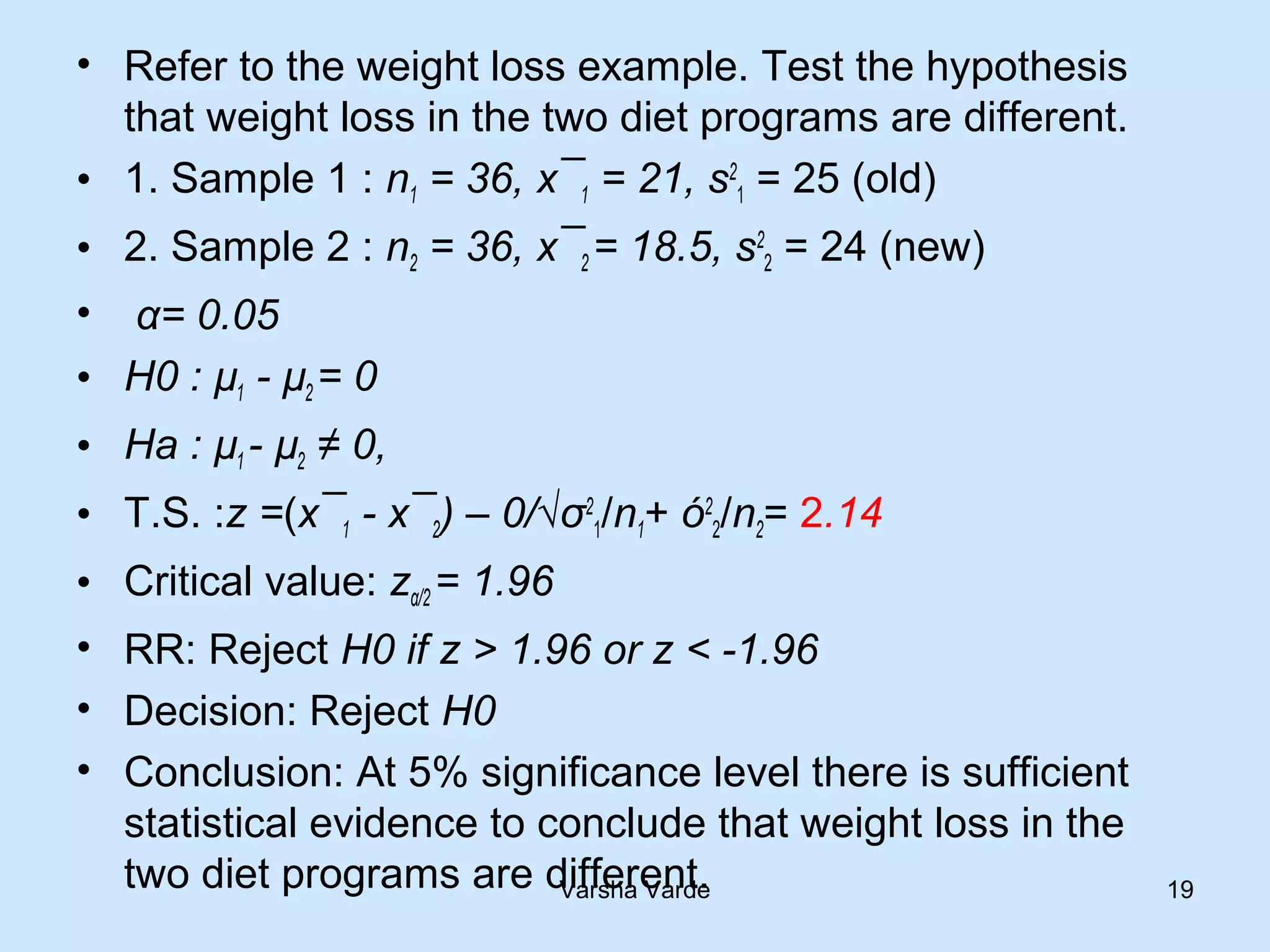
• Refer to the weight loss example. Test the hypothesis
that weight loss in the two diet programs are different.
• 1. Sample 1 : n1 = 36, x¯1 = 21, s2
1 = 25 (old)
• 2. Sample 2 : n2 = 36, x¯2 = 18.5, s2
2 = 24 (new)
• α= 0.05
• H0 : µ1 - µ2 = 0
• Ha : µ1 - µ2 ≠ 0,
• T.S. :z =(x¯1 - x¯2) – 0/√σ2
1/n1+ ó2
2/n2= 2.14
• Critical value: zα/2 = 1.96
• RR: Reject H0 if z > 1.96 or z < -1.96
• Decision: Reject H0
• Conclusion: At 5% significance level there is sufficient
statistical evidence to conclude that weight loss in the
two diet programs are different.Varsha Varde 19
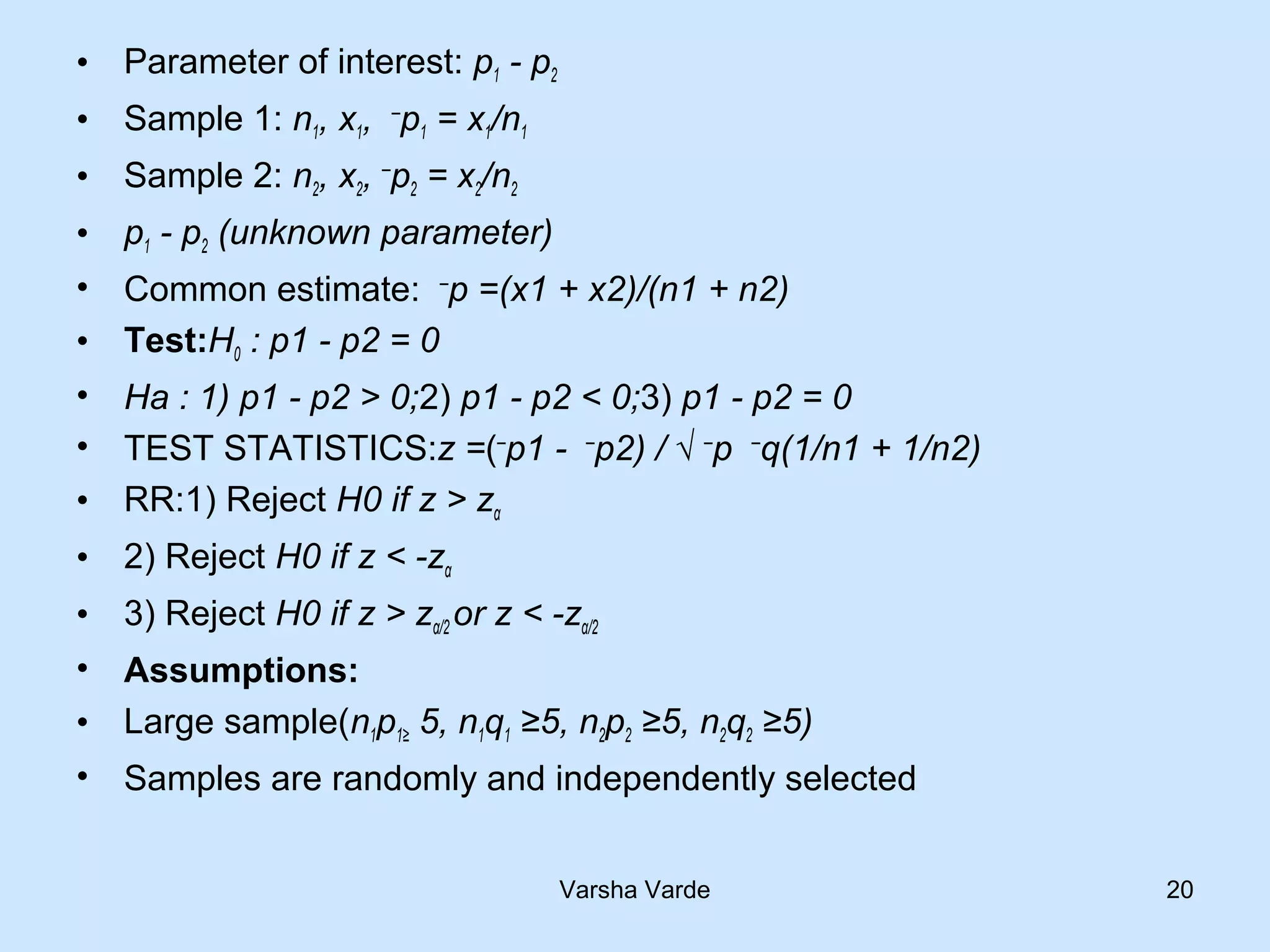
• Parameter of interest: p1 - p2
• Sample 1: n1, x1, ─
p1 = x1/n1
• Sample 2: n2, x2, ─
p2 = x2/n2
• p1 - p2 (unknown parameter)
• Common estimate: ─
p =(x1 + x2)/(n1 + n2)
• Test:H0 : p1 - p2 = 0
• Ha : 1) p1 - p2 > 0;2) p1 - p2 < 0;3) p1 - p2 = 0
• TEST STATISTICS:z =(─
p1 - ─
p2) / √ ─
p ─
q(1/n1 + 1/n2)
• RR:1) Reject H0 if z > zα
• 2) Reject H0 if z < -zα
• 3) Reject H0 if z > zα/2 or z < -zα/2
• Assumptions:
• Large sample(n1p1≥ 5, n1q1 ≥5, n2p2 ≥5, n2q2 ≥5)
• Samples are randomly and independently selected
Varsha Varde 20
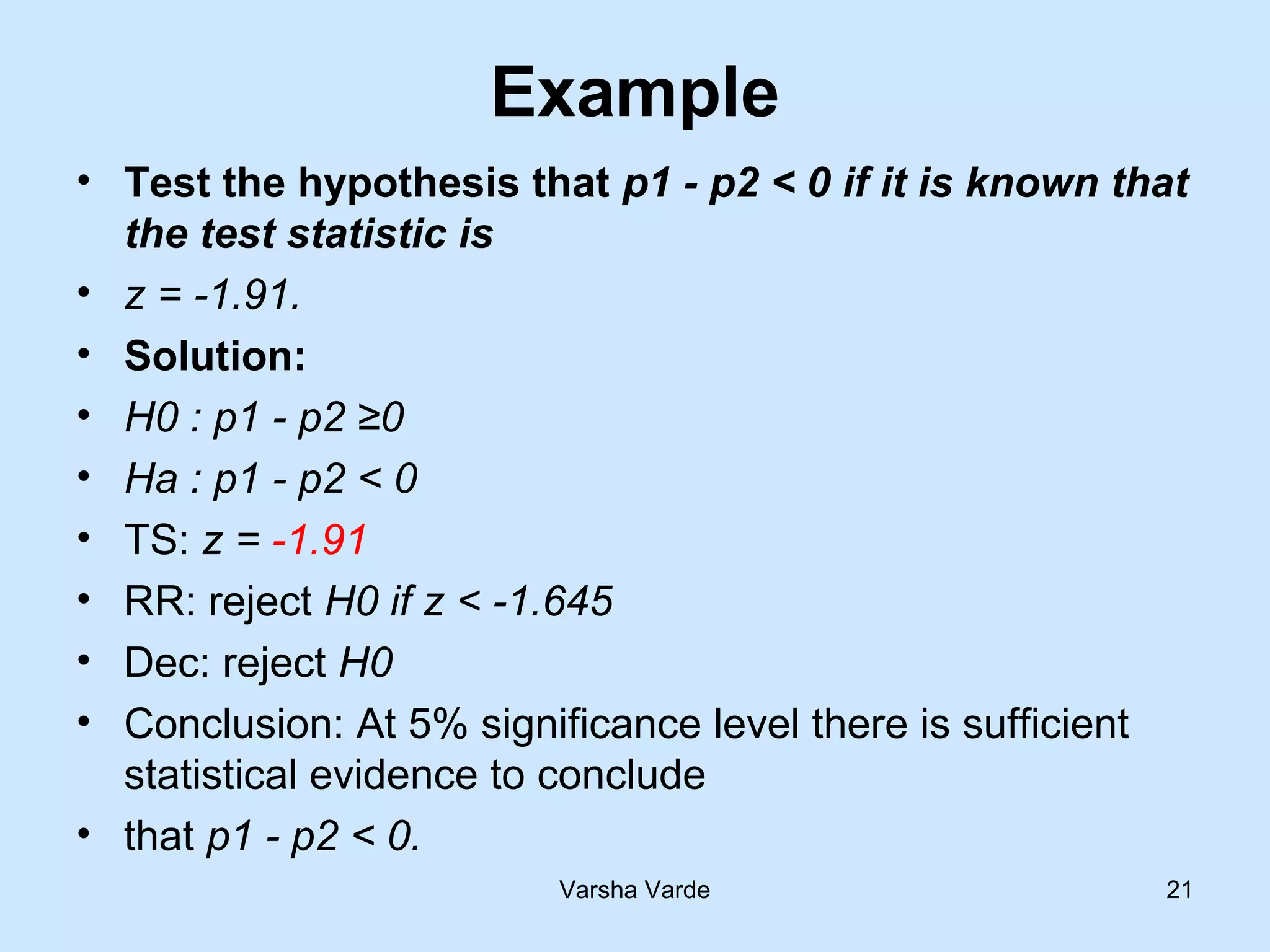
Example
• Test the hypothesis that p1 - p2 < 0 if it is known that
the test statistic is
• z = -1.91.
• Solution:
• H0 : p1 - p2 ≥0
• Ha : p1 - p2 < 0
• TS: z = -1.91
• RR: reject H0 if z < -1.645
• Dec: reject H0
• Conclusion: At 5% significance level there is sufficient
statistical evidence to conclude
• that p1 - p2 < 0.
Varsha Varde 21
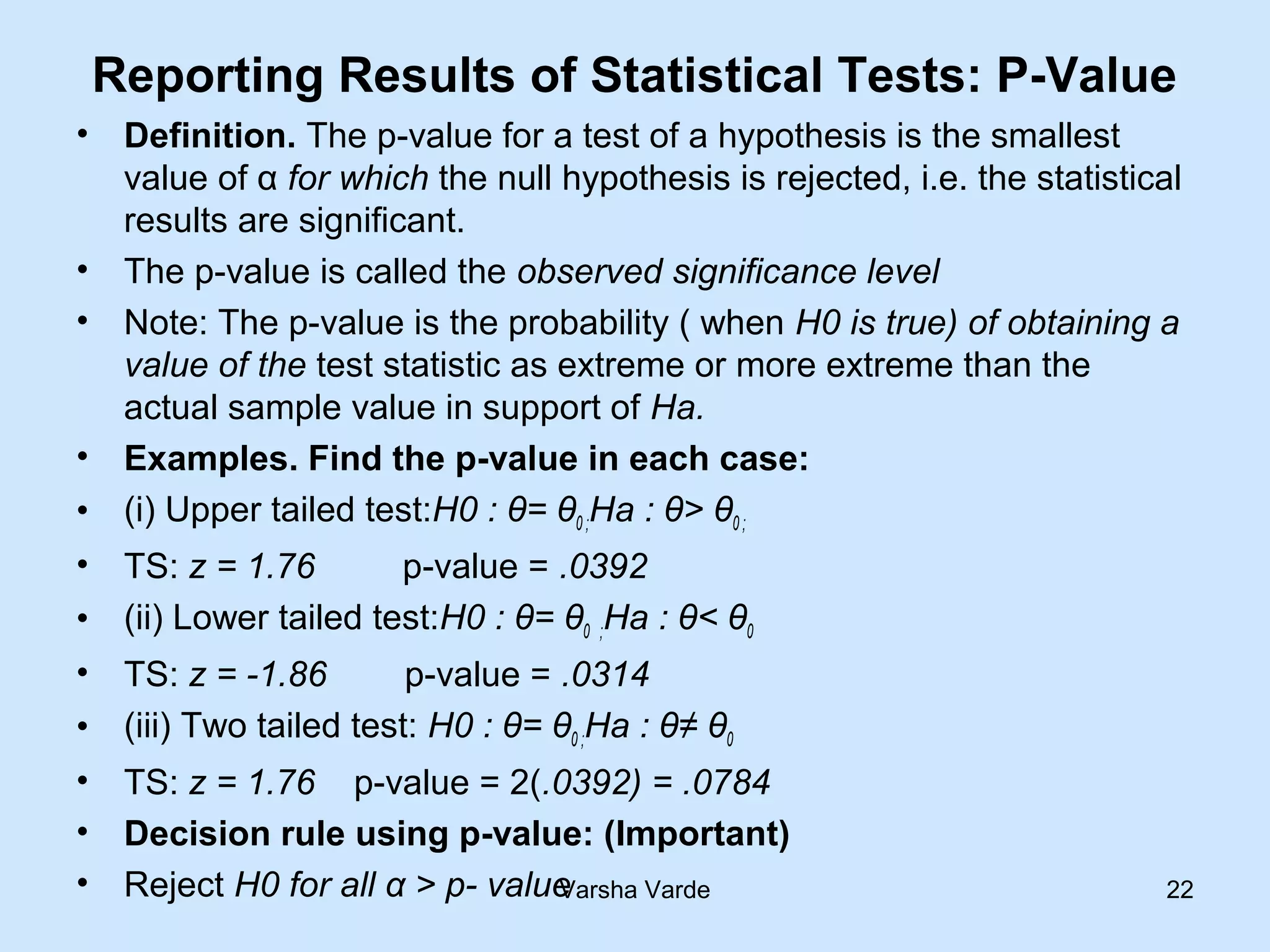
Reporting Results of Statistical Tests: P-Value
• Definition. The p-value for a test of a hypothesis is the smallest
value of α for which the null hypothesis is rejected, i.e. the statistical
results are significant.
• The p-value is called the observed significance level
• Note: The p-value is the probability ( when H0 is true) of obtaining a
value of the test statistic as extreme or more extreme than the
actual sample value in support of Ha.
• Examples. Find the p-value in each case:
• (i) Upper tailed test:H0 : θ= θ0 ;Ha : θ> θ0 ;
• TS: z = 1.76 p-value = .0392
• (ii) Lower tailed test:H0 : θ= θ0 ;Ha : θ< θ0
• TS: z = -1.86 p-value = .0314
• (iii) Two tailed test: H0 : θ= θ0 ;Ha : θ≠ θ0
• TS: z = 1.76 p-value = 2(.0392) = .0784
• Decision rule using p-value: (Important)
• Reject H0 for all α > p- valueVarsha Varde 22
Varsha Varde 23
Varsha Varde 24
Varsha Varde 25
Varsha Varde 26
Varsha Varde 27
Varsha Varde 28
Varsha Varde 29

08 test of hypothesis large sample.ppt

  • 1.
  • 2.
    Varsha Varde 2 •Contents. • 1. Elements of a statistical test • 2. A Large-sample statistical test • 3. Testing a population mean • 4. Testing a population proportion • 5. Testing the difference between two population means • 6. Testing the difference between two population proportions • 7. Reporting results of statistical tests: p-Value
  • 3.
    Varsha Varde 3 Mechanicsof Hypothesis Testing •Null Hypothesis :Ho: What You Believe (Claim/Status quo) •Alternative Hypothesis: Ha: The Opposite (prove or disprove with sample study)
  • 4.
    Ha is lessthan type or left-tail test • 1. One-Sided Test of Hypothesis: • < (Ha is less than type or left-tail test). • To see if a minimum standard is met • Examples • Contents of cold drink in a bottle • Weight of rice in a pack • Null hypothesis (H0) : : µ = µ0 Alternative hypothesis (Ha): : µ < µ0 Varsha Varde 4
  • 5.
    Ha is morethan type or right -tail test • One-Sided Test of Hypothesis: • > (Ha is more than type or right -tail test). • To see that maximum standards are not exceeded. • Examples • Defectives In a Lot • Accountant Claims that Hardly 1% Account Statements Contain Error • . Null hypothesis (H0): p = p0 Alternative hypothesis (Ha): p > p0
  • 6.
    Two-Sided Test ofHypothesis: • Two-Sided Test of Hypothesis: • ≠ (Ha not equal to type) • Divergence in either direction is critical • Examples • Shirt Size of 42 • Size of Bolt & nuts • Null hypothesis (H0) : µ = µ0 Alternative hypothesis (Ha): µ ≠ µ0 Varsha Varde 6
  • 7.
    DEFINITIONS • Type Ierror ≡{ reject H0|H0 is true } • Type II error ≡{ do not reject H0|H0 is false} • α= Prob{Type I error} • β= Prob{Type II error} • Power of a statistical test: Prob{reject H0 |H0 is false }= 1-β Varsha Varde 7
  • 8.
    EXAMPLE • Example 1. •H0: Innocent • Ha: Guilty • α= Prob{sending an innocent person to jail} • β= Prob{letting a guilty person go free} • Example 2. • H0: New drug is not acceptable • Ha: New drug is acceptable • α= Prob{marketing a bad drug} • β= Prob{not marketing an acceptable drug} Varsha Varde 8
  • 9.
    GENERAL PROCEDURE FORHYPOTHESIS TESTING • Formulate the null & alternative hypothesis • Equality Sign Should Always Be In Null Hypothesis • Choose the appropriate sampling distribution • Select the level of significance and hence the critical values which specify the rejection and acceptance region • Compute the test statistics and compare it to critical values • Reject the Null Hypothesis if test statistics falls in the rejection region .Otherwise accept it
  • 10.
    • Null hypothesis:H0 • Alternative (research) hypothesis: Ha • Test statistic: • Rejection region : reject H0 if ..... • Decision: either “Reject H0 ” or “Do not reject H0 ” • Conclusion: At 100α% significance level there is (in)sufficient statistical evidence to “ favour Ha” . • Comments: • * H0 represents the status-quo • * Ha is the hypothesis that we want to provide evidence to justify. We show that Ha is true by showing that H0 is false, that is proof by contradiction. Varsha Varde 10
  • 11.
    A general Large-SampleStatistical Test • Parameter of interest: θ • Sample data: n, ˆθ, σˆθ • Other information: µ0= target value, α= Level of significance • Test:Null hypothesis (H0) : θ= θ0 :Alternative hypothesis (Ha): 1) θ > θ0 or 2) θ <θ0 or 3) θ ≠θ0 • Test statistic (TS): z =(ˆθ - θ0 )/σˆθ • Critical value: either zα or zα/2 Varsha Varde 11
  • 12.
    A General Large-SampleStatistical Test • Rejection region (RR) : • 1) Reject H0 if z > zα • 2) Reject H0 if z < - zα • 3) Reject H0 if z > zα/2 or z < -zα/2 Decision: 1) if observed value is in RR: “Reject H0” • 2) if observed value is not in RR: “Do not reject H0” • Conclusion: At 100α% significance level there is (in)sufficient statistical evidence to…….. . • Assumptions: Large sample + others (to be specified in each case). Varsha Varde 12
  • 13.
    Testing a PopulationMean • Parameter of interest: µ • Sample data: n, x¯, s • Other information: µ0= target value, α • Test: H0 : µ = µ0 • Ha : 1) µ > µ0 ; 2) µ < µ0 ; 3) µ ≠ µ0 • T.S. :z =x¯- µ0 /σ/√n • Rejection region (RR) : • 1) Reject H0 if z > zα • 2) Reject H0 if z < - zα • 3) Reject H0 if z > zα/2 or z < -zα/2 • Graph: • Decision: 1) if observed value is in RR: “Reject H0” • 2) if observed value is not in RR: “Do no reject H0”Varsha Varde 13
  • 14.
    Testing a PopulationMean • Conclusion: At 100α% significance level there is (in)suficient statistical evidence to “ favour Ha” . • Assumptions: • Large sample (n ≥30) • Sample is randomly selected Varsha Varde 14
  • 15.
    EXAMPLE • Example: Itis claimed that weight loss in a new diet program is at least 20 pounds during the first month. Formulate &Test the appropriate hypothesis • Sample data : n = 36, x¯ = 21, s2 = 25, µ0 = 20, α= 0.05 • H0 : µ ≥20 (µ is 20 or larger) • Ha : µ < 20 (µ is less than 20) • T.S. :z =(x - µ0 )/(s/√n)=21 – 20/5/√36= 1.2 • Critical value: zα= -1.645 • RR: Reject H0 if z < -1.645 • Decision: Do not reject H0 • Conclusion: At 5% significance level there is sufficient statistical evidence to conclude that weight loss in a new diet program exceeds 20 pounds per first month. Varsha Varde 15
  • 16.
    Testing a PopulationProportion • Parameter of interest: p (unknown parameter) • Sample data: n and x (or p = x/n) • p0 = target value • α (significance level) • Test:H0 : p = p0 • Ha: 1) p > p0; 2) p < p0; 3) p = p0 • T.S. :z =( p - p0)/√p0q0/n • Rejection region (RR) : • 1) Reject H0 if z > zα • 2) Reject H0 if z < - zα • 3) Reject H0 if z > zα/2 or z < -zα/2 • Decision: 1) if observed value is in RR: “Reject H0” • 2) if observed value is not in RR: “Do no reject H0” Varsha Varde
  • 17.
    Example • Test thehypothesis that p > .10 for sample data: • n = 200, x = 26. • Solution. p = x/n = 26/200 = .13, • H0 : p ≤ .10 (p is not larger than .10) • Ha : p > .10 • TS:z = (p - p0)/√p0q0/n=.13 - .10/√(.10)(.90)/200= 1.41 • RR: reject H0 if z > 1.645 • Dec: Do not reject H0 • Conclusion: At 5% significance level there is insufficient statistical evidence to conclude that p > .10. • Exercise: Is the large sample assumption satisfied here ? Varsha Varde 17
  • 18.
    Comparing Two PopulationMeans • Parameter of interest: µ1 - µ2 • Sample data: • Sample 1: n1, x¯1, s1 • Sample 2: n2, x¯2, s2 • Test: • H0 : µ1 - µ2 = 0 • Ha : 1)µ1 - µ2 > 0; 2) 1)µ1 - µ2 < 0;3) µ1 - µ2 ≠ 0 • T.S. :z =(x¯1 - x¯2) /√σ2 1/n1+ σ2 2/n2 • RR:1) Reject H0 if z > zα;2) Reject H0 if z < -zα • 3) Reject H0 if z > zα/2 or z < -zα/2 • Assumptions: • 1. Large samples ( n1≥ 30; n2 ≥30) • 2. Samples are randomly selected • 3. Samples are independentVarsha Varde 18
  • 19.
    • Refer tothe weight loss example. Test the hypothesis that weight loss in the two diet programs are different. • 1. Sample 1 : n1 = 36, x¯1 = 21, s2 1 = 25 (old) • 2. Sample 2 : n2 = 36, x¯2 = 18.5, s2 2 = 24 (new) • α= 0.05 • H0 : µ1 - µ2 = 0 • Ha : µ1 - µ2 ≠ 0, • T.S. :z =(x¯1 - x¯2) – 0/√σ2 1/n1+ ó2 2/n2= 2.14 • Critical value: zα/2 = 1.96 • RR: Reject H0 if z > 1.96 or z < -1.96 • Decision: Reject H0 • Conclusion: At 5% significance level there is sufficient statistical evidence to conclude that weight loss in the two diet programs are different.Varsha Varde 19
  • 20.
    • Parameter ofinterest: p1 - p2 • Sample 1: n1, x1, ─ p1 = x1/n1 • Sample 2: n2, x2, ─ p2 = x2/n2 • p1 - p2 (unknown parameter) • Common estimate: ─ p =(x1 + x2)/(n1 + n2) • Test:H0 : p1 - p2 = 0 • Ha : 1) p1 - p2 > 0;2) p1 - p2 < 0;3) p1 - p2 = 0 • TEST STATISTICS:z =(─ p1 - ─ p2) / √ ─ p ─ q(1/n1 + 1/n2) • RR:1) Reject H0 if z > zα • 2) Reject H0 if z < -zα • 3) Reject H0 if z > zα/2 or z < -zα/2 • Assumptions: • Large sample(n1p1≥ 5, n1q1 ≥5, n2p2 ≥5, n2q2 ≥5) • Samples are randomly and independently selected Varsha Varde 20
  • 21.
    Example • Test thehypothesis that p1 - p2 < 0 if it is known that the test statistic is • z = -1.91. • Solution: • H0 : p1 - p2 ≥0 • Ha : p1 - p2 < 0 • TS: z = -1.91 • RR: reject H0 if z < -1.645 • Dec: reject H0 • Conclusion: At 5% significance level there is sufficient statistical evidence to conclude • that p1 - p2 < 0. Varsha Varde 21
  • 22.
    Reporting Results ofStatistical Tests: P-Value • Definition. The p-value for a test of a hypothesis is the smallest value of α for which the null hypothesis is rejected, i.e. the statistical results are significant. • The p-value is called the observed significance level • Note: The p-value is the probability ( when H0 is true) of obtaining a value of the test statistic as extreme or more extreme than the actual sample value in support of Ha. • Examples. Find the p-value in each case: • (i) Upper tailed test:H0 : θ= θ0 ;Ha : θ> θ0 ; • TS: z = 1.76 p-value = .0392 • (ii) Lower tailed test:H0 : θ= θ0 ;Ha : θ< θ0 • TS: z = -1.86 p-value = .0314 • (iii) Two tailed test: H0 : θ= θ0 ;Ha : θ≠ θ0 • TS: z = 1.76 p-value = 2(.0392) = .0784 • Decision rule using p-value: (Important) • Reject H0 for all α > p- valueVarsha Varde 22
  • 23.
  • 24.
  • 25.
  • 26.
  • 27.
  • 28.
  • 29.