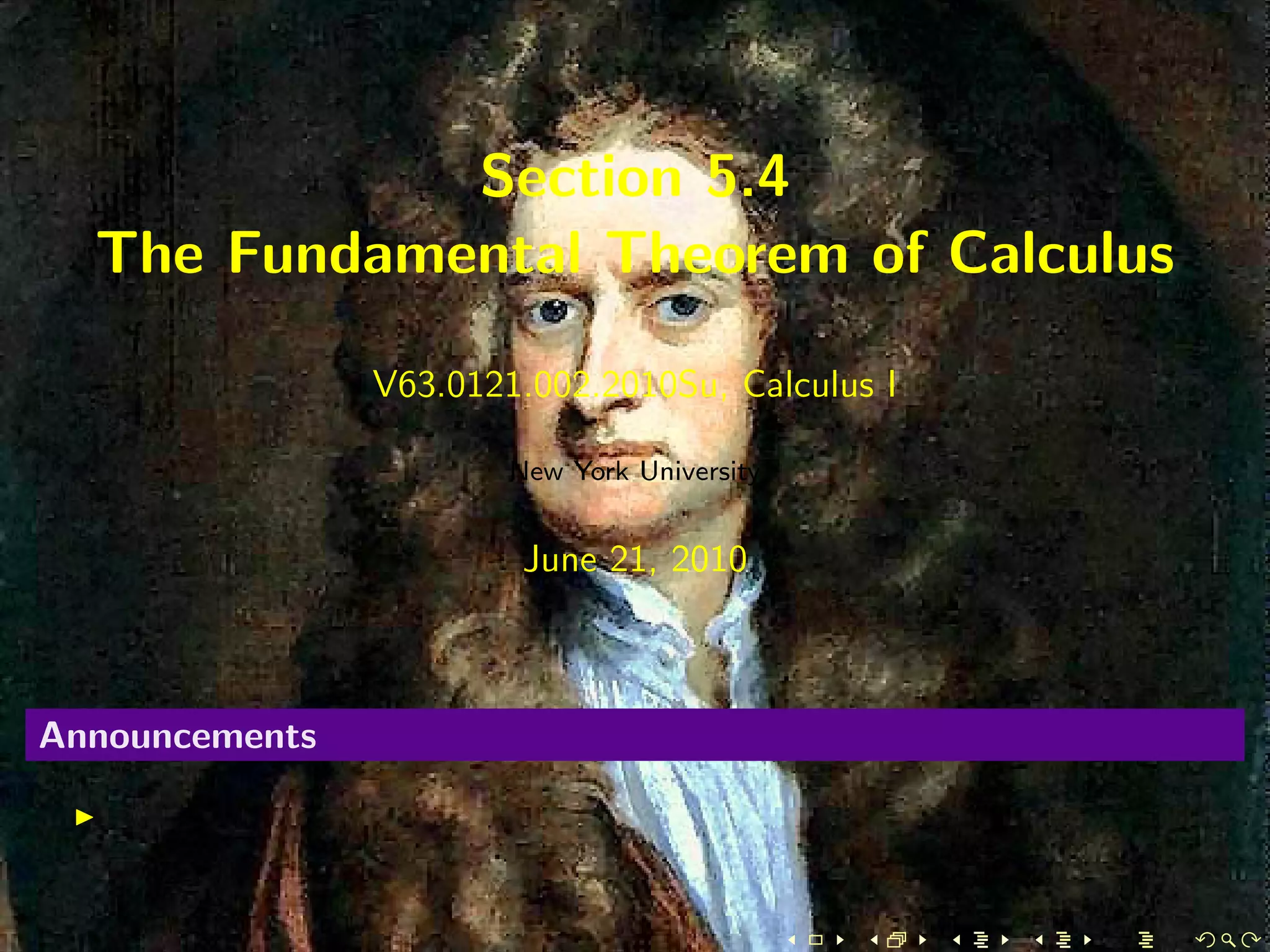
Section 5.4
  The Fundamental Theorem of Calculus

                V63.0121.002.2010Su, Calculus I

                        New York University


                         June 21, 2010


Announcements
Announcements


V63.0121.002.2010Su, Calculus I (NYU)   Section 5.4 The Fundamental Theorem   June 21, 2010   2 / 33
Objectives


           State and explain the
           Fundemental Theorems of
           Calculus
           Use the first fundamental
           theorem of calculus to find
           derivatives of functions
           defined as integrals.
           Compute the average value
           of an integrable function
           over a closed interval.


V63.0121.002.2010Su, Calculus I (NYU)   Section 5.4 The Fundamental Theorem   June 21, 2010   3 / 33
Outline


 Recall: The Evaluation Theorem a/k/a 2FTC

 The First Fundamental Theorem of Calculus
   The Area Function
   Statement and proof of 1FTC
   Biographies

 Differentiation of functions defined by integrals
    “Contrived” examples
    Erf
    Other applications


V63.0121.002.2010Su, Calculus I (NYU)   Section 5.4 The Fundamental Theorem   June 21, 2010   4 / 33
The definite integral as a limit


 Definition
 If f is a function defined on [a, b], the definite integral of f from a to b
 is the number
                                        b                            n
                                            f (x) dx = lim               f (ci ) ∆x
                                    a                     ∆x→0
                                                                   i=1


V63.0121.002.2010Su, Calculus I (NYU)       Section 5.4 The Fundamental Theorem       June 21, 2010   5 / 33
Big time Theorem


 Theorem (The Second Fundamental Theorem of Calculus)
 Suppose f is integrable on [a, b] and f = F for another function F , then
                                            b
                                                f (x) dx = F (b) − F (a).
                                        a


V63.0121.002.2010Su, Calculus I (NYU)   Section 5.4 The Fundamental Theorem   June 21, 2010   6 / 33
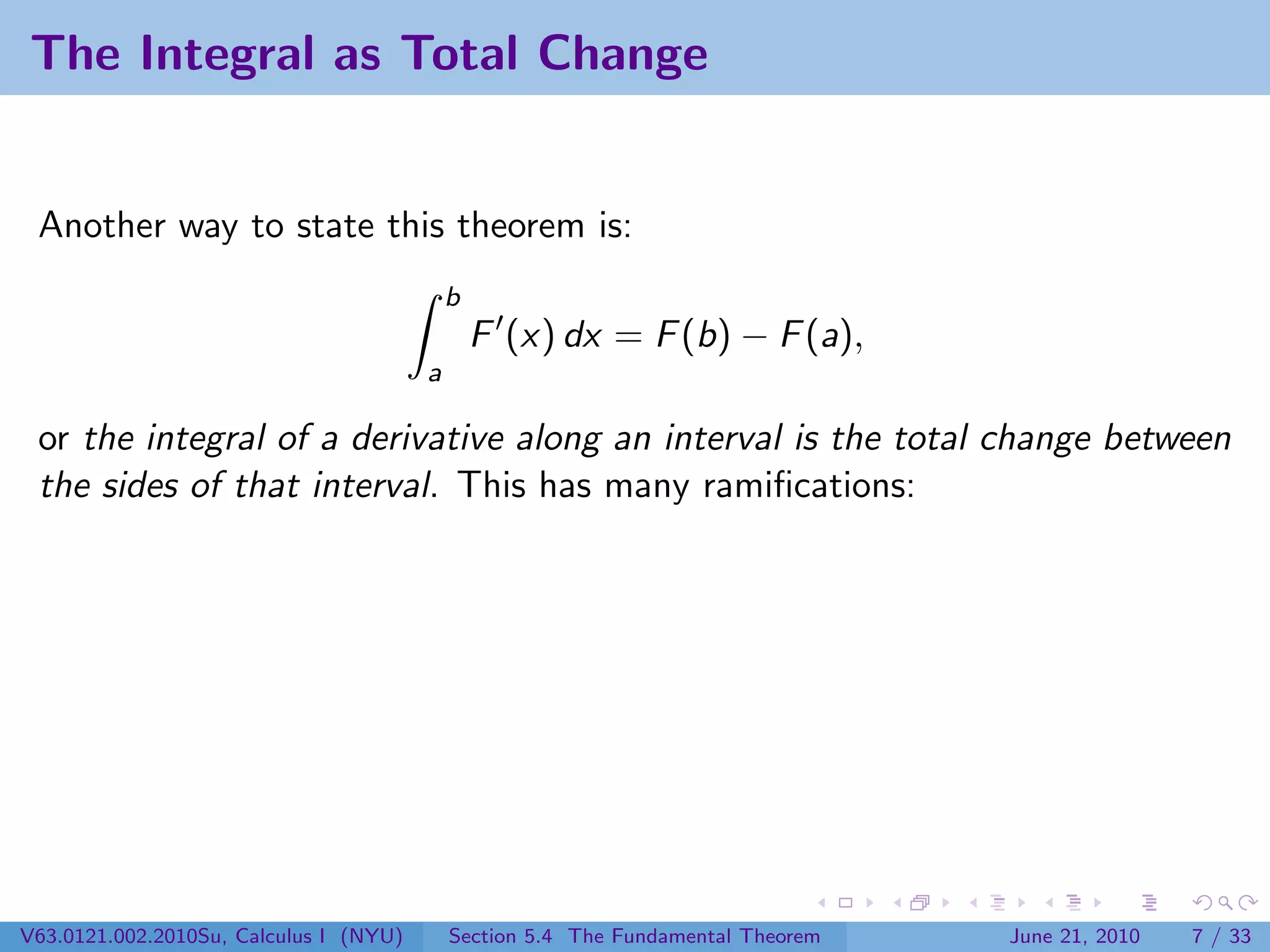
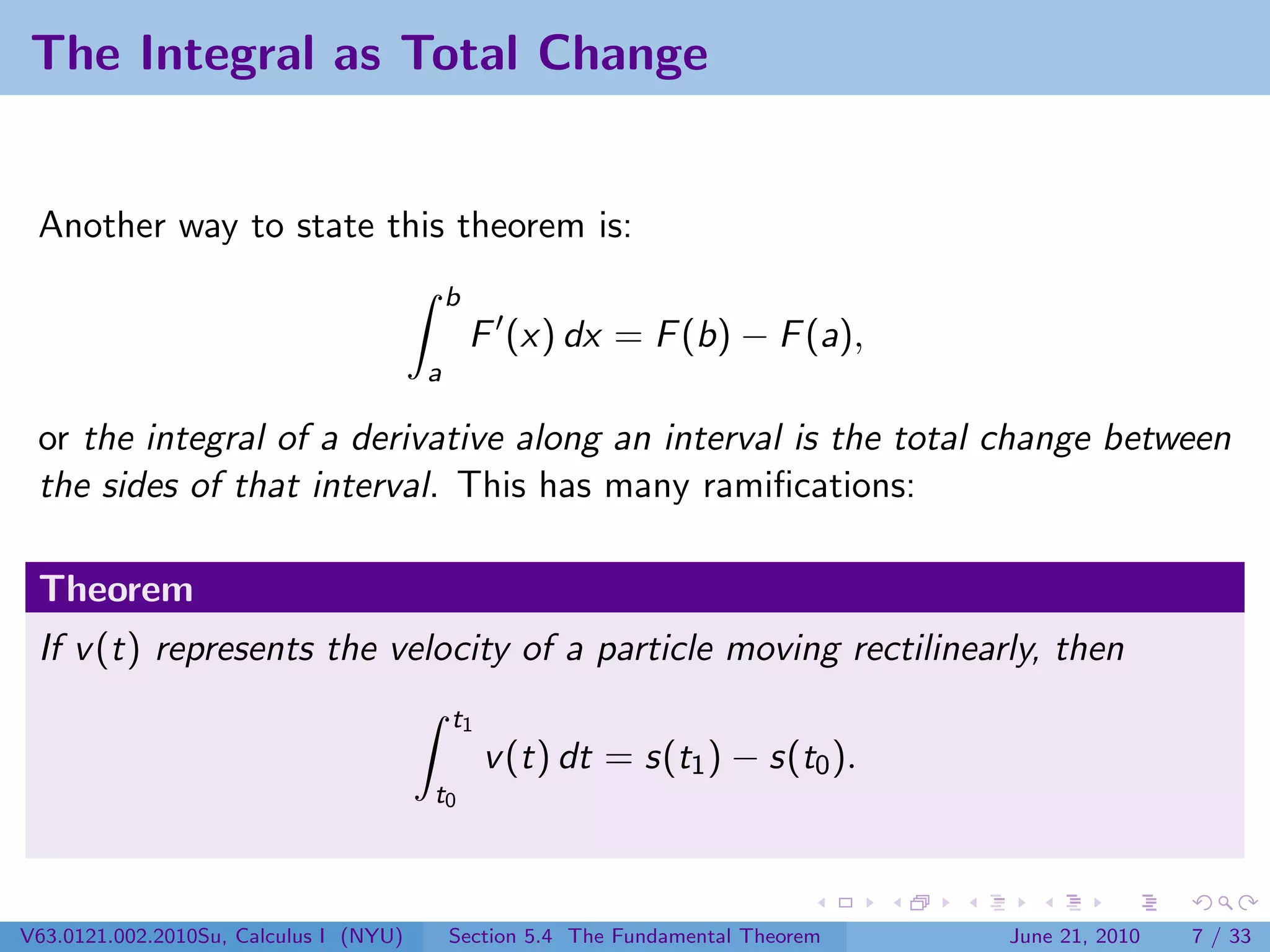
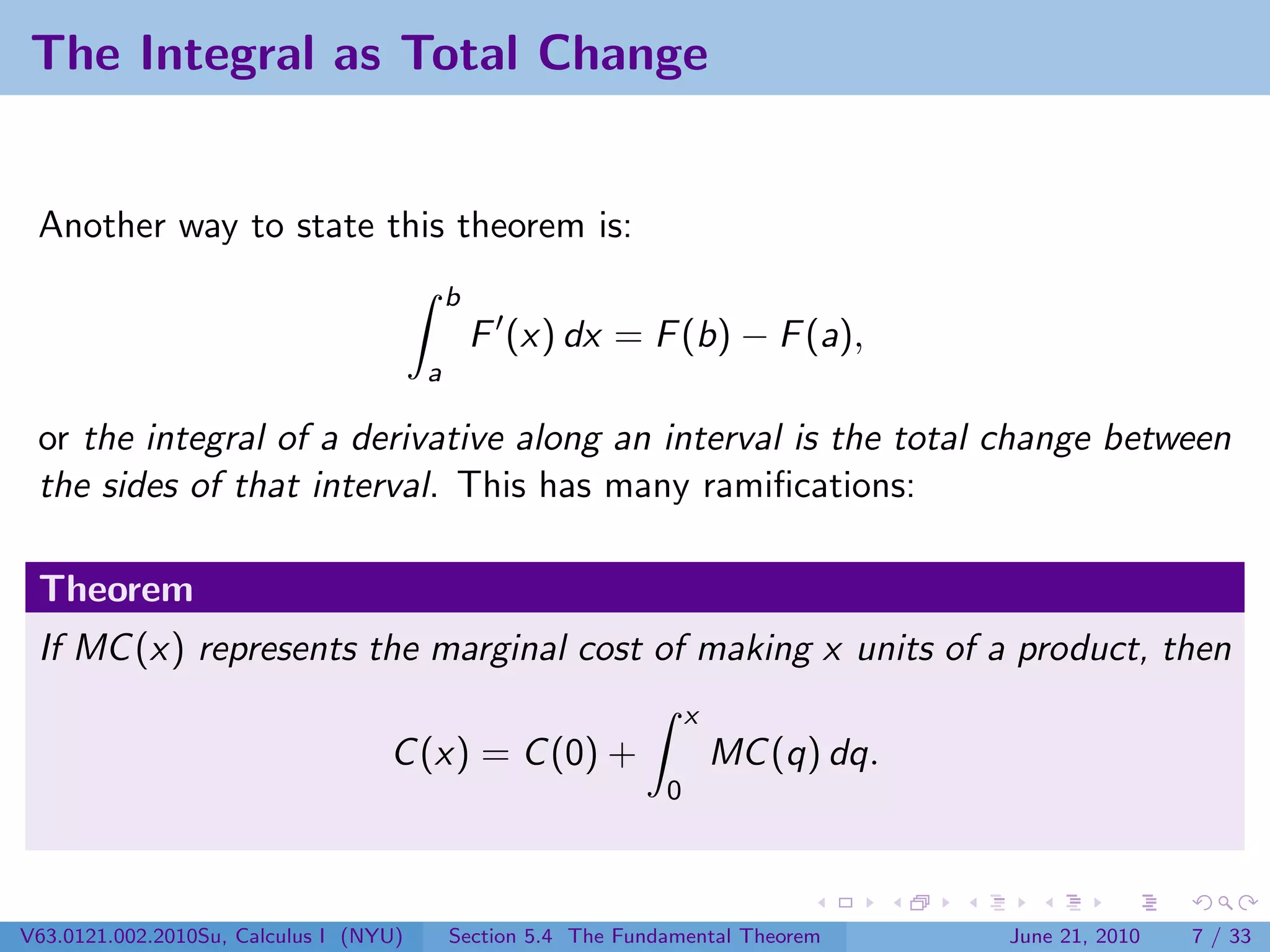
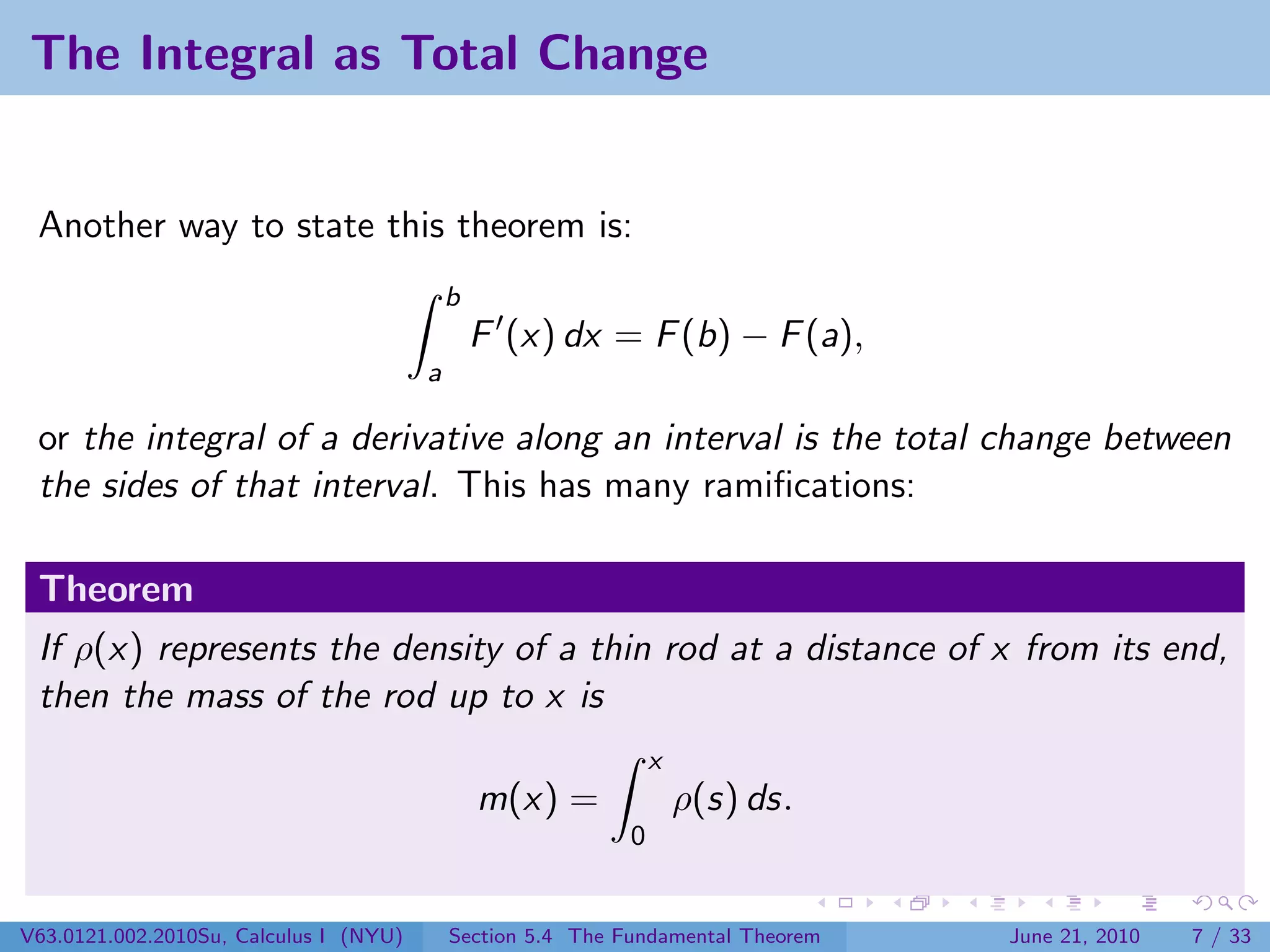
The Integral as Total Change


 Another way to state this theorem is:
                                            b
                                                F (x) dx = F (b) − F (a),
                                        a

 or the integral of a derivative along an interval is the total change between
 the sides of that interval. This has many ramifications:


V63.0121.002.2010Su, Calculus I (NYU)       Section 5.4 The Fundamental Theorem   June 21, 2010   7 / 33
The Integral as Total Change


 Another way to state this theorem is:
                                            b
                                                F (x) dx = F (b) − F (a),
                                        a

 or the integral of a derivative along an interval is the total change between
 the sides of that interval. This has many ramifications:

 Theorem
 If v (t) represents the velocity of a particle moving rectilinearly, then
                                            t1
                                                 v (t) dt = s(t1 ) − s(t0 ).
                                        t0


V63.0121.002.2010Su, Calculus I (NYU)       Section 5.4 The Fundamental Theorem   June 21, 2010   7 / 33
The Integral as Total Change


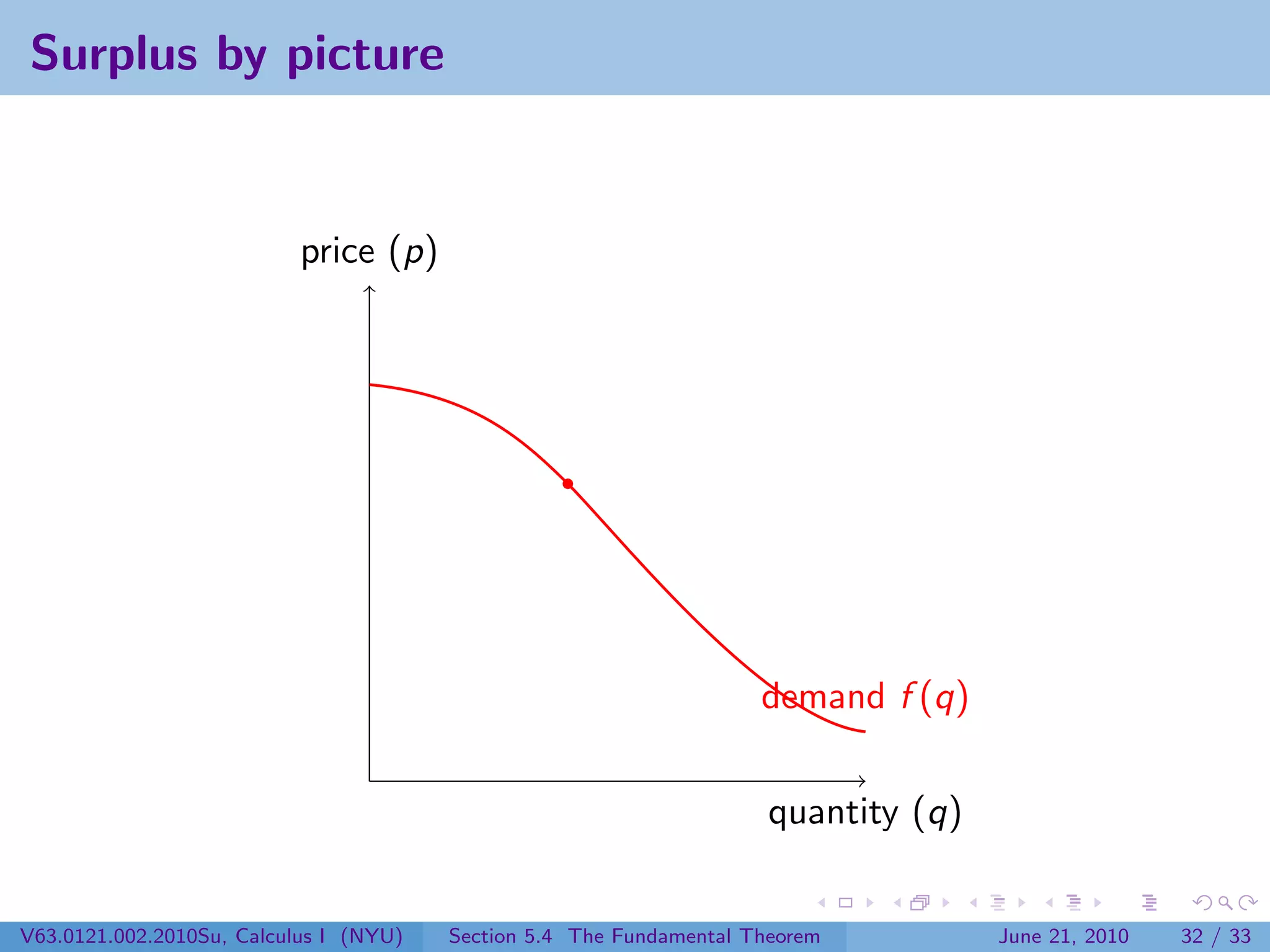
 Another way to state this theorem is:
                                            b
                                                F (x) dx = F (b) − F (a),
                                        a

 or the integral of a derivative along an interval is the total change between
 the sides of that interval. This has many ramifications:

 Theorem
 If MC (x) represents the marginal cost of making x units of a product, then
                                                                    x
                                   C (x) = C (0) +                      MC (q) dq.
                                                                0


V63.0121.002.2010Su, Calculus I (NYU)       Section 5.4 The Fundamental Theorem      June 21, 2010   7 / 33
The Integral as Total Change


 Another way to state this theorem is:
                                            b
                                                F (x) dx = F (b) − F (a),
                                        a

 or the integral of a derivative along an interval is the total change between
 the sides of that interval. This has many ramifications:

 Theorem
 If ρ(x) represents the density of a thin rod at a distance of x from its end,
 then the mass of the rod up to x is
                                                                 x
                                                m(x) =               ρ(s) ds.
                                                             0


V63.0121.002.2010Su, Calculus I (NYU)       Section 5.4 The Fundamental Theorem   June 21, 2010   7 / 33
My first table of integrals


          [f (x) + g (x)] dx =          f (x) dx +      g (x) dx

                        x n+1
            x n dx =          + C (n = −1)                    cf (x) dx = c    f (x) dx
                        n+1
                                                                   1
                     e x dx = e x + C                                dx = ln |x| + C
                                                                   x
                                                                            ax
                 sin x dx = − cos x + C                            ax dx =       +C
                                                                           ln a

                  cos x dx = sin x + C                        csc2 x dx = − cot x + C

                 sec2 x dx = tan x + C                     csc x cot x dx = − csc x + C
                                                                  1
               sec x tan x dx = sec x + C                   √          dx = arcsin x + C
                                                                1 − x2
                 1
                      dx = arctan x + C
               1 + x2

V63.0121.002.2010Su, Calculus I (NYU)   Section 5.4 The Fundamental Theorem            June 21, 2010   8 / 33
Outline


 Recall: The Evaluation Theorem a/k/a 2FTC

 The First Fundamental Theorem of Calculus
   The Area Function
   Statement and proof of 1FTC
   Biographies

 Differentiation of functions defined by integrals
    “Contrived” examples
    Erf
    Other applications


V63.0121.002.2010Su, Calculus I (NYU)   Section 5.4 The Fundamental Theorem   June 21, 2010   9 / 33
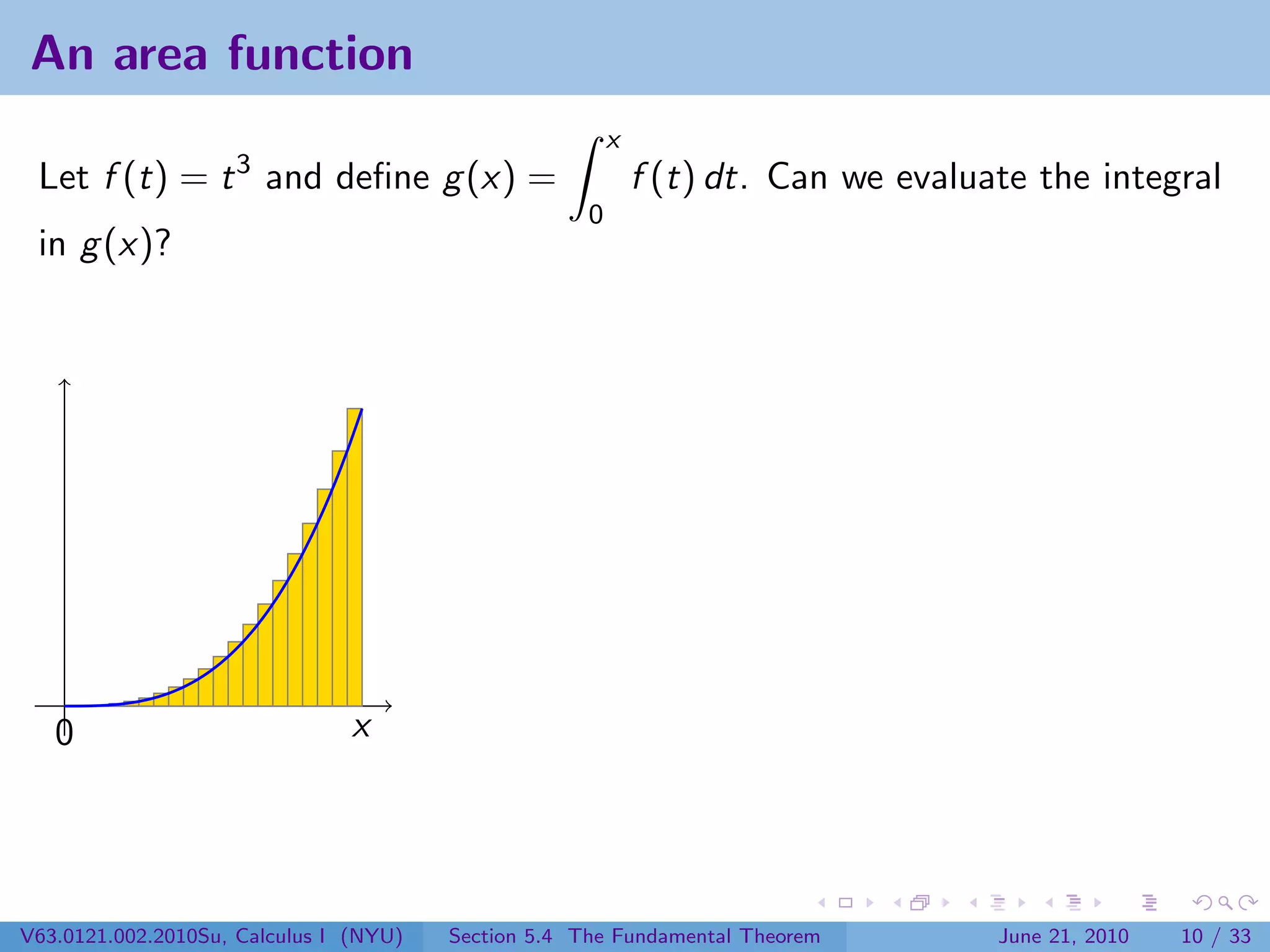
An area function
                                                         x
 Let f (t) = t 3 and define g (x) =                           f (t) dt. Can we evaluate the integral
                                                     0
 in g (x)?


   0                           x


V63.0121.002.2010Su, Calculus I (NYU)   Section 5.4 The Fundamental Theorem         June 21, 2010   10 / 33
An area function
                                                         x
 Let f (t) = t 3 and define g (x) =                           f (t) dt. Can we evaluate the integral
                                                     0
 in g (x)?
                                              Dividing the interval [0, x] into n pieces
                                                          x                        ix
                                              gives ∆t = and ti = 0 + i∆t = . So
                                                          n                         n
                                                       x x 3 x (2x)3                x (nx)3
                                                Rn =      · 3+ ·         3
                                                                             + ··· + ·
                                                       n n         n   n            n   n3
                                                       x4
                                                     = 4 13 + 23 + 33 + · · · + n3
                                                       n
                                                       x4 1            2
                                                     = 4 2 n(n + 1)
                                                       n
   0                           x
                                                       x 4 n2 (n + 1)2     x4
                                                     =           4
                                                                       →
                                                              4n           4
                                              as n → ∞.
V63.0121.002.2010Su, Calculus I (NYU)   Section 5.4 The Fundamental Theorem         June 21, 2010   10 / 33
An area function, continued


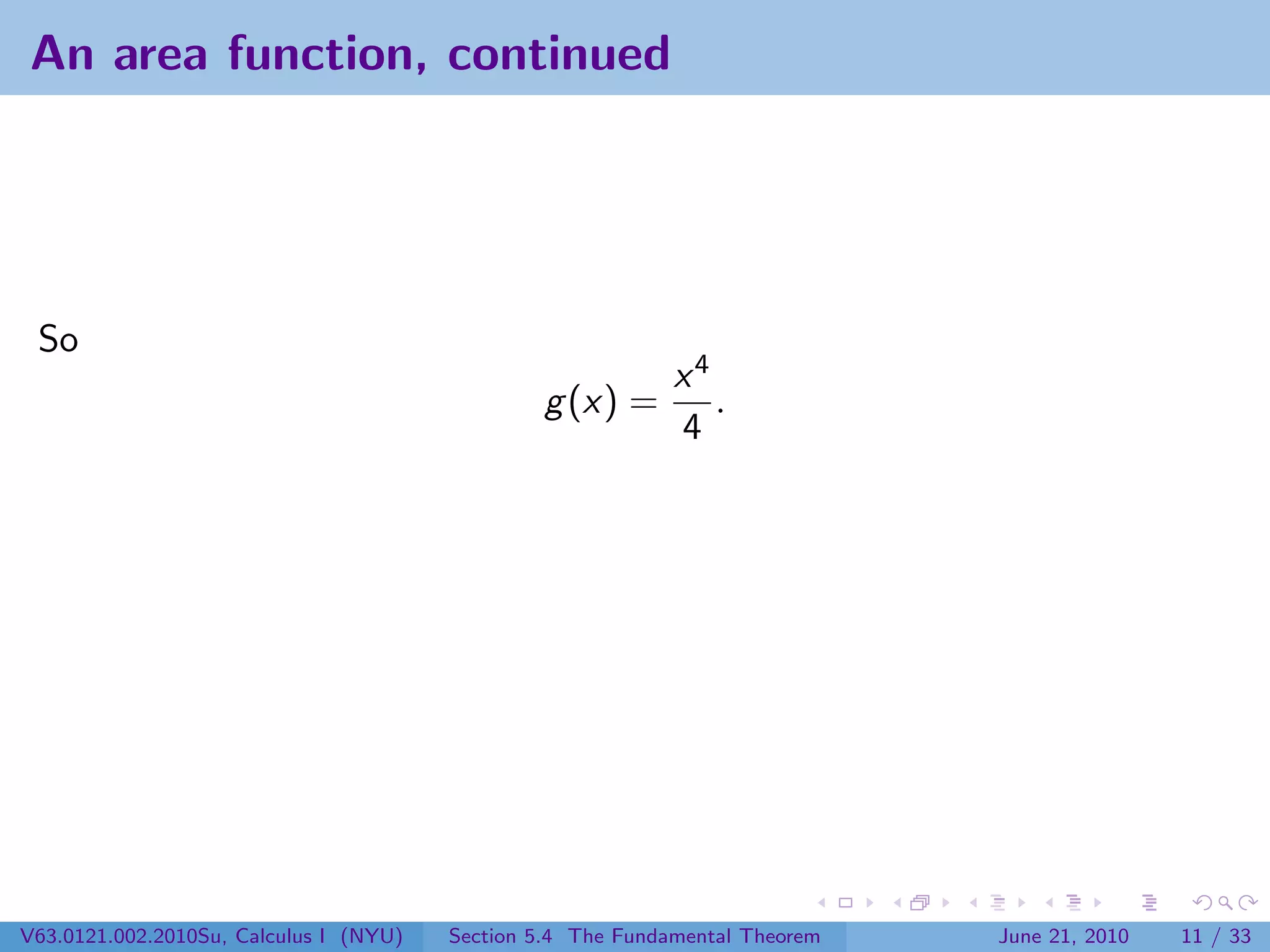
 So
                                                             x4
                                                g (x) =         .
                                                             4


V63.0121.002.2010Su, Calculus I (NYU)   Section 5.4 The Fundamental Theorem   June 21, 2010   11 / 33
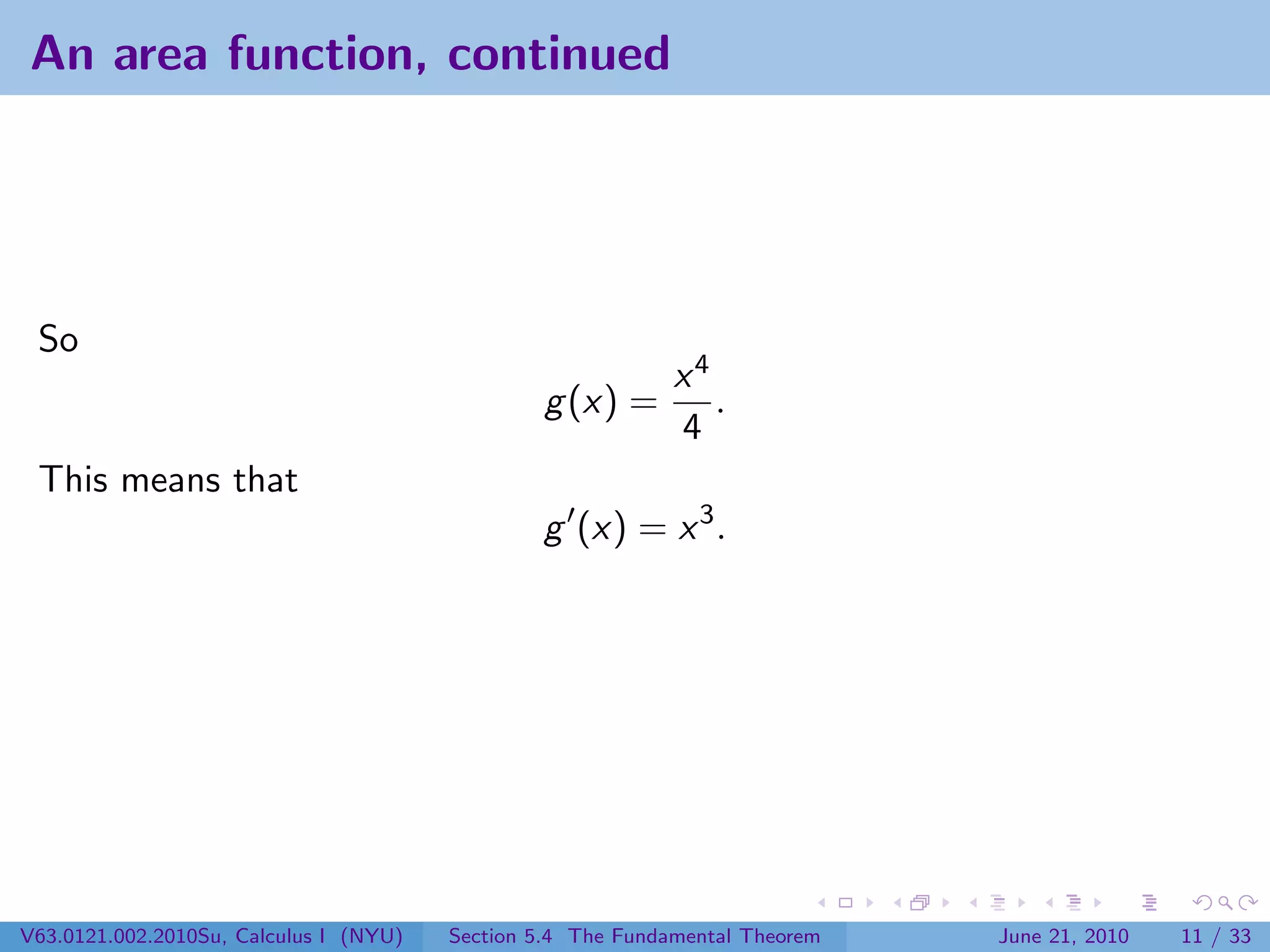
An area function, continued


 So
                                                             x4
                                                g (x) =         .
                                                             4
 This means that
                                                g (x) = x 3 .


V63.0121.002.2010Su, Calculus I (NYU)   Section 5.4 The Fundamental Theorem   June 21, 2010   11 / 33
The area function


 Let f be a function which is integrable (i.e., continuous or with finitely
 many jump discontinuities) on [a, b]. Define
                                                            x
                                           g (x) =              f (t) dt.
                                                        a


         The variable is x; t is a “dummy” variable that’s integrated over.
         Picture changing x and taking more of less of the region under the
         curve.
         Question: What does f tell you about g ?


V63.0121.002.2010Su, Calculus I (NYU)   Section 5.4 The Fundamental Theorem   June 21, 2010   12 / 33
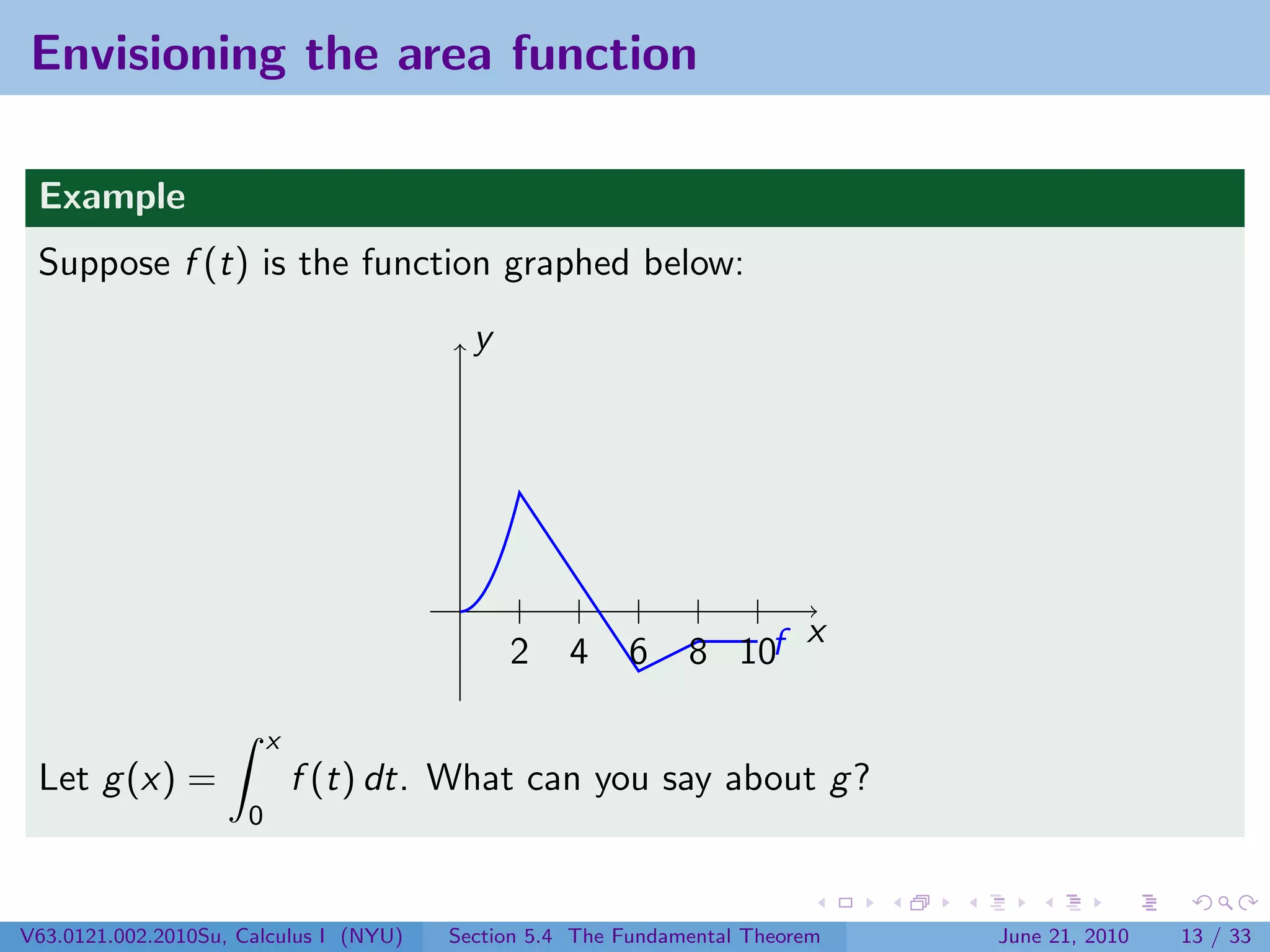
Envisioning the area function

 Example
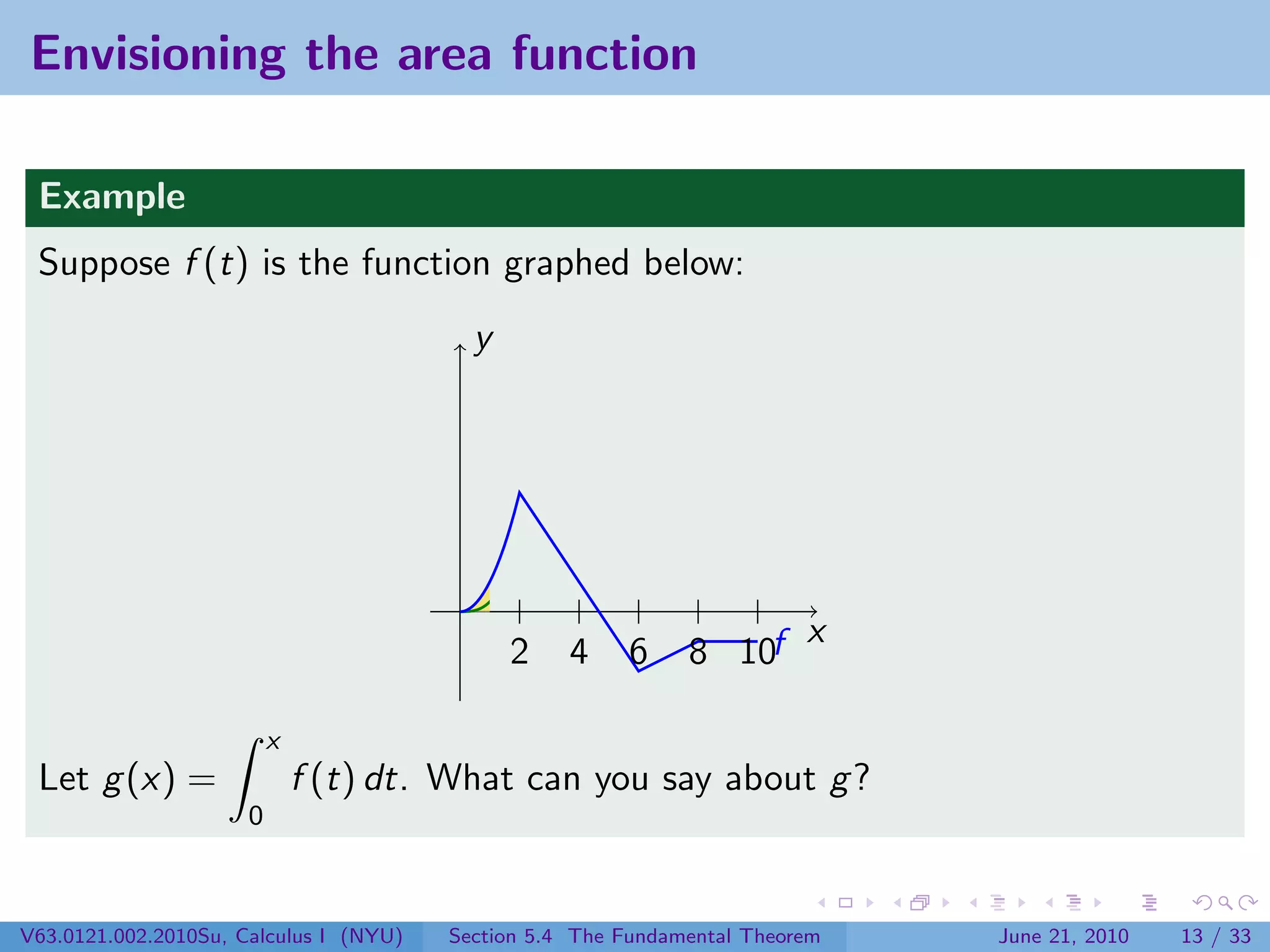
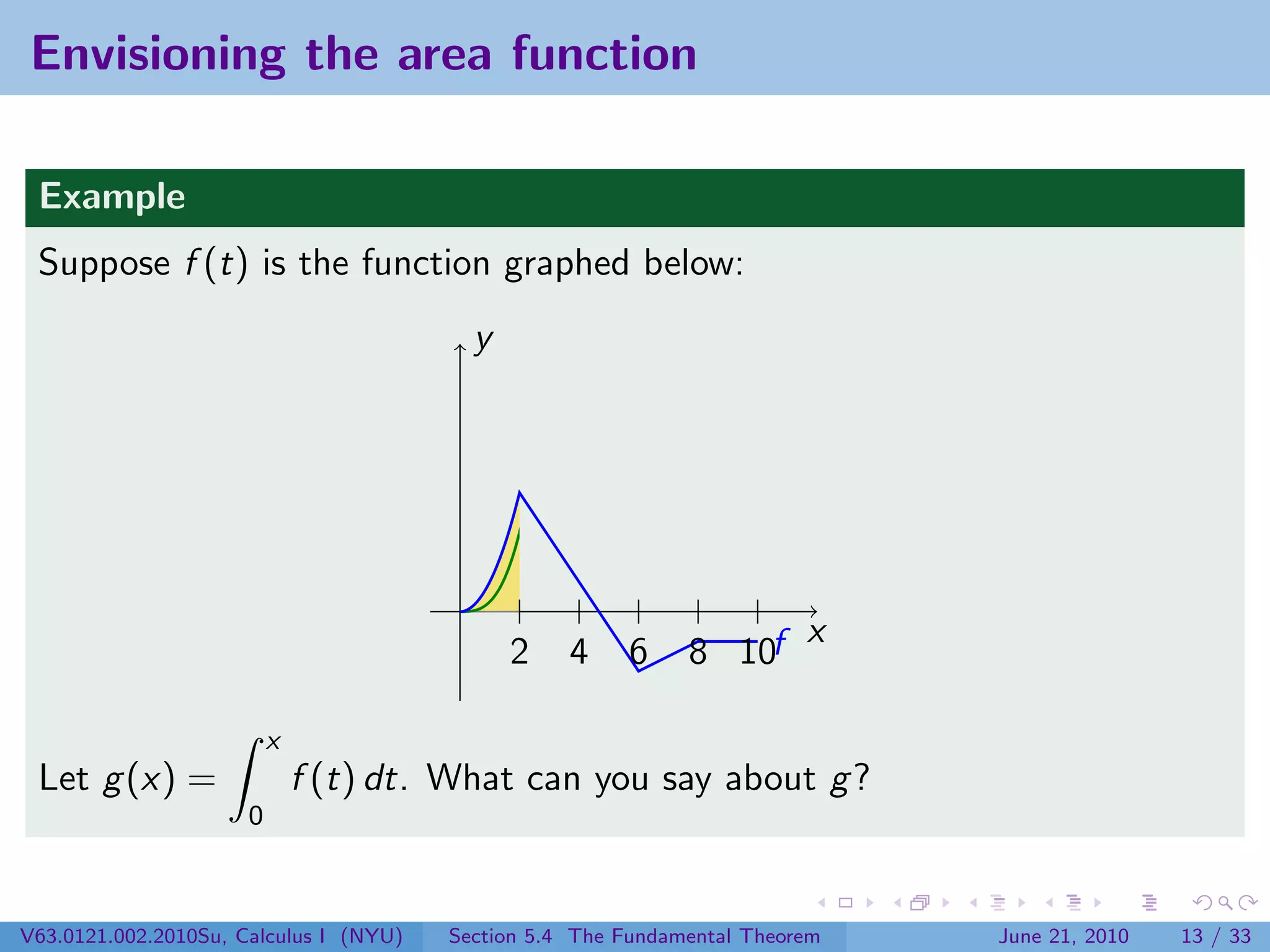
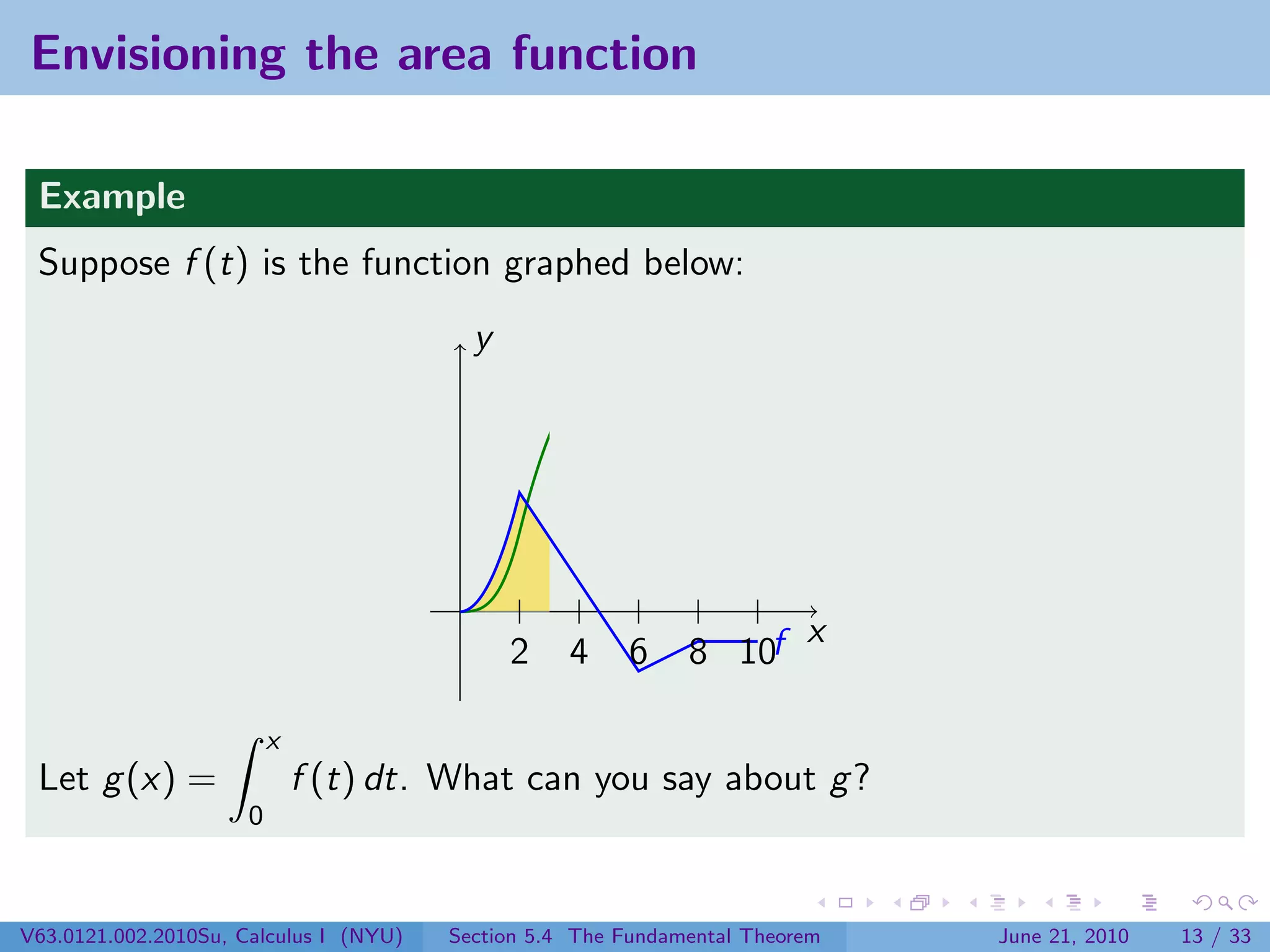
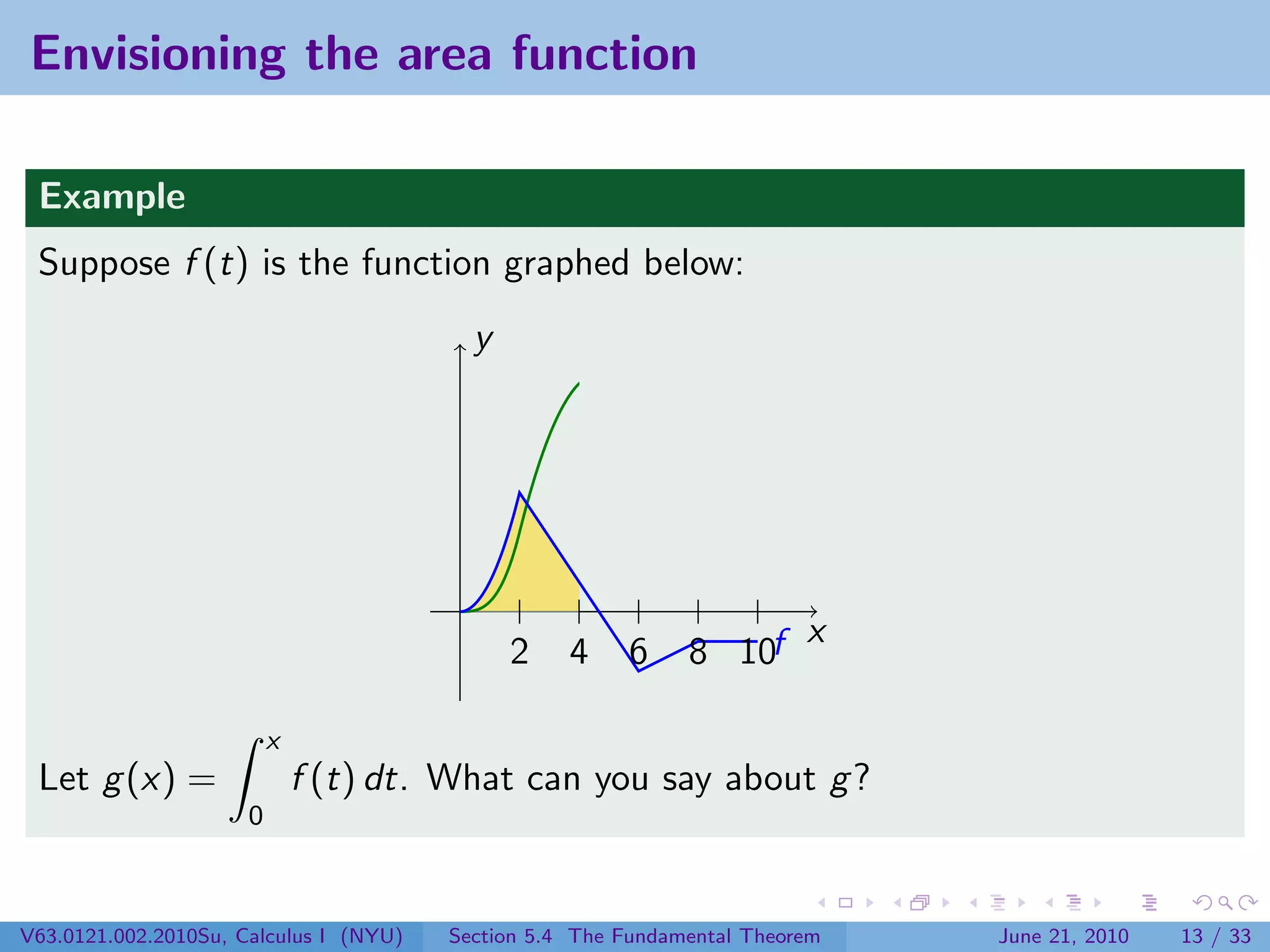
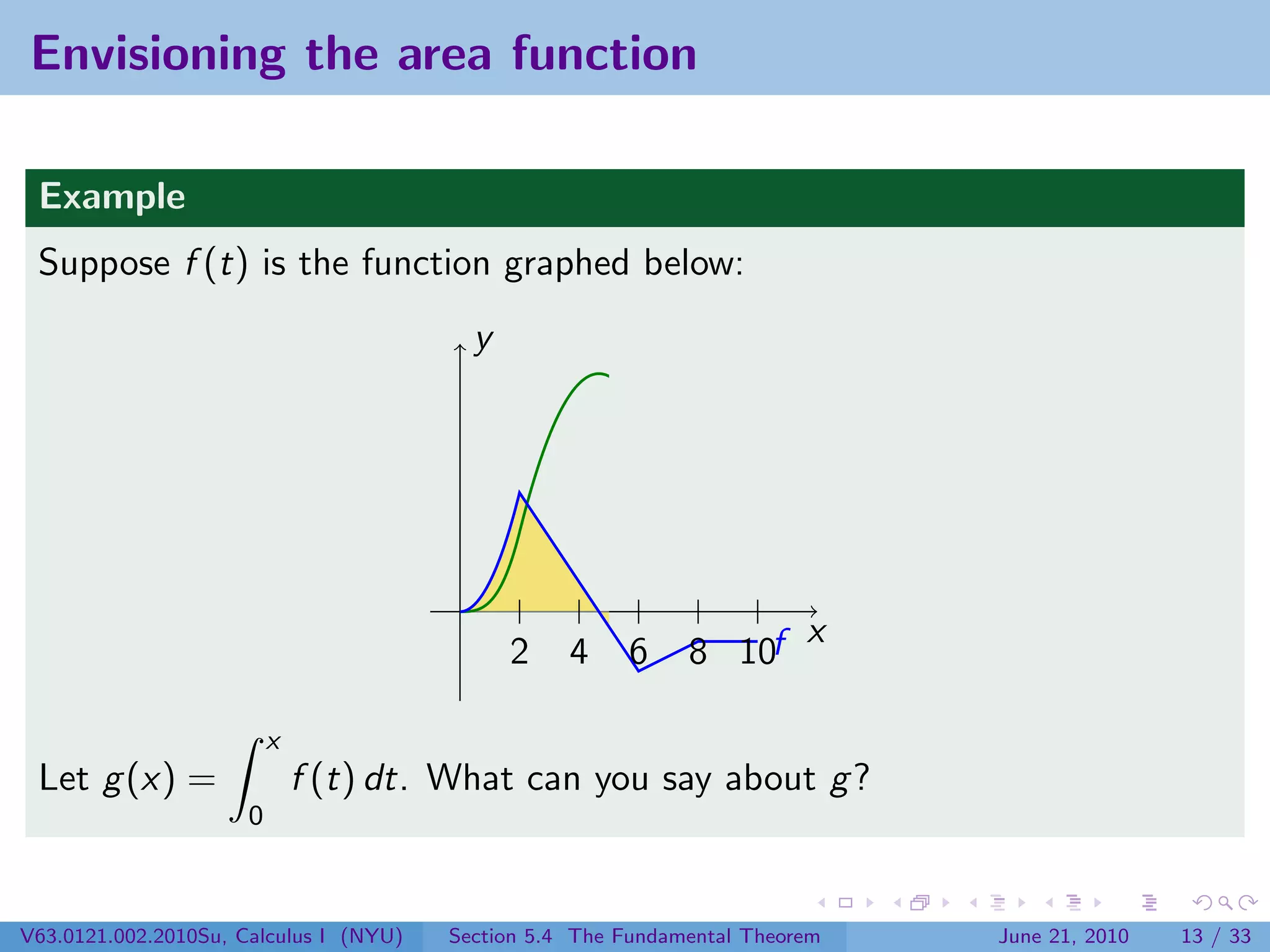
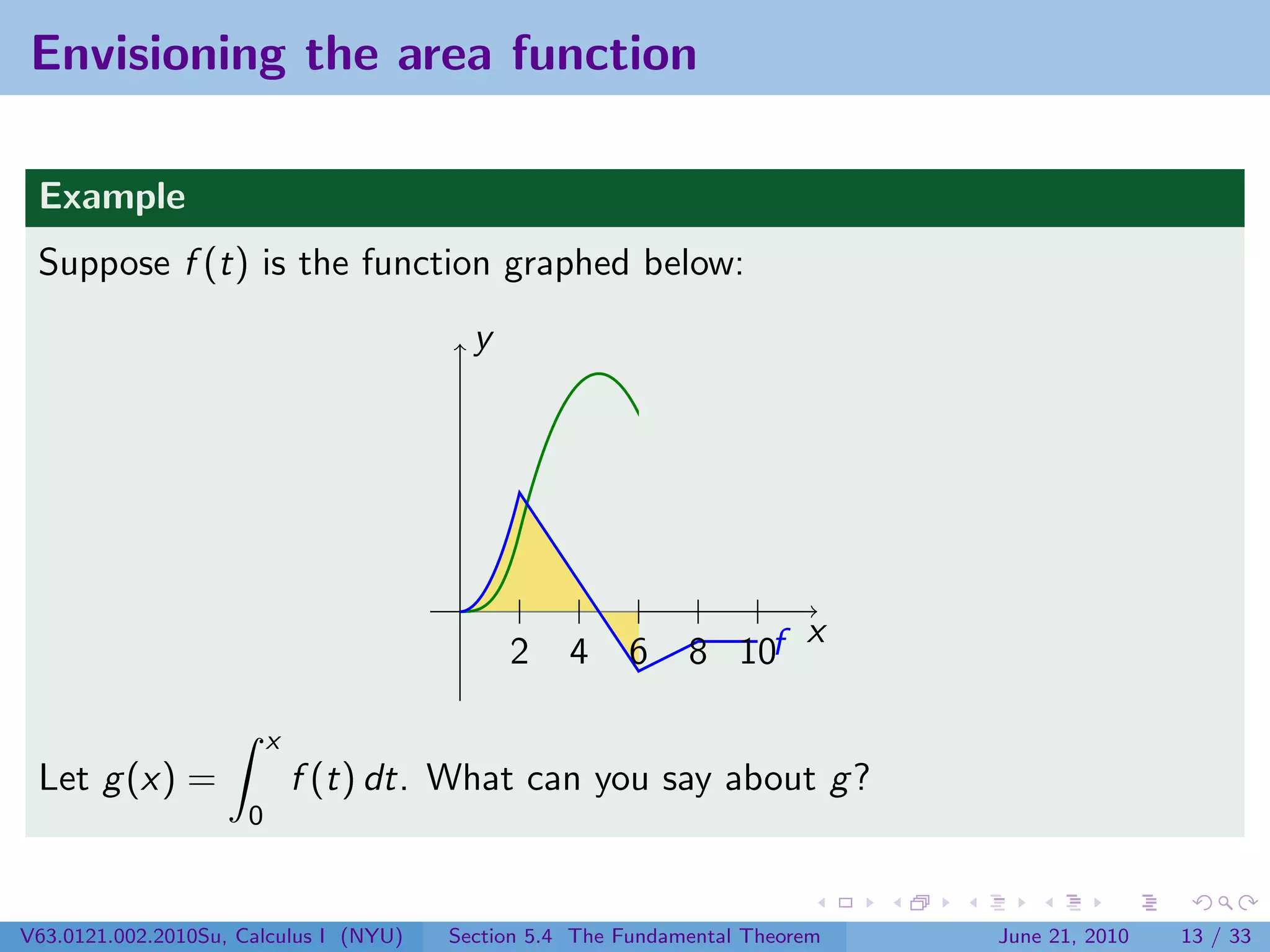
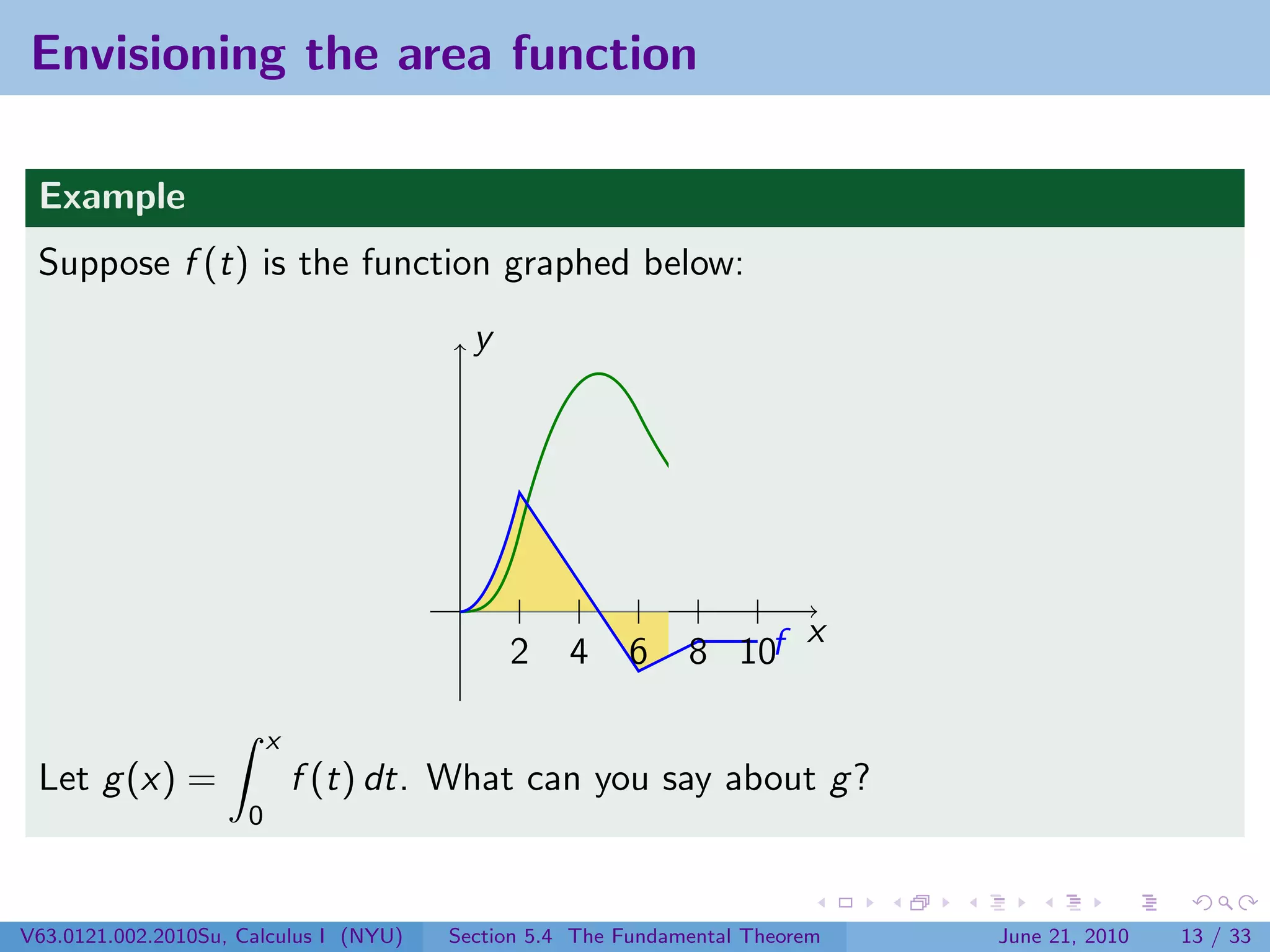
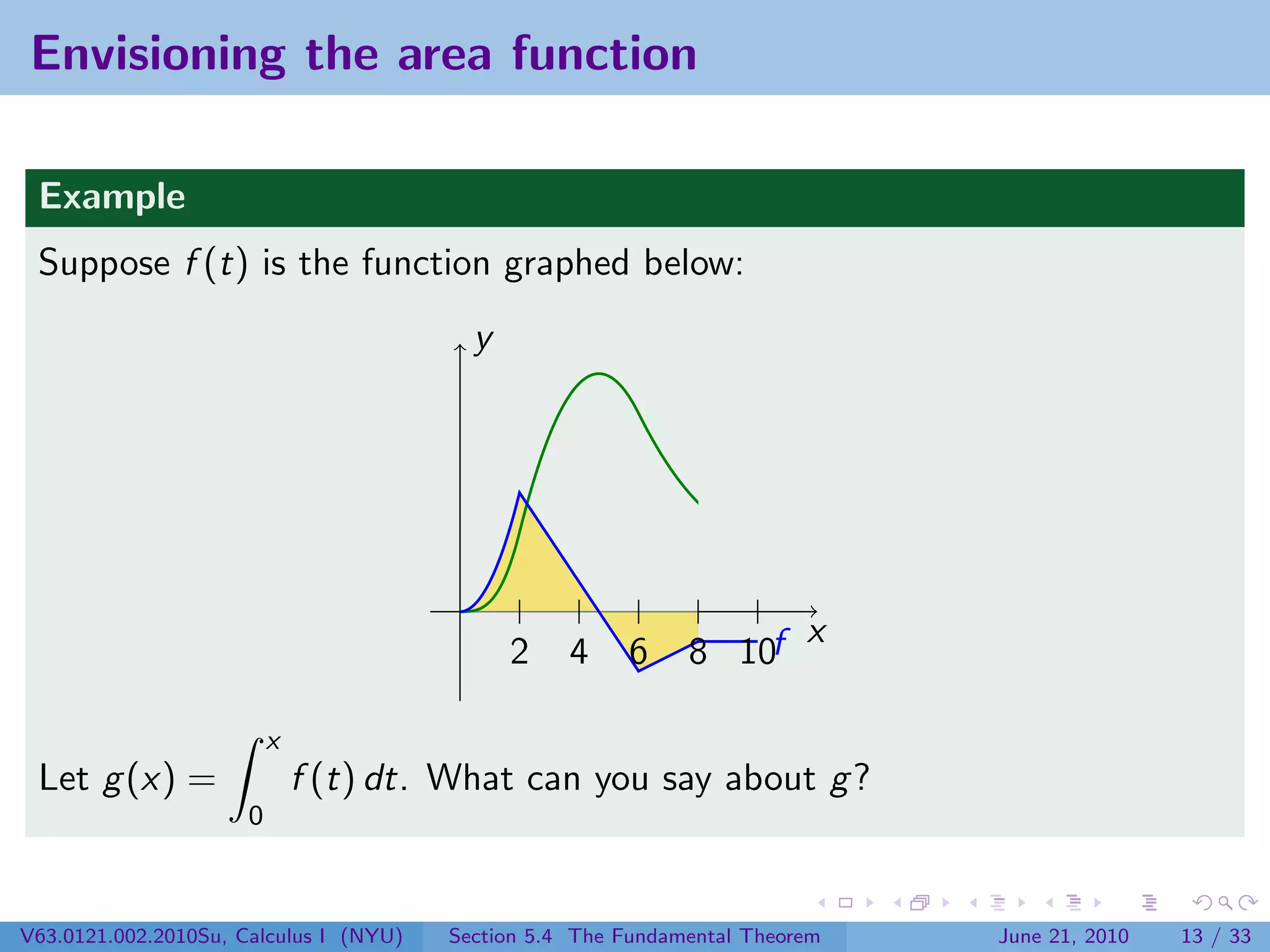
 Suppose f (t) is the function graphed below:
                                          y


                                                                    x
                                              2    4    6     8 10f

                          x
 Let g (x) =                  f (t) dt. What can you say about g ?
                      0


V63.0121.002.2010Su, Calculus I (NYU)   Section 5.4 The Fundamental Theorem   June 21, 2010   13 / 33
Envisioning the area function

 Example
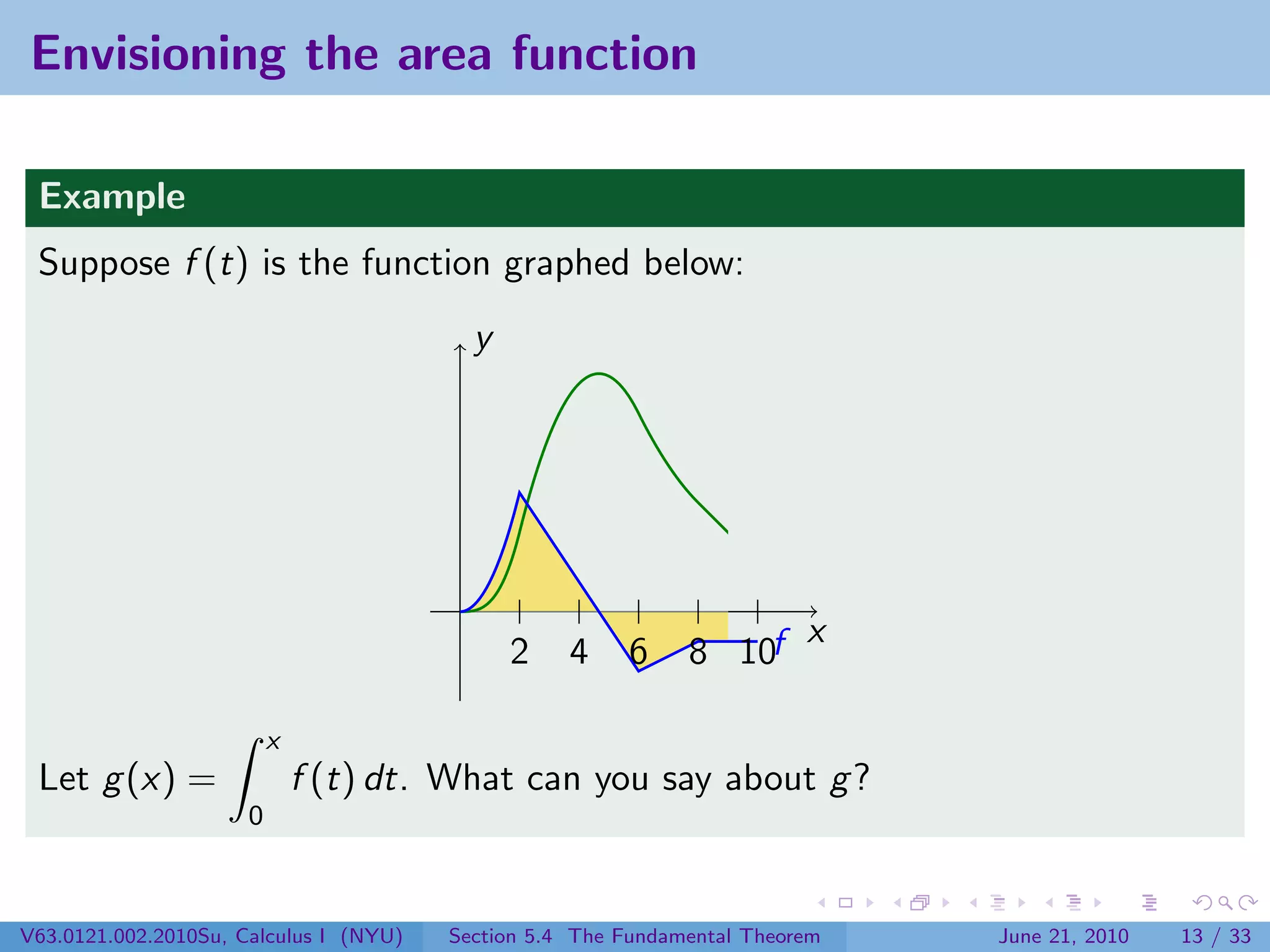
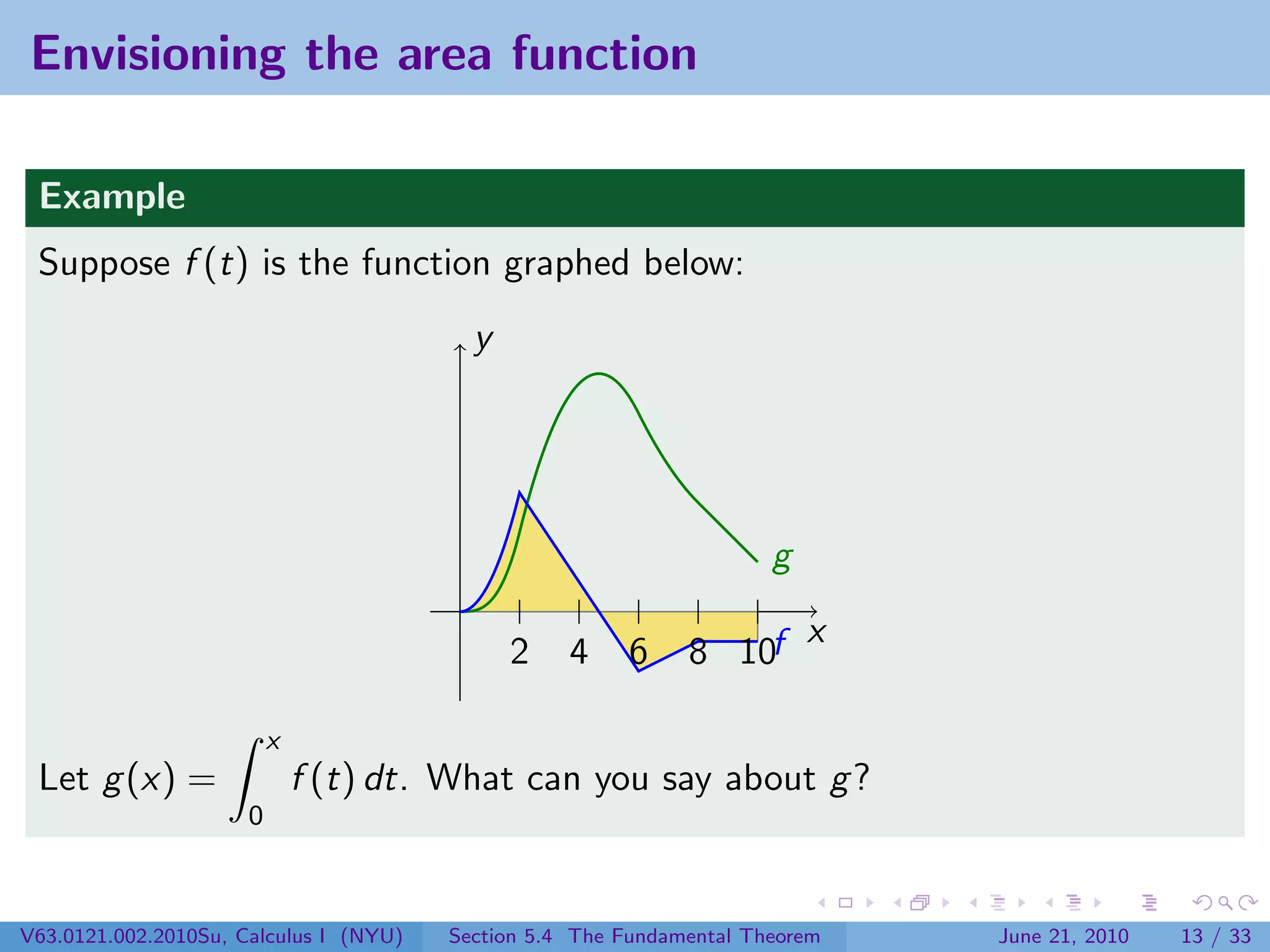
 Suppose f (t) is the function graphed below:
                                          y


                                                                      g
                                                                    x
                                              2    4    6     8 10f

                          x
 Let g (x) =                  f (t) dt. What can you say about g ?
                      0


V63.0121.002.2010Su, Calculus I (NYU)   Section 5.4 The Fundamental Theorem   June 21, 2010   13 / 33
Envisioning the area function

 Example
 Suppose f (t) is the function graphed below:
                                          y


                                                                      g
                                                                    x
                                              2    4    6     8 10f

                          x
 Let g (x) =                  f (t) dt. What can you say about g ?
                      0


V63.0121.002.2010Su, Calculus I (NYU)   Section 5.4 The Fundamental Theorem   June 21, 2010   13 / 33
Envisioning the area function

 Example
 Suppose f (t) is the function graphed below:
                                          y


                                                                      g
                                                                    x
                                              2    4    6     8 10f

                          x
 Let g (x) =                  f (t) dt. What can you say about g ?
                      0


V63.0121.002.2010Su, Calculus I (NYU)   Section 5.4 The Fundamental Theorem   June 21, 2010   13 / 33
Envisioning the area function

 Example
 Suppose f (t) is the function graphed below:
                                          y


                                                                      g
                                                                    x
                                              2    4    6     8 10f

                          x
 Let g (x) =                  f (t) dt. What can you say about g ?
                      0


V63.0121.002.2010Su, Calculus I (NYU)   Section 5.4 The Fundamental Theorem   June 21, 2010   13 / 33
Envisioning the area function

 Example
 Suppose f (t) is the function graphed below:
                                          y


                                                                      g
                                                                    x
                                              2    4    6     8 10f

                          x
 Let g (x) =                  f (t) dt. What can you say about g ?
                      0


V63.0121.002.2010Su, Calculus I (NYU)   Section 5.4 The Fundamental Theorem   June 21, 2010   13 / 33
Envisioning the area function

 Example
 Suppose f (t) is the function graphed below:
                                          y


                                                                      g
                                                                    x
                                              2    4    6     8 10f

                          x
 Let g (x) =                  f (t) dt. What can you say about g ?
                      0


V63.0121.002.2010Su, Calculus I (NYU)   Section 5.4 The Fundamental Theorem   June 21, 2010   13 / 33
Envisioning the area function

 Example
 Suppose f (t) is the function graphed below:
                                          y


                                                                      g
                                                                    x
                                              2    4    6     8 10f

                          x
 Let g (x) =                  f (t) dt. What can you say about g ?
                      0


V63.0121.002.2010Su, Calculus I (NYU)   Section 5.4 The Fundamental Theorem   June 21, 2010   13 / 33
Envisioning the area function

 Example
 Suppose f (t) is the function graphed below:
                                          y


                                                                      g
                                                                    x
                                              2    4    6     8 10f

                          x
 Let g (x) =                  f (t) dt. What can you say about g ?
                      0


V63.0121.002.2010Su, Calculus I (NYU)   Section 5.4 The Fundamental Theorem   June 21, 2010   13 / 33
Envisioning the area function

 Example
 Suppose f (t) is the function graphed below:
                                          y


                                                                      g
                                                                    x
                                              2    4    6     8 10f

                          x
 Let g (x) =                  f (t) dt. What can you say about g ?
                      0


V63.0121.002.2010Su, Calculus I (NYU)   Section 5.4 The Fundamental Theorem   June 21, 2010   13 / 33
Envisioning the area function

 Example
 Suppose f (t) is the function graphed below:
                                          y


                                                                      g
                                                                    x
                                              2    4    6     8 10f

                          x
 Let g (x) =                  f (t) dt. What can you say about g ?
                      0


V63.0121.002.2010Su, Calculus I (NYU)   Section 5.4 The Fundamental Theorem   June 21, 2010   13 / 33
Envisioning the area function

 Example
 Suppose f (t) is the function graphed below:
                                          y


                                                                      g
                                                                    x
                                              2    4    6     8 10f

                          x
 Let g (x) =                  f (t) dt. What can you say about g ?
                      0


V63.0121.002.2010Su, Calculus I (NYU)   Section 5.4 The Fundamental Theorem   June 21, 2010   13 / 33
features of g from f


     y
                              Interval sign monotonicity monotonicity concavity
                                       of f    of g         of f        of g
                        g
                                [0, 2]        +
                  x
      2 4 6 8 10f              [2, 4.5]       +
                               [4.5, 6]       −
                                [6, 8]        −
                               [8, 10]        −                                →              none


V63.0121.002.2010Su, Calculus I (NYU)    Section 5.4 The Fundamental Theorem       June 21, 2010   14 / 33
features of g from f


     y
                              Interval sign monotonicity monotonicity concavity
                                       of f    of g         of f        of g
                        g
                                [0, 2]        +
                  x
      2 4 6 8 10f              [2, 4.5]       +
                               [4.5, 6]       −
                                [6, 8]        −
                               [8, 10]        −                                →              none

 We see that g is behaving a lot like an antiderivative of f .


V63.0121.002.2010Su, Calculus I (NYU)    Section 5.4 The Fundamental Theorem       June 21, 2010   14 / 33
Another Big Time Theorem


 Theorem (The First Fundamental Theorem of Calculus)
 Let f be an integrable function on [a, b] and define
                                                            x
                                           g (x) =              f (t) dt.
                                                        a

 If f is continuous at x in (a, b), then g is differentiable at x and

                                               g (x) = f (x).


V63.0121.002.2010Su, Calculus I (NYU)   Section 5.4 The Fundamental Theorem   June 21, 2010   15 / 33
Proving the Fundamental Theorem

 Proof.
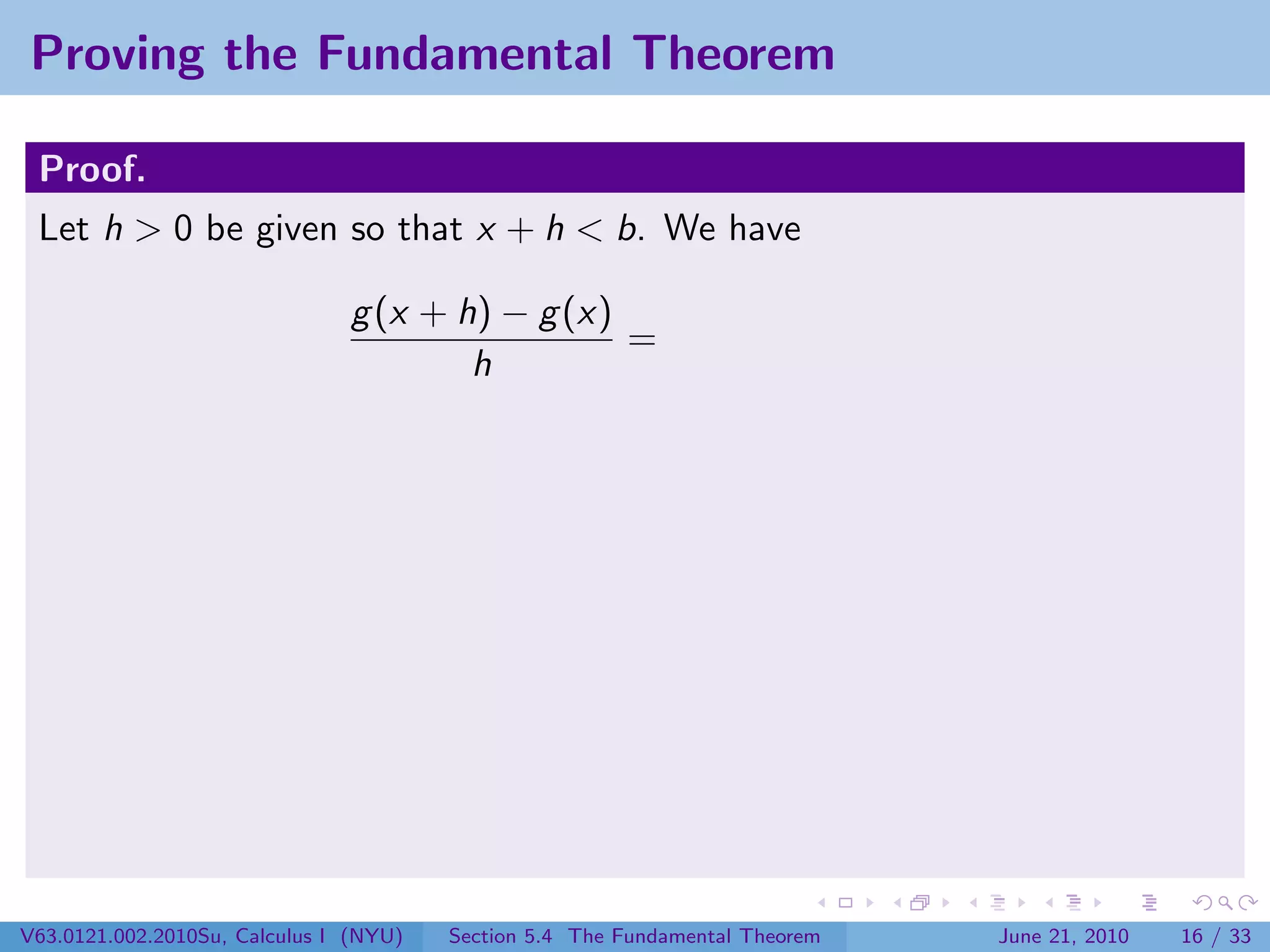
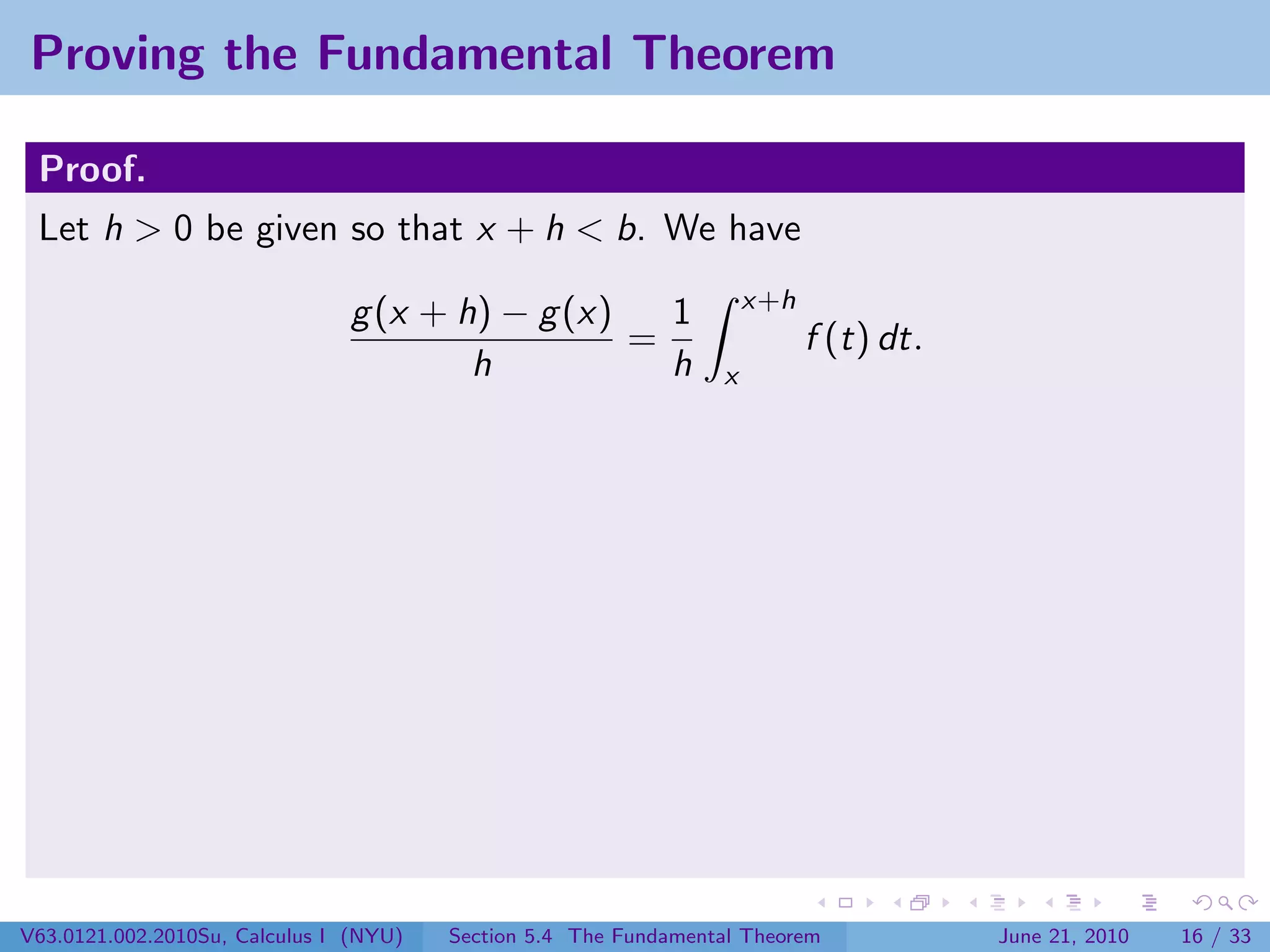
 Let h > 0 be given so that x + h < b. We have

                               g (x + h) − g (x)
                                                 =
                                       h


V63.0121.002.2010Su, Calculus I (NYU)   Section 5.4 The Fundamental Theorem   June 21, 2010   16 / 33
Proving the Fundamental Theorem

 Proof.
 Let h > 0 be given so that x + h < b. We have
                                                                     x+h
                               g (x + h) − g (x)   1
                                                 =                         f (t) dt.
                                       h           h             x


V63.0121.002.2010Su, Calculus I (NYU)   Section 5.4 The Fundamental Theorem            June 21, 2010   16 / 33
Proving the Fundamental Theorem

 Proof.
 Let h > 0 be given so that x + h < b. We have
                                                                      x+h
                               g (x + h) − g (x)   1
                                                 =                          f (t) dt.
                                       h           h             x

 Let Mh be the maximum value of f on [x, x + h], and let mh the minimum
 value of f on [x, x + h]. From §5.2 we have
                                                     x+h
                                                           f (t) dt
                                                 x


V63.0121.002.2010Su, Calculus I (NYU)   Section 5.4 The Fundamental Theorem             June 21, 2010   16 / 33
Proving the Fundamental Theorem

 Proof.
 Let h > 0 be given so that x + h < b. We have
                                                                     x+h
                               g (x + h) − g (x)   1
                                                 =                         f (t) dt.
                                       h           h             x

 Let Mh be the maximum value of f on [x, x + h], and let mh the minimum
 value of f on [x, x + h]. From §5.2 we have
                                                     x+h
                                                           f (t) dt ≤ Mh · h
                                                 x


V63.0121.002.2010Su, Calculus I (NYU)   Section 5.4 The Fundamental Theorem            June 21, 2010   16 / 33
Proving the Fundamental Theorem

 Proof.
 Let h > 0 be given so that x + h < b. We have
                                                                     x+h
                               g (x + h) − g (x)   1
                                                 =                         f (t) dt.
                                       h           h             x

 Let Mh be the maximum value of f on [x, x + h], and let mh the minimum
 value of f on [x, x + h]. From §5.2 we have
                                                     x+h
                                  mh · h ≤                 f (t) dt ≤ Mh · h
                                                 x


V63.0121.002.2010Su, Calculus I (NYU)   Section 5.4 The Fundamental Theorem            June 21, 2010   16 / 33
Proving the Fundamental Theorem

 Proof.
 Let h > 0 be given so that x + h < b. We have
                                                                     x+h
                               g (x + h) − g (x)   1
                                                 =                         f (t) dt.
                                       h           h             x

 Let Mh be the maximum value of f on [x, x + h], and let mh the minimum
 value of f on [x, x + h]. From §5.2 we have
                                                     x+h
                                  mh · h ≤                 f (t) dt ≤ Mh · h
                                                 x

  So
                                            g (x + h) − g (x)
                                    mh ≤                      ≤ Mh .
                                                    h


V63.0121.002.2010Su, Calculus I (NYU)   Section 5.4 The Fundamental Theorem            June 21, 2010   16 / 33
Proving the Fundamental Theorem

 Proof.
 Let h > 0 be given so that x + h < b. We have
                                                                     x+h
                               g (x + h) − g (x)   1
                                                 =                         f (t) dt.
                                       h           h             x

 Let Mh be the maximum value of f on [x, x + h], and let mh the minimum
 value of f on [x, x + h]. From §5.2 we have
                                                     x+h
                                  mh · h ≤                 f (t) dt ≤ Mh · h
                                                 x

  So
                          g (x + h) − g (x)
                                    mh ≤    ≤ Mh .
                                  h
  As h → 0, both mh and Mh tend to f (x).

V63.0121.002.2010Su, Calculus I (NYU)   Section 5.4 The Fundamental Theorem            June 21, 2010   16 / 33
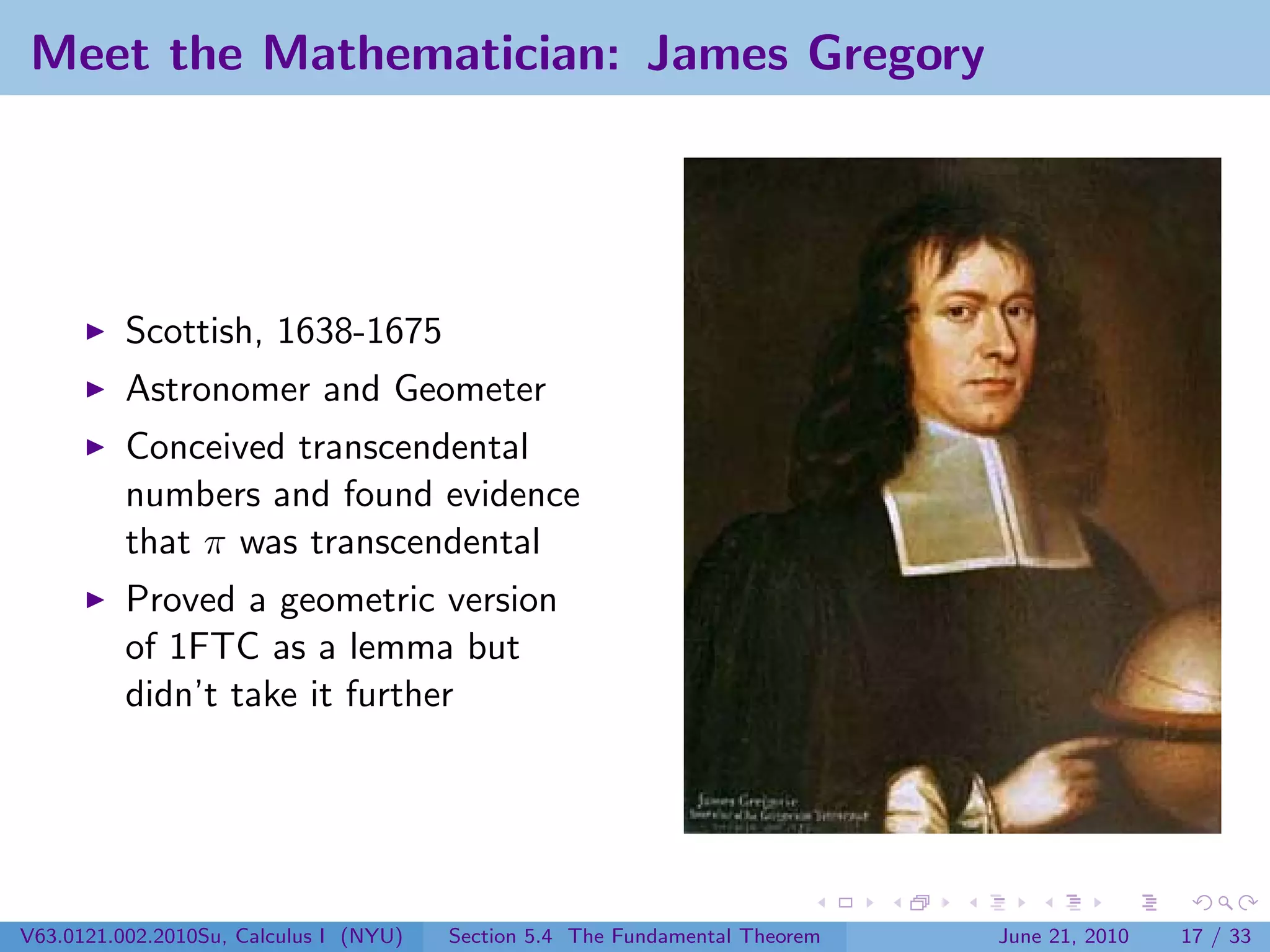
Meet the Mathematician: James Gregory


          Scottish, 1638-1675
          Astronomer and Geometer
          Conceived transcendental
          numbers and found evidence
          that π was transcendental
          Proved a geometric version
          of 1FTC as a lemma but
          didn’t take it further


V63.0121.002.2010Su, Calculus I (NYU)   Section 5.4 The Fundamental Theorem   June 21, 2010   17 / 33
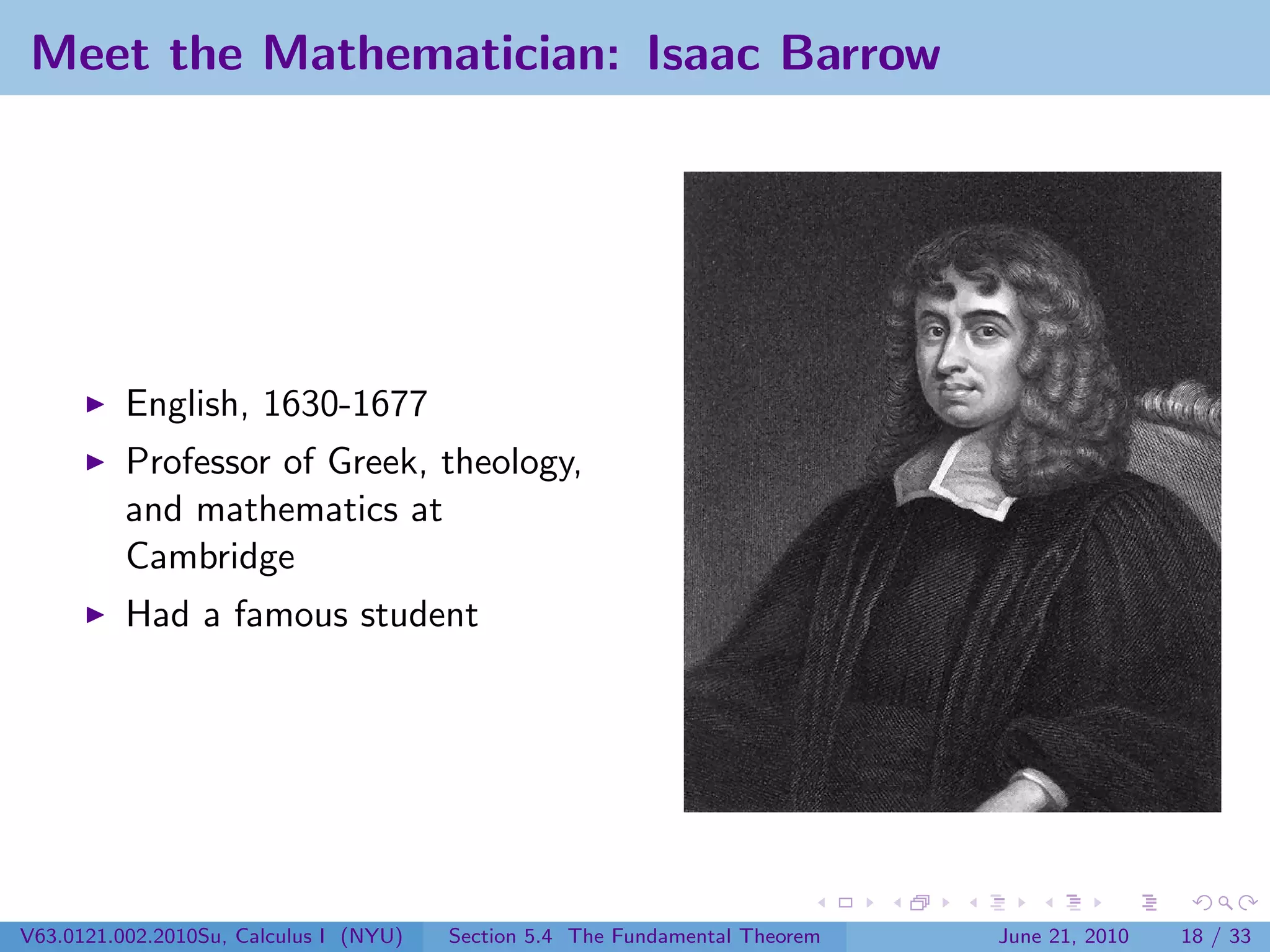
Meet the Mathematician: Isaac Barrow


          English, 1630-1677
          Professor of Greek, theology,
          and mathematics at
          Cambridge
          Had a famous student


V63.0121.002.2010Su, Calculus I (NYU)   Section 5.4 The Fundamental Theorem   June 21, 2010   18 / 33
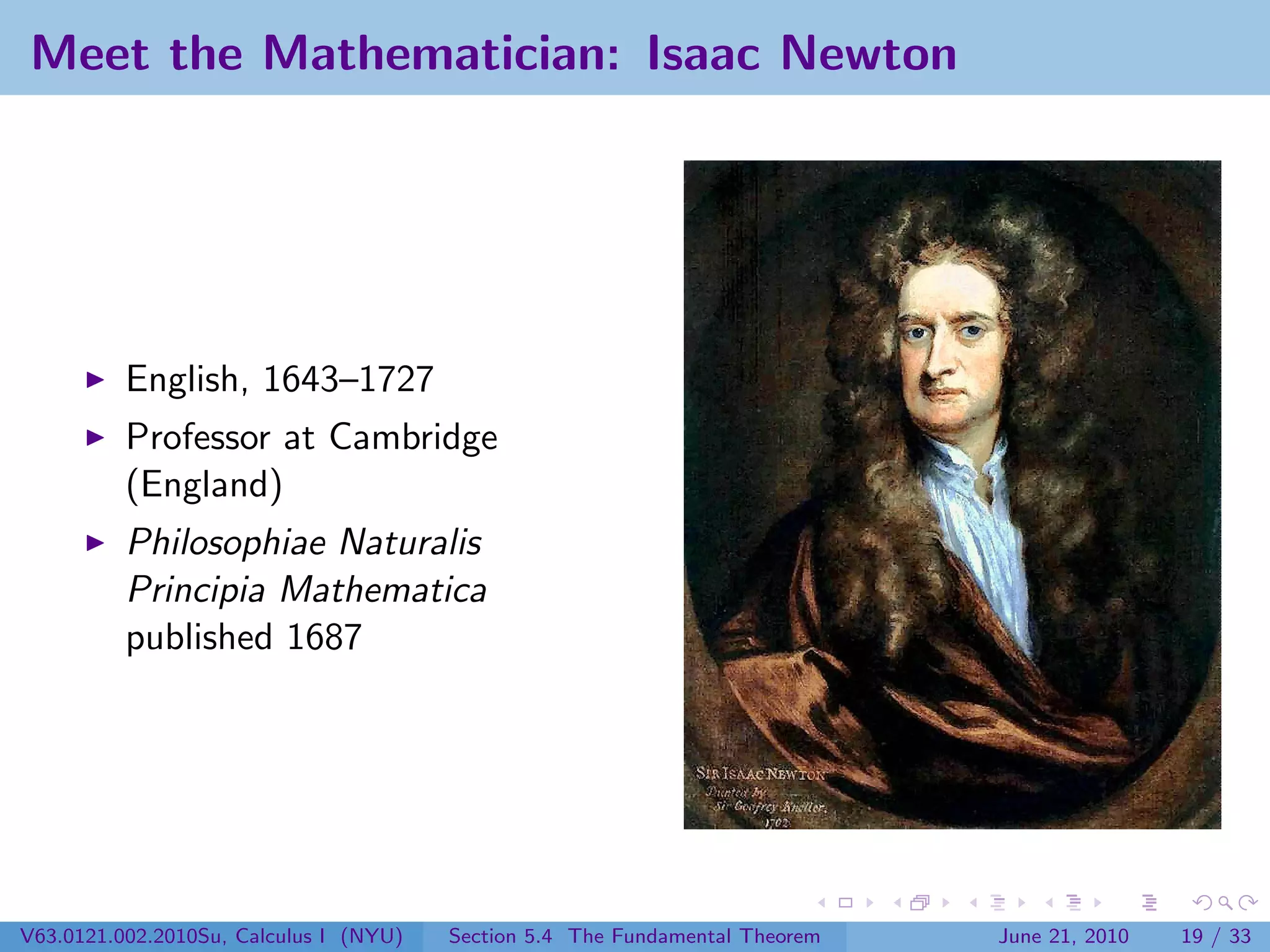
Meet the Mathematician: Isaac Newton


          English, 1643–1727
          Professor at Cambridge
          (England)
          Philosophiae Naturalis
          Principia Mathematica
          published 1687


V63.0121.002.2010Su, Calculus I (NYU)   Section 5.4 The Fundamental Theorem   June 21, 2010   19 / 33
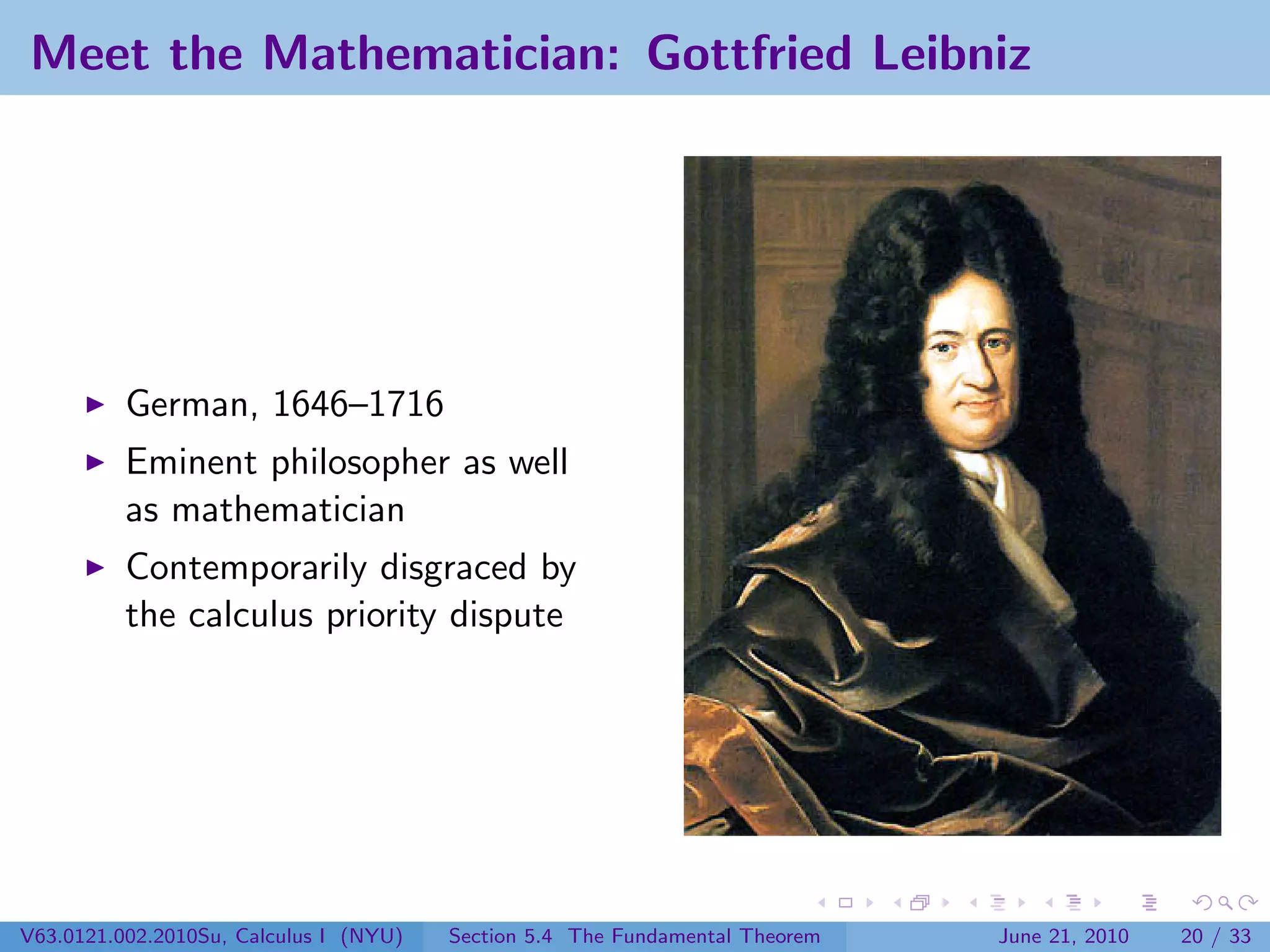
Meet the Mathematician: Gottfried Leibniz


          German, 1646–1716
          Eminent philosopher as well
          as mathematician
          Contemporarily disgraced by
          the calculus priority dispute


V63.0121.002.2010Su, Calculus I (NYU)   Section 5.4 The Fundamental Theorem   June 21, 2010   20 / 33
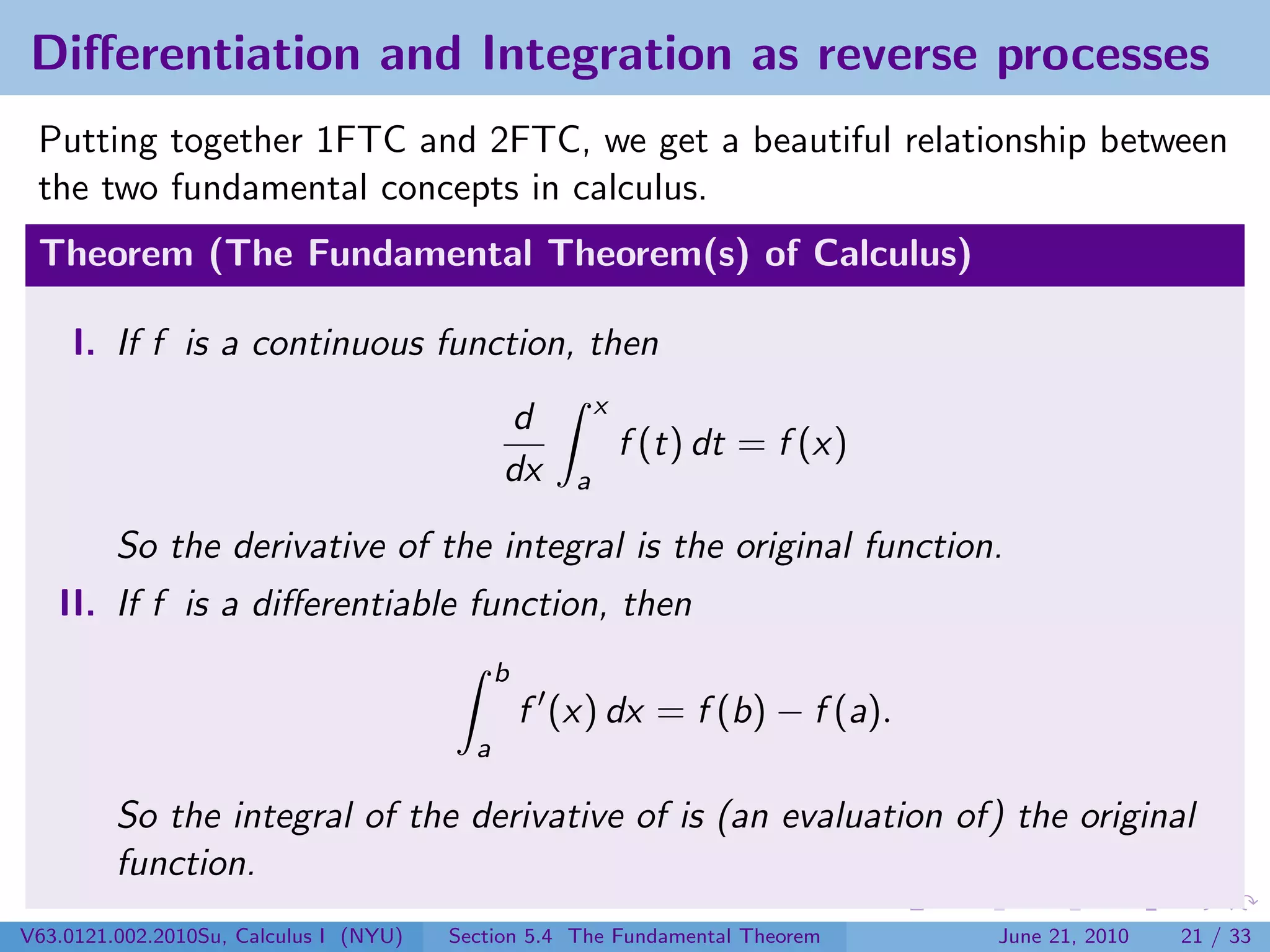
Differentiation and Integration as reverse processes
 Putting together 1FTC and 2FTC, we get a beautiful relationship between
 the two fundamental concepts in calculus.
 Theorem (The Fundamental Theorem(s) of Calculus)

     I. If f is a continuous function, then
                                                         x
                                              d
                                                             f (t) dt = f (x)
                                              dx     a

         So the derivative of the integral is the original function.
   II. If f is a differentiable function, then
                                              b
                                                  f (x) dx = f (b) − f (a).
                                          a

         So the integral of the derivative of is (an evaluation of) the original
         function.
V63.0121.002.2010Su, Calculus I (NYU)   Section 5.4 The Fundamental Theorem     June 21, 2010   21 / 33
Outline


 Recall: The Evaluation Theorem a/k/a 2FTC

 The First Fundamental Theorem of Calculus
   The Area Function
   Statement and proof of 1FTC
   Biographies

 Differentiation of functions defined by integrals
    “Contrived” examples
    Erf
    Other applications


V63.0121.002.2010Su, Calculus I (NYU)   Section 5.4 The Fundamental Theorem   June 21, 2010   22 / 33
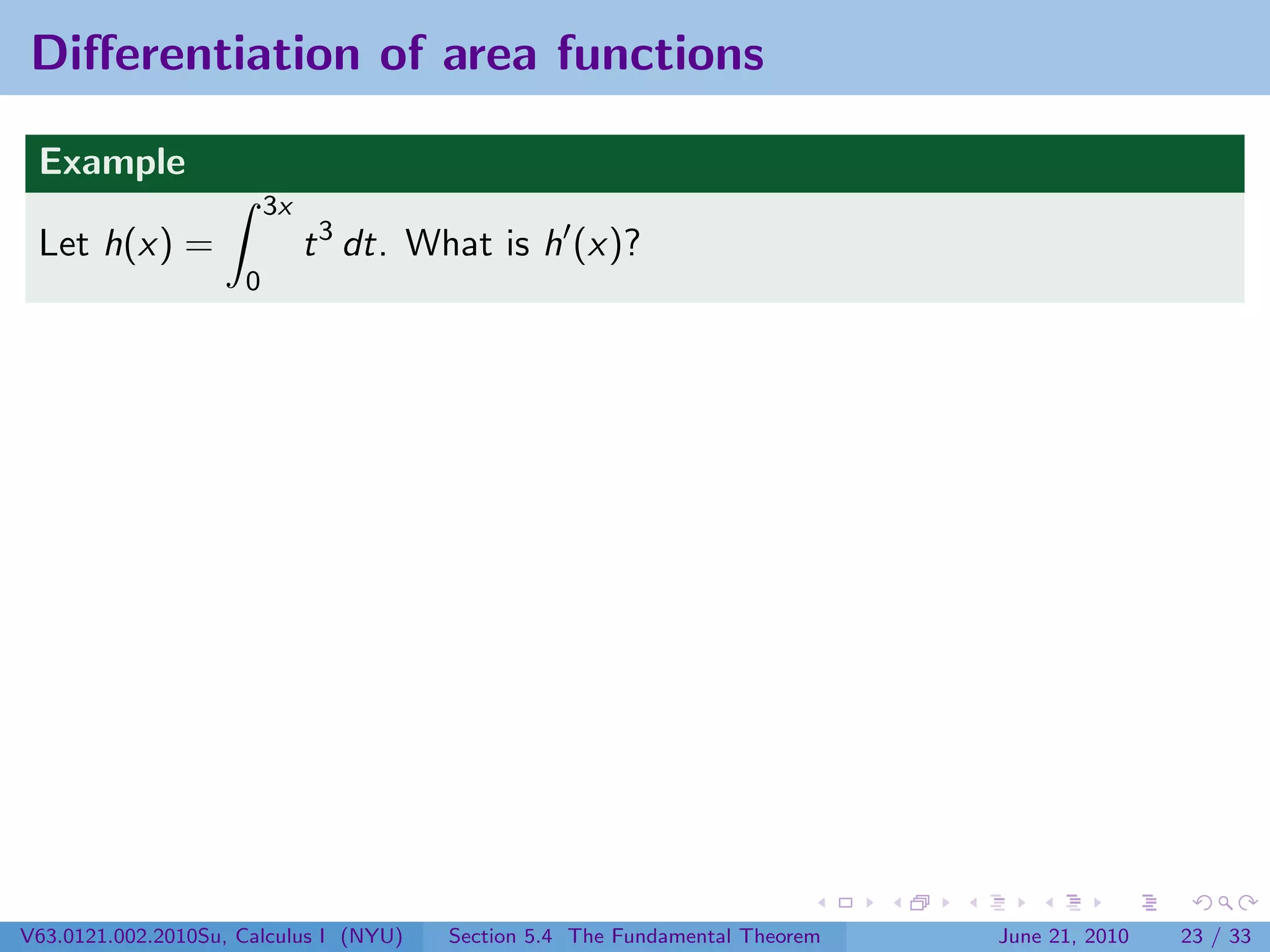
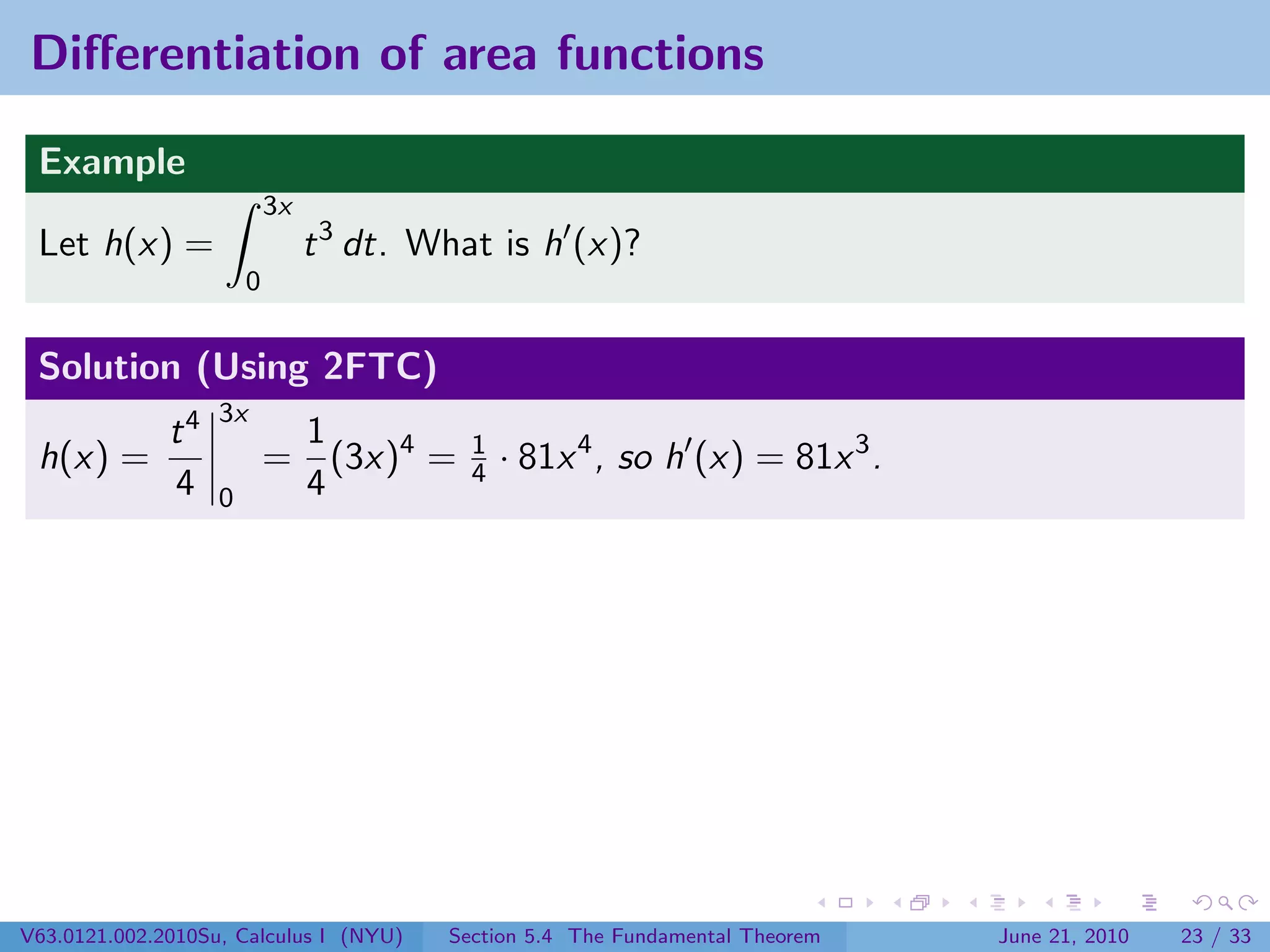
Differentiation of area functions

 Example
                         3x
 Let h(x) =                   t 3 dt. What is h (x)?
                     0


V63.0121.002.2010Su, Calculus I (NYU)   Section 5.4 The Fundamental Theorem   June 21, 2010   23 / 33
Differentiation of area functions

 Example
                           3x
 Let h(x) =                     t 3 dt. What is h (x)?
                       0


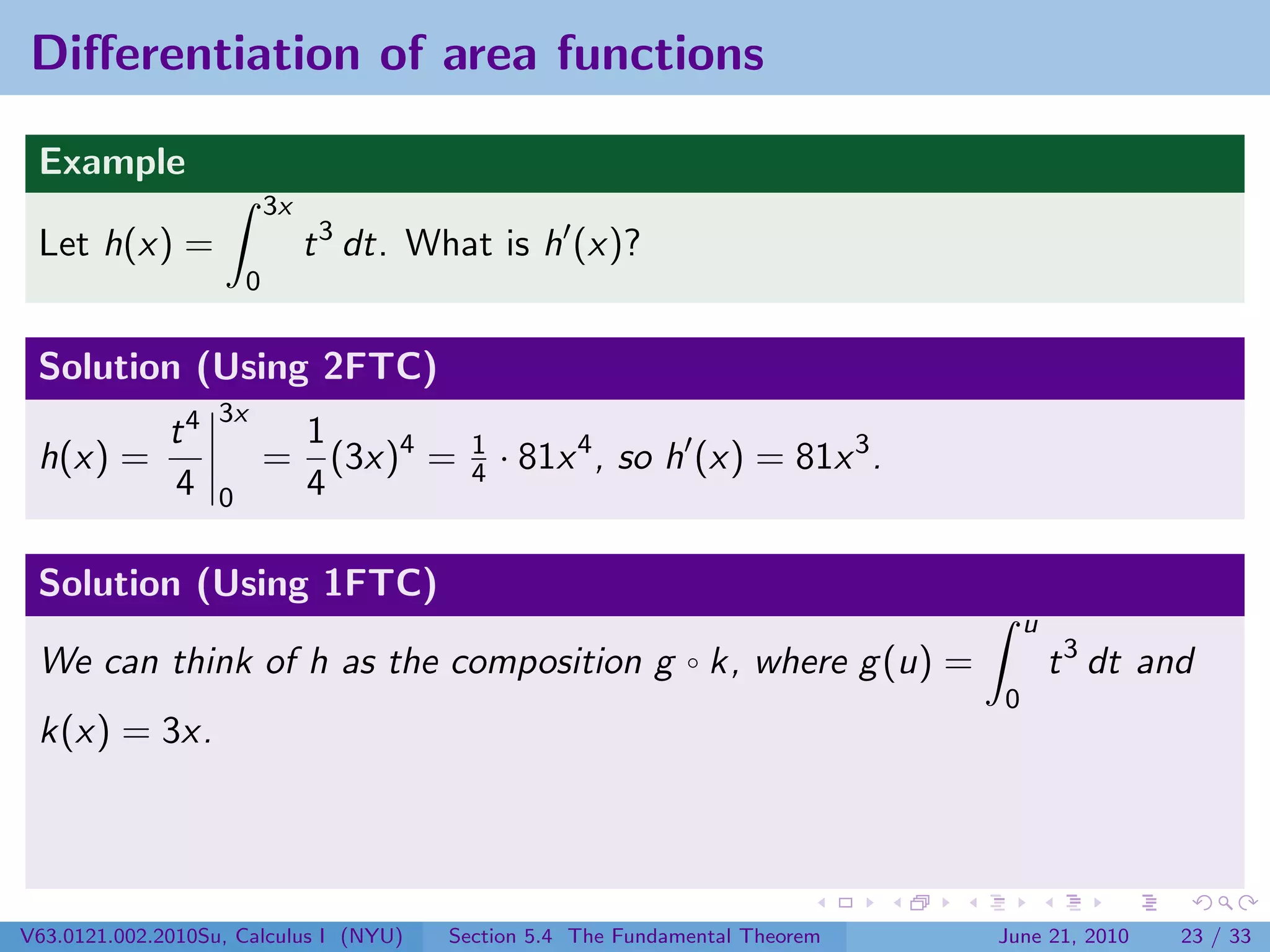
 Solution (Using 2FTC)
                   3x
              t4            1
 h(x) =                    = (3x)4 =       1
                                           4   · 81x 4 , so h (x) = 81x 3 .
              4    0        4


V63.0121.002.2010Su, Calculus I (NYU)    Section 5.4 The Fundamental Theorem   June 21, 2010   23 / 33
Differentiation of area functions

 Example
                           3x
 Let h(x) =                     t 3 dt. What is h (x)?
                       0


 Solution (Using 2FTC)
                   3x
              t4            1
 h(x) =                    = (3x)4 =       1
                                           4   · 81x 4 , so h (x) = 81x 3 .
              4    0        4

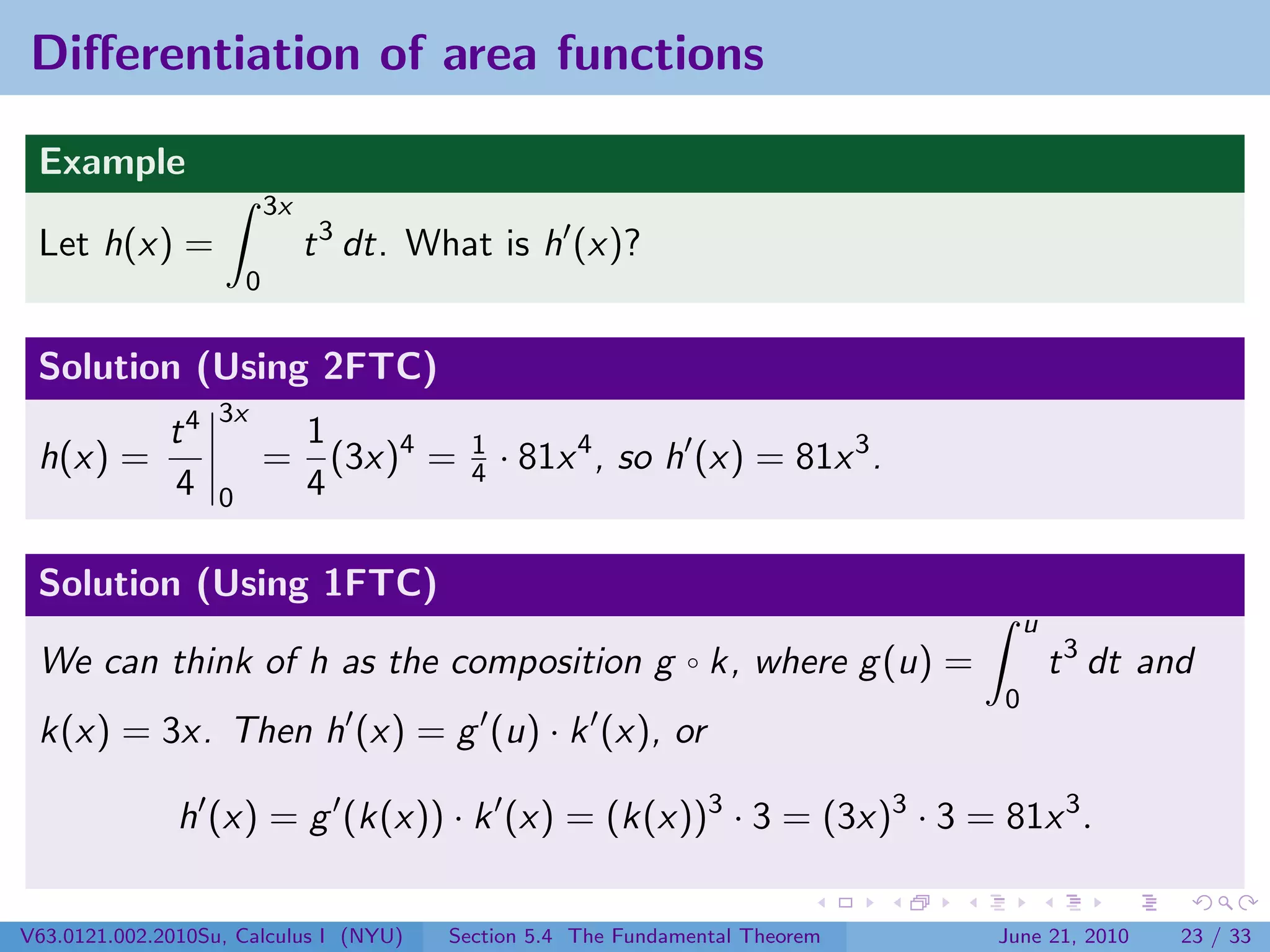
 Solution (Using 1FTC)
                                                                                   u
 We can think of h as the composition g ◦ k, where g (u) =                             t 3 dt and
                                                                               0
 k(x) = 3x.


V63.0121.002.2010Su, Calculus I (NYU)    Section 5.4 The Fundamental Theorem   June 21, 2010    23 / 33
Differentiation of area functions

 Example
                           3x
 Let h(x) =                     t 3 dt. What is h (x)?
                       0


 Solution (Using 2FTC)
                   3x
              t4            1
 h(x) =                    = (3x)4 =       1
                                           4   · 81x 4 , so h (x) = 81x 3 .
              4    0        4

 Solution (Using 1FTC)
                                                                                   u
 We can think of h as the composition g ◦ k, where g (u) =                             t 3 dt and
                                                                               0
 k(x) = 3x. Then h (x) = g (u) · k (x), or

               h (x) = g (k(x)) · k (x) = (k(x))3 · 3 = (3x)3 · 3 = 81x 3 .

V63.0121.002.2010Su, Calculus I (NYU)    Section 5.4 The Fundamental Theorem   June 21, 2010    23 / 33
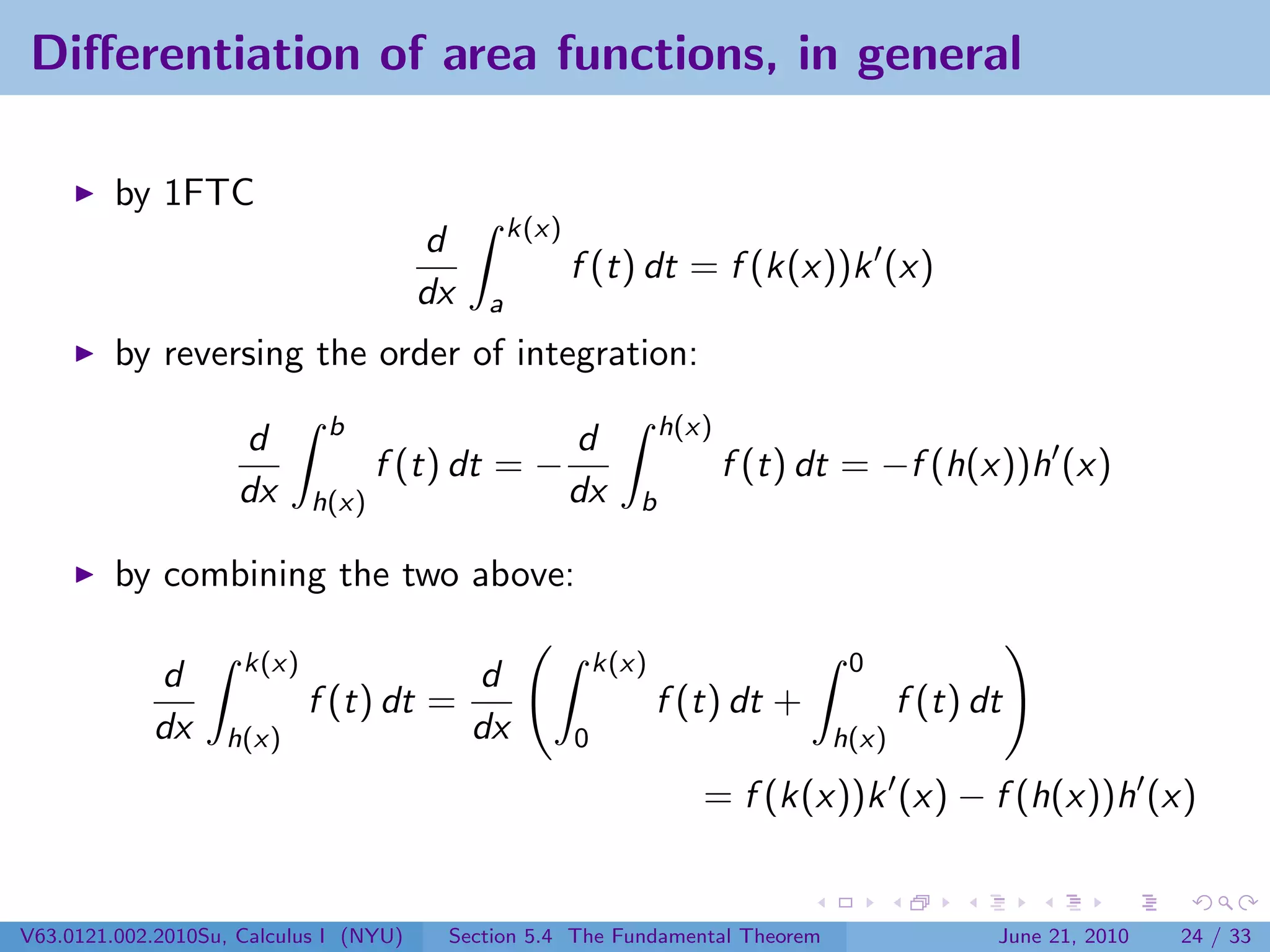
Differentiation of area functions, in general

         by 1FTC
                                                 k(x)
                                        d
                                                        f (t) dt = f (k(x))k (x)
                                        dx   a
         by reversing the order of integration:
                             b                                     h(x)
                     d                                  d
                                   f (t) dt = −                           f (t) dt = −f (h(x))h (x)
                     dx     h(x)                        dx     b

         by combining the two above:

                     k(x)                                   k(x)                  0
            d                                d
                            f (t) dt =                             f (t) dt +           f (t) dt
            dx     h(x)                      dx         0                        h(x)

                                                                      = f (k(x))k (x) − f (h(x))h (x)


V63.0121.002.2010Su, Calculus I (NYU)    Section 5.4 The Fundamental Theorem                   June 21, 2010   24 / 33
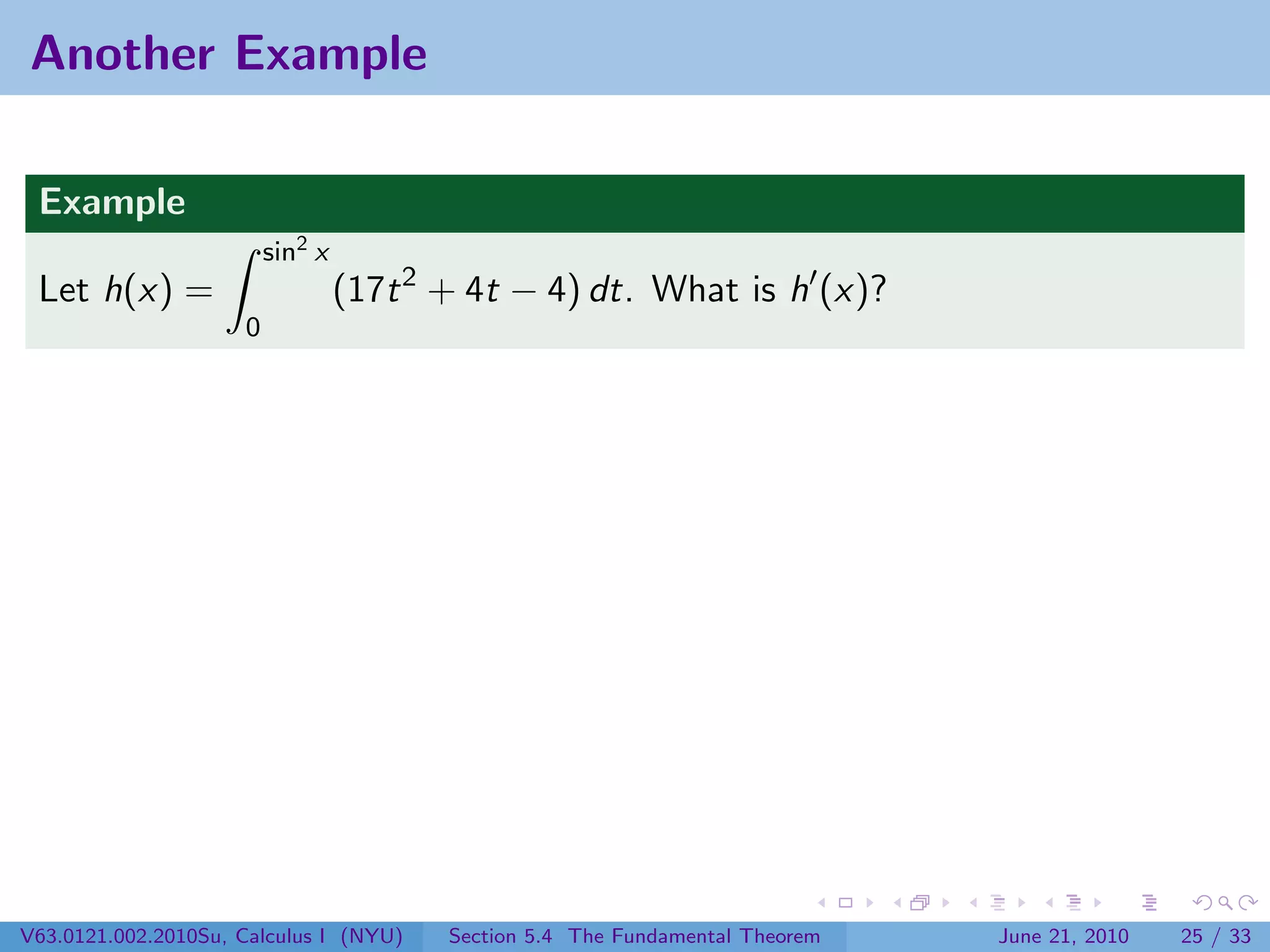
Another Example

 Example
                         sin2 x
 Let h(x) =                       (17t 2 + 4t − 4) dt. What is h (x)?
                     0


V63.0121.002.2010Su, Calculus I (NYU)    Section 5.4 The Fundamental Theorem   June 21, 2010   25 / 33
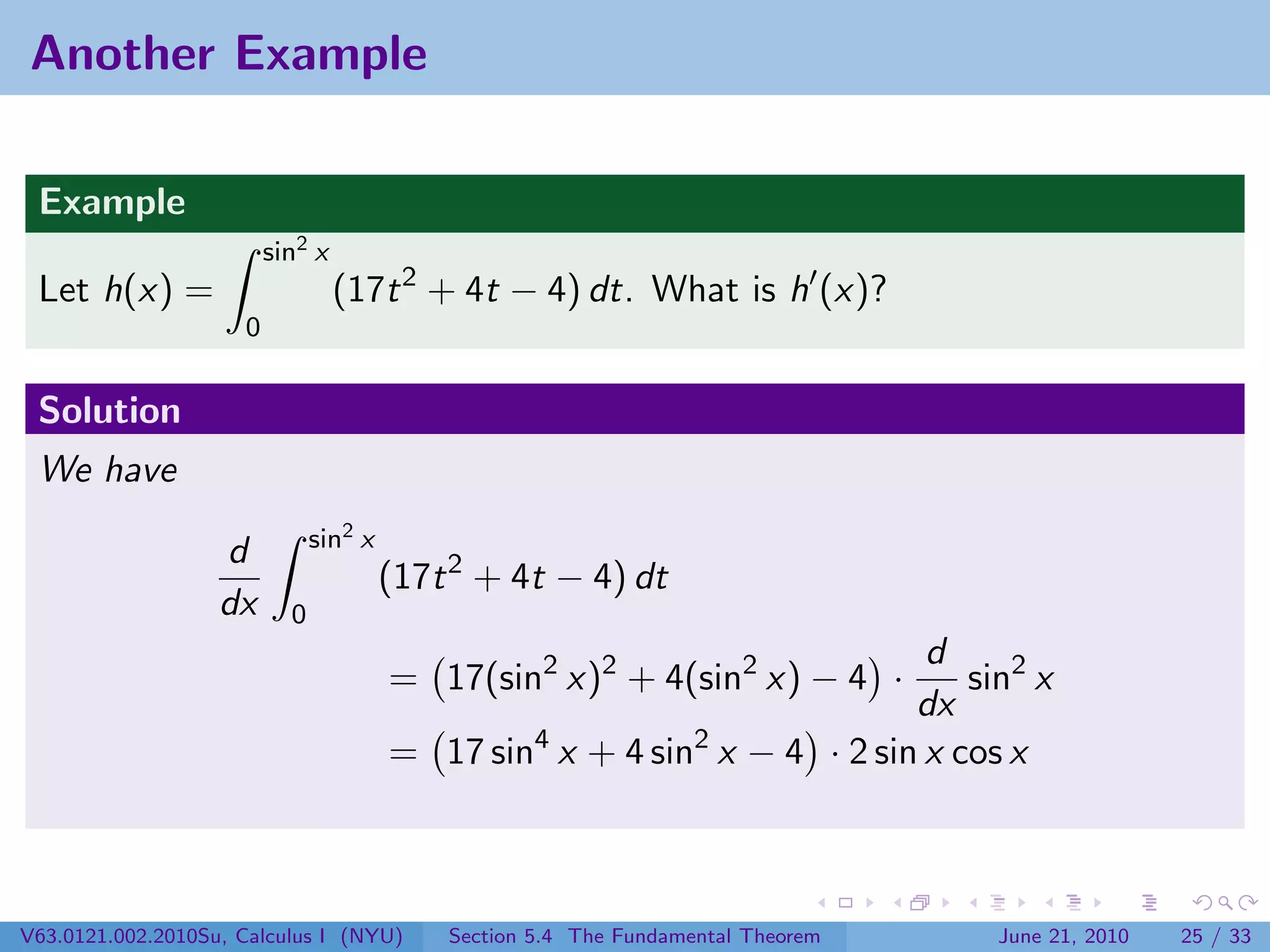
Another Example

 Example
                         sin2 x
 Let h(x) =                       (17t 2 + 4t − 4) dt. What is h (x)?
                     0


 Solution
 We have
                               sin2 x
                   d
                                        (17t 2 + 4t − 4) dt
                   dx      0
                                                                           d
                                        = 17(sin2 x)2 + 4(sin2 x) − 4 ·       sin2 x
                                                                          dx
                                        = 17 sin4 x + 4 sin2 x − 4 · 2 sin x cos x


V63.0121.002.2010Su, Calculus I (NYU)       Section 5.4 The Fundamental Theorem   June 21, 2010   25 / 33
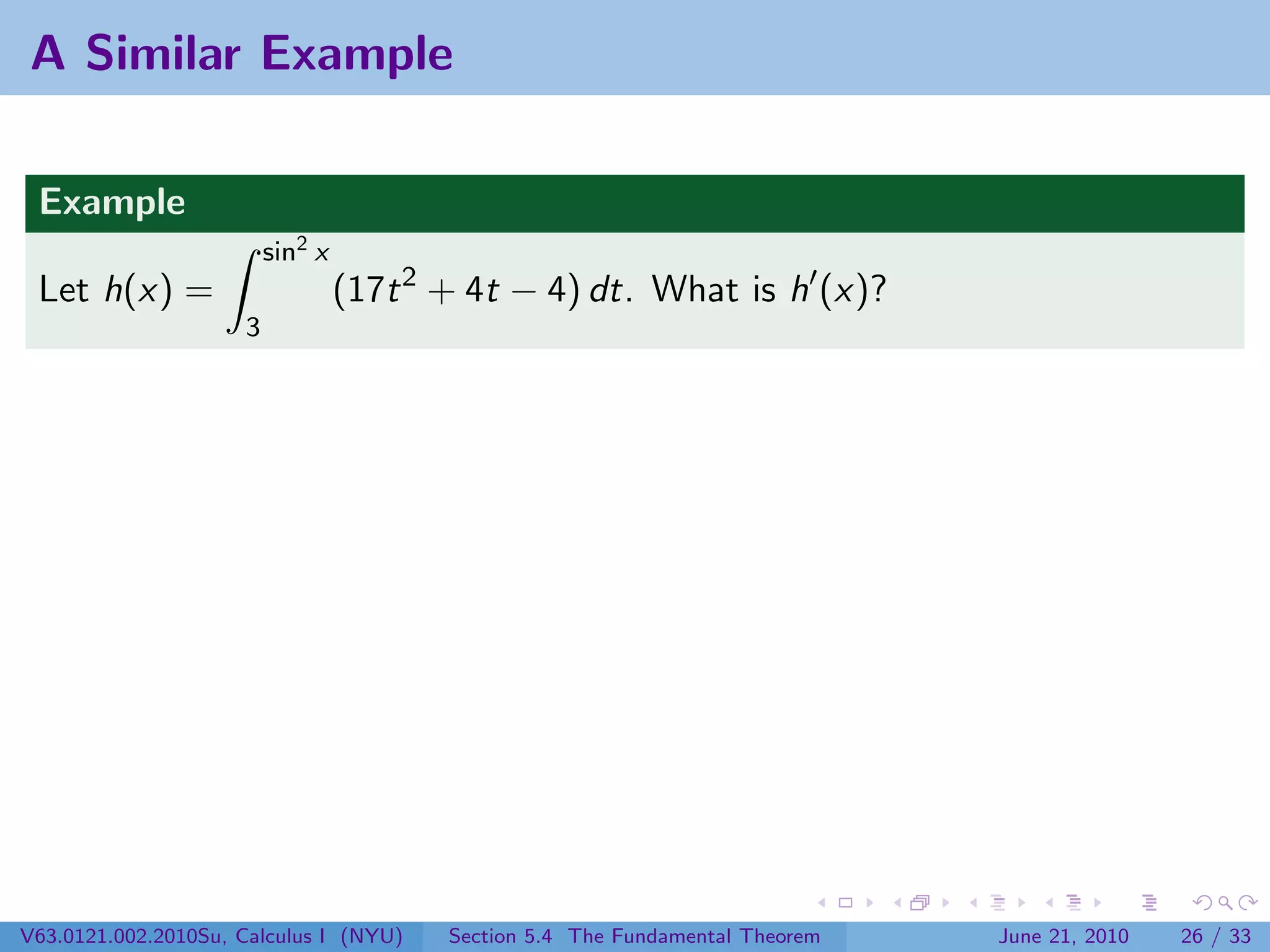
A Similar Example

 Example
                         sin2 x
 Let h(x) =                       (17t 2 + 4t − 4) dt. What is h (x)?
                     3


V63.0121.002.2010Su, Calculus I (NYU)    Section 5.4 The Fundamental Theorem   June 21, 2010   26 / 33
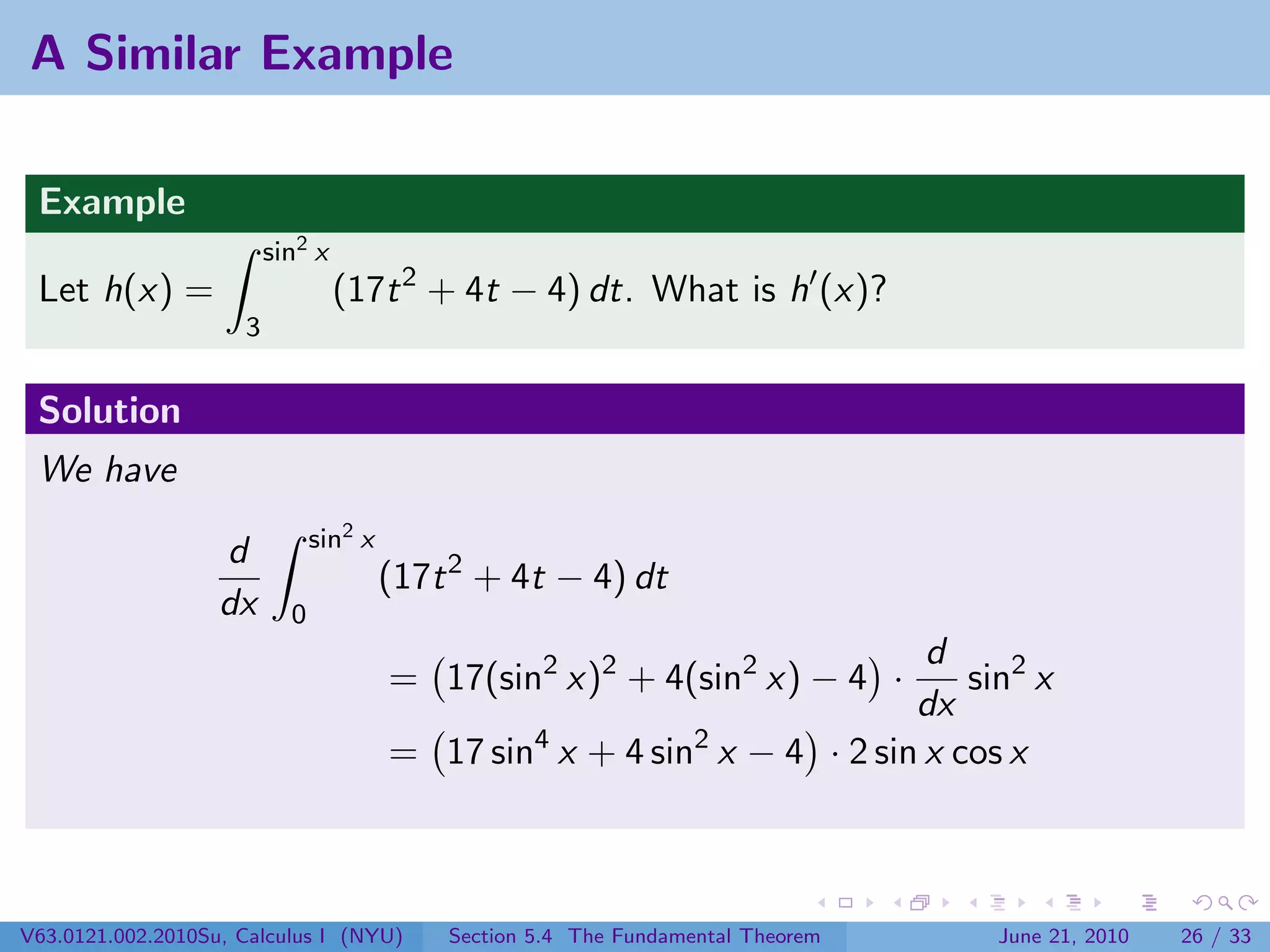
A Similar Example

 Example
                         sin2 x
 Let h(x) =                       (17t 2 + 4t − 4) dt. What is h (x)?
                     3


 Solution
 We have
                               sin2 x
                   d
                                        (17t 2 + 4t − 4) dt
                   dx      0
                                                                           d
                                        = 17(sin2 x)2 + 4(sin2 x) − 4 ·       sin2 x
                                                                          dx
                                        = 17 sin4 x + 4 sin2 x − 4 · 2 sin x cos x


V63.0121.002.2010Su, Calculus I (NYU)       Section 5.4 The Fundamental Theorem   June 21, 2010   26 / 33
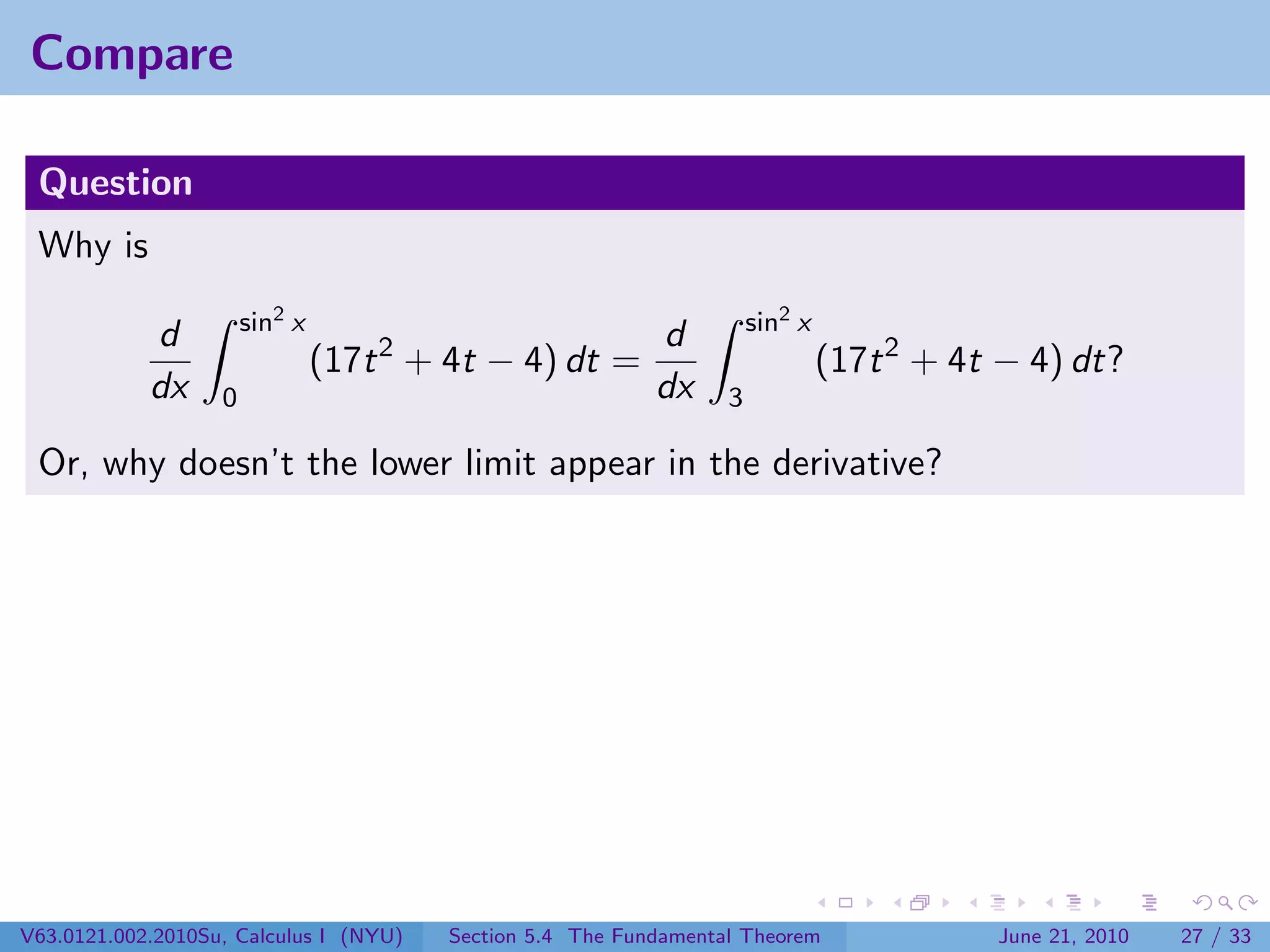
Compare

 Question
 Why is
                       sin2 x                                         sin2 x
            d                      2                d
                                (17t + 4t − 4) dt =                            (17t 2 + 4t − 4) dt?
            dx     0                                dx            3

 Or, why doesn’t the lower limit appear in the derivative?


V63.0121.002.2010Su, Calculus I (NYU)   Section 5.4 The Fundamental Theorem               June 21, 2010   27 / 33
Compare

 Question
 Why is
                         sin2 x                                         sin2 x
                d                    2                d
                                  (17t + 4t − 4) dt =                            (17t 2 + 4t − 4) dt?
                dx   0                                dx            3

 Or, why doesn’t the lower limit appear in the derivative?

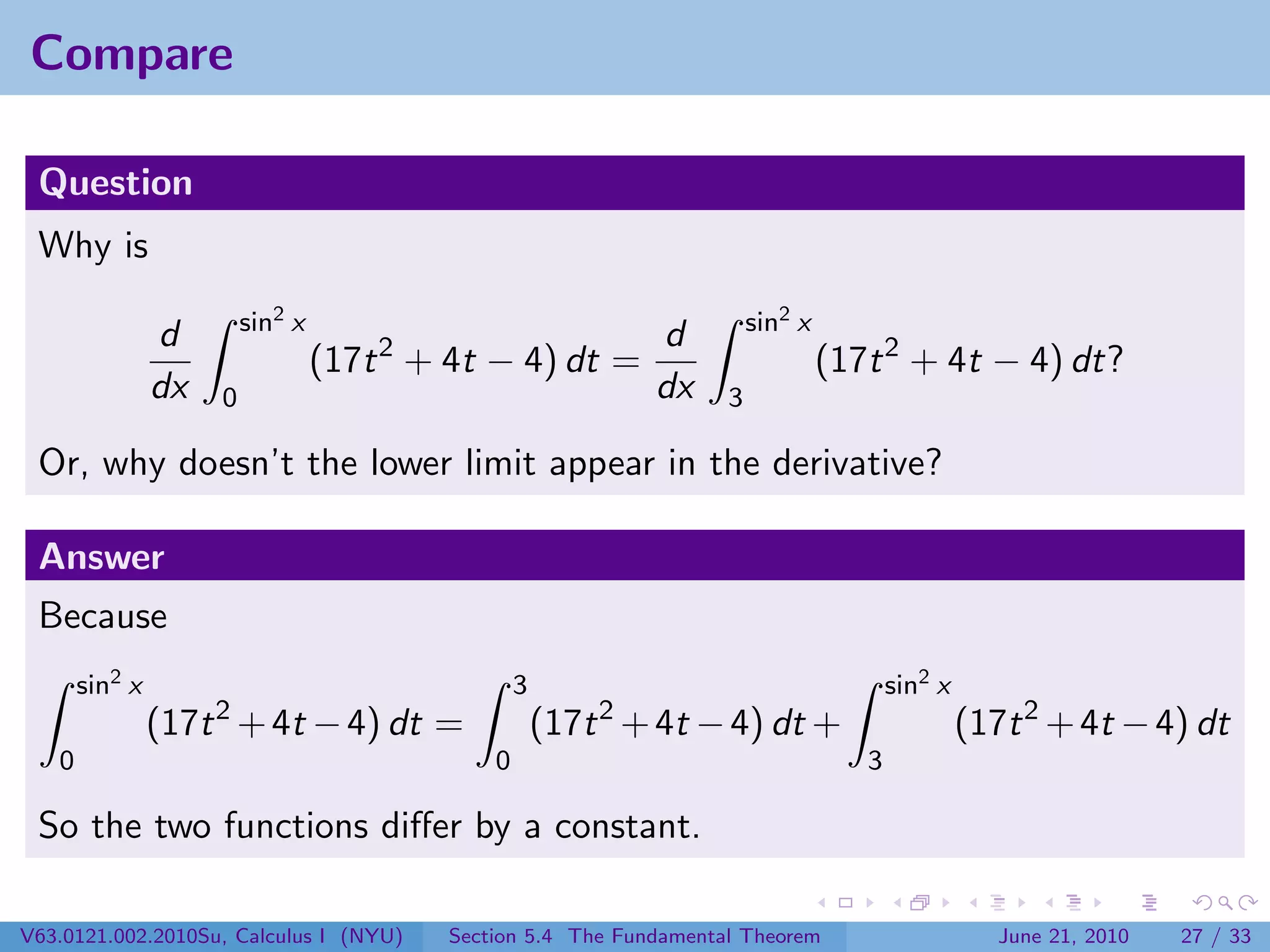
 Answer
 Because
       sin2 x                                     3                                     sin2 x
                     2                                    2
                (17t + 4t − 4) dt =                   (17t + 4t − 4) dt +                        (17t 2 + 4t − 4) dt
   0                                          0                                     3

 So the two functions differ by a constant.

V63.0121.002.2010Su, Calculus I (NYU)     Section 5.4 The Fundamental Theorem                       June 21, 2010   27 / 33
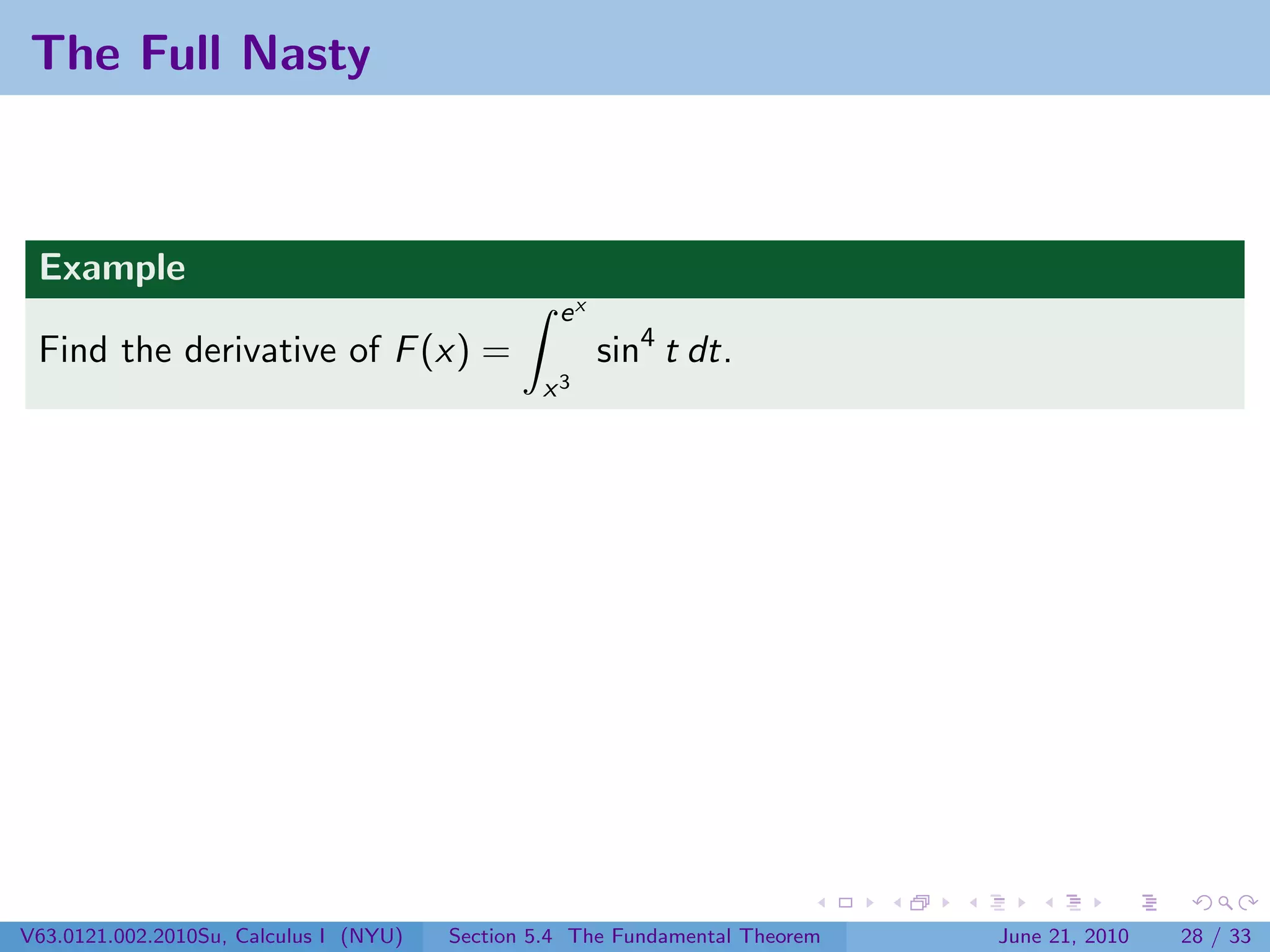
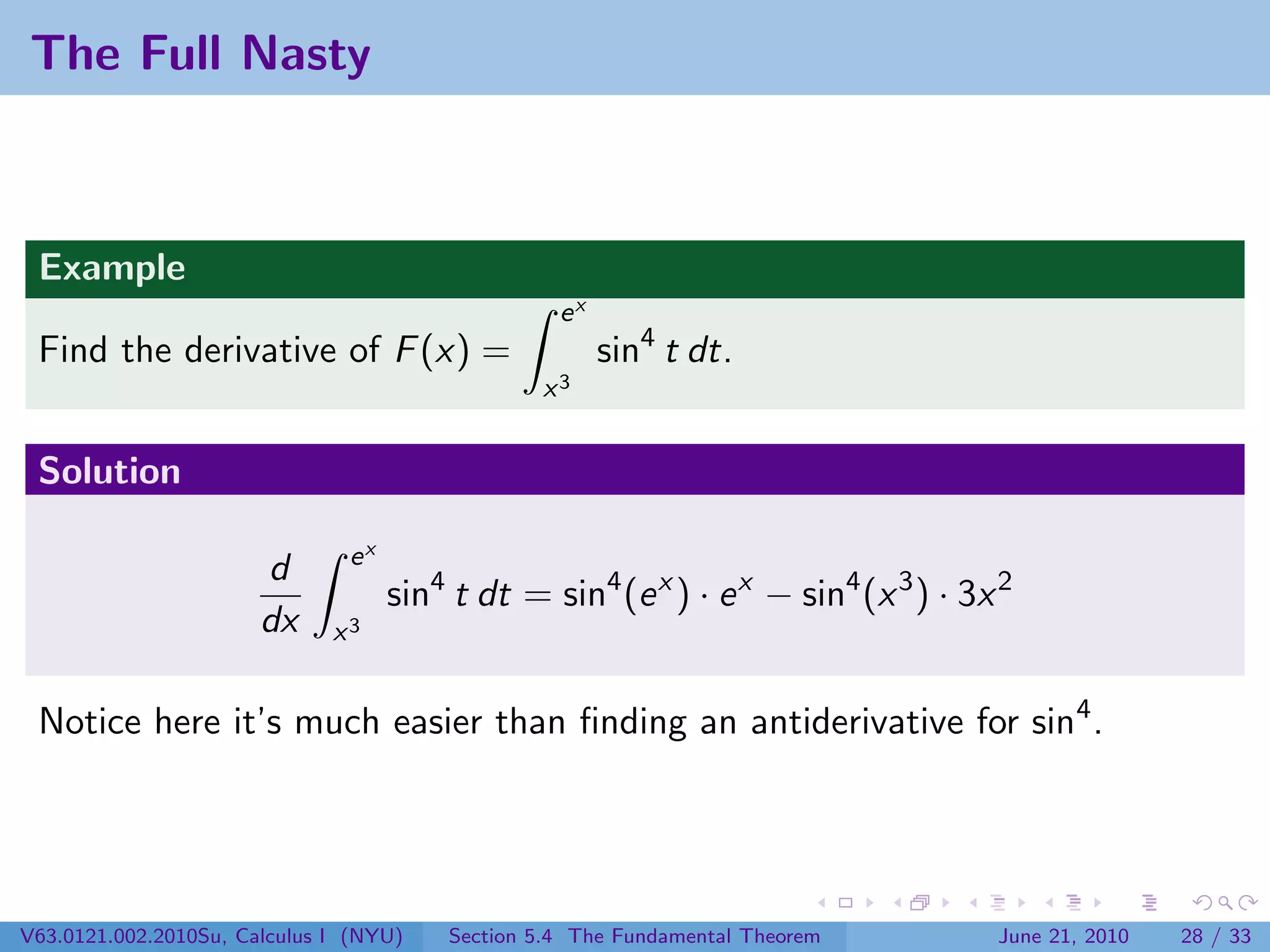
The Full Nasty


 Example
                                                  ex
 Find the derivative of F (x) =                        sin4 t dt.
                                                x3


V63.0121.002.2010Su, Calculus I (NYU)   Section 5.4 The Fundamental Theorem   June 21, 2010   28 / 33
The Full Nasty


 Example
                                                  ex
 Find the derivative of F (x) =                        sin4 t dt.
                                                x3


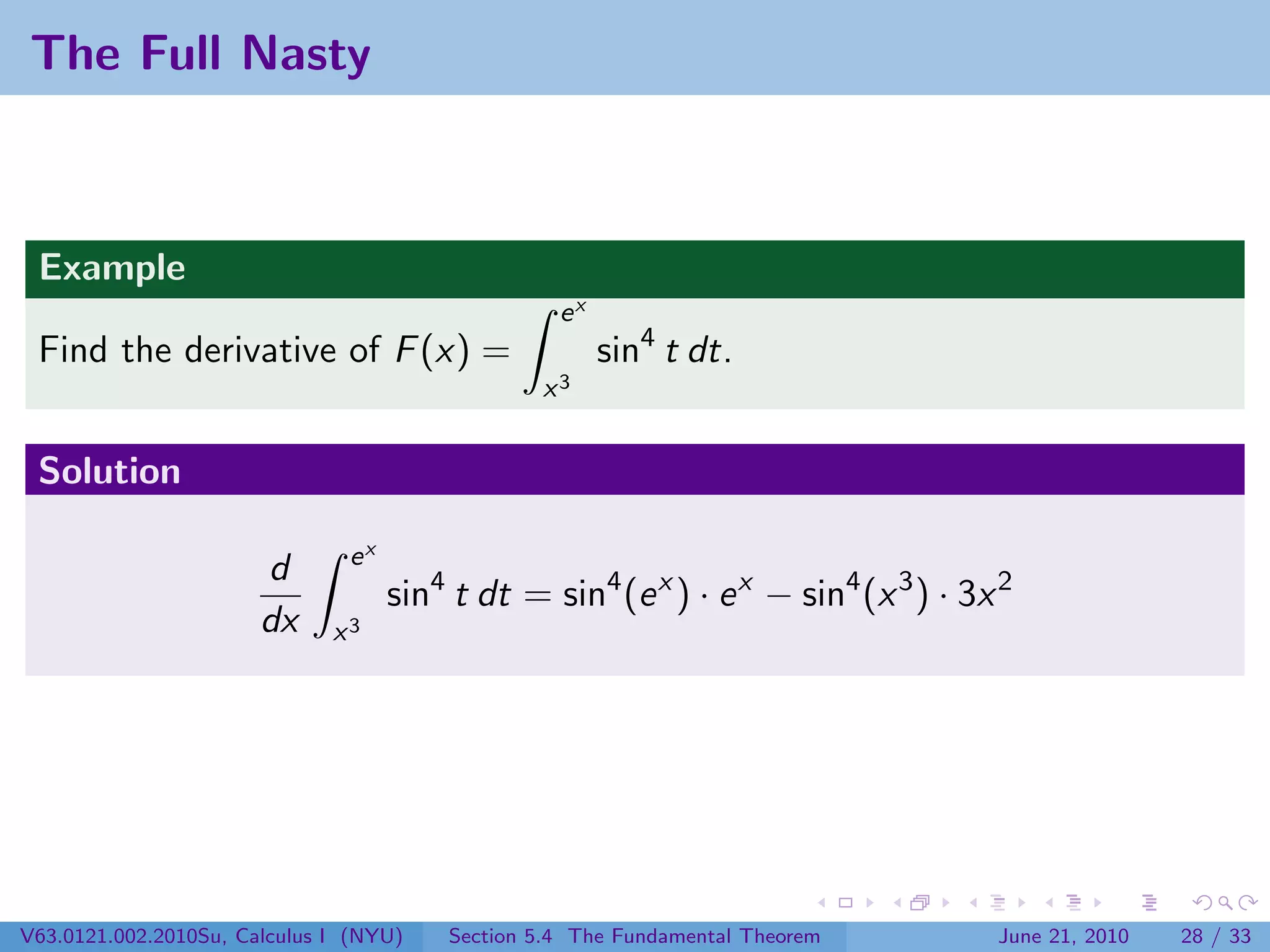
 Solution

                               ex
                       d
                                    sin4 t dt = sin4 (e x ) · e x − sin4 (x 3 ) · 3x 2
                       dx     x3


V63.0121.002.2010Su, Calculus I (NYU)   Section 5.4 The Fundamental Theorem         June 21, 2010   28 / 33
The Full Nasty


 Example
                                                  ex
 Find the derivative of F (x) =                        sin4 t dt.
                                                x3


 Solution

                               ex
                       d
                                    sin4 t dt = sin4 (e x ) · e x − sin4 (x 3 ) · 3x 2
                       dx     x3


 Notice here it’s much easier than finding an antiderivative for sin4 .


V63.0121.002.2010Su, Calculus I (NYU)   Section 5.4 The Fundamental Theorem         June 21, 2010   28 / 33
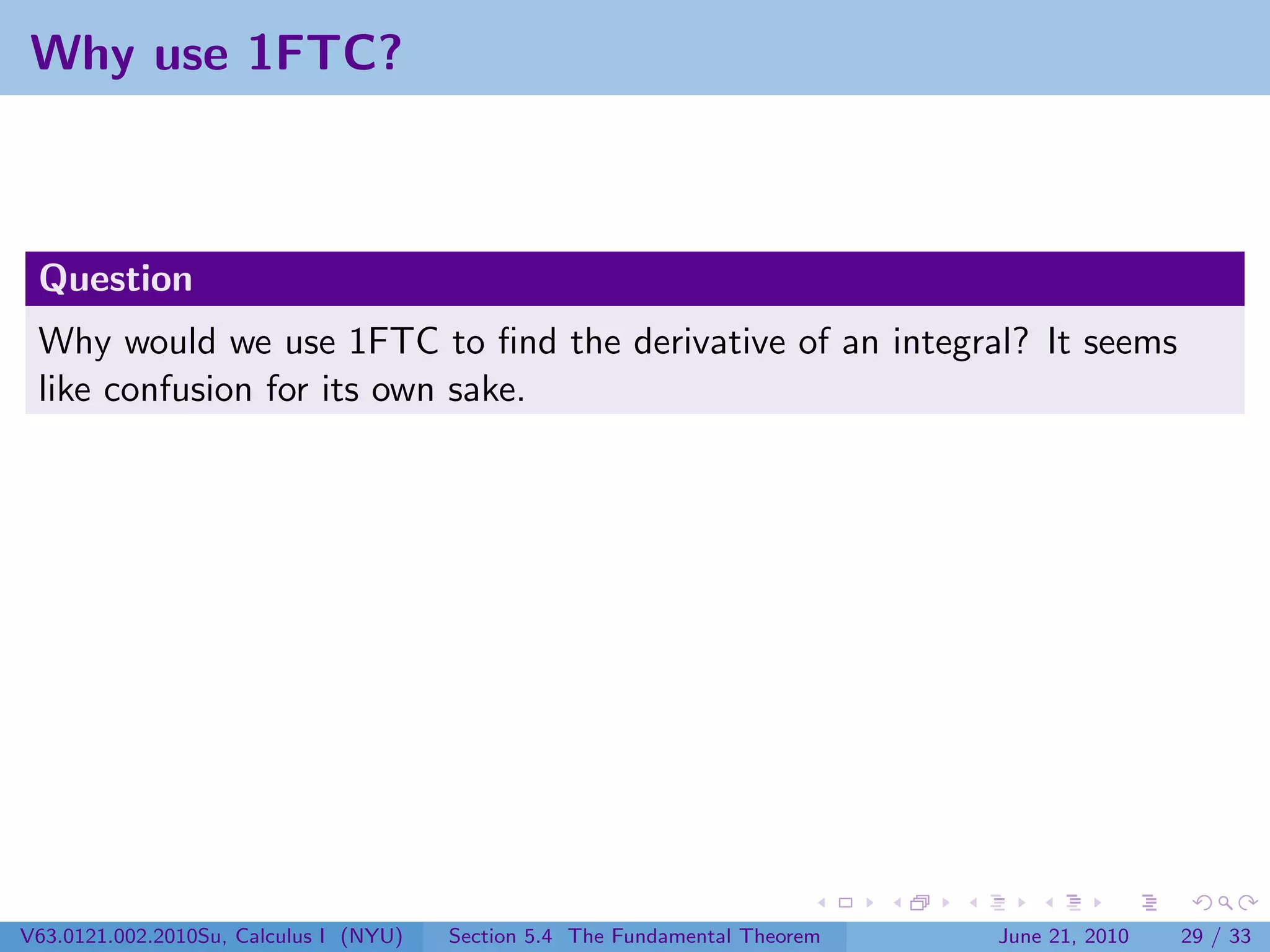
Why use 1FTC?


 Question
 Why would we use 1FTC to find the derivative of an integral? It seems
 like confusion for its own sake.


V63.0121.002.2010Su, Calculus I (NYU)   Section 5.4 The Fundamental Theorem   June 21, 2010   29 / 33
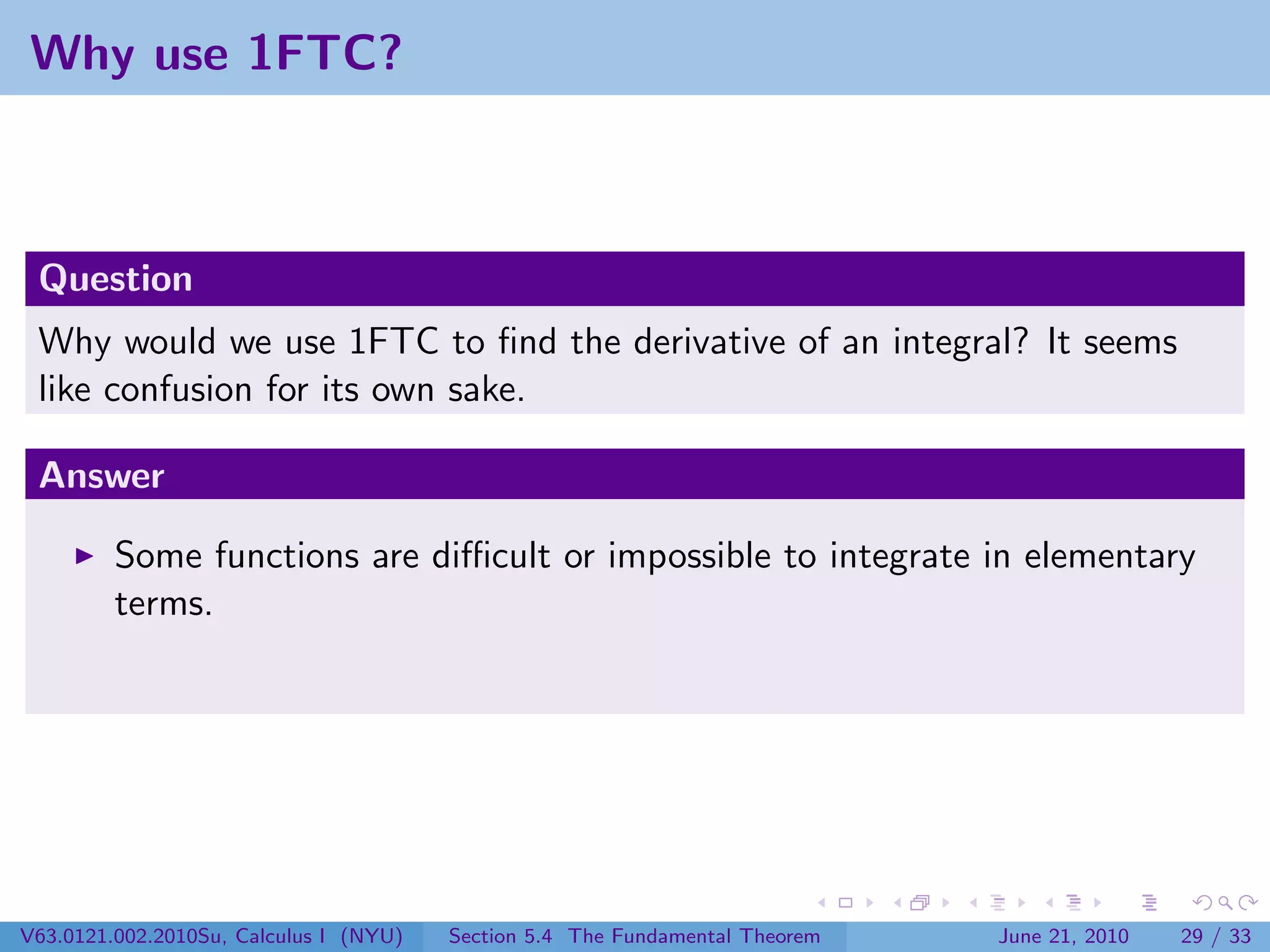
Why use 1FTC?


 Question
 Why would we use 1FTC to find the derivative of an integral? It seems
 like confusion for its own sake.

 Answer

         Some functions are difficult or impossible to integrate in elementary
         terms.


V63.0121.002.2010Su, Calculus I (NYU)   Section 5.4 The Fundamental Theorem   June 21, 2010   29 / 33
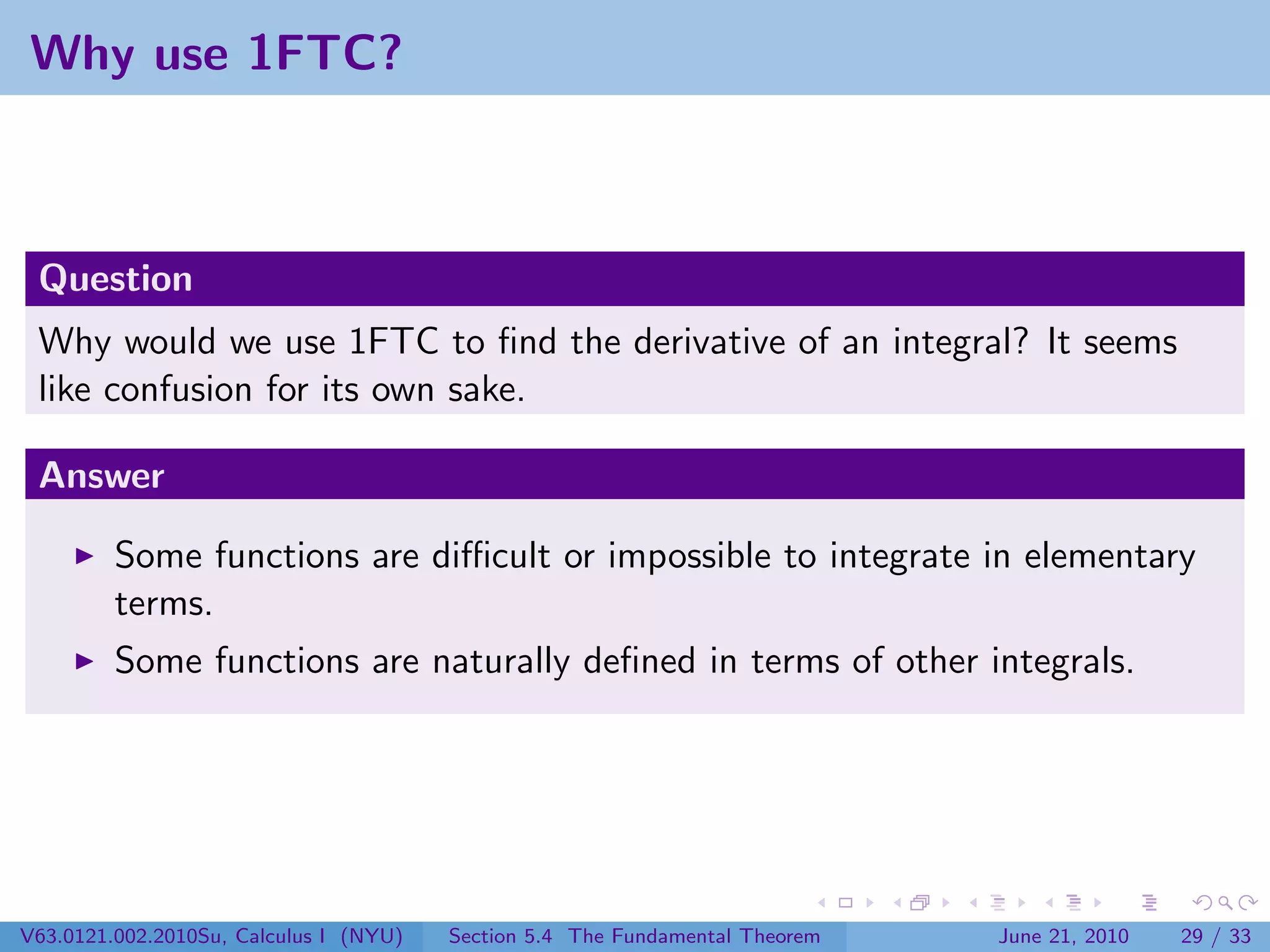
Why use 1FTC?


 Question
 Why would we use 1FTC to find the derivative of an integral? It seems
 like confusion for its own sake.

 Answer

         Some functions are difficult or impossible to integrate in elementary
         terms.
         Some functions are naturally defined in terms of other integrals.


V63.0121.002.2010Su, Calculus I (NYU)   Section 5.4 The Fundamental Theorem   June 21, 2010   29 / 33
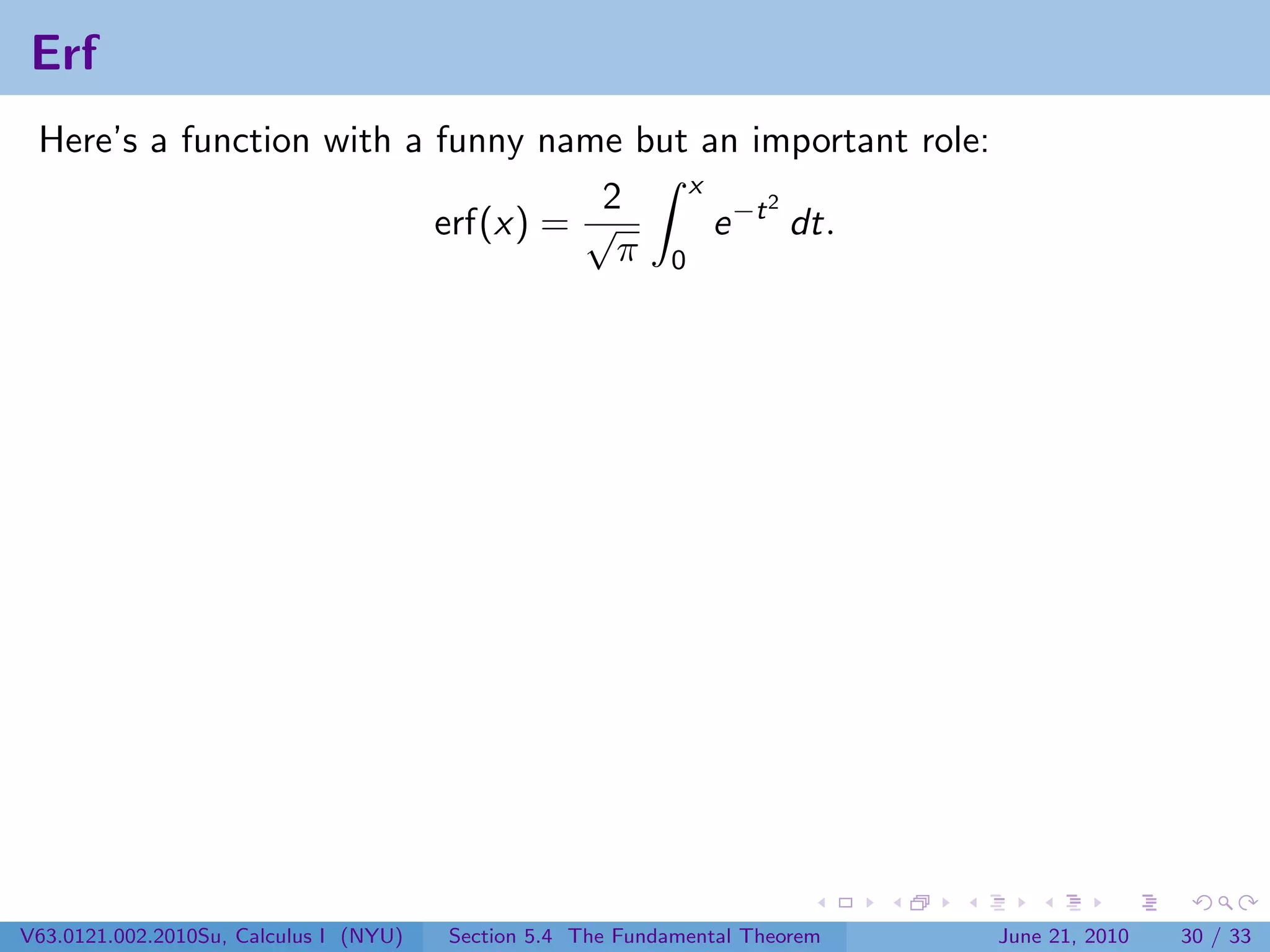
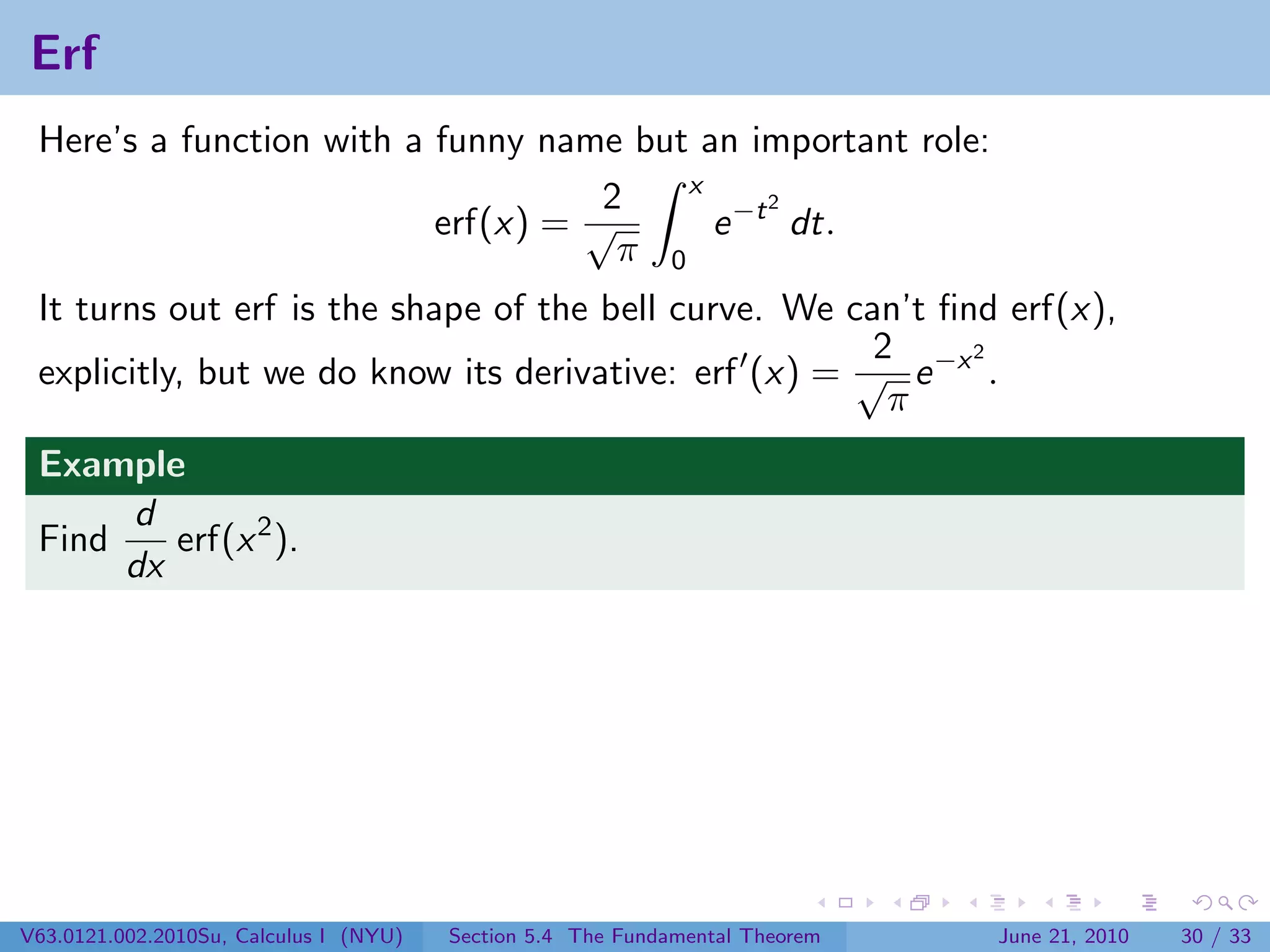
Erf
 Here’s a function with a funny name but an important role:
                                         x
                                    2          2
                          erf(x) = √       e −t dt.
                                     π 0


V63.0121.002.2010Su, Calculus I (NYU)   Section 5.4 The Fundamental Theorem   June 21, 2010   30 / 33
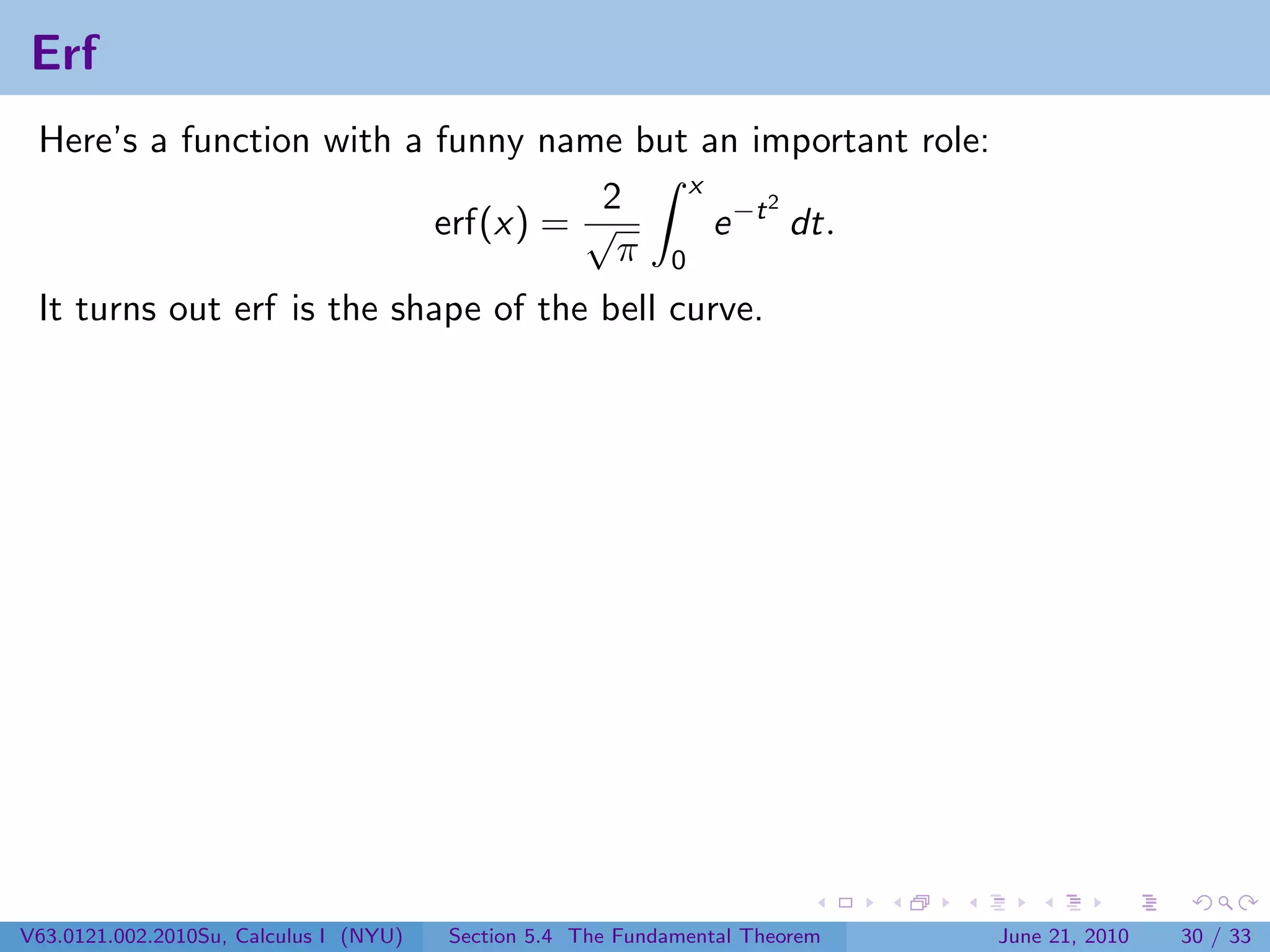
Erf
 Here’s a function with a funny name but an important role:
                                         x
                                    2          2
                          erf(x) = √       e −t dt.
                                     π 0
 It turns out erf is the shape of the bell curve.


V63.0121.002.2010Su, Calculus I (NYU)   Section 5.4 The Fundamental Theorem   June 21, 2010   30 / 33
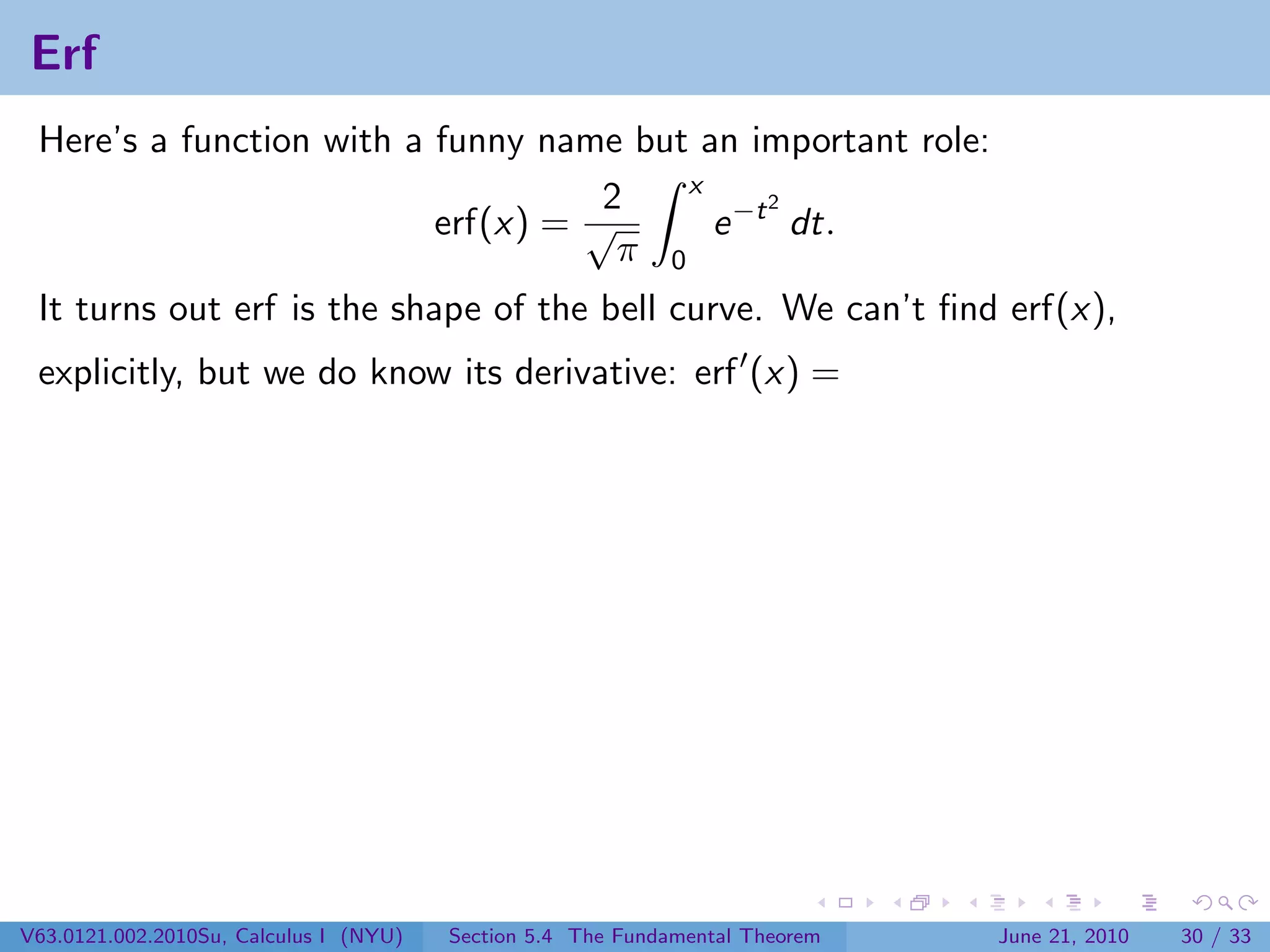
Erf
 Here’s a function with a funny name but an important role:
                                         x
                                    2          2
                          erf(x) = √       e −t dt.
                                     π 0
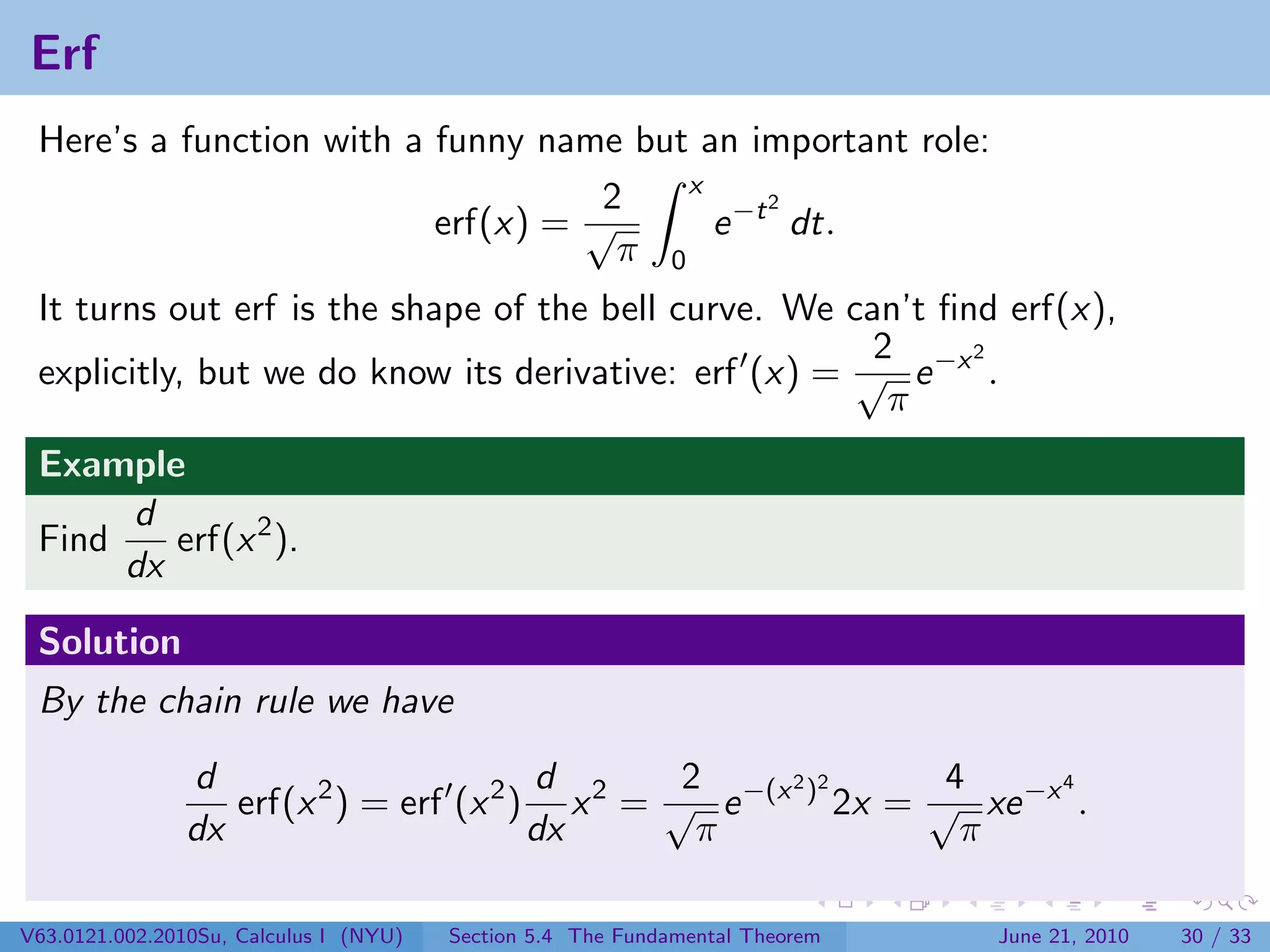
 It turns out erf is the shape of the bell curve. We can’t find erf(x),
 explicitly, but we do know its derivative: erf (x) =


V63.0121.002.2010Su, Calculus I (NYU)   Section 5.4 The Fundamental Theorem   June 21, 2010   30 / 33
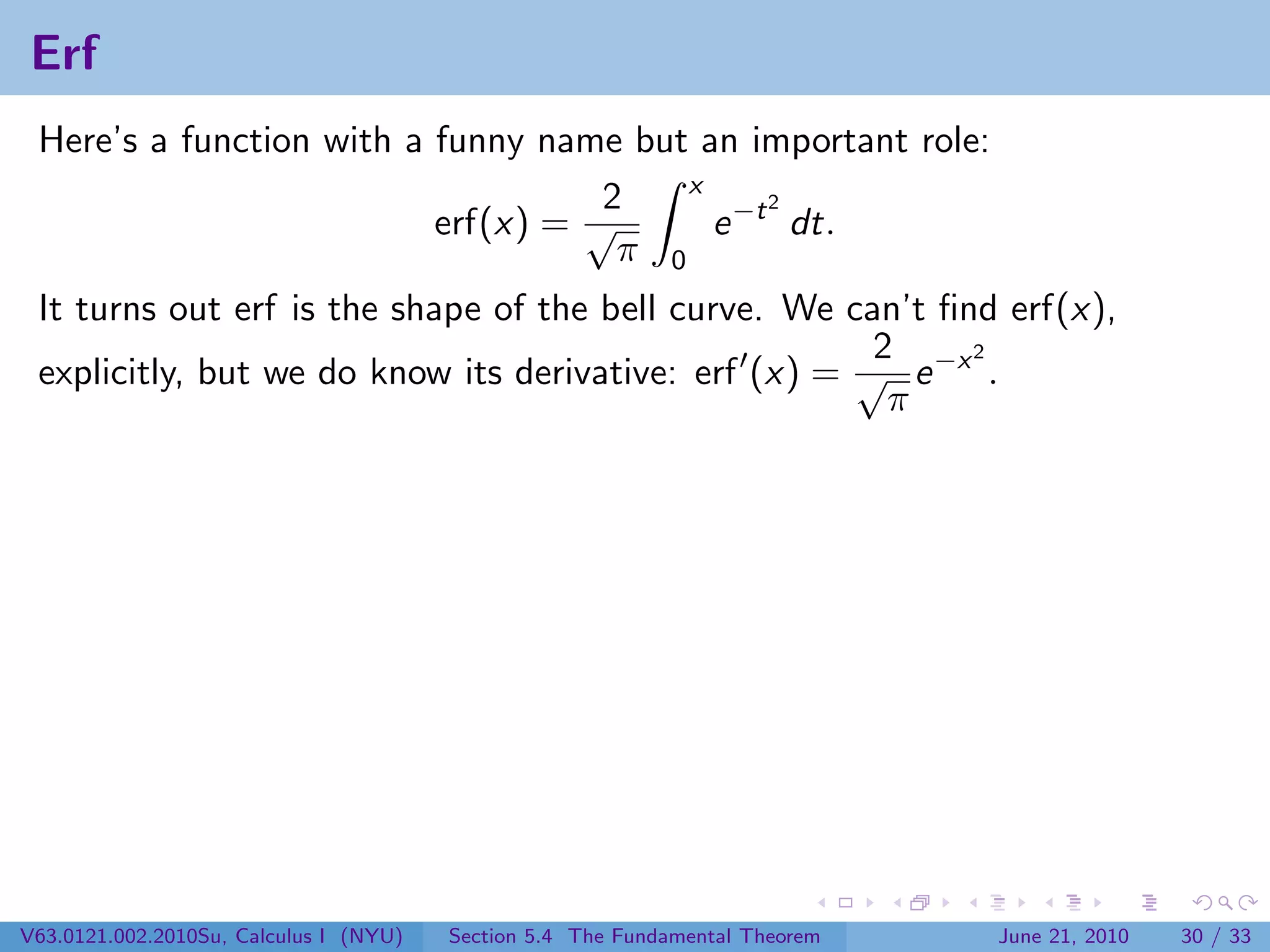
Erf
 Here’s a function with a funny name but an important role:
                                         x
                                    2          2
                          erf(x) = √       e −t dt.
                                     π 0
 It turns out erf is the shape of the bell curve. We can’t find erf(x),
                                                       2     2
 explicitly, but we do know its derivative: erf (x) = √ e −x .
                                                        π


V63.0121.002.2010Su, Calculus I (NYU)   Section 5.4 The Fundamental Theorem   June 21, 2010   30 / 33
Erf
 Here’s a function with a funny name but an important role:
                                         x
                                    2          2
                          erf(x) = √       e −t dt.
                                     π 0
 It turns out erf is the shape of the bell curve. We can’t find erf(x),
                                                       2     2
 explicitly, but we do know its derivative: erf (x) = √ e −x .
                                                        π
 Example
      d
 Find    erf(x 2 ).
      dx


V63.0121.002.2010Su, Calculus I (NYU)   Section 5.4 The Fundamental Theorem   June 21, 2010   30 / 33
Erf
 Here’s a function with a funny name but an important role:
                                         x
                                    2          2
                          erf(x) = √       e −t dt.
                                     π 0
 It turns out erf is the shape of the bell curve. We can’t find erf(x),
                                                       2     2
 explicitly, but we do know its derivative: erf (x) = √ e −x .
                                                        π
 Example
      d
 Find    erf(x 2 ).
      dx

 Solution
 By the chain rule we have
                d                        d       2     2 2      4     4
                   erf(x 2 ) = erf (x 2 ) x 2 = √ e −(x ) 2x = √ xe −x .
                dx                       dx       π              π

V63.0121.002.2010Su, Calculus I (NYU)   Section 5.4 The Fundamental Theorem   June 21, 2010   30 / 33
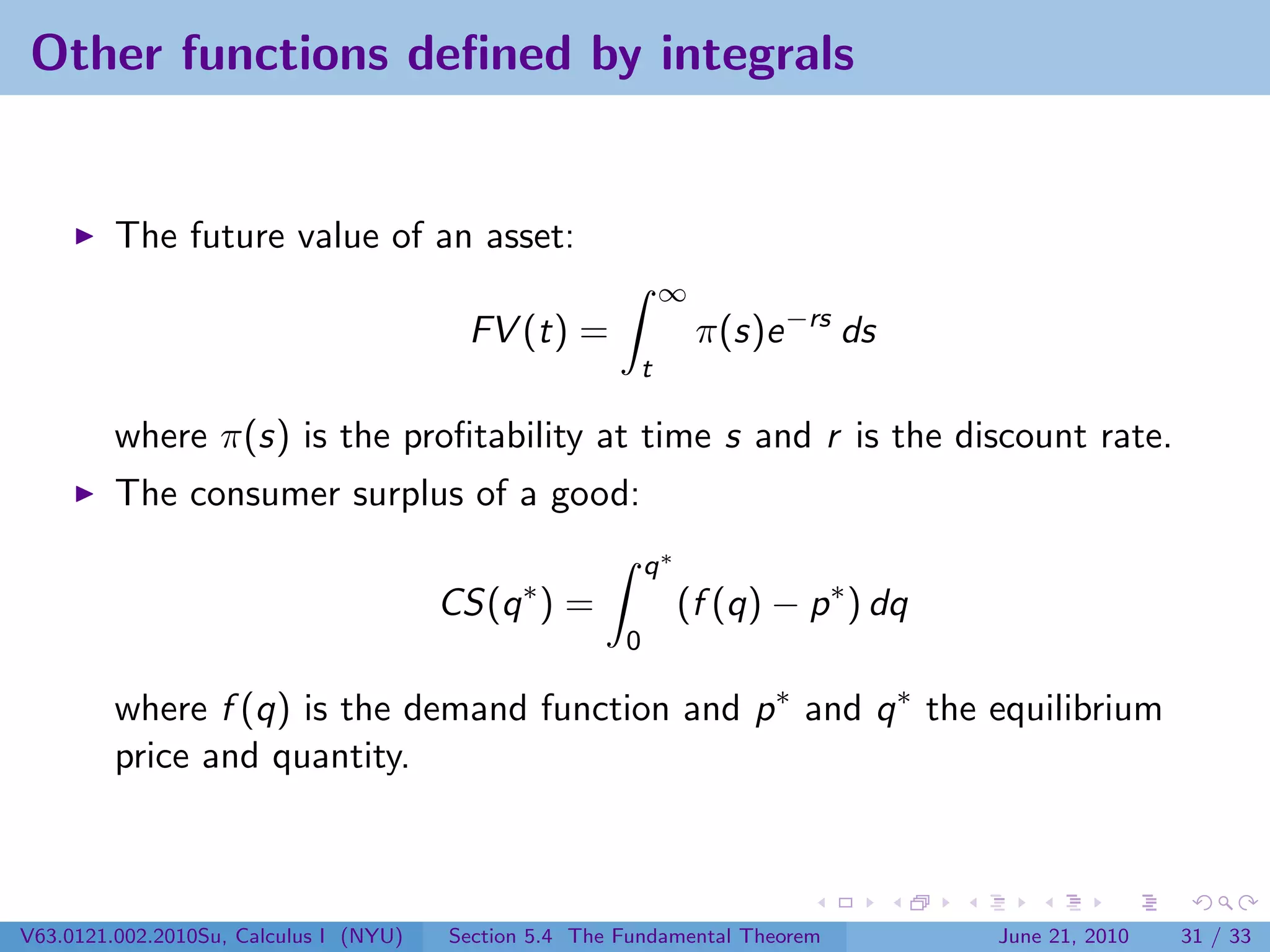
Other functions defined by integrals


         The future value of an asset:
                                                              ∞
                                          FV (t) =                π(s)e −rs ds
                                                          t

         where π(s) is the profitability at time s and r is the discount rate.
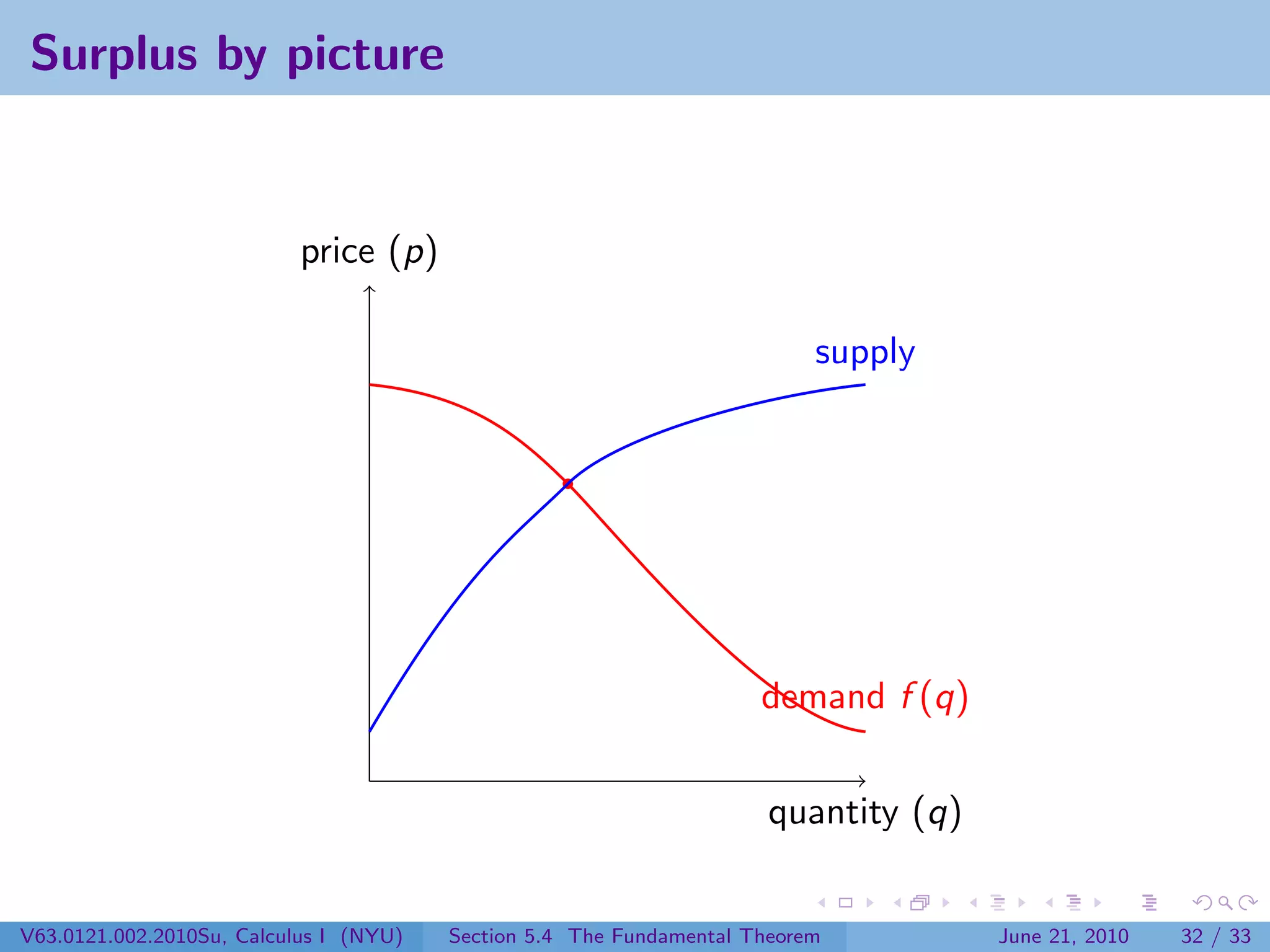
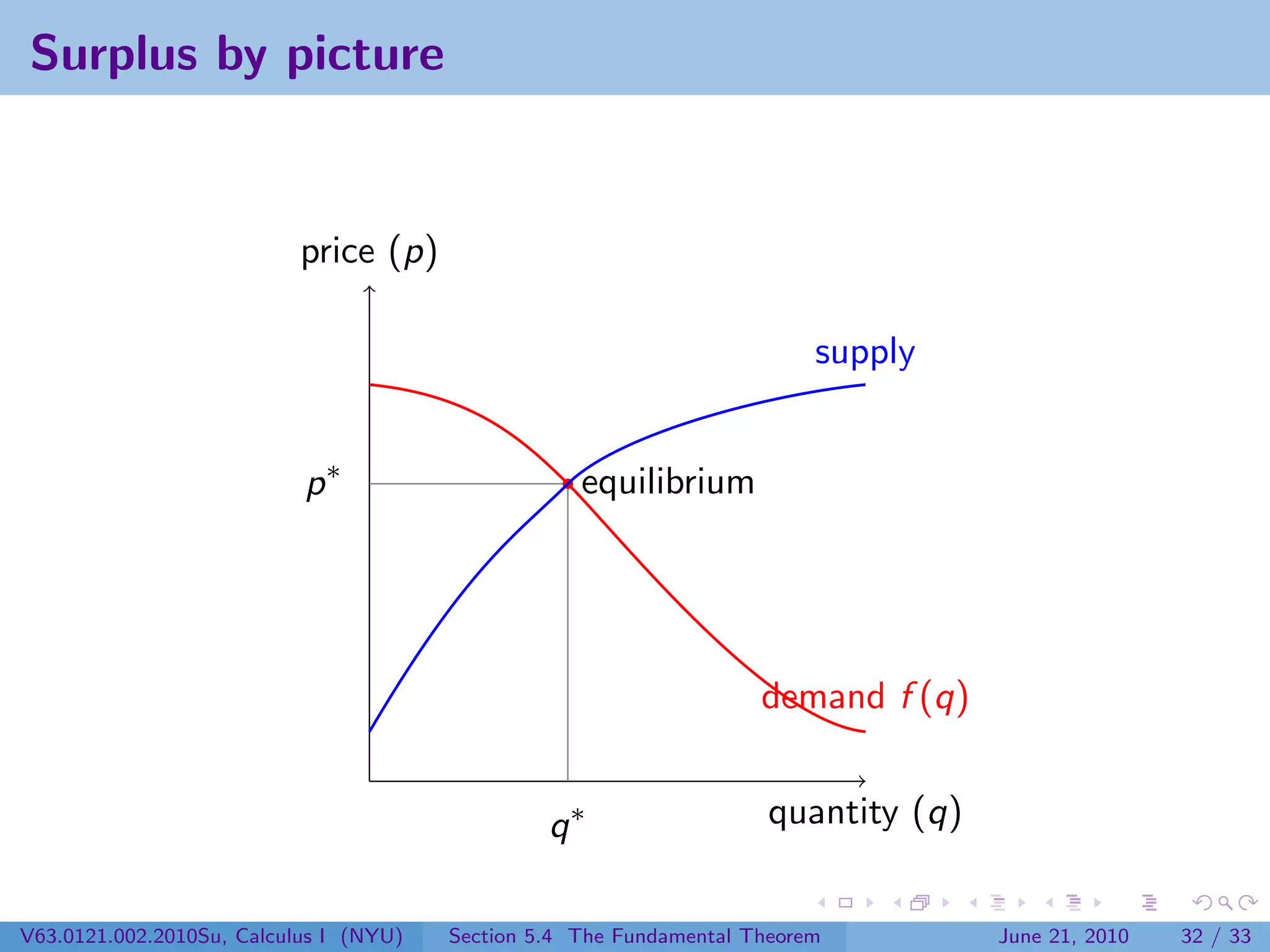
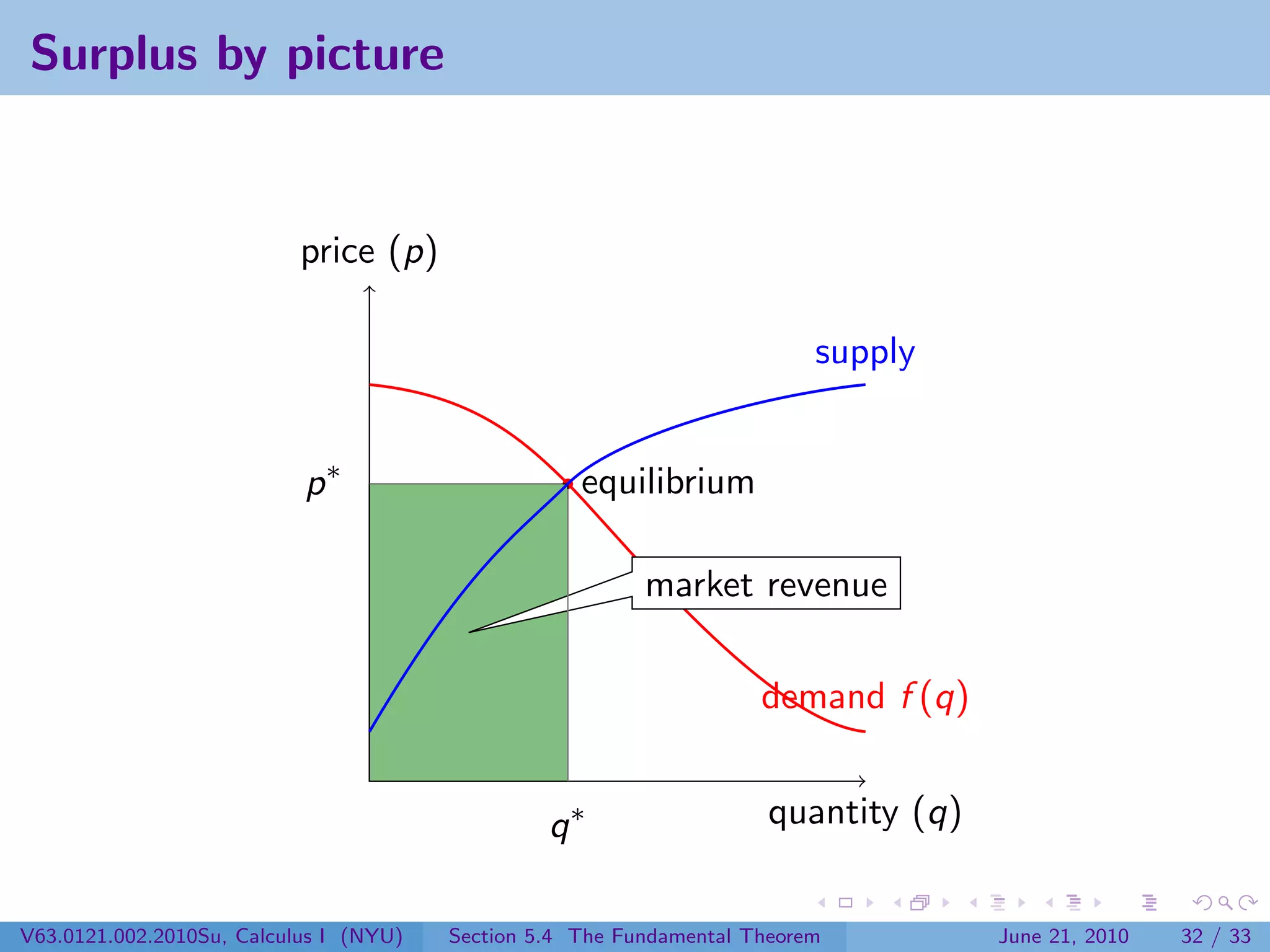
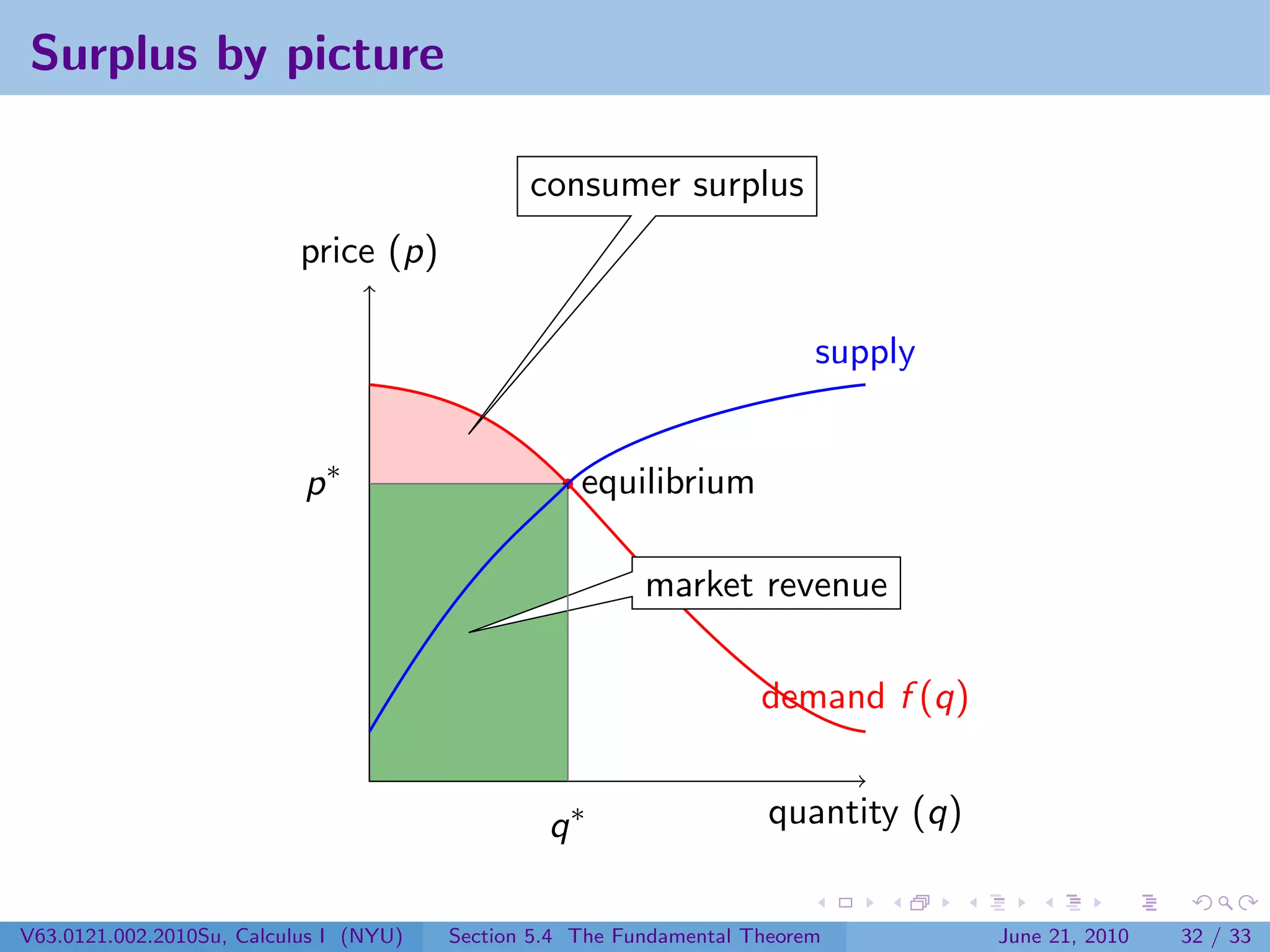
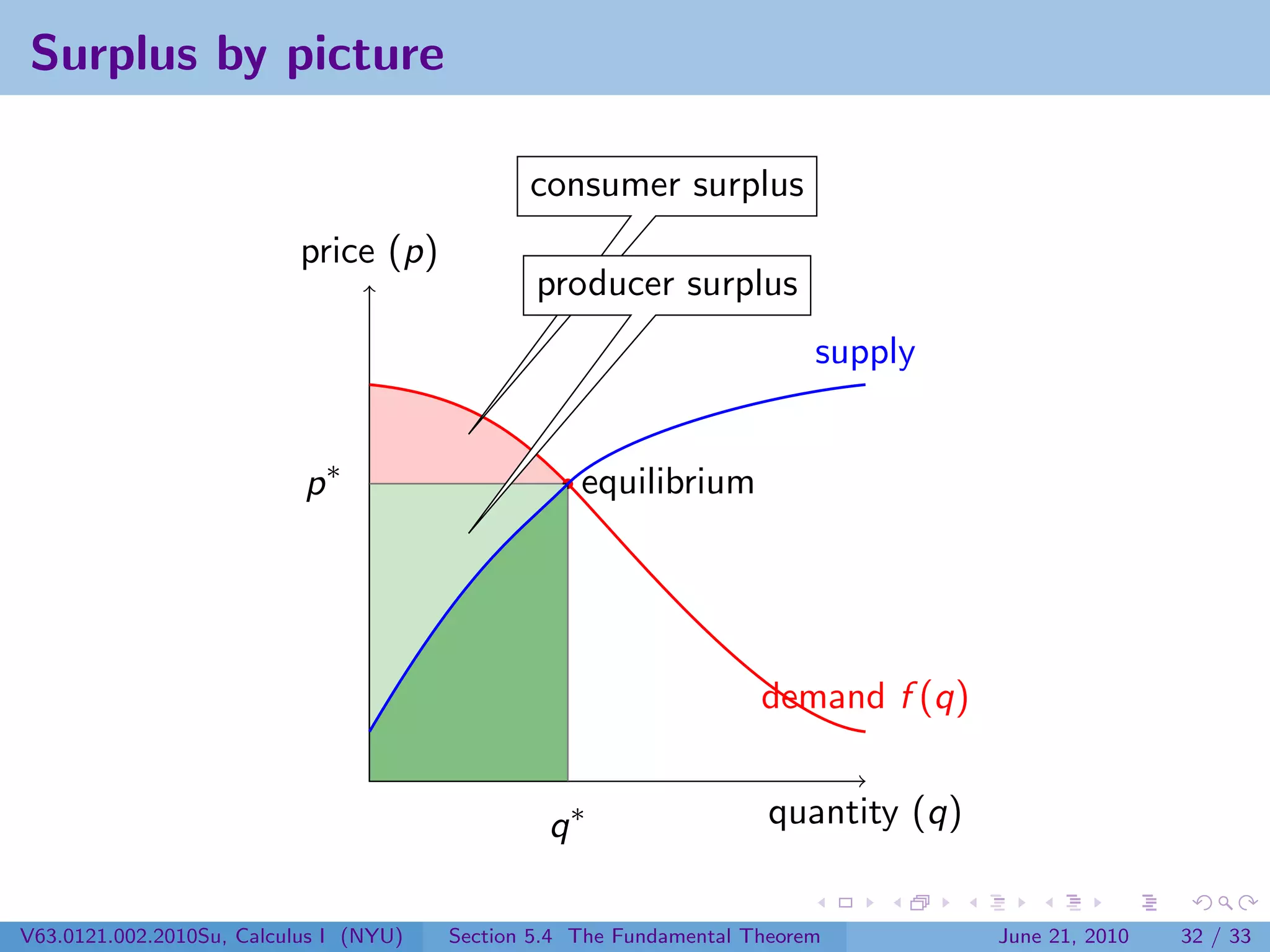
         The consumer surplus of a good:
                                                            q∗
                                        CS(q ∗ ) =               (f (q) − p ∗ ) dq
                                                        0

         where f (q) is the demand function and p ∗ and q ∗ the equilibrium
         price and quantity.


V63.0121.002.2010Su, Calculus I (NYU)   Section 5.4 The Fundamental Theorem          June 21, 2010   31 / 33
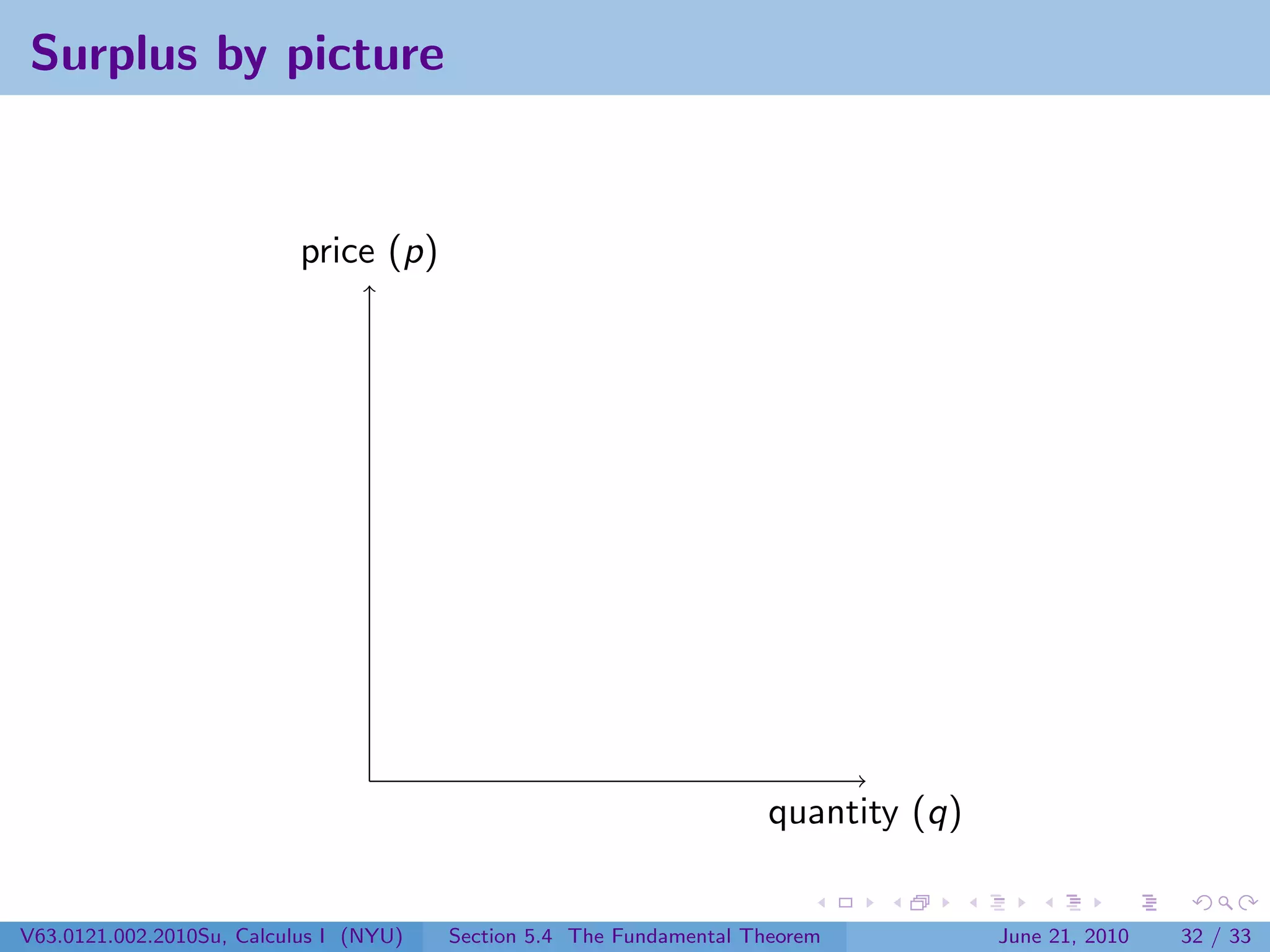
Surplus by picture


                           price (p)


                                                                      quantity (q)


V63.0121.002.2010Su, Calculus I (NYU)   Section 5.4 The Fundamental Theorem          June 21, 2010   32 / 33
Surplus by picture


                           price (p)


                                                                     demand f (q)


                                                                      quantity (q)


V63.0121.002.2010Su, Calculus I (NYU)   Section 5.4 The Fundamental Theorem          June 21, 2010   32 / 33
Surplus by picture


                           price (p)

                                                                          supply


                                                                     demand f (q)


                                                                      quantity (q)


V63.0121.002.2010Su, Calculus I (NYU)   Section 5.4 The Fundamental Theorem          June 21, 2010   32 / 33
Surplus by picture


                           price (p)

                                                                          supply


                           p∗                       equilibrium


                                                                     demand f (q)


                                                 q∗                   quantity (q)


V63.0121.002.2010Su, Calculus I (NYU)   Section 5.4 The Fundamental Theorem          June 21, 2010   32 / 33
Surplus by picture


                           price (p)

                                                                          supply


                           p∗                       equilibrium

                                                          market revenue

                                                                     demand f (q)


                                                 q∗                   quantity (q)


V63.0121.002.2010Su, Calculus I (NYU)   Section 5.4 The Fundamental Theorem          June 21, 2010   32 / 33
Surplus by picture

                                               consumer surplus
                           price (p)

                                                                          supply


                           p∗                       equilibrium

                                                          market revenue

                                                                     demand f (q)


                                                 q∗                   quantity (q)


V63.0121.002.2010Su, Calculus I (NYU)   Section 5.4 The Fundamental Theorem          June 21, 2010   32 / 33
Surplus by picture

                                               consumer surplus
                           price (p)
                                                producer surplus
                                                                          supply


                           p∗                       equilibrium


                                                                     demand f (q)


                                                 q∗                   quantity (q)


V63.0121.002.2010Su, Calculus I (NYU)   Section 5.4 The Fundamental Theorem          June 21, 2010   32 / 33
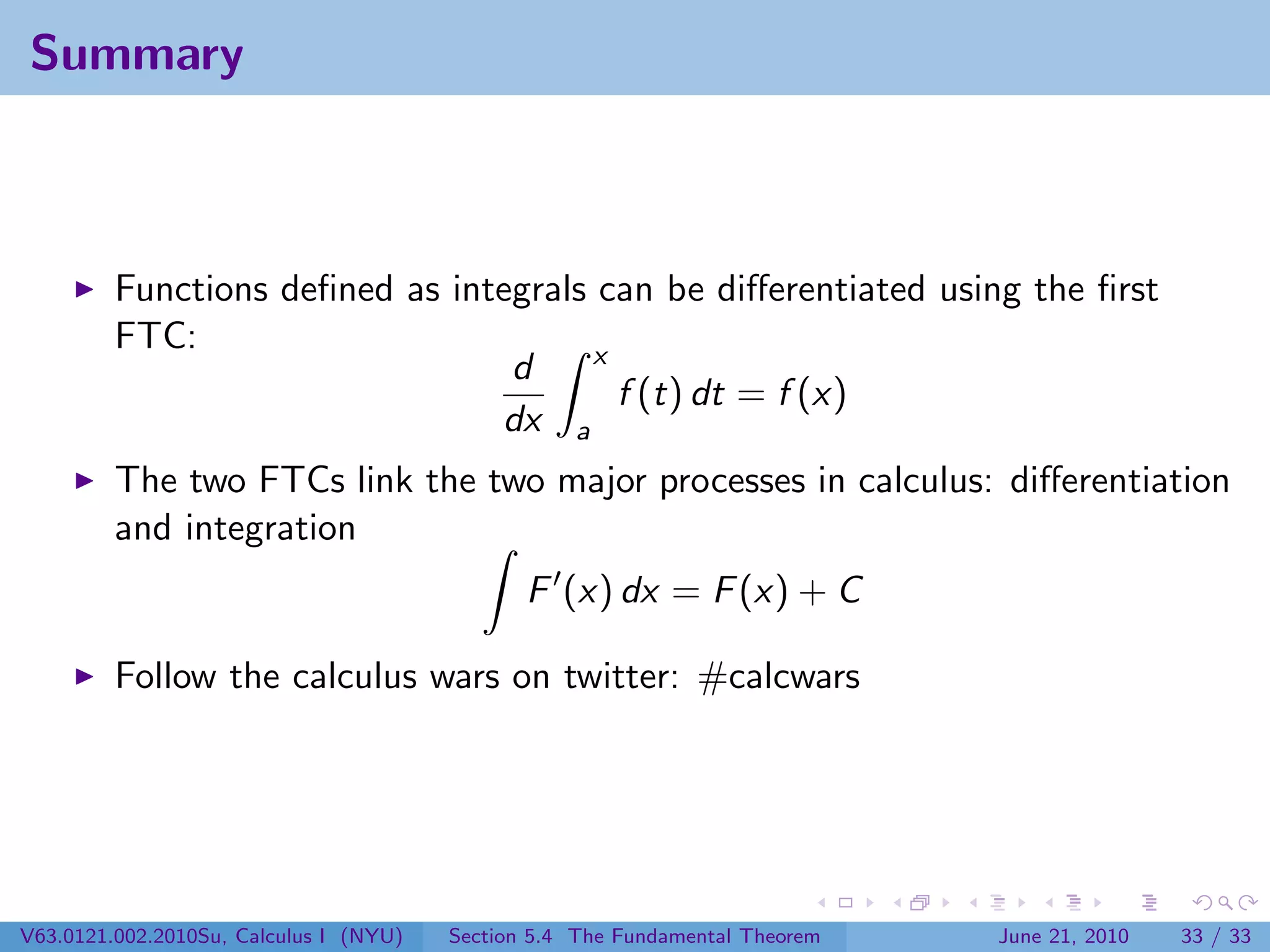
Summary


         Functions defined as integrals can be differentiated using the first
         FTC:                         x
                                 d
                                        f (t) dt = f (x)
                                dx a
         The two FTCs link the two major processes in calculus: differentiation
         and integration
                                               F (x) dx = F (x) + C

         Follow the calculus wars on twitter: #calcwars


V63.0121.002.2010Su, Calculus I (NYU)   Section 5.4 The Fundamental Theorem   June 21, 2010   33 / 33

Lesson 27: The Fundamental Theorem of Calculus

  • 1.
    Section 5.4 The Fundamental Theorem of Calculus V63.0121.002.2010Su, Calculus I New York University June 21, 2010 Announcements
  • 2.
    Announcements V63.0121.002.2010Su, Calculus I(NYU) Section 5.4 The Fundamental Theorem June 21, 2010 2 / 33
  • 3.
    Objectives State and explain the Fundemental Theorems of Calculus Use the first fundamental theorem of calculus to find derivatives of functions defined as integrals. Compute the average value of an integrable function over a closed interval. V63.0121.002.2010Su, Calculus I (NYU) Section 5.4 The Fundamental Theorem June 21, 2010 3 / 33
  • 4.
    Outline Recall: TheEvaluation Theorem a/k/a 2FTC The First Fundamental Theorem of Calculus The Area Function Statement and proof of 1FTC Biographies Differentiation of functions defined by integrals “Contrived” examples Erf Other applications V63.0121.002.2010Su, Calculus I (NYU) Section 5.4 The Fundamental Theorem June 21, 2010 4 / 33
  • 5.
    The definite integralas a limit Definition If f is a function defined on [a, b], the definite integral of f from a to b is the number b n f (x) dx = lim f (ci ) ∆x a ∆x→0 i=1 V63.0121.002.2010Su, Calculus I (NYU) Section 5.4 The Fundamental Theorem June 21, 2010 5 / 33
  • 6.
    Big time Theorem Theorem (The Second Fundamental Theorem of Calculus) Suppose f is integrable on [a, b] and f = F for another function F , then b f (x) dx = F (b) − F (a). a V63.0121.002.2010Su, Calculus I (NYU) Section 5.4 The Fundamental Theorem June 21, 2010 6 / 33
  • 7.
    The Integral asTotal Change Another way to state this theorem is: b F (x) dx = F (b) − F (a), a or the integral of a derivative along an interval is the total change between the sides of that interval. This has many ramifications: V63.0121.002.2010Su, Calculus I (NYU) Section 5.4 The Fundamental Theorem June 21, 2010 7 / 33
  • 8.
    The Integral asTotal Change Another way to state this theorem is: b F (x) dx = F (b) − F (a), a or the integral of a derivative along an interval is the total change between the sides of that interval. This has many ramifications: Theorem If v (t) represents the velocity of a particle moving rectilinearly, then t1 v (t) dt = s(t1 ) − s(t0 ). t0 V63.0121.002.2010Su, Calculus I (NYU) Section 5.4 The Fundamental Theorem June 21, 2010 7 / 33
  • 9.
    The Integral asTotal Change Another way to state this theorem is: b F (x) dx = F (b) − F (a), a or the integral of a derivative along an interval is the total change between the sides of that interval. This has many ramifications: Theorem If MC (x) represents the marginal cost of making x units of a product, then x C (x) = C (0) + MC (q) dq. 0 V63.0121.002.2010Su, Calculus I (NYU) Section 5.4 The Fundamental Theorem June 21, 2010 7 / 33
  • 10.
    The Integral asTotal Change Another way to state this theorem is: b F (x) dx = F (b) − F (a), a or the integral of a derivative along an interval is the total change between the sides of that interval. This has many ramifications: Theorem If ρ(x) represents the density of a thin rod at a distance of x from its end, then the mass of the rod up to x is x m(x) = ρ(s) ds. 0 V63.0121.002.2010Su, Calculus I (NYU) Section 5.4 The Fundamental Theorem June 21, 2010 7 / 33
  • 11.
    My first tableof integrals [f (x) + g (x)] dx = f (x) dx + g (x) dx x n+1 x n dx = + C (n = −1) cf (x) dx = c f (x) dx n+1 1 e x dx = e x + C dx = ln |x| + C x ax sin x dx = − cos x + C ax dx = +C ln a cos x dx = sin x + C csc2 x dx = − cot x + C sec2 x dx = tan x + C csc x cot x dx = − csc x + C 1 sec x tan x dx = sec x + C √ dx = arcsin x + C 1 − x2 1 dx = arctan x + C 1 + x2 V63.0121.002.2010Su, Calculus I (NYU) Section 5.4 The Fundamental Theorem June 21, 2010 8 / 33
  • 12.
    Outline Recall: TheEvaluation Theorem a/k/a 2FTC The First Fundamental Theorem of Calculus The Area Function Statement and proof of 1FTC Biographies Differentiation of functions defined by integrals “Contrived” examples Erf Other applications V63.0121.002.2010Su, Calculus I (NYU) Section 5.4 The Fundamental Theorem June 21, 2010 9 / 33
  • 13.
    An area function x Let f (t) = t 3 and define g (x) = f (t) dt. Can we evaluate the integral 0 in g (x)? 0 x V63.0121.002.2010Su, Calculus I (NYU) Section 5.4 The Fundamental Theorem June 21, 2010 10 / 33
  • 14.
    An area function x Let f (t) = t 3 and define g (x) = f (t) dt. Can we evaluate the integral 0 in g (x)? Dividing the interval [0, x] into n pieces x ix gives ∆t = and ti = 0 + i∆t = . So n n x x 3 x (2x)3 x (nx)3 Rn = · 3+ · 3 + ··· + · n n n n n n3 x4 = 4 13 + 23 + 33 + · · · + n3 n x4 1 2 = 4 2 n(n + 1) n 0 x x 4 n2 (n + 1)2 x4 = 4 → 4n 4 as n → ∞. V63.0121.002.2010Su, Calculus I (NYU) Section 5.4 The Fundamental Theorem June 21, 2010 10 / 33
  • 15.
    An area function,continued So x4 g (x) = . 4 V63.0121.002.2010Su, Calculus I (NYU) Section 5.4 The Fundamental Theorem June 21, 2010 11 / 33
  • 16.
    An area function,continued So x4 g (x) = . 4 This means that g (x) = x 3 . V63.0121.002.2010Su, Calculus I (NYU) Section 5.4 The Fundamental Theorem June 21, 2010 11 / 33
  • 17.
    The area function Let f be a function which is integrable (i.e., continuous or with finitely many jump discontinuities) on [a, b]. Define x g (x) = f (t) dt. a The variable is x; t is a “dummy” variable that’s integrated over. Picture changing x and taking more of less of the region under the curve. Question: What does f tell you about g ? V63.0121.002.2010Su, Calculus I (NYU) Section 5.4 The Fundamental Theorem June 21, 2010 12 / 33
  • 18.
    Envisioning the areafunction Example Suppose f (t) is the function graphed below: y x 2 4 6 8 10f x Let g (x) = f (t) dt. What can you say about g ? 0 V63.0121.002.2010Su, Calculus I (NYU) Section 5.4 The Fundamental Theorem June 21, 2010 13 / 33
  • 19.
    Envisioning the areafunction Example Suppose f (t) is the function graphed below: y g x 2 4 6 8 10f x Let g (x) = f (t) dt. What can you say about g ? 0 V63.0121.002.2010Su, Calculus I (NYU) Section 5.4 The Fundamental Theorem June 21, 2010 13 / 33
  • 20.
    Envisioning the areafunction Example Suppose f (t) is the function graphed below: y g x 2 4 6 8 10f x Let g (x) = f (t) dt. What can you say about g ? 0 V63.0121.002.2010Su, Calculus I (NYU) Section 5.4 The Fundamental Theorem June 21, 2010 13 / 33
  • 21.
    Envisioning the areafunction Example Suppose f (t) is the function graphed below: y g x 2 4 6 8 10f x Let g (x) = f (t) dt. What can you say about g ? 0 V63.0121.002.2010Su, Calculus I (NYU) Section 5.4 The Fundamental Theorem June 21, 2010 13 / 33
  • 22.
    Envisioning the areafunction Example Suppose f (t) is the function graphed below: y g x 2 4 6 8 10f x Let g (x) = f (t) dt. What can you say about g ? 0 V63.0121.002.2010Su, Calculus I (NYU) Section 5.4 The Fundamental Theorem June 21, 2010 13 / 33
  • 23.
    Envisioning the areafunction Example Suppose f (t) is the function graphed below: y g x 2 4 6 8 10f x Let g (x) = f (t) dt. What can you say about g ? 0 V63.0121.002.2010Su, Calculus I (NYU) Section 5.4 The Fundamental Theorem June 21, 2010 13 / 33
  • 24.
    Envisioning the areafunction Example Suppose f (t) is the function graphed below: y g x 2 4 6 8 10f x Let g (x) = f (t) dt. What can you say about g ? 0 V63.0121.002.2010Su, Calculus I (NYU) Section 5.4 The Fundamental Theorem June 21, 2010 13 / 33
  • 25.
    Envisioning the areafunction Example Suppose f (t) is the function graphed below: y g x 2 4 6 8 10f x Let g (x) = f (t) dt. What can you say about g ? 0 V63.0121.002.2010Su, Calculus I (NYU) Section 5.4 The Fundamental Theorem June 21, 2010 13 / 33
  • 26.
    Envisioning the areafunction Example Suppose f (t) is the function graphed below: y g x 2 4 6 8 10f x Let g (x) = f (t) dt. What can you say about g ? 0 V63.0121.002.2010Su, Calculus I (NYU) Section 5.4 The Fundamental Theorem June 21, 2010 13 / 33
  • 27.
    Envisioning the areafunction Example Suppose f (t) is the function graphed below: y g x 2 4 6 8 10f x Let g (x) = f (t) dt. What can you say about g ? 0 V63.0121.002.2010Su, Calculus I (NYU) Section 5.4 The Fundamental Theorem June 21, 2010 13 / 33
  • 28.
    Envisioning the areafunction Example Suppose f (t) is the function graphed below: y g x 2 4 6 8 10f x Let g (x) = f (t) dt. What can you say about g ? 0 V63.0121.002.2010Su, Calculus I (NYU) Section 5.4 The Fundamental Theorem June 21, 2010 13 / 33
  • 29.
    Envisioning the areafunction Example Suppose f (t) is the function graphed below: y g x 2 4 6 8 10f x Let g (x) = f (t) dt. What can you say about g ? 0 V63.0121.002.2010Su, Calculus I (NYU) Section 5.4 The Fundamental Theorem June 21, 2010 13 / 33
  • 30.
    features of gfrom f y Interval sign monotonicity monotonicity concavity of f of g of f of g g [0, 2] + x 2 4 6 8 10f [2, 4.5] + [4.5, 6] − [6, 8] − [8, 10] − → none V63.0121.002.2010Su, Calculus I (NYU) Section 5.4 The Fundamental Theorem June 21, 2010 14 / 33
  • 31.
    features of gfrom f y Interval sign monotonicity monotonicity concavity of f of g of f of g g [0, 2] + x 2 4 6 8 10f [2, 4.5] + [4.5, 6] − [6, 8] − [8, 10] − → none We see that g is behaving a lot like an antiderivative of f . V63.0121.002.2010Su, Calculus I (NYU) Section 5.4 The Fundamental Theorem June 21, 2010 14 / 33
  • 32.
    Another Big TimeTheorem Theorem (The First Fundamental Theorem of Calculus) Let f be an integrable function on [a, b] and define x g (x) = f (t) dt. a If f is continuous at x in (a, b), then g is differentiable at x and g (x) = f (x). V63.0121.002.2010Su, Calculus I (NYU) Section 5.4 The Fundamental Theorem June 21, 2010 15 / 33
  • 33.
    Proving the FundamentalTheorem Proof. Let h > 0 be given so that x + h < b. We have g (x + h) − g (x) = h V63.0121.002.2010Su, Calculus I (NYU) Section 5.4 The Fundamental Theorem June 21, 2010 16 / 33
  • 34.
    Proving the FundamentalTheorem Proof. Let h > 0 be given so that x + h < b. We have x+h g (x + h) − g (x) 1 = f (t) dt. h h x V63.0121.002.2010Su, Calculus I (NYU) Section 5.4 The Fundamental Theorem June 21, 2010 16 / 33
  • 35.
    Proving the FundamentalTheorem Proof. Let h > 0 be given so that x + h < b. We have x+h g (x + h) − g (x) 1 = f (t) dt. h h x Let Mh be the maximum value of f on [x, x + h], and let mh the minimum value of f on [x, x + h]. From §5.2 we have x+h f (t) dt x V63.0121.002.2010Su, Calculus I (NYU) Section 5.4 The Fundamental Theorem June 21, 2010 16 / 33
  • 36.
    Proving the FundamentalTheorem Proof. Let h > 0 be given so that x + h < b. We have x+h g (x + h) − g (x) 1 = f (t) dt. h h x Let Mh be the maximum value of f on [x, x + h], and let mh the minimum value of f on [x, x + h]. From §5.2 we have x+h f (t) dt ≤ Mh · h x V63.0121.002.2010Su, Calculus I (NYU) Section 5.4 The Fundamental Theorem June 21, 2010 16 / 33
  • 37.
    Proving the FundamentalTheorem Proof. Let h > 0 be given so that x + h < b. We have x+h g (x + h) − g (x) 1 = f (t) dt. h h x Let Mh be the maximum value of f on [x, x + h], and let mh the minimum value of f on [x, x + h]. From §5.2 we have x+h mh · h ≤ f (t) dt ≤ Mh · h x V63.0121.002.2010Su, Calculus I (NYU) Section 5.4 The Fundamental Theorem June 21, 2010 16 / 33
  • 38.
    Proving the FundamentalTheorem Proof. Let h > 0 be given so that x + h < b. We have x+h g (x + h) − g (x) 1 = f (t) dt. h h x Let Mh be the maximum value of f on [x, x + h], and let mh the minimum value of f on [x, x + h]. From §5.2 we have x+h mh · h ≤ f (t) dt ≤ Mh · h x So g (x + h) − g (x) mh ≤ ≤ Mh . h V63.0121.002.2010Su, Calculus I (NYU) Section 5.4 The Fundamental Theorem June 21, 2010 16 / 33
  • 39.
    Proving the FundamentalTheorem Proof. Let h > 0 be given so that x + h < b. We have x+h g (x + h) − g (x) 1 = f (t) dt. h h x Let Mh be the maximum value of f on [x, x + h], and let mh the minimum value of f on [x, x + h]. From §5.2 we have x+h mh · h ≤ f (t) dt ≤ Mh · h x So g (x + h) − g (x) mh ≤ ≤ Mh . h As h → 0, both mh and Mh tend to f (x). V63.0121.002.2010Su, Calculus I (NYU) Section 5.4 The Fundamental Theorem June 21, 2010 16 / 33
  • 40.
    Meet the Mathematician:James Gregory Scottish, 1638-1675 Astronomer and Geometer Conceived transcendental numbers and found evidence that π was transcendental Proved a geometric version of 1FTC as a lemma but didn’t take it further V63.0121.002.2010Su, Calculus I (NYU) Section 5.4 The Fundamental Theorem June 21, 2010 17 / 33
  • 41.
    Meet the Mathematician:Isaac Barrow English, 1630-1677 Professor of Greek, theology, and mathematics at Cambridge Had a famous student V63.0121.002.2010Su, Calculus I (NYU) Section 5.4 The Fundamental Theorem June 21, 2010 18 / 33
  • 42.
    Meet the Mathematician:Isaac Newton English, 1643–1727 Professor at Cambridge (England) Philosophiae Naturalis Principia Mathematica published 1687 V63.0121.002.2010Su, Calculus I (NYU) Section 5.4 The Fundamental Theorem June 21, 2010 19 / 33
  • 43.
    Meet the Mathematician:Gottfried Leibniz German, 1646–1716 Eminent philosopher as well as mathematician Contemporarily disgraced by the calculus priority dispute V63.0121.002.2010Su, Calculus I (NYU) Section 5.4 The Fundamental Theorem June 21, 2010 20 / 33
  • 44.
    Differentiation and Integrationas reverse processes Putting together 1FTC and 2FTC, we get a beautiful relationship between the two fundamental concepts in calculus. Theorem (The Fundamental Theorem(s) of Calculus) I. If f is a continuous function, then x d f (t) dt = f (x) dx a So the derivative of the integral is the original function. II. If f is a differentiable function, then b f (x) dx = f (b) − f (a). a So the integral of the derivative of is (an evaluation of) the original function. V63.0121.002.2010Su, Calculus I (NYU) Section 5.4 The Fundamental Theorem June 21, 2010 21 / 33
  • 45.
    Outline Recall: TheEvaluation Theorem a/k/a 2FTC The First Fundamental Theorem of Calculus The Area Function Statement and proof of 1FTC Biographies Differentiation of functions defined by integrals “Contrived” examples Erf Other applications V63.0121.002.2010Su, Calculus I (NYU) Section 5.4 The Fundamental Theorem June 21, 2010 22 / 33
  • 46.
    Differentiation of areafunctions Example 3x Let h(x) = t 3 dt. What is h (x)? 0 V63.0121.002.2010Su, Calculus I (NYU) Section 5.4 The Fundamental Theorem June 21, 2010 23 / 33
  • 47.
    Differentiation of areafunctions Example 3x Let h(x) = t 3 dt. What is h (x)? 0 Solution (Using 2FTC) 3x t4 1 h(x) = = (3x)4 = 1 4 · 81x 4 , so h (x) = 81x 3 . 4 0 4 V63.0121.002.2010Su, Calculus I (NYU) Section 5.4 The Fundamental Theorem June 21, 2010 23 / 33
  • 48.
    Differentiation of areafunctions Example 3x Let h(x) = t 3 dt. What is h (x)? 0 Solution (Using 2FTC) 3x t4 1 h(x) = = (3x)4 = 1 4 · 81x 4 , so h (x) = 81x 3 . 4 0 4 Solution (Using 1FTC) u We can think of h as the composition g ◦ k, where g (u) = t 3 dt and 0 k(x) = 3x. V63.0121.002.2010Su, Calculus I (NYU) Section 5.4 The Fundamental Theorem June 21, 2010 23 / 33
  • 49.
    Differentiation of areafunctions Example 3x Let h(x) = t 3 dt. What is h (x)? 0 Solution (Using 2FTC) 3x t4 1 h(x) = = (3x)4 = 1 4 · 81x 4 , so h (x) = 81x 3 . 4 0 4 Solution (Using 1FTC) u We can think of h as the composition g ◦ k, where g (u) = t 3 dt and 0 k(x) = 3x. Then h (x) = g (u) · k (x), or h (x) = g (k(x)) · k (x) = (k(x))3 · 3 = (3x)3 · 3 = 81x 3 . V63.0121.002.2010Su, Calculus I (NYU) Section 5.4 The Fundamental Theorem June 21, 2010 23 / 33
  • 50.
    Differentiation of areafunctions, in general by 1FTC k(x) d f (t) dt = f (k(x))k (x) dx a by reversing the order of integration: b h(x) d d f (t) dt = − f (t) dt = −f (h(x))h (x) dx h(x) dx b by combining the two above: k(x) k(x) 0 d d f (t) dt = f (t) dt + f (t) dt dx h(x) dx 0 h(x) = f (k(x))k (x) − f (h(x))h (x) V63.0121.002.2010Su, Calculus I (NYU) Section 5.4 The Fundamental Theorem June 21, 2010 24 / 33
  • 51.
    Another Example Example sin2 x Let h(x) = (17t 2 + 4t − 4) dt. What is h (x)? 0 V63.0121.002.2010Su, Calculus I (NYU) Section 5.4 The Fundamental Theorem June 21, 2010 25 / 33
  • 52.
    Another Example Example sin2 x Let h(x) = (17t 2 + 4t − 4) dt. What is h (x)? 0 Solution We have sin2 x d (17t 2 + 4t − 4) dt dx 0 d = 17(sin2 x)2 + 4(sin2 x) − 4 · sin2 x dx = 17 sin4 x + 4 sin2 x − 4 · 2 sin x cos x V63.0121.002.2010Su, Calculus I (NYU) Section 5.4 The Fundamental Theorem June 21, 2010 25 / 33
  • 53.
    A Similar Example Example sin2 x Let h(x) = (17t 2 + 4t − 4) dt. What is h (x)? 3 V63.0121.002.2010Su, Calculus I (NYU) Section 5.4 The Fundamental Theorem June 21, 2010 26 / 33
  • 54.
    A Similar Example Example sin2 x Let h(x) = (17t 2 + 4t − 4) dt. What is h (x)? 3 Solution We have sin2 x d (17t 2 + 4t − 4) dt dx 0 d = 17(sin2 x)2 + 4(sin2 x) − 4 · sin2 x dx = 17 sin4 x + 4 sin2 x − 4 · 2 sin x cos x V63.0121.002.2010Su, Calculus I (NYU) Section 5.4 The Fundamental Theorem June 21, 2010 26 / 33
  • 55.
    Compare Question Whyis sin2 x sin2 x d 2 d (17t + 4t − 4) dt = (17t 2 + 4t − 4) dt? dx 0 dx 3 Or, why doesn’t the lower limit appear in the derivative? V63.0121.002.2010Su, Calculus I (NYU) Section 5.4 The Fundamental Theorem June 21, 2010 27 / 33
  • 56.
    Compare Question Whyis sin2 x sin2 x d 2 d (17t + 4t − 4) dt = (17t 2 + 4t − 4) dt? dx 0 dx 3 Or, why doesn’t the lower limit appear in the derivative? Answer Because sin2 x 3 sin2 x 2 2 (17t + 4t − 4) dt = (17t + 4t − 4) dt + (17t 2 + 4t − 4) dt 0 0 3 So the two functions differ by a constant. V63.0121.002.2010Su, Calculus I (NYU) Section 5.4 The Fundamental Theorem June 21, 2010 27 / 33
  • 57.
    The Full Nasty Example ex Find the derivative of F (x) = sin4 t dt. x3 V63.0121.002.2010Su, Calculus I (NYU) Section 5.4 The Fundamental Theorem June 21, 2010 28 / 33
  • 58.
    The Full Nasty Example ex Find the derivative of F (x) = sin4 t dt. x3 Solution ex d sin4 t dt = sin4 (e x ) · e x − sin4 (x 3 ) · 3x 2 dx x3 V63.0121.002.2010Su, Calculus I (NYU) Section 5.4 The Fundamental Theorem June 21, 2010 28 / 33
  • 59.
    The Full Nasty Example ex Find the derivative of F (x) = sin4 t dt. x3 Solution ex d sin4 t dt = sin4 (e x ) · e x − sin4 (x 3 ) · 3x 2 dx x3 Notice here it’s much easier than finding an antiderivative for sin4 . V63.0121.002.2010Su, Calculus I (NYU) Section 5.4 The Fundamental Theorem June 21, 2010 28 / 33
  • 60.
    Why use 1FTC? Question Why would we use 1FTC to find the derivative of an integral? It seems like confusion for its own sake. V63.0121.002.2010Su, Calculus I (NYU) Section 5.4 The Fundamental Theorem June 21, 2010 29 / 33
  • 61.
    Why use 1FTC? Question Why would we use 1FTC to find the derivative of an integral? It seems like confusion for its own sake. Answer Some functions are difficult or impossible to integrate in elementary terms. V63.0121.002.2010Su, Calculus I (NYU) Section 5.4 The Fundamental Theorem June 21, 2010 29 / 33
  • 62.
    Why use 1FTC? Question Why would we use 1FTC to find the derivative of an integral? It seems like confusion for its own sake. Answer Some functions are difficult or impossible to integrate in elementary terms. Some functions are naturally defined in terms of other integrals. V63.0121.002.2010Su, Calculus I (NYU) Section 5.4 The Fundamental Theorem June 21, 2010 29 / 33
  • 63.
    Erf Here’s afunction with a funny name but an important role: x 2 2 erf(x) = √ e −t dt. π 0 V63.0121.002.2010Su, Calculus I (NYU) Section 5.4 The Fundamental Theorem June 21, 2010 30 / 33
  • 64.
    Erf Here’s afunction with a funny name but an important role: x 2 2 erf(x) = √ e −t dt. π 0 It turns out erf is the shape of the bell curve. V63.0121.002.2010Su, Calculus I (NYU) Section 5.4 The Fundamental Theorem June 21, 2010 30 / 33
  • 65.
    Erf Here’s afunction with a funny name but an important role: x 2 2 erf(x) = √ e −t dt. π 0 It turns out erf is the shape of the bell curve. We can’t find erf(x), explicitly, but we do know its derivative: erf (x) = V63.0121.002.2010Su, Calculus I (NYU) Section 5.4 The Fundamental Theorem June 21, 2010 30 / 33
  • 66.
    Erf Here’s afunction with a funny name but an important role: x 2 2 erf(x) = √ e −t dt. π 0 It turns out erf is the shape of the bell curve. We can’t find erf(x), 2 2 explicitly, but we do know its derivative: erf (x) = √ e −x . π V63.0121.002.2010Su, Calculus I (NYU) Section 5.4 The Fundamental Theorem June 21, 2010 30 / 33
  • 67.
    Erf Here’s afunction with a funny name but an important role: x 2 2 erf(x) = √ e −t dt. π 0 It turns out erf is the shape of the bell curve. We can’t find erf(x), 2 2 explicitly, but we do know its derivative: erf (x) = √ e −x . π Example d Find erf(x 2 ). dx V63.0121.002.2010Su, Calculus I (NYU) Section 5.4 The Fundamental Theorem June 21, 2010 30 / 33
  • 68.
    Erf Here’s afunction with a funny name but an important role: x 2 2 erf(x) = √ e −t dt. π 0 It turns out erf is the shape of the bell curve. We can’t find erf(x), 2 2 explicitly, but we do know its derivative: erf (x) = √ e −x . π Example d Find erf(x 2 ). dx Solution By the chain rule we have d d 2 2 2 4 4 erf(x 2 ) = erf (x 2 ) x 2 = √ e −(x ) 2x = √ xe −x . dx dx π π V63.0121.002.2010Su, Calculus I (NYU) Section 5.4 The Fundamental Theorem June 21, 2010 30 / 33
  • 69.
    Other functions definedby integrals The future value of an asset: ∞ FV (t) = π(s)e −rs ds t where π(s) is the profitability at time s and r is the discount rate. The consumer surplus of a good: q∗ CS(q ∗ ) = (f (q) − p ∗ ) dq 0 where f (q) is the demand function and p ∗ and q ∗ the equilibrium price and quantity. V63.0121.002.2010Su, Calculus I (NYU) Section 5.4 The Fundamental Theorem June 21, 2010 31 / 33
  • 70.
    Surplus by picture price (p) quantity (q) V63.0121.002.2010Su, Calculus I (NYU) Section 5.4 The Fundamental Theorem June 21, 2010 32 / 33
  • 71.
    Surplus by picture price (p) demand f (q) quantity (q) V63.0121.002.2010Su, Calculus I (NYU) Section 5.4 The Fundamental Theorem June 21, 2010 32 / 33
  • 72.
    Surplus by picture price (p) supply demand f (q) quantity (q) V63.0121.002.2010Su, Calculus I (NYU) Section 5.4 The Fundamental Theorem June 21, 2010 32 / 33
  • 73.
    Surplus by picture price (p) supply p∗ equilibrium demand f (q) q∗ quantity (q) V63.0121.002.2010Su, Calculus I (NYU) Section 5.4 The Fundamental Theorem June 21, 2010 32 / 33
  • 74.
    Surplus by picture price (p) supply p∗ equilibrium market revenue demand f (q) q∗ quantity (q) V63.0121.002.2010Su, Calculus I (NYU) Section 5.4 The Fundamental Theorem June 21, 2010 32 / 33
  • 75.
    Surplus by picture consumer surplus price (p) supply p∗ equilibrium market revenue demand f (q) q∗ quantity (q) V63.0121.002.2010Su, Calculus I (NYU) Section 5.4 The Fundamental Theorem June 21, 2010 32 / 33
  • 76.
    Surplus by picture consumer surplus price (p) producer surplus supply p∗ equilibrium demand f (q) q∗ quantity (q) V63.0121.002.2010Su, Calculus I (NYU) Section 5.4 The Fundamental Theorem June 21, 2010 32 / 33
  • 77.
    Summary Functions defined as integrals can be differentiated using the first FTC: x d f (t) dt = f (x) dx a The two FTCs link the two major processes in calculus: differentiation and integration F (x) dx = F (x) + C Follow the calculus wars on twitter: #calcwars V63.0121.002.2010Su, Calculus I (NYU) Section 5.4 The Fundamental Theorem June 21, 2010 33 / 33