

Making Lesson Plans
Calculus Instructors
Orientation
September 13, 2005
Matthew Leingang
Copyright ©2005 The President and Fellows of Harvard College
Introduction
We need to cover the section on the
product rule.
Students hate the product rule
What to do?
This “problem” exists for every topic
of every course
Why plan lessons? (apologies
to Andy Engelward)
PPPPPPP
Proper Planning and Preparation Prevent
Pretty Poor Performance!
Be an effective teacher
Make yourself look smart
Lesson Styles
Theorem-oriented
Definition
Theorem
Proof
Example
QuickTime™ and a
TIFF (Uncompressed) decompressor
are needed to see this picture.
Lesson Styles (continued)
 Problem-oriented
 Example
 Example
 Definition
 Theorem
 Proof?
 Example
 Example
 Example (repeat as
necessary)
QuickTime™ and a
TIFF (Uncompressed) decompressor
are needed to see this picture.
Basic Lesson Planning
Start with the end
“Students will be able to” (SWBAT) points
Context, Big Picture
Assessment
What class activities will determine if you have
met your goals?
What homework problems are going to be
assigned after this class?
Sample Goals
“Understand the interplay between
logarithms and exponentials”
(conceptual)
“Use the product rule to take
derivatives of elementary functions”
(technical)
“Recognize when to use logarithmic
differentiation” (strategic)
Then go to the beginning
Introductory Example (Hatsumon)
here’s a problem you can’t do now, but
will be able to do at the end of the class
Big Question that you plan to answer
Anticipating Questions
What will students
find difficult?
What examples will
illustrate and
illuminate?
Practice and
experience will
improve this skill
End with the middle
Fill in the big idea
Proof?
Use your knowledge of students
backgrounds to fill in your examples.
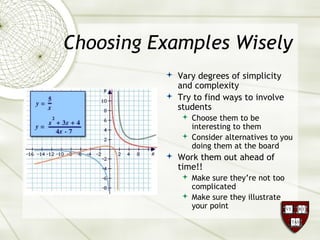
Choosing Examples Wisely
 Vary degrees of simplicity
and complexity
 Try to find ways to involve
students
 Choose them to be
interesting to them
 Consider alternatives to you
doing them at the board
 Work them out ahead of
time!!
 Make sure they’re not too
complicated
 Make sure they illustrate
your point
Scripting your Lesson
Consider writing out
some parts verbatim
Important diagrams
can be practiced
ahead of time
Depends on
experience and
language skills
QuickTime™ and a
TIFF (Uncompressed) decompressor
are needed to see this picture.
Time Management
Know how much of
your notes
corresponds to how
much class time
Put a timeline in
your lessons
“accordion”
sections
QuickTime™ and a
TIFF (Uncompressed) decompressor
are needed to see this picture.
Methods (aka Choreography)
Group Work
Breaking up
students
Preparing
worksheets
Big problems/small
problems
QuickTime™ and a
TIFF (Uncompressed) decompressor
are needed to see this picture.
Student Board Work
Work out an example
Races
Polling/Discussion organizing
Informal
PRS
Get students to talk
to each otherQuickTime™ and a
TIFF (Uncompressed) decompressor
are needed to see this picture.
Transitions
Moving from one thing to the next
Simple Summary
Not necessarily delivered by you!
Breakouts: Develop a Lesson
for your class
Debriefing
Discuss
What ideas did you hear that you
hadn’t thought of?
What principles of lesson planning did
you take away?
Assignment
Think about your lesson in the next
couple of days
Fill in the rest
Meet in your group and share
Postmortem
Assess your Class!
Analyze
What went right
What went wrong
What you’d do next
time
Keep for posterity
QuickTime™ and a
TIFF (Uncompressed) decompressor
are needed to see this picture.
Cheats and Hacks
Look in (different)
textbook
Reuse old lesson
plans
“Borrow” someone
else’s lesson plan
Collaborate on
lesson plans
Lesson Study
QuickTime™ and a
TIFF (Uncompressed) decompressor
are needed to see this picture.
Closing Remarks
PPPPPPP
Ontogeny recapitulates phylogeny
The more you teach, the smarter you
get, but students stay the same!
References
First Day to Final Grade: A Graduate
Student’s Guide to Teaching (Curzan,
Damour)
Learning to Teach and Teaching to Learn
Mathematics: Resources for Professional
Development (Delong, Winter)
How to Teach Mathematics (Krantz)

Making Lesson Plans

  • 1.
    Making Lesson Plans CalculusInstructors Orientation September 13, 2005 Matthew Leingang Copyright ©2005 The President and Fellows of Harvard College
  • 2.
    Introduction We need tocover the section on the product rule. Students hate the product rule What to do? This “problem” exists for every topic of every course
  • 3.
    Why plan lessons?(apologies to Andy Engelward) PPPPPPP Proper Planning and Preparation Prevent Pretty Poor Performance! Be an effective teacher Make yourself look smart
  • 4.
    Lesson Styles Theorem-oriented Definition Theorem Proof Example QuickTime™ anda TIFF (Uncompressed) decompressor are needed to see this picture.
  • 5.
    Lesson Styles (continued) Problem-oriented  Example  Example  Definition  Theorem  Proof?  Example  Example  Example (repeat as necessary) QuickTime™ and a TIFF (Uncompressed) decompressor are needed to see this picture.
  • 6.
  • 7.
    Start with theend “Students will be able to” (SWBAT) points Context, Big Picture Assessment What class activities will determine if you have met your goals? What homework problems are going to be assigned after this class?
  • 8.
    Sample Goals “Understand theinterplay between logarithms and exponentials” (conceptual) “Use the product rule to take derivatives of elementary functions” (technical) “Recognize when to use logarithmic differentiation” (strategic)
  • 9.
    Then go tothe beginning Introductory Example (Hatsumon) here’s a problem you can’t do now, but will be able to do at the end of the class Big Question that you plan to answer
  • 10.
    Anticipating Questions What willstudents find difficult? What examples will illustrate and illuminate? Practice and experience will improve this skill
  • 11.
    End with themiddle Fill in the big idea Proof? Use your knowledge of students backgrounds to fill in your examples.
  • 12.
    Choosing Examples Wisely Vary degrees of simplicity and complexity  Try to find ways to involve students  Choose them to be interesting to them  Consider alternatives to you doing them at the board  Work them out ahead of time!!  Make sure they’re not too complicated  Make sure they illustrate your point
  • 13.
    Scripting your Lesson Considerwriting out some parts verbatim Important diagrams can be practiced ahead of time Depends on experience and language skills QuickTime™ and a TIFF (Uncompressed) decompressor are needed to see this picture.
  • 14.
    Time Management Know howmuch of your notes corresponds to how much class time Put a timeline in your lessons “accordion” sections QuickTime™ and a TIFF (Uncompressed) decompressor are needed to see this picture.
  • 15.
  • 16.
    Group Work Breaking up students Preparing worksheets Bigproblems/small problems QuickTime™ and a TIFF (Uncompressed) decompressor are needed to see this picture.
  • 17.
    Student Board Work Workout an example Races
  • 18.
    Polling/Discussion organizing Informal PRS Get studentsto talk to each otherQuickTime™ and a TIFF (Uncompressed) decompressor are needed to see this picture.
  • 19.
    Transitions Moving from onething to the next Simple Summary Not necessarily delivered by you!
  • 20.
    Breakouts: Develop aLesson for your class
  • 21.
  • 22.
    Discuss What ideas didyou hear that you hadn’t thought of? What principles of lesson planning did you take away?
  • 23.
    Assignment Think about yourlesson in the next couple of days Fill in the rest Meet in your group and share
  • 24.
    Postmortem Assess your Class! Analyze Whatwent right What went wrong What you’d do next time Keep for posterity QuickTime™ and a TIFF (Uncompressed) decompressor are needed to see this picture.
  • 25.
    Cheats and Hacks Lookin (different) textbook Reuse old lesson plans “Borrow” someone else’s lesson plan Collaborate on lesson plans Lesson Study QuickTime™ and a TIFF (Uncompressed) decompressor are needed to see this picture.
  • 26.
    Closing Remarks PPPPPPP Ontogeny recapitulatesphylogeny The more you teach, the smarter you get, but students stay the same!
  • 27.
    References First Day toFinal Grade: A Graduate Student’s Guide to Teaching (Curzan, Damour) Learning to Teach and Teaching to Learn Mathematics: Resources for Professional Development (Delong, Winter) How to Teach Mathematics (Krantz)

Editor's Notes

  • #5 Lesson: what happens in a class period. This is chosen to include not only lectures but interactive classes, which of course we encourage.
  • #6 It’s important to note that this is not the only way to teach a class. If the only way you can do a class is theorem-oriented, and you can do it well, great. But we believe this is an effective way to teach a “service” calculusclass to non-mathematics majors
  • #8 Class activities: students do examples on board, ask questions of students,etc. SWBAT: The things you want your students to come away with
  • #11 Difficult: remembering that the product rule is NOT just the product of the derivatives Example: a simple function that if the product rule is applied, will give an answer which is known to be wrong. Practice, experience: and memory! Think about when you were a student.
  • #12 Proofs are not always necessary. I like formal proofs that show the idea. For instance, two ways to prove the product Rule are the rectangle and the old add-and-subtract-the-same-thing trick. Avoid deltas and epsilons. This doesn’t mean avoid all infinitesimal arguments, but make sure to keep the language informal.
  • #13 Avoid extreme simplicity: differentiating the zero function might be confusing if it’s the first thing you do. Choosing examples: find things that you can get the students to feed you Work them out: you don’t want to end up with an irreducible quadratic or cubic
  • #14 Think about writing the first paragraph out. My (bad) example of teaching the method of Lagrange Multipliers, missing the key sentence to drive the essential idea home Nonnative speakers may employ this technique more often. Don’t wory about being Shakespeare; concentrate on getting the sentences coherent. Consider colored chalk--not just “using it”, but which colors will stand for what
  • #15 Nothing against you, but students have other classes to get to! Accordion sections expand or contract to fit the time TRANSITION: “These are the basic ideas behind buildiing your lesson. But there are other pieces which go into how your lesson is delivered”
  • #17 Re breaking up: can do it geographically, by interest, randomly, by fiat
  • #18 Yielding the chalk breaks the structure of class-as-television. Silly stuff like board races may be well-received.
  • #20 SS: “So we’ve seen that the product rule is a necessary and important tool for computing derivatives. It’s not the most obvious thing, but it is easy to memorize with the right mnemonic…”
  • #21 Hand out Winter & DeLong WS Breakout
  • #25 Analyze: whether your timeline was appropriate. Whether your assumptions about their level pre-lesson were appropriate. Keep: We’re all about saving time. So save it and save yourself the couple of hours you just spent next year. But it’s much more useful if you take that extra step
  • #26 Different is pretty important. Students will feel a little cheated if all you put on the board are worked-out examples from the book. Preceptors are working on archiving lesson plans. Math 301 does one lesson collaboratively, per year! Your records consist of your own lesson study program