This is the combination of
slides from two people which
are
Melanie Tomlinson and
Morrobea.
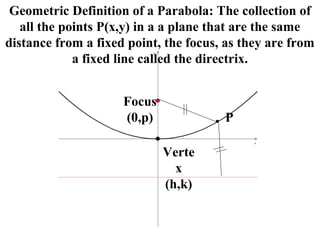
Geometric Definition of a Parabola: The collection of
all the points P(x,y) in a a plane that are the same
distance from a fixed point, the focus, as they are from
a fixed line called the directrix.
y

Focus
(0,p)

P
Verte
x
(h,k)

x
•Parabola is a
Quadratic
function
Quadratic Function
•

A function of the form y=ax2+bx+c
where a≠0 making a u-shaped graph
called a parabola.
Example quadratic equation:
Vertex• The lowest or highest point
of a parabola.

Vertex

Axis of symmetry• The vertical line through the vertex of the
parabola.

Axis of
Symmetry
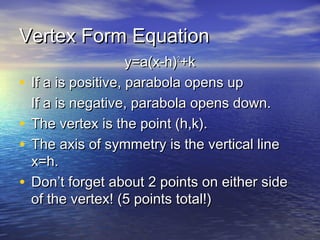
Vertex Form Equation
•
•
•
•

y=a(x-h)2+k
If a is positive, parabola opens up
If a is negative, parabola opens down.
The vertex is the point (h,k).
The axis of symmetry is the vertical line
x=h.
Don’t forget about 2 points on either side
of the vertex! (5 points total!)
Vertex Form

Each function we just looked at can be written in the
form (x – h)2 + k, where (h , k) is the vertex of the
parabola, and x = h is its axis of symmetry.

(x – h) 2 + k – vertex form
Equation

Vertex

Axis of Symmetry

y = x2 or
y = (x – 0)2 + 0

( 0 , 0)

x=0

y = x2 + 2 or
y = (x – 0)2 + 2

( 0 , 2)

x=0

y = (x – 3)2 or
y = (x – 3)2 + 0

( 3 , 0)

x=3
Example 1: Graph y = (x + 2)2 + 1

Analyze y = (x + 2)2 + 1.
•
• Step 1 Plot the vertex (-2 , 1)
• Step 2 Draw the axis of symmetry, x = -2.
• Step 3 Find and plot two points on one side

, such as (-1, 2) and (0 , 5).
• Step 4 Use symmetry to complete the graph,
or find two points on the
• left side of the vertex.
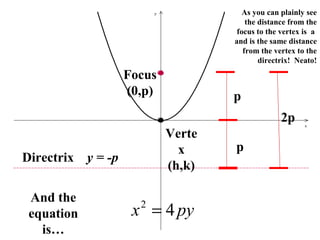
As you can plainly see
the distance from the
focus to the vertex is a
and is the same distance
from the vertex to the
directrix! Neato!

y

Focus
(0,p)

p
2p
Verte
x
(h,k)

Directrix y = -p
And the
equation
is…

x = 4 py
2

p

x
y

y
Directrix = a
Verte
x
(h,k)
Focus
(0,-p)
And the
equation
is…

x = −4 py
2

p
x

p
y

2p

x
Directrix = −a

p

p

Verte
x
(h,k)

And the
equation

Focus
(p,0)

y = 4 px
2

x
y

p

p

Vertex

Focus (p,0)

And the
equation

x
Directrix = a

(h,k)
x

y = −4 px
2
Your Turn!

• Analyze and Graph:
y = (x + 4)2 - 3.

(-4,-3)
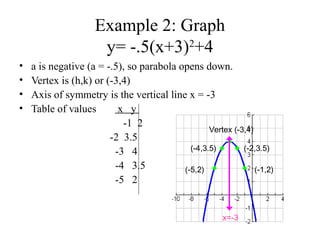
Example 2: Graph
y= -.5(x+3)2+4
•
•
•
•

a is negative (a = -.5), so parabola opens down.
Vertex is (h,k) or (-3,4)
Axis of symmetry is the vertical line x = -3
Table of values
x y
-1 2
Vertex (-3,4)
-2 3.5
(-4,3.5)
(-2,3.5)
-3 4
-4 3.5
(-5,2)
(-1,2)
-5 2
x=-3
Try this one!
y=2(x-1)2+3

• Open up or down?
• Vertex?
• Axis of symmetry?

• Table of values with 4 points (other
than the vertex?
(-1, 11)

(3,11)
X=1

(0,5)

(2,5)

(1,3)
Intercept Form Equation
y=a(x-p)(x-q)

•
•
•
•
•

The x-intercepts are the points (p,0) and (q,0).
+
The axis of symmetry is the vertical line x= p 2 q
p +q
The x-coordinate of the vertex is 2
To find the y-coordinate of the vertex, plug the xcoord. into the equation and solve for y.
If a is positive, parabola opens up
If a is negative, parabola opens down.
Example 3: Graph y=-(x+2)(x-4)
• Since a is negative,
•
•

parabola opens down.
The x-intercepts are (2,0) and (4,0)
To find the x-coord. of
p+q
the vertex, use
2
x=

•The axis of symmetry
is the vertical line x=1
(from the x-coord. of
the vertex)
(1,9)

−2+4 2
= =1
2
2

• To find the y-coord.,
plug 1 in for x.

y = −(1 + 2)(1 − 4) = −(3)(−3) = 9

(-2,0)

(4,0)
x=1
Now you try one!
y=2(x-3)(x+1)

• Open up or down?
• X-intercepts?
• Vertex?
• Axis of symmetry?
x=1
(-1,0)

(3,0)

(1,-8)
Changing from vertex or intercepts
form to standard form
• The key is to FOIL! (first, outside, inside,
last)
• Ex: y=-(x+4)(x-9)
=-(x2-9x+4x-36)
=-(x2-5x-36)
y=-x2+5x+36

Ex: y=3(x-1)2+8
=3(x-1)(x-1)+8
=3(x2-x-x+1)+8
=3(x2-2x+1)+8
=3x2-6x+3+8
y=3x2-6x+11
Challenge Problem
• Write the equation of the graph in vertex form.

y = 3( x + 2) 2 − 4
Graphing an Equation of a Parabola
Standard Equation of a Parabola (Vertex at Origin)

x = 4 py
2
x = 12 y
2

( 0, p )
focus

y= −p
directrix

y = −3

( 0, 3)
Graphing an Equation of a Parabola
Standard Equation of a Parabola (Vertex at Origin)

y = 4 px
2
y = 12 x
2

( p, 0 )
focus

x= −p
directrix

x = −3

( 3, 0)
Graphing an Equation of a Parabola
Graph the equation. Identify the focus and directrix of the
parabola.

1. x = 2 y
2

1
4p = 2 p =
2

 1
focus:  0, 
 2

1
directrix: y = −
2
Graphing an Equation of a Parabola
Graph the equation. Identify the focus and directrix of the
parabola.

2. y = 16 x
2

4 p = 16 p = 4
focus: ( 4, 0 )
directrix: x = − 4
Graphing an Equation of a Parabola
Graph the equation. Identify the focus and directrix of the
parabola.

1
3. x = − y
4
1
1
4p = − p = −
16
4
2

1

focus:  0, − 
16 


1
directrix: y =
16
Graphing an Equation of a Parabola
Graph the equation. Identify the focus and directrix of the
parabola.

4. y = −4 x
2

4 p = −4 p = −1
focus: ( − 1, 0 )
directrix: x = 1
Writing an Equation of a Parabola
Write the standard form of the equation of the parabola
with the given focus and vertex at (0, 0).
2
5. 0, 1

(

)

x = 4( 1 ) y
2

 1 
6.  − , 0 
 2 

y =
2

( )x

1
4−
2

x = 4 py

x = 4y
2

y = 4 px
2

y = −2 x
2
Writing an Equation of a Parabola
Write the standard form of the equation of the parabola
with the given focus and vertex at (0, 0).

7. ( − 2, 0 )

y = 4( − 2) x
2

 1
8.  0, 
 4

x = 4(
2

y = 4 px
2
y = −8x
2

x = 4 py
2

1
4

)y

x =y
2
Modeling a Parabolic Reflector
9. A searchlight reflector is designed so
that a cross section through its axis is a
parabola and the light source is at the
focus. Find the focus if the reflector is 3
feet across at the opening and 1 foot deep.

(1x5) = 4 p (1)
.
y
2 2

(1.5, 1)

2.25 = 4 p

2.25 9
225
p=
=
4
400 16
Notes Over 10.2

Modeling a Parabolic Reflector

10. One of the largest radio telescopes has
a diameter of 250 feet and a focal length
of 50 feet. If the cross section of the radio
telescope is a parabola, find the depth.
2
250

x = 4 py
2
x = 4( 50 ) y

x = 200 y
2
125 = 200 y
2

2

= 125

15,625 = 200 y

y = 78.1 ft
General Form of any Parabola

Ax + By + Cx + Dy + E = 0
2

2

*Where either A or B is zero!
* You will use the “Completing the
Square” method to go from the
General Form to Standard Form,
Graphing a Parabola: Use completing the square
to convert a general form equation to standard
conic form
General form
y2 - 10x + 6y - 11 = 0
y2 + 6y + 9 = 10x + 11 + _____
9
(y + 3)2 = 10x + 20
(y + 3)2 = 10(x + 2)
Standard form
aka: Graphing form
(y-k)2 = 4p(x-h)
References
• Melanie Tomlinson, M. 2012.
•

http://www.slideshare.net/melanieitomlinson/parabola-14893256?qid=170dff68-7
. Accessed on 06 March 2014
Morrobea. 2013.
http://www.slideshare.net/morrobea/52-solve-quadratic-equations-by-graphingver
http://www.slideshare.net/morrobea/52-solve-quadratic-equations-by-graphingve
. Accessed on 06 March 2014

Parabola complete

  • 1.
    This is thecombination of slides from two people which are Melanie Tomlinson and Morrobea.
  • 3.
    Geometric Definition ofa Parabola: The collection of all the points P(x,y) in a a plane that are the same distance from a fixed point, the focus, as they are from a fixed line called the directrix. y Focus (0,p) P Verte x (h,k) x
  • 4.
  • 5.
    Quadratic Function • A functionof the form y=ax2+bx+c where a≠0 making a u-shaped graph called a parabola. Example quadratic equation:
  • 6.
    Vertex• The lowestor highest point of a parabola. Vertex Axis of symmetry• The vertical line through the vertex of the parabola. Axis of Symmetry
  • 7.
    Vertex Form Equation • • • • y=a(x-h)2+k Ifa is positive, parabola opens up If a is negative, parabola opens down. The vertex is the point (h,k). The axis of symmetry is the vertical line x=h. Don’t forget about 2 points on either side of the vertex! (5 points total!)
  • 8.
    Vertex Form Each functionwe just looked at can be written in the form (x – h)2 + k, where (h , k) is the vertex of the parabola, and x = h is its axis of symmetry. (x – h) 2 + k – vertex form Equation Vertex Axis of Symmetry y = x2 or y = (x – 0)2 + 0 ( 0 , 0) x=0 y = x2 + 2 or y = (x – 0)2 + 2 ( 0 , 2) x=0 y = (x – 3)2 or y = (x – 3)2 + 0 ( 3 , 0) x=3
  • 9.
    Example 1: Graphy = (x + 2)2 + 1 Analyze y = (x + 2)2 + 1. • • Step 1 Plot the vertex (-2 , 1) • Step 2 Draw the axis of symmetry, x = -2. • Step 3 Find and plot two points on one side , such as (-1, 2) and (0 , 5). • Step 4 Use symmetry to complete the graph, or find two points on the • left side of the vertex.
  • 10.
    As you canplainly see the distance from the focus to the vertex is a and is the same distance from the vertex to the directrix! Neato! y Focus (0,p) p 2p Verte x (h,k) Directrix y = -p And the equation is… x = 4 py 2 p x
  • 11.
    y y Directrix = a Verte x (h,k) Focus (0,-p) Andthe equation is… x = −4 py 2 p x p
  • 12.
    y 2p x Directrix = −a p p Verte x (h,k) Andthe equation Focus (p,0) y = 4 px 2 x
  • 13.
  • 14.
    Your Turn! • Analyzeand Graph: y = (x + 4)2 - 3. (-4,-3)
  • 15.
    Example 2: Graph y=-.5(x+3)2+4 • • • • a is negative (a = -.5), so parabola opens down. Vertex is (h,k) or (-3,4) Axis of symmetry is the vertical line x = -3 Table of values x y -1 2 Vertex (-3,4) -2 3.5 (-4,3.5) (-2,3.5) -3 4 -4 3.5 (-5,2) (-1,2) -5 2 x=-3
  • 16.
    Try this one! y=2(x-1)2+3 •Open up or down? • Vertex? • Axis of symmetry? • Table of values with 4 points (other than the vertex?
  • 17.
  • 18.
    Intercept Form Equation y=a(x-p)(x-q) • • • • • Thex-intercepts are the points (p,0) and (q,0). + The axis of symmetry is the vertical line x= p 2 q p +q The x-coordinate of the vertex is 2 To find the y-coordinate of the vertex, plug the xcoord. into the equation and solve for y. If a is positive, parabola opens up If a is negative, parabola opens down.
  • 19.
    Example 3: Graphy=-(x+2)(x-4) • Since a is negative, • • parabola opens down. The x-intercepts are (2,0) and (4,0) To find the x-coord. of p+q the vertex, use 2 x= •The axis of symmetry is the vertical line x=1 (from the x-coord. of the vertex) (1,9) −2+4 2 = =1 2 2 • To find the y-coord., plug 1 in for x. y = −(1 + 2)(1 − 4) = −(3)(−3) = 9 (-2,0) (4,0) x=1
  • 20.
    Now you tryone! y=2(x-3)(x+1) • Open up or down? • X-intercepts? • Vertex? • Axis of symmetry?
  • 21.
  • 22.
    Changing from vertexor intercepts form to standard form • The key is to FOIL! (first, outside, inside, last) • Ex: y=-(x+4)(x-9) =-(x2-9x+4x-36) =-(x2-5x-36) y=-x2+5x+36 Ex: y=3(x-1)2+8 =3(x-1)(x-1)+8 =3(x2-x-x+1)+8 =3(x2-2x+1)+8 =3x2-6x+3+8 y=3x2-6x+11
  • 23.
    Challenge Problem • Writethe equation of the graph in vertex form. y = 3( x + 2) 2 − 4
  • 24.
    Graphing an Equationof a Parabola Standard Equation of a Parabola (Vertex at Origin) x = 4 py 2 x = 12 y 2 ( 0, p ) focus y= −p directrix y = −3 ( 0, 3)
  • 25.
    Graphing an Equationof a Parabola Standard Equation of a Parabola (Vertex at Origin) y = 4 px 2 y = 12 x 2 ( p, 0 ) focus x= −p directrix x = −3 ( 3, 0)
  • 26.
    Graphing an Equationof a Parabola Graph the equation. Identify the focus and directrix of the parabola. 1. x = 2 y 2 1 4p = 2 p = 2  1 focus:  0,   2 1 directrix: y = − 2
  • 27.
    Graphing an Equationof a Parabola Graph the equation. Identify the focus and directrix of the parabola. 2. y = 16 x 2 4 p = 16 p = 4 focus: ( 4, 0 ) directrix: x = − 4
  • 28.
    Graphing an Equationof a Parabola Graph the equation. Identify the focus and directrix of the parabola. 1 3. x = − y 4 1 1 4p = − p = − 16 4 2 1  focus:  0, −  16   1 directrix: y = 16
  • 29.
    Graphing an Equationof a Parabola Graph the equation. Identify the focus and directrix of the parabola. 4. y = −4 x 2 4 p = −4 p = −1 focus: ( − 1, 0 ) directrix: x = 1
  • 30.
    Writing an Equationof a Parabola Write the standard form of the equation of the parabola with the given focus and vertex at (0, 0). 2 5. 0, 1 ( ) x = 4( 1 ) y 2  1  6.  − , 0   2  y = 2 ( )x 1 4− 2 x = 4 py x = 4y 2 y = 4 px 2 y = −2 x 2
  • 31.
    Writing an Equationof a Parabola Write the standard form of the equation of the parabola with the given focus and vertex at (0, 0). 7. ( − 2, 0 ) y = 4( − 2) x 2  1 8.  0,   4 x = 4( 2 y = 4 px 2 y = −8x 2 x = 4 py 2 1 4 )y x =y 2
  • 32.
    Modeling a ParabolicReflector 9. A searchlight reflector is designed so that a cross section through its axis is a parabola and the light source is at the focus. Find the focus if the reflector is 3 feet across at the opening and 1 foot deep. (1x5) = 4 p (1) . y 2 2 (1.5, 1) 2.25 = 4 p 2.25 9 225 p= = 4 400 16
  • 33.
    Notes Over 10.2 Modelinga Parabolic Reflector 10. One of the largest radio telescopes has a diameter of 250 feet and a focal length of 50 feet. If the cross section of the radio telescope is a parabola, find the depth. 2 250 x = 4 py 2 x = 4( 50 ) y x = 200 y 2 125 = 200 y 2 2 = 125 15,625 = 200 y y = 78.1 ft
  • 34.
    General Form ofany Parabola Ax + By + Cx + Dy + E = 0 2 2 *Where either A or B is zero! * You will use the “Completing the Square” method to go from the General Form to Standard Form,
  • 35.
    Graphing a Parabola:Use completing the square to convert a general form equation to standard conic form General form y2 - 10x + 6y - 11 = 0 y2 + 6y + 9 = 10x + 11 + _____ 9 (y + 3)2 = 10x + 20 (y + 3)2 = 10(x + 2) Standard form aka: Graphing form (y-k)2 = 4p(x-h)
  • 36.
    References • Melanie Tomlinson,M. 2012. • http://www.slideshare.net/melanieitomlinson/parabola-14893256?qid=170dff68-7 . Accessed on 06 March 2014 Morrobea. 2013. http://www.slideshare.net/morrobea/52-solve-quadratic-equations-by-graphingver http://www.slideshare.net/morrobea/52-solve-quadratic-equations-by-graphingve . Accessed on 06 March 2014