Section 4.2
            The Mean Value Theorem

                   V63.0121.002.2010Su, Calculus I

                           New York University


                            June 8, 2010


Announcements
   Exams not graded yet
   Assignment 4 is on the website
   Quiz 3 on Thursday covering 3.3, 3.4, 3.5, 3.7
Announcements


           Exams not graded yet
           Assignment 4 is on the
           website
           Quiz 3 on Thursday covering
           3.3, 3.4, 3.5, 3.7


V63.0121.002.2010Su, Calculus I (NYU)   Section 4.2 The Mean Value Theorem   June 8, 2010   2 / 28
Objectives


           Understand and be able to
           explain the statement of
           Rolle’s Theorem.
           Understand and be able to
           explain the statement of the
           Mean Value Theorem.


V63.0121.002.2010Su, Calculus I (NYU)   Section 4.2 The Mean Value Theorem   June 8, 2010   3 / 28
Outline


 Rolle’s Theorem


 The Mean Value Theorem
   Applications


 Why the MVT is the MITC
   Functions with derivatives that are zero
   MVT and differentiability


V63.0121.002.2010Su, Calculus I (NYU)   Section 4.2 The Mean Value Theorem   June 8, 2010   4 / 28
Heuristic Motivation for Rolle’s Theorem

 If you bike up a hill, then back down, at some point your elevation was
 stationary.


Image credit: SpringSun
V63.0121.002.2010Su, Calculus I (NYU)   Section 4.2 The Mean Value Theorem   June 8, 2010   5 / 28
Mathematical Statement of Rolle’s Theorem


Theorem (Rolle’s Theorem)


   Let f be continuous on [a, b]
   and differentiable on (a, b).
   Suppose f (a) = f (b). Then
   there exists a point c in (a, b)
   such that f (c) = 0.
                                      a     b
Mathematical Statement of Rolle’s Theorem


 Theorem (Rolle’s Theorem)

                                                                                 c

        Let f be continuous on [a, b]
        and differentiable on (a, b).
        Suppose f (a) = f (b). Then
        there exists a point c in (a, b)
        such that f (c) = 0.
                                                                             a            b


V63.0121.002.2010Su, Calculus I (NYU)   Section 4.2 The Mean Value Theorem           June 8, 2010   6 / 28
Flowchart proof of Rolle’s Theorem


                                                                             endpoints
       Let c be                             Let d be
                                                                              are max
      the max pt                           the min pt
                                                                              and min


                                                                               f is
        is c an                              is d an
                            yes                                yes           constant
       endpoint?                            endpoint?
                                                                             on [a, b]

             no                                   no

                                                                             f (x) ≡ 0
       f (c) = 0                            f (d) = 0
                                                                              on (a, b)

V63.0121.002.2010Su, Calculus I (NYU)   Section 4.2 The Mean Value Theorem           June 8, 2010   8 / 28
Outline


 Rolle’s Theorem


 The Mean Value Theorem
   Applications


 Why the MVT is the MITC
   Functions with derivatives that are zero
   MVT and differentiability


V63.0121.002.2010Su, Calculus I (NYU)   Section 4.2 The Mean Value Theorem   June 8, 2010   9 / 28
Heuristic Motivation for The Mean Value Theorem

 If you drive between points A and B, at some time your speedometer
 reading was the same as your average speed over the drive.


Image credit: ClintJCL
V63.0121.002.2010Su, Calculus I (NYU)   Section 4.2 The Mean Value Theorem   June 8, 2010   10 / 28
The Mean Value Theorem


Theorem (The Mean Value Theorem)


   Let f be continuous on [a, b]
   and differentiable on (a, b).
   Then there exists a point c in
   (a, b) such that

       f (b) − f (a)                    b
                     = f (c).
           b−a
                                    a
The Mean Value Theorem


Theorem (The Mean Value Theorem)


   Let f be continuous on [a, b]
   and differentiable on (a, b).
   Then there exists a point c in
   (a, b) such that

       f (b) − f (a)                    b
                     = f (c).
           b−a
                                    a
The Mean Value Theorem


 Theorem (The Mean Value Theorem)


                                                                                 c
        Let f be continuous on [a, b]
        and differentiable on (a, b).
        Then there exists a point c in
        (a, b) such that

               f (b) − f (a)                                                               b
                             = f (c).
                   b−a
                                                                             a


V63.0121.002.2010Su, Calculus I (NYU)   Section 4.2 The Mean Value Theorem           June 8, 2010   11 / 28
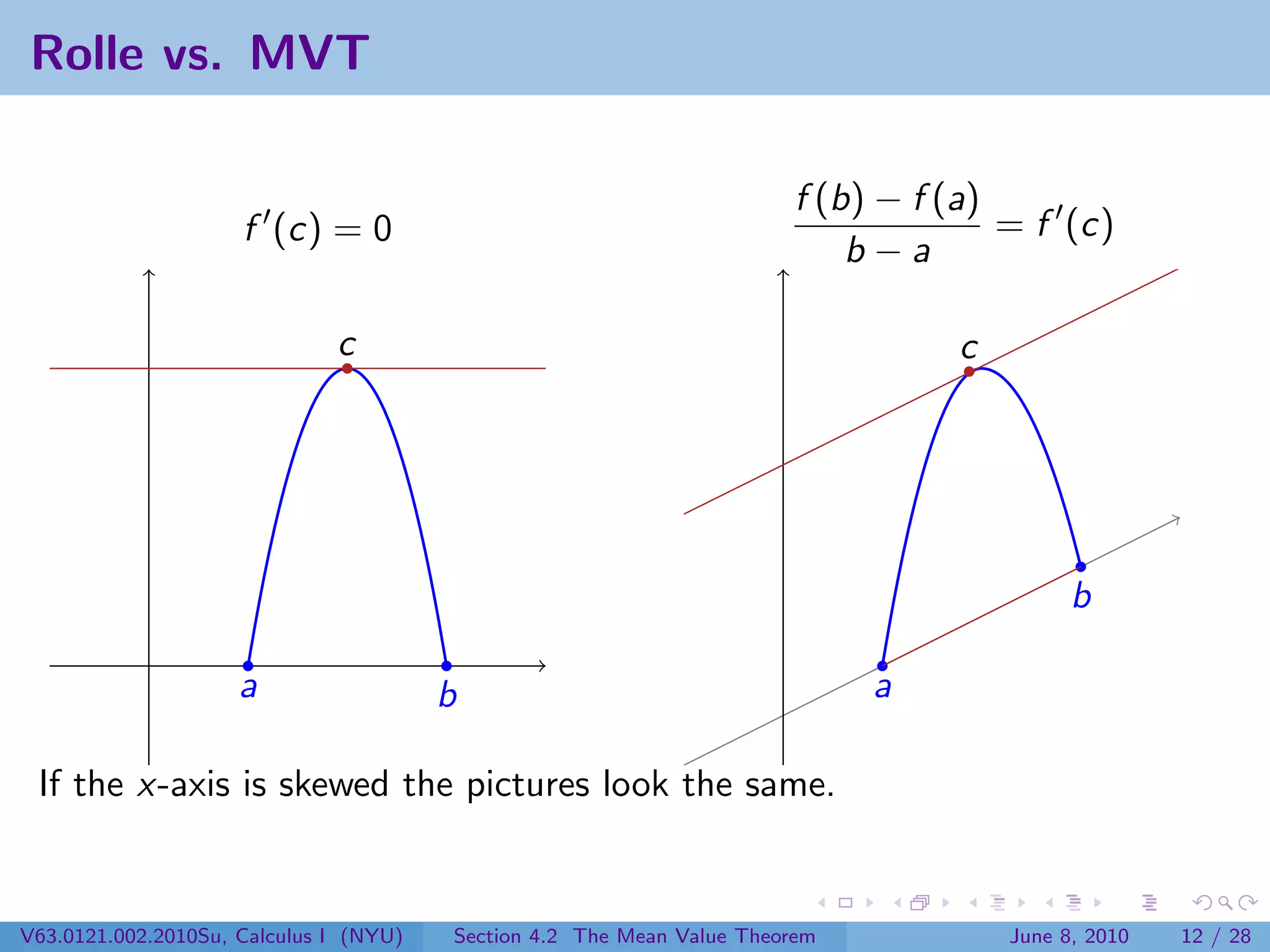
Rolle vs. MVT

                                                                       f (b) − f (a)
                     f (c) = 0                                                       = f (c)
                                                                           b−a

                              c                                                  c


                                                                                           b

                     a                  b                                    a


V63.0121.002.2010Su, Calculus I (NYU)   Section 4.2 The Mean Value Theorem           June 8, 2010   12 / 28
Rolle vs. MVT

                                                                       f (b) − f (a)
                     f (c) = 0                                                       = f (c)
                                                                           b−a

                              c                                                  c


                                                                                           b

                     a                  b                                    a

 If the x-axis is skewed the pictures look the same.


V63.0121.002.2010Su, Calculus I (NYU)   Section 4.2 The Mean Value Theorem           June 8, 2010   12 / 28
Proof of the Mean Value Theorem
 Proof.
 The line connecting (a, f (a)) and (b, f (b)) has equation

                                                   f (b) − f (a)
                                   y − f (a) =                   (x − a)
                                                       b−a


V63.0121.002.2010Su, Calculus I (NYU)   Section 4.2 The Mean Value Theorem   June 8, 2010   13 / 28
Proof of the Mean Value Theorem
 Proof.
 The line connecting (a, f (a)) and (b, f (b)) has equation

                                                   f (b) − f (a)
                                   y − f (a) =                   (x − a)
                                                       b−a
 Apply Rolle’s Theorem to the function

                                                           f (b) − f (a)
                          g (x) = f (x) − f (a) −                        (x − a).
                                                               b−a


V63.0121.002.2010Su, Calculus I (NYU)   Section 4.2 The Mean Value Theorem          June 8, 2010   13 / 28
Proof of the Mean Value Theorem
 Proof.
 The line connecting (a, f (a)) and (b, f (b)) has equation

                                                   f (b) − f (a)
                                   y − f (a) =                   (x − a)
                                                       b−a
 Apply Rolle’s Theorem to the function

                                                           f (b) − f (a)
                          g (x) = f (x) − f (a) −                        (x − a).
                                                               b−a
 Then g is continuous on [a, b] and differentiable on (a, b) since f is.


V63.0121.002.2010Su, Calculus I (NYU)   Section 4.2 The Mean Value Theorem          June 8, 2010   13 / 28
Proof of the Mean Value Theorem
 Proof.
 The line connecting (a, f (a)) and (b, f (b)) has equation

                                                   f (b) − f (a)
                                   y − f (a) =                   (x − a)
                                                       b−a
 Apply Rolle’s Theorem to the function

                                                           f (b) − f (a)
                          g (x) = f (x) − f (a) −                        (x − a).
                                                               b−a
 Then g is continuous on [a, b] and differentiable on (a, b) since f is. Also
 g (a) = 0 and g (b) = 0 (check both)


V63.0121.002.2010Su, Calculus I (NYU)   Section 4.2 The Mean Value Theorem          June 8, 2010   13 / 28
Proof of the Mean Value Theorem
 Proof.
 The line connecting (a, f (a)) and (b, f (b)) has equation

                                                   f (b) − f (a)
                                   y − f (a) =                   (x − a)
                                                       b−a
 Apply Rolle’s Theorem to the function

                                                           f (b) − f (a)
                          g (x) = f (x) − f (a) −                        (x − a).
                                                               b−a
 Then g is continuous on [a, b] and differentiable on (a, b) since f is. Also
 g (a) = 0 and g (b) = 0 (check both) So by Rolle’s Theorem there exists a
 point c in (a, b) such that

                                                               f (b) − f (a)
                                 0 = g (c) = f (c) −                         .
                                                                   b−a

V63.0121.002.2010Su, Calculus I (NYU)   Section 4.2 The Mean Value Theorem          June 8, 2010   13 / 28
Using the MVT to count solutions

 Example
 Show that there is a unique solution to the equation x 3 − x = 100 in the
 interval [4, 5].


V63.0121.002.2010Su, Calculus I (NYU)   Section 4.2 The Mean Value Theorem   June 8, 2010   14 / 28
Using the MVT to count solutions

 Example
 Show that there is a unique solution to the equation x 3 − x = 100 in the
 interval [4, 5].

 Solution

         By the Intermediate Value Theorem, the function f (x) = x 3 − x must
         take the value 100 at some point on c in (4, 5).


V63.0121.002.2010Su, Calculus I (NYU)   Section 4.2 The Mean Value Theorem   June 8, 2010   14 / 28
Using the MVT to count solutions

 Example
 Show that there is a unique solution to the equation x 3 − x = 100 in the
 interval [4, 5].

 Solution

         By the Intermediate Value Theorem, the function f (x) = x 3 − x must
         take the value 100 at some point on c in (4, 5).
         If there were two points c1 and c2 with f (c1 ) = f (c2 ) = 100, then
         somewhere between them would be a point c3 between them with
         f (c3 ) = 0.


V63.0121.002.2010Su, Calculus I (NYU)   Section 4.2 The Mean Value Theorem   June 8, 2010   14 / 28
Using the MVT to count solutions

 Example
 Show that there is a unique solution to the equation x 3 − x = 100 in the
 interval [4, 5].

 Solution

         By the Intermediate Value Theorem, the function f (x) = x 3 − x must
         take the value 100 at some point on c in (4, 5).
         If there were two points c1 and c2 with f (c1 ) = f (c2 ) = 100, then
         somewhere between them would be a point c3 between them with
         f (c3 ) = 0.
         However, f (x) = 3x 2 − 1, which is positive all along (4, 5). So this is
         impossible.


V63.0121.002.2010Su, Calculus I (NYU)   Section 4.2 The Mean Value Theorem   June 8, 2010   14 / 28
Using the MVT to estimate

 Example
 We know that |sin x| ≤ 1 for all x. Show that |sin x| ≤ |x|.


V63.0121.002.2010Su, Calculus I (NYU)   Section 4.2 The Mean Value Theorem   June 8, 2010   15 / 28
Using the MVT to estimate

 Example
 We know that |sin x| ≤ 1 for all x. Show that |sin x| ≤ |x|.

 Solution
 Apply the MVT to the function f (t) = sin t on [0, x]. We get

                                          sin x − sin 0
                                                        = cos(c)
                                              x −0
 for some c in (0, x). Since |cos(c)| ≤ 1, we get

                                        sin x
                                              ≤ 1 =⇒ |sin x| ≤ |x|
                                          x


V63.0121.002.2010Su, Calculus I (NYU)    Section 4.2 The Mean Value Theorem   June 8, 2010   15 / 28
Using the MVT to estimate II
 Example
 Let f be a differentiable function with f (1) = 3 and f (x) < 2 for all x in
 [0, 5]. Could f (4) ≥ 9?


V63.0121.002.2010Su, Calculus I (NYU)   Section 4.2 The Mean Value Theorem   June 8, 2010   16 / 28
Using the MVT to estimate II
 Example
 Let f be a differentiable function with f (1) = 3 and f (x) < 2 for all x in
 [0, 5]. Could f (4) ≥ 9?

 Solution
                                                                             y    (4, 9)
        By MVT

                     f (4) − f (1)                                                   (4, f (4))
                                   = f (c) < 2
                         4−1
        for some c in (1, 4). Therefore

         f (4) = f (1) + f (c)(3) < 3 + 2 · 3 = 9.
                                                                                 (1, 3)
        So no, it is impossible that f (4) ≥ 9.
                                                                                                 x
V63.0121.002.2010Su, Calculus I (NYU)   Section 4.2 The Mean Value Theorem        June 8, 2010       16 / 28
Food for Thought


 Question
 A driver travels along the New Jersey Turnpike using E-ZPass. The system
 takes note of the time and place the driver enters and exits the Turnpike.
 A week after his trip, the driver gets a speeding ticket in the mail. Which
 of the following best describes the situation?
 (a) E-ZPass cannot prove that the driver was speeding
 (b) E-ZPass can prove that the driver was speeding
 (c) The driver’s actual maximum speed exceeds his ticketed speed
 (d) Both (b) and (c).


V63.0121.002.2010Su, Calculus I (NYU)   Section 4.2 The Mean Value Theorem   June 8, 2010   17 / 28
Food for Thought


 Question
 A driver travels along the New Jersey Turnpike using E-ZPass. The system
 takes note of the time and place the driver enters and exits the Turnpike.
 A week after his trip, the driver gets a speeding ticket in the mail. Which
 of the following best describes the situation?
 (a) E-ZPass cannot prove that the driver was speeding
 (b) E-ZPass can prove that the driver was speeding
 (c) The driver’s actual maximum speed exceeds his ticketed speed
 (d) Both (b) and (c).


V63.0121.002.2010Su, Calculus I (NYU)   Section 4.2 The Mean Value Theorem   June 8, 2010   17 / 28
Outline


 Rolle’s Theorem


 The Mean Value Theorem
   Applications


 Why the MVT is the MITC
   Functions with derivatives that are zero
   MVT and differentiability


V63.0121.002.2010Su, Calculus I (NYU)   Section 4.2 The Mean Value Theorem   June 8, 2010   18 / 28
Functions with derivatives that are zero
 Fact
 If f is constant on (a, b), then f (x) = 0 on (a, b).


V63.0121.002.2010Su, Calculus I (NYU)   Section 4.2 The Mean Value Theorem   June 8, 2010   19 / 28
Functions with derivatives that are zero
 Fact
 If f is constant on (a, b), then f (x) = 0 on (a, b).

         The limit of difference quotients must be 0
         The tangent line to a line is that line, and a constant function’s graph
         is a horizontal line, which has slope 0.
         Implied by the power rule since c = cx 0


V63.0121.002.2010Su, Calculus I (NYU)   Section 4.2 The Mean Value Theorem   June 8, 2010   19 / 28
Functions with derivatives that are zero
 Fact
 If f is constant on (a, b), then f (x) = 0 on (a, b).

         The limit of difference quotients must be 0
         The tangent line to a line is that line, and a constant function’s graph
         is a horizontal line, which has slope 0.
         Implied by the power rule since c = cx 0

 Question
 If f (x) = 0 is f necessarily a constant function?


V63.0121.002.2010Su, Calculus I (NYU)   Section 4.2 The Mean Value Theorem   June 8, 2010   19 / 28
Functions with derivatives that are zero
 Fact
 If f is constant on (a, b), then f (x) = 0 on (a, b).

         The limit of difference quotients must be 0
         The tangent line to a line is that line, and a constant function’s graph
         is a horizontal line, which has slope 0.
         Implied by the power rule since c = cx 0

 Question
 If f (x) = 0 is f necessarily a constant function?

         It seems true
         But so far no theorem (that we have proven) uses information about
         the derivative of a function to determine information about the
         function itself
V63.0121.002.2010Su, Calculus I (NYU)   Section 4.2 The Mean Value Theorem   June 8, 2010   19 / 28
Why the MVT is the MITC
Most Important Theorem In Calculus!


 Theorem
 Let f = 0 on an interval (a, b).


V63.0121.002.2010Su, Calculus I (NYU)   Section 4.2 The Mean Value Theorem   June 8, 2010   20 / 28
Why the MVT is the MITC
Most Important Theorem In Calculus!


 Theorem
 Let f = 0 on an interval (a, b). Then f is constant on (a, b).


V63.0121.002.2010Su, Calculus I (NYU)   Section 4.2 The Mean Value Theorem   June 8, 2010   20 / 28
Why the MVT is the MITC
Most Important Theorem In Calculus!


 Theorem
 Let f = 0 on an interval (a, b). Then f is constant on (a, b).

 Proof.
 Pick any points x and y in (a, b) with x < y . Then f is continuous on
 [x, y ] and differentiable on (x, y ). By MVT there exists a point z in (x, y )
 such that
                            f (y ) − f (x)
                                           = f (z) = 0.
                                y −x
 So f (y ) = f (x). Since this is true for all x and y in (a, b), then f is
 constant.


V63.0121.002.2010Su, Calculus I (NYU)   Section 4.2 The Mean Value Theorem   June 8, 2010   20 / 28
Functions with the same derivative


 Theorem
 Suppose f and g are two differentiable functions on (a, b) with f = g .
 Then f and g differ by a constant. That is, there exists a constant C such
 that f (x) = g (x) + C .


V63.0121.002.2010Su, Calculus I (NYU)   Section 4.2 The Mean Value Theorem   June 8, 2010   21 / 28
Functions with the same derivative


 Theorem
 Suppose f and g are two differentiable functions on (a, b) with f = g .
 Then f and g differ by a constant. That is, there exists a constant C such
 that f (x) = g (x) + C .

 Proof.

         Let h(x) = f (x) − g (x)
         Then h (x) = f (x) − g (x) = 0 on (a, b)
         So h(x) = C , a constant
         This means f (x) − g (x) = C on (a, b)


V63.0121.002.2010Su, Calculus I (NYU)   Section 4.2 The Mean Value Theorem   June 8, 2010   21 / 28
MVT and differentiability
 Example
 Let
                                                     −x       if x ≤ 0
                                        f (x) =
                                                     x2       if x ≥ 0
 Is f differentiable at 0?


V63.0121.002.2010Su, Calculus I (NYU)   Section 4.2 The Mean Value Theorem   June 8, 2010   22 / 28
MVT and differentiability
 Example
 Let
                                                     −x       if x ≤ 0
                                        f (x) =
                                                     x2       if x ≥ 0
 Is f differentiable at 0?


 Solution (from the definition)
 We have
                                f (x) − f (0)        −x
                           lim                = lim      = −1
                         x→0−       x −0       x→0 − x

                                f (x) − f (0)        x2
                           lim+               = lim+    = lim+ x = 0
                          x→0       x −0       x→0 x      x→0

 Since these limits disagree, f is not differentiable at 0.
V63.0121.002.2010Su, Calculus I (NYU)   Section 4.2 The Mean Value Theorem   June 8, 2010   22 / 28
MVT and differentiability
 Example
 Let
                                                     −x       if x ≤ 0
                                        f (x) =
                                                     x2       if x ≥ 0
 Is f differentiable at 0?


 Solution (Sort of)
 If x < 0, then f (x) = −1. If x > 0, then f (x) = 2x. Since

                               lim f (x) = 0 and lim f (x) = −1,
                              x→0+                         x→0−

 the limit lim f (x) does not exist and so f is not differentiable at 0.
               x→0


V63.0121.002.2010Su, Calculus I (NYU)   Section 4.2 The Mean Value Theorem   June 8, 2010   22 / 28
Why only “sort of”?

                                                                                           f (x)
          This solution is valid but less                                    y             f (x)
          direct.
          We seem to be using the
          following fact: If lim f (x)
                             x→a
          does not exist, then f is not
                                                                                            x
          differentiable at a.
          equivalently: If f is
          differentiable at a, then
          lim f (x) exists.
          x→a
          But this “fact” is not true!


V63.0121.002.2010Su, Calculus I (NYU)   Section 4.2 The Mean Value Theorem       June 8, 2010   23 / 28
Differentiable with discontinuous derivative

 It is possible for a function f to be differentiable at a even if lim f (x)
                                                                  x→a
 does not exist.
 Example
                       x 2 sin(1/x)       if x = 0
 Let f (x) =                                       . Then when x = 0,
                       0                  if x = 0

      f (x) = 2x sin(1/x) + x 2 cos(1/x)(−1/x 2 ) = 2x sin(1/x) − cos(1/x),

 which has no limit at 0. However,

                         f (x) − f (0)       x 2 sin(1/x)
         f (0) = lim                   = lim              = lim x sin(1/x) = 0
                     x→0     x −0        x→0        x       x→0

 So f (0) = 0. Hence f is differentiable for all x, but f is not continuous at
 0!

V63.0121.002.2010Su, Calculus I (NYU)   Section 4.2 The Mean Value Theorem   June 8, 2010   24 / 28
Differentiability FAIL

                         f (x)                                               f (x)


                                           x                                                    x


  This function is differentiable at                          But the derivative is not
  0.                                                         continuous at 0!


V63.0121.002.2010Su, Calculus I (NYU)   Section 4.2 The Mean Value Theorem           June 8, 2010   25 / 28
MVT to the rescue
 Lemma
 Suppose f is continuous on [a, b] and lim+ f (x) = m. Then
                                                          x→a

                                               f (x) − f (a)
                                        lim+                 = m.
                                        x→a        x −a


V63.0121.002.2010Su, Calculus I (NYU)   Section 4.2 The Mean Value Theorem   June 8, 2010   26 / 28
MVT to the rescue
 Lemma
 Suppose f is continuous on [a, b] and lim+ f (x) = m. Then
                                                          x→a

                                               f (x) − f (a)
                                        lim+                 = m.
                                        x→a        x −a


 Proof.
 Choose x near a and greater than a. Then

                                         f (x) − f (a)
                                                       = f (cx )
                                             x −a
 for some cx where a < cx < x. As x → a, cx → a as well, so:
                            f (x) − f (a)
                     lim                  = lim+ f (cx ) = lim+ f (x) = m.
                   x→a+         x −a       x→a            x→a

V63.0121.002.2010Su, Calculus I (NYU)   Section 4.2 The Mean Value Theorem   June 8, 2010   26 / 28
Theorem
 Suppose
                               lim f (x) = m1 and lim+ f (x) = m2
                             x→a−                            x→a

 If m1 = m2 , then f is differentiable at a. If m1 = m2 , then f is not
 differentiable at a.


V63.0121.002.2010Su, Calculus I (NYU)   Section 4.2 The Mean Value Theorem   June 8, 2010   27 / 28
Theorem
 Suppose
                               lim f (x) = m1 and lim+ f (x) = m2
                             x→a−                              x→a

 If m1 = m2 , then f is differentiable at a. If m1 = m2 , then f is not
 differentiable at a.

 Proof.
 We know by the lemma that

                                         f (x) − f (a)
                                    lim                = lim f (x)
                                   x→a−      x −a       x→a−
                                         f (x) − f (a)
                                    lim+               = lim+ f (x)
                                   x→a       x −a       x→a

 The two-sided limit exists if (and only if) the two right-hand sides
 agree.

V63.0121.002.2010Su, Calculus I (NYU)     Section 4.2 The Mean Value Theorem   June 8, 2010   27 / 28
Summary


         Rolle’s Theorem: under suitable conditions, functions must have
         critical points.
         Mean Value Theorem: under suitable conditions, functions must have
         an instantaneous rate of change equal to the average rate of change.
         A function whose derivative is identically zero on an interval must be
         constant on that interval.
         E-ZPass is kinder than we realized.


V63.0121.002.2010Su, Calculus I (NYU)   Section 4.2 The Mean Value Theorem   June 8, 2010   28 / 28

Lesson 19: The Mean Value Theorem

  • 1.
    Section 4.2 The Mean Value Theorem V63.0121.002.2010Su, Calculus I New York University June 8, 2010 Announcements Exams not graded yet Assignment 4 is on the website Quiz 3 on Thursday covering 3.3, 3.4, 3.5, 3.7
  • 2.
    Announcements Exams not graded yet Assignment 4 is on the website Quiz 3 on Thursday covering 3.3, 3.4, 3.5, 3.7 V63.0121.002.2010Su, Calculus I (NYU) Section 4.2 The Mean Value Theorem June 8, 2010 2 / 28
  • 3.
    Objectives Understand and be able to explain the statement of Rolle’s Theorem. Understand and be able to explain the statement of the Mean Value Theorem. V63.0121.002.2010Su, Calculus I (NYU) Section 4.2 The Mean Value Theorem June 8, 2010 3 / 28
  • 4.
    Outline Rolle’s Theorem The Mean Value Theorem Applications Why the MVT is the MITC Functions with derivatives that are zero MVT and differentiability V63.0121.002.2010Su, Calculus I (NYU) Section 4.2 The Mean Value Theorem June 8, 2010 4 / 28
  • 5.
    Heuristic Motivation forRolle’s Theorem If you bike up a hill, then back down, at some point your elevation was stationary. Image credit: SpringSun V63.0121.002.2010Su, Calculus I (NYU) Section 4.2 The Mean Value Theorem June 8, 2010 5 / 28
  • 6.
    Mathematical Statement ofRolle’s Theorem Theorem (Rolle’s Theorem) Let f be continuous on [a, b] and differentiable on (a, b). Suppose f (a) = f (b). Then there exists a point c in (a, b) such that f (c) = 0. a b
  • 7.
    Mathematical Statement ofRolle’s Theorem Theorem (Rolle’s Theorem) c Let f be continuous on [a, b] and differentiable on (a, b). Suppose f (a) = f (b). Then there exists a point c in (a, b) such that f (c) = 0. a b V63.0121.002.2010Su, Calculus I (NYU) Section 4.2 The Mean Value Theorem June 8, 2010 6 / 28
  • 8.
    Flowchart proof ofRolle’s Theorem endpoints Let c be Let d be are max the max pt the min pt and min f is is c an is d an yes yes constant endpoint? endpoint? on [a, b] no no f (x) ≡ 0 f (c) = 0 f (d) = 0 on (a, b) V63.0121.002.2010Su, Calculus I (NYU) Section 4.2 The Mean Value Theorem June 8, 2010 8 / 28
  • 9.
    Outline Rolle’s Theorem The Mean Value Theorem Applications Why the MVT is the MITC Functions with derivatives that are zero MVT and differentiability V63.0121.002.2010Su, Calculus I (NYU) Section 4.2 The Mean Value Theorem June 8, 2010 9 / 28
  • 10.
    Heuristic Motivation forThe Mean Value Theorem If you drive between points A and B, at some time your speedometer reading was the same as your average speed over the drive. Image credit: ClintJCL V63.0121.002.2010Su, Calculus I (NYU) Section 4.2 The Mean Value Theorem June 8, 2010 10 / 28
  • 11.
    The Mean ValueTheorem Theorem (The Mean Value Theorem) Let f be continuous on [a, b] and differentiable on (a, b). Then there exists a point c in (a, b) such that f (b) − f (a) b = f (c). b−a a
  • 12.
    The Mean ValueTheorem Theorem (The Mean Value Theorem) Let f be continuous on [a, b] and differentiable on (a, b). Then there exists a point c in (a, b) such that f (b) − f (a) b = f (c). b−a a
  • 13.
    The Mean ValueTheorem Theorem (The Mean Value Theorem) c Let f be continuous on [a, b] and differentiable on (a, b). Then there exists a point c in (a, b) such that f (b) − f (a) b = f (c). b−a a V63.0121.002.2010Su, Calculus I (NYU) Section 4.2 The Mean Value Theorem June 8, 2010 11 / 28
  • 14.
    Rolle vs. MVT f (b) − f (a) f (c) = 0 = f (c) b−a c c b a b a V63.0121.002.2010Su, Calculus I (NYU) Section 4.2 The Mean Value Theorem June 8, 2010 12 / 28
  • 15.
    Rolle vs. MVT f (b) − f (a) f (c) = 0 = f (c) b−a c c b a b a If the x-axis is skewed the pictures look the same. V63.0121.002.2010Su, Calculus I (NYU) Section 4.2 The Mean Value Theorem June 8, 2010 12 / 28
  • 16.
    Proof of theMean Value Theorem Proof. The line connecting (a, f (a)) and (b, f (b)) has equation f (b) − f (a) y − f (a) = (x − a) b−a V63.0121.002.2010Su, Calculus I (NYU) Section 4.2 The Mean Value Theorem June 8, 2010 13 / 28
  • 17.
    Proof of theMean Value Theorem Proof. The line connecting (a, f (a)) and (b, f (b)) has equation f (b) − f (a) y − f (a) = (x − a) b−a Apply Rolle’s Theorem to the function f (b) − f (a) g (x) = f (x) − f (a) − (x − a). b−a V63.0121.002.2010Su, Calculus I (NYU) Section 4.2 The Mean Value Theorem June 8, 2010 13 / 28
  • 18.
    Proof of theMean Value Theorem Proof. The line connecting (a, f (a)) and (b, f (b)) has equation f (b) − f (a) y − f (a) = (x − a) b−a Apply Rolle’s Theorem to the function f (b) − f (a) g (x) = f (x) − f (a) − (x − a). b−a Then g is continuous on [a, b] and differentiable on (a, b) since f is. V63.0121.002.2010Su, Calculus I (NYU) Section 4.2 The Mean Value Theorem June 8, 2010 13 / 28
  • 19.
    Proof of theMean Value Theorem Proof. The line connecting (a, f (a)) and (b, f (b)) has equation f (b) − f (a) y − f (a) = (x − a) b−a Apply Rolle’s Theorem to the function f (b) − f (a) g (x) = f (x) − f (a) − (x − a). b−a Then g is continuous on [a, b] and differentiable on (a, b) since f is. Also g (a) = 0 and g (b) = 0 (check both) V63.0121.002.2010Su, Calculus I (NYU) Section 4.2 The Mean Value Theorem June 8, 2010 13 / 28
  • 20.
    Proof of theMean Value Theorem Proof. The line connecting (a, f (a)) and (b, f (b)) has equation f (b) − f (a) y − f (a) = (x − a) b−a Apply Rolle’s Theorem to the function f (b) − f (a) g (x) = f (x) − f (a) − (x − a). b−a Then g is continuous on [a, b] and differentiable on (a, b) since f is. Also g (a) = 0 and g (b) = 0 (check both) So by Rolle’s Theorem there exists a point c in (a, b) such that f (b) − f (a) 0 = g (c) = f (c) − . b−a V63.0121.002.2010Su, Calculus I (NYU) Section 4.2 The Mean Value Theorem June 8, 2010 13 / 28
  • 21.
    Using the MVTto count solutions Example Show that there is a unique solution to the equation x 3 − x = 100 in the interval [4, 5]. V63.0121.002.2010Su, Calculus I (NYU) Section 4.2 The Mean Value Theorem June 8, 2010 14 / 28
  • 22.
    Using the MVTto count solutions Example Show that there is a unique solution to the equation x 3 − x = 100 in the interval [4, 5]. Solution By the Intermediate Value Theorem, the function f (x) = x 3 − x must take the value 100 at some point on c in (4, 5). V63.0121.002.2010Su, Calculus I (NYU) Section 4.2 The Mean Value Theorem June 8, 2010 14 / 28
  • 23.
    Using the MVTto count solutions Example Show that there is a unique solution to the equation x 3 − x = 100 in the interval [4, 5]. Solution By the Intermediate Value Theorem, the function f (x) = x 3 − x must take the value 100 at some point on c in (4, 5). If there were two points c1 and c2 with f (c1 ) = f (c2 ) = 100, then somewhere between them would be a point c3 between them with f (c3 ) = 0. V63.0121.002.2010Su, Calculus I (NYU) Section 4.2 The Mean Value Theorem June 8, 2010 14 / 28
  • 24.
    Using the MVTto count solutions Example Show that there is a unique solution to the equation x 3 − x = 100 in the interval [4, 5]. Solution By the Intermediate Value Theorem, the function f (x) = x 3 − x must take the value 100 at some point on c in (4, 5). If there were two points c1 and c2 with f (c1 ) = f (c2 ) = 100, then somewhere between them would be a point c3 between them with f (c3 ) = 0. However, f (x) = 3x 2 − 1, which is positive all along (4, 5). So this is impossible. V63.0121.002.2010Su, Calculus I (NYU) Section 4.2 The Mean Value Theorem June 8, 2010 14 / 28
  • 25.
    Using the MVTto estimate Example We know that |sin x| ≤ 1 for all x. Show that |sin x| ≤ |x|. V63.0121.002.2010Su, Calculus I (NYU) Section 4.2 The Mean Value Theorem June 8, 2010 15 / 28
  • 26.
    Using the MVTto estimate Example We know that |sin x| ≤ 1 for all x. Show that |sin x| ≤ |x|. Solution Apply the MVT to the function f (t) = sin t on [0, x]. We get sin x − sin 0 = cos(c) x −0 for some c in (0, x). Since |cos(c)| ≤ 1, we get sin x ≤ 1 =⇒ |sin x| ≤ |x| x V63.0121.002.2010Su, Calculus I (NYU) Section 4.2 The Mean Value Theorem June 8, 2010 15 / 28
  • 27.
    Using the MVTto estimate II Example Let f be a differentiable function with f (1) = 3 and f (x) < 2 for all x in [0, 5]. Could f (4) ≥ 9? V63.0121.002.2010Su, Calculus I (NYU) Section 4.2 The Mean Value Theorem June 8, 2010 16 / 28
  • 28.
    Using the MVTto estimate II Example Let f be a differentiable function with f (1) = 3 and f (x) < 2 for all x in [0, 5]. Could f (4) ≥ 9? Solution y (4, 9) By MVT f (4) − f (1) (4, f (4)) = f (c) < 2 4−1 for some c in (1, 4). Therefore f (4) = f (1) + f (c)(3) < 3 + 2 · 3 = 9. (1, 3) So no, it is impossible that f (4) ≥ 9. x V63.0121.002.2010Su, Calculus I (NYU) Section 4.2 The Mean Value Theorem June 8, 2010 16 / 28
  • 29.
    Food for Thought Question A driver travels along the New Jersey Turnpike using E-ZPass. The system takes note of the time and place the driver enters and exits the Turnpike. A week after his trip, the driver gets a speeding ticket in the mail. Which of the following best describes the situation? (a) E-ZPass cannot prove that the driver was speeding (b) E-ZPass can prove that the driver was speeding (c) The driver’s actual maximum speed exceeds his ticketed speed (d) Both (b) and (c). V63.0121.002.2010Su, Calculus I (NYU) Section 4.2 The Mean Value Theorem June 8, 2010 17 / 28
  • 30.
    Food for Thought Question A driver travels along the New Jersey Turnpike using E-ZPass. The system takes note of the time and place the driver enters and exits the Turnpike. A week after his trip, the driver gets a speeding ticket in the mail. Which of the following best describes the situation? (a) E-ZPass cannot prove that the driver was speeding (b) E-ZPass can prove that the driver was speeding (c) The driver’s actual maximum speed exceeds his ticketed speed (d) Both (b) and (c). V63.0121.002.2010Su, Calculus I (NYU) Section 4.2 The Mean Value Theorem June 8, 2010 17 / 28
  • 31.
    Outline Rolle’s Theorem The Mean Value Theorem Applications Why the MVT is the MITC Functions with derivatives that are zero MVT and differentiability V63.0121.002.2010Su, Calculus I (NYU) Section 4.2 The Mean Value Theorem June 8, 2010 18 / 28
  • 32.
    Functions with derivativesthat are zero Fact If f is constant on (a, b), then f (x) = 0 on (a, b). V63.0121.002.2010Su, Calculus I (NYU) Section 4.2 The Mean Value Theorem June 8, 2010 19 / 28
  • 33.
    Functions with derivativesthat are zero Fact If f is constant on (a, b), then f (x) = 0 on (a, b). The limit of difference quotients must be 0 The tangent line to a line is that line, and a constant function’s graph is a horizontal line, which has slope 0. Implied by the power rule since c = cx 0 V63.0121.002.2010Su, Calculus I (NYU) Section 4.2 The Mean Value Theorem June 8, 2010 19 / 28
  • 34.
    Functions with derivativesthat are zero Fact If f is constant on (a, b), then f (x) = 0 on (a, b). The limit of difference quotients must be 0 The tangent line to a line is that line, and a constant function’s graph is a horizontal line, which has slope 0. Implied by the power rule since c = cx 0 Question If f (x) = 0 is f necessarily a constant function? V63.0121.002.2010Su, Calculus I (NYU) Section 4.2 The Mean Value Theorem June 8, 2010 19 / 28
  • 35.
    Functions with derivativesthat are zero Fact If f is constant on (a, b), then f (x) = 0 on (a, b). The limit of difference quotients must be 0 The tangent line to a line is that line, and a constant function’s graph is a horizontal line, which has slope 0. Implied by the power rule since c = cx 0 Question If f (x) = 0 is f necessarily a constant function? It seems true But so far no theorem (that we have proven) uses information about the derivative of a function to determine information about the function itself V63.0121.002.2010Su, Calculus I (NYU) Section 4.2 The Mean Value Theorem June 8, 2010 19 / 28
  • 36.
    Why the MVTis the MITC Most Important Theorem In Calculus! Theorem Let f = 0 on an interval (a, b). V63.0121.002.2010Su, Calculus I (NYU) Section 4.2 The Mean Value Theorem June 8, 2010 20 / 28
  • 37.
    Why the MVTis the MITC Most Important Theorem In Calculus! Theorem Let f = 0 on an interval (a, b). Then f is constant on (a, b). V63.0121.002.2010Su, Calculus I (NYU) Section 4.2 The Mean Value Theorem June 8, 2010 20 / 28
  • 38.
    Why the MVTis the MITC Most Important Theorem In Calculus! Theorem Let f = 0 on an interval (a, b). Then f is constant on (a, b). Proof. Pick any points x and y in (a, b) with x < y . Then f is continuous on [x, y ] and differentiable on (x, y ). By MVT there exists a point z in (x, y ) such that f (y ) − f (x) = f (z) = 0. y −x So f (y ) = f (x). Since this is true for all x and y in (a, b), then f is constant. V63.0121.002.2010Su, Calculus I (NYU) Section 4.2 The Mean Value Theorem June 8, 2010 20 / 28
  • 39.
    Functions with thesame derivative Theorem Suppose f and g are two differentiable functions on (a, b) with f = g . Then f and g differ by a constant. That is, there exists a constant C such that f (x) = g (x) + C . V63.0121.002.2010Su, Calculus I (NYU) Section 4.2 The Mean Value Theorem June 8, 2010 21 / 28
  • 40.
    Functions with thesame derivative Theorem Suppose f and g are two differentiable functions on (a, b) with f = g . Then f and g differ by a constant. That is, there exists a constant C such that f (x) = g (x) + C . Proof. Let h(x) = f (x) − g (x) Then h (x) = f (x) − g (x) = 0 on (a, b) So h(x) = C , a constant This means f (x) − g (x) = C on (a, b) V63.0121.002.2010Su, Calculus I (NYU) Section 4.2 The Mean Value Theorem June 8, 2010 21 / 28
  • 41.
    MVT and differentiability Example Let −x if x ≤ 0 f (x) = x2 if x ≥ 0 Is f differentiable at 0? V63.0121.002.2010Su, Calculus I (NYU) Section 4.2 The Mean Value Theorem June 8, 2010 22 / 28
  • 42.
    MVT and differentiability Example Let −x if x ≤ 0 f (x) = x2 if x ≥ 0 Is f differentiable at 0? Solution (from the definition) We have f (x) − f (0) −x lim = lim = −1 x→0− x −0 x→0 − x f (x) − f (0) x2 lim+ = lim+ = lim+ x = 0 x→0 x −0 x→0 x x→0 Since these limits disagree, f is not differentiable at 0. V63.0121.002.2010Su, Calculus I (NYU) Section 4.2 The Mean Value Theorem June 8, 2010 22 / 28
  • 43.
    MVT and differentiability Example Let −x if x ≤ 0 f (x) = x2 if x ≥ 0 Is f differentiable at 0? Solution (Sort of) If x < 0, then f (x) = −1. If x > 0, then f (x) = 2x. Since lim f (x) = 0 and lim f (x) = −1, x→0+ x→0− the limit lim f (x) does not exist and so f is not differentiable at 0. x→0 V63.0121.002.2010Su, Calculus I (NYU) Section 4.2 The Mean Value Theorem June 8, 2010 22 / 28
  • 44.
    Why only “sortof”? f (x) This solution is valid but less y f (x) direct. We seem to be using the following fact: If lim f (x) x→a does not exist, then f is not x differentiable at a. equivalently: If f is differentiable at a, then lim f (x) exists. x→a But this “fact” is not true! V63.0121.002.2010Su, Calculus I (NYU) Section 4.2 The Mean Value Theorem June 8, 2010 23 / 28
  • 45.
    Differentiable with discontinuousderivative It is possible for a function f to be differentiable at a even if lim f (x) x→a does not exist. Example x 2 sin(1/x) if x = 0 Let f (x) = . Then when x = 0, 0 if x = 0 f (x) = 2x sin(1/x) + x 2 cos(1/x)(−1/x 2 ) = 2x sin(1/x) − cos(1/x), which has no limit at 0. However, f (x) − f (0) x 2 sin(1/x) f (0) = lim = lim = lim x sin(1/x) = 0 x→0 x −0 x→0 x x→0 So f (0) = 0. Hence f is differentiable for all x, but f is not continuous at 0! V63.0121.002.2010Su, Calculus I (NYU) Section 4.2 The Mean Value Theorem June 8, 2010 24 / 28
  • 46.
    Differentiability FAIL f (x) f (x) x x This function is differentiable at But the derivative is not 0. continuous at 0! V63.0121.002.2010Su, Calculus I (NYU) Section 4.2 The Mean Value Theorem June 8, 2010 25 / 28
  • 47.
    MVT to therescue Lemma Suppose f is continuous on [a, b] and lim+ f (x) = m. Then x→a f (x) − f (a) lim+ = m. x→a x −a V63.0121.002.2010Su, Calculus I (NYU) Section 4.2 The Mean Value Theorem June 8, 2010 26 / 28
  • 48.
    MVT to therescue Lemma Suppose f is continuous on [a, b] and lim+ f (x) = m. Then x→a f (x) − f (a) lim+ = m. x→a x −a Proof. Choose x near a and greater than a. Then f (x) − f (a) = f (cx ) x −a for some cx where a < cx < x. As x → a, cx → a as well, so: f (x) − f (a) lim = lim+ f (cx ) = lim+ f (x) = m. x→a+ x −a x→a x→a V63.0121.002.2010Su, Calculus I (NYU) Section 4.2 The Mean Value Theorem June 8, 2010 26 / 28
  • 49.
    Theorem Suppose lim f (x) = m1 and lim+ f (x) = m2 x→a− x→a If m1 = m2 , then f is differentiable at a. If m1 = m2 , then f is not differentiable at a. V63.0121.002.2010Su, Calculus I (NYU) Section 4.2 The Mean Value Theorem June 8, 2010 27 / 28
  • 50.
    Theorem Suppose lim f (x) = m1 and lim+ f (x) = m2 x→a− x→a If m1 = m2 , then f is differentiable at a. If m1 = m2 , then f is not differentiable at a. Proof. We know by the lemma that f (x) − f (a) lim = lim f (x) x→a− x −a x→a− f (x) − f (a) lim+ = lim+ f (x) x→a x −a x→a The two-sided limit exists if (and only if) the two right-hand sides agree. V63.0121.002.2010Su, Calculus I (NYU) Section 4.2 The Mean Value Theorem June 8, 2010 27 / 28
  • 51.
    Summary Rolle’s Theorem: under suitable conditions, functions must have critical points. Mean Value Theorem: under suitable conditions, functions must have an instantaneous rate of change equal to the average rate of change. A function whose derivative is identically zero on an interval must be constant on that interval. E-ZPass is kinder than we realized. V63.0121.002.2010Su, Calculus I (NYU) Section 4.2 The Mean Value Theorem June 8, 2010 28 / 28