Educational Goals and
     Objectives

 A GUIDE TO DEVELOPING LEARNER BASED
              INSTRUCTION
Educational Objectives for this Presentation

At the end of this presentation you will be able to:

 Compare and contrast educational goals vs. educational
 objectives

 Write an educational objective using the ABCD model

 Develop educational objectives that focus on the learner
 or participant as the intended audience

 List three adult learning preferences
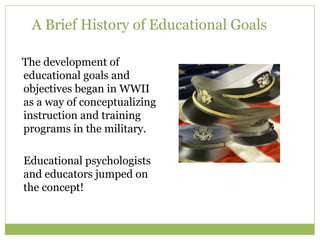
A Brief History of Educational Goals

The development of
educational goals and
objectives began in WWII
as a way of conceptualizing
instruction and training
programs in the military.

Educational psychologists
and educators jumped on
the concept!
1956

Benjamin Bloom and his
colleagues published a
taxonomy of learner
behaviors which was taken
into the public schools and
eventually adopted in the
health profession schools .
It has influenced
curriculum development
and driven the movement
towards competency based
instruction for health
professionals.


Bloom. B. and Krathwolh,D. (1956)
Taxonomy of Educational
Objectives:The Classification of
Educational Goals , New
York,Longmans
Today-
Educational goals and
objectives are widely
used and required for
the development of
continuing professional
education activities that
award continuing
education credit.


Bloom’s original work
has been revised and
updated.
Educational Objectives
are also called:


Learning Objectives

Outcomes

Terminal Objectives

Enabling Objectives

Performance Objectives

Aims

Competencies               The use of the terms “goals” and
Instructional Objectives   “objectives” can be confusing!
Behavioral Objectives
                           Let’s clarify the differences.
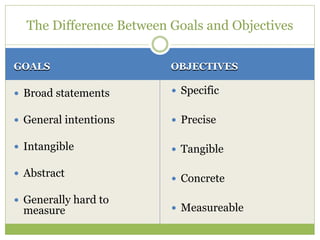
The Difference Between Goals and Objectives


GOALS                   OBJECTIVES

 Broad statements        Specific

 General intentions      Precise

 Intangible              Tangible

 Abstract                Concrete
 Generally hard to
 measure                 Measureable
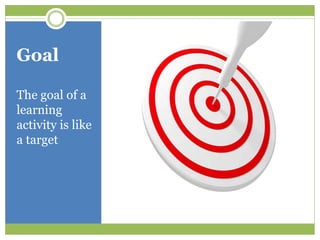
Goal

The goal of a
learning
activity is like
a target
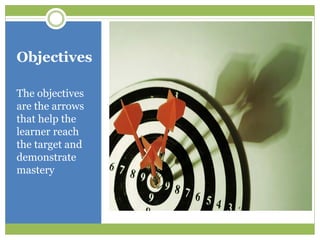
Objectives

The objectives
are the arrows
that help the
learner reach
the target and
demonstrate
mastery
Can you identify the Goals?

A. State the definition of a complimentary medical
     intervention or therapy.

B.   Provide the health professional with the latest
     information about over the counter (OTC) anti-
     histamines and their side effects.

C.   Introduce the reader to a new development in the early
     detection of oral cancer.

D. Be exposed to a new way of organizing paperwork.
Clue:

   There is only one objective on the previous slide-


A.State the definition of a complimentary medical
 intervention or therapy.

          The rest are all broad based goals!
Common Pitfalls in Writing Goals

  Focus on the instructor actions-not the learner

“Provide an overview of the latest site research.”
  The purpose of this course is to provide the participant with print and web
  references regarding site research”.

“Dispel common myths about hand washing.”
  The goal of this course is to provide the health care professional with a
  review of the history and origin of common myths about hand washing .

  Confusing a goal (broad) with an objective (specific)

“How to turn just ten minutes a day into a revenue stream.”
  To clarify this example the author or presenter needs to decide what is the
  overall goal-then what specific behaviors the learners need to do to
  demonstrate mastery of the information or skill.
A few things to remember about goals

                     Every educational
                     activity should have a
                     goal

                     The goal focuses on what
                     the learner will
                     experience, rather than
                     what the instructor will
                     share or do

                     It is a broad statement of
                     purpose
In general terms
what is the overall
purpose of the
educational
activity?
What is the main
intention?


                      The purpose of this article is to
Example:              provide health care professionals
                      with new information on MRSA
                      screening.
Writing educational
goals and
objectives does not
have to be a
struggle.


Mastering the basic
components will help
you to zero in on what
you want the learners or
participants to gain from
the experience .

Goals and objectives
help to focus your          Clearly written objectives help to
presentation!
                            define the outcome of the activity.
The Components of an
Educational Objective

ALWAYS BEGIN WITH THE END RESULT IN MIND!


           THE ABCD APPROACH
Who is this activity
intended for? Be
specific!


At the end of the
webinar the participants
will be able to…..


At the conclusion of the
conference presentation
the attendees will be
able to…


                           A=Audience (the learners, readers
                           or participants, not the instructor)
What exactly is it that
you want the learner to
be able to do as a result
of your …


Journal article


Webinar


Self Study Module


Conference presentation
                            B=BEHAVIOR
Hands on Workshop
                            (what the participants will do)
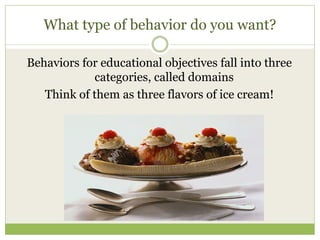
What type of behavior do you want?

Behaviors for educational objectives fall into three
             categories, called domains
   Think of them as three flavors of ice cream!
Dealing with intellectual
abilities


Approximately 80% of
educational objectives
fall into this domain


Most familiar to both
instructors, authors and
learners


“Head” objectives
                            Cognitive Domain
Relating to the
expression of feelings ,
including emotions,
fears, interests,
attitudes, beliefs, values
and appreciations


Often the most difficult
objectives to develop


Sometimes called
“heart” objectives


                             Affective Domain
Motor Skills


The easiest objectives to
write as the behavior is
easily observed and
monitored. Psychomotor
skills often involve the
use of tools or
instruments.


“ Hands On” courses will
contain psychomotor
objectives

                            Psychomotor Domain
“Hand” Objectives
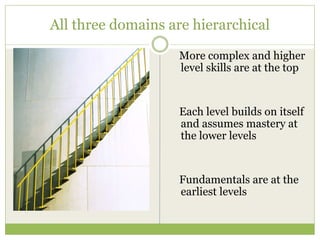
All three domains are hierarchical

                   More complex and higher
                   level skills are at the top


                   Each level builds on itself
                   and assumes mastery at
                   the lower levels


                   Fundamentals are at the
                   earliest levels
States what conditions
the instructor will
impose when the
learners are
demonstrating mastery
of a skill.


Usually a WHEN or
WHILE statement


“when given a set of five
unlabeled slides”


“when given a list of
common over the
counter drugs”
                            C= Condition
“while working
independently”
                            (imposed by the instructor)
The standard or
criterion for judging the
behavioral performance.


What has to happen for
the learner to succeed?


It might be:

Speed

Accuracy

Quality
                            D=Degree
Quantity

                            What is “Good Enough”?
Putting It All Together

      Getting Started

    First develop the overall
    broad goal for your
    educational activity.

o   “The purpose of this
    activity (lecture, article,
    etc) is to……..
A=Audience
                  Next

      o Define your AUDIENCE

      o If possible, identify what
        level they are..novice,
        intermediate, advanced or
        mixed?


            Remember, the
        audience is always the
        learner, not the instructor
B=Behaviors the learners will demonstrate

                      • What does a participant
                       have to do to
                       demonstrate they have
                       mastered the material?

                      • Are those behaviors
                       cognitive, affective or
                       psychomotor?

                      • This will influence your
                       word choice.
Cognitive Domain

Because educational objectives frequently target the cognitive
domain, examples of the levels and sample action verbs will be
helpful in developing your educational objectives.


                                                          These examples are based on
                                                          the revised version of Bloom’s
                                                          work.


Anderson, L.W. and Krathwohl(Eds.) 2001 A Taxonomy for Learning, Teaching and Assessing: A Revision of
Bloom’s Taxonomy of Educational Objectives.New York, Longman
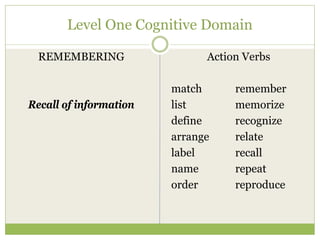
Level One Cognitive Domain

 REMEMBERING                  Action Verbs

                        match      remember
Recall of information   list       memorize
                        define     recognize
                        arrange    relate
                        label      recall
                        name       repeat
                        order      reproduce
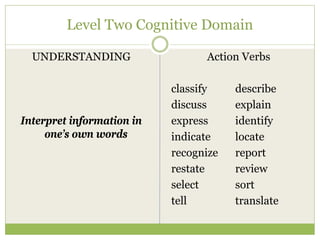
Level Two Cognitive Domain

  UNDERSTANDING                  Action Verbs

                           classify    describe
                           discuss     explain
Interpret information in   express     identify
     one’s own words       indicate    locate
                           recognize   report
                           restate     review
                           select      sort
                           tell        translate
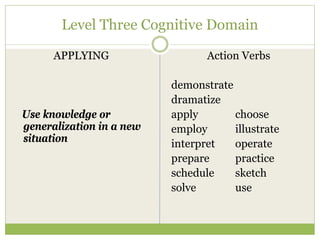
Level Three Cognitive Domain

      APPLYING                   Action Verbs

                          demonstrate
                          dramatize
Use knowledge or          apply       choose
generalization in a new   employ      illustrate
situation                 interpret   operate
                          prepare     practice
                          schedule    sketch
                          solve       use
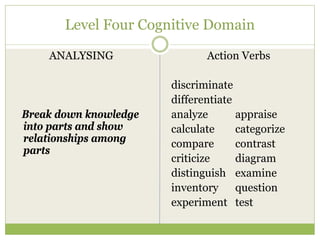
Level Four Cognitive Domain

    ANALYSING                 Action Verbs

                       discriminate
                       differentiate
Break down knowledge   analyze       appraise
into parts and show    calculate     categorize
relationships among    compare       contrast
parts
                       criticize     diagram
                       distinguish examine
                       inventory     question
                       experiment test
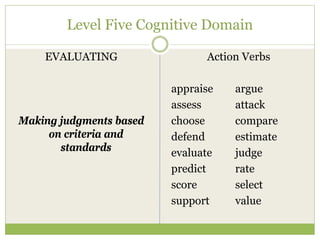
Level Five Cognitive Domain

    EVALUATING                 Action Verbs

                         appraise   argue
                         assess     attack
Making judgments based   choose     compare
     on criteria and     defend     estimate
       standards         evaluate   judge
                         predict    rate
                         score      select
                         support    value
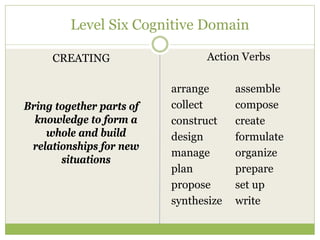
Level Six Cognitive Domain

     CREATING                    Action Verbs

                          arrange      assemble
Bring together parts of   collect      compose
  knowledge to form a     construct    create
    whole and build       design       formulate
 relationships for new
                          manage       organize
       situations
                          plan         prepare
                          propose      set up
                          synthesize   write
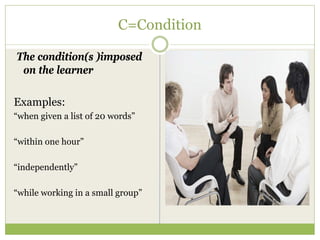
C=Condition

The condition(s )imposed
 on the learner

Examples:
“when given a list of 20 words”

“within one hour”

“independently”

“while working in a small group”
D=Degree
The criterion for success!

Examples:

“select the correct one”

“with 80% accuracy”

“4 out of 5 times

“three”

  How do you evaluate if the
  learner “got it”?
Examples of Objectives Using ABCD

 “At the end of this webinar the participant will be
 able to recall the three most common types of
 personal protection in breaking the chain of
 transmission for effective infection control.

Audience    “the participant”
Behavior    “recall” (Level One Cognitive)
Condition   “the end of this webinar”
Degree      “three”
Example

“When given a list of 20 words, the learner will be able
 to identify correctly all the cognitive action verbs”.

Audience    “the learner”
Behavior    “identify” (Level Two Cognitive)
Condition   “when given a list of 20 words”
Degree      “all” (100%)
Common Pitfalls When Writing Objectives

 Not using measurable action verbs in the educational
 objective

“to be knowledgeable out the rates of osteoporosis”
Know, learn, understand, be aware of, be exposed to are
  too general to be effectively measured

  Not listing the degree required for mastery
“At the conclusion of this presentation the learner will be
  able to list (how many) common side effects of low dose
  aspirin therapy”.
Thoughts on Adult Learning Preferences


Adults seek information to
solve problems-more than
acquiring new knowledge

Presenting solutions and
potential strategies for
solving problems
increases the probability
of success for your
educational activity
Adult Learning Preferences

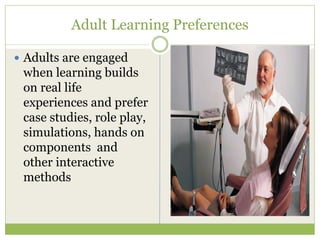
Adults are engaged
when learning builds
on real life
experiences and prefer
case studies, role play,
simulations, hands on
components and
other interactive
methods
Adult Learning Preferences

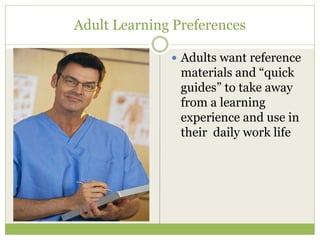
                Adults want reference
                materials and “quick
                guides” to take away
                from a learning
                experience and use in
                their daily work life
Summary
Educational goals are general
statements of intent and        The ABCD method of writing
purpose                         educational objectives helps
                                to assure that all the critical
Every educational activity      components are included
should have a goal
                                Adult learners select
Educational objectives are      educational activities to solve
specific, measureable and       problems
precise
                                Adult learners prefer to have
The cognitive domain is most    interactive, real life scenarios,
frequently used in developing   role play and references
educational objectives
For more information:


Additional resources for
exploring the affective
and psychomotor
domains and key words
are easily found on the
web.


                           Congratulations! Good luck and
                           thank you for completing this
                           presentation!

Ed goals objctvs

  • 1.
    Educational Goals and Objectives A GUIDE TO DEVELOPING LEARNER BASED INSTRUCTION
  • 2.
    Educational Objectives forthis Presentation At the end of this presentation you will be able to: Compare and contrast educational goals vs. educational objectives Write an educational objective using the ABCD model Develop educational objectives that focus on the learner or participant as the intended audience List three adult learning preferences
  • 3.
    A Brief Historyof Educational Goals The development of educational goals and objectives began in WWII as a way of conceptualizing instruction and training programs in the military. Educational psychologists and educators jumped on the concept!
  • 4.
    1956 Benjamin Bloom andhis colleagues published a taxonomy of learner behaviors which was taken into the public schools and eventually adopted in the health profession schools . It has influenced curriculum development and driven the movement towards competency based instruction for health professionals. Bloom. B. and Krathwolh,D. (1956) Taxonomy of Educational Objectives:The Classification of Educational Goals , New York,Longmans
  • 5.
    Today- Educational goals and objectivesare widely used and required for the development of continuing professional education activities that award continuing education credit. Bloom’s original work has been revised and updated.
  • 6.
    Educational Objectives are alsocalled: Learning Objectives Outcomes Terminal Objectives Enabling Objectives Performance Objectives Aims Competencies The use of the terms “goals” and Instructional Objectives “objectives” can be confusing! Behavioral Objectives Let’s clarify the differences.
  • 7.
    The Difference BetweenGoals and Objectives GOALS OBJECTIVES Broad statements Specific General intentions Precise Intangible Tangible Abstract Concrete Generally hard to measure Measureable
  • 8.
    Goal The goal ofa learning activity is like a target
  • 9.
    Objectives The objectives are thearrows that help the learner reach the target and demonstrate mastery
  • 10.
    Can you identifythe Goals? A. State the definition of a complimentary medical intervention or therapy. B. Provide the health professional with the latest information about over the counter (OTC) anti- histamines and their side effects. C. Introduce the reader to a new development in the early detection of oral cancer. D. Be exposed to a new way of organizing paperwork.
  • 11.
    Clue: There is only one objective on the previous slide- A.State the definition of a complimentary medical intervention or therapy. The rest are all broad based goals!
  • 12.
    Common Pitfalls inWriting Goals Focus on the instructor actions-not the learner “Provide an overview of the latest site research.” The purpose of this course is to provide the participant with print and web references regarding site research”. “Dispel common myths about hand washing.” The goal of this course is to provide the health care professional with a review of the history and origin of common myths about hand washing . Confusing a goal (broad) with an objective (specific) “How to turn just ten minutes a day into a revenue stream.” To clarify this example the author or presenter needs to decide what is the overall goal-then what specific behaviors the learners need to do to demonstrate mastery of the information or skill.
  • 13.
    A few thingsto remember about goals Every educational activity should have a goal The goal focuses on what the learner will experience, rather than what the instructor will share or do It is a broad statement of purpose
  • 14.
    In general terms whatis the overall purpose of the educational activity? What is the main intention? The purpose of this article is to Example: provide health care professionals with new information on MRSA screening.
  • 15.
    Writing educational goals and objectivesdoes not have to be a struggle. Mastering the basic components will help you to zero in on what you want the learners or participants to gain from the experience . Goals and objectives help to focus your Clearly written objectives help to presentation! define the outcome of the activity.
  • 16.
    The Components ofan Educational Objective ALWAYS BEGIN WITH THE END RESULT IN MIND! THE ABCD APPROACH
  • 17.
    Who is thisactivity intended for? Be specific! At the end of the webinar the participants will be able to….. At the conclusion of the conference presentation the attendees will be able to… A=Audience (the learners, readers or participants, not the instructor)
  • 18.
    What exactly isit that you want the learner to be able to do as a result of your … Journal article Webinar Self Study Module Conference presentation B=BEHAVIOR Hands on Workshop (what the participants will do)
  • 19.
    What type ofbehavior do you want? Behaviors for educational objectives fall into three categories, called domains Think of them as three flavors of ice cream!
  • 20.
    Dealing with intellectual abilities Approximately80% of educational objectives fall into this domain Most familiar to both instructors, authors and learners “Head” objectives Cognitive Domain
  • 21.
    Relating to the expressionof feelings , including emotions, fears, interests, attitudes, beliefs, values and appreciations Often the most difficult objectives to develop Sometimes called “heart” objectives Affective Domain
  • 22.
    Motor Skills The easiestobjectives to write as the behavior is easily observed and monitored. Psychomotor skills often involve the use of tools or instruments. “ Hands On” courses will contain psychomotor objectives Psychomotor Domain “Hand” Objectives
  • 23.
    All three domainsare hierarchical More complex and higher level skills are at the top Each level builds on itself and assumes mastery at the lower levels Fundamentals are at the earliest levels
  • 24.
    States what conditions theinstructor will impose when the learners are demonstrating mastery of a skill. Usually a WHEN or WHILE statement “when given a set of five unlabeled slides” “when given a list of common over the counter drugs” C= Condition “while working independently” (imposed by the instructor)
  • 25.
    The standard or criterionfor judging the behavioral performance. What has to happen for the learner to succeed? It might be: Speed Accuracy Quality D=Degree Quantity What is “Good Enough”?
  • 26.
    Putting It AllTogether Getting Started First develop the overall broad goal for your educational activity. o “The purpose of this activity (lecture, article, etc) is to……..
  • 27.
    A=Audience Next o Define your AUDIENCE o If possible, identify what level they are..novice, intermediate, advanced or mixed? Remember, the audience is always the learner, not the instructor
  • 28.
    B=Behaviors the learnerswill demonstrate • What does a participant have to do to demonstrate they have mastered the material? • Are those behaviors cognitive, affective or psychomotor? • This will influence your word choice.
  • 29.
    Cognitive Domain Because educationalobjectives frequently target the cognitive domain, examples of the levels and sample action verbs will be helpful in developing your educational objectives. These examples are based on the revised version of Bloom’s work. Anderson, L.W. and Krathwohl(Eds.) 2001 A Taxonomy for Learning, Teaching and Assessing: A Revision of Bloom’s Taxonomy of Educational Objectives.New York, Longman
  • 30.
    Level One CognitiveDomain REMEMBERING Action Verbs match remember Recall of information list memorize define recognize arrange relate label recall name repeat order reproduce
  • 31.
    Level Two CognitiveDomain UNDERSTANDING Action Verbs classify describe discuss explain Interpret information in express identify one’s own words indicate locate recognize report restate review select sort tell translate
  • 32.
    Level Three CognitiveDomain APPLYING Action Verbs demonstrate dramatize Use knowledge or apply choose generalization in a new employ illustrate situation interpret operate prepare practice schedule sketch solve use
  • 33.
    Level Four CognitiveDomain ANALYSING Action Verbs discriminate differentiate Break down knowledge analyze appraise into parts and show calculate categorize relationships among compare contrast parts criticize diagram distinguish examine inventory question experiment test
  • 34.
    Level Five CognitiveDomain EVALUATING Action Verbs appraise argue assess attack Making judgments based choose compare on criteria and defend estimate standards evaluate judge predict rate score select support value
  • 35.
    Level Six CognitiveDomain CREATING Action Verbs arrange assemble Bring together parts of collect compose knowledge to form a construct create whole and build design formulate relationships for new manage organize situations plan prepare propose set up synthesize write
  • 36.
    C=Condition The condition(s )imposed on the learner Examples: “when given a list of 20 words” “within one hour” “independently” “while working in a small group”
  • 37.
    D=Degree The criterion forsuccess! Examples: “select the correct one” “with 80% accuracy” “4 out of 5 times “three” How do you evaluate if the learner “got it”?
  • 38.
    Examples of ObjectivesUsing ABCD “At the end of this webinar the participant will be able to recall the three most common types of personal protection in breaking the chain of transmission for effective infection control. Audience “the participant” Behavior “recall” (Level One Cognitive) Condition “the end of this webinar” Degree “three”
  • 39.
    Example “When given alist of 20 words, the learner will be able to identify correctly all the cognitive action verbs”. Audience “the learner” Behavior “identify” (Level Two Cognitive) Condition “when given a list of 20 words” Degree “all” (100%)
  • 40.
    Common Pitfalls WhenWriting Objectives Not using measurable action verbs in the educational objective “to be knowledgeable out the rates of osteoporosis” Know, learn, understand, be aware of, be exposed to are too general to be effectively measured Not listing the degree required for mastery “At the conclusion of this presentation the learner will be able to list (how many) common side effects of low dose aspirin therapy”.
  • 41.
    Thoughts on AdultLearning Preferences Adults seek information to solve problems-more than acquiring new knowledge Presenting solutions and potential strategies for solving problems increases the probability of success for your educational activity
  • 42.
    Adult Learning Preferences Adultsare engaged when learning builds on real life experiences and prefer case studies, role play, simulations, hands on components and other interactive methods
  • 43.
    Adult Learning Preferences Adults want reference materials and “quick guides” to take away from a learning experience and use in their daily work life
  • 44.
    Summary Educational goals aregeneral statements of intent and The ABCD method of writing purpose educational objectives helps to assure that all the critical Every educational activity components are included should have a goal Adult learners select Educational objectives are educational activities to solve specific, measureable and problems precise Adult learners prefer to have The cognitive domain is most interactive, real life scenarios, frequently used in developing role play and references educational objectives
  • 45.
    For more information: Additionalresources for exploring the affective and psychomotor domains and key words are easily found on the web. Congratulations! Good luck and thank you for completing this presentation!