Writing Behavioral
Objectives
(Taxonomy of
educational objectives)
Learning and Teaching
• Learning
– Learning is a process through
which a person acquires new
Knowledge, Skill or Attitude.
– The result of learning is “Change
in Behavior” of a person.
• Teaching
– Teaching involves live human
interaction between a teacher and
one or more learners.
Information and Instruction
• Information
– The aim of information is to
officially tell someone something
• Instruction
– The aim of instruction is to
change the behavior of a person
• Behavior refers to any
observable activity performed
by a person
Goals vs. Objectives
• Goals
– Goals are broad statements of intent
that provide focus or vision for
planning.
– A statement that describes in broad
terms what the learner will do.
• They are:
– Non-specific
– Unclear
– Non-measurable
– Usually cannot be attained.
Goals vs. Objectives
• Objectives
– Much more specific than a goal
– Meant to be realistic targets for the
program or project.
– Help you focus your program
– Written in an active tense and use
strong verbs like:
– Plan, write, conduct, produce, etc
• Rather than:
– learn, understand, feel
Objectives
• There are a number of
approaches to writing objectives:
• Mager – Behavioral objectives
• Gronlund – General / specific
objectives
• Eisner – Expressive objectives
Behavioral Objectives-Definition
• A statement in specific
and measurable terms
that describes what
the learner will know
or be able to do.
Effective Behavioral Objectives
• Consistent with the goals of the
curriculum
• Clearly stated
• Clearly measurable
• Realistic and doable
• Appropriate for the level of the
learner/achievable
• Worthwhile
• SMART/SMARTER (George T. Doran)
Why Are Behavioral Objectives
Important?
• Communication tool
– Teacher should be able to tell all
who are interested what students
will learn from instruction
– NOTE: Teacher must first see
ends (objectives) of his/her own
instruction
• Objectives stated behaviorally
communicate better than non-
behaviorally stated objectives.
What is the Purpose of Behavioral
Objectives?
• Guide for the teacher
• Guide for learner
• Basis for dialogue
• Basis for evaluation
• Makes curriculum explicit
• Makes curriculum
analysis/evaluation possible
Components of Behavioral
Objectives
• Audience: For whom is the objective
written? student, class, school
• Behavior: What must the student do to
demonstrate mastery? Identify, circle,
list…
• Condition: Under what condition will they
demonstrate this understanding? Given a
paragraph, While reading a story, On a
multiple choice test
• Degree of proficiency: How much should
they know to be proficient? 100%, 3 out of
4, at lest half.
Example
• Given a list of the first 100
numbers arranged in ascending
order (conditions), the student
will circle (verb) at least nine
prime numbers (criteria).
Guidelines for Behavioral Objectives in
the Cognitive Domain
• State each objective in terms of
student performance rather than
teacher performance.
• State each objective as a learning
product (outcome or terminal
behavior) rather than in terms of the
learning process.
• State only one outcome or behavior in
each objective.
• Make objectives clear, brief and
unambiguous.
• Do not include trivial objectives.
Guidelines for Behavioral Objectives in
the Cognitive Domain
• When building objectives, think:
"At the end of the lesson the
student will be able to……"
• Good Objectives tell
students what they are
expected to know and what
they are to be able to do.
Vague Verbs
• Unacceptable
• Replace with more specific
verbs
• Example
– Vague: understand, know, or learn
about
– Specific: list, identify, state,
describe, define, solve, compare &
contrast, operate
Tips About Word Choice
• Use "doing words"
– Words which describe a
performance (e.g., identify)
– Words that can be observed and
measured
• Words to avoid
– Those that describe abstract states
of being (e.g., know)
– Words that are difficult to observe
or measure
Do Not Use Any of These!
• Understand
• Appreciate
• Be aware of
• Have faith in
• Really understand
• Become Familiar with
• Grasp the significance of
• Know
• Learn
• Enjoy
• Believe
Why not use these? Because they are open to
several interpretations and are not measurable!!!
EXAMPLES OF OBJECTIVES
On completion of the study of this Unit the learner will be able:
1. To comprehend the nature of Viral diseases
2. To define Virus (K)
3. To explain the origin of Viruses on the basis of “Regressive
theory” (C)
4. To list the four characteristic features of Viruses (K)
5. To define virulent cycle (K)
6. To give an example for (i) Spherical virus and (ii) Tadpole
shaped Virus (C)
7. To describe the shape and general structure of Viruses (C)
8. To name three Viral diseases in plants (K)
9. To describe the structure of HIV (C)
10. To explain the multiplication of T4 bacteriophage with
labeled sketches (C&Sk)
11. To describe any three Viral diseases in Human beings and
methods of preventing them (C)
Conclusion
• Well-written learning objectives
are at the heart of any lesson
plan
• Before you begin to write an
objective, spend a little time
thinking about what you are
describing, and remember to
make the student behavior
observable.
Our Objectives Today….
• List and describe the three
domains of learning
• List and provide an example
of the levels of Bloom’s
Taxonomy
• Paper 834
Descartes Moment
• What do you know about the
three domains of learning?
• What do you know about
Bloom’s Taxonomy?
• Where will WE use this
information later?
What is a Taxonomy?
• What do you think of when you
hear the word Taxonomy?
• Taxonomy is the practice and
science of classification.
– Phylum, Class, Order, Family,
Genus, Species, Variety
The Three DOMAINS
The Three DOMAINS
TAXONOMY OF
EDUCATIONAL OBJECTIVES
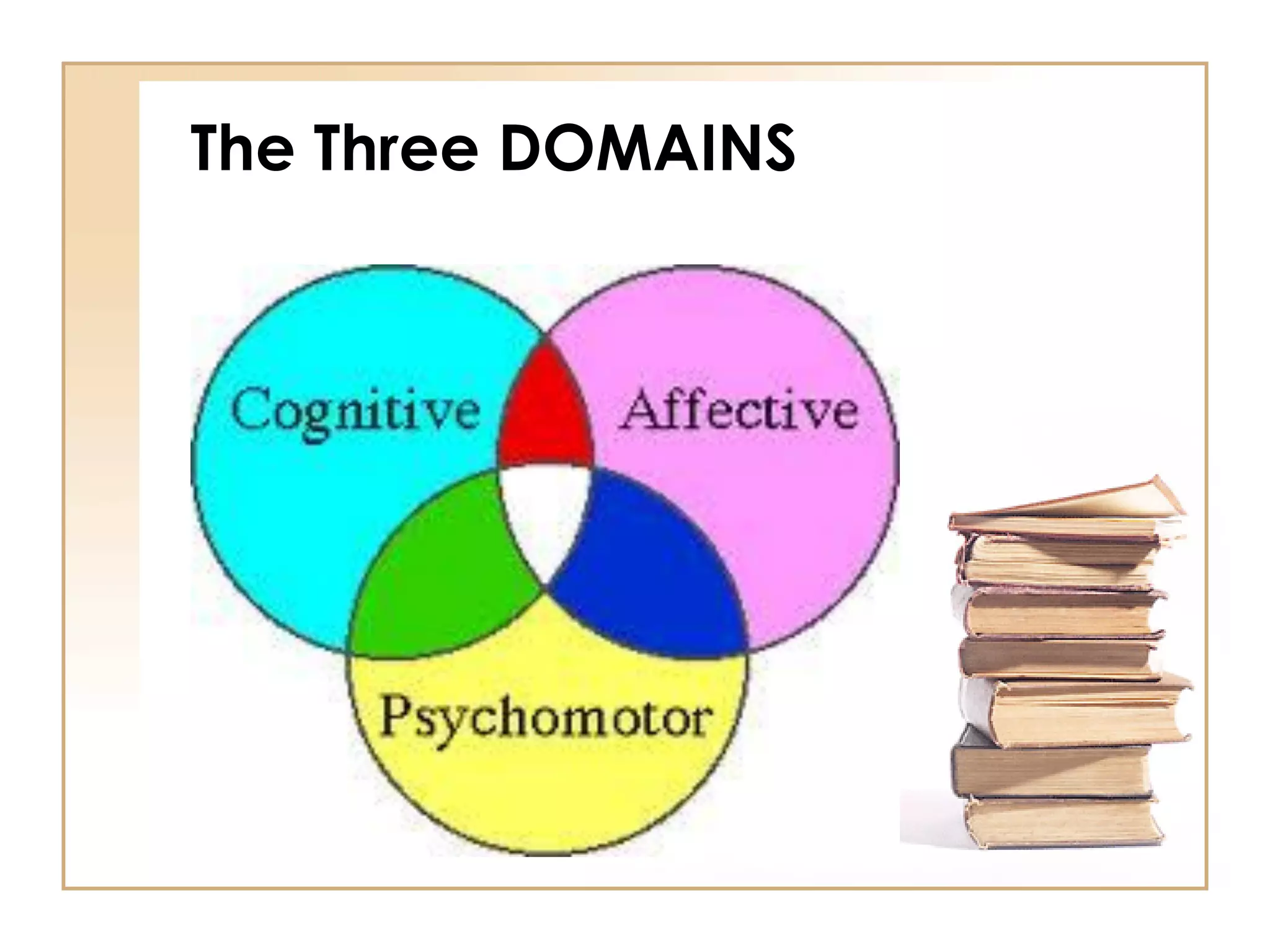
• The three domains are in a
hierarchical order
1. Cognitive Domain (Thinking)
2. Affective Domain (Feeling and
Attitudes)
3. Psychomotor Domain (Acting
or Doing)
TAXONOMY OF
EDUCATIONAL OBJECTIVES
Knowledge
(HEAD)
Cognitive
Domain
Affective
domain
Attitudes
(HEART)
Skills
(HANDS)
Psychomotor
Domain
Bloom’s Taxonomy
• Cognitive Domain
– Bloom (1956)
– Six ascending levels of
complexity
– Helps teachers develop
objectives that guide day-to-
day instruction
– Provide a structure for writing
text questions and evaluating
student progress
Cognitive Domain
• Hierarchical order of the categories in the
cognitive domain
Application
Analysis
Synthesis
Evaluation
Knowledge
Comprehension
Cognitive Domain
• A mnemonic device for
remembering the six levels:
Knowledge
Comprehension
Application
Analysis
Synthesis
Evaluation
Killing
Cats
Almost
Always
Seems
Evil.
Cognitive Domain
• Knowledge
– Remembering previously learned
material
• Specifics, Facts, Trends,
Criteria, Principles, Methodology
– Student recalls or recognizes
information, ideas, and principles in
the approximate form in which they
were learned.
– Write, List, Label, Name, State, Define
– The student will define the 6 levels
of Bloom's taxonomy of the
cognitive domain.
Cognitive Domain
• Comprehension
– Grasping the meaning of material
• Translation, Interpretation,
Extrapolation
– Student translates, comprehends,
or interprets information based on
prior learning.
– Explain, Summarize, Paraphrase,
Describe, Illustrate
– The student will explain the
purpose of Bloom's taxonomy of
the cognitive domain.
Cognitive Domain
• Application
– This refers to the ability to use learned
material in new and concrete
situations.
– Include application of rules, methods,
concepts, principles, laws and theories
and solving of problems.
– Use, Compute, Solve,
Demonstrate, Apply, Construct
– The student will write an
instructional objective for each
level of Bloom's taxonomy.
Cognitive Domain
• Analysis
– Breaking down material into its parts
– Student distinguishes, classifies,
and relates the assumptions,
hypotheses, evidence, or structure
of a statement or question.
– Analyze, Categorize, Compare,
Contrast, Separate
– The student will compare and
contrast the cognitive and
affective domains.
Cognitive Domain
• Synthesis
– Putting parts together into a whole
– Student originates, integrates, and
combines ideas into a product, plan
or proposal that is new to him or her.
– Create, Design, Hypothesize, Invent,
Develop
– The student will design a
classification scheme for writing
educational objectives that
combines the cognitive, affective,
and psychomotor domains.
Cognitive Domain
• Evaluation
– Judging the value of a thing for a
given purpose using definite criteria
– Student appraises, assesses, or
critiques on a basis of specific
standards and criteria.
– Judge, Recommend, Critique, Justify
– The student will judge the
effectiveness of writing objectives
using Bloom's taxonomy.
Old Bloom’s vs. New Bloom’s
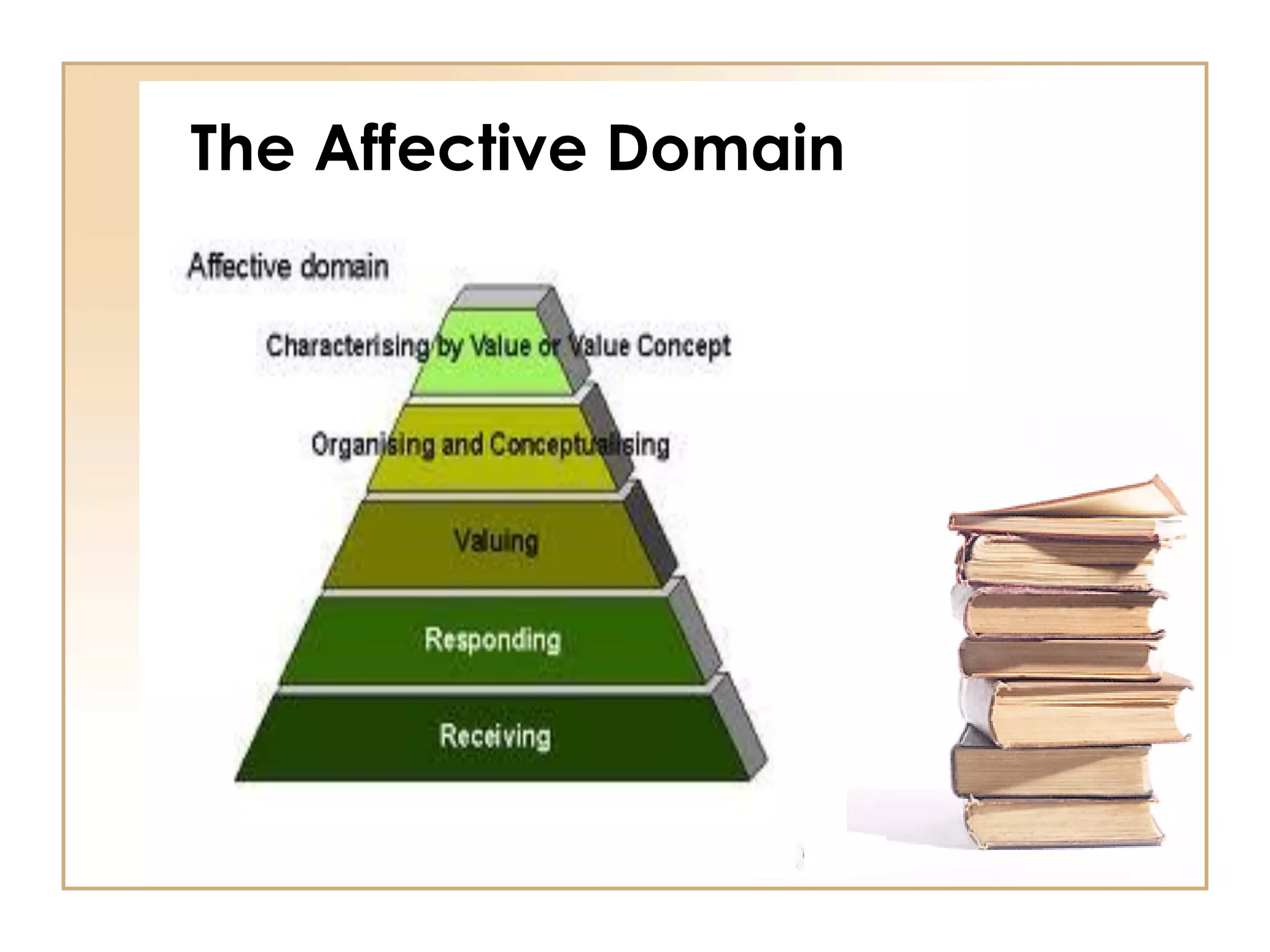
The Affective Domain
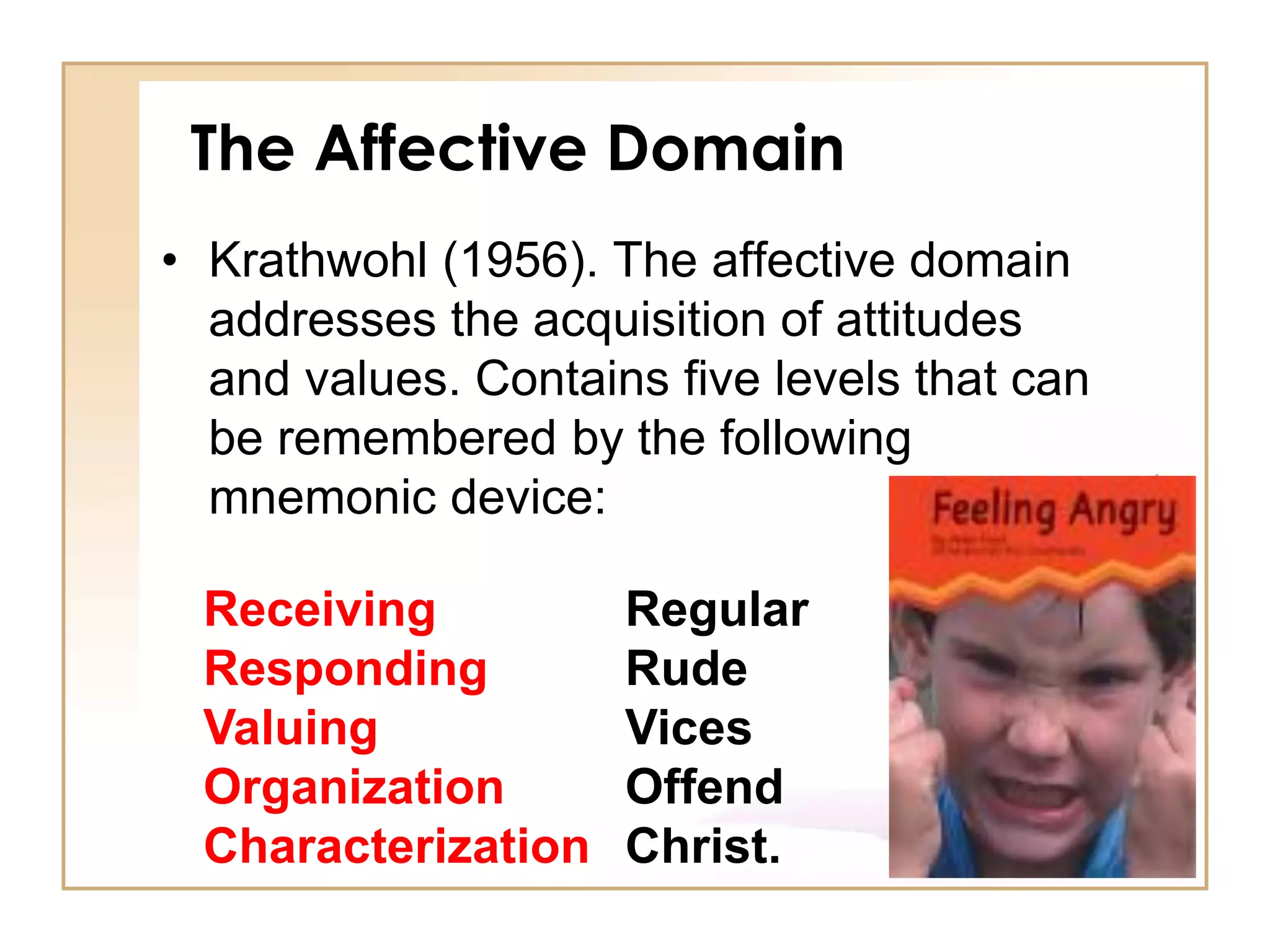
• Krathwohl (1956). The affective domain
addresses the acquisition of attitudes
and values. Contains five levels that can
be remembered by the following
mnemonic device:
Regular
Rude
Vices
Offend
Christ.
Receiving
Responding
Valuing
Organization
Characterization
The Affective Domain
• Receiving:
– Student is aware of or attending to
something in the environment.
• Responding:
– Students displays some new
behavior as a result of experiences
and responds to the experiences.
• Valuing:
– Students displays definite
involvement or commitment toward
some experience.
The Affective Domain
• Organization:
– Student has integrated a new value
into his or her general set of values
and can give it its proper place in a
priority system.
• Characterization by value:
– Students acts consistently
according to the value and is firmly
committed to the experience.
Psychomotor Domain
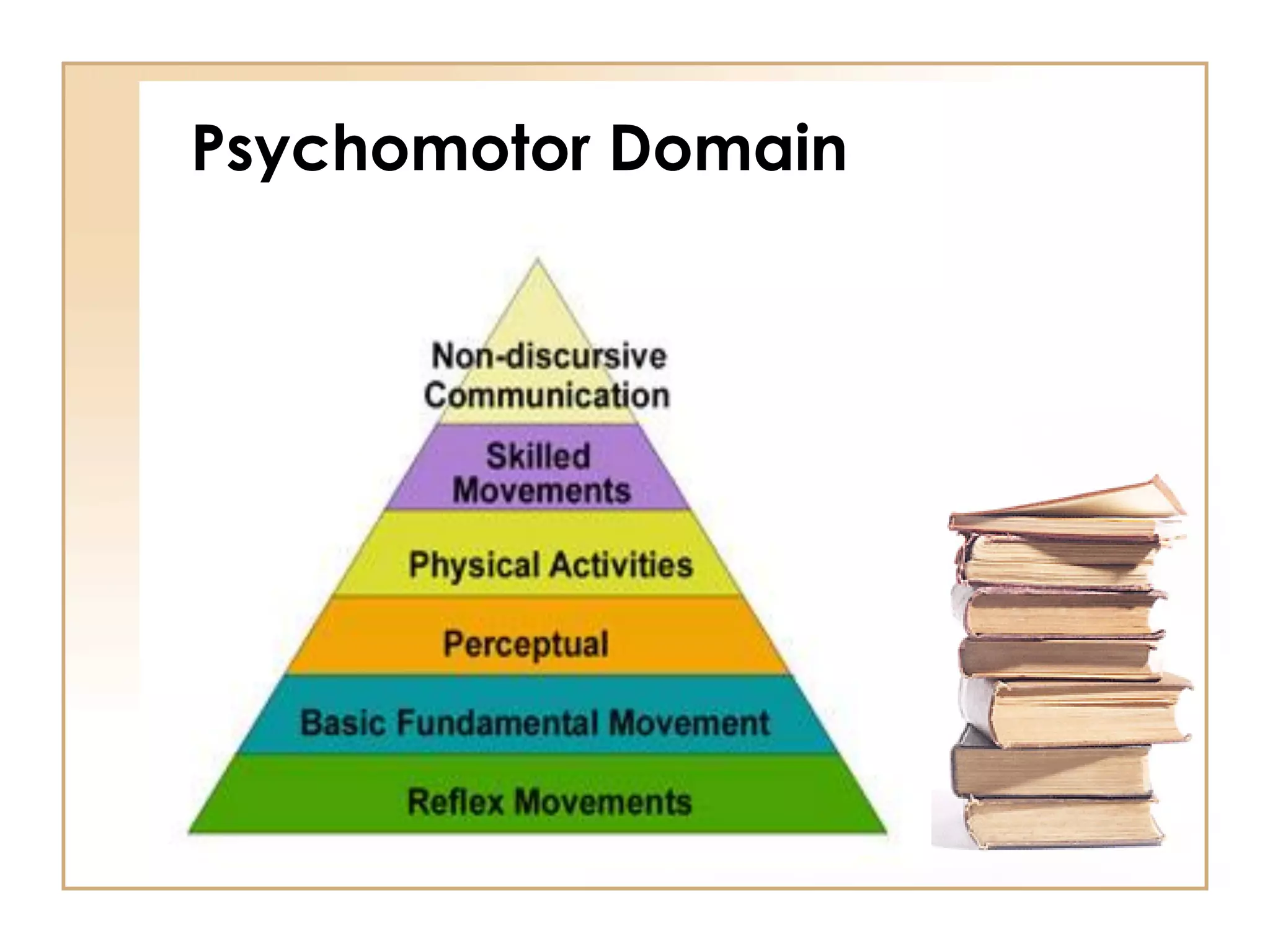
• Anita J. Harrow (1972)
• This taxonomy is organized according
to the degree of coordination from
involuntary responses to refined
learned capabilities:
– Reflex Movements
– Basic Fundamental Movement
– Perceptual Abilities
– Physical Abilities
– Skilled Movements
– Non-discursive Communication
Psychomotor Domain
Psychomotor Domain
• Reflex Movements
– Automatic reactions
• Basic Fundamental Movement
– Simple movements that can build to
more complex sets of movements.
• Perceptual Abilities
– Environmental cues that allow one to
adjust movements.
• Physical Abilities
– Things requiring endurance, strength,
vigor, and agility.
Psychomotor Domain
• Skilled Movements
– Activities where a level of efficiency
is achieved.
• Non-discursive Communication
– Expressive movement, body
language.
THANK YOU

2 Writing Behavioral Objectives Taxonomy of educational objectives (2).pdf

  • 1.
  • 2.
    Learning and Teaching •Learning – Learning is a process through which a person acquires new Knowledge, Skill or Attitude. – The result of learning is “Change in Behavior” of a person. • Teaching – Teaching involves live human interaction between a teacher and one or more learners.
  • 3.
    Information and Instruction •Information – The aim of information is to officially tell someone something • Instruction – The aim of instruction is to change the behavior of a person • Behavior refers to any observable activity performed by a person
  • 4.
    Goals vs. Objectives •Goals – Goals are broad statements of intent that provide focus or vision for planning. – A statement that describes in broad terms what the learner will do. • They are: – Non-specific – Unclear – Non-measurable – Usually cannot be attained.
  • 5.
    Goals vs. Objectives •Objectives – Much more specific than a goal – Meant to be realistic targets for the program or project. – Help you focus your program – Written in an active tense and use strong verbs like: – Plan, write, conduct, produce, etc • Rather than: – learn, understand, feel
  • 6.
    Objectives • There area number of approaches to writing objectives: • Mager – Behavioral objectives • Gronlund – General / specific objectives • Eisner – Expressive objectives
  • 7.
    Behavioral Objectives-Definition • Astatement in specific and measurable terms that describes what the learner will know or be able to do.
  • 8.
    Effective Behavioral Objectives •Consistent with the goals of the curriculum • Clearly stated • Clearly measurable • Realistic and doable • Appropriate for the level of the learner/achievable • Worthwhile • SMART/SMARTER (George T. Doran)
  • 9.
    Why Are BehavioralObjectives Important? • Communication tool – Teacher should be able to tell all who are interested what students will learn from instruction – NOTE: Teacher must first see ends (objectives) of his/her own instruction • Objectives stated behaviorally communicate better than non- behaviorally stated objectives.
  • 10.
    What is thePurpose of Behavioral Objectives? • Guide for the teacher • Guide for learner • Basis for dialogue • Basis for evaluation • Makes curriculum explicit • Makes curriculum analysis/evaluation possible
  • 11.
    Components of Behavioral Objectives •Audience: For whom is the objective written? student, class, school • Behavior: What must the student do to demonstrate mastery? Identify, circle, list… • Condition: Under what condition will they demonstrate this understanding? Given a paragraph, While reading a story, On a multiple choice test • Degree of proficiency: How much should they know to be proficient? 100%, 3 out of 4, at lest half.
  • 12.
    Example • Given alist of the first 100 numbers arranged in ascending order (conditions), the student will circle (verb) at least nine prime numbers (criteria).
  • 13.
    Guidelines for BehavioralObjectives in the Cognitive Domain • State each objective in terms of student performance rather than teacher performance. • State each objective as a learning product (outcome or terminal behavior) rather than in terms of the learning process. • State only one outcome or behavior in each objective. • Make objectives clear, brief and unambiguous. • Do not include trivial objectives.
  • 14.
    Guidelines for BehavioralObjectives in the Cognitive Domain • When building objectives, think: "At the end of the lesson the student will be able to……" • Good Objectives tell students what they are expected to know and what they are to be able to do.
  • 15.
    Vague Verbs • Unacceptable •Replace with more specific verbs • Example – Vague: understand, know, or learn about – Specific: list, identify, state, describe, define, solve, compare & contrast, operate
  • 16.
    Tips About WordChoice • Use "doing words" – Words which describe a performance (e.g., identify) – Words that can be observed and measured • Words to avoid – Those that describe abstract states of being (e.g., know) – Words that are difficult to observe or measure
  • 17.
    Do Not UseAny of These! • Understand • Appreciate • Be aware of • Have faith in • Really understand • Become Familiar with • Grasp the significance of • Know • Learn • Enjoy • Believe Why not use these? Because they are open to several interpretations and are not measurable!!!
  • 18.
    EXAMPLES OF OBJECTIVES Oncompletion of the study of this Unit the learner will be able: 1. To comprehend the nature of Viral diseases 2. To define Virus (K) 3. To explain the origin of Viruses on the basis of “Regressive theory” (C) 4. To list the four characteristic features of Viruses (K) 5. To define virulent cycle (K) 6. To give an example for (i) Spherical virus and (ii) Tadpole shaped Virus (C) 7. To describe the shape and general structure of Viruses (C) 8. To name three Viral diseases in plants (K) 9. To describe the structure of HIV (C) 10. To explain the multiplication of T4 bacteriophage with labeled sketches (C&Sk) 11. To describe any three Viral diseases in Human beings and methods of preventing them (C)
  • 19.
    Conclusion • Well-written learningobjectives are at the heart of any lesson plan • Before you begin to write an objective, spend a little time thinking about what you are describing, and remember to make the student behavior observable.
  • 20.
    Our Objectives Today…. •List and describe the three domains of learning • List and provide an example of the levels of Bloom’s Taxonomy • Paper 834
  • 21.
    Descartes Moment • Whatdo you know about the three domains of learning? • What do you know about Bloom’s Taxonomy? • Where will WE use this information later?
  • 22.
    What is aTaxonomy? • What do you think of when you hear the word Taxonomy? • Taxonomy is the practice and science of classification. – Phylum, Class, Order, Family, Genus, Species, Variety
  • 23.
  • 24.
  • 25.
    TAXONOMY OF EDUCATIONAL OBJECTIVES •The three domains are in a hierarchical order 1. Cognitive Domain (Thinking) 2. Affective Domain (Feeling and Attitudes) 3. Psychomotor Domain (Acting or Doing)
  • 26.
  • 27.
    Bloom’s Taxonomy • CognitiveDomain – Bloom (1956) – Six ascending levels of complexity – Helps teachers develop objectives that guide day-to- day instruction – Provide a structure for writing text questions and evaluating student progress
  • 28.
    Cognitive Domain • Hierarchicalorder of the categories in the cognitive domain Application Analysis Synthesis Evaluation Knowledge Comprehension
  • 29.
    Cognitive Domain • Amnemonic device for remembering the six levels: Knowledge Comprehension Application Analysis Synthesis Evaluation Killing Cats Almost Always Seems Evil.
  • 30.
    Cognitive Domain • Knowledge –Remembering previously learned material • Specifics, Facts, Trends, Criteria, Principles, Methodology – Student recalls or recognizes information, ideas, and principles in the approximate form in which they were learned. – Write, List, Label, Name, State, Define – The student will define the 6 levels of Bloom's taxonomy of the cognitive domain.
  • 31.
    Cognitive Domain • Comprehension –Grasping the meaning of material • Translation, Interpretation, Extrapolation – Student translates, comprehends, or interprets information based on prior learning. – Explain, Summarize, Paraphrase, Describe, Illustrate – The student will explain the purpose of Bloom's taxonomy of the cognitive domain.
  • 32.
    Cognitive Domain • Application –This refers to the ability to use learned material in new and concrete situations. – Include application of rules, methods, concepts, principles, laws and theories and solving of problems. – Use, Compute, Solve, Demonstrate, Apply, Construct – The student will write an instructional objective for each level of Bloom's taxonomy.
  • 33.
    Cognitive Domain • Analysis –Breaking down material into its parts – Student distinguishes, classifies, and relates the assumptions, hypotheses, evidence, or structure of a statement or question. – Analyze, Categorize, Compare, Contrast, Separate – The student will compare and contrast the cognitive and affective domains.
  • 34.
    Cognitive Domain • Synthesis –Putting parts together into a whole – Student originates, integrates, and combines ideas into a product, plan or proposal that is new to him or her. – Create, Design, Hypothesize, Invent, Develop – The student will design a classification scheme for writing educational objectives that combines the cognitive, affective, and psychomotor domains.
  • 35.
    Cognitive Domain • Evaluation –Judging the value of a thing for a given purpose using definite criteria – Student appraises, assesses, or critiques on a basis of specific standards and criteria. – Judge, Recommend, Critique, Justify – The student will judge the effectiveness of writing objectives using Bloom's taxonomy.
  • 36.
    Old Bloom’s vs.New Bloom’s
  • 37.
    The Affective Domain •Krathwohl (1956). The affective domain addresses the acquisition of attitudes and values. Contains five levels that can be remembered by the following mnemonic device: Regular Rude Vices Offend Christ. Receiving Responding Valuing Organization Characterization
  • 38.
  • 39.
    The Affective Domain •Receiving: – Student is aware of or attending to something in the environment. • Responding: – Students displays some new behavior as a result of experiences and responds to the experiences. • Valuing: – Students displays definite involvement or commitment toward some experience.
  • 40.
    The Affective Domain •Organization: – Student has integrated a new value into his or her general set of values and can give it its proper place in a priority system. • Characterization by value: – Students acts consistently according to the value and is firmly committed to the experience.
  • 41.
    Psychomotor Domain • AnitaJ. Harrow (1972) • This taxonomy is organized according to the degree of coordination from involuntary responses to refined learned capabilities: – Reflex Movements – Basic Fundamental Movement – Perceptual Abilities – Physical Abilities – Skilled Movements – Non-discursive Communication
  • 42.
  • 43.
    Psychomotor Domain • ReflexMovements – Automatic reactions • Basic Fundamental Movement – Simple movements that can build to more complex sets of movements. • Perceptual Abilities – Environmental cues that allow one to adjust movements. • Physical Abilities – Things requiring endurance, strength, vigor, and agility.
  • 44.
    Psychomotor Domain • SkilledMovements – Activities where a level of efficiency is achieved. • Non-discursive Communication – Expressive movement, body language.
  • 45.