Assessment 21st Century Classrooms
Created by Kelly Hedges
June 15th, 2013
1Teach Elements: Assessment 21st Century Classrooms
Formative Assessment
 Assessment for learning
 ‘The main purpose for formative assessment is to help
teachers monitor their students’ progress and to modify
the instruction accordingly. It is used to detect if the
teaching/learning is working or not.’
(formative-assessment.com)
2Teach Elements: Assessment 21st Century Classrooms
Summative Assessment
 Assessment of learning
 ‘The process of evaluating (and grading) the learning of
students at a point in time.’
(qualityresearchinternational.com)
3Teach Elements: Assessment 21st Century Classrooms
“If we think of our children as plants. . .
summative assessment of the plants is the process of
simply measuring them. The measurements might be
interesting to compare and analyse, but, in themselves,
they do not affect the growth of the plants. Formative
assessment, on the other hand, is the garden equivalent of
feeding and watering the plants-directly affecting their
growth.”
www.wiki.umu.edu
Teach Elements: Assessment 21st Century Classrooms 4
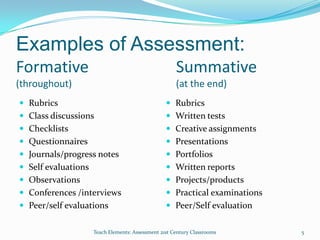
Examples of Assessment:
Formative Summative
(throughout) (at the end)
 Rubrics
 Class discussions
 Checklists
 Questionnaires
 Journals/progress notes
 Self evaluations
 Observations
 Conferences /interviews
 Peer/self evaluations
 Rubrics
 Written tests
 Creative assignments
 Presentations
 Portfolios
 Written reports
 Projects/products
 Practical examinations
 Peer/Self evaluation
Teach Elements: Assessment 21st Century Classrooms 5
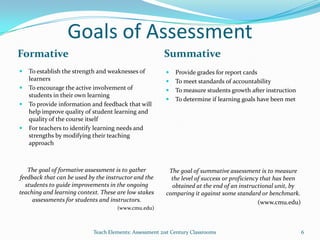
Goals of Assessment
Formative Summative
 To establish the strength and weaknesses of
learners
 To encourage the active involvement of
students in their own learning
 To provide information and feedback that will
help improve quality of student learning and
quality of the course itself
 For teachers to identify learning needs and
strengths by modifying their teaching
approach
The goal of formative assessment is to gather
feedback that can be used by the instructor and the
students to guide improvements in the ongoing
teaching and learning context. These are low stakes
assessments for students and instructors.
(www.cmu.edu)
 Provide grades for report cards
 To meet standards of accountability
 To measure students growth after instruction
 To determine if learning goals have been met
The goal of summative assessment is to measure
the level of success or proficiency that has been
obtained at the end of an instructional unit, by
comparing it against some standard or benchmark.
(www.cmu.edu)
Teach Elements: Assessment 21st Century Classrooms 6
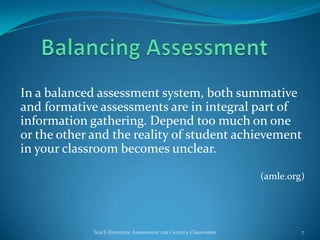
In a balanced assessment system, both summative
and formative assessments are in integral part of
information gathering. Depend too much on one
or the other and the reality of student achievement
in your classroom becomes unclear.
(amle.org)
Teach Elements: Assessment 21st Century Classrooms 7
Sources:
Teach Elements: Assessment 21st Century Classrooms 8
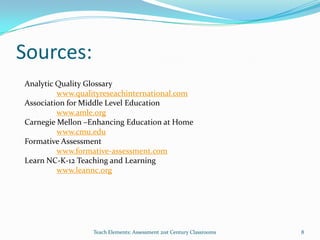
Analytic Quality Glossary
www.qualityreseachinternational.com
Association for Middle Level Education
www.amle.org
Carnegie Mellon –Enhancing Education at Home
www.cmu.edu
Formative Assessment
www.formative-assessment.com
Learn NC-K-12 Teaching and Learning
www.leannc.org