TYLER’S OBJECTIVES-
CENTERED MODEL
ANNE E. DANTES
BSE III- PHYSICAL
SCIENCE
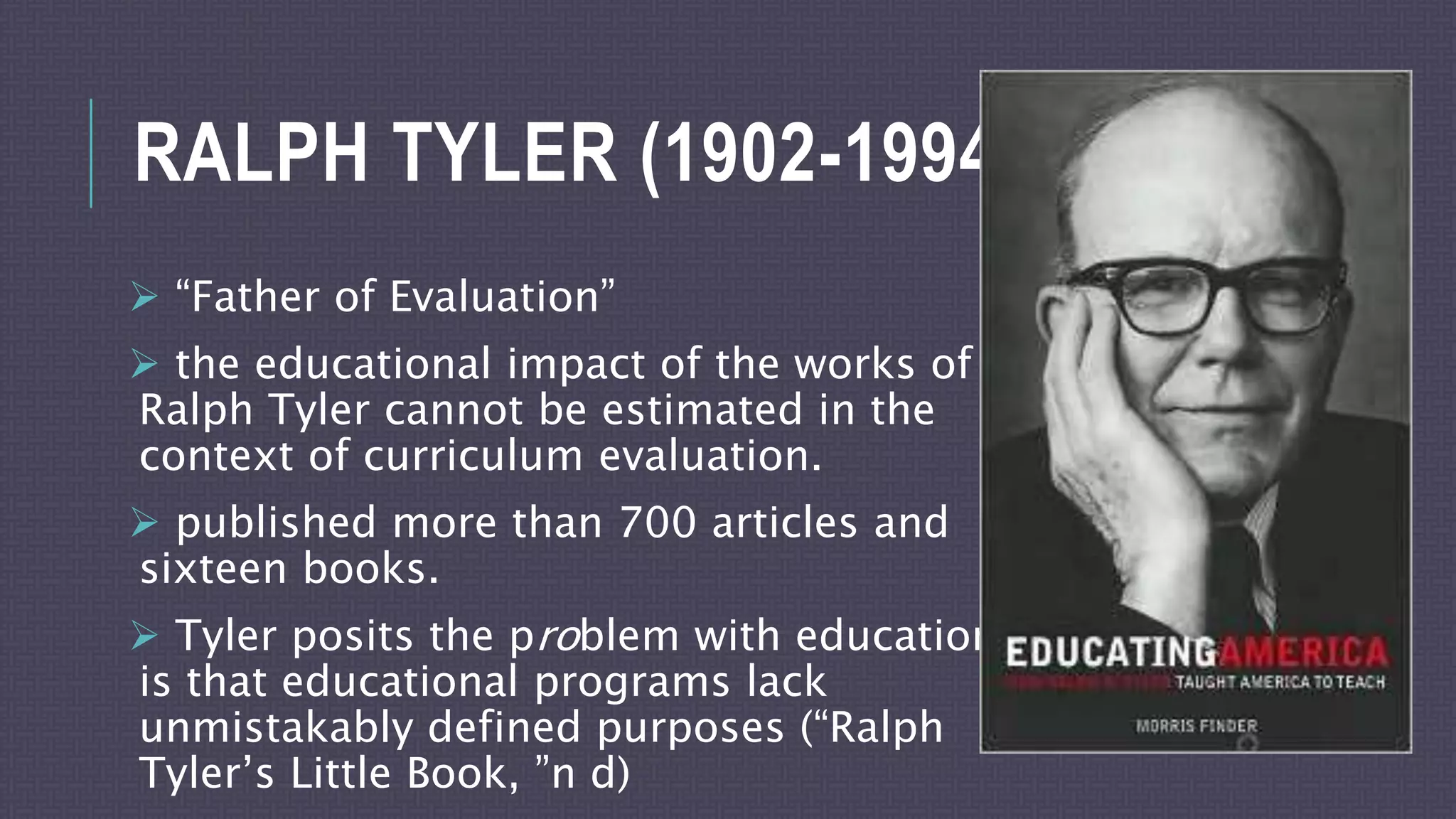
RALPH TYLER (1902-1994)
 “Father of Evaluation”
 the educational impact of the works of
Ralph Tyler cannot be estimated in the
context of curriculum evaluation.
 published more than 700 articles and
sixteen books.
 Tyler posits the problem with education
is that educational programs lack
unmistakably defined purposes (“Ralph
Tyler’s Little Book, ”n d)
RALPH TYLER
 in his book Tyler presented the
concept that curriculum should be:
 dynamic.
 a program under constant
evaluation and revision.
THE TYLER’S OBJECTIVES-
CENTERED MODEL
 one of the best known models
for curriculum development.
 known for the special attention it
gives to the planning phases.
 it is a deductive process.
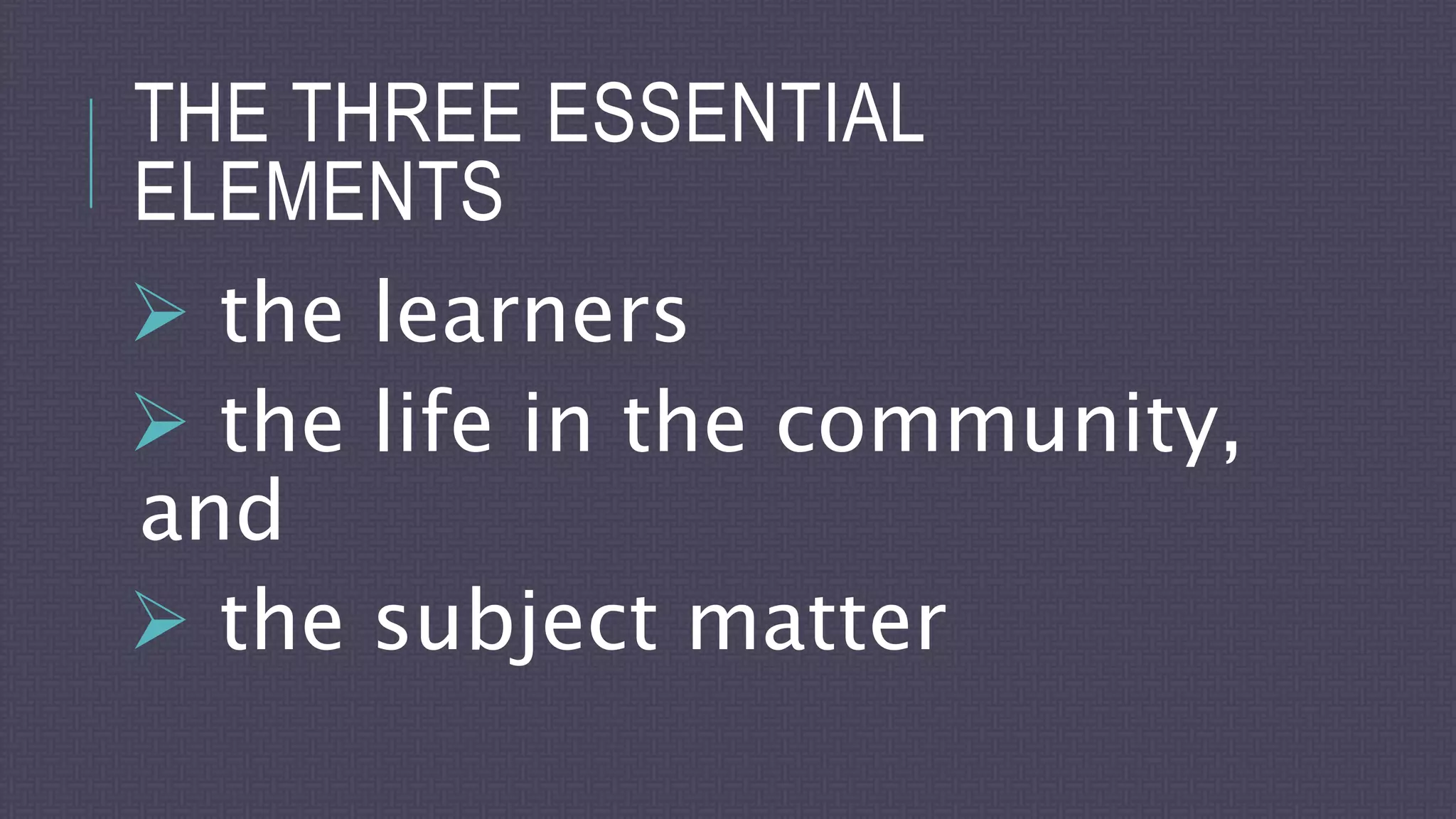
THE THREE ESSENTIAL
ELEMENTS
 the learners
 the life in the community,
and
 the subject matter
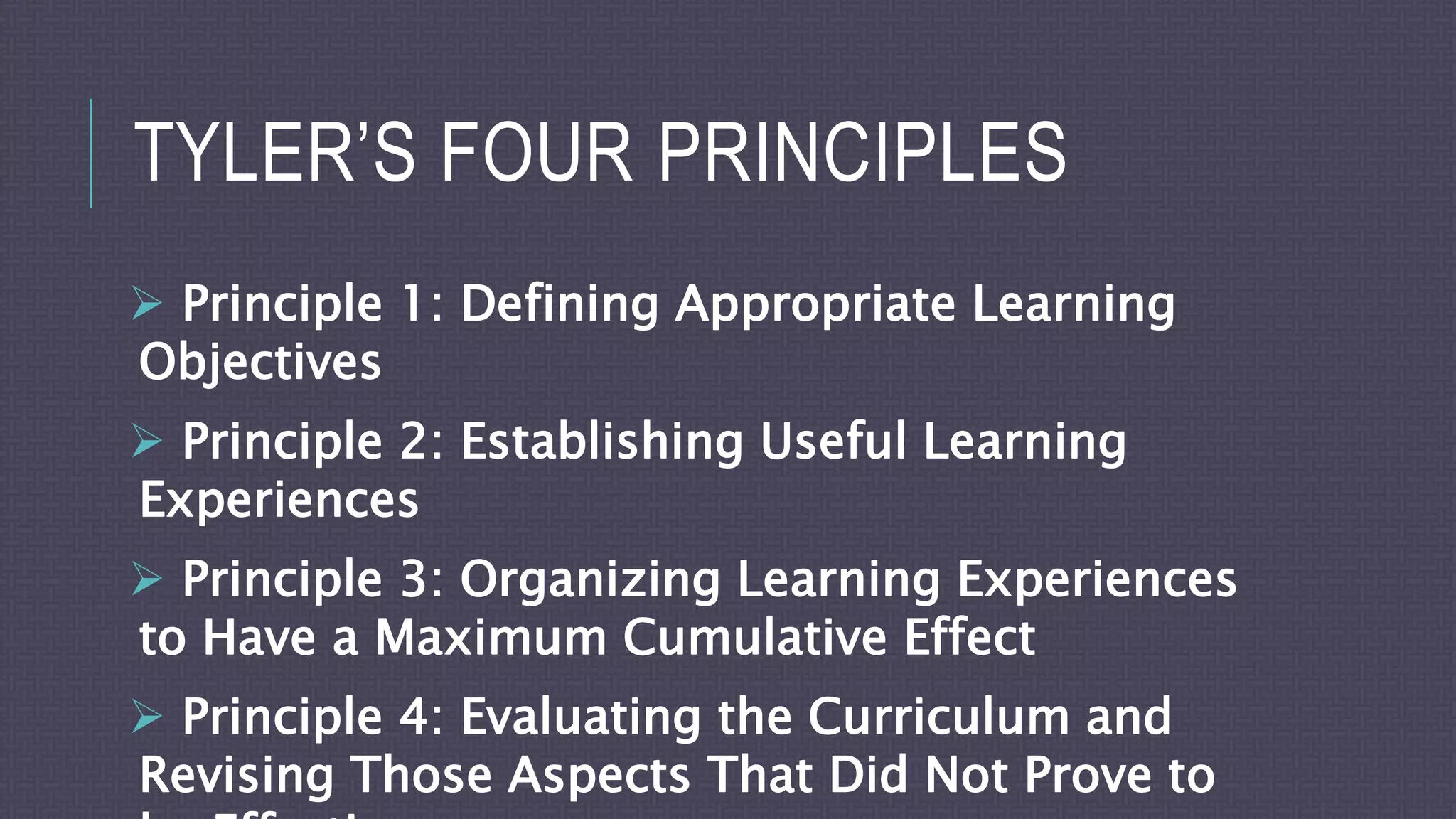
TYLER’S FOUR PRINCIPLES
 Principle 1: Defining Appropriate Learning
Objectives
 Principle 2: Establishing Useful Learning
Experiences
 Principle 3: Organizing Learning Experiences
to Have a Maximum Cumulative Effect
 Principle 4: Evaluating the Curriculum and
Revising Those Aspects That Did Not Prove to
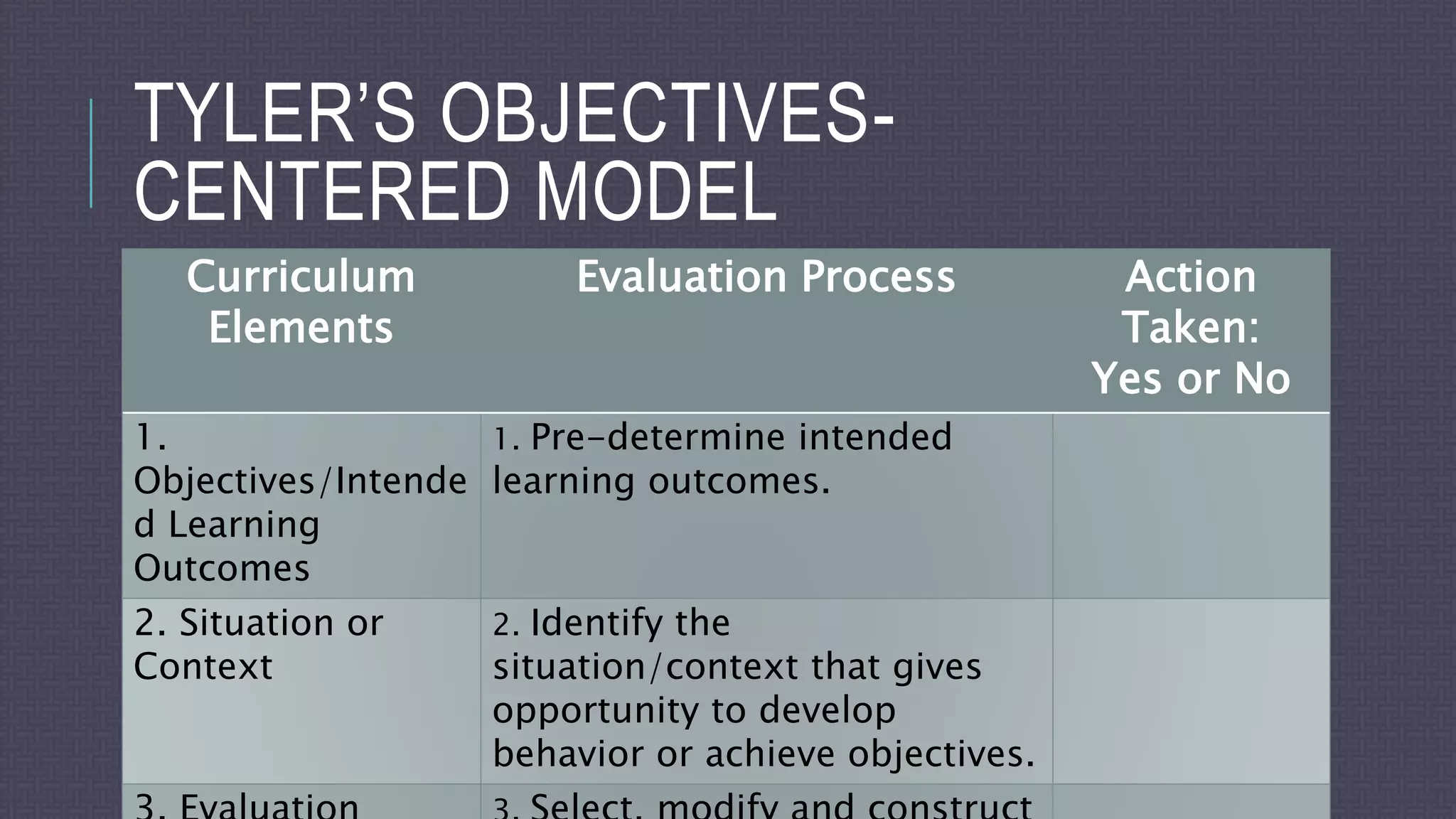
TYLER’S OBJECTIVES-
CENTERED MODEL
Curriculum
Elements
Evaluation Process Action
Taken:
Yes or No
1.
Objectives/Intende
d Learning
Outcomes
1. Pre-determine intended
learning outcomes.
2. Situation or
Context
2. Identify the
situation/context that gives
opportunity to develop
behavior or achieve objectives.
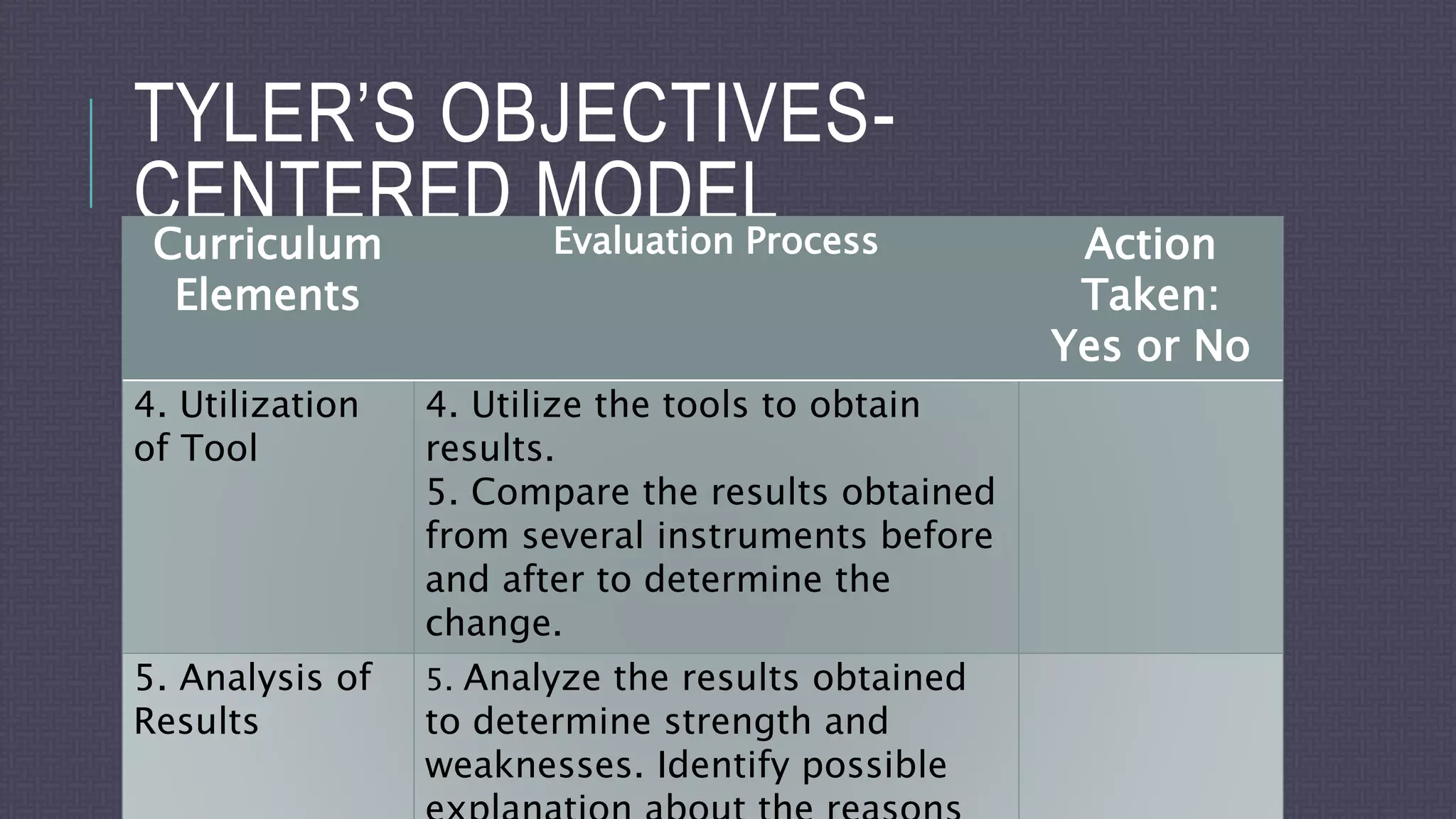
TYLER’S OBJECTIVES-
CENTERED MODELCurriculum
Elements
Evaluation Process Action
Taken:
Yes or No
4. Utilization
of Tool
4. Utilize the tools to obtain
results.
5. Compare the results obtained
from several instruments before
and after to determine the
change.
5. Analysis of
Results
5. Analyze the results obtained
to determine strength and
weaknesses. Identify possible
STRENGTHS OF TYLER’S MODEL
 clearly stated objectives a good
place to begin.
 involves the active participation of
the learner.
 Simple linear approach to
development of behavior of all
objectives
CRITICISM OF THE TYLER
MODEL:
 narrowly interpreted objectives (acceptable
verbs)
 difficult and time consuming construction of
behavioral objectives.
 curriculum restricted to a constricted range of
student skills and knowledge.
 critical thinking, problem solving and value
acquiring processes cannot be plainly declared
in behavioral objectives.

Ralph Tyler Objective Centered Model

  • 1.
    TYLER’S OBJECTIVES- CENTERED MODEL ANNEE. DANTES BSE III- PHYSICAL SCIENCE
  • 2.
    RALPH TYLER (1902-1994) “Father of Evaluation”  the educational impact of the works of Ralph Tyler cannot be estimated in the context of curriculum evaluation.  published more than 700 articles and sixteen books.  Tyler posits the problem with education is that educational programs lack unmistakably defined purposes (“Ralph Tyler’s Little Book, ”n d)
  • 3.
    RALPH TYLER  inhis book Tyler presented the concept that curriculum should be:  dynamic.  a program under constant evaluation and revision.
  • 4.
    THE TYLER’S OBJECTIVES- CENTEREDMODEL  one of the best known models for curriculum development.  known for the special attention it gives to the planning phases.  it is a deductive process.
  • 5.
    THE THREE ESSENTIAL ELEMENTS the learners  the life in the community, and  the subject matter
  • 6.
    TYLER’S FOUR PRINCIPLES Principle 1: Defining Appropriate Learning Objectives  Principle 2: Establishing Useful Learning Experiences  Principle 3: Organizing Learning Experiences to Have a Maximum Cumulative Effect  Principle 4: Evaluating the Curriculum and Revising Those Aspects That Did Not Prove to
  • 7.
    TYLER’S OBJECTIVES- CENTERED MODEL Curriculum Elements EvaluationProcess Action Taken: Yes or No 1. Objectives/Intende d Learning Outcomes 1. Pre-determine intended learning outcomes. 2. Situation or Context 2. Identify the situation/context that gives opportunity to develop behavior or achieve objectives.
  • 8.
    TYLER’S OBJECTIVES- CENTERED MODELCurriculum Elements EvaluationProcess Action Taken: Yes or No 4. Utilization of Tool 4. Utilize the tools to obtain results. 5. Compare the results obtained from several instruments before and after to determine the change. 5. Analysis of Results 5. Analyze the results obtained to determine strength and weaknesses. Identify possible
  • 9.
    STRENGTHS OF TYLER’SMODEL  clearly stated objectives a good place to begin.  involves the active participation of the learner.  Simple linear approach to development of behavior of all objectives
  • 10.
    CRITICISM OF THETYLER MODEL:  narrowly interpreted objectives (acceptable verbs)  difficult and time consuming construction of behavioral objectives.  curriculum restricted to a constricted range of student skills and knowledge.  critical thinking, problem solving and value acquiring processes cannot be plainly declared in behavioral objectives.

Editor's Notes

  • #3 Kaya sya tinawag na “Father of Evaluation” kasi sa dami nyang nagawa o natulong sa education evaluation at sa dahil sa sobra nyang nagawa madaming aklat ang naiugnay at binase sa gawa ni Ralph Tyler. Sa dami ngang nagawa ni Ralph Tyler sa curriculum evaluation hindi talaga mamaliitin ang gawa ni Tyler kasi nakatulong ang gawa ni Tyler sa ating curriculum. Sa aklat ni Tyler na Little Book ipinagpalagay nya na ang problema sa ating Educational Program ay maling pagbibigay o pagtatakda ng mga layunin.
  • #4 Dynamic because that the curriculum must be changeable if its not effective in our society. Like I say that the curriculum must be evaluate and revise because our society is change in what the needs or demand in our society. Curriculum had always been thought of as a static, set program, and in an era preoccupied with student testing, he offered the innovative idea that teachers and administrators should spend as much time evaluating their plans as they do assessing their students.
  • #5  one of the best known models for curriculum development.(kasi nakatulong ng Malaki ang ginawa ni Tylerna model na ito.) known for the special attention it gives to the planning phases. deductive for it proceeds from the general (examining the needs of society, for example) to the specific (specifying instructional objectives).
  • #6 Tyler recommends that curriculum planners identify general objectives by gathering data from three sources: the learners-dapat ang objectives ay the life in the community the subject matter
  • #7 Principle 1: Defining Appropriate Learning Objectives Studies of the Learners Themselves as a Source of Educational Objectives The progressive emphasizes the importance of studying the child to find out what kinds of interests he has, what problems he encounters, what purposes he has in mind. The progressive sees this information as providing the basic source for selecting objectives Studies of Contemporary Life outside the School The Use of Philosophy in Selecting Objectives The Use of a Psychology of Learning in Selecting Objectives Stating Objectives in a Form to be Helpful in Selecting Learning Experiences and in Guiding Teaching Principle 2: Establishing Useful Learning Experiences Meaning of the Term “Learning Experience” Tyler believes that students learn through exploration Like his mentor, John Dewey, Tyler believes teachers should encourage children to become actively engaged in discovering what the world is like General Principles in Selecting Learning Experiences Illustrations of the Characteristics of Learning Experiences Useful in Attaining Various Types of Objectives Principle 3: Organizing Learning Experiences to Have a Maximum Cumulative Effect What is meant by “Organization?” Central to Tyler’s Model is effectively organizing the learning activities Students need concrete experiences to which the readings are meaningfully connected Three major criteria are required in building organized learning experiences: continuity, sequence and integration Criteria for Effective Organization Elements to be organized Organizing Principles The Organizing Structure The Process of Planning a Unit of Organization Principle 4: Evaluating the Curriculum and Revising Those Aspects That Did Not Prove to be Effective (Keating, 2006) The Need for Evaluation The process of assessment is critical to Tyler’s Model and begins with the objectives of the educational program The process of evaluation is essentially the process of determining to what extent the educational objectives are actually being realized by the program of curriculum and instruction Basic Notions Regarding Evaluation Evaluation Procedures Using the Results of Evaluation Other Values and Uses of Evaluation Procedures
  • #8 Para malaman kung ano ang mga dapat baguhin at pagbutihin sa kinalabasan ng pagaaral ng mga students kung ito ay nakatulong sa kanila kung hindi doon na gagawa ng mga suggestions at feedbacks kung pano maipapabuti pa ang curriculum.