Curriculum Development Models By Dr.Kumuda Gurruao Advisor / Consultant to Hr.Edu / Corporate Sectors www.advisor2u.com
Why should we consider various models? To keep the educational system up-to-date with prevailing advancements in various subjects. To reduce the gap between actual output and required output. To adopt blended mode of education. To offer more meaningful education. To offer international standard so that credit transfers, student, faculty exchange program can take place.
When should you consider introducing new curriculum models? When the gap between existing and expected outcome is noticeable. Adoption of new advancements become essential to carry forward. A new methodology such as blended mode of education demands change of curriculum.
Curriculum defined as a Structured Series of Intended Learning Outcomes  Written Total Plan for Education of Learners for which Action to be taken. Domains of Curriculum consists of Curriculum Development  Curriculum Design
Curriculum Development Involves planning, implementation and evaluation of curriculum.  Constructing the curriculum.  A logical step-by-step procedure based on managerial or behavioral approaches to curriculum and rooted in  scientific principles of education.
Curriculum Design Refers to, how we conceptualize the curriculum and arrange its major components (subject matter content and learning experiences) to provide guidance and direction as one develops the curriculum.  Involved as a part of curriculum development.
Curriculum Model Curriculum Model  is defined as a plan of action that  can be employed to structure a subject or knowledge area from a theory into practice.
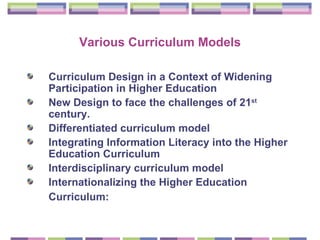
Various Curriculum Models Curriculum Design in a Context of Widening Participation in Higher Education   New Design to face the   challenges of   21 st  century. Differentiated curriculum model Integrating Information Literacy into the Higher Education Curriculum Interdisciplinary curriculum model Internationalizing the Higher Education Curriculum:
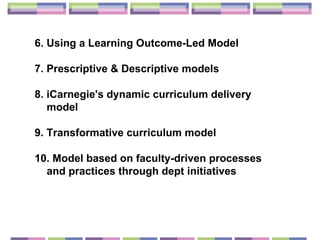
6. Using a Learning Outcome-Led  Model 7. Prescriptive & Descriptive models  8.  iCarnegie's dynamic curriculum delivery model  9.  Transformative curriculum model 10. Model based on  faculty-driven processes and practices through dept initiatives
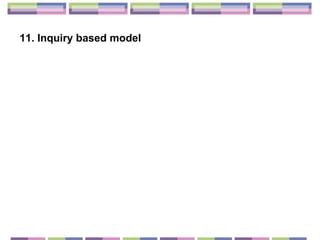
11. Inquiry based model
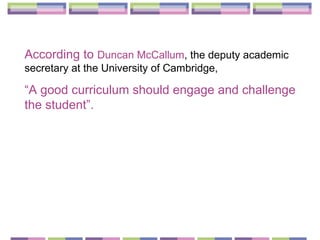
According to  Duncan McCallum , the deputy academic secretary at the University of Cambridge,  “ A good curriculum should engage and challenge the student”.
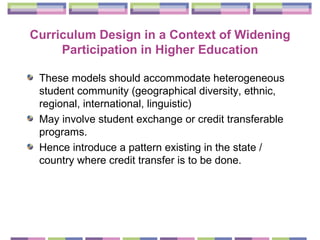
Curriculum Design in a Context of Widening Participation in Higher Education These models should accommodate heterogeneous student community (geographical diversity, ethnic, regional, international, linguistic) May involve student exchange or credit transferable programs. Hence introduce a pattern existing in the state / country where credit transfer is to be done.
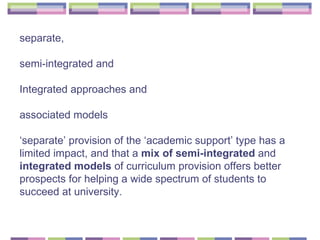
separate,  semi-integrated and  Integrated approaches and  associated models  ‘ separate’ provision of the ‘academic support’ type has a limited impact, and that a  mix of semi-integrated  and  integrated models  of curriculum provision offers better prospects for helping a wide spectrum of students to succeed at university.
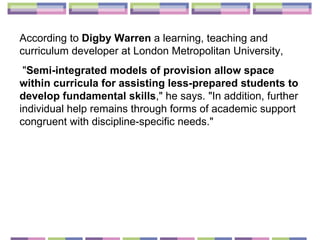
According to  Digby Warren  a learning, teaching and curriculum developer at London Metropolitan University, " Semi-integrated models of provision allow space within curricula for assisting less-prepared students to develop fundamental skills ," he says. "In addition, further individual help remains through forms of academic support congruent with discipline-specific needs."
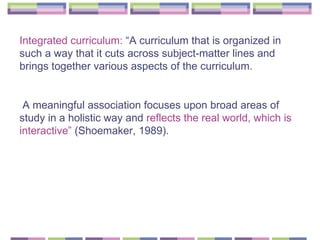
Integrated curriculum:  “A curriculum that is organized in such a way that it cuts across subject-matter lines and brings together various aspects of the curriculum. A meaningful association focuses upon broad areas of study in a holistic way and  reflects the real world, which is interactive”  (Shoemaker, 1989).
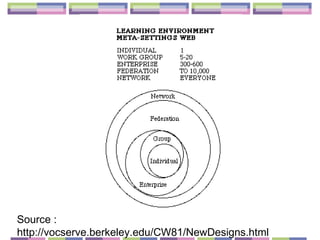
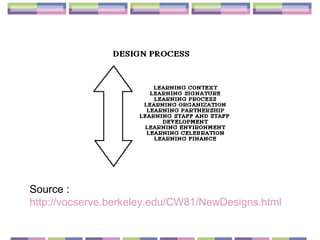
New Design to face the   challenges of   21 st  century. The new design should take into account Learning Environment Learning Process Learning Reward Design Process
Source :  http://vocserve.berkeley.edu/CW81/NewDesigns.html
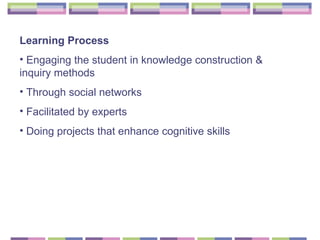
Learning Process   Engaging the student in knowledge construction & inquiry methods Through social networks Facilitated by experts Doing projects that enhance cognitive skills
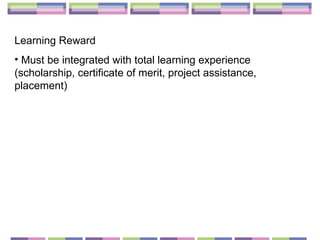
Learning Reward Must be integrated with total learning experience (scholarship, certificate of merit, project assistance, placement)
Source :  http://vocserve.berkeley.edu/CW81/NewDesigns.html
The Differentiated Curriculum model By monitoring of each student’s performance as they progress through the course content within a Learning Management System (LMS), enables  learning programs to be differentiated according to each student’s need . This approach is consistent with that of Lee (2005) where a  Diagnostic Tutorial Assessment System  (DTAS) and the  Intelligent Content Assessment Marking
(ICAM) System provided teachers with the facility to identify the strengths and weaknesses of students and automatically prompted component lessons for remediation in weak concepts.
Integrating Information Literacy into the Higher Education Curriculum Curriculum must be designed to include information literacy skills by means of assignments, project work, assessments, quiz, etc
Interdisciplinary curriculum model Terms associated with this model are:  ‘ interdisciplinary’, ‘pluridisciplinary’, ‘cross-disciplinary’, ‘transdisciplinary’ and ‘multidisciplinary’   Based on Melbourne model, stresses producing students with ‘depth’ as well as ‘breath’, so-called ‘T’ graduates   Introducing New Generation Degrees
Internationalizing the Higher Education Curriculum Can be implemented through Exchange programs (faculty & student) Partnership programs Rationale, purpose and status
Using a Learning Outcome-Led  Model The  learner is placed at the centre of the learning experience  which is defined as  incorporating  three domains :  the  teaching context;  the assessment régime;  and the directed learning   undertaken by students outside of taught sessions.
The model incorporates a  trichotomy of outcomes  which  define the subject -specific, the transferable skills and the generic academic outcomes which influence directly both the  content and process of learning , and  which successful students are expected to achieve on completion of a module.
Prescriptive & Descriptive models This is also known as  Ralph Tyler’s Objectives or Rational Planning Model. This curriculum model demands you to address following questions: What educational purposes should the school seek to attain?  What educational experiences are likely to attain the purposes?
How can these educational experiences be organised effectively?  How can we determine whether these purposes are being attained?
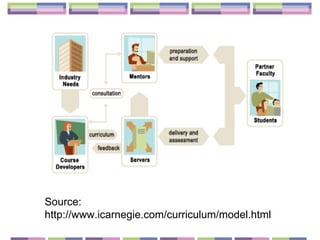
iCarnegie's dynamic curriculum delivery model iCarnegie delivers curriculum using an innovative " blended approach " that  couples web-based content and data collection  with the traditional classroom setting.
Source:  http://www.icarnegie.com/curriculum/model.html
Transformative curriculum model These type of models  not only inform, but also transform learners.  It is based on the research of  Mezirow (2000), Herbers (1988), Maslow (1971), and Habermas (1984).
Model based on  faculty-driven processes and practices through dept initiatives Assisting curriculum change through departmental initiatives.
Inquiry based model This model aims to develop the skills of  critical and creative thinking Hypothesis building  Informed decision-making problem-solving
Students are encouraged to become active investigators by  Identifying a range of information along with sources and checking for bias in it.  This would enable them to evaluate data and draw meaningful conclusions supported by evidence.
Things to be done after choosing curriculum model One should plan, develop, and assess curriculum products (content & learning experiences)
Various Approaches to Curriculum Development Behavioral  Managerial  Systems  Academic  Humanistic  Reconceptualist (understand, not just implement or evaluate, the curriculum)
Behavioral Viewpoint   Goals and objectives must be specified.  Content and activities must be sequenced based on objectives.  Learning outcomes must be evaluated based on goals and objectives
Managerial Viewpoint   Curriculum planned in terms of programs, schedules, space, resources.  Supervisory & administrative aspects are concerned.
Systems Viewpoint   Takes in to account  systems theory, systems analysis, and systems engineering (used mostly in business, government & military)
Academic Viewpoint   Related to broad aspects of schooling (discipline, values, extra-curricular) Humanistic Viewpoint Student centered
Reconceptualist Viewpoint   Focuses on larger ideological and moral issues of education  Views school as an extension of society
Curriculum Practioners   Successful  Curriculum Practioners  must be able to select and organize:  Goals and objectives  Content (subject matter)  Incorporate methods, materials, and media  Interactive & Engaging learning experiences and activities  Evaluation techniques
Thank You   By Dr.Kumuda Gurruao Advisor / Consultant to Hr.Edu / Corporate Sectors www.advisor2u.com

Curriculum Development Models

  • 1.
    Curriculum Development ModelsBy Dr.Kumuda Gurruao Advisor / Consultant to Hr.Edu / Corporate Sectors www.advisor2u.com
  • 2.
    Why should weconsider various models? To keep the educational system up-to-date with prevailing advancements in various subjects. To reduce the gap between actual output and required output. To adopt blended mode of education. To offer more meaningful education. To offer international standard so that credit transfers, student, faculty exchange program can take place.
  • 3.
    When should youconsider introducing new curriculum models? When the gap between existing and expected outcome is noticeable. Adoption of new advancements become essential to carry forward. A new methodology such as blended mode of education demands change of curriculum.
  • 4.
    Curriculum defined asa Structured Series of Intended Learning Outcomes Written Total Plan for Education of Learners for which Action to be taken. Domains of Curriculum consists of Curriculum Development Curriculum Design
  • 5.
    Curriculum Development Involvesplanning, implementation and evaluation of curriculum. Constructing the curriculum. A logical step-by-step procedure based on managerial or behavioral approaches to curriculum and rooted in scientific principles of education.
  • 6.
    Curriculum Design Refersto, how we conceptualize the curriculum and arrange its major components (subject matter content and learning experiences) to provide guidance and direction as one develops the curriculum. Involved as a part of curriculum development.
  • 7.
    Curriculum Model CurriculumModel is defined as a plan of action that can be employed to structure a subject or knowledge area from a theory into practice.
  • 8.
    Various Curriculum ModelsCurriculum Design in a Context of Widening Participation in Higher Education New Design to face the challenges of 21 st century. Differentiated curriculum model Integrating Information Literacy into the Higher Education Curriculum Interdisciplinary curriculum model Internationalizing the Higher Education Curriculum:
  • 9.
    6. Using aLearning Outcome-Led Model 7. Prescriptive & Descriptive models 8. iCarnegie's dynamic curriculum delivery model 9. Transformative curriculum model 10. Model based on faculty-driven processes and practices through dept initiatives
  • 10.
  • 11.
    According to Duncan McCallum , the deputy academic secretary at the University of Cambridge, “ A good curriculum should engage and challenge the student”.
  • 12.
    Curriculum Design ina Context of Widening Participation in Higher Education These models should accommodate heterogeneous student community (geographical diversity, ethnic, regional, international, linguistic) May involve student exchange or credit transferable programs. Hence introduce a pattern existing in the state / country where credit transfer is to be done.
  • 13.
    separate, semi-integratedand Integrated approaches and associated models ‘ separate’ provision of the ‘academic support’ type has a limited impact, and that a mix of semi-integrated and integrated models of curriculum provision offers better prospects for helping a wide spectrum of students to succeed at university.
  • 14.
    According to Digby Warren a learning, teaching and curriculum developer at London Metropolitan University, " Semi-integrated models of provision allow space within curricula for assisting less-prepared students to develop fundamental skills ," he says. "In addition, further individual help remains through forms of academic support congruent with discipline-specific needs."
  • 15.
    Integrated curriculum: “A curriculum that is organized in such a way that it cuts across subject-matter lines and brings together various aspects of the curriculum. A meaningful association focuses upon broad areas of study in a holistic way and reflects the real world, which is interactive” (Shoemaker, 1989).
  • 16.
    New Design toface the challenges of 21 st century. The new design should take into account Learning Environment Learning Process Learning Reward Design Process
  • 17.
    Source : http://vocserve.berkeley.edu/CW81/NewDesigns.html
  • 18.
    Learning Process Engaging the student in knowledge construction & inquiry methods Through social networks Facilitated by experts Doing projects that enhance cognitive skills
  • 19.
    Learning Reward Mustbe integrated with total learning experience (scholarship, certificate of merit, project assistance, placement)
  • 20.
    Source : http://vocserve.berkeley.edu/CW81/NewDesigns.html
  • 21.
    The Differentiated Curriculummodel By monitoring of each student’s performance as they progress through the course content within a Learning Management System (LMS), enables learning programs to be differentiated according to each student’s need . This approach is consistent with that of Lee (2005) where a Diagnostic Tutorial Assessment System (DTAS) and the Intelligent Content Assessment Marking
  • 22.
    (ICAM) System providedteachers with the facility to identify the strengths and weaknesses of students and automatically prompted component lessons for remediation in weak concepts.
  • 23.
    Integrating Information Literacyinto the Higher Education Curriculum Curriculum must be designed to include information literacy skills by means of assignments, project work, assessments, quiz, etc
  • 24.
    Interdisciplinary curriculum modelTerms associated with this model are: ‘ interdisciplinary’, ‘pluridisciplinary’, ‘cross-disciplinary’, ‘transdisciplinary’ and ‘multidisciplinary’ Based on Melbourne model, stresses producing students with ‘depth’ as well as ‘breath’, so-called ‘T’ graduates Introducing New Generation Degrees
  • 25.
    Internationalizing the HigherEducation Curriculum Can be implemented through Exchange programs (faculty & student) Partnership programs Rationale, purpose and status
  • 26.
    Using a LearningOutcome-Led Model The learner is placed at the centre of the learning experience which is defined as incorporating three domains : the teaching context; the assessment régime; and the directed learning undertaken by students outside of taught sessions.
  • 27.
    The model incorporatesa trichotomy of outcomes which define the subject -specific, the transferable skills and the generic academic outcomes which influence directly both the content and process of learning , and which successful students are expected to achieve on completion of a module.
  • 28.
    Prescriptive & Descriptivemodels This is also known as Ralph Tyler’s Objectives or Rational Planning Model. This curriculum model demands you to address following questions: What educational purposes should the school seek to attain? What educational experiences are likely to attain the purposes?
  • 29.
    How can theseeducational experiences be organised effectively? How can we determine whether these purposes are being attained?
  • 30.
    iCarnegie's dynamic curriculumdelivery model iCarnegie delivers curriculum using an innovative " blended approach " that couples web-based content and data collection with the traditional classroom setting.
  • 31.
  • 32.
    Transformative curriculum modelThese type of models not only inform, but also transform learners. It is based on the research of Mezirow (2000), Herbers (1988), Maslow (1971), and Habermas (1984).
  • 33.
    Model based on faculty-driven processes and practices through dept initiatives Assisting curriculum change through departmental initiatives.
  • 34.
    Inquiry based modelThis model aims to develop the skills of critical and creative thinking Hypothesis building Informed decision-making problem-solving
  • 35.
    Students are encouragedto become active investigators by Identifying a range of information along with sources and checking for bias in it. This would enable them to evaluate data and draw meaningful conclusions supported by evidence.
  • 36.
    Things to bedone after choosing curriculum model One should plan, develop, and assess curriculum products (content & learning experiences)
  • 37.
    Various Approaches toCurriculum Development Behavioral Managerial Systems Academic Humanistic Reconceptualist (understand, not just implement or evaluate, the curriculum)
  • 38.
    Behavioral Viewpoint Goals and objectives must be specified. Content and activities must be sequenced based on objectives. Learning outcomes must be evaluated based on goals and objectives
  • 39.
    Managerial Viewpoint Curriculum planned in terms of programs, schedules, space, resources. Supervisory & administrative aspects are concerned.
  • 40.
    Systems Viewpoint Takes in to account systems theory, systems analysis, and systems engineering (used mostly in business, government & military)
  • 41.
    Academic Viewpoint Related to broad aspects of schooling (discipline, values, extra-curricular) Humanistic Viewpoint Student centered
  • 42.
    Reconceptualist Viewpoint Focuses on larger ideological and moral issues of education Views school as an extension of society
  • 43.
    Curriculum Practioners Successful Curriculum Practioners must be able to select and organize: Goals and objectives Content (subject matter) Incorporate methods, materials, and media Interactive & Engaging learning experiences and activities Evaluation techniques
  • 44.
    Thank You By Dr.Kumuda Gurruao Advisor / Consultant to Hr.Edu / Corporate Sectors www.advisor2u.com