OBJECTIVE-
RELATED
PRINCIPLE IN
TEACHING
PRESENTED BY:
Group I
“Goals are our guiding star.
Focus Questions:
• What are objective-related principle and their
implications to teaching?
• What are the three domains of learning?
• How do we write good lesson objectives?
1. “Begin with the end mind”
• In the context of teaching, this means that we
must begin our lesson with clearly defined
lesson objective.
2. Share lesson objective with students.
• Like a seminar that begins with a statement
purpose, our lesson ought to begin with a
statement and clarification of our lesson
objective.
3. Lesson objectives must be in the two or
three domain – knowledge (cognitive), skill
(psychomotor) and values (affective)
• Our lesson maybe dominantly cognitive
psychomotor or affective.
• Dominantly cognitive - meant primarily for
knowledge acquisition and
• Dominantly psychomotor - intended for the
acquisition and honoring of skills.
• Affective domain - mainly focused on attitude
and value formation.
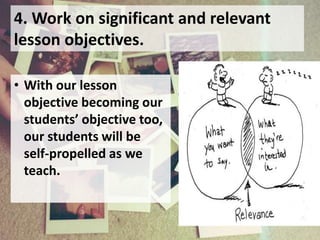
4. Work on significant and relevant
lesson objectives.
• With our lesson
objective becoming our
students’ objective too,
our students will be
self-propelled as we
teach.
5. Lesson objective must be aligned
with the aims of education as
embodied in the Philippine
Constitutions and on the vision-
mission statements of the educational
institution of which you are a part.
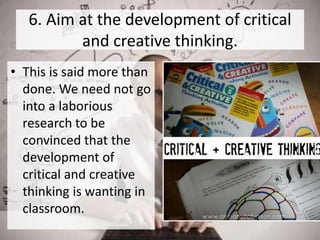
6. Aim at the development of critical
and creative thinking.
• This is said more than
done. We need not go
into a laborious
research to be
convinced that the
development of
critical and creative
thinking is wanting in
classroom.
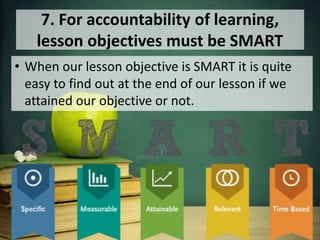
7. For accountability of learning,
lesson objectives must be SMART
• When our lesson objective is SMART it is quite
easy to find out at the end of our lesson if we
attained our objective or not.
TAXONOMY OF
TAXONOMY OF OBJECTIVES
With educational taxonomy, learning is
classified into three domains namely: (1)
cognitive, (2) affective, (3) psychomotor or
behavioral.
Bloom’s Taxonomy of Cognitive
Domain
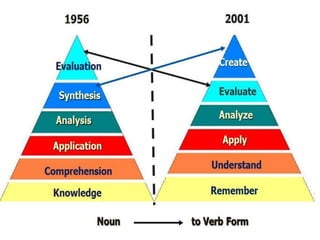
• Benjamin Bloom (1956) led his group in
coming up with the list of instructional
objectives in the cognitive domain.
Arranged from lowest to the highest
level, they are as follows:
• Knowledge or recall –
knowledge of
terminology and
conventions, trends and
sequences, classifications
and categories, criteria
and methodologies,
principles, theories, and
structures;
Comprehension – relate to translation,
interpretation, and extrapolation;
Application – use of abstraction in particular
situations;
Analysis – objectives relate to breaking a whole
into parts
Synthesis – putting parts together in a new form
such as a unique communication, a plan of
operation, and a set of abstract relations;
Evaluation – judging in terms of internal
evidence or logical consistency and external
evidence or consistency with facts developed
elsewhere;
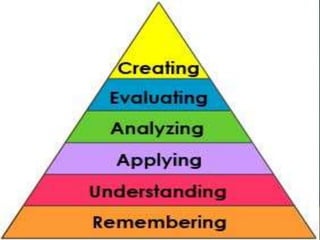
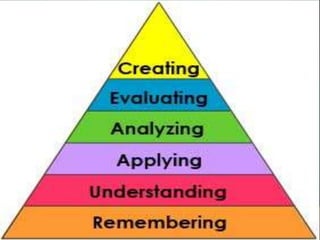
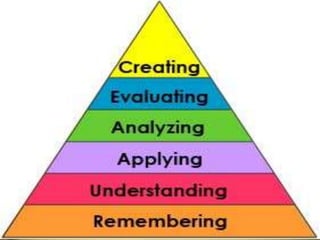
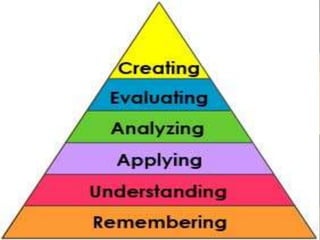
Anderson’s Taxonomy of Cognitive
Domain
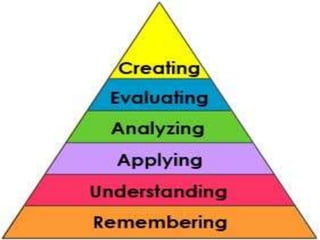
In the 1990’s, Anderson, Bloom’s former
student, together with a team of cognitive
psychologists revisited Bloom’s taxonomy in the
light of the 21st century skills. This led to
Anderson’s taxonomy in 2001.
Definition of Anderson’s Revised
Taxonomy
Definition Verbs
Remembering: Can the
student recall or
remember the
informatoion?
Define, duplicate, list
memorize, recall,
repeat, reproduce,
state
Definition of Anderson’s Revised
Taxonomy
Definition Verbs
Understanding: Can
the student explain
ideas or concept?
Classify, describe,
discuss, explain,
identify, locate,
recognize, report,
select, translate,
paraphrase
Definition of Anderson’s Revised
Taxonomy
Definition Verbs
Applying: Can the
student use the
information in a new
way?
Choose, demonstrate,
dramatize, employ,
illustrate interpret,
operate, schedule,
sketch, solve, use, write
Definition of Anderson’s Revised
Taxonomy
Definition Verbs
Analyzing: Can the
student distinguish
between the different
parts?
Appraise, compare,
contrast, criticize,
differentiate,
discriminate, distinguish,
examine, experiment,
question, test
Definition of Anderson’s Revised
Taxonomy
Definition Verbs
Evaluating: Can the
student justify a stand or
decision?
Appraise, argue, defend,
judge, select, support,
value, evaluate
Definition of Anderson’s Revised
Taxonomy
Definition Verbs
Evaluating: Can the
student create new
product or point of view?
Assemble, construct,
create, design, develop,
formulate, write
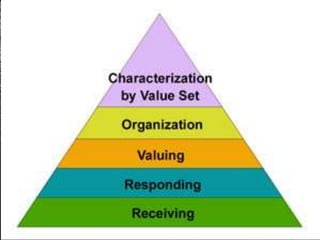
Krathwol’s Taxonomy of Affective
Domain
Krathwol’s affective learning is
demonstrated by behaviors indicating attitudes
of awareness, interest, and values of concern,
and responsibility, ability to listen and respond
in interactions with others, and ability to
demonstratethose attitudinal characteristics or
values which are appropriate to the test
situation and the field of study.
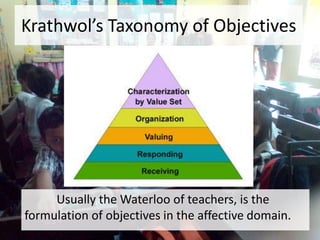
Krathwol’s Taxonomy of Objectives
Usually the Waterloo of teachers, is the
formulation of objectives in the affective domain.
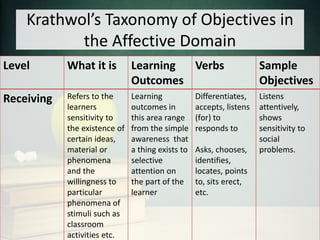
Krathwol’s Taxonomy of Objectives in
the Affective Domain
Level What it is Learning
Outcomes
Verbs Sample
Objectives
Receiving Refers to the
learners
sensitivity to
the existence of
certain ideas,
material or
phenomena
and the
willingness to
particular
phenomena of
stimuli such as
classroom
activities etc.
Learning
outcomes in
this area range
from the simple
awareness that
a thing exists to
selective
attention on
the part of the
learner
Differentiates,
accepts, listens
(for) to
responds to
Asks, chooses,
identifies,
locates, points
to, sits erect,
etc.
Listens
attentively,
shows
sensitivity to
social
problems.
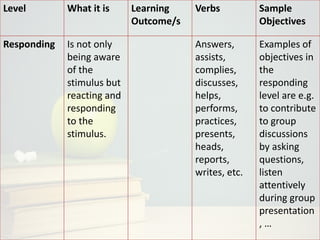
Level What it is Learning
Outcome/s
Verbs Sample
Objectives
Responding Is not only
being aware
of the
stimulus but
reacting and
responding
to the
stimulus.
Answers,
assists,
complies,
discusses,
helps,
performs,
practices,
presents,
heads,
reports,
writes, etc.
Examples of
objectives in
the
responding
level are e.g.
to contribute
to group
discussions
by asking
questions,
listen
attentively
during group
presentation
, …
Level What it is Learning
Outcome/s
Verbs Sample
Objectives
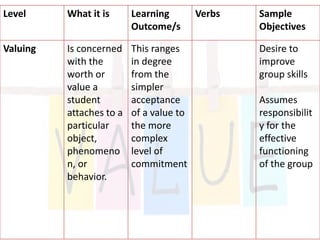
Valuing Is concerned
with the
worth or
value a
student
attaches to a
particular
object,
phenomeno
n, or
behavior.
This ranges
in degree
from the
simpler
acceptance
of a value to
the more
complex
level of
commitment
Desire to
improve
group skills
Assumes
responsibilit
y for the
effective
functioning
of the group
Level What it is Learning
Outcome/s
Verbs Sample
Objectives
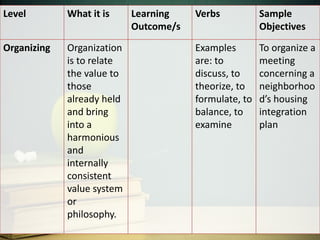
Organizing Organization
is to relate
the value to
those
already held
and bring
into a
harmonious
and
internally
consistent
value system
or
philosophy.
Examples
are: to
discuss, to
theorize, to
formulate, to
balance, to
examine
To organize a
meeting
concerning a
neighborhoo
d’s housing
integration
plan
Level What it is Learning
Outcome/s
Verbs Sample
Objectives
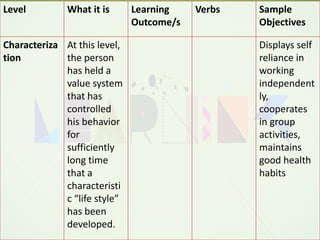
Characteriza
tion
At this level,
the person
has held a
value system
that has
controlled
his behavior
for
sufficiently
long time
that a
characteristi
c “life style”
has been
developed.
Displays self
reliance in
working
independent
ly,
cooperates
in group
activities,
maintains
good health
habits
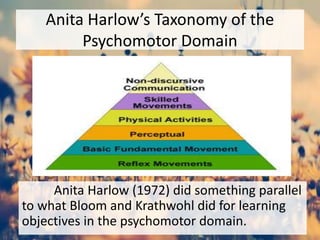
Anita Harlow’s Taxonomy of the
Psychomotor Domain
Anita Harlow (1972) did something parallel
to what Bloom and Krathwohl did for learning
objectives in the psychomotor domain.
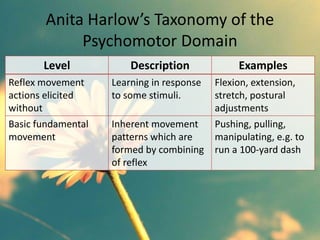
Anita Harlow’s Taxonomy of the
Psychomotor Domain
Level Description Examples
Reflex movement
actions elicited
without
Learning in response
to some stimuli.
Flexion, extension,
stretch, postural
adjustments
Basic fundamental
movement
Inherent movement
patterns which are
formed by combining
of reflex
Pushing, pulling,
manipulating, e.g. to
run a 100-yard dash
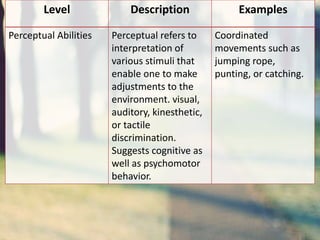
Level Description Examples
Perceptual Abilities Perceptual refers to
interpretation of
various stimuli that
enable one to make
adjustments to the
environment. visual,
auditory, kinesthetic,
or tactile
discrimination.
Suggests cognitive as
well as psychomotor
behavior.
Coordinated
movements such as
jumping rope,
punting, or catching.
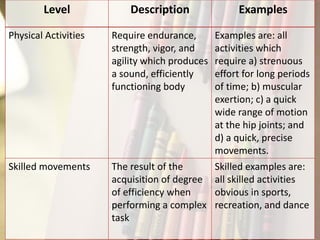
Level Description Examples
Physical Activities Require endurance,
strength, vigor, and
agility which produces
a sound, efficiently
functioning body
Examples are: all
activities which
require a) strenuous
effort for long periods
of time; b) muscular
exertion; c) a quick
wide range of motion
at the hip joints; and
d) a quick, precise
movements.
Skilled movements The result of the
acquisition of degree
of efficiency when
performing a complex
task
Skilled examples are:
all skilled activities
obvious in sports,
recreation, and dance
Level Description Examples
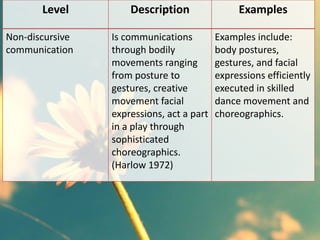
Non-discursive
communication
Is communications
through bodily
movements ranging
from posture to
gestures, creative
movement facial
expressions, act a part
in a play through
sophisticated
choreographics.
(Harlow 1972)
Examples include:
body postures,
gestures, and facial
expressions efficiently
executed in skilled
dance movement and
choreographics.
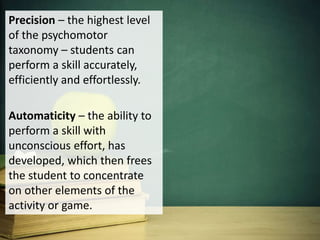
Precision – the highest level
of the psychomotor
taxonomy – students can
perform a skill accurately,
efficiently and effortlessly.
Automaticity – the ability to
perform a skill with
unconscious effort, has
developed, which then frees
the student to concentrate
on other elements of the
activity or game.
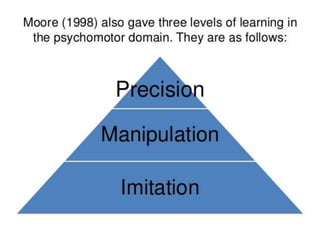
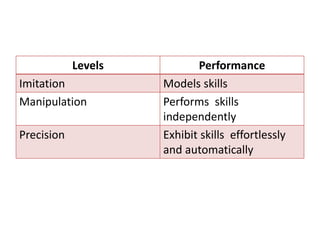
Levels Performance
Imitation Models skills
Manipulation Performs skills
independently
Precision Exhibit skills effortlessly
and automatically

Objective related principle in teaching

  • 1.
  • 2.
    “Goals are ourguiding star.
  • 3.
    Focus Questions: • Whatare objective-related principle and their implications to teaching? • What are the three domains of learning? • How do we write good lesson objectives?
  • 5.
    1. “Begin withthe end mind” • In the context of teaching, this means that we must begin our lesson with clearly defined lesson objective.
  • 6.
    2. Share lessonobjective with students. • Like a seminar that begins with a statement purpose, our lesson ought to begin with a statement and clarification of our lesson objective.
  • 7.
    3. Lesson objectivesmust be in the two or three domain – knowledge (cognitive), skill (psychomotor) and values (affective) • Our lesson maybe dominantly cognitive psychomotor or affective. • Dominantly cognitive - meant primarily for knowledge acquisition and • Dominantly psychomotor - intended for the acquisition and honoring of skills. • Affective domain - mainly focused on attitude and value formation.
  • 8.
    4. Work onsignificant and relevant lesson objectives. • With our lesson objective becoming our students’ objective too, our students will be self-propelled as we teach.
  • 9.
    5. Lesson objectivemust be aligned with the aims of education as embodied in the Philippine Constitutions and on the vision- mission statements of the educational institution of which you are a part.
  • 10.
    6. Aim atthe development of critical and creative thinking. • This is said more than done. We need not go into a laborious research to be convinced that the development of critical and creative thinking is wanting in classroom.
  • 11.
    7. For accountabilityof learning, lesson objectives must be SMART • When our lesson objective is SMART it is quite easy to find out at the end of our lesson if we attained our objective or not.
  • 12.
  • 13.
    TAXONOMY OF OBJECTIVES Witheducational taxonomy, learning is classified into three domains namely: (1) cognitive, (2) affective, (3) psychomotor or behavioral.
  • 14.
    Bloom’s Taxonomy ofCognitive Domain • Benjamin Bloom (1956) led his group in coming up with the list of instructional objectives in the cognitive domain.
  • 15.
    Arranged from lowestto the highest level, they are as follows: • Knowledge or recall – knowledge of terminology and conventions, trends and sequences, classifications and categories, criteria and methodologies, principles, theories, and structures;
  • 16.
    Comprehension – relateto translation, interpretation, and extrapolation;
  • 17.
    Application – useof abstraction in particular situations;
  • 18.
    Analysis – objectivesrelate to breaking a whole into parts
  • 19.
    Synthesis – puttingparts together in a new form such as a unique communication, a plan of operation, and a set of abstract relations;
  • 20.
    Evaluation – judgingin terms of internal evidence or logical consistency and external evidence or consistency with facts developed elsewhere;
  • 22.
    Anderson’s Taxonomy ofCognitive Domain In the 1990’s, Anderson, Bloom’s former student, together with a team of cognitive psychologists revisited Bloom’s taxonomy in the light of the 21st century skills. This led to Anderson’s taxonomy in 2001.
  • 23.
    Definition of Anderson’sRevised Taxonomy Definition Verbs Remembering: Can the student recall or remember the informatoion? Define, duplicate, list memorize, recall, repeat, reproduce, state
  • 24.
    Definition of Anderson’sRevised Taxonomy Definition Verbs Understanding: Can the student explain ideas or concept? Classify, describe, discuss, explain, identify, locate, recognize, report, select, translate, paraphrase
  • 25.
    Definition of Anderson’sRevised Taxonomy Definition Verbs Applying: Can the student use the information in a new way? Choose, demonstrate, dramatize, employ, illustrate interpret, operate, schedule, sketch, solve, use, write
  • 26.
    Definition of Anderson’sRevised Taxonomy Definition Verbs Analyzing: Can the student distinguish between the different parts? Appraise, compare, contrast, criticize, differentiate, discriminate, distinguish, examine, experiment, question, test
  • 27.
    Definition of Anderson’sRevised Taxonomy Definition Verbs Evaluating: Can the student justify a stand or decision? Appraise, argue, defend, judge, select, support, value, evaluate
  • 28.
    Definition of Anderson’sRevised Taxonomy Definition Verbs Evaluating: Can the student create new product or point of view? Assemble, construct, create, design, develop, formulate, write
  • 29.
    Krathwol’s Taxonomy ofAffective Domain Krathwol’s affective learning is demonstrated by behaviors indicating attitudes of awareness, interest, and values of concern, and responsibility, ability to listen and respond in interactions with others, and ability to demonstratethose attitudinal characteristics or values which are appropriate to the test situation and the field of study.
  • 30.
    Krathwol’s Taxonomy ofObjectives Usually the Waterloo of teachers, is the formulation of objectives in the affective domain.
  • 31.
    Krathwol’s Taxonomy ofObjectives in the Affective Domain Level What it is Learning Outcomes Verbs Sample Objectives Receiving Refers to the learners sensitivity to the existence of certain ideas, material or phenomena and the willingness to particular phenomena of stimuli such as classroom activities etc. Learning outcomes in this area range from the simple awareness that a thing exists to selective attention on the part of the learner Differentiates, accepts, listens (for) to responds to Asks, chooses, identifies, locates, points to, sits erect, etc. Listens attentively, shows sensitivity to social problems.
  • 32.
    Level What itis Learning Outcome/s Verbs Sample Objectives Responding Is not only being aware of the stimulus but reacting and responding to the stimulus. Answers, assists, complies, discusses, helps, performs, practices, presents, heads, reports, writes, etc. Examples of objectives in the responding level are e.g. to contribute to group discussions by asking questions, listen attentively during group presentation , …
  • 33.
    Level What itis Learning Outcome/s Verbs Sample Objectives Valuing Is concerned with the worth or value a student attaches to a particular object, phenomeno n, or behavior. This ranges in degree from the simpler acceptance of a value to the more complex level of commitment Desire to improve group skills Assumes responsibilit y for the effective functioning of the group
  • 34.
    Level What itis Learning Outcome/s Verbs Sample Objectives Organizing Organization is to relate the value to those already held and bring into a harmonious and internally consistent value system or philosophy. Examples are: to discuss, to theorize, to formulate, to balance, to examine To organize a meeting concerning a neighborhoo d’s housing integration plan
  • 35.
    Level What itis Learning Outcome/s Verbs Sample Objectives Characteriza tion At this level, the person has held a value system that has controlled his behavior for sufficiently long time that a characteristi c “life style” has been developed. Displays self reliance in working independent ly, cooperates in group activities, maintains good health habits
  • 36.
    Anita Harlow’s Taxonomyof the Psychomotor Domain Anita Harlow (1972) did something parallel to what Bloom and Krathwohl did for learning objectives in the psychomotor domain.
  • 37.
    Anita Harlow’s Taxonomyof the Psychomotor Domain Level Description Examples Reflex movement actions elicited without Learning in response to some stimuli. Flexion, extension, stretch, postural adjustments Basic fundamental movement Inherent movement patterns which are formed by combining of reflex Pushing, pulling, manipulating, e.g. to run a 100-yard dash
  • 38.
    Level Description Examples PerceptualAbilities Perceptual refers to interpretation of various stimuli that enable one to make adjustments to the environment. visual, auditory, kinesthetic, or tactile discrimination. Suggests cognitive as well as psychomotor behavior. Coordinated movements such as jumping rope, punting, or catching.
  • 39.
    Level Description Examples PhysicalActivities Require endurance, strength, vigor, and agility which produces a sound, efficiently functioning body Examples are: all activities which require a) strenuous effort for long periods of time; b) muscular exertion; c) a quick wide range of motion at the hip joints; and d) a quick, precise movements. Skilled movements The result of the acquisition of degree of efficiency when performing a complex task Skilled examples are: all skilled activities obvious in sports, recreation, and dance
  • 40.
    Level Description Examples Non-discursive communication Iscommunications through bodily movements ranging from posture to gestures, creative movement facial expressions, act a part in a play through sophisticated choreographics. (Harlow 1972) Examples include: body postures, gestures, and facial expressions efficiently executed in skilled dance movement and choreographics.
  • 43.
    Precision – thehighest level of the psychomotor taxonomy – students can perform a skill accurately, efficiently and effortlessly. Automaticity – the ability to perform a skill with unconscious effort, has developed, which then frees the student to concentrate on other elements of the activity or game.
  • 45.
    Levels Performance Imitation Modelsskills Manipulation Performs skills independently Precision Exhibit skills effortlessly and automatically