Abdominal Injuries
First Aid and Treatment Options
Anas Bahnassi PhD
6
Anas Bahnassi PhD CDM CDE 2
Introduction:
3Anas Bahnassi PhD CDM CDE
Anatomy and major abdominal trauma
Blunt abdominal trauma may push the abdominal content upward and
cause rupture of the diaphragm.
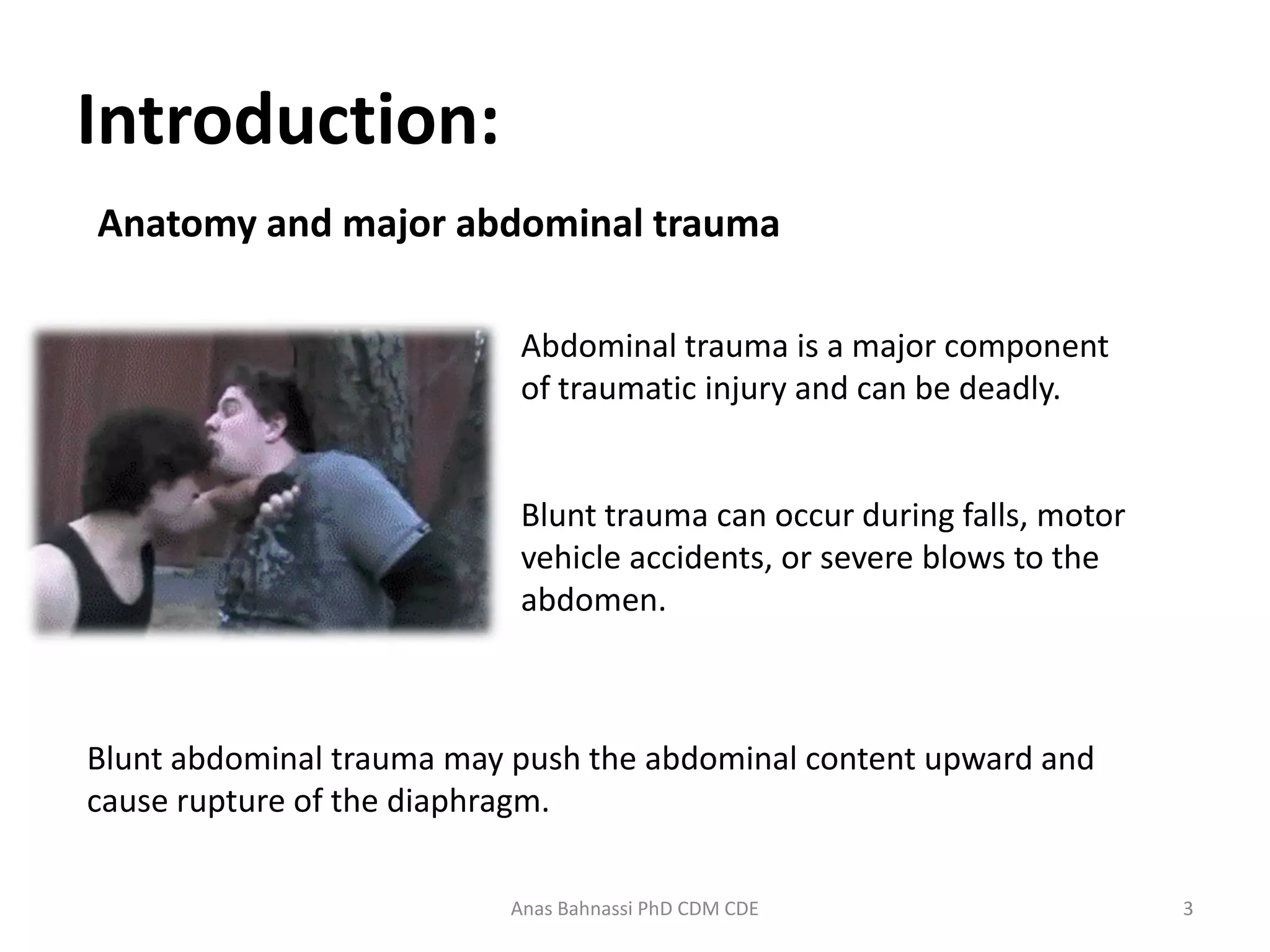
Abdominal trauma is a major component
of traumatic injury and can be deadly.
Blunt trauma can occur during falls, motor
vehicle accidents, or severe blows to the
abdomen.
Introduction:
4Anas Bahnassi PhD CDM CDE
Physiology review
• The liver is a vascular solid organ
in the right upper quadrant,
protected by the lower ribs, than
may be lacerated by blunt trauma.
• The resultant bleeding can be
massive.
Gallbladder injury is unusual but may release bile into the abdominal
cavity causing a severe peritoneal reaction.
Introduction:
5Anas Bahnassi PhD CDM CDE
Physiology review
• The spleen is a highly vascular
organ located behind the stomach
and protected by the lower ribs on
the left side of the body.
• The spleen is the most commonly
injured organ in blunt abdominal
trauma and it can bleed profusely
when injured.
Fractures of lower ribs on the left side along with hypotension should
raise suspicion of spleen injury.
Introduction:
6Anas Bahnassi PhD CDM CDE
Physiology review
Abdominal injuries can significantly delay
intestinal emptying.
Bowels rupture is most frequently
associated to penetrating injuries.
Injuries that break bowel wall spill the
intestinal contents into the peritoneal cavity
causing peritoneal irritation with diffuse
abdominal pain, tenderness and ilus as the
commonest findings
Introduction:
7Anas Bahnassi PhD CDM CDE
Physiology review
The urinary bladder is vulnerable to injury
when the pelvis is fractured.
The pancreas, duodenum, kidneys, ureters,
aorta and inferior cava are retroperitoneal
structures. Injuries to them are difficult to
detect for retroperitoneal bleeding does
produce neither abdominal distension nor
peritoneal reaction.
The pancreas. Seriously injury to the pancreas is
not common in accidents. Damage can be seen in
cases of kicking injuries, abdominal gunshot
wounds. When injured can bleed profusely and
release digestive juices into the abdomen
Types of Abdominal Trauma
Anas Bahnassi PhD CDM CDE 8
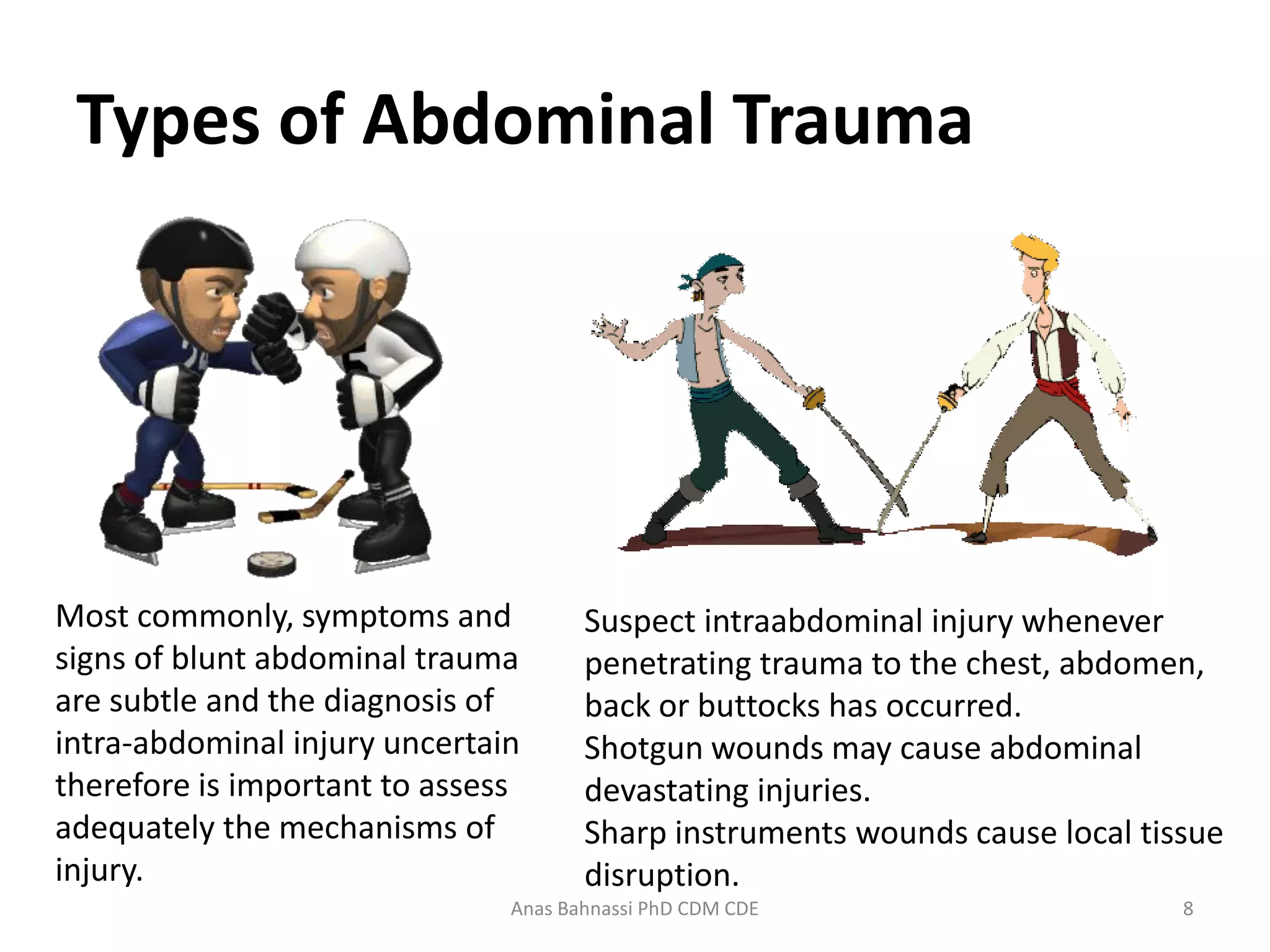
Most commonly, symptoms and
signs of blunt abdominal trauma
are subtle and the diagnosis of
intra-abdominal injury uncertain
therefore is important to assess
adequately the mechanisms of
injury.
Suspect intraabdominal injury whenever
penetrating trauma to the chest, abdomen,
back or buttocks has occurred.
Shotgun wounds may cause abdominal
devastating injuries.
Sharp instruments wounds cause local tissue
disruption.
Primary Survey
• Airway
– Ensure an adequate airway since vomiting may compromised the
airway in abdominal trauma. (See indications for endotracheal
intubation).
• Breathing
– Auscultate the chest for breath sounds. Impairment of breathing and
presence of bowel sounds may indicate rupture of the diaphragm.
– If there is an inadequate oxygenation, oxygen should be delivered at a
high flow rate.
– If adequate ventilation or oxygenation cannot be provided by other
means, bag-mask ventilation followed by pharyngeal or
tracheal intubation should be used.
Anas Bahnassi PhD CDM CDE 9
Primary Survey
• Circulation
– Look for signs of hypotension or shock.
– Hypotension and left upper quadrant trauma is suggestive of ruptured
spleen.
– Maintain a high index of suspicion for intra-abdominal or
retroperitoneal bleeding if the patient has unexplained hypotension or
shock. This is an indication for peritoneal lavage, exploratory
laparatomy or focused abdominal sonography for trauma. Computed
tomography is only recommended for the evaluation of
hemodynamically stable patients.
– Begin treatment for hypotension or shock if present.
Anas Bahnassi PhD CDM CDE 10
Primary Survey
• Disability
– Assess the level of responsiveness with the AVPU scale
– Check pupil size and reflection to light.
• Exposure/Monitoring
– Undress the patient for further examination.
– Monitor BP, HR, EGC, temperature, etc…
– Obtain arterial blood gases to evaluate the adequacy of ventilatory
function and the severity of tissue perfusion.
– Perform frequent monitoring of vital signs.
Anas Bahnassi PhD CDM CDE 11
Secondary Survey
• Perform a detailed head to toe survey and obtain as detail a
medical history of the patient as possible.
• Chest:
Anas Bahnassi PhD CDM CDE 12
Check for broken ribs than may
indicate abdominal organs
injury.
Fractures of the 7th -9th ribs on
the right or the left side may be
associated to liver injury or
spleen injury.
Secondary Survey
• Abdomen
– Altered level of consciousness due to
trauma
– intoxicated patients
confounding factors in the accuracy of
abdominal assessment.
Anas Bahnassi PhD CDM CDE 13
Secondary Survey
• Abdomen
– Levels of abdominal pain and reaction to
palpation are unreliable (often masked by
other major injuries.)
– Peritoneal irritation signs produced by
blood loss or spillage of bowel content
may not develop for one to four hours.
– Distention is a late and unreliable sing.
– Bruises may take several hours to
develop.
Anas Bahnassi PhD CDM CDE 14
Secondary Survey
• Abdomen
– Fractures of the lower ribs, vertebral
fractures, transverse process
fractures are often associated
with renal injuries.
– Renal vessel lacerations may cause
intensive blood loss into the
retroperitoneal space.
– Major renal trauma causes gross
hematuria.
Anas Bahnassi PhD CDM CDE 15
Secondary Survey
• Abdomen
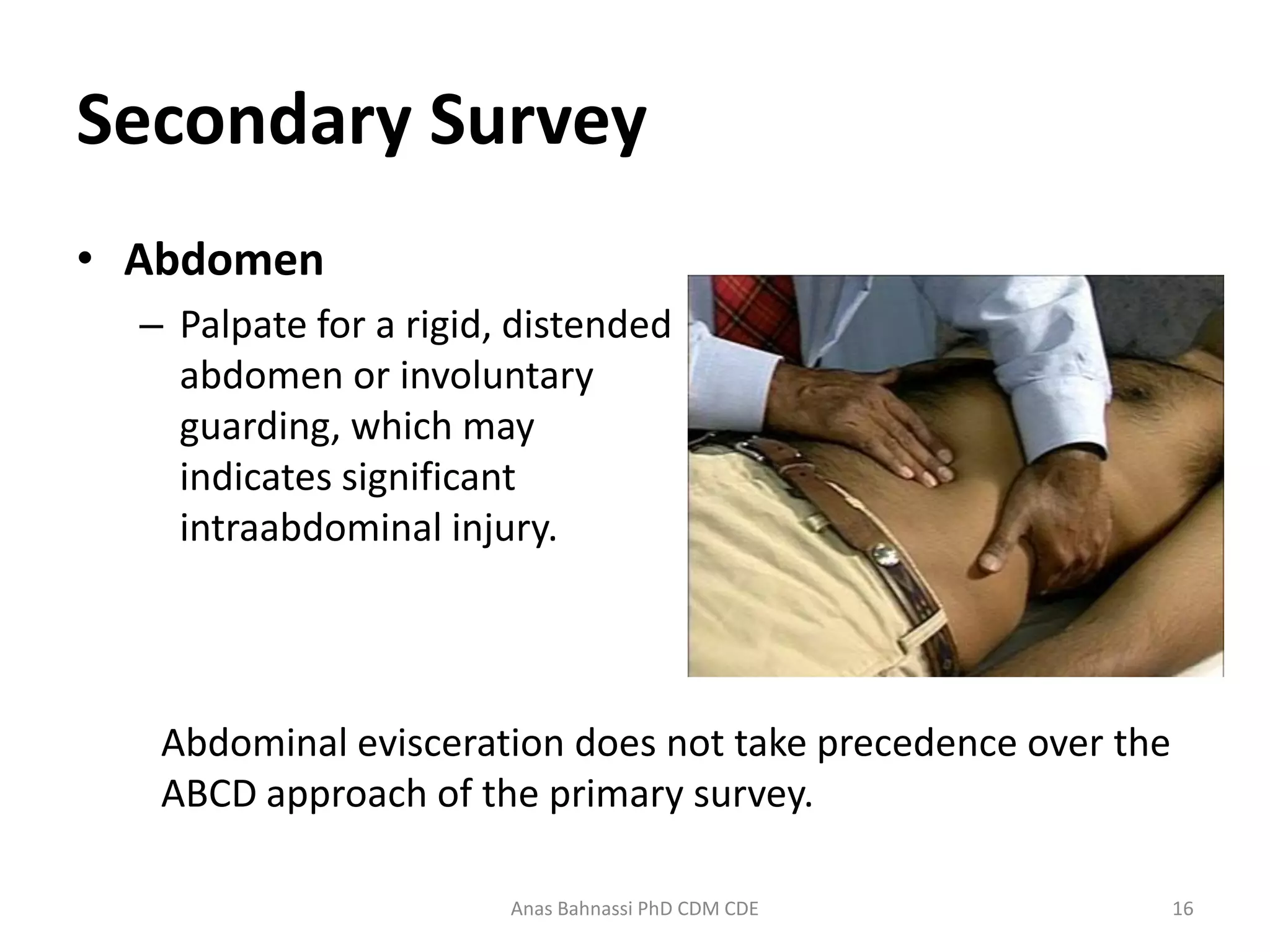
– Palpate for a rigid, distended
abdomen or involuntary
guarding, which may
indicates significant
intraabdominal injury.
Anas Bahnassi PhD CDM CDE 16
Abdominal evisceration does not take precedence over the
ABCD approach of the primary survey.
Management
• Cover any exposed abdominal viscera with
sterile saline-soaked packs do not attempt to
reduce the viscera into the abdomen
• Do not remove any impaled foreign matter.
Stabilize impaled objects with bulky dressings
that are bandaged in place.
• Assess the pelvis for associated fractures by
pressing over the anterior iliac crest to detect
instability.
Anas Bahnassi PhD CDM CDE 17
Pelvis Fracture
• A fractured pelvis may produce a blood loss up to
3 L
• Examine the anus and vagina to confirm their
integrity. Rectal bleeding may be suggestive of
trauma to the colon. Pelvic fractures may disrupt
the vaginal wall.
• Look for lacerations, haematoma, active bleeding,
scrotal contusions or haematomas than may
indicate testicular rupture.
• Look for associated urinary bladder or urethral
injury.
Anas Bahnassi PhD CDM CDE 18
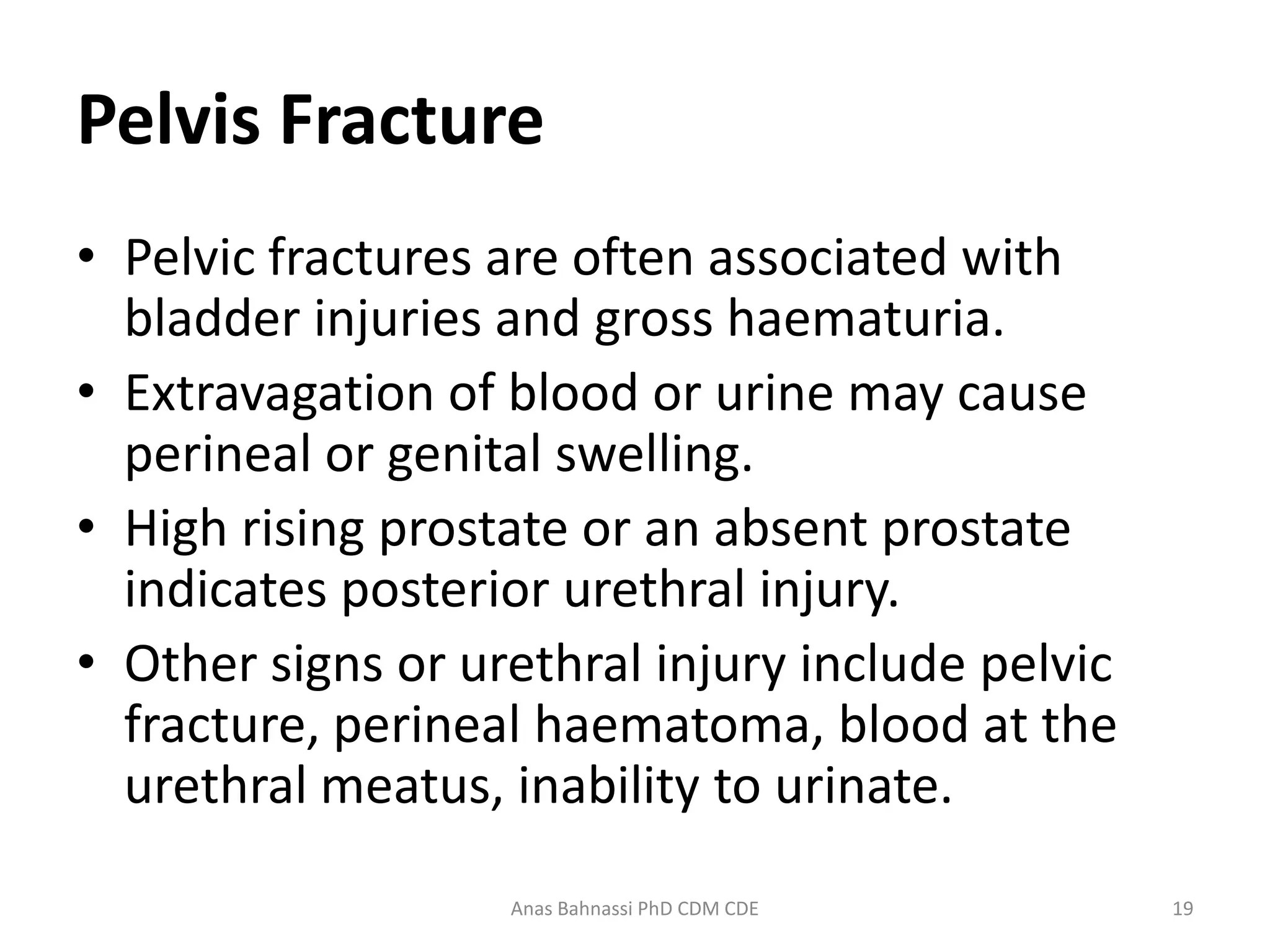
Pelvis Fracture
• Pelvic fractures are often associated with
bladder injuries and gross haematuria.
• Extravagation of blood or urine may cause
perineal or genital swelling.
• High rising prostate or an absent prostate
indicates posterior urethral injury.
• Other signs or urethral injury include pelvic
fracture, perineal haematoma, blood at the
urethral meatus, inability to urinate.
Anas Bahnassi PhD CDM CDE 19
Pelvis Fracture – Management.
• Fluid resuscitation
• Determine if open or closed fracture
• Determine associated perineal /GU injuries
• Determine need for transfer
• Splint pelvic fracture
Anas Bahnassi PhD CDM CDE 20
Pelvis Fracture – Management.
Anas Bahnassi PhD CDM CDE 21
Management
• Extremities
– Liver or spleen injury may cause referred right
shoulder pain or referred left shoulder pain
respectively that may be enhanced by
Trendelenburg position.
Anas Bahnassi PhD CDM CDE 22
Management
• Other Considerations
– Insert a nasogastric tube to drain and decompress
the stomach.
– Insert a urinary catheter to monitor urine output if
no contraindications exist (meatal bleeding,
scrotal haematoma or prostate malposition)
Anas Bahnassi PhD CDM CDE 23
Clinical Pharmacy VI:
First Aid
abahnassi@gmail.com
http://www.twitter.com/abpharm
http://www.facebook.com/pharmaprof
http://www.linkedin.com/in/abahnassi
Anas Bahnassi PhD CDM CDE

Lecture six abdominal injuries

  • 1.
    Abdominal Injuries First Aidand Treatment Options Anas Bahnassi PhD 6
  • 2.
  • 3.
    Introduction: 3Anas Bahnassi PhDCDM CDE Anatomy and major abdominal trauma Blunt abdominal trauma may push the abdominal content upward and cause rupture of the diaphragm. Abdominal trauma is a major component of traumatic injury and can be deadly. Blunt trauma can occur during falls, motor vehicle accidents, or severe blows to the abdomen.
  • 4.
    Introduction: 4Anas Bahnassi PhDCDM CDE Physiology review • The liver is a vascular solid organ in the right upper quadrant, protected by the lower ribs, than may be lacerated by blunt trauma. • The resultant bleeding can be massive. Gallbladder injury is unusual but may release bile into the abdominal cavity causing a severe peritoneal reaction.
  • 5.
    Introduction: 5Anas Bahnassi PhDCDM CDE Physiology review • The spleen is a highly vascular organ located behind the stomach and protected by the lower ribs on the left side of the body. • The spleen is the most commonly injured organ in blunt abdominal trauma and it can bleed profusely when injured. Fractures of lower ribs on the left side along with hypotension should raise suspicion of spleen injury.
  • 6.
    Introduction: 6Anas Bahnassi PhDCDM CDE Physiology review Abdominal injuries can significantly delay intestinal emptying. Bowels rupture is most frequently associated to penetrating injuries. Injuries that break bowel wall spill the intestinal contents into the peritoneal cavity causing peritoneal irritation with diffuse abdominal pain, tenderness and ilus as the commonest findings
  • 7.
    Introduction: 7Anas Bahnassi PhDCDM CDE Physiology review The urinary bladder is vulnerable to injury when the pelvis is fractured. The pancreas, duodenum, kidneys, ureters, aorta and inferior cava are retroperitoneal structures. Injuries to them are difficult to detect for retroperitoneal bleeding does produce neither abdominal distension nor peritoneal reaction. The pancreas. Seriously injury to the pancreas is not common in accidents. Damage can be seen in cases of kicking injuries, abdominal gunshot wounds. When injured can bleed profusely and release digestive juices into the abdomen
  • 8.
    Types of AbdominalTrauma Anas Bahnassi PhD CDM CDE 8 Most commonly, symptoms and signs of blunt abdominal trauma are subtle and the diagnosis of intra-abdominal injury uncertain therefore is important to assess adequately the mechanisms of injury. Suspect intraabdominal injury whenever penetrating trauma to the chest, abdomen, back or buttocks has occurred. Shotgun wounds may cause abdominal devastating injuries. Sharp instruments wounds cause local tissue disruption.
  • 9.
    Primary Survey • Airway –Ensure an adequate airway since vomiting may compromised the airway in abdominal trauma. (See indications for endotracheal intubation). • Breathing – Auscultate the chest for breath sounds. Impairment of breathing and presence of bowel sounds may indicate rupture of the diaphragm. – If there is an inadequate oxygenation, oxygen should be delivered at a high flow rate. – If adequate ventilation or oxygenation cannot be provided by other means, bag-mask ventilation followed by pharyngeal or tracheal intubation should be used. Anas Bahnassi PhD CDM CDE 9
  • 10.
    Primary Survey • Circulation –Look for signs of hypotension or shock. – Hypotension and left upper quadrant trauma is suggestive of ruptured spleen. – Maintain a high index of suspicion for intra-abdominal or retroperitoneal bleeding if the patient has unexplained hypotension or shock. This is an indication for peritoneal lavage, exploratory laparatomy or focused abdominal sonography for trauma. Computed tomography is only recommended for the evaluation of hemodynamically stable patients. – Begin treatment for hypotension or shock if present. Anas Bahnassi PhD CDM CDE 10
  • 11.
    Primary Survey • Disability –Assess the level of responsiveness with the AVPU scale – Check pupil size and reflection to light. • Exposure/Monitoring – Undress the patient for further examination. – Monitor BP, HR, EGC, temperature, etc… – Obtain arterial blood gases to evaluate the adequacy of ventilatory function and the severity of tissue perfusion. – Perform frequent monitoring of vital signs. Anas Bahnassi PhD CDM CDE 11
  • 12.
    Secondary Survey • Performa detailed head to toe survey and obtain as detail a medical history of the patient as possible. • Chest: Anas Bahnassi PhD CDM CDE 12 Check for broken ribs than may indicate abdominal organs injury. Fractures of the 7th -9th ribs on the right or the left side may be associated to liver injury or spleen injury.
  • 13.
    Secondary Survey • Abdomen –Altered level of consciousness due to trauma – intoxicated patients confounding factors in the accuracy of abdominal assessment. Anas Bahnassi PhD CDM CDE 13
  • 14.
    Secondary Survey • Abdomen –Levels of abdominal pain and reaction to palpation are unreliable (often masked by other major injuries.) – Peritoneal irritation signs produced by blood loss or spillage of bowel content may not develop for one to four hours. – Distention is a late and unreliable sing. – Bruises may take several hours to develop. Anas Bahnassi PhD CDM CDE 14
  • 15.
    Secondary Survey • Abdomen –Fractures of the lower ribs, vertebral fractures, transverse process fractures are often associated with renal injuries. – Renal vessel lacerations may cause intensive blood loss into the retroperitoneal space. – Major renal trauma causes gross hematuria. Anas Bahnassi PhD CDM CDE 15
  • 16.
    Secondary Survey • Abdomen –Palpate for a rigid, distended abdomen or involuntary guarding, which may indicates significant intraabdominal injury. Anas Bahnassi PhD CDM CDE 16 Abdominal evisceration does not take precedence over the ABCD approach of the primary survey.
  • 17.
    Management • Cover anyexposed abdominal viscera with sterile saline-soaked packs do not attempt to reduce the viscera into the abdomen • Do not remove any impaled foreign matter. Stabilize impaled objects with bulky dressings that are bandaged in place. • Assess the pelvis for associated fractures by pressing over the anterior iliac crest to detect instability. Anas Bahnassi PhD CDM CDE 17
  • 18.
    Pelvis Fracture • Afractured pelvis may produce a blood loss up to 3 L • Examine the anus and vagina to confirm their integrity. Rectal bleeding may be suggestive of trauma to the colon. Pelvic fractures may disrupt the vaginal wall. • Look for lacerations, haematoma, active bleeding, scrotal contusions or haematomas than may indicate testicular rupture. • Look for associated urinary bladder or urethral injury. Anas Bahnassi PhD CDM CDE 18
  • 19.
    Pelvis Fracture • Pelvicfractures are often associated with bladder injuries and gross haematuria. • Extravagation of blood or urine may cause perineal or genital swelling. • High rising prostate or an absent prostate indicates posterior urethral injury. • Other signs or urethral injury include pelvic fracture, perineal haematoma, blood at the urethral meatus, inability to urinate. Anas Bahnassi PhD CDM CDE 19
  • 20.
    Pelvis Fracture –Management. • Fluid resuscitation • Determine if open or closed fracture • Determine associated perineal /GU injuries • Determine need for transfer • Splint pelvic fracture Anas Bahnassi PhD CDM CDE 20
  • 21.
    Pelvis Fracture –Management. Anas Bahnassi PhD CDM CDE 21
  • 22.
    Management • Extremities – Liveror spleen injury may cause referred right shoulder pain or referred left shoulder pain respectively that may be enhanced by Trendelenburg position. Anas Bahnassi PhD CDM CDE 22
  • 23.
    Management • Other Considerations –Insert a nasogastric tube to drain and decompress the stomach. – Insert a urinary catheter to monitor urine output if no contraindications exist (meatal bleeding, scrotal haematoma or prostate malposition) Anas Bahnassi PhD CDM CDE 23
  • 24.
    Clinical Pharmacy VI: FirstAid abahnassi@gmail.com http://www.twitter.com/abpharm http://www.facebook.com/pharmaprof http://www.linkedin.com/in/abahnassi Anas Bahnassi PhD CDM CDE