Abdominal Trauma
30.08.2023
Sr. DR. Assumpta Nabawanuka
Outline
• Global context & epidemiology
• Blunt and Penetrating Abdominal/Pelvic trauma
• FAST Scan
• Management strategies/ Ideal treatment
• Case for discussion
Global context and epidemiology
• Abdominal injury ; 20% of trauma deaths
• It is frequently missed
• Apparently isolated injuries may have other associated
injuries
– Splenic injuries have a 10% chance
– Co-occuring
• diaphragm
• small bowel injuries
• Falls from heights can present with
• Bowel and bladder lacerations can also occur as well as retroperitoneal
hemorrhage
• Seatbelt sign: 23% of patients will have mesenteric, hepatic,
duodenal or jejunal lacerations
Blunt Abdominal Injury Epidemiology
Organ Injury Frequency of Occurrence (%)
Spleen 30
Liver 25
Kidney 20
Small Bowel 6
Diaphragm 4
Bladder 4
Colon 3
Abdominal Vessels 2
Other 6
Stereotypical Patterns of Injury
Mechanism of Injury Pattern of Injury
• Seat Belt – lap and sash belts • Jejunal Perforation
• Seat Belt – lap belt only • Duodenal or Pancreatic Injury
• Side Impact • Hepatic or Splenic Injury
• Sporting Injury • Splenic Laceration
• Bicycle Handle Bar Injury • Pancreatic Injury
• Animal (Cow/ Horse) Kick/Bicycle
horns
• Small Bowel Perforation
Injuries are often categorized by type of structure
that is damaged:
• Abdominal wall
• Solid organ (liver, spleen, pancreas, kidneys)
• Hollow viscus (stomach, small intestine, colon,
ureters, bladder)
• Vasculature
Several pathophysiologic mechanisms can occur in patients with blunt abdominal trauma .
Sudden and pronounced rise in intra-abdominal pressure created by outward forces can rupture a
hollow viscus.
• Sit belt without a shoulder attachment - the belt forcefully compresses the abdomen.
• Blunt forces on anterior abdominal wall can compress abdominal viscera against the posterior thoracic
cage or vertebral column, crushing tissue.
• Susceptible Solid organs (eg, spleen and liver) = laceration or fracture by this mechanism.
• Lax abdominal walls e.g. In Elderly and alcoholic are more likely to sustain such injuries.
• Delayed splenic rupture can occur.
• Retroperitoneal structures, such as the duodenum or pancreas, may be injured.
Mechanism of injury
Shearing forces
• Created by sudden deceleration can cause
lacerations of both solid and hollow organs at their points
of attachment to the peritoneum.
• They may also create tears at vascular pedicles or
cause stretch injuries to the intima and media of arteries,
resulting in infarction of the susceptible organ.
• The kidney is most susceptible to such stretch injury.
• Fractured ribs or pelvic bones can lacerate intra-abdominal
tissue.
Blunt Abdominal Injury
• Blunt abdominal injury
– Assess for the occurrence of associated abdominal organ injury
in the evaluation of these patients
– Injury may be due to seat belt use, sporting injuries or innocent
scenarios such as handle bar injury
Seatbelt Sign:
bruising in distribution of seatbelt
Penetrating Abdominal Injury
• Stab wounds:
– Injury generally confined to the tract of the weapon at
wounding however
• Gunshot wounds:
– Injury dependent on type of weapon (pistol vs. shotgun), size of
projectile, distance from assailant
– High energy rifles (i.e. military weapons) produce cavitation
resulting in wide tract of destruction and contamination
Trauma Seen sizing
Initial Trauma Assessment
Kampala Advanced Trauma Care Course
Last Edited August 2016 by Maija Cheung MD & Michael DeWane MD
Abdominal Trauma
Initial Assessment
Abdominal Assessment
• Primary survey
– ABCDE & adjuncts
– Assess hemodynamic stability
– Identify obvious need for surgical intervention (ie. Penetrating
trauma or evisceration)
• Secondary survey
– Classification of injury: blunt vs. penetrating vs. both
– Inspection, palpation, percussion, auscultation
– Location of injury
Abdominal Assessment
• Clinical examination of the abdomen is unreliable in
approximately 50% of blunt abdominal trauma patients
• Have a high index of suspicion for occult injury in any of
the following:
• Presence of abdominal tenderness and rebound tenderness
• Rigid abdomen
• Patients with seatbelt marking
Abdominal Assessment
• Inspection
– Expose patient from lower chest to upper thighs
– Inspect back (bullet wound pictured)
Abdominal Assessment
/Percussion
– Guarding – voluntary (normal reaction) vs. involuntary
(peritoneal irritation)
– Superficial, deep or rebound tenderness
– Look for increased tympany (pneumoperitoneum)
– Useful to detect an enlarged solid viscus or a distended bladder
Auscultation
– Rarely helpful in trauma assessment
Initial Trauma Assessment
Kampala Advanced Trauma Care Course
Last Edited August 2016 by Maija Cheung MD & Michael DeWane MD
Abdominal Trauma
Diagnostic Adjuncts
AXR
• Trauma series- Chest XR, Pelvic XR. Head CT
• Upright Abdominal X-Ray: free air under
the diaphragm indicates hollow viscous injury
Ultrasound- FAST/ e-FAST
• (extended) Focussed Assessment with Sonography in Trauma
• FAST is rapid, noninvasive, accurate, inexpensive and can be
repeated multiple times.
• A positive FAST examination (hemoperitoneum) is useful and
reliable in the hemodynamically unstable blunt trauma patient
• However, if the FAST examination is negative or equivocal, it
may be followed by a DPL or CT Scan
Where to scan
VIEWS
RIGHT UPPER QUADRANT
• Mid axillary line-pleural
cavity
• Below diaphragm
• Hepatorenal
recess(morrisons pouch)
• Inferior pole of kidney-
right paracolic gutter
LEFT UPPER QUADRANT
• Pleural cavity
• Below
diaphragm(perisplenic
space)
• Splenorenal recess
• Inferior pole of kidney-left
paracolic gutter
VIEWS
SUB XIPHOID SPACE
• Heart chambers-
pericardial space
SPRAPUBIC
• Retrovesical space/
retrouterine space in
women(pouch of
douglas)
Focused Assessment with Sonography for Trauma (FAST)
Abdominal Assessment: Ultrasound
CT Scan
• In the hemodynamically stable patient, CT is preferred
because it is noninvasive and highly accurate
• CT reliably diagnoses solid-organ injuries and evaluates
the retroperitoneum, but it is less sensitive and specific
for hollow viscus injuries and mesenteric injuries than
DPL is
DPL
Diagnostic Peritoneal Lavage
• Positive exam
– Initial aspiration of gross blood (>10ml), bile, vegetable fibers,
GI contents
• If nothing is aspirated
– Infuse 1L warm crystalloid into peritoneum, allow time to mix
then let it drain by gravity.
• Positive:
– if you see gross blood, bile, vegetable fibers, other gastrointestinal contents
– >100,000 RBC/mm3, >500WBCs/mm3
– 175 units of amylase/mm3
– Intestinal Contents
– Bacteria present on gram stain
Comparison of Diagnostic Options
Laboratory Analysis
• Full blood count
– Elevated white cell count may help point towards a
gastrointestinal perforation
• Urinalysis
– Macroscopic or Microscopic hematuria may indicated
bladder/kidney injury
– 98% of bladder rupture is accompanied by hematuria (10%
microscopic)
Evaluating Genitourinary Tract Injury
• CT with IV contrast
– Excellent for kidney and ureter
• Retrograde cystogram
– Excellent for bladder injuries
– Can be performed at the bedside
• Retrograde urethrogram
– Necessary to rule out urethral injury if:
• Blood at the urethral meatus
• High riding prostate on rectal exam
• Edema/ecchymosis in perineum
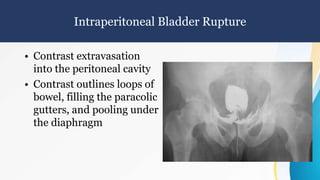
Intraperitoneal Bladder Rupture
• Contrast extravasation
into the peritoneal cavity
• Contrast outlines loops of
bowel, filling the paracolic
gutters, and pooling under
the diaphragm
Initial Trauma Assessment
Kampala Advanced Trauma Care Course
Last Edited August 2016 by Maija Cheung MD & Michael DeWane MD
Abdominal Trauma
Initial Mangement
Hemoperitoneum
• Hemoperitoneum is seen on abdominal ultrasound scan
– Note that the injured organ is not known
– Not seen on AXR
• If the patient is not hemodynamically unstable surgery
may not be indicated
• Surgical Consult
• Lack of CT scan services does not and should not lower
the threshold for exploratory laparotomy to find the cause
of hemoperitoneum
Hollow Organ Injury
• Sudden abdominal pain,
distension, vomiting, fever
• Serial abdominal Exams
– Peritoneal signs can manifest
at anytime after injury (up to
6-12 hours) and may manifest
as rapid gaseous distension,
fever and features of intestinal
obstruction
– These signs warrant surgical
evaluation
Solid Organ Injury
• Abdominal ultrasound is not sensitive for diagnosis of
solid organ injury but is not sensitive
• If the ultrasound findings are inconclusive with absence
of free peritoneal fluid and one suspects solid organ
injury, the patient’s hemodynamic status should
determine the need for laparotomy
Retroperitoneal Injuries
• The site of the injury, like trauma to the flank should raise
suspicion on the possibility of retroperitoneal injury
• Ultrasound scan can be used to diagnose a retroperitoneal
hematoma by a skilled operator
• Use repeated ultrasound scans every 12-24 hours to
ascertain if the hematoma is expanding indicating
continuous bleed that warrants exploration
Penetrating injury
PELVIC TRAUMA
Pelvic Binder
Case
• A 20 year old male was thrown off of his bicycle and his
his abdomen on his handlebars. He has a GCS of 15,
blood pressure 105/80, heart rate 112, and respiratory
rate of 18.
What are your initial steps in management?

Abdominal Trauma 3.pptx

  • 1.
  • 2.
    Outline • Global context& epidemiology • Blunt and Penetrating Abdominal/Pelvic trauma • FAST Scan • Management strategies/ Ideal treatment • Case for discussion
  • 3.
    Global context andepidemiology • Abdominal injury ; 20% of trauma deaths • It is frequently missed • Apparently isolated injuries may have other associated injuries – Splenic injuries have a 10% chance – Co-occuring • diaphragm • small bowel injuries • Falls from heights can present with • Bowel and bladder lacerations can also occur as well as retroperitoneal hemorrhage • Seatbelt sign: 23% of patients will have mesenteric, hepatic, duodenal or jejunal lacerations
  • 5.
    Blunt Abdominal InjuryEpidemiology Organ Injury Frequency of Occurrence (%) Spleen 30 Liver 25 Kidney 20 Small Bowel 6 Diaphragm 4 Bladder 4 Colon 3 Abdominal Vessels 2 Other 6
  • 6.
    Stereotypical Patterns ofInjury Mechanism of Injury Pattern of Injury • Seat Belt – lap and sash belts • Jejunal Perforation • Seat Belt – lap belt only • Duodenal or Pancreatic Injury • Side Impact • Hepatic or Splenic Injury • Sporting Injury • Splenic Laceration • Bicycle Handle Bar Injury • Pancreatic Injury • Animal (Cow/ Horse) Kick/Bicycle horns • Small Bowel Perforation
  • 7.
    Injuries are oftencategorized by type of structure that is damaged: • Abdominal wall • Solid organ (liver, spleen, pancreas, kidneys) • Hollow viscus (stomach, small intestine, colon, ureters, bladder) • Vasculature
  • 9.
    Several pathophysiologic mechanismscan occur in patients with blunt abdominal trauma . Sudden and pronounced rise in intra-abdominal pressure created by outward forces can rupture a hollow viscus. • Sit belt without a shoulder attachment - the belt forcefully compresses the abdomen. • Blunt forces on anterior abdominal wall can compress abdominal viscera against the posterior thoracic cage or vertebral column, crushing tissue. • Susceptible Solid organs (eg, spleen and liver) = laceration or fracture by this mechanism. • Lax abdominal walls e.g. In Elderly and alcoholic are more likely to sustain such injuries. • Delayed splenic rupture can occur. • Retroperitoneal structures, such as the duodenum or pancreas, may be injured. Mechanism of injury
  • 10.
    Shearing forces • Createdby sudden deceleration can cause lacerations of both solid and hollow organs at their points of attachment to the peritoneum. • They may also create tears at vascular pedicles or cause stretch injuries to the intima and media of arteries, resulting in infarction of the susceptible organ. • The kidney is most susceptible to such stretch injury. • Fractured ribs or pelvic bones can lacerate intra-abdominal tissue.
  • 11.
    Blunt Abdominal Injury •Blunt abdominal injury – Assess for the occurrence of associated abdominal organ injury in the evaluation of these patients – Injury may be due to seat belt use, sporting injuries or innocent scenarios such as handle bar injury
  • 12.
    Seatbelt Sign: bruising indistribution of seatbelt
  • 13.
    Penetrating Abdominal Injury •Stab wounds: – Injury generally confined to the tract of the weapon at wounding however • Gunshot wounds: – Injury dependent on type of weapon (pistol vs. shotgun), size of projectile, distance from assailant – High energy rifles (i.e. military weapons) produce cavitation resulting in wide tract of destruction and contamination
  • 14.
  • 15.
    Initial Trauma Assessment KampalaAdvanced Trauma Care Course Last Edited August 2016 by Maija Cheung MD & Michael DeWane MD Abdominal Trauma Initial Assessment
  • 17.
    Abdominal Assessment • Primarysurvey – ABCDE & adjuncts – Assess hemodynamic stability – Identify obvious need for surgical intervention (ie. Penetrating trauma or evisceration) • Secondary survey – Classification of injury: blunt vs. penetrating vs. both – Inspection, palpation, percussion, auscultation – Location of injury
  • 19.
    Abdominal Assessment • Clinicalexamination of the abdomen is unreliable in approximately 50% of blunt abdominal trauma patients • Have a high index of suspicion for occult injury in any of the following: • Presence of abdominal tenderness and rebound tenderness • Rigid abdomen • Patients with seatbelt marking
  • 20.
    Abdominal Assessment • Inspection –Expose patient from lower chest to upper thighs – Inspect back (bullet wound pictured)
  • 21.
    Abdominal Assessment /Percussion – Guarding– voluntary (normal reaction) vs. involuntary (peritoneal irritation) – Superficial, deep or rebound tenderness – Look for increased tympany (pneumoperitoneum) – Useful to detect an enlarged solid viscus or a distended bladder Auscultation – Rarely helpful in trauma assessment
  • 22.
    Initial Trauma Assessment KampalaAdvanced Trauma Care Course Last Edited August 2016 by Maija Cheung MD & Michael DeWane MD Abdominal Trauma Diagnostic Adjuncts
  • 23.
    AXR • Trauma series-Chest XR, Pelvic XR. Head CT • Upright Abdominal X-Ray: free air under the diaphragm indicates hollow viscous injury
  • 24.
    Ultrasound- FAST/ e-FAST •(extended) Focussed Assessment with Sonography in Trauma • FAST is rapid, noninvasive, accurate, inexpensive and can be repeated multiple times. • A positive FAST examination (hemoperitoneum) is useful and reliable in the hemodynamically unstable blunt trauma patient • However, if the FAST examination is negative or equivocal, it may be followed by a DPL or CT Scan
  • 26.
  • 28.
    VIEWS RIGHT UPPER QUADRANT •Mid axillary line-pleural cavity • Below diaphragm • Hepatorenal recess(morrisons pouch) • Inferior pole of kidney- right paracolic gutter LEFT UPPER QUADRANT • Pleural cavity • Below diaphragm(perisplenic space) • Splenorenal recess • Inferior pole of kidney-left paracolic gutter
  • 29.
    VIEWS SUB XIPHOID SPACE •Heart chambers- pericardial space SPRAPUBIC • Retrovesical space/ retrouterine space in women(pouch of douglas)
  • 30.
    Focused Assessment withSonography for Trauma (FAST)
  • 31.
  • 32.
    CT Scan • Inthe hemodynamically stable patient, CT is preferred because it is noninvasive and highly accurate • CT reliably diagnoses solid-organ injuries and evaluates the retroperitoneum, but it is less sensitive and specific for hollow viscus injuries and mesenteric injuries than DPL is
  • 34.
  • 35.
    Diagnostic Peritoneal Lavage •Positive exam – Initial aspiration of gross blood (>10ml), bile, vegetable fibers, GI contents • If nothing is aspirated – Infuse 1L warm crystalloid into peritoneum, allow time to mix then let it drain by gravity. • Positive: – if you see gross blood, bile, vegetable fibers, other gastrointestinal contents – >100,000 RBC/mm3, >500WBCs/mm3 – 175 units of amylase/mm3 – Intestinal Contents – Bacteria present on gram stain
  • 36.
  • 37.
    Laboratory Analysis • Fullblood count – Elevated white cell count may help point towards a gastrointestinal perforation • Urinalysis – Macroscopic or Microscopic hematuria may indicated bladder/kidney injury – 98% of bladder rupture is accompanied by hematuria (10% microscopic)
  • 38.
    Evaluating Genitourinary TractInjury • CT with IV contrast – Excellent for kidney and ureter • Retrograde cystogram – Excellent for bladder injuries – Can be performed at the bedside • Retrograde urethrogram – Necessary to rule out urethral injury if: • Blood at the urethral meatus • High riding prostate on rectal exam • Edema/ecchymosis in perineum
  • 39.
    Intraperitoneal Bladder Rupture •Contrast extravasation into the peritoneal cavity • Contrast outlines loops of bowel, filling the paracolic gutters, and pooling under the diaphragm
  • 40.
    Initial Trauma Assessment KampalaAdvanced Trauma Care Course Last Edited August 2016 by Maija Cheung MD & Michael DeWane MD Abdominal Trauma Initial Mangement
  • 41.
    Hemoperitoneum • Hemoperitoneum isseen on abdominal ultrasound scan – Note that the injured organ is not known – Not seen on AXR • If the patient is not hemodynamically unstable surgery may not be indicated • Surgical Consult • Lack of CT scan services does not and should not lower the threshold for exploratory laparotomy to find the cause of hemoperitoneum
  • 42.
    Hollow Organ Injury •Sudden abdominal pain, distension, vomiting, fever • Serial abdominal Exams – Peritoneal signs can manifest at anytime after injury (up to 6-12 hours) and may manifest as rapid gaseous distension, fever and features of intestinal obstruction – These signs warrant surgical evaluation
  • 43.
    Solid Organ Injury •Abdominal ultrasound is not sensitive for diagnosis of solid organ injury but is not sensitive • If the ultrasound findings are inconclusive with absence of free peritoneal fluid and one suspects solid organ injury, the patient’s hemodynamic status should determine the need for laparotomy
  • 44.
    Retroperitoneal Injuries • Thesite of the injury, like trauma to the flank should raise suspicion on the possibility of retroperitoneal injury • Ultrasound scan can be used to diagnose a retroperitoneal hematoma by a skilled operator • Use repeated ultrasound scans every 12-24 hours to ascertain if the hematoma is expanding indicating continuous bleed that warrants exploration
  • 47.
  • 50.
  • 51.
  • 52.
    Case • A 20year old male was thrown off of his bicycle and his his abdomen on his handlebars. He has a GCS of 15, blood pressure 105/80, heart rate 112, and respiratory rate of 18. What are your initial steps in management?

Editor's Notes

  • #7  Citation?
  • #13 Open Access Image: https://commons.wikimedia.org/wiki/File:Seatbelt.svg
  • #21 Open Access Image: http://www.trauma.org/index.php/main/image/147/
  • #24 Open Access Image: https://en.wikipedia.org/wiki/Cupola_sign#/media/File:Pneumoperitoneum_modification.jpg
  • #31 Open Access Image: trauma.org
  • #40 Open Access Image: https://umem.org/files/uploads/images/pearls/Visual_diagnosis/Haney/RetrogradeCystogram.jpg