Week

5

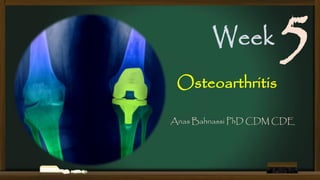
Osteoarthritis

Anas Bahnassi PhD CDM CDE
Overview
•
•
•
•
•
•
•
•
•
•

Definition and Risk Factors
Idiopathic vs. Secondary OA
Clinical Features
Diagnosis
Radiologic Features
ACR OA dx for knees, hands, hips
Goals of Treatment
Non-pharmacologic treatment
Pharmacologic treatment
Surgical Considerations
Osteoarthritis

•

•
•

•

Articular cartilage failure induced by a
complex interplay of genetic, metabolic,
biochemical, and biomechanical factors
With secondary components of
inflammation
Initiating mechanism is damage to
normal articular cartilage by physical
forces (macrotrauma or repeated
microtrauma)
Not necessarily normal consequence of
aging
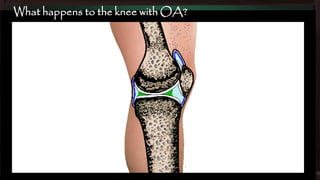
What happens to the knee with OA?
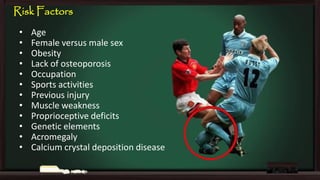
Risk Factors
•
•
•
•
•
•
•
•
•
•
•
•

Age
Female versus male sex
Obesity
Lack of osteoporosis
Occupation
Sports activities
Previous injury
Muscle weakness
Proprioceptive deficits
Genetic elements
Acromegaly
Calcium crystal deposition disease
Idiopathic Osteoarthritis

• Localized or generalized forms
• Localized OA most commonly affects the hands, feet,
knee, hip, and spine
• Other joints less commonly involved
– shoulder, temporomandibular, sacroiliac, ankle, and wrist
joints

• Generalized OA
– three or more joint sites
Patterns of Presentation
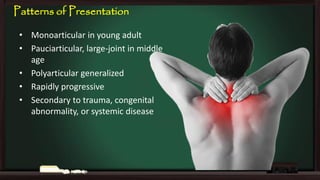
• Monoarticular in young adult
• Pauciarticular, large-joint in middle
age
• Polyarticular generalized
• Rapidly progressive
• Secondary to trauma, congenital
abnormality, or systemic disease
Secondary Osteoarthritis
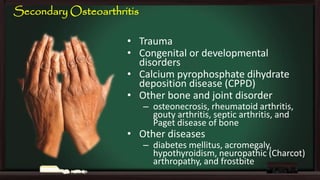
• Trauma
• Congenital or developmental
disorders
• Calcium pyrophosphate dihydrate
deposition disease (CPPD)
• Other bone and joint disorder

– osteonecrosis, rheumatoid arthritis,
gouty arthritis, septic arthritis, and
Paget disease of bone

• Other diseases

– diabetes mellitus, acromegaly,
hypothyroidism, neuropathic (Charcot)
arthropathy, and frostbite
Clinical Features
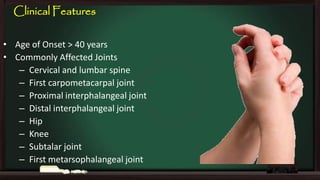
• Age of Onset > 40 years
• Commonly Affected Joints
– Cervical and lumbar spine
– First carpometacarpal joint
– Proximal interphalangeal joint
– Distal interphalangeal joint
– Hip
– Knee
– Subtalar joint
– First metarsophalangeal joint
Uncommonly Affected Joints
•
•
•
•
•
•
•

Shoulder
Wrist
Elbow
Metacarpophalangeal joint
TMJ
SI
Ankle
Clinical Diagnosis
• Symptoms
– Pain
– Stiffness
– Gelling
• Physical examination
– Crepitus
– Bony enlargement
– Decreased range of motion
– Malalignment
– Tenderness to palpation
• The more features, the more likely the diagnosis
Differential Diagnosis

•
•
•
•
•

Rheumatoid Arthritis
Gout
CPPD (Calcium pyrophosphate crystal deposition disease)
Septic Joint
Polymyalgia Rheumatica
Synovial fluid analysis
•

Severe, acute joint pain is an uncommon manifestation of OA

•

Clear fluid WBC <2000/mm3

•

Normal viscosity
Radiographic Features

•
•
•
•

Joint space narrowing
Subchondral sclerosis
Marginal osteophytes
Subchondral cyst
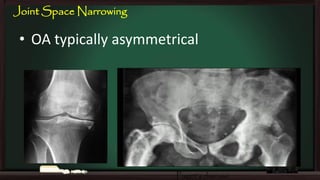
Joint Space Narrowing

• OA typically asymmetrical

Paget’s disease
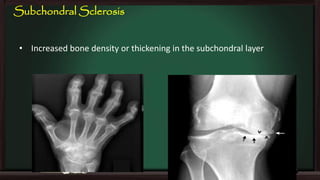
Subchondral Sclerosis
• Increased bone density or thickening in the subchondral layer
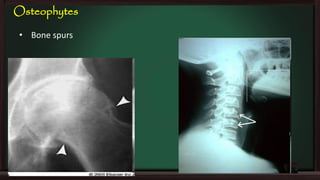
Osteophytes
• Bone spurs
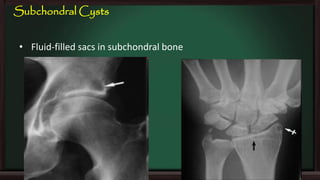
Subchondral Cysts
• Fluid-filled sacs in subchondral bone
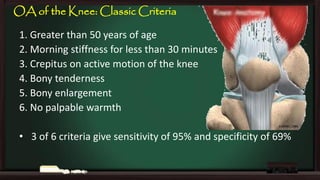
OA of the Knee: Classic Criteria
1. Greater than 50 years of age
2. Morning stiffness for less than 30 minutes
3. Crepitus on active motion of the knee
4. Bony tenderness
5. Bony enlargement
6. No palpable warmth
• 3 of 6 criteria give sensitivity of 95% and specificity of 69%
OA of the Knee: Addition of X-rays
• ACR Criteria of:
1. knee pain
2. radiographic evidence of osteophytes
3. one of three additional findings:
• age greater than 50 years of age
• morning stiffness of less than 30 minutes
• crepitus

– Sensitivity and specificity for OA of 91
and 86%
Hand Osteoarthritis
• Diagnosis by hand pain
• Plus at least three of the following four features:
1. Hard tissue enlargement of 2 or more of 10 selected joints.
• The 10 selected joints are the second and third distal interphalangeal (DIP) joints, the
second and third proximal interphalangeal (PIP) joints, and the first carpometacarpal
(CMC) of both hands

2. Hard enlargement of two or more DIP joints
3. Fewer than three swollen metacarpophalangeal (MCP) joints
4. Deformity of at least 1 of the 10 selected joints
• Sensitivity and Specificity for hand OA of 94 and 87%
Hip Osteoarthritis Diagnosis
• Use history, physical, laboratory, and
radiographic features (ACR)
• Hip Pain, plus at least two of the
following three features:
1. ESR of less than 20 mm/h
2. Radiographic osteophytes
3. Joint space narrowing on radiography

• Sensitivity of 89 percent and a
specificity of 91 percent
Distinction between OA and RA
Typical OA work-up
• History
• PE
• Consider following (especially if OA of knees or hips)
–
–
–
–

Erythrocyte sedimentation rate (ESR)
Rheumatoid factor titers
Evaluation of synovial fluid
Radiographic study of affected joints
Overview
•
•
•
•
•
•
•
•
•
•

Definition and Risk Factors
Idiopathic vs. Secondary OA
Clinical Features
Diagnosis
Radiologic Features
ACR OA dx for knees, hands, hips
Goals of Treatment
Non-pharmacologic treatment
Pharmacologic treatment
Surgical Considerations
Goals of Treatment
•
•
•
•
•
•

Control pain and swelling
Minimize disability
Improve the quality of life
Prevent progression
Education
Chronic Condition and Management
Non-pharmacologic Treatment
• Weight Loss
– Ten-pound weight loss over 10 years decreased the odds for
developing knee OA by 50%
– Even a modest amount of weight loss may be beneficial

• Rest
– Short period of time, typically 12-24 hours
– Prolonged rest can lead to muscle atrophy and decreased joint
mobility
Non-pharmacological Treatment
• Physical Therapy
– “Manual therapy" may be more beneficial than exercise programs that focus
on muscle strengthening, endurance training, and improved coordination
– May be more beneficial in those with mild OA
– Ultrasound therapy may have some benefit based on 2009 Cochrane Review
Tens
•
•
•
•
•
•

SOR B
Safety/Tolerability: High
Efficacy: Medium
20 points more effective on scale of 100 compared to placebo
Few long term studies
Price: Low to medium
Non-pharmacologic Treatment
•

•

Knee Braces/Shoe Inserts - SOR C
– Cochrane reports a “sliver of benefit”
– 73% taping for 3 weeks reported improvement (elastic knee sleeve)
– Price: Low $30
Acupuncture
– Cochrane January 2010
– Very small improvements in pain and physical function after 8 weeks and
26 weeks
– A lot seems to be placebo effect due to incomplete blinding
– Price: Medium to high, 1000$ over 3-4 months
– Reasonable to offer if patient resistant to conventional treatment and
wants to try alternative therapies
Non-pharmacological Treatment
• Exercise – focus on low load exercise
–
–
–
–
–
–
–

Tai Chi
Yoga
Swimming
Biking
Walking
Most important aspect to counsel patients for prevention and treatment
Cochrane Review 2009 compares efficacy to NSAIDs in short-term benefits

• Heat and Cold
– Lack of convincing data despite being commonly used
Acetaminophen
• Cochrane 2009 Review
• NSAIDs are superior to acetaminophen for improving knee
and hip pain in people with OA
• Treatment effect was modest
• Median trial duration was only six weeks
• In OA subjects with moderate-to-severe levels of pain
• NSAIDs > Acetaminophen > Placebo
• NNT for Acetaminophen 4 to 16
• 1000mg three to four times daily
NSAIDs
• Tend to avoid for long-term use
– Rash and hypersensitivity reactions
– Abdominal pain and gastrointestinal bleeding
– Impairment of renal, hepatic, and bone marrow function, and platelet
aggregation
– Central nervous system dysfunction in the elderly

• Low dose ibuprofen (less than 1600 mg/day) may have less serious GI
toxicity
• Nonacetylated salicylates (salsalate, choline magnesium trisalicylate),
sulindac, and nabumetone appear to have less renal toxicity
• Indomethacin should be avoided for long-term use in patients with
hip OA
– associated with accelerated joint destruction
Topical NSAIDs
• A 2004 meta-analysis included 13 trials involving almost 2000
patients
• Randomly assigned to topical NSAID, oral NSAID, or placebo
• Significant short term (one to two weeks) efficacy for pain relief and
functional improvement when topical NSAIDs were compared to
placebo
• Effect was not apparent at three to four weeks
• Topical NSAIDs were generally inferior to oral NSAIDs
• However topical route was safer than oral use
• Topical Diflofenac (1% gel or patch)
COX-2 Inhibitors
•
•
•
•

COX-2 inhibitors appear to be as effective NSAIDs
Associated with less GI toxicity
However increased risk of CV events
Use of low dose ASA may negate the GI sparing effects of
COX-2 inhibitors
• Those who are receiving low dose aspirin and a COX-2
selective agent may benefit from antiulcer prophylaxis
Capsaicin
• Capsaicin Ointment 0.025% (qid) & 0.075% (bid)
– Principle ingredient of chili peppers (substance P)
– Love It!
– Tolerability: Medium
•
•
•
•

50% experience burning which wanes
50% decrease in pain, 25% with placebo
Price: 15$ per month
Apply 2-4 times per day
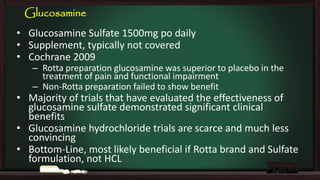
Glucosamine

• Glucosamine Sulfate 1500mg po daily
• Supplement, typically not covered
• Cochrane 2009

– Rotta preparation glucosamine was superior to placebo in the
treatment of pain and functional impairment
– Non-Rotta preparation failed to show benefit

• Majority of trials that have evaluated the effectiveness of
glucosamine sulfate demonstrated significant clinical
benefits
• Glucosamine hydrochloride trials are scarce and much less
convincing
• Bottom-Line, most likely beneficial if Rotta brand and Sulfate
formulation, not HCL
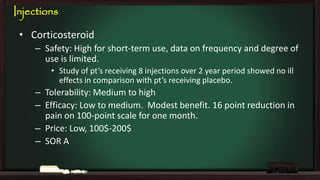
Injections
• Corticosteroid
– Safety: High for short-term use, data on frequency and degree of
use is limited.
• Study of pt’s receiving 8 injections over 2 year period showed no ill
effects in comparison with pt’s receiving placebo.

– Tolerability: Medium to high
– Efficacy: Low to medium. Modest benefit. 16 point reduction in
pain on 100-point scale for one month.
– Price: Low, 100$-200$
– SOR A
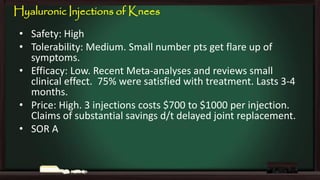
Hyaluronic Injections of Knees
• Safety: High
• Tolerability: Medium. Small number pts get flare up of
symptoms.
• Efficacy: Low. Recent Meta-analyses and reviews small
clinical effect. 75% were satisfied with treatment. Lasts 3-4
months.
• Price: High. 3 injections costs $700 to $1000 per injection.
Claims of substantial savings d/t delayed joint replacement.
• SOR A
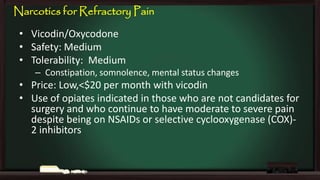
Narcotics for Refractory Pain
• Vicodin/Oxycodone
• Safety: Medium
• Tolerability: Medium
– Constipation, somnolence, mental status changes

• Price: Low,<$20 per month with vicodin
• Use of opiates indicated in those who are not candidates for
surgery and who continue to have moderate to severe pain
despite being on NSAIDs or selective cyclooxygenase (COX)2 inhibitors
Arthroscopic Interventions
•
•
•
•
•

Controversial
Arthroscopic debridement with lavage
Sham-surgery versus arthroscopic lavage/debridement study
Remove loose pieces of bone and cartilage
Resurface (smooth out) bones
Prosthetic Joints
•
•
•
•
•

Commonly of the hip or knee or shoulder
Several types: metal, plastic, ceramic
Last 10-15 years or more
About 10% need to be redone
Usually a treatment of “last resort”
Joint Replacement
•
•
•
•
•
•

Surgical candidate?
Often greater improvement in pain rather than function
Recovery can be strenuous and lengthy
Infection rate 1%
Low mortality 0.6% to 0.7%
Complications include thrombo-embolic events 5%
Education and Self-Help
•
•
•
•
•
•

Understand the disease
Reduce pain but remain active
Clear Functional goals
Cope physically, emotionally, and mentally
Have greater control over the disease
Build confidence
Pharmacottherapy
Anas Bahnassi PhD CDM CDE
abahnassi@gmail.com
http://www.twitter.com/abpharm
http://www.facebook.com/pharmaprof
http://www.linkedin.com/in/abahnassi

Osteoarthritis

  • 1.
  • 2.
    Overview • • • • • • • • • • Definition and RiskFactors Idiopathic vs. Secondary OA Clinical Features Diagnosis Radiologic Features ACR OA dx for knees, hands, hips Goals of Treatment Non-pharmacologic treatment Pharmacologic treatment Surgical Considerations
  • 3.
    Osteoarthritis • • • • Articular cartilage failureinduced by a complex interplay of genetic, metabolic, biochemical, and biomechanical factors With secondary components of inflammation Initiating mechanism is damage to normal articular cartilage by physical forces (macrotrauma or repeated microtrauma) Not necessarily normal consequence of aging
  • 4.
    What happens tothe knee with OA?
  • 5.
    Risk Factors • • • • • • • • • • • • Age Female versusmale sex Obesity Lack of osteoporosis Occupation Sports activities Previous injury Muscle weakness Proprioceptive deficits Genetic elements Acromegaly Calcium crystal deposition disease
  • 6.
    Idiopathic Osteoarthritis • Localizedor generalized forms • Localized OA most commonly affects the hands, feet, knee, hip, and spine • Other joints less commonly involved – shoulder, temporomandibular, sacroiliac, ankle, and wrist joints • Generalized OA – three or more joint sites
  • 7.
    Patterns of Presentation •Monoarticular in young adult • Pauciarticular, large-joint in middle age • Polyarticular generalized • Rapidly progressive • Secondary to trauma, congenital abnormality, or systemic disease
  • 8.
    Secondary Osteoarthritis • Trauma •Congenital or developmental disorders • Calcium pyrophosphate dihydrate deposition disease (CPPD) • Other bone and joint disorder – osteonecrosis, rheumatoid arthritis, gouty arthritis, septic arthritis, and Paget disease of bone • Other diseases – diabetes mellitus, acromegaly, hypothyroidism, neuropathic (Charcot) arthropathy, and frostbite
  • 9.
    Clinical Features • Ageof Onset > 40 years • Commonly Affected Joints – Cervical and lumbar spine – First carpometacarpal joint – Proximal interphalangeal joint – Distal interphalangeal joint – Hip – Knee – Subtalar joint – First metarsophalangeal joint
  • 10.
  • 11.
    Clinical Diagnosis • Symptoms –Pain – Stiffness – Gelling • Physical examination – Crepitus – Bony enlargement – Decreased range of motion – Malalignment – Tenderness to palpation • The more features, the more likely the diagnosis
  • 12.
    Differential Diagnosis • • • • • Rheumatoid Arthritis Gout CPPD(Calcium pyrophosphate crystal deposition disease) Septic Joint Polymyalgia Rheumatica
  • 13.
    Synovial fluid analysis • Severe,acute joint pain is an uncommon manifestation of OA • Clear fluid WBC <2000/mm3 • Normal viscosity
  • 14.
    Radiographic Features • • • • Joint spacenarrowing Subchondral sclerosis Marginal osteophytes Subchondral cyst
  • 15.
    Joint Space Narrowing •OA typically asymmetrical Paget’s disease
  • 16.
    Subchondral Sclerosis • Increasedbone density or thickening in the subchondral layer
  • 17.
  • 18.
    Subchondral Cysts • Fluid-filledsacs in subchondral bone
  • 19.
    OA of theKnee: Classic Criteria 1. Greater than 50 years of age 2. Morning stiffness for less than 30 minutes 3. Crepitus on active motion of the knee 4. Bony tenderness 5. Bony enlargement 6. No palpable warmth • 3 of 6 criteria give sensitivity of 95% and specificity of 69%
  • 20.
    OA of theKnee: Addition of X-rays • ACR Criteria of: 1. knee pain 2. radiographic evidence of osteophytes 3. one of three additional findings: • age greater than 50 years of age • morning stiffness of less than 30 minutes • crepitus – Sensitivity and specificity for OA of 91 and 86%
  • 21.
    Hand Osteoarthritis • Diagnosisby hand pain • Plus at least three of the following four features: 1. Hard tissue enlargement of 2 or more of 10 selected joints. • The 10 selected joints are the second and third distal interphalangeal (DIP) joints, the second and third proximal interphalangeal (PIP) joints, and the first carpometacarpal (CMC) of both hands 2. Hard enlargement of two or more DIP joints 3. Fewer than three swollen metacarpophalangeal (MCP) joints 4. Deformity of at least 1 of the 10 selected joints • Sensitivity and Specificity for hand OA of 94 and 87%
  • 22.
    Hip Osteoarthritis Diagnosis •Use history, physical, laboratory, and radiographic features (ACR) • Hip Pain, plus at least two of the following three features: 1. ESR of less than 20 mm/h 2. Radiographic osteophytes 3. Joint space narrowing on radiography • Sensitivity of 89 percent and a specificity of 91 percent
  • 23.
  • 24.
    Typical OA work-up •History • PE • Consider following (especially if OA of knees or hips) – – – – Erythrocyte sedimentation rate (ESR) Rheumatoid factor titers Evaluation of synovial fluid Radiographic study of affected joints
  • 25.
    Overview • • • • • • • • • • Definition and RiskFactors Idiopathic vs. Secondary OA Clinical Features Diagnosis Radiologic Features ACR OA dx for knees, hands, hips Goals of Treatment Non-pharmacologic treatment Pharmacologic treatment Surgical Considerations
  • 26.
    Goals of Treatment • • • • • • Controlpain and swelling Minimize disability Improve the quality of life Prevent progression Education Chronic Condition and Management
  • 27.
    Non-pharmacologic Treatment • WeightLoss – Ten-pound weight loss over 10 years decreased the odds for developing knee OA by 50% – Even a modest amount of weight loss may be beneficial • Rest – Short period of time, typically 12-24 hours – Prolonged rest can lead to muscle atrophy and decreased joint mobility
  • 28.
    Non-pharmacological Treatment • PhysicalTherapy – “Manual therapy" may be more beneficial than exercise programs that focus on muscle strengthening, endurance training, and improved coordination – May be more beneficial in those with mild OA – Ultrasound therapy may have some benefit based on 2009 Cochrane Review
  • 29.
    Tens • • • • • • SOR B Safety/Tolerability: High Efficacy:Medium 20 points more effective on scale of 100 compared to placebo Few long term studies Price: Low to medium
  • 30.
    Non-pharmacologic Treatment • • Knee Braces/ShoeInserts - SOR C – Cochrane reports a “sliver of benefit” – 73% taping for 3 weeks reported improvement (elastic knee sleeve) – Price: Low $30 Acupuncture – Cochrane January 2010 – Very small improvements in pain and physical function after 8 weeks and 26 weeks – A lot seems to be placebo effect due to incomplete blinding – Price: Medium to high, 1000$ over 3-4 months – Reasonable to offer if patient resistant to conventional treatment and wants to try alternative therapies
  • 31.
    Non-pharmacological Treatment • Exercise– focus on low load exercise – – – – – – – Tai Chi Yoga Swimming Biking Walking Most important aspect to counsel patients for prevention and treatment Cochrane Review 2009 compares efficacy to NSAIDs in short-term benefits • Heat and Cold – Lack of convincing data despite being commonly used
  • 32.
    Acetaminophen • Cochrane 2009Review • NSAIDs are superior to acetaminophen for improving knee and hip pain in people with OA • Treatment effect was modest • Median trial duration was only six weeks • In OA subjects with moderate-to-severe levels of pain • NSAIDs > Acetaminophen > Placebo • NNT for Acetaminophen 4 to 16 • 1000mg three to four times daily
  • 33.
    NSAIDs • Tend toavoid for long-term use – Rash and hypersensitivity reactions – Abdominal pain and gastrointestinal bleeding – Impairment of renal, hepatic, and bone marrow function, and platelet aggregation – Central nervous system dysfunction in the elderly • Low dose ibuprofen (less than 1600 mg/day) may have less serious GI toxicity • Nonacetylated salicylates (salsalate, choline magnesium trisalicylate), sulindac, and nabumetone appear to have less renal toxicity • Indomethacin should be avoided for long-term use in patients with hip OA – associated with accelerated joint destruction
  • 34.
    Topical NSAIDs • A2004 meta-analysis included 13 trials involving almost 2000 patients • Randomly assigned to topical NSAID, oral NSAID, or placebo • Significant short term (one to two weeks) efficacy for pain relief and functional improvement when topical NSAIDs were compared to placebo • Effect was not apparent at three to four weeks • Topical NSAIDs were generally inferior to oral NSAIDs • However topical route was safer than oral use • Topical Diflofenac (1% gel or patch)
  • 35.
    COX-2 Inhibitors • • • • COX-2 inhibitorsappear to be as effective NSAIDs Associated with less GI toxicity However increased risk of CV events Use of low dose ASA may negate the GI sparing effects of COX-2 inhibitors • Those who are receiving low dose aspirin and a COX-2 selective agent may benefit from antiulcer prophylaxis
  • 36.
    Capsaicin • Capsaicin Ointment0.025% (qid) & 0.075% (bid) – Principle ingredient of chili peppers (substance P) – Love It! – Tolerability: Medium • • • • 50% experience burning which wanes 50% decrease in pain, 25% with placebo Price: 15$ per month Apply 2-4 times per day
  • 37.
    Glucosamine • Glucosamine Sulfate1500mg po daily • Supplement, typically not covered • Cochrane 2009 – Rotta preparation glucosamine was superior to placebo in the treatment of pain and functional impairment – Non-Rotta preparation failed to show benefit • Majority of trials that have evaluated the effectiveness of glucosamine sulfate demonstrated significant clinical benefits • Glucosamine hydrochloride trials are scarce and much less convincing • Bottom-Line, most likely beneficial if Rotta brand and Sulfate formulation, not HCL
  • 38.
    Injections • Corticosteroid – Safety:High for short-term use, data on frequency and degree of use is limited. • Study of pt’s receiving 8 injections over 2 year period showed no ill effects in comparison with pt’s receiving placebo. – Tolerability: Medium to high – Efficacy: Low to medium. Modest benefit. 16 point reduction in pain on 100-point scale for one month. – Price: Low, 100$-200$ – SOR A
  • 39.
    Hyaluronic Injections ofKnees • Safety: High • Tolerability: Medium. Small number pts get flare up of symptoms. • Efficacy: Low. Recent Meta-analyses and reviews small clinical effect. 75% were satisfied with treatment. Lasts 3-4 months. • Price: High. 3 injections costs $700 to $1000 per injection. Claims of substantial savings d/t delayed joint replacement. • SOR A
  • 40.
    Narcotics for RefractoryPain • Vicodin/Oxycodone • Safety: Medium • Tolerability: Medium – Constipation, somnolence, mental status changes • Price: Low,<$20 per month with vicodin • Use of opiates indicated in those who are not candidates for surgery and who continue to have moderate to severe pain despite being on NSAIDs or selective cyclooxygenase (COX)2 inhibitors
  • 41.
    Arthroscopic Interventions • • • • • Controversial Arthroscopic debridementwith lavage Sham-surgery versus arthroscopic lavage/debridement study Remove loose pieces of bone and cartilage Resurface (smooth out) bones
  • 42.
    Prosthetic Joints • • • • • Commonly ofthe hip or knee or shoulder Several types: metal, plastic, ceramic Last 10-15 years or more About 10% need to be redone Usually a treatment of “last resort”
  • 43.
    Joint Replacement • • • • • • Surgical candidate? Oftengreater improvement in pain rather than function Recovery can be strenuous and lengthy Infection rate 1% Low mortality 0.6% to 0.7% Complications include thrombo-embolic events 5%
  • 44.
    Education and Self-Help • • • • • • Understandthe disease Reduce pain but remain active Clear Functional goals Cope physically, emotionally, and mentally Have greater control over the disease Build confidence
  • 45.
    Pharmacottherapy Anas Bahnassi PhDCDM CDE abahnassi@gmail.com http://www.twitter.com/abpharm http://www.facebook.com/pharmaprof http://www.linkedin.com/in/abahnassi