
Abdominal Trauma
Chea Chan Hooi
Surgeon
Sibu Hospital
BLS Sibu Hospital
14/08/2018
Content
• Anatomy
• Classification
• Investigations
• Management
• Conclusion
• Q&A
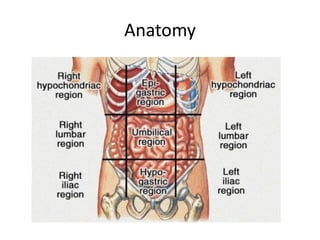
Anatomy
Classification
• Etiology
– Blunt
– Penetrating
• Structure injured
– Abdominal wall
– Solid organ (liver, spleen, kidneys)
– Hollow organ (GI tract, ureters, bladder)
– Vasculature
Blunt abdominal trauma
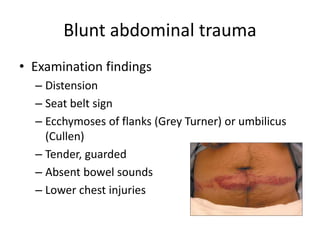
• Examination findings
– Distension
– Seat belt sign
– Ecchymoses of flanks (Grey Turner) or umbilicus
(Cullen)
– Tender, guarded
– Absent bowel sounds
– Lower chest injuries
Investigations
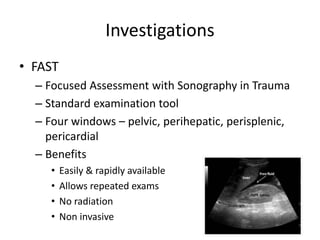
• FAST
– Focused Assessment with Sonography in Trauma
– Standard examination tool
– Four windows – pelvic, perihepatic, perisplenic,
pericardial
– Benefits
• Easily & rapidly available
• Allows repeated exams
• No radiation
• Non invasive
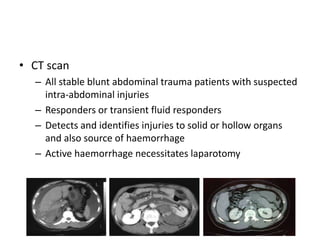
• CT scan
– All stable blunt abdominal trauma patients with suspected
intra-abdominal injuries
– Responders or transient fluid responders
– Detects and identifies injuries to solid or hollow organs
and also source of haemorrhage
– Active haemorrhage necessitates laparotomy
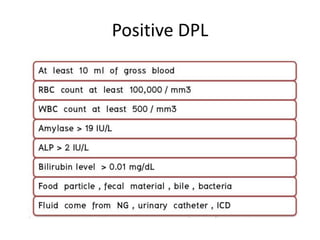
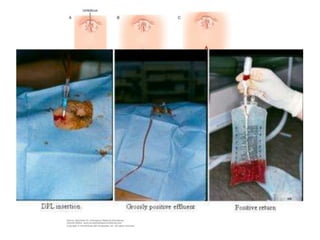
• DPL
– Diagnostic peritoneal lavage
– Open or percutaneous technique
– Indications
• Unreliable physical exam (spinal cord injury, altered
mental state, intubated)
• FAST or CT not available
• Radiographs equivocal
– Obsolete
Positive DPL
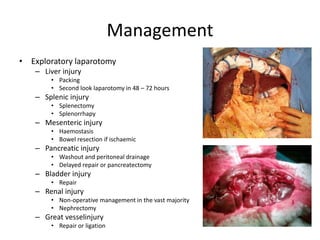
Management
• Exploratory laparotomy
– Liver injury
• Packing
• Second look laparotomy in 48 – 72 hours
– Splenic injury
• Splenectomy
• Splenorrhapy
– Mesenteric injury
• Haemostasis
• Bowel resection if ischaemic
– Pancreatic injury
• Washout and peritoneal drainage
• Delayed repair or pancreatectomy
– Bladder injury
• Repair
– Renal injury
• Non-operative management in the vast majority
• Nephrectomy
– Great vesselinjury
• Repair or ligation
• Non-operative management
– Admit
– CRIB
– Close vital sign monitoring
– Analgesics
– GXM 4 units packed cells
– Daily monitoring of Hb, TWC & Urea/Creat
– Indication for laparotomy
• Haemodynamic unstable
• Peritonism
• Persistent blood product transfusion
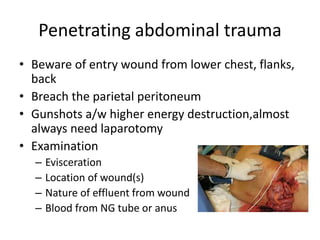
Penetrating abdominal trauma
• Beware of entry wound from lower chest, flanks,
back
• Breach the parietal peritoneum
• Gunshots a/w higher energy destruction,almost
always need laparotomy
• Examination
– Evisceration
– Location of wound(s)
– Nature of effluent from wound
– Blood from NG tube or anus
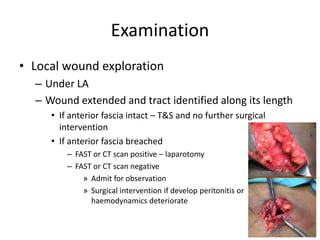
Examination
• Local wound exploration
– Under LA
– Wound extended and tract identified along its length
• If anterior fascia intact – T&S and no further surgical
intervention
• If anterior fascia breached
– FAST or CT scan positive – laparotomy
– FAST or CT scan negative
» Admit for observation
» Surgical intervention if develop peritonitis or
haemodynamics deteriorate
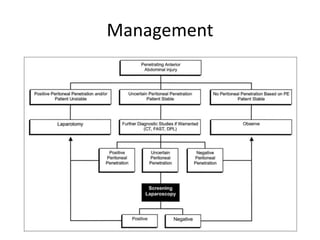
Management
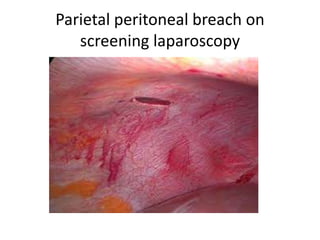
Parietal peritoneal breach on
screening laparoscopy
Intra-abdominal injuries
• All solid or hollow organ injuries intra-
operatively managed similar to blunt injury
Conclusion
• Abdominal trauma can be associated with
polysystemic trauma
• Patients tend to be unstable and may require
crash laparotomy
• DPL has been replaced by FAST
• CT scan is helpful but must not delay surgical
intervention in unstable patients
• Unnecessary laparotomy can be avoided in well-
selected patients with penetrating abdominal
trauma
Thank you!
Q&A?
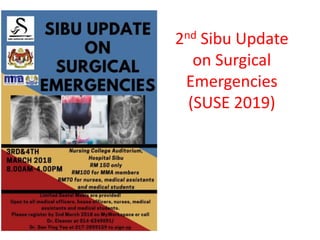
2nd Sibu Update
on Surgical
Emergencies
(SUSE 2019)

Abdominal trauma

  • 1.
    Abdominal Trauma Chea ChanHooi Surgeon Sibu Hospital BLS Sibu Hospital 14/08/2018
  • 2.
    Content • Anatomy • Classification •Investigations • Management • Conclusion • Q&A
  • 3.
  • 4.
    Classification • Etiology – Blunt –Penetrating • Structure injured – Abdominal wall – Solid organ (liver, spleen, kidneys) – Hollow organ (GI tract, ureters, bladder) – Vasculature
  • 5.
    Blunt abdominal trauma •Examination findings – Distension – Seat belt sign – Ecchymoses of flanks (Grey Turner) or umbilicus (Cullen) – Tender, guarded – Absent bowel sounds – Lower chest injuries
  • 6.
    Investigations • FAST – FocusedAssessment with Sonography in Trauma – Standard examination tool – Four windows – pelvic, perihepatic, perisplenic, pericardial – Benefits • Easily & rapidly available • Allows repeated exams • No radiation • Non invasive
  • 7.
    • CT scan –All stable blunt abdominal trauma patients with suspected intra-abdominal injuries – Responders or transient fluid responders – Detects and identifies injuries to solid or hollow organs and also source of haemorrhage – Active haemorrhage necessitates laparotomy
  • 8.
    • DPL – Diagnosticperitoneal lavage – Open or percutaneous technique – Indications • Unreliable physical exam (spinal cord injury, altered mental state, intubated) • FAST or CT not available • Radiographs equivocal – Obsolete
  • 9.
  • 11.
    Management • Exploratory laparotomy –Liver injury • Packing • Second look laparotomy in 48 – 72 hours – Splenic injury • Splenectomy • Splenorrhapy – Mesenteric injury • Haemostasis • Bowel resection if ischaemic – Pancreatic injury • Washout and peritoneal drainage • Delayed repair or pancreatectomy – Bladder injury • Repair – Renal injury • Non-operative management in the vast majority • Nephrectomy – Great vesselinjury • Repair or ligation
  • 12.
    • Non-operative management –Admit – CRIB – Close vital sign monitoring – Analgesics – GXM 4 units packed cells – Daily monitoring of Hb, TWC & Urea/Creat – Indication for laparotomy • Haemodynamic unstable • Peritonism • Persistent blood product transfusion
  • 13.
    Penetrating abdominal trauma •Beware of entry wound from lower chest, flanks, back • Breach the parietal peritoneum • Gunshots a/w higher energy destruction,almost always need laparotomy • Examination – Evisceration – Location of wound(s) – Nature of effluent from wound – Blood from NG tube or anus
  • 14.
    Examination • Local woundexploration – Under LA – Wound extended and tract identified along its length • If anterior fascia intact – T&S and no further surgical intervention • If anterior fascia breached – FAST or CT scan positive – laparotomy – FAST or CT scan negative » Admit for observation » Surgical intervention if develop peritonitis or haemodynamics deteriorate
  • 15.
  • 16.
    Parietal peritoneal breachon screening laparoscopy
  • 17.
    Intra-abdominal injuries • Allsolid or hollow organ injuries intra- operatively managed similar to blunt injury
  • 18.
    Conclusion • Abdominal traumacan be associated with polysystemic trauma • Patients tend to be unstable and may require crash laparotomy • DPL has been replaced by FAST • CT scan is helpful but must not delay surgical intervention in unstable patients • Unnecessary laparotomy can be avoided in well- selected patients with penetrating abdominal trauma
  • 19.
  • 20.
    2nd Sibu Update onSurgical Emergencies (SUSE 2019)