ABDOMINAL INJURIES
Dr. Prasenjit Gogoi
Masters in Emergency Medicine,
3rd
Yr Resident
Fortis Hospital, Kolkata
Introduction
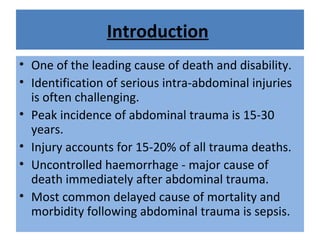
• One of the leading cause of death and disability.
• Identification of serious intra-abdominal injuries
is often challenging.
• Peak incidence of abdominal trauma is 15-30
years.
• Injury accounts for 15-20% of all trauma deaths.
• Uncontrolled haemorrhage - major cause of
death immediately after abdominal trauma.
• Most common delayed cause of mortality and
morbidity following abdominal trauma is sepsis.
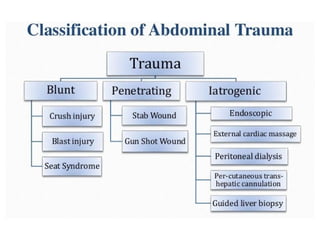
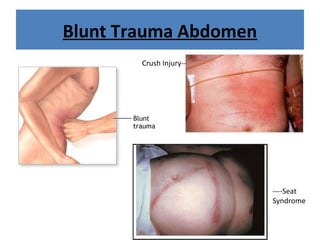
Blunt Trauma Abdomen
----Seat
Syndrome
Crush Injury--
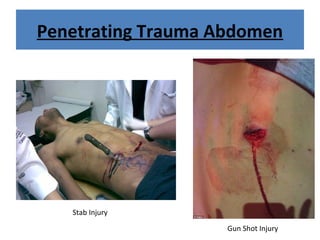
Penetrating Trauma Abdomen
Stab Injury
Gun Shot Injury
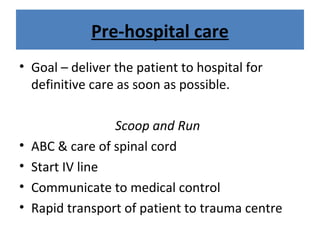
Pre-hospital care
• Goal – deliver the patient to hospital for
definitive care as soon as possible.
Scoop and Run
• ABC & care of spinal cord
• Start IV line
• Communicate to medical control
• Rapid transport of patient to trauma centre
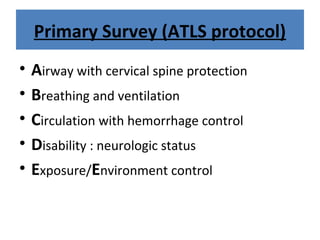
Primary Survey (ATLS protocol)
• Airway with cervical spine protection
• Breathing and ventilation
• Circulation with hemorrhage control
• Disability : neurologic status
• Exposure/Environment control
Adjuncts to primary survey
• ECG monitoring
• Urinary catheter
• Gastric catheter
• Monitoring
– ABG
– Pulse oximeter
– Blood pressure
• X-rays
– AP CXR
– AP PELVIS
– C-SPINE
• DPL
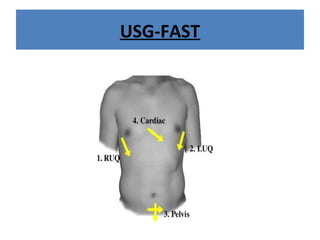
• ABD USG - FAST
Secondary Survey (ATLS protocol)
• Head to toe evaluation
• Complete history and physical examination
• Reassessment of all vital signs
• Complete neurological examination
• Indicated x-rays are obtained
• Special procedures
• Tubes and fingers in every orifice
Secondary Survey (ATLS protocol)
AMPLE history
• Allergies
• Medications
• Past illness/Pregnancy
• Last meal
• Events/Environment related to injury
Clinical Features- Abdominal Injury
Physical examination
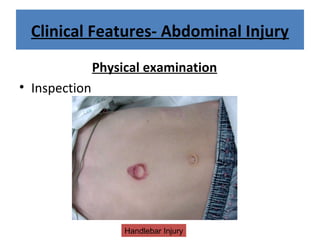
• Inspection
Handlebar Injury
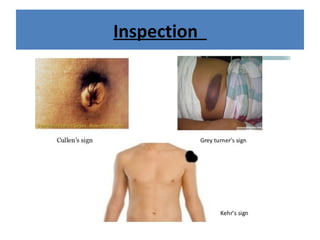
Inspection
Cullen’s Sign
Grey Turner’s Sign
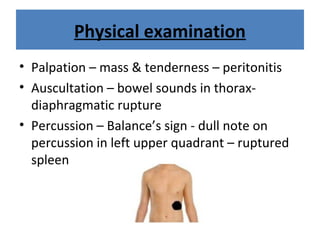
Physical examination
• Palpation – mass & tenderness – peritonitis
• Auscultation – bowel sounds in thorax-
diaphragmatic rupture
• Percussion – Balance’s sign - dull note on
percussion in left upper quadrant – ruptured
spleen
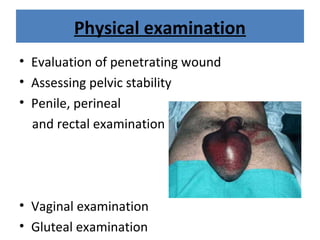
Physical examination
• Evaluation of penetrating wound
• Assessing pelvic stability
• Penile, perineal
and rectal examination
• Vaginal examination
• Gluteal examination
Clinical Features- Abdominal Injury
Abdominal Wall Injuries
• Direct blow
• Indirectly by sudden muscle contraction
• Pain with flexion and rotation of trunk.
• Palpable hematomas – rectus hematomas
Clinical Feature - Abdominal Injury
Solid Visceral Injuries
• Hypotension
• Tachycardia
• Skin changes
• Mental confusion
• Late – abdominal tenderness
distention
tympany
Solid Visceral Injury
• Splenic Injury
– most common (40-55%)
– 20% occur due to left lower rib fracture
• Liver Injury
– 2nd
most common (35-45%)
– 50% liver injury stop bleeding spontaneously by
the time of surgery
– Mortality 10%
Clinical Feature -Abdominal Injury
Gastrointestinal Injuries
• Incidence – 1-12%
• Perforation of stomach, small bowel and
colon.
• Gastric injuries cause chemical irritation.
• Small bowel and colonic injuries cause
suppurative peritonitis.
• Inflammation may take 6-7 hours to develop.
Clinical Feature - Abdominal Injury
Retroperitoneal Injuries
• Pancreatic Injuries
• 4% of patient with abdominal trauma.
• No specific signs and symptoms.
• Mechanism of injury – rapid deceleration
• Duodenal injuries
• Relatively asymptomatic on presentation – small
hematomas may go undiagnosed.
• Gastric outlet obstruction
• Duodenal rupture – high velocity deceleration
Clinical Feature - Abdominal Injury
• Kidney injuries
– 10% patients with abdominal trauma
– Injuries consist of lacerations, avulsions and
hematomas to the kidney itself and renal pelvis
– Renal vascular injuries are uncommon
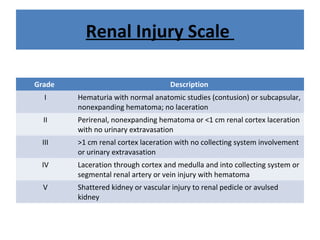
Renal Injury Scale
Grade Description
I Hematuria with normal anatomic studies (contusion) or subcapsular,
nonexpanding hematoma; no laceration
II Perirenal, nonexpanding hematoma or <1 cm renal cortex laceration
with no urinary extravasation
III >1 cm renal cortex laceration with no collecting system involvement
or urinary extravasation
IV Laceration through cortex and medulla and into collecting system or
segmental renal artery or vein injury with hematoma
V Shattered kidney or vascular injury to renal pedicle or avulsed
kidney
Clinical Feature - Abdominal Injury
• Ureteral Injury
– Isolated urethral injury is rare in trauma
– Penetrating trauma – 90% & blunt trauma 10%
– 70% cases will have gross or microscopic
hematuria
Clinical Feature - Abdominal Injury
• Bladder Injury
– 2% of blunt abdominal trauma
– 70-97% associated with pelvic fracture
– Lower abdominal pain, tenderness and gross
hematuria
– Lower abdominal bruising, abdominal swelling from
urinary ascites, perineal or scrotal edema from
urinary extravasation, and inability to void
– secondary to penetrating trauma - injuries to the
rectum or buttocks.
Clinical Feature - Abdominal Injury
Urethral Injury – Anatomical Classification
• Posterior urethral injuries
– Major blunt force trauma- rapid deceleration
mechanism
– Triad of urinary retention, blood at the meatus
and high riding prostate.
– 10% of patients with pelvic fractures.
• Anterior urethral injuries
– Direct perineal trauma – blunt / penetrating
– Straddle injury is classic mechanism
– Can also occur with penile fracture
Clinical Feature - Abdominal Injury
Diaphragmatic Injuries
• Diaphragm spasm – secondary to direct blow
to epigastrium.
• Diaphragmatic rupture – penetrating trauma
or blunt force mechanism.
• Failure to diagnose – delayed herniation or
strangulation hernia of abdominal contents.
Investigations
• Blood tests
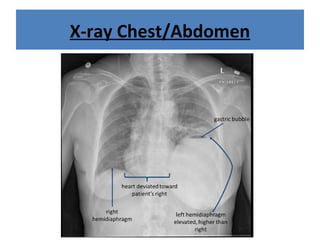
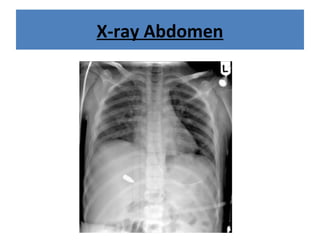
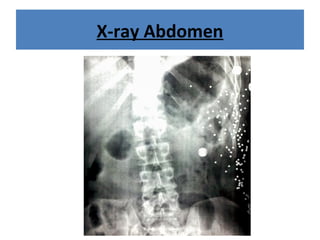
• X-rays – plain abdominal x rays/cxr
• Diagnostic Peritoneal Lavage
• USG abdomen
• CT abdomen
• Diagnostic Laparoscopy
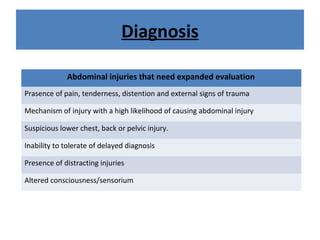
Diagnosis
Abdominal injuries that need expanded evaluation
Prasence of pain, tenderness, distention and external signs of trauma
Mechanism of injury with a high likelihood of causing abdominal injury
Suspicious lower chest, back or pelvic injury.
Inability to tolerate of delayed diagnosis
Presence of distracting injuries
Altered consciousness/sensorium
X-ray Chest/Abdomen
X-ray Abdomen
X-ray Abdomen
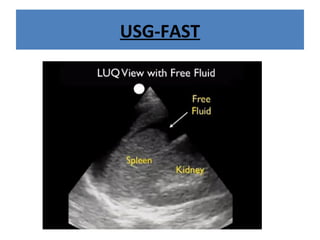
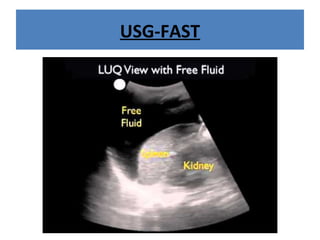
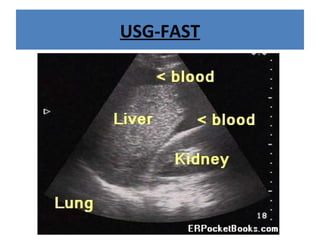
USG-FAST
USG-FAST
USG-FAST
USG-FAST
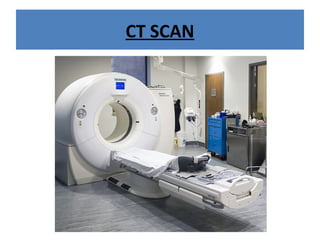
CT SCAN
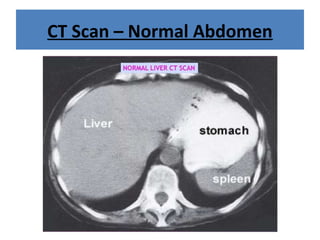
CT Scan – Normal Abdomen
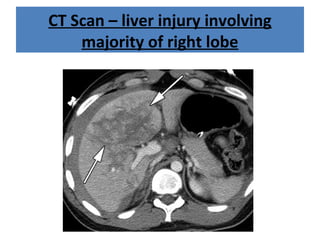
CT Scan – liver injury involving
majority of right lobe
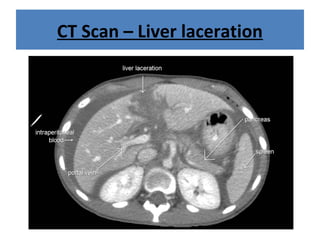
CT Scan – Liver laceration
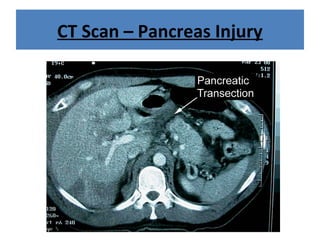
CT Scan – Pancreas Injury
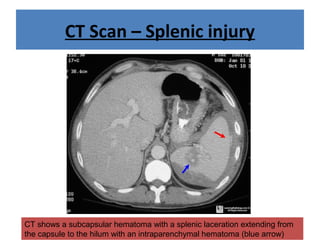
CT Scan – Splenic injury
CT shows a subcapsular hematoma with a splenic laceration extending from
the capsule to the hilum with an intraparenchymal hematoma (blue arrow)
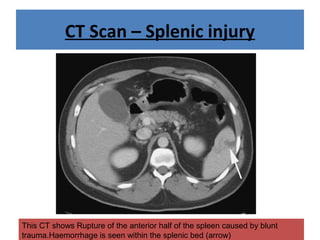
CT Scan – Splenic injury
This CT shows Rupture of the anterior half of the spleen caused by blunt
trauma.Haemorrhage is seen within the splenic bed (arrow)
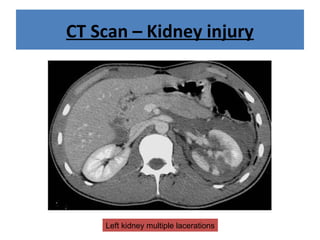
CT Scan – Kidney injury
Left kidney multiple lacerations
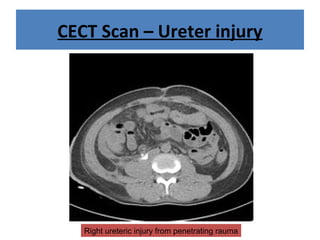
CECT Scan – Ureter injury
Right ureteric injury from penetrating rauma
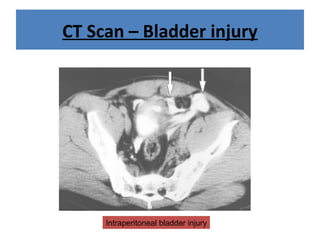
CT Scan – Bladder injury
Intraperitoneal bladder injury
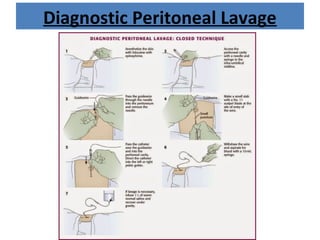
Diagnostic Peritoneal Lavage
Penetrating Abdominal Trauma
• Gunshot wounds
– Small bowel (50%)
– Colon (40%)
– Liver (30%)
– Abdominal vascular structures (25%)
• Stab wounds
– Liver (40%)
– Small bowel (30%)
– Diaphragm (20%)
– Colon (10%)
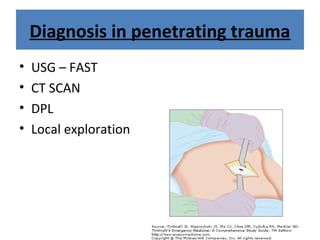
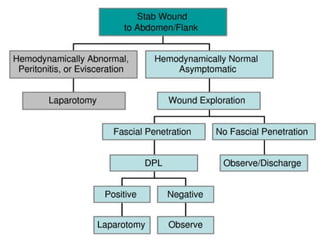
Diagnosis in penetrating trauma
• USG – FAST
• CT SCAN
• DPL
• Local exploration
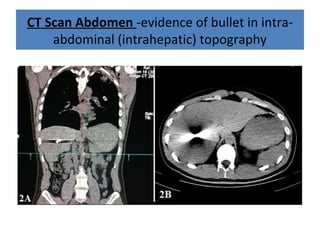
CT Scan Abdomen -evidence of bullet in intra-
abdominal (intrahepatic) topography
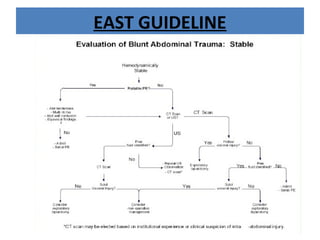
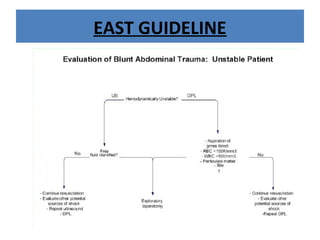
EAST GUIDELINE
EAST GUIDELINE
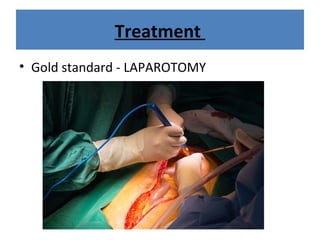
Treatment
• Gold standard - LAPAROTOMY
Treatment
• Gold standard - LAPAROTOMY
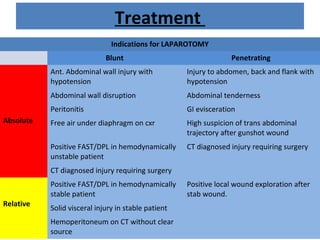
Indications for LAPAROTOMY
Blunt Penetrating
Absolute
Ant. Abdominal wall injury with
hypotension
Injury to abdomen, back and flank with
hypotension
Abdominal wall disruption Abdominal tenderness
Peritonitis GI evisceration
Free air under diaphragm on cxr High suspicion of trans abdominal
trajectory after gunshot wound
Positive FAST/DPL in hemodynamically
unstable patient
CT diagnosed injury requiring surgery
Relative
Positive FAST/DPL in hemodynamically
stable patient
Positive local wound exploration after
stab wound.
Solid visceral injury in stable patient
Hemoperitoneum on CT without clear
source
Non-operative management of blunt
trauma
• Patient hemodynamically stable after initial
resuscitation.
• Continious patient monitoring for 48 hrs
• Surgical team immediately available.
• Adequate ICU support and transfusion
services available.
• Absence of peritonitis.
• Normal sensorium.
• Angioembolization may be an alternative to
surgery
Reference
• Tintinallis Emergency Medicine – 8th
edition
• Advanced Trauma Life Support Guidelines
• Eastern Association for the Surgery of Trauma
Guidelines
• Abdominal trauma imaging –
www.intechopen.com
THANK YOU

Abdominal injuries

  • 1.
    ABDOMINAL INJURIES Dr. PrasenjitGogoi Masters in Emergency Medicine, 3rd Yr Resident Fortis Hospital, Kolkata
  • 2.
    Introduction • One ofthe leading cause of death and disability. • Identification of serious intra-abdominal injuries is often challenging. • Peak incidence of abdominal trauma is 15-30 years. • Injury accounts for 15-20% of all trauma deaths. • Uncontrolled haemorrhage - major cause of death immediately after abdominal trauma. • Most common delayed cause of mortality and morbidity following abdominal trauma is sepsis.
  • 4.
  • 5.
    Penetrating Trauma Abdomen StabInjury Gun Shot Injury
  • 6.
    Pre-hospital care • Goal– deliver the patient to hospital for definitive care as soon as possible. Scoop and Run • ABC & care of spinal cord • Start IV line • Communicate to medical control • Rapid transport of patient to trauma centre
  • 7.
    Primary Survey (ATLSprotocol) • Airway with cervical spine protection • Breathing and ventilation • Circulation with hemorrhage control • Disability : neurologic status • Exposure/Environment control
  • 8.
    Adjuncts to primarysurvey • ECG monitoring • Urinary catheter • Gastric catheter • Monitoring – ABG – Pulse oximeter – Blood pressure • X-rays – AP CXR – AP PELVIS – C-SPINE • DPL • ABD USG - FAST
  • 9.
    Secondary Survey (ATLSprotocol) • Head to toe evaluation • Complete history and physical examination • Reassessment of all vital signs • Complete neurological examination • Indicated x-rays are obtained • Special procedures • Tubes and fingers in every orifice
  • 10.
    Secondary Survey (ATLSprotocol) AMPLE history • Allergies • Medications • Past illness/Pregnancy • Last meal • Events/Environment related to injury
  • 11.
    Clinical Features- AbdominalInjury Physical examination • Inspection Handlebar Injury
  • 12.
  • 13.
    Physical examination • Palpation– mass & tenderness – peritonitis • Auscultation – bowel sounds in thorax- diaphragmatic rupture • Percussion – Balance’s sign - dull note on percussion in left upper quadrant – ruptured spleen
  • 14.
    Physical examination • Evaluationof penetrating wound • Assessing pelvic stability • Penile, perineal and rectal examination • Vaginal examination • Gluteal examination
  • 15.
    Clinical Features- AbdominalInjury Abdominal Wall Injuries • Direct blow • Indirectly by sudden muscle contraction • Pain with flexion and rotation of trunk. • Palpable hematomas – rectus hematomas
  • 16.
    Clinical Feature -Abdominal Injury Solid Visceral Injuries • Hypotension • Tachycardia • Skin changes • Mental confusion • Late – abdominal tenderness distention tympany
  • 17.
    Solid Visceral Injury •Splenic Injury – most common (40-55%) – 20% occur due to left lower rib fracture • Liver Injury – 2nd most common (35-45%) – 50% liver injury stop bleeding spontaneously by the time of surgery – Mortality 10%
  • 18.
    Clinical Feature -AbdominalInjury Gastrointestinal Injuries • Incidence – 1-12% • Perforation of stomach, small bowel and colon. • Gastric injuries cause chemical irritation. • Small bowel and colonic injuries cause suppurative peritonitis. • Inflammation may take 6-7 hours to develop.
  • 19.
    Clinical Feature -Abdominal Injury Retroperitoneal Injuries • Pancreatic Injuries • 4% of patient with abdominal trauma. • No specific signs and symptoms. • Mechanism of injury – rapid deceleration • Duodenal injuries • Relatively asymptomatic on presentation – small hematomas may go undiagnosed. • Gastric outlet obstruction • Duodenal rupture – high velocity deceleration
  • 20.
    Clinical Feature -Abdominal Injury • Kidney injuries – 10% patients with abdominal trauma – Injuries consist of lacerations, avulsions and hematomas to the kidney itself and renal pelvis – Renal vascular injuries are uncommon
  • 21.
    Renal Injury Scale GradeDescription I Hematuria with normal anatomic studies (contusion) or subcapsular, nonexpanding hematoma; no laceration II Perirenal, nonexpanding hematoma or <1 cm renal cortex laceration with no urinary extravasation III >1 cm renal cortex laceration with no collecting system involvement or urinary extravasation IV Laceration through cortex and medulla and into collecting system or segmental renal artery or vein injury with hematoma V Shattered kidney or vascular injury to renal pedicle or avulsed kidney
  • 22.
    Clinical Feature -Abdominal Injury • Ureteral Injury – Isolated urethral injury is rare in trauma – Penetrating trauma – 90% & blunt trauma 10% – 70% cases will have gross or microscopic hematuria
  • 23.
    Clinical Feature -Abdominal Injury • Bladder Injury – 2% of blunt abdominal trauma – 70-97% associated with pelvic fracture – Lower abdominal pain, tenderness and gross hematuria – Lower abdominal bruising, abdominal swelling from urinary ascites, perineal or scrotal edema from urinary extravasation, and inability to void – secondary to penetrating trauma - injuries to the rectum or buttocks.
  • 24.
    Clinical Feature -Abdominal Injury Urethral Injury – Anatomical Classification • Posterior urethral injuries – Major blunt force trauma- rapid deceleration mechanism – Triad of urinary retention, blood at the meatus and high riding prostate. – 10% of patients with pelvic fractures. • Anterior urethral injuries – Direct perineal trauma – blunt / penetrating – Straddle injury is classic mechanism – Can also occur with penile fracture
  • 25.
    Clinical Feature -Abdominal Injury Diaphragmatic Injuries • Diaphragm spasm – secondary to direct blow to epigastrium. • Diaphragmatic rupture – penetrating trauma or blunt force mechanism. • Failure to diagnose – delayed herniation or strangulation hernia of abdominal contents.
  • 26.
    Investigations • Blood tests •X-rays – plain abdominal x rays/cxr • Diagnostic Peritoneal Lavage • USG abdomen • CT abdomen • Diagnostic Laparoscopy
  • 27.
    Diagnosis Abdominal injuries thatneed expanded evaluation Prasence of pain, tenderness, distention and external signs of trauma Mechanism of injury with a high likelihood of causing abdominal injury Suspicious lower chest, back or pelvic injury. Inability to tolerate of delayed diagnosis Presence of distracting injuries Altered consciousness/sensorium
  • 28.
  • 29.
  • 30.
  • 31.
  • 32.
  • 33.
  • 34.
  • 35.
  • 36.
    CT Scan –Normal Abdomen
  • 37.
    CT Scan –liver injury involving majority of right lobe
  • 38.
    CT Scan –Liver laceration
  • 39.
    CT Scan –Pancreas Injury
  • 40.
    CT Scan –Splenic injury CT shows a subcapsular hematoma with a splenic laceration extending from the capsule to the hilum with an intraparenchymal hematoma (blue arrow)
  • 41.
    CT Scan –Splenic injury This CT shows Rupture of the anterior half of the spleen caused by blunt trauma.Haemorrhage is seen within the splenic bed (arrow)
  • 42.
    CT Scan –Kidney injury Left kidney multiple lacerations
  • 43.
    CECT Scan –Ureter injury Right ureteric injury from penetrating rauma
  • 44.
    CT Scan –Bladder injury Intraperitoneal bladder injury
  • 45.
  • 46.
    Penetrating Abdominal Trauma •Gunshot wounds – Small bowel (50%) – Colon (40%) – Liver (30%) – Abdominal vascular structures (25%) • Stab wounds – Liver (40%) – Small bowel (30%) – Diaphragm (20%) – Colon (10%)
  • 47.
    Diagnosis in penetratingtrauma • USG – FAST • CT SCAN • DPL • Local exploration
  • 48.
    CT Scan Abdomen-evidence of bullet in intra- abdominal (intrahepatic) topography
  • 49.
  • 50.
  • 52.
  • 53.
    Treatment • Gold standard- LAPAROTOMY Indications for LAPAROTOMY Blunt Penetrating Absolute Ant. Abdominal wall injury with hypotension Injury to abdomen, back and flank with hypotension Abdominal wall disruption Abdominal tenderness Peritonitis GI evisceration Free air under diaphragm on cxr High suspicion of trans abdominal trajectory after gunshot wound Positive FAST/DPL in hemodynamically unstable patient CT diagnosed injury requiring surgery CT diagnosed injury requiring surgery Relative Positive FAST/DPL in hemodynamically stable patient Positive local wound exploration after stab wound. Solid visceral injury in stable patient Hemoperitoneum on CT without clear source
  • 54.
    Non-operative management ofblunt trauma • Patient hemodynamically stable after initial resuscitation. • Continious patient monitoring for 48 hrs • Surgical team immediately available. • Adequate ICU support and transfusion services available. • Absence of peritonitis. • Normal sensorium. • Angioembolization may be an alternative to surgery
  • 55.
    Reference • Tintinallis EmergencyMedicine – 8th edition • Advanced Trauma Life Support Guidelines • Eastern Association for the Surgery of Trauma Guidelines • Abdominal trauma imaging – www.intechopen.com
  • 56.